INTRODUCTION
Recently, due to the diversification and westernization of dietary habits, the consumption of high calorie food and meats have increased, and consequently, obesity, stroke, arteriosclerosis, hypertension, diabetes, and other life style diseases are on the increase. According to the national nutri- tion survey by the health and welfare department (Korea), in Korean diet, the fat consumption rate per day is continuously increasing from 16.9 g in the year of 1969 to 36.8 g in 2007 (Annual report 2008). Such increase of fat consumption has led to an increase in the incidence and mortality of circula- tory diseases by increasing the lipid content in the body.
Among diseases of the circulatory system, hyperlipidemia refers to the condition wherein plasma cholesterol or trigly- ceride levels are abnormally elevated. In the development of cardiovascular diseases, the concentration of cholesterol has been known to act as an important contributing factor.
Blood cholesterol concentration is controlled in vivo and maintained constantly. Nonetheless if it were consumed excessively for a long period of time, its blood concentration becomes accumulated and induces hyperlipidemia, arterio- sclerosis, coronary artery diseases and other cardiovascular diseases (Lusis 1988).
Chronic high calorie food intake can impair the function of liver cells, which play an important role in the metabolism of nutrients. Hepatic injury can result in severe damage to the serum level of AST, ALT and cholesterol (LDL. Chol and HDL. chol.) (Lee et al. 2005). The degradation of nor-
─
─ 79 ─ ─
The Effect of Codium fragile (Chlorophyta) Extract on Hepatic Dysfunction and Hyperlipidemia in Rats
Kap Joo Park, Eun Kyoung Hwang
1, Chan Sun Park
2, Myung Hwan Cho and Jae Seok Lee*
Department of Biological Sciences, Konkuk University, Seoul 143-701, Korea
1
Seaweed Research Center, NFRDI, Jeonnam 530-831, Korea
2
Department of Marine Resources, Mokpo National University, Jeonnam 534-729, Korea
Abstract - - To examine the effect of Codium fragile on blood cholesterol and lipid metabolism, hyperlipidemia was induced in experimental animal rats through the administration of a hyper- cholesterolemic diet. Codium fragile powder was then administered to the rats for 5 weeks, after which, blood biochemical changes such as blood cholesterol, Aspartate Aminotransferase (AST:
serum SGOT) and Alanine Aminotransferase (ALT: serum SGPT) enzyme activity, etc. were determined. And histological changes in liver cells were examined using an electron microscope.
Codium fragile treatment resulted in a significant reduction of the levels of total cholesterol, blood triglyceride and low-density cholesterol (LDL. Chol) compared to the control rats. In contrast the expression levels of high-density cholesterol (HDL. chol.) were increased. The AST value of the Codium fragile administration group was significantly reduced and the blood ALT value of the Codium fragile group showed a significant decrease in comparison to the negative control group.
In summary, this study demonstrated the beneficial possibilities of Codium fragile in improving the abnormality of lipid metabolism caused by liver cell damage and hyperlipidemia.
Key words : hyperlipidemia, Codium fragile, rat liver cell, lipid metabolism
* Corresponding author: Jae Seok Lee, Tel. 02-447-5018,
Fax. 02-3436-5432, E-mail. [email protected]
mal liver functions is indicated by the increased levels of serum AST and ALT enzymes that are normally concentrat- ed in the hepatic tissue. Increased levels of AST and ALT enzymes in the serum can be caused by fatty liver or expo- sure to by-products, resulting in metabolic problems of the liver and hepatocyte death. And high levels of cholesterol are major causal factors in the development of atherosclero- sis and subsequent cardiovascular disease (Park et al. 2002).
Recently, drugs suppressing 3-hydroxy-3-methylglutaryl CoA reductase (HMG-CoA reductase), which is an enzyme required for the synthesis of cholesterol in hepatocytes, have been reported to be most effective among drugs for the treatment of hypercholesterolemia (Samuel and McNanara 1983). In addition, cholestyramine, clofibrate, gemfivrozil, nicotinic acid, probucol, etc. have been developed as drugs to decrease blood lipid concentration. However, the effect of these drugs are not constant between various individuals and furthermore, various side effects of these drugs have recently been revealed (Lim et al. 2005).
Therefore, to resolve the safety problem of the long-term intake of lipid-depression drugs currently supplied by clinics, the appropriate consumption of natural food types has been recommended for the prevention and treatment of cardiova- scular diseases (Lee et al. 1997). Interests in natural diet therapy has heightened as the physiological approach to lowering blood cholesterol level. Studies on the prevention and improvement of hyperlipidemia by applying functional materials extracted from natural food types are also genera- ting widespread interest (Harris et al. 1993; Cameron et al.
1997).
A type of green algae, Codium fragile is used widely as food in Korea, China, Japan as well as Philippines, Hawaii, Africa, and other countries (Champman 1962; Oh et al.
1990). It has been used as a helminthic in folk medicine as well as for urinary diseases and obesity treatments (Tseng and Zhang 1984). The extract of Codium fragile contains acrylic acid that has antibiotic activity, anticoagulation acti- vation materials, agglutinin and also anticancer as well as anti-mutation and immune activity (Cho et al. 1990). Thus it is a useful marine plant that could be applied in the field of pharmacology and medicine and has the potential to be a candidate material for the treatment of hyperlipidemia as well as obesity (Rogers et al. 1990; Rogers et al. 1991).
This study was therefore conducted to elucidate the effects of Codium fragile on hepatic function damaged by hyperli-
pidemia and elevated blood lipid concentrations in rats.
Codium fragile extract was administered to rats that were previously maintained on a high-fat diet so as to induce hyperlipidemia. Aspartate Aminotransferase (AST: serum SGOT) and Alanine Aminotransferase (ALT: serum SGPT) activities were measured. Also, the serum major lipid com- ponents, i.e. triglycerides, total cholesterol (T. chol.), low- density cholesterol (LDL. chol.), and high-density cholesterol (HDL. chol.) activity were measured.
MATERIALS AND METHODS
1. Experiment animals and diet
As experiment animals, 32 Sprague Dawley male rats, 4 weeks of age, with an average weight of 79.29 1.73 g were obtained from Daehan Biolink Co., Ltd. (Seoul). The ani- mals were allowed to adapt to the animal facility for 1 week.
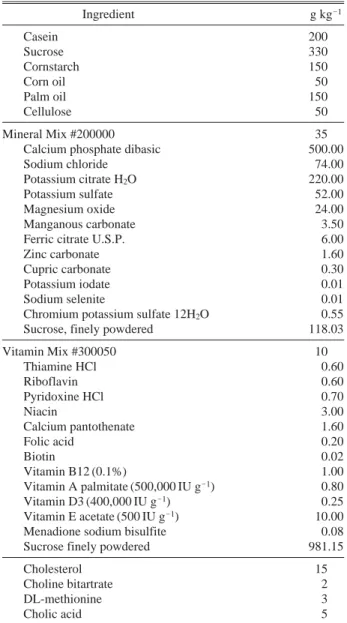
The temperature and humidity of the animal room were maintained as 22±2� C and 55±5%, respectively. The rats were kept on the 12 h light/dark cycle and acclimatized to the housing situation. Under a free environment, basal food (Superspeed, Co. Seoul) (Table 1), food inducing fatty liver (Table 2), and drinking water were freely supplied.
2. Classification of experiment groups
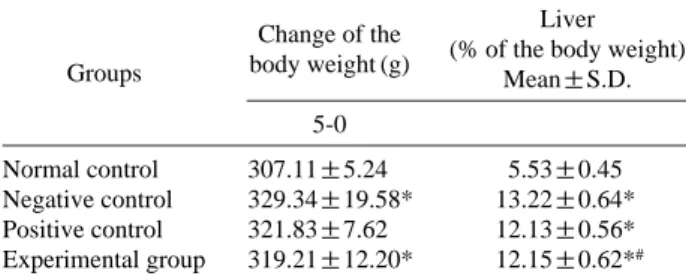
After one week of the adaptation period, the rats were divided into 4 groups (n= =8) as follows: (i) normal control rats administered with a basic diet
++distilled water, (ii) nega- tive control rats administered fatty liver-inducing feed
++dis- tilled water, (iii) positive control rats administered fatty liver- inducing feed
++blood circulation promotion Solution (BCPS), (iv) experimental control rats administered fatty liver-induc- ing feed
++Codium fragile extract (Table 3) (Kang et al. 2003).
Each feed was prepared by 200 g fatty liver feed (Dyets Table 1. Composition of basal diet
Ingredients Contents (%)
1)Crude protein 22.1
Crude fat 3.5
Fiber 5.0
Crude ash 8.0
Calcium 0.6
Phosphate 0.4
1)