*The author thanks President Chang-Ho Kim and members of KSNMT for the opportunity to give this talk.
Review Article Hospital Radiation Safety and Radioactive Waste Management (Radiation Protection in Nuclear Medicine - What’s our role ? -)
Hiroshi Watanabe
Yokohama Rosai Hospital, JAPAN
A : Reception area in the Radiation Section B : Consultation Reception
Fig. 1. Consultation window for Radiation Section in Yokohama Rosai Hospital in JAPAN.
I. INTRODUCUCTION
We use radioisotopes (RI) in nuclear medicine, and it is very important to ensure that patients, medical workers and the public are safe from radiation. In this lecture, I outline the specific radiation protection tasks performed in Japan. Although many of the problems faced are common worldwide,1,2) there are differences in radiation protection between Asia and western countries.
This paper discusses the roles of radiological technologists and medical technologists in radiation protection in nuclear medicine.
II. RADIATION PROTECTION OF PATIENTS
First, I’ll describe the radiation protection of patients.
A paper of Berrington and others3) published by The Lancet had a global influence. Then, the media reported on the radiation protection of patients in Japan, and people became concerned about medical exposure.
Medical exposure in Japan is considered to be very large, with one Japanese paper reporting exposure of radiation diagnosis of 3.2%.
Medical exposure is a global concern. ICRP raised interest over medical exposure, and published many reports since 2000. As discussed in Chapter 7, new recommendations4) were adopted by the main committee of ICRP on March 24, 2007. Furthermore, IAEA presented a guidance level for medical exposure in BSS
No. 115.
Medical exposure is a problem in the rest of Asia.
Mr. Lee of the Korea Food and Drug Administration (KFDA) visited Yokohama Rosai Hospital (YRH) on December 14 last year. In Korea, medical workers cannot reply to patients’ questions about medical exposure with certainty, so Mr. Lee wished to refer to the situation of medical radiation administration in Japan. The KFDA created a “Guideline for Patients” in December, 2007.
This guideline refers to the situation in Japan and western countries. It refers to estimations of the exposure dose of patients by all medical diagnostic examinations in YRH. The hospital estimates the dose using an index dose and a standard organs dose. Figure 1 shows the consultation window for the Radiation Section, which is next to the reception of the Radiation Section in YRH (Fig. 1). A patient can consult about various radiographic examinations here. Moreover, patients are given the “Roentgen-rays Notebook,” created by The Japanese Association of Radiological Technologists (JART).
0 0.5 1 1.5 2 2.5
Medical worker
RT Ns Airplane*1 Natural
radiation*2 0.26
0.68
0.12 0.12
2.4 Effective dose 【mSv】
*1: The round trip of Narita-Los Angeles
*2: World average
Fig. 2. Comparison of exposure dose.
Table 2. Anxiety regarding exposure to medical workers
Group Very anxious Anxious hardly anxious
Not anxious at all
Unentered or Invalid
Doctor (Clinician) 11.4 31.4 44.3 12.9 0.0
Radiologist 4.8 38.1 28.6 28.6 0.0
Nurse 18.6 35.6 36.4 8.5 0.8
Radiological technologist 2.7 21.8 53.6 19.1 2.7
(%)
Table 1. Investigation data and Guideline 2006 in PET in Japan
The percentage response of the questionnaire was 61.5% (48/78, facilities). June (2005)
Facility Ave Max Min 75% tile Guidline Facility Ave Max Min 75% tile Guideline
[number] [MBq] [MBq] [MBq] [MBq] [MBq] [number] [MBq] [MBq] [MBq] [MBq] [MBq]
Tumor 18F-FDG 20 258 394 185 316 320 29 217 380 125 240 240
Tumor 11C-Methionine 4 599 740 442 696 700 4 283 320 206 306 310
Tumor 11C-Choline 1 482 482 482 0
Myocardial
blood flow 13N-Ammonia 6 653 1,110 374 740 1 320 320 320
Myocardial
metabolism 18F-FDG 8 291 370 125 370 370 4 231 370 160 210 210
Myocardial
metabolism 11C-Acetic acid 3 580 740 300 0
Brain
metabolism 18F-FDG 11 227 370 84 300 300 15 214 379 100 296 300
Examination RI
2D(Dimension) Acquisition 3D(Dimension) Acquisition
Our activities were accepted by JART, and YRH became the first medical exposure reduction facilities authorization system to be recognized by JART in 2005.
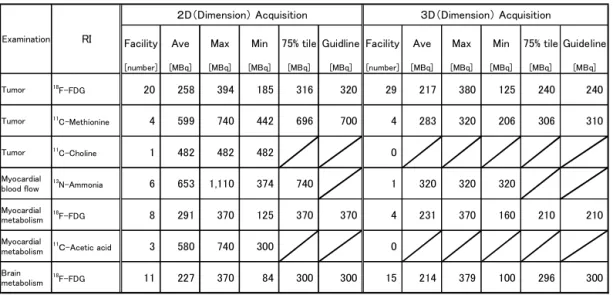
A dose index such as a guidance level or a guideline is useful for optimizing the dose. JART created a guideline unique to Japan in 2000, and JART revised the guideline in 2006. I took charge of Nuclear Medicine in the guideline in 2006.5)
The dose index is shown by medication radioactivity to patients in Nuclear Medicine. Table 1 shows the PET guideline. I investigated patients’ medication radio- activity in PET facilities all over the country in order to create a guideline in 2005. The percentage response to the questionnaire was 61.5% (48/78, facilities). In PET, 2D collection differs in medication radioactivity from 3D collection. I made 75% tile of replies to the guideline. However, comments on the number of replies was removed. Optimization of medical exposure is an international subject. A guideline that grasps and optimizes the dosage by CT of PET/CT or SPECT/CT should be created based on the actual situation in each country.
III. RADIATION PROTECTION FOR MEDICAL WORKERS
Figure 2 shows the average occupation dose of medical workers in 2003 in Japan. The effective dose of medical workers, radiological technologists and nurses is 0.26 mSv, 0.68 mSv and 0.12 mSv respectively. There
Table 3. Data on the PET study facilities
Items Surveyed datas
average(min-max) Standard model
The injected doses[MBq] 231(185-300) 230
The number of patients(Cases) 140(35-217)*1 152(7)*1
The waiting time [min.] 52(30-60) 60
The distance of each patient during waiting [cm] 57(30-150) 90(60)*2 The distance in between patient and medical staff
during waiting [m] 5(2.5-7) 5
PET scan time [min] 33.1(21-60) 30
Time after FDG injection to the end of the PET
study [min] 92.6(71-126) 90
Residual activity in the end of the PET study
[MBq] 132(108-170) 104*3
Time after the PET study to the release of patient
[min] 52(23-120)*4 -
Time after FDG injection to the release of patient
[min] 158(120-210)*4 -
Residual activity at the time of release [MBq] 88(51-117)*4 -
*1:Persons per PET camera in a month. The figure in parenthesis in the standard model indicate persons per PET camera in a day.
*2:Distance between the centers. The figure in parenthesis is the distance between body surfaces.
*4:The data excludes one hospital performing another examination.
*3:The standard model considers the biological half-time.
Table 4. Effective doses for clerical staff, staff at restaurants and medical staff after PET patient release from controlled area
one PET camera
three PET cameras
patientA*1 1(3) 30 0.35(1)*5 54.3 67.7
patientB*2 3(9) 20 1 27.6 82.8
clerical staff 7(21)/d 20 1(5)*6 630 1,890
② another
examination medical staff 7/d 10 1 3,640 5,720
patientC*3 1 45 0.4(0.1)*7 59.6 78.6
staff at the
restaurant 7(21)/d 60 1 , 3 1,729 4,423
*4:The number in parenthesis shows the situation for three PET cameras
*5:Distance between (person sits next to the PET patient) PET patient. The number in parenthesis means the distance between the non-PET patient and another PET patient.
*1:Person sits next to PET patient for accounting.
*2:Patient visits hospital six times per year.
*3:Person sits next to the PET patient for meals at the hospital's restaurant.
Distance Subjects (m)
Scenario
Effective dose (μSv/y) Number of patients*4
Estimatied time (minutes)
Exposure doses(effective doses) and parameters for the subjects following the scenario after the PET study (90 min after the administration of FDG). Only US examination assumed to take thirty minutes before starting.
*7:Distance between the centers. The number in parenthesis is the distance between body surfaces.
*6:Distance of clerical staff to PETpatient face to face.The number in parenthesis means the distance between the center of non-PET patient body and that of PET patient.
① accounting
③ meal
is no major change each year. The average dose of radioactivity of Ns or Dr is low. However, half of doctors and nurses were found to be anxious about the effects of exposure (Table 2).6) About 45% of clinicians were very anxious or slightly anxious, and about 54%
of nurses were found to be very anxious or slightly anxious in our investigation data.
These results suggest that medical workers need education and counseling. I am also responsible for the radiation management of the whole hospital, and teach medical workers about many doses of radioactivity.
Lectures on the theme of medical safety of the Radiation Section and radiation protection are held 5 days per year in YRH. I confirm whether medical workers are over the dose limit using individual data. In particular, I am counseling pregnant female medical workers.
IV. RADIATION PROTECTION OF PUBLIC
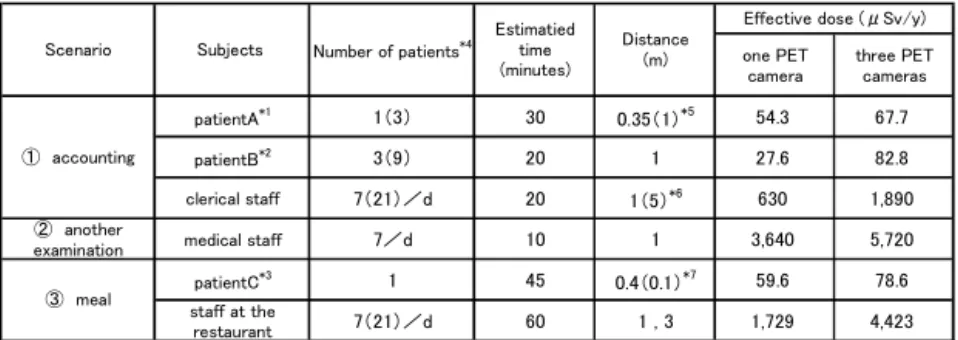
Medical checkups rapidly began adopting FDG-PET examinations in Japan, and we began evaluating the exposure dose of the hospital staff and the public.7) We defined the standard model for evaluation based on data from 2004. I evaluated the data of clerical staff, other examination staff and restaurant staff (Table 3~5).
We decided the number of patients, clerical staff, distance and estimated time, etc. Consequently, in facilities having three PET cameras, the dose of clerical staff in charge of accounts was 1890 μSv. That is, the general public’s dose limit may be exceeded. Similarly, we evaluated the dose of other examination staff, such as by echo, and restaurant staff in a hospital. That is, the general public's dose limit may be exceeded. Similarly, we evaluated the dose of drivers and bus passengers, train passengers, taxi drivers, family, partner and infants at home and care staff, etc. These results suggest that we have to instruct FDG medicated patients on protecting hospital staff and the public. Moreover, these results suggest that dose assess- ment of the public, etc. is very important.
V. MANAGEMENT OF RADIOACTIVE WASTE
In the management of radioactive waste, Decay in Storage (DIS) is em- ployed in Korea, but not in Japan.
Management of radioactive waste and progress of the disposal method are advanced in Japan, so, a special research group has been composed and this problem is being tackled by the Japanese Society of Radiological
Table 5. Effective doses for the public exposed to PET patients after release from controlled area
one PET camera
three PET cameras
Passenger A*1 1 60min 0.3(0) 135 -
Passenger B*2 0.028(0.083) 30min 1 48.8 144
Driver 0.016(0.048) 30min 1 81.7 245
Passenger A*1 1 60min 0.3(0) 135 -
Passenger B*2 0.014(0.083) 30min 1 20.7 62.2
⑥ Shinkansen Passenger C*3 1 180min 0.35(0.05) 177 -
⑦ Taxi Driver 0.038(0.11) 8min 1 17.1 51.3
⑧ Private car Patient's family 1 60min 1 12.0 -
Family*4 1 12h 1 38.2 -
Partner*5 1 13h 1 , 0.3 94.2 -
Infant*6 1 13h 0.55 , 0.1 2360 -
After return to patient's room
Patient other than PET study
patient*7
1 24h 2 16.3 -
Care Caretaker*8 1 24h 1 65.5 -
Exposure doses(effective doses) and parameters for estimated object person follow scenario after PET study. The US examination was assumed to take 30 minutes before starting.
④ Bus
⑤ Train
⑨ At home
*7:Patient other than the PETpatient stays with the PET sutudy patient for 24 hours after the PET study.
*8:PETpatient is cared during 24 hours after the PET study.
*1:Passenger sits next to PET patient
*4:Included pregnant women
*3:Passenger sits next to PET patient
*2:Passenger using the same bus with PET patients when commuting.
*5:PET patient stays with the partner for 5 hours at 1 meter and cuddles up to the partner for 8 hours.
Distance*10 Subjects (m)
Scenario
Effective dose (μSv/y) The number of
PET patients*9 Estimated time
*10:Distance between the centers. Parenthetic number is the distance between body surfaces.
*9:The value in parenthesis is the value when there are three cameras.
*6:PET patient stays with infant for 5 hours at 1 meter and cuddles up to the infant for 8 hours.
Technology.
Particular areas of interest include activation using a generator and DIS. We measured activation in coope- ration with a special researcher. Moreover, we are helping to introduce a law and creating a guideline in cooperation with a government agency that has juris- diction over radioactive waste. Toward this end, we conducted a national investigation to grasp the actual condition of medical use of an accelerator.
VI. DIFFERENCES BETWEEN ASIA AND WESTERN COUNTRIES IN RADIATION
PROTECTION
Medical radiation protection is important worldwide.
I inspected a British hospital in 2004, and studied how medical radiation protection is organized in Britain.
Special staff responsible for radiation protection are
stationed in British hospitals (Fig. 3). The Radiation Protection Adviser (RPA) is the chief executive of radiation protection of the whole hospital. A Radiation Protection Supervisor (RPS) is responsible for each section, such as the Diagnostic Section, CT Section, and NM Section. The RPS is responsible for measuring occupational exposure, educational training, etc. of medical workers. The radiation protection staff are responsible for evaluating medical exposure. These radiological protection staff evaluate the patient’s exposure dose in case a new examination method is introduced, and advise on the examination method from this viewpoint.
On the other hand, in the U.S., medical physicists are responsible for radiological protection in hospitals.
VIII. CONCLUSION
Radiation protection is very important in Nuclear
Medicine. However, as for Asia, unlike in western countries, the staff of a radiation protection specialty are not stationed in the Radiation Section. Radiation technologists and medical technologists should take charge of radiation protection in Asia. The countries of Asia should cooperate in establishing medical radiation protection.
REFERENCES
1 ICRP: Recommendations of the International Commission on Radiological Protection (ICRP Publ.60), (1991). Oxford.
2 IAEA: Safety Series No.115, International Basic Safety Standards for Protection against Ionizing Radiation and for Safety Radiation Sources, (1996). VIENNA.
3 Amy Berrington de Gonzalez, Sarah Darby: Risk of cancer from diagnostic X-rays: estimates for the UK and 14 other countries, The Lancet, 363,345-351, (2004).
4 ICRP: Recommendations of the International Commission on Radiological Protection (ICRP Publ.103), (2007).
5 H. Watanabe: Medical exposure guideline 2006: Nuclear medicine, JART, Vol.54,No.5,29-42, (2007). Japan.
6 H. Watanabe, Y. Kawasaki and A. Kida et al: Investigation on the knowledge and opinions of medical workers, The Japanese Society of Radiation Public Safety Journal,Vol. 4,23-35, (2007).
Japan.
7 H. Watanabe, H. Otake and R. Nakazawa et al: Examination of the exposure dose of radiation workers and the public by a patient medicated with FDG for PET, Kakuigakugijyutu, Vol.25, No.1, 1-11, (2005). Japan.