1. Introduction
The world witnessed the outbreak of a virus pandemic in December 2019, which is known as the coronavirus (COVID-19), which triggered a new pandemic in all countries around the world in 2020 (Herwany et al., 2021). Since October 30, 2020, COVID-19 has spread to 216 countries and territories (Khanthavit, 2021). It impacted people’s behavior, not just in Saudi Arabia but across the globe. In Saudi Arabia, 37 million people have been affected financially and
Print ISSN: 2288-4637 / Online ISSN 2288-4645 doi:10.13106/jafeb.2021.vol8.no7.0067
Continuance Adoption of Working from Home after the COVID-19 Outbreak: Empirical Evidence from Saudi Arabia
Salem Mohamed AHMED
1, Nor KHALIL MD
2Received: March 20, 2021 Revised: May 22, 2021 Accepted: June 01, 2021
Abstract
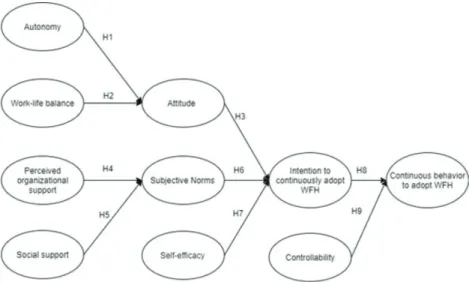
The COVID-19 pandemic sweeping the world has rendered a large proportion of the workforce unable to commute to work, to mitigate the spread of the virus. This has resulted in both employers and employees seeking alternative work arrangements. Due to the pandemic, most if not all workers experienced work from home Hence work from home has become a policy priority for most governments. Individuals have started to change their behavior to stick to the curfew and rapidly conform to the new way of life. This study is conducted to understand how organizations and people adjust to these developments and challenges. Numerous organizations are changing to the online method of working because of the COVID-19. Because of the continuous adoption of a specific behavior after the COVID-19 pandemic situation ended, employees were expected to continue working from home. To investigate deep into the behavioral consequences of such a pandemic situation, in-depth interviews were conducted in several companies in Saudi Arabia. This study was conducted by extending the Theory of Planned Behavior (TPB) and the theory of reasoned action (TRA) to explore and assess the various factors that determine the continuous adoption intention of work-from-home by the Saudis. The finding shows that the employees’ positive attitude, subjective norms, and self-efficacy affect the employees’ intention to adopt work from home. The continuous adoption of work from home has been affected by employees’ relevant intention and controllability.
Keywords: COVID-19, Continuance Adoption, Theory of Planned Behavior, Saudi Arabia JEL Classification Code: M12, M54, N35, O21, O35
economically due to the COVID-19 outbreak. The Saudi government has been taking proactive measures since the pandemic was discovered. To mitigate the spreading of the virus, restrictions have been imposed on public gatherings, including workplace attendance. Workplaces were not the only places that were shut down, as the lockdown was also applicable for schools, universities, and even government agencies. On the 14
thof March 2020, government regulations directed a strict curfew in all the cities, restricting all kinds of gatherings, and on the 16
thof March 2020, released a set of guidelines on working from home. In relation to business owners, several researchers have stated that if the work-from- home model is implemented with adequate resources to the employees, a rise in productivity and a decrease in the stress of the employees will be found (Gibson & Shrader, 2018).
Furthermore, when employees are working remotely and in different areas, it enables the firm to obtain a better understanding of the local market. Continuous adoption is the measure to which a person continuously adopts a specific behavior (Lu & Hsiao, 2010). One can assess the success of the work-from-home model by evaluating the enthusiasm exhibited by the targeted population to adopt it.
1
First Author and Corresponding Author. Ph.D. Scholar, Azman Hashim International Business School (AHIBS), Universiti Teknologi Malaysia, Malaysia [Postal Address: Sultan Ibrahim Chancellery Building, Jalan Iman, 81310 Skudai, Johor, Malaysia]
Email: [email protected]
2
Professor, Azman Hashim International Business School, Universiti Teknologi Malaysia, Johor Bahru Campus, Malaysia.
Email: [email protected]
© Copyright: The Author(s)
This is an Open Access article distributed under the terms of the Creative Commons Attribution Non-Commercial License (https://creativecommons.org/licenses/by-nc/4.0/) which permits unrestricted non-commercial use, distribution, and reproduction in any medium, provided the original work is properly cited.