Print ISSN: 2288-4637 / Online ISSN 2288-4645 doi:10.13106/jafeb.2020.vol7.no12.1017
The Effect of Workplace Spirituality on Workplace Deviant Behavior and Employee Performance: The Role of Job Satisfaction
Rini Juni ASTUTI
1, Tri MARYATI
2, Mugi HARSONO
3Received: September 10, 2020 Revised: November 02, 2020 Accepted: November 16, 2020
Abstract
This study aims to analyze the effect of workplace spirituality in reducing workplace deviant behavior through job satisfaction and its impact on employee performance. The objectives of this study are to explore and investigate (1) the effect of workplace spirituality on workplace deviant behavior; (2) the effect of workplace spirituality on job satisfaction; (3) the effect of workplace spirituality on employee performance;
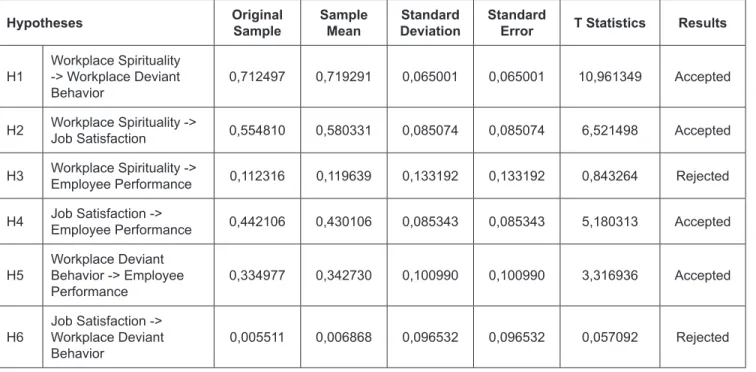
(4) the effect of job satisfaction on employee performance; (5) the effect of workplace deviant behavior on employee performance; and (6) the mediating role of job satisfaction in the relationship between workplace spirituality and workplace deviant behavior. This study was conducted with 143 permanent non-lecturer staff at Universitas Muhammadiyah Yogyakarta, Indonesia. The data analysis technique employed in this study was Structural Equation Modeling (SEM) based on Partial Least Square (PLS). The results of this study indicate that workplace spirituality affected workplace deviant behavior; workplace spirituality affected job satisfaction; job satisfaction affected employee performance; and workplace deviant behavior affected employee performance. Meanwhile, the findings further showed that workplace spirituality did not affect employee performance; job satisfaction did not affect workplace deviant behavior; and job satisfaction could not mediate the effect of workplace spirituality on workplace deviant behavior.
Keywords: Workplace Spirituality, Workplace Deviant Behavior, Job Satisfaction, Employee Performance JEL Classification Code: M11, M12, M53, M54
a more motivated attitude, more loyal to their organization, and better performance (Zhu, 2008). Organizational identification also substantially impacts the various areas of desired employee behaviors, attitudes, and cognitions (He & Brown, 2013; Lee et al., 2015). These findings propel organizations into a “magic bullet” that seeks to increase employee engagement and individual performance even if, under certain circumstances, the magic bullet will incur some disadvantages (Galvin et al., 2015). The disadvantages can be in the form of low attendance rates, high employee turnover, and decreased organizational commitment, which is often referred to as workplace deviant behavior.
Workplace deviant behavior is a severe problem in companies (Appelbaum et al., 2006). Deviations are often recognized as reactions to individual stressors in organizations that frustrate them, such as financial, social, and working conditions (Lawrence & Robinson, 2007).
Deviant behaviors within the organization that often occur are unethical deviations and sometimes develop even within the organization. Unethical behavior is common and special in work organizations (Umphress & Bingham, 2011).
1
First Author and Corresponding Author. [1] Business and Economic Faculty, Universitas Muhammadiyah Yogyakarta, Indonesia [2] PhD Student, Business and Economic Faculty, Universitas Sebelas Maret, Surakarta, Indonesia [Postal Address: Jl. Brawijaya, Tamantirto, Kec.
Kasihan, Yogyakarta, 55183, Indonesia] Email: [email protected]
2
Business and Economic Faculty, Universitas Muhammadiyah Yogyakarta, Yogyakarta, Indonesia. Email: [email protected]
3
Business and Economic Faculty, Universitas Sebelas Maret, Surakarta, Indonesia. Email: [email protected]
© Copyright: The Author(s)
This is an Open Access article distributed under the terms of the Creative Commons Attribution Non-Commercial License (https://creativecommons.org/licenses/by-nc/4.0/) which permits unrestricted non-commercial use, distribution, and reproduction in any medium, provided the original work is properly cited.