Print ISSN: 2288-4637 / Online ISSN 2288-4645 doi:10.13106/jafeb.2021.vol8.no1.519
Human Resource Management Practices and Employee Performance:
The Role of Job Satisfaction
Yousef ALSAFADI
1, Shadi ALTAHAT
2Received: September 30, 2020 Revised: November 30, 2020 Accepted: December 05, 2020
Abstract
This study aims to investigate the impact of Human Resource Management Practices (HRMP) on improving Employee Performance (EP).
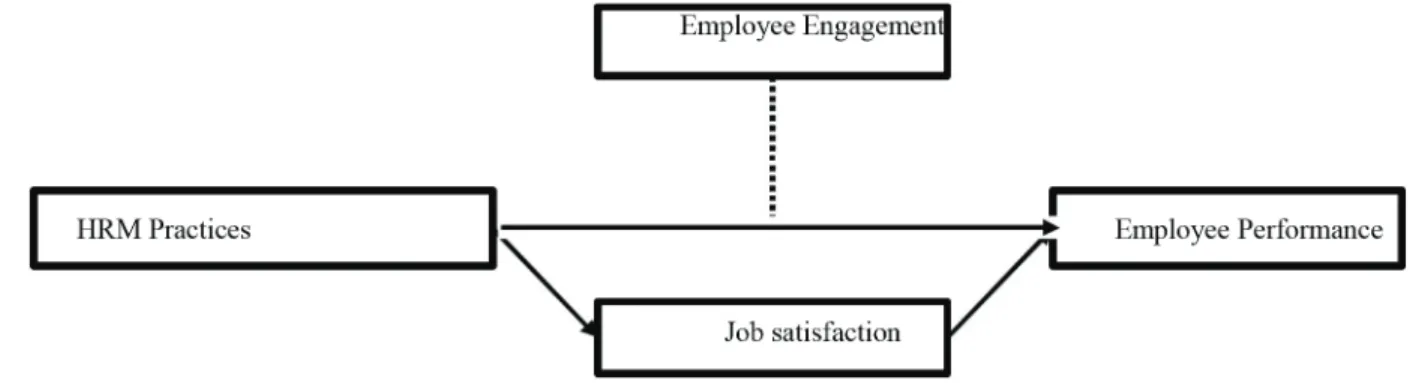
The study is accomplished by hypothesizing the impact of HRMP on EP, additionally, this impact is theorized to be mediated through job satisfaction. Employee engagement is also taken into account because of the potential moderating effect it has within the theorized model.
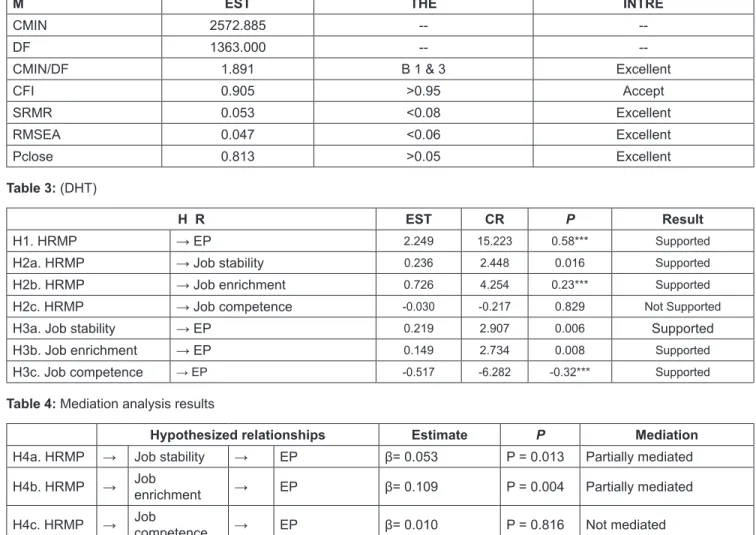
Data was collected from 480 questionnaires which were distributed among commercial banks’ workers in Jordan and were analyzed using structural equation modeling techniques (SEM), path analysis, and confirmatory factor analysis (CFA). Analysis of a moment structures (AMOS) software version 24 was applied to complete our analysis. The results show that HRMP had a positive impact on EP, as well as job satisfaction and its components (job stability and job enrichment). The mediating role of job satisfaction (enrichment and stability) was discovered. Finally, employee engagement emerged as a moderating variable linking HRMP and EP. The findings of this study show the importance of the role played by job satisfaction and employee engagement in achieving human resources performance goals. Future analysis is recommended to gain deeper insight into the relationship between HRMP, job satisfaction, worker training, and performance appraisal.
Keywords: Human Resource Management Practices, EP, Job Satisfaction JEL Classification Code: L25, M12, M16, M54, O15
changes, considerable advances in information and banking technologies, the extensive dominance and acceptance of the market economy by less open economies, and the increase and integration of global financial markets and markets and institutions have created new opportunities and challenges for commercial banking institutions. While these transformations have provided an expanded opportunity set for banks, they have intensified the competitive pressure in the global banking arena as well (Al-Safadi, 2016; Alzoubi et al., 2020).
Commercial banks in Jordan contribute to enhancing the formation of capital and investment and play a significant role in influencing the economy. The commercial banks in Jordan play a decisive role in the growth and development of the country. They are the pillar of economic activity as well as key providers to the national economy as they play a leading role in improving economic growth in the country. Low-interest rates will encourage investment and jointly commercial banks contribute to the implementation of the financial policy that is controlled by the Central Bank of Jordan (CBJ). By increasing the quantity of cash
1
First Author and Corresponding Author. Assistant Professor, Department of Entrepreneurship, School of Business, Irbid National University, Jordan [Postal Address: Irbid, Jordan]
Email: [email protected]
2
Assistant Professor, Department of Business Administration, School of Business, Jadara University, Jordan.
Email: [email protected]
© Copyright: The Author(s)
This is an Open Access article distributed under the terms of the Creative Commons Attribution Non-Commercial License (https://creativecommons.org/licenses/by-nc/4.0/) which permits unrestricted non-commercial use, distribution, and reproduction in any medium, provided the original work is properly cited.