일터영성이 팀 생산성에 미치는 영향: 창의성의 매개효과를 중심으로
A Study on the Relationships between Workplace Spirituality and Team Productivity : Mediating Effect of Employee Creativity
전기석*, 데이비드 패스모어**
충남대학교 국가안보융합학부*, Pennsylvania State University**
Ki Seok Jeon([email protected])*, David L. Passmore([email protected])**
요약
본 논문의 목적은 일터영성이 팀 생산성에 미치는 영향과 이들의 관계 속에서 창의성의 매개효과를 연구하 는 것이다. 최근 한국에서는 조직의 실무자들과 연구자 그룹에서 일터영성에 대한 관심도가 지속적으로 증가 하고 있다. 반면, 한국 조직의 맥락에서 일터영성에 대한 다양한 연구들은 아직 부족한 상황이다. 이에 본 연구 에서는 일터영성과 팀 생산성, 그리고 창의성의 관계에 대해 살펴보는 것이다. 창의성은 내적 동기와 긍정적인 관계를 가지고 있다. 일터 영성은 내적 동기요소로서 임직원의 창의성을 촉진하는 것 뿐 아니라 이를 통해서 조직의 성과에도 효과적인 영향을 미칠 수 있다. 본 연구에서는 국내 기업 임직원 514명을 대상으로 실증연구 를 실시하였다. 일터영성 세 가지 요소인 내적 삶과 의미 있는 일, 그리고 조직소속감은 창의성에 긍정적 영향 을 주었다. 또한 창의성은 일터영성과 팀 생산성의 관계를 매개하였다. 이에 따라 이론과 실무적 차원의 시사 점을 기술하였다.
■ 중심어 :∣일터영성∣창의성∣생산성∣내적 동기∣
Abstract
The purpose of this study is to examine the relationship among workplace spirituality, creativity, and organization performance in the Korean context. In South Korea, workplace spirituality has recently received attention from scholars and practitioners. However, research on workplace spirituality is little known in the South Korean business context.
Creativity is positively related to intrinsic motivation. The workplace spirituality can provide a corporate several advantages for their competitiveness in developing employees’ creativity as well as resulting in more effective organizational performance. 514 cases was analyzed for this study. Three all factors (Inner life, meaningful work, & membership) of workplace spirituality as intrinsic motivation positively influenced employee creativity. employee creativity positively mediated the relationship between workplace spirituality and team productivity.
■ keyword :∣Workplace Spirituality∣Creativity∣Productivity∣Intrinsic Motivation∣
* 이 논문은 2017년 대한민국 교육부와 한국연구재단의 지원을 받아 수행된 연구임 (NRF- 2017S1A5A8019579) 접수일자 : 2019년 06월 11일
수정일자 : 2019년 07월 26일 심사완료일 : 2019년 07월 26일
교신저자 : 전기석, e-mail : [email protected]
I. INTRODUCTION
Scholars greater attention has paid to workplace spirituality in recent years[1]. Only beyond earning, employees seek to achieve the purpose of life by finding calling and meaning within their workplace[2]. They want to come to workplace with their body and mind as well as spirit, because they are just a part of themselves[3].
Although there are a variety of concepts of workplace spirituality, in the absence of a universally accepted definition, workplace spirituality researchers have identified common components of workplace spirituality. These include: (a) a recognition that employees have an inner life; (b) an assumption that employees desire to find meaningful work as a calling; and (c) a membership as a connectedness to others and community[4][5]. This study adopts these three components for the purpose of the current research.
Business scholars in Korea like western scholars regards workplace spirituality as one of promising research topic[8][9]. Workplace spirituality is an emerging research topic within the broader context of organizational literature.
Also, it is at the theoretical developmental stage. Creativity always has been considered to be important in the business organization [10].
Creativity is positively related to intrinsic motivation[11][12]. Especially, intrinsic motivation is often positioned as the most essential component for creativity. The workplace spirituality can provide a corporate several advantages for their competitiveness in developing employees’ creativity as well as resulting in more effective organizational performance[12]. There are still little known
about the relationship between workplace spirituality and creativity[13].
This study seeks to identify the issue of lack of theory development of workplace spirituality because there are small sizes of empirical research even though workplace spirituality has gotten increasing interesting from practices and scholars[14]. The purpose of this study is to examine the relationship among workplace spirituality, creativity, and team performance in the Korean context.
Ⅱ. LITERATURE REVIEW
1. The Concept of Workplace Spirituality A variety of concepts of workplace spirituality have been suggested but there are lack universally accepted definitions[15][16].
Although the term workplace spirituality has been usually used in research papers and the literature, to describe the same phenomenon several terms have been used: workplace spirituality, organizational spirituality, spirituality in business, spirituality in the workplace, spirituality at work[15].
Ashmos and Duchon[16] provided the three dimensions of workplace spirituality:
community in terms of connectedness, meaningful work in terms of meaning and purpose of personal life, and inner life.
1.1 Meaningful work and calling
Famous leadership scholar, Bennis emphasized meaningful work because people look for the meaning in life, also they want the meaning in their work. Therefore, leaders must create a meaningful workplace[17].
Employees seek to achieve the purpose of life
by finding calling and meaning within their workplace, beyond earning money[4]. Pfeffer suggested that employee search for interesting and meaningful work based on mastery and a sense of competence[18]. Futhermore, they wish to feel some purpose in meaningful work. Also, Pfeffer insisted that calling is related to professional because employees realize their life goal and vision through their work.
Professionals want to feel calling through their meaningful work as well as social value or recognition[18]. Furthermore, Fry insisted that
"calling refers to the experience of transcendence or how one makes a difference through service to others and, in doing so, derives meaning and purpose in life"[19].
1.2 Membership and connectedness to a community
Membership as suggested by Fry [19]as another of workplace spirituality is similar to the notion of belonging to a community introduced by Ashmos and Duchon[16].
Membership includes feeling a sense of being understood and interconnected at work, eventually becoming a member of a larger community[18]. Connecting to our coworkers, our customer, our community is fundamental in workplace spirituality[7]. Employee are more working for their organization when they feel connectedness to community at work.
Furthermore, they find some meaning in their work when they feel contribution to their community and society through their work.
Human being live in connection to people, as spiritual beings[16].
1.3 Inner life
Fry defined inner life as a process of
understanding and tapping into one’s own divine power and learning how to draw on that power to live a more satisfying and full outer life[5]. Also, inner life has to do with the feeling individuals have about the fundamental meaning of who you are, what you are doing, and the contributions you are making[20]. Inner life comprehensively includes practices(e.g.
meditation, prayer, yoga, journaling, and walking in nature) as well as organizational contexts (such as rooms for inner silence and reflection) to help individuals and groups draw strength from Higher Power or God and be more self-aware and conscious from moment to moment[5].
Duchon and Plowman insisted that “individual identity is part of a person’s self-concept, or view of themselves, and the expression of that inner life is, in part, an expression of social identity”[4]. Ashmos and Duchon[16] suggested that the importance of inner life as people have both an outer and inner life, which can influence people to a more meaningful outer life.
2. The Relationship of Workplace Spirituality and Creativity
Mostly, creativity is the generation of novel and useful ideas, products, or processes[11].
Creativity in organizational literature is examined in terms of creative ideas, process, products being novel and potentially useful.
Managers in organization seek to enhance
employee creativity. Scholars have conducted
several research on how social and contextual
conditions impact individual as well as team
creativity in organization[21]. The goal of
workplace spirituality is to reach attain
employee’s highest potential, which in turn can
lead to employee creativity and motivation[22].
The relationship among each dimension of workplace place and creativity could be assumed through intrinsic motivation theories.
Intrinsic motivation is defined as individuals' interest and involvement in the task itself[23].
Intrinsic motivation is often positioned as the most essential component for creativity.
First, especially inner life is related to intrinsic motivation because they are not by extrinsic resources (money, power and so on).
Inner life makes their outer life more fulfillment [16]. Creativity is positively related to intrinsic motivation. According to pioneering research by Mitroff and Denton[12]. Employees who feel fulfillment in their inner life would lead creative activity such as searching of new solutions and creating innovative ideas regardless of rewards because they are intrinsically motived[24].
Second, meaningful work and calling means transcendence from individual interests for others and society. The employees are to get calling in their own work would be intrinsically motivated. Because workplace spirituality pursuit to integrate employee’s individual spiritual values and organizational values, the employee who feels the alignment between individual spiritual values and organizational ones would increase to practice creativity[16].
Third, according to self-determination theory(SDT), spirituality serves to creativity [13][24]. SDT suggested that needs satisfaction motivation, which improves outcomes such as problem solving and creativity[25]. Contexts characterized by a sense of relatedness would be more likely to impact on intrinsic motivation. Social environments can facilitate intrinsic motivation by satisfaction of the need of interpersonal relatedness.
Membership of workplace spirituality is similar to interpersonal relatedness of SDT[13].
When employee feel interpersonal relatedness (membership), they are more working for their organization, and eventually they are more creative and productive[9]. Employee will volunteerly work hard and make creative efforts in oder to contribute to team and organization beyond their own performance because they feel psychological well-being through interpersonal relatedness[26].
These discussions suggest the following hypothesis.
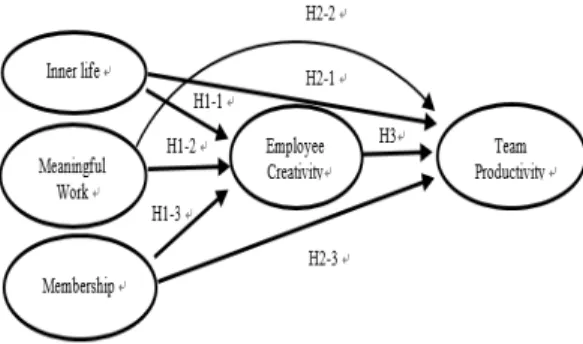
H1-1. Inner life of workplace spirituality would positively influence individual employee’s creativity.
H1-2. Meaningful work & calling of workplace spirituality would positively influence individual employee’s creativity.
H1-3. Membership of workplace spirituality would positively influence individual employee’s creativity.
3. The Relationship of Workplace Spirituality and Team productivity
Several researches have examined the relationship of workplace spirituality and performance.
Karakas identified three different perspectives how workplace spirituality benefits employees and support performance based on review about 140 articles : first, employee well-being and qulity of lfie; second, a sense of meaning at work; lastly, a sense of interconnectedness[27].
However, the variables used as performance
was usually job satisfaction, commitment and
motivation. There are a few research conducted
by adopting job performance such as quality of
work and knowledge of work, instead on
psychological well-being or motivation[22][28].
Therefore, scholars have suggested that positive effects of workplace spirituality on performance in terms of task outcomes should be empirically and rigorously examined[27][28].
First, inner life can lead to a more meaningful and productive outer life [16]. Inner life is the inner voice as the ultimate source of wisdom when making decisions in terms of personal and organization problems[28]. Inner life means that people bring their whole selves to their work, not just a part of themselves, so that they are more productive.
McCarty[29] examined that prayers activities increase employee productivity and decrease employee turnover. Osamn-Gani[22] reported that the inner life through mediation and prayer influence on employee performance (quality of work and knowledge of work etc.).
Second, employees who feel meaningful work and calling in the workplace ultimately produces positive organizational outcomes because employees having a sense of calling will be more committed, attached, and loyal to the organization[30]. Further, employees who feel calling from their own work will make extra effort because they think they work for achieving a purpose in life and social value beyond earning[18]. Eventually, employees feeling a higher meaning of work will experience transcendence or pursuit how they make a difference which leads to team performance[28].
Third, membership means having a sense of being understood and appreciated and thus feeling interconnected at work[18]. When employees feel membership in the workplace, they have trust and respect among team members. Several researches have identified the
trust and respect among team member has a positive impact on team performance[31].
Membership is based on shared experiences of group members that facilitates cooperation necessary to continuously improve team productivity and performance[28].
These discussions suggest the following hypothesis.
H2-1. Inner life of workplace spirituality would positively influence team productivity
H2-2. Meaningful work & calling of workplace spirituality would positively influence team productivity
H2-3. Membership of workplace spirituality would positively influence team productivity
4. Mediating Role of Creativity
Creativity needs novelty and useful ideas, often is understood the first step of innovation.
Therefore, creativity has been regarded as element factor to make innovation, productivity, and performance[32]. Creativity can be considered as a process as well as outcome, so that there are some variable to influence on creativity.
Several research identified the mediation effect of creativity on performance[16][33].
Workplace spirituality as intrinsic motivation positively influences on creativity[4][13].
Therefore, creativity can mediate the effect of workplace spirituality on team productivity.
Daniel proposed that theoretical model for the effect of workplace spirituality on team performance, which is mediated by creativity [31]. However, empirical studies on the theoretical model are little known in business context.
Especially this study uses the team as the unit
of analysis. Generally, the researches about
workplace spirituality have focused on the individual level than team level[31]. The understanding of effects by workplace spirituality on work groups can contribute to both academic advance and the practical implication of workplace spirituality.
These discussions suggest the following hypothesis.
H3. Employee creativity would positively mediate the relationship between workplace spirituality and team productivity.
Conceptual framework for this study is used like below (see [Figure 1])
Figure 1. Research conceptual model
Ⅲ. METHOD
1. Sample and Data collection & analysis method
The population was employees who were working for private corporate organizations in South Korea. 556 employees from 18 companies responded to this survey.
Respondents worked in the manufacturing industry (motor, electronics, & steel) 42.4 %, financial 10.5%, construction 6.0%, telecom 10.3%, Pharmaceutical 14.8%, audit & consulting 9.3%, and others 6.6%. Also, sample was male
76.8%, age (30–39) 40.9%, age (40–49) 34.8%. In terms of education, 4-year college graduate 54.3%, graduate degree 28.6%. Finally, in this study 514 cases were analyzed. This study did not include 42 missing cases.
Demographic Information n %
Industry
Manufacture 218 42.4
Financial 54 10.5
Construction 31 6.0
Telecom/IT 53 10.3
Pharmaceutical 76 14.8
Audit & consulting 48 9.3
Others 34 6.6
Gender Male 395 76.8
Female 111 21.6
Not answer 8 1.6
Age
20–29 50 9.7
30–39- 210 40.9
40–49 179 34.8
50 & over 57 11.1
Not answer 18 3.5
Education
High school 42 8.2
2yrs college 38 7.4
4yrs college 279 54.3
Graduate degree 147 28.6
Not answer 8 1.6
Table 1. Demographic Information
2. Research variables and instrumentation
2.1 Workplace spirituality
Ashmos and Duchon developed a Meaning and Purpose at Work Questionnaire to measure inner life, meaningful work, and community[16].
Fry[5] suggested membership with regard to
belong to a community by Ashmos and
Duchon[16]. Responses were made on a
five-point Likert-type scale ranging from 1 =
strongly disagree to 5 = strongly agree. Sample
questions of inner life are: (a) My spiritual
values influence the choice I make, (b) I
consider myself a spiritual person. Sample
questions of calling/meaning are: (a) The work
I do makes a difference in people’s lives, (b) My
job activities are personally meaningful to me.
Sample questions of membership are: (a) A sense that one is understood and appreciated, (b) I feel my organization demonstrates respect for me and my work.
2.2 Employee creativity
To measure individual creativity in work four from the 9-item measure developed and used by Tierney, Farmer & Graen[34] was adapted.
Responses were made on a five-point Likert-type scale ranging from 1 = strongly disagree to 5 = strongly agree. Sample questions are: (a) I demonstrated originality in my work, (b) I tried out new ideas and approached to problems.
2.3 Team productivity
Nyhan[35] developed affective organizational commitment and productivity and validated in several research. Sample questions are: (a) My work group is very productive, (b) My work group is very efficient in getting maximum output from the resources (money, people, equipment, etc.) available.
Ⅳ. RESULTS
To test for a potential common method bias be a problem, Harman’s single factor analysis was examined[36]. The results of unrotated exploratory factor analysis showed not a single factor. Also, main factor accounts for 42.% of covariance and other four factors account for 31.4% of covariance. Thus common method variance or bias is not a serious problem.
1. Measurement Model Assessment The descriptive statistics of this study such as
mean, SD, and Pearson’s correlations and reliability is presented in [Table 2].
Overall measurement model of CFA indicated a good fit in indices (χ2[179] = 636.834, p=.000;
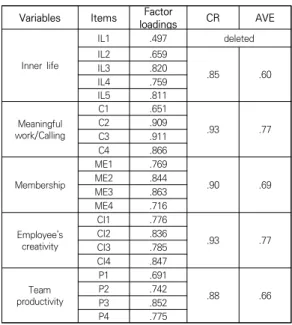
CFI =.931, TLI=.919; RMSEA=.071). All factor loadings were over . 651 (see [Table 3]) and all measure demonstrated adequate levels of reliability (ranges from .848 to .898 see Table 1). One item(IL1: I feel hopeful about life) of Inner life was deleted because of low factor loading(.497). All of CR(Construct Reliability) were over .85 and AVE(Average Variance Extracted) were over .60.
Variables Items Factor
loadings CR AVE
Inner life
IL1 .497 deleted
IL2 .659
.85 .60
IL3 .820
IL4 .759
IL5 .811
Meaningful work/Calling
C1 .651
.93 .77
C2 .909
C3 .911
C4 .866
Membership
ME1 .769
.90 .69
ME2 .844
ME3 .863
ME4 .716
Employee’s creativity
CI1 .776
.93 .77
CI2 .836
CI3 .785
CI4 .847
Team productivity
P1 .691
.88 .66
P2 .742
P3 .852
P4 .775
Table 3. Factor loading for the CFA
V M SD 1 2 3 4 5
1 3.38 .81 .85
2 3.94 .74 .43** .90
3 3.38 .75 .40** .59** .87
4 3.75 .65 .54** .65** .59** .88
5 3.49 .71 .37** .51** .60** .51** .85
V(.variables) : 1.Inner life, 2. Meaningful work, 3.Membership, 4.Creativity, 5.Productivity
Scale reliabilities are shown on diagonal in parentheses, *p<.05,
**p<.01.
Table 2. Descriptive Statistics and Reliabilities
2. Structural Equation Model
The assessment of main structural model was conducted. The hypothesized model indicated a good fit in indices(χ2[160] = 485.826, p=.000;
CFI = 0.949;TLI = 0.939; RMSEA = 0.063).
All the paths among constructs were significant with the exception of coefficient between inner life and team productivity (See [Figure 2]). The coefficient between membership and team productivity was the highest one(path coefficient = .41). Furthermore, this one was twice coefficient for The coefficient between meaningful work/calling and team productivity.
3. Hypotheses Testing
H1 was tested as shown [Figure 2].
H1-1 was adapted because inner life positively influences on individual employee’s creativity (path coefficient = .25).
H1-2 was adapted because meaningful work/calling positively influences on individual employee’s creativity (path coefficient = .39).
H1-3 was adapted because membership positively influences on individual employee’s
creativity (path coefficient = .27).
H2-1 was rejected because the path coefficient was not significant (path coefficient
= .06).
H2-2 was adapted because meaningful work/calling positively influences on team productivity (path coefficient = .15)
H2-3 was adapted because membership positively influences on team productivity (path coefficient = .41.
H3 was accepted. For the examination of H3, all mediated effects were statically significant according to the joint significance rule[37].
Joint significance means that the relationship between each of workplace spirituality (inner life, meaningful work/calling, membership) and employee creativity was significant, and the relationship between employ creativity and team productivity was significant (path coefficient = .14). The highest total effect on team productivity came from membership and the smallest total effect came from inner life (See [Table 4]).
Ⅴ. DISCUSSION
First, three all factors (Inner life, meaningful work, & membership) of workplace spirituality
Direct
Effects Indirect
Effects Total Effects Inner life
→team
productivity Non-significant .026 .094 Meaningful work
→team
productivity .150 .045 .205
Membership
→team
productivity .410 .038 .448
Table 4. Direct, Indirect, and Total Effects of workplace spirituality and employee creativity on team productivity
*p < .05, **p < .01,--- not statistically significant
Figure 2. Standardized Path Coefficient Estimate of
main hypothesized model
as intrinsic motivation positively influenced on employee creativity. The results supported previous similar studies which identified workplace spirituality positively influence on creativity in organization[22][24]. Employees who have high inner life, get meaning form their own work, feel membership with colleagues could be intrinsically motivated. The employee who get high spiritual energy can facilitate their creativity in work and result in the best services and products for the company.
Fostering employee’s creativity by material resource such as money and bonus has limitation. However, workplace spirituality would be used as intrinsic motivation which lead authentic potential of employees.
Second, employee creativity positively mediated the relationship between workplace spirituality and team productivity. This results supported the theoretical model proposed by Daniel[31]. Especially, inner life did not influence directly on team productivity.
However, it influenced indirectly through individual creativity. The highest total effect on team productivity came from membership.
Employee are more working for their organization when, they feel connectedness to colleagues, organization, and community at work. Employee is more productive when they find community in their workplace.
This study provides empirical foundations for the relationship between workplace spirituality and creativity. HR practitioners should pay to attention to significant influence of meaningful work on creativity. HR department need to make employees to recognize the meaning of work because everyone wants to know their work is meaningful beyond earning. Employees who are intrinsically motivated would lead
transcendence from individual interests for others and society[36].
HR department need to make an effort to build membership among employees and to match employee’s task to their skill, will, and aptitude for fostering employee feel more calling on their work and task. Although employees look for meaning in their task, these tasks may not inspire them to feel meaning and calling because these are routine, stressful, and problematic; further, employees must work to earn.
This study has several limitations. First, the results have limited generalizability in the all-Korean organization due to small size of sample and the non-randomized sample selection process. Therefore, future research should involve a large in the Korean context.
Furthermore, it assumes that the result will be different according to organization characteristics. For example, public sectors may be more feel meaningful work and calling than would those in the private sector as well as in the private sector, advertising company and traditional manufacturing company would be different in requiring employee creativity. Also, the result of this study has limited generalizability to other national cultures.
Future research should involve Islam employee
to expand the research topic on religion,
workplace spirituality, creativity, and
organization performance. Second, this study
used perceived behavior such as workplace
spiritualty, employee creativity, and team
productivity which was not real outcomes and
used a self-report method at only one point in
time. Even though, Harman’s single factor test
was examined, there are a potential concerns of
common method bias due to self-report
questionnaires.
Third, this study did not include other constructs of workplace spirituality. A several of concepts of workplace spirituality have been suggested but this study used only three constructs (Inner life, meaningful work, membership)[4][16]. The results of this study could be different if other constructs of workplace spirituality would be used.
참 고 문 헌
[1] P. Pradhan and L. Jena, “Workplace Spirituality and Organizational Commitment: Role of Emotional Intelligence among Indian Banking Professionals,” J. of Human Resource Management, Vol.19, No.1, pp.13-23, 2016.
[2] L. W. Fry, “Toward a Paradigm of Spiritual Leadership,” The Leadership Quarterly, Vol.16, No.4, pp.619–622, 2005.
[3] C. McLaughlin, “Spirituality and Ethics in Business,” European Business Review, Vol.17, pp.94–101, 2005.
[4] D. Duchon and D. A. Plowman, “Nurturing the Spirit at Work: Impact on Work Unit Performance,” The Leadership Quarterly, Vol.16, pp.807–833, 2005.
[5] L. W. Fry,
Spiritual Leadership: State-of-the Art and Future Directions for Theory, Research, and Practice.In J. Biberman & L.
Tischler (Eds.), Spirituality in Business pp.106-124, Palgrave Macmillan, 2008.
[6] D. A. Hicks, “Spiritual and Religious Diversity in the Workplace. Implication for Leadership,”
The Leadership Quarterly, Vol.13, pp.379-396, 2002.
[7] M. Driver, “From Empty Speech to Full Speech?
Reconceptualizing Spirituality in Organizations based on a Psychoanalytically-Grounded Understanding of the Self,” Human Relations, Vol.58, No.9, pp.1091–1110, 2005.
[8] K. H. Han, “A Study on Relationship among Workplace Spirituality, Spiritual Maturity, Burnout Outcomes : Developing a Scale to Measure the Workplace Spirituality,” The Korean J. of Human Resource Management, Vol.41, No.2, pp.81-107, 2017.
[9] K. S. Heo, “Workplace Spirituality and its Relationship to Leadership,” Korea Human Resource Management, Vol.17, No.1, pp.329-336, 2010.
[10] C. E. Shalley, J. Zhou, and G. R. Oldham, “The Effects of Personal and Contextual Characteristics on Creativity: Where should We Go from Here?,” J. of Management, Vol.30, No.6, pp.933-958, 2004.
[11] T. M. Amabile, “Social Psychology of Creativity: A Componential Conceptualization,”
J. of Personality and Social Psychology, Vol.45, pp.357-376, 1983.
[12] I. I. Mitroff and E. A. Denton,
A Spiritual Audit of Corporate America,Jossey-Bass, 1999.
[13] W. A. Williams, R. Brandon, R. Hayek, S. P.
Haden, and G. Atinc, “Servant Leadership and Followership Creativity: The Influence of Workplace Spirituality and Political Skill,”
Leadership & Organization Development Journal, Vol.38, No.2, pp.178-193, 2017.
[14] A. Gatling, J. Kim, and J. Milliman, “The Relationship between Workplace Spirituality and Hospitality Supervisors’ Work Attitudes: A Self-determination Theory Perspective,”
International J. of Contemporary Hospitality Management, Vol.28, No.3, pp.471-489, 2015.
[15] G. Gotsis and Z. Kortezi, “Philosophical Foundation of Workplace Spirituality: A Critical Approach,” J. of Business Ethics, Vol.78, pp.575–600, 2008.
[16] D. Ashmos and D. Duchon, “Spiritual at Work:
A Conceptualization and Measure,” J. of Management Inquiry, No.2, pp.134–145, 2000.
[17] W. Bennis,
Old Dogs, New Tricks,Executive
Excellence Publishing, 1999.
[18] J. Pfeffer, Business and the Spirit:
Management Practices that Sustain Values. In R. A Giacalone & C. L. Jurkiewicz (Eds.), Handbook of Workplace Spirituality and Organizational Performance, Sharpe Inc, 2010.
[19] L. W. Fry, “Toward a Theory of Spiritual Leadership,” The Leadership Quarterly, Vol.14, pp.693–727,2003.
[20] P. Vaill,
Spirited leading and learning,Jossey-Bass, 1998.
[21] L. L. Gilson, R. Litchfield, H. S. Lim, and P. W.
Gilson, Creativity in Teams: Directions for Future Research. In C. E. Shalley, M. A. Hitt, J.
Zhou, (Eds.).The Oxford Handbook of Creativity, Innovation, and Entrepreneurship Oxford University Press, pp.177-205, 2015.
[22] A. M. Osman-Gani, J. Hashim, and Y. Ismail,
"Establishing Linkages between Religiosity and Spirituality on Employee Performance,"
Employee Relations, Vol.35, No.4, pp.360-376, 2013.
[23] C. E. Shalley and L. L. Gilson, “Creativity and the Management of Technology: Balancing Creativity and Standardization,” Production and Operations Management, Vol.26, No.4, pp.605-616, 2016.
[24] E. L. Deci and R. M. Ryan, “Intrinsic Motivation and Self-Determination in Human Behavior,” Springer Science & Business Media, 1985.
[25] P. Baard, E. Deci, and R. Ryan, “Intrinsic Need Satisfaction: a Motivational Basis of Performance and Well-being in Two Work Settings,” J. of Applied Social Psychology, Vol.34, No.10, pp.2045-2068, 2004.
[26] M. Wang, T. Guo, Y. Ni, S. Shang, and Z.
Tang, “The Effect of Spiritual Leadership on Employee Effectiveness: An Intrinsic Motivation Perspective,” Frontiers in Psychology, Vol.9, pp.1–11, 2018.
[27] F. Karakas, “Spirituality and Performance in Organizations: A Literature Review,” J. of Business Ethics, Vol.94, No.1, pp.89-106, 2009.
[28] M. Yang and L. Fry, “The Role of Spiritual Leadership in Reducing Healthcare Worker Burnout,” J. of Management, Spirituality &
Religion, Vol.15, No.4, pp.305-324, 2018.
[29] W. B. McCarty, “Prayer in the Workplace:
Risks and Strategies to Manage Them,”
Business Renaissance Quarterly; Pasadena, Vol.2, pp.97-105, 2007.
[30] L. W. Fry, J. R. Latham, S. Clinebell, and K.
Krahnke, “Spiritual Leadership as a Model for Performance Excellence: A Study of Baldrige Award Recipients,” J. of Management, Spirituality & Religion, Vol.14, No.1, pp.22–47, 2017.
[31] J. L. Daniel, “The Effect of Workplace Spirituality on Team Effectiveness,” J. of Management Development Vol.29, No.5, pp.442-456, 2010.
[32] A. M. Grant and J. W. Berry, “The Necessity of Others is The Mother of Invention: Intrinsic and Prosocial Motivations, Perspective Taking, and Creativity,” Academy of Management Journal, Vol.54, No.1, pp.73-96, 2017.
[33] G. Barczak, F. Lassk, and J. Mulki,
“Antecedents of Team Creativity: An Examination of Team Emotional Intelligence, Team Trust and Collaborative Culture,”
Creativity Innovation Management, Vol.19, pp.332–345, 2010.
[34] P. Tierney, S. M. Farmer, and G. B. Graen, “An Examination of Leadership and Employee Creativity: The Relevance of Traits and Relations,” Personnel Psychology, Vol.52, pp.591-620, 1999.
[35] R. C. Nyhan, “Changing the Paradigm: Trust and its Role in Public Sector Organizations,”
American Review of Public Administration, Vol.30, No.1, pp.87-109, 2000.
[36] P. M. Podsakoff and D. W. Organ,
“Self-reports in Organizational Research:
Problems and Prospects,” J. of Management, Vol.12, No.4, pp.531-544, 1986.
[37] D. P. MacKinnon, C. M. Lockwood, J. M.
Hoffman, S. G. West, and V. Sheets, “A Comparison of Methods to Test Mediation and Other Intervening Variable Effects,”
Psychological Methods, Vol.7, No.1, pp.83-104, 2002.
저 자 소 개
전 기 석(Ki Seok Jeon) 정회원
▪ 1995년 3월 : 육군사관학교
▪ 2005년 8월 : 고려대학교 경영학 석사
▪ 2011년 12월 : 펜실베니아 주립대 학교 인적자원개발 박사
▪ 2016년 9월 ∼ 현재 : 충남대학교 국가안보융합학부 교수
<관심분야> : 일터영성, 창의성, 리더십, 조직문화
데이비드 패스모어(David L. Passmore) 정회원