• 검색 결과가 없습니다.

Comparison of Blood Lead Concentration Using Graphite Furnace Atomic Absorption Spectrometry (GF-AAs) and Inductively Coupled Plasma-mass Spectrometry (ICP-MS)

N/A
N/A
Protected

Academic year: 2021

Share "Comparison of Blood Lead Concentration Using Graphite Furnace Atomic Absorption Spectrometry (GF-AAs) and Inductively Coupled Plasma-mass Spectrometry (ICP-MS)"

Copied!
9
0
0

로드 중.... (전체 텍스트 보기)

전체 글

(1)

흑연로 원자 흡광 광도법과 유도 결합 플라즈마 질량 분석법을 이용한 혈중 납 농도 비교

강민경* · 권정연* · 김병권*

,

** · 임현주* · 서정욱* · 김유미*

,

** · 홍영습*

,

**

*동아대학교 중금속 노출 환경보건센터, **동아대학교 의과대학 예방의학교실

Comparison of Blood Lead Concentration Using Graphite Furnace Atomic Absorption Spectrometry (GF-AAs) and Inductively Coupled

Plasma-mass Spectrometry (ICP-MS)

Min-Kyung Kang*, Jung-Yeon Kwon*, Byoung-Gwon Kim*

,

**, Hyoun-Ju Lim*, Jeong-Wook Seo*, Yu-Mi Kim*

,

**, and Young-Seoub Hong*

,

**

*Heavy Metal Exposure Environmental Health Center, Dong-A University

**Department of Preventive Medicine, College of Medicine, Dong-A University

ABSTRACT

Objectives: In this study, blood lead was analyzed using graphite furnace atomic absorption spectrometry (GF- AAs) and inductively coupled plasma mass spectrometry (ICP-MS). We tried to examine the difference and consistency of the analytical values and the applicability of the analytical method.

Methods: We selected 57 people who agreed to participate in this study. After confirming the linearity of the calibration standard curves in GF-AAs and ICP-MS, the concentrations of lead in quality control material and samples were measured, and the degree of agreement was compared.

Results: The detection limit of the ICP-MS was lower than that of GF-AAs. The coefficient of variation of reference materials was shown to be stable in the ICP-MS and GF-AAs. When the correspondence between the two equipments was verified by bias of the analysis values, a concordance was shown, and approximately 98%

of the ideal reference lines were present within ±40% of the deflection.

Conclusion: GF-AAs showed high sensitivity to single heavy metal analysis, but it took much time and showed higher detection limit than ICP-MS. Therefore, it would be considered necessary to switch to ICP-MS analysis method, considering that the level of lead exposure is gradually decreasing.

Key words: Lead, ICP-MS, GF-AAs, degree of agreement

I. 서 론

납(Lead,Pb)은 환경 중에 널리 분포하며 인체에 유 해성이 높은 물질로써 국가적으로 노출 관리가 필요 한 물질 중의 하나이다. 대기, 수질, 음식물, 환경에

방출되어진 납은 영구적으로 존재할 수 있고, 인체 에 흡수된 납은 장기간 인체에 존재하면서 선천성 기형, 발달장애, 고혈압, 신장장애, 혈액장애, 청력 손실 등의 문제를 야기할 수 있다.

1,2)

이러한 납의 인체 노출상태를 평가할 수 있는 방법 중에서 생물

Corresponding author: Department of Preventive Medicine, College of Medicine, Dong-A University, 32, Daesingongwon-ro, Seo-gu, Busan, Republic of Korea, Heavy metal exposure Environmental Health Center, Dong-A University, 32, Daesingongwon-ro, Seo-gu, Busan, Republic of Korea, Tel: +82-51-240-2888, Fax: +82-51-253-5729, E-mail: [email protected]

Received: 7 June 2019, Revised: 13 June 2019, Accepted: 20 June 2019

원 저 Original articles

(2)

학적 노출평가는 우선적으로 고려해볼 수 있는 방법 이며, 신뢰할 수 있는 생물학적 노출평가를 위해서 는 분석방법의 확립이 선결되어야 한다.

3)

생체 시료의 납 농도를 분석하는 방법으로는 원자 흡수분광법, 유도결합 플라스마 원자방출분광법, 유 도결합 플라즈마 질량분석법 등 다양한 분석방법이 존재하지만 ,국내에서 가장 널리 활용하는 방법으로 는 원자흡수분광법을 이용한 분석법이다.

3-14)

흑연로 원자 흡광 광도법(GF-AAs)을 이용한 분석 방법은 특정 원소에 대해 높은 민감도와 선택성을 가지고 있어 오래전부터 보편화된 분석법으로 활용되어왔지 만, 높은 검출한계와 특정 원소만을 분석할 수 있는 단점에 대한 문제점을 가지고 있다. 이에 비하여 유 도 결합 플라즈마 질량분석법(ICP-MS)은 다중의 원 소 분석이 가능하고, 낮은 검출한계와 높은 선택성 으로 극미량의 원소를 분석이 가능한 장점에 의해서 국제적으로 사용이 증가하고 있는 추세이다.

3-10,15,16)

미국 등 많은 선진 국가에서는 ICP-MS를 활용하여 중금속을 분석 값을 제시하고 있고, 또한 국내에서도 ICP-MS 를 이용한 연구가 늘어나고 있다.

3-9,19-22,25-30)

따 라서, 두 가지 분석법의 차이점과 장단점을 파악한 연구를 통해서 각각 분석법에 대한 상호보완적인 연 구결과의 제시가 필요할 것으로 생각된다.

최근에는 GF-AAs와 ICP-MS를 사용하여 생물학 적 지표를 분석하고 비교한 논문들이 다수 제시되고 있으나 국내에서는 혈중 납의 분석을 직접적으로 GF-AAs 와 ICP-MS를 이용하여 비교한 평가나 논문 은 드물다.

3-8,15,17,18)

GF-AAs 와 ICP-MS의 분석 장비 는 지속적으로 보완 발전하기 때문에 과거의 분석 값과 최근의 분석 값을 비교하기에는 여러 가지 한 계가 있다. 그러나 현 시점에서 활용되고 있는 각 장비에 의한 분석 값의 비교 고찰은 신뢰성 있는 정 확한 값의 제시라는 측면에서 의미가 있다.

본 연구는 중금속 분석에 활용되는 방법인 GF- AAs와 ICP-MS를 사용하여 혈중 납을 분석하여 분 석 값의 차이점과 일치성을 확인하고 이를 통한 각 분석방법의 활용성을 검토해 보고자 한다.

II. 대상 및 방법 1. 연구 대상, 혈액 시료 채취

본 연구는 환경보건캠프에 참여한 인구집단 중 동

의하여 조사 시점에 급만성 질환을 앓고 있지 않은 일반인 성인 57명을 대상으로 하였다. 대상자들은 남성 15명, 여성 42명, 평균 연령은 남성 54.3세, 여 성 52.7세이다. 혈액 채취는 항응고제(EDTA)가 들 어있는 혈액채취용기를 사용하여 대상자의 혈액을 채취하였다. 채취 후 혈액의 응고를 막기 위해 혈액 을 흔들어 준 뒤 roller mixer에 혈액을 rolling시켰 다. 혈액은 아이스박스에 보관, 이송하여 분석 전까 지 냉동 보관했다.

본 연구는 동아대학교병원 연구윤리심의위원회의 승인(IRB 13-010)을 받은 후 연구를 진행하였다.

2. GF-AAs, ICP-MS를 사용한 혈중 납 분석 및 실험 조건

혈액 중 납을 분석하기 위해서 사용한 장비는 GF- AAs (900Z, Perkin Elmer, USA)와, ICP-MS (7700series, Agilent Technologies, USA)를 사용하였 다. GF-AAs의 표준용액 제조에 사용되는 표준시약 은 Pb 1000 mg/L (Perkin Elmer, USA)을 이용하였 고, ICP-MS의 표준용액 제조에 사용되는 표준시약 은 10 mg/L Multi-element calibration standard material (Agilent Technologies, USA)를 이용하였다.

GF-AAs 을 이용한 혈중 납 분석에 사용한 희석 액 은 0.2% 인산수소이암모늄(99.99%, Sigma Aldrich, USA)과 0.2% Triton X-100 (Sigma Aldrich, USA) 을 사용하였다. ICP-MS를 이용한 혈중 납 분석에 사 용한 희석 액은 2% 1-butanol (99.7%, Sigma Aldrich, USA), 0.05% EDTA (99.995%, Sigma Aldrich, USA), 0.05% Triton X-100 (Sigma Aldrich, USA), 1% NH

4

OH (28-30%, Sigma Aldrich, USA)를 사용 하였다.

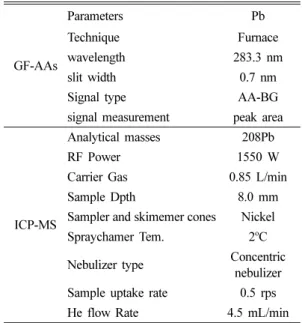
각 기기의 조건은 Table 1, 2와 같다.

3. 표준물질

GF-AAs 와 ICP-MS 모두 표준물질(certified reference material)을 이용하여 실험방법을 검증하였고, 이때 표준물질로 Seronorm Level I (SERO, Norway)와 ClinChek Level I (RECIPE Chemicals, Germany)을 사용하여 두 장비의 정확도를 평가하였다.

4. 시료 전처리, 검정곡선 작성, 혈중 납 분석

시료는 냉동고에 보관하고 분석에 사용할 때는 상

(3)

온에 꺼내어 roller mixer를 이용하여 30분~1시간 이 상 충분히 rolling을 시켜주고 사용하고, 시료 20개 마다 표준물질,검량선 일정 농도를 사용하여 기준 값 의 ±10% 이내에 들어가는지를 확인하여 검정곡선 을 확인, 분석하였다.

GF-AAs는 납 표준용액 1000 mg/L (Perkin Elmer, USA) 을 사용하여 80 µg/dL로 만든 후, 단계적으로 0.6-10.0 µg/dL의 농도를 제조하였다. 희석 액에 농도 별로 제조한 표준용액을 희석 액에 섞고, Base Blood 를 섞어 검정곡선을 작성하고(혈액첨가법), 시료는 희 석 액에 탈이온수와 함께 섞어 분석한다(10배 희석).

ICP-MS 는 10 mg/L Multi-element calibration standard material (Agilent Technologies, USA)을 사용하여 0.005~2 µg/dL 사이의 7개 검정표준용액을 제조하였 다. 검정표준용액의 농도는 미지시료의 농도가 포함

되게 범위를 설정하였다. 희석 액에 표준용액을 원 하는 농도에 맞게 섞고, Base Blood를 섞어 검정곡 선을 작성하고(혈액첨가법), 시료는 희석 액에 탈이 온수와 함께 섞어 분석한다(10배 희석).

5. GF-AAs와 ICP-MS의 기기검출한계, 방법검 출한계

GF-AAs 와 ICP-MS의 기기검출한계(Instrument detection limit)는 탈이온수를 7회 분석하여 표준편 차(SD)를 산출하고 3.14를 곱하여 나타내고. 방법검 출한계(Method detection limit)는 검정곡선 중 최저 농도를 7회 분석하여 표준편차를 구하고 3.14를 곱 하여 계산하였다.

6. 통계분석방법

통계 분석은 SAS (Version 9.4, SAS Institute, Cary, NC) 를 이용하였다. 두 가지 다른 분석 방법으 로 분석된 혈중 납의 농도의 분포를 확인하기 위하 여 중심위치 및 산포도를 제시하였고, 이들 중심위 치에 대한 Paired t-test, Wilcoxon signed rank test 를 실시하였다. 두 방법 간 일치성의 평가로 일치도 상관계수(concordance correlation coefficient)를 산출 하였고, bias plot과 Bland-Altman plot으로 일치성 정도를 제시하였다. 모든 검정은 유의수준 5%하에 서 실시하였다.

Bland-Altman plot 은 2개 분석 값에 대한 일치도 를 확인하기 위한 방법으로 x축은 2개 분석 값의 평 균을 제시하고, y축은 그 값의 차이를 나타냈다. 중 심 수평선은 차이의 평균을 나타내고, 상하의 수평 선은 일반적으로 95% 신뢰구간(차이의 평균 ±1.96×

표준편차)이며 이를 일치 한계로 활용한다. 즉, 각 산점도는 다수의 대상자 분석 값으로부터 편향성을 나타내는지를 말한다.

Table 2. Temperature program of GF-AAs

Step Temp (

o

C) Ramp time (sec) Hold time (sec) Internal Flow (mL/min) Gas Type

1 100 5 20 250 Normal

2 450 15 20 250 Normal

3 600 10 1 250 Normal

4 2000 0 3 0 Normal

5 2500 1 10 250 Normal

Table 1. GF-AAs, ICP-MS equipment conditions

GF-AAs

Parameters Pb

Technique Furnace

wavelength 283.3 nm

slit width 0.7 nm

Signal type AA-BG

signal measurement peak area

Analytical masses 208Pb

ICP-MS

RF Power 1550 W

Carrier Gas 0.85 L/min

Sample Dpth 8.0 mm

Sampler and skimemer cones Nickel

Spraychamer Tem. 2

o

C

Nebulizer type Concentric nebulizer Sample uptake rate 0.5 rps

He flow Rate 4.5 mL/min

(4)

III. 결 과

1. GF-AAs와 ICP-MS의 검량선, 검출한계, 표준 물질 분석 비교

GF-AAs 와 ICP-MS 두 장비 모두 검정곡선을 작 성하였을 때 상관계수(R

2

) 가 실험실의 기준인 0.999 이상으로 좋은 직선성을 나타냈다.

검출한계는 Table 3에 나타내었으며, GF-AAs의

값도 낮게 나타났지만 ICP-MS의 값이 더 낮게 나 타났다. 또한, GF-AAs와 ICP-MS에서 혈중 납 분석 에 사용한 표준물질에 대한 회수율과 변동계수는 Table 4에 나타냈다. 표준물질 sero1의 회수율 (recovery) 은 각각 105.899, 101.262%로 회수율을 나 타내며, GF-AAs에서 혈중 납 분석에 사용한 표준 물질 clinchek 1의 회수율(recovery)은 97.806%이고 ICP-MS 에서 혈중 납 분석에 사용한 표준물질 clinchek 1 의 회수율(recovery)은 96.301%로 회수율을 나타냈 다. 변동계수(coefficient of variation)는 10% 미만으 로 나오는 것을 확인하였다.

2. GF-AAs와 ICP-MS의 혈액 분석 시료 값 비교 57 명의 일반인을 대상으로 두 장비로 분석한 혈중 납의 농도의 분포는 Table 5와 같다.

Table 3. Limits of Detection µg/dL

MDL* IDL**

GF-AAs 0.145 0.042

ICP-MS 0.092 <0.001

*MDL: Method Detection Limit

**IDL: Instrument Detection Limit

Table 4. Quality control standard material in each equipment (µg/dL) Reference value Tolerance value Conc

(µg/dL, mean±SD) CV (%) Recovery (%)

GF-AAs sero1 0.990 0.790-1.190 1.048±0.024 2.316 105.899

Clinchek-1 5.998 5.498-6.499 5.866±0.129 2.191 97.806

ICP-MS sero1 0.990 0.790-1.190 1.002±0.011 1.058 101.262

Clinchek-1 5.910 4.790-7.090 5.691±0.072 1.269 96.301

mean±SD: arithmetic mean±standard deviation CV: coefficient of variation

Table 5. Level of Pb in blood of 57 subjects

Blood Pb (µg/dL)

ICP-MS GF-AAs Difference p-value

n 57 57 57

Mean±std 1.36±0.41 1.48±0.50 -0.12±0.16 <.001*

GM (95% CI) 1.30(1.20-1.41) 1.40(1.27-1.53) 0.77(0.70-0.84) <.001*

Median (range) 1.31(0.67-2.24) 1.40(0.60-2.52) -0.12(-0.46-0.38) <.001

Fractile

P5 0.76 0.72 0.05

P10 0.86 0.81 0.05

P25 1.04 1.10 -0.06

P75 1.63 1.82 -0.19

P90 1.93 2.29 -0.35

P95 2.12 2.32 -0.20

*Paired t-test

Wilcoxon signed rank test

Mean±std: arithmetic mean±standard deviation

GM (95% CI): geometric mean (95% confidence interval)

(5)

ICP-MS에 의한 산술평균(mean)은 1.36 µg/dL로 GF-AAs 의 1.48 µg/dL와 비교하여 –0.12 µg/dL 정도 의 차이를 보였고, 중앙값(median)은 각각 1.31, 1.40 µg/dL, 기하평균(GM, geometric mean)은 1.30, 1.40 µg/dL로 ICP-MS이 GF-AAs로 분석한 혈중 납 의 농도보다 좀 더 낮게 나온 것을 알 수 있다. ICP- MS의 표준편차가 0.41 µg/dL로 GF-AAs의 표준편 차 0.50 µg/dL보다 산포의 정도가 더 작은 것으로 나타났다.

GF-AAs 와 ICP-MS 두 장비로 분석한 분석 값 분 포 비교는 Fig. 1에 제시하였다. 기울기는 0.7884로 낮은 농도에서는 ICP-MS 값이 GF-AAs 값보다 높 게 나타났으나, 농도가 높아짐에 따라 ICP-MS 값이 GF-AAs 값보다 낮게 도출됨을 확인할 수 있다. Table 5 에서 P25부터 ICP-MS 값이 GF-AAs 값보다 낮게 도출되었다. 하지만, 전체적으로 GF-AAs의 값이 높 게 나왔다. 피어슨 상관계수는 0.958, 일치도 상관계 수는 0.910으로 나타났다. 이상적인 참조 선으로부 터 벗어난 점들이 일부 존재하는 것을 확인하였다.

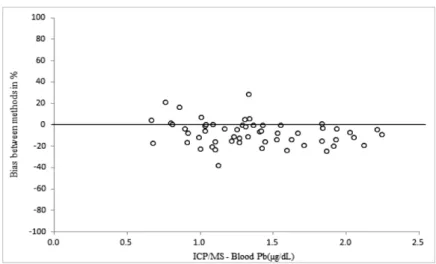
두 장비간의 일치성을 확인하기 위해 분석 값 편 향(bias)의 비율은 Fig. 2와 같다. ICP-MS를 기준으 로 했을 때, 대부분의 분석 값이 이상적인 참조선 (y=0) 을 기준으로 편향 ±40% 내에 거의 존재하였다.

전체적으로 ICP-MS의 농도보다 GF-AAs의 농도가 높게 나오는 것으로 확인되었다.

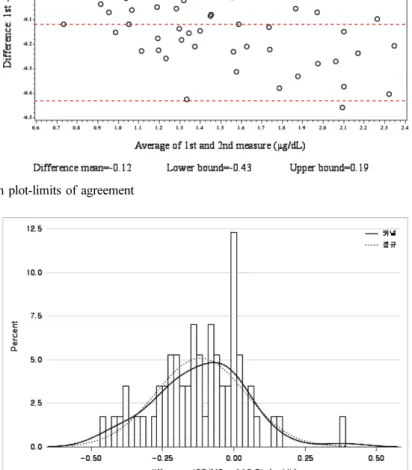
또, 일치성을 확인하기 위해 일치 한계(limits of agreement) 를 Fig. 3과 같다.

본 연구에서는 두 장비의 분석 값 차이의 평균은 –0.12 µg/dL이며 이에 대한 95% 신뢰구간은 –0.43- 0.19 µg/dL로 총 자료 중 해당 구간 내 포함되는 분석 값은 약 98%에 해당하였다. 한편, 각 점들은 차이의 평균을 중심으로 무작위로 분포되어 있음을 알 수 있다. 그 분포는 Fig. 4와 같이 정규분포와 유사하다.

Fig. 1. Comparison between the GF-AAs and the ICP-MS measurements

*r: Pearson’s correlation coefficient

**ccc: concordance correlation coefficient

Fig. 2. Bias plot displaying the difference of the two methods in percentage

(6)

IV. 고 찰

GF-AAs 와 ICP-MS 두 장비는 각각의 장점과 단 점을 가지고 있고 장비 간의 다른 특성이 있다. GF- AAs 를 이용한 납 분석법은 특정 원소를 민감하게 분석할 수 있는 선택성을 가지고 있고, 시료의 특성 에 따른 매질의 간섭영향을 크게 받지 않는다는 장 점에 의해서 과거부터 현재까지 많이 활용되는 분석 방법이다. 그러나 검출한계가 높으며 특정 원소에 한 정해서 분석이 가능하다는 단점이 있다.

4,5,23,24)

ICP-MS 는 최근 국제적으로 활용도가 더욱 높아져

가고 있는 방법이다. ICP-MS는 다중의 원소 분석이 가능하고 검출한계가 낮은 장점을 가진 분석법이지 만 매질의 간섭을 받는다는 단점이 있다.

4,5,23,24)

매질 간섭의 단점을 보완하기 위해서 산을 이용하여 매질 내의 유기 물질을 제거하여 간섭을 최소화하는 방법 등 보완적인 방법이 개발 활용되고 있다.

5)

본 연구에서는 두 장비를 이용하여 같은 시료를 분석하고, 두 장비간의 일치성을 파악하고자 하였다.

ICP-MS 의 검출한계는 0.092 µg/dL, GF-AAs의 검출 한계는 0.145 µg/dL로 ICP-MS의 검출한계가 GF- AAs 의 검출한계보다 낮았다. 본 연구와 유사한 형 Fig. 3. Bland-Altman plot-limits of agreement

Fig. 4. Distribution pattern of the differences between methods for each sample

(7)

태를 볼 수 있었다. 국립환경과학원(2008)의 보고서 에서는 ICP-MS의 검출한계는 0.114 µg/dL이고, GF- AAs의 검출한계는 0.3 µg/dL를 보였고,

3)

Trzcinka- Ochocka (2016) 등에서도 본 연구와 같이 ICP-MS 의 검출한계는 0.016 µg/dL, GF-AAs의 검출한계는 0.1 µg/dL로 ICP-MS의 검출한계보다 GF-AAs의 검 출한계가 낮음을 확인하였다.

5)

표준물질을 이용하여 두 장비의 값을 비교하여 보 았을 때, 회수율(recovery)은 비슷한 수준이지만, 변 이계수(CV)는 ICP-MS가 낮은 양상을 보였다. 국립 환경과학원(2008) 보고서에서도 본 연구와 같은 표 준물질은 sero1을 사용하여 GF-AAs와 희석법-ICP- MS, 마이크로웨이브 분해-ICP-MS의 분석방법간의 축정 값을 비교하고, 회수율로 정확도를 비교하였을 때, 모두 정확도 허용범위인 80~120%를 만족하였 고, 그 중 희석법-ICP-MS의 분석법이 정확도 및 정 밀도에서 가장 우수하다는 것을 보았고,

3)

본 연구와 비교하여 보았을 때 sero1의 인증 값과 범위를 현재 와 고려하여 보아도 큰 차이가 없었다. GF-AAs 인 증 값: 2.1±0.4 µg/dL, 측정 값: 2.32±0.04 µg/dL, 희 석법-ICP-MS 인증 값: 2.76±0.14 µg/dL, 측정 값:

2.86±0.0644 µg/dL, 희석법-ICP-MS의 경우 혈중 납 표준물질의 정확도는 (103.7%) 국립환경과학원(2008) 보고서에서도 두 장비간의 결과 값을 분산분석과 상 관성을 분석한 혈중 납의 결과는 p=0.97>0.05, R=0.99 로 두 분석 장비간의 유의한 차이가 없음을 확인하였고, 측정값 간에도 유의한 상관관계를 보이 는 것을 확인하였다.

3)

Trzcinka-Ochocka (2016) 등 은 직업적으로 납에 노출되는 작업자 40명을 대상 으로 ICP-MS와 GF-AAs의 비교에 대한 연구를 수 행하였는데, 본 연구와 같은 표준물질인 Clinchek 1 을 사용한 내부정도관리 결과 회수율은 ICP-MS에 서는 101%이고, ICP-MS와 GF-AAs에서 두 기계에 사용된 표준물질인 SERO Ⅱ의 회수율은 각각 105%

와 99%로 높은 회수율을 보였다.

5)

회수율은 본 연 구와 비슷한 수준이였고, 본 연구와 같이 높은 회수 율을 확인하였다.

본 연구에서는 57명의 일반 성인의 혈액을 이용하 여 두 장비간의 농도차이를 보았으므로 납 노출 작 업자를 대상으로 한 Trzcinka-Ochocka (2016) 등의 연구와 비교 시 측정값이 다소 낮게 유지되었다.

5)

본 연구에서 측정된 값의 산술평균 값(GF-AAs:

1.48±0.50 µg/dL, ICP-MS: 1.36±0.41 µg/dL), 기하평 균(GF-AAs: 1.40(1.27-1.53 µg/dL), ICP-MS: 1.30 (1.20-1.41 µg/dL), 중간 값(GF-AAs: 1.40(0.60-2.52 µg/dL), ICP-MS: 1.31(0.67-2.24 µg/dL), 백분위들을 비교하면, GF-AAs의 값이 ICP-MS의 값보다 높게 나온 것으로 알 수 있었다. Zhang ZW (1997)는 중 국인들과 일본인의 식이와 혈액 납의 농도를 GF- AAs 와 ICP-MS를 비교하였는데, 전체적으로 GF- AAs의 값이 ICP-MS의 값보다 높게 나온 것을 확 인하였다.

15)

David (1995) 등의 연구에서도 목표 허 용 한계보다 GF-AAs의 값은 높고, ICP-MS의 값은 낮게 나온 것을 확인하였는데 본 연구를 포함한 최 근의 비교분석실험에서도 이러한 경향성이 유지되고 있다.

17)

일치한계를 이용한 두 장비간의 분석 값의 산점도 편향의 비율을 비교하면, 분석 값이 신뢰구간 안에 있는 것으로 보아 두 장비간의 일치정도가 높은 것 을 알 수 있다. 피어슨 상관계수와 일치성 상관계수 는 각각 0.958과 0.910으로 높은 상관관계를 보였 다. 그러나 Fig. 1에서 나타나듯이 이상적인 참조 값 에서 벗어나는 값이 일부 나타나는 것으로 보였고, 이상적인 참조 값보다는 아래로 향하는 것을 나타났 다(Fig. 2). Trzcinka-Ochocka 등(2016)의 연구에서 ICP-MS 와 GF-AAs를 이용하여 혈중 납을 분석 비 교하였을 때, 두 분석법의 상계관계는 높았고(r=

0.9998), 검출한계는 ICP-MS 0.16, GF-AAs 1.0 µg/

L 로 본 연구와 같이 ICP-MS이 낮은 양상을 보였 다.

5)

David 등 (1995)의 연구에서 혈중 납에 대한 ICP-MS 와 GF-AAs의 비교분석에서도 높은 상관관 계(r=0.9954)를 보였다.

17)

분석 값의 편향으로 일치성을 확인하였을 때, 분 석 값의 약 98%가 이상적인 참조선(y=0)에서 편향

±40% 내에 존재하였다. 그래프를 보면 ICP-MS의 분

석 값이 GF-AAs의 분석 값보다 낮게 나타나는 것

을 볼 수 있다. 본 연구에서는 ICP-MS는 낮은 농도

에서GF-AAs보다 높게 나타났지만, 높은 농도에서

ICP-MS 가 GF-AAs보다 낮게 나타난다는 것을 알

수 있다. 하지만 전체적으로 GF-AAs의 값이 높게

나왔으며, 현재 사용하고 있는 조건이 저 농도에 집

중되어있으므로 ICP-MS와 GF-AAs의 차이는 미미

한 것으로 판단된다. 따라서 GF-AAs는 ICP-MS와

비교하여 저 농도에서도 매우 정확한 값을 제시하고

(8)

있는 것으로 판단된다.

저 농도와 고 농도의 두 분석법간의 차이가 있지 만, 현재 GF-AAs의 조건을 보면 저 농도의 조건으 로 혈중 납을 분석하고 있어 ICP-MS 못지않게 GF- AAs는 낮은 농도의 혈중 납에도 신뢰성을 가진다고 생각한다. 그러나 Trzcinka-Ochocka (2016)의 연구 와 같이 ICP-MS에 의한 측정이 낮은 검출한계와 신 속한 분석, 다중원소 동시정량 등의 장점에 의해서 ICP-MS 에 의한 분석으로 전환되는 것이 세계적이

추세로

3-9,19-22,25-30)

파악되고 있다. 향후에도 두 분석

방법의 장단점을 고려한 분석법에 대한 더욱 많은 연구가 필요하지만, 국제적인 중금속 생물학적모니 터링 방법의 변화에 발맞추어 국내의 중금속 생물학 적 모니터링의 ICP-MS의 전환을 고려해 볼 수도 있 다고 생각한다.

V. 결 론

혈중 납 농도에 대한 두 가지 분석법의 비교분석 에서 GF-AAs와 ICP-MS 방법의 높은 상관성과 일 치성이 있는 것을 확인하였다. 그러나 우리나라 국 민들의 납 노출수준이 점차 낮아지고 있는 점과 세 계적인 추세 등을 고려해 볼 때 ICP-MS의 분석 방 법으로의 전환을 검토해 볼 시점으로 생각한다.

감사의 글

본 연구는 환경부 지정 환경보건센터의 지원으로 수행되었습니다.

References

1. Kim HJ, Hong YS, Lee KE, Kim DS, Lee MJ, Yeah BJ, et al. The Levels of Blood Lead and Cad- mium in Urban and Rural Population in Korea.

Journal of Life Science. 2009; 19(4): 472-478.

2. Zhang ZW, Moon CS, Watanabe T, Shimbo S, He FS et al. Background exposure of urban popula- tions to lead and cadmium: comparison between China and Japan. International Archives of Occupa- tional and Environmental Health. 1997; 69(4): 273- 281

3. Lee JS, Kim YH, Park JS, Lee JH, Im TH, et al.

Establishment of analytical method for blood and

urine using ICP/MS (I). 1st ed. Republic of Korea:

National Institute of Environmental; 2008. p. 1-86.

4. Torrence KM, McDaniel RL, Self DA, Chang MJ.

Slurry sampling for the determination of arsenic, cadmium, and lead in mainstream cigarette smoke condensate by graphite furnace–atomic absorption spectrometry and inductively coupled plasma–mass spectrometry. Analytical and Bioanalytical Chemis- try. 2002; 372(5-6): 723-731.

5. Trzcinka-Ochocka M, Brodzka R, Janasik B. Use- ful and Fast Method for Blood Lead and Cadmium Determination Using ICP-MS and GF-AAS; Valida- tion Parameters. Journal of Clinical Laboratory Analysis. 2016; 30(2): 130-139.

6. Lee SB , Kim YS, Lee YH, Ahn BJ, Kim NS, et al.

Validation of ICP-MS method for trace level anal- ysis of Pb in plasma. Analytical Science & Technol- ogy. 2015; 28(5): 309-316.

7. Xiao M, Huang Z, Cai J, Jia J, Zhang Y, Dong W, Wang Z. Comparison of different sample prepara- tion methods for platinum determination in cul- tured cells by graphite furnace atomic absorption spectrometry. PeerJ. 2017; 5:e2873

8. Lee SB, Yang JS, Choi SB, Shin HS. Trace level analysis of Pb in plasma by inductively coupled plasma/mass spectrometry. Analytical Science &

Technology. 2012; 25(3): 190-196.

9. Kwon JY, Kim BG, Lim HJ, Seo JW, Kim YM, et al. Comparison of Human Blood Cadmium Concen- trations using Graphite Furnace Atomic Absorption Spectrometry (GF-AAS) and Inductively Coupled Plasma-mass Spectrometry (ICP-MS). Korean Jour- nal of Environmental Health Sciences. 2018; 44(5):

491-501.

10. Lee SY, Oh HJ, Choi YH, Kim JW, Kim SH. Trace Metal Analysis Using Inductively Coupled Plasma- Mass Spectrometry (ICP-MS). Annals of Labora- tory Medicine. 2004; 24(6): 362-370.

11. Kristiansen J, Christensen JM, Iversen BS, Sabbi- oni E. Toxic trace element reference levels in blood and urine: influence of gender and lifestyle factors.

The Science of the Total Environment. 1997; 204(2):

147-160.

12. Rahil-Khazen R, Bolann BJ, Ulvik RJ. Trace ele- ment reference values in serum determined by inductively coupled plasma atomic emission spec- trometry. Clinical Chemistry and Laboratory Medi- cine. 2000; 38(8): 765-772.

13. Mortada WI, Sobh MA, el-Defrawy MM, Farahat

SE. Reference intervals of cadmium, lead, and mer-

cury in blood, urine, hair, and nails among resi-

(9)

dents in Mansoura city, Nile delta, Egypt.

Environmental Research. 2002; 90(2): 104-110.

14. Kim JM, Ahn JM, Kim WS, Kim JI, Shin HR, Jung KY, et al. Blood Lead, MAnganese, Alumin- ium and Silicon Concentrations in Korean Adults.

Korean Journal of Preventive Medicine. 2000;

33(2): 157-164.

15. Zhang ZW, Shimbo S, Ochi N, Eguchi M, Wata- nabe T, Moon C-S, et al. Determination of lead and cadmium in food and blood by inductively coupled plasma mass spectrometry: a comparison with graphite furnace atomic absorption spectrometry.

ELSEVIER The Science of the Total Environment.

1997; 205(2-3): 179-187.

16. Yedomon B, Menudier A, Etangs FLD, Anani L, Fayomi B, Druet-Cabanac M, et al. Biomonitoring of 29 trace elements in whole blood from inhabi- tants of Cotonou (Benin) by ICP-MS. Journal of Trace Elements in Medicine and Biology. 2017; 43:

38-45.

17. Nixon DE, Moyer TP. Routine clinical determina- tion of lead, arsenic, cadmium, and thallium in urine and whole blood by inductively coupled plasma mass spectrometry. Spectrochimica Acta Part B:Atomic Spectroscopy. 1996; 51(1): 13-25.

18. White MA. A comparison of inductively coupled plasma mass spectrometry with electrothermal atomic absorption spectrometry for determination of trace elements in blood and urine from non occu- pationally exposed populations. Journal of Trace Elements in Medicine and Biology. 1999; 13(1-2):

93-101.

19. Heitland P, Köster HD. Biomonitoring of 37 trace elements in blood samples from inhabitants of northern Germany by ICP-MS. Journal of Trace Elements in Medicine and Biology. 2006; 20(4):

253-262.

20. Bocca B, Forte G, Petrucci F, Senofonte O, Vio- lante N, Alimonti A. Development of methods for the quantification of essential and toxic elements in human biomonitoring. Ann Ist Super Sanita. 2005;

41(2): 165-170.

21. Heitland P, Köster HD. Fast, simple and reliable routine determination of 23 elements in urine by ICP-MS. J Anal At Spectrom. 2004; 19: 1552-1558.

22. Kira CS, Sakuma AM, Gouveia Nda C. Fast and simple multi-element determination of essential and toxic metals in whole blood with quadrupole ICP- MS. Journal of Applied Pharmaceutical Science.

2014; 4(5): 39-45.

23. Zhang WS, Ren T, Zhao LJ. Determination of Pb (Lead), Cd (Cadmium), Cr (Chromium), Cu (Cop- per), and Ni (Nickel) in Chinese tea with high-res- olution continuum source graphite furnace atomic absorption spectrometry. Journal of food and drug analysis. 2016; 24(1): 46-55.

24. Soares AR, Nascentes CC. Development of a sim- ple method for the determination of lead in lipstick using alkaline solubilization and graphite furnace atomic absorption spectrometry. Talanta. 2013; 105:

272-277.

25. Park KS ,Kim ST . A study on the determination of lead in whole blood by ICP/MS. Analy science &

technology. 1997; 10(4): 240-245.

26. Nunes JA, Batista BL, Rodrigues JL, Caldas NM, Neto JA, Barbosa F Jr. A Simple Method Based on ICP-MS for Estimation of Background Levels of Arsenic, Cadmium, Copper, Manganese, Nickel, Lead, and Selenium in Blood of the Brazilian Pop- ulation. Journal of Toxicology and Environmental Health. 2010; 73(13-14): 878-887.

27. Hsieh HF, Chang WS, Hsieh YK, Wang C-F, Lead determination in whole blood by laser ablation cou- pled with inductively coupled plasma mass spec- trometry. Talanta. 2009, 79: 183-188.

28. Gajek R, Barley F, She J. Determination of essen- tial and toxic metals in blood by ICP-MS with cal- ibration in synthetic matrix. Analytical Methods.

2013; p. 2193-2202.

29. Batista BL, Rodrigues JL, Nunes JA, Souza VC, Barbosa F Jr. Exploiting dynamic reaction cell inductively coupled plasma mass spectrometry (DRC-ICP-MS) for sequential determination of trace elements in blood using a dilute-and-shoot procedure. Analytica Chimica Acta. 2009; 639(1-2):

13-18.

30. Iked M, Ohashi F, Fukui Y, Sakuragi S, Moriguchi J. Cadmium, chromium, lead, manganese and nickel concentrations in blood of women in non-polluted areas in Japan, as determined by inductively cou- pled plasma-sector field-mass spectrometry. Interna- tional Archives of Occupational and Environmental Health. 2011; 84(2): 139-150.

<저자정보>

강민경(연구원), 권정연(연구원), 김병권(교수)

임현주(연구원), 서정욱(연구원), 김유미(교수)

홍영습(교수)

수치

Table 2. Temperature program of GF-AAs
Table 4. Quality control standard material in each equipment (µg/dL) Reference value Tolerance value Conc
Fig. 2. Bias plot displaying the difference of the two methods in percentage
Fig. 4. Distribution pattern of the differences between methods for each sample

참조

관련 문서

Determination of Lead in Different Samples by Atomic Absorption Spectrometry after Preconcentration with Dithizone Immobilized on Surfactant-Coated Alumina.. Dehgan

A method for the direct determination of trace amounts in molybdenum matrix by inductively coupled plasma atomic emission spectroscopy is described with emphasis on line

Preconcentration of Ultra Trace Amounts Bismuth in Water Samples Using Cloud Point Extraction with Na-DDTC and Determination.. by Electrothermal Atomic Absorption

Preconcentration, Separation and Determination of lead(II) with Methyl Thymol Blue Adsorbed on Activated Carbon Using Flame Atomic.. Absorption

Determination of Urinary Iodine Concentration by Inductively Coupled Plasma-mass Spectrometry in Thyroid Cancer Patients on Low-iodine Diet.. Ji Hyun

현재 가장 보편적인 중금속 분석방법은 유도결합 플 라즈마 질량분석(Inductively Coupled Plasma Mass Spectrometry, ICP-MS)이나 원자흡광/방출광도계