DCT and DWT Based Robust Audio Watermarking Scheme for Copyright Protection
Kaushik Deb*, Md. Ashikur Rahman*, Kazi Zakia Sultana*, Md. Iqbal Hasan Sarker* Ui-Pil Chong**
Digital watermarking techniques are attracting attention as a proper solution to protect copyright for multimedia data. This paper proposes a new audio watermarking method based on Discrete Cosine Transformation (DCT) and Discrete Wavelet Transformation (DWT) for copyright protection. In our proposed watermarking method, the original audio is transformed into DCT domain and divided into two parts. Synchronization code is applied on the signal in first part and 2 levels DWT domain is applied on the signal in second part. The absolute value of DWT coefficient is divided into arbitrary number of segments and calculates the energy of each segment and middle peak. Watermarks are then embedded into each middle peak. Watermarks are extracted by performing the inverse operation of watermark embedding process. Experimental results show that the hidden watermark data is robust to re-sampling, low-pass filtering, re-quantization, MP3 compression, cropping, echo addition, delay, and pitch shifting, amplitude change. Performance analysis of the proposed scheme shows low error probability rates.
Keywords : Audio watermarking; Synchronization code embedding; Discrete Cosine Transform (DCT); Discrete Wavelet Transform (DWT)
* Department of Computer Science & Engineering Chittagong University of Engineering & Technology
Chittagong-4349, Bangladesh
** School of Electrical Engineering University of Ulsan 투고 일자 : 2013. 11. 27 수정완료일자 : 2014. 1. 27 게재확정일자 : 2014. 2. 4
Transmission and distribution of digital multimedia (audio, video and image) are utilized very efficiently in the recent internet based communication and digital multimedia technology. Since the facilities of doing unauthenticated copy and distribution of multimedia
nformation is applied, intellectual property rights and protection of it is very crucial and important fact. Digital
watermarking is focused to solve this problem efficiently.
As a result the field of effective and optimized copyright protection and concealed verification message is major concern to the scientific and research based communities in the world. That’s why watermarking technology has been considered as a very effective and reliable solution to mark the original signal. Prospective digital watermarking for piracy of the multimedia content is more effective than traditional cryptography because it just allows valid key holders to access the multimedia content. Digital watermarking is the technology to embed identification information invisibly in such way that the information remains permanent.
Digital watermarking [3] technology has received
great deal of attention to solve this problem. In general an effective audio watermarking [7] scheme must satisfy the following basic requirements: (i) Imperceptibility: The quality of the audio should be retained after adding the watermark. Imperceptibility can be evaluated using both objective and subjective measures. In the literature, several watermarking techniques have already been proposed for image and video watermarking [4, 5]. These techniques can also be applied to audio watermarking.
However, audio watermarking algorithms are not easy to develop because of the sensitivity of human auditory system [8]. In the recent years, audio watermarking techniques have achieved significant progress, and several good algorithms have been developed. A detailed survey of audio watermarking algorithms can be found in [9].
Most of the recent audio watermarking algorithms can be broadly classified into two categories: time-domain algorithms [6, 10 and 11] and frequency-domain algorithms [12 and 13]. Time-domain algorithms directly insert the watermark in to the audio signal, where as frequency-domain algorithms embed the watermark based on modifying the frequency coefficients. Compared with frequency-domain algorithms, time-domain algorithms are relatively easier to implement and require less computational cost, but they are less robust to some audio signal-processing attacks. Some of the novel and popular audio watermarking algorithms use the patch work method [14], and spread spectrum techniques [15].
The main weaknesses of the existing algorithms are as follows: (i) the watermark embedding positions are not
selected adaptively according to the characteristics of the audio signals, leading to significant reduction in imperceptibility [12, 13]. (ii) Synchronized code is embedded by modifying individual sample values, thereby reducing the resistance of the synchronized code against signal processing attacks, to a great extent [12, 13]. (iii) Low payload, for example 43bps [11] (time domain), 22bps [16,17] (cepstrum domain), 16bps [7] (time domain), 10bps [14] (modified patch work algorithm (MPA)), 8.5bps [18]
(frequency domain), 5bps [19] (salient point), 4bps [20]
(time domain), 0.83bps [11] (Fourier domain), and 0.5–1 bps [15] (spread spectrum). (iv) Low robustness, like vulnerability to cropping [14, 17].
In this paper we work on audio watermarking. An effective audio watermarking design provides the way to embed copyright information while maintaining the integrity and quality of the original audio. We propose a new procedure of audio watermarking based on Discrete Cosine Transform (DCT) and Discrete Wavelet Transform (DWT).
In this paper, we work on audio watermarking.
Synchronization code embedding process gives our better security. Our proposed method checks the peak value of first part and second part audio signal. Only a few audio watermarking algorithms based on synchronization code have been proposed. De-synchronization attacks (watermark is present but cannot be detected because of a loss of synchronization) a serious problem to any watermarking scheme, especially during audio watermarking. Some attacks, such as cropping, shifting and MP3 compression, which change the length of the audio signal, usually lead to a failure
to extract the watermark.. This problem can be solved by concatenating a synchronization code and watermark bits.
We select the middle peak because when we use high peak and apply low pass filter, then remove the high frequency and when we use low peak, someone can easily identify something has been added. We propose a new procedure of audio watermarking based on Discrete Cosine Transform (DCT) and Discrete Wavelet Transform (DWT) and Synchronization code. The DCT that has been widely used recently in signal compressing algorithms that is because of its considerable capability in com-pressing the signal energy even in few coefficients. Moreover, DCT is robust against re-sampling and low pass filtering attacks. However, it is vulnerable to compressing attacks such as mp3 since in the heart of every audio compressing algorithm an energy compressing transform such as DCT can be found.
The decomposition process can be performed in different levels. The more the levels are, the more accurate DWT
in terms of the frequency and the time is obtained. In other words, since in higher levels of DWT, the frequency ranges of the sub-band become narrower, signal can be represented in detail with more precise frequencies. Moreover, DWT is reasonably robust against attacks. That’s why first we can use DCT and later in DWT transform.
In this section we will discuss about the watermark bits embedding process and extraction of the watermark from the watermarked audio.
A. Embedding Approach
The embedding procedure is shown in Figure 3. To embed watermark bits in the host audio the following steps are needed.
1) The original audio signal is transformed into DCT domain. Assume that the samples of audio signal define as u and apply DCT on this samples by the following equation:
The new sequence v generated by the DCT where v denotes as frequency components.
2) The DCT domain is divided into two parts defined by first part x1 and second part x2, respectively.
Synchronization code is applied on the x1 and x2 is used for watermarking.
3) The signal in part x2 is transformed into 2 levels DWT domain. When we apply 2 levels DWT, the wavelet coefficients are more visible. The decomposition into 2 levels DWT sub bands gives a higher flexibility more than lower level DWT in terms of scalability in resolution and distortion. So, we can easily calculate the middle frequency value from low and high frequency for each segment.
4) The energy of each segment is calculated using the following equation:
(1)
5) Calculate middle peak from each energy segment.
6) The watermark is then embedding into middle peak using the following equation:
(2) Where the watermark is sequence and is the
original audio signal. Find the middle peak from signal and insert watermark in this position and α is the scaling parameter.
7) Apply the inverse 2 levels DWT after watermark
embedded.
8) Add part audio signal with part audio signal.
9) Apply inverse DCT apply to find the watermark signal.
B. Proposed Synchronization Code Embedding
The Synchronization code can be embedded as follows:
1) The part of of the audio signal having k audio segment, with each audio segment having n samples.
=
; (3) Where is the mth segment.
2) The mean value of each segment CX1(m) is given by:
= (4) Where is the mean value of mth segment.
3) Each bit of the synchronization code is embedded into CX1(m) as follows
= - - , if( )=1,
= - + , if( )=0,
When mean value is positive then embed 1 and when mean value is negative then embed 0.
Fig. 1. The proposed framework for embedding watermark bits into the host audio.
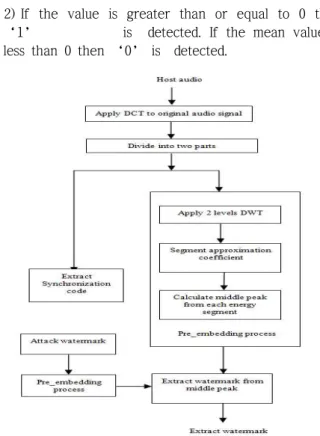
C. The Watermark Extraction Algorithm The watermark extraction algorithm is implemented in following steps
1) The attacked watermark signal is transformed into DCT domain.
2) The DCT domain audio signal is divided into two parts defined by first part and second part . 3) The signal in second part is transformed into two levels of DWT.
4) Calculate middle peak.
5) Calculate middle peak by apply step 1 to 4 from host audio signal and extract watermark from middle peak.
= (5)
D. The Synchronization Code Extraction
1) The mean value of each segment is calculated.
2) If the value is greater than or equal to 0 then
‘1’ is detected. If the mean value is less than 0 then ‘0’ is detected.
Fig. 2. The proposed watermark detecting process.
We have performed extensive simulations using MATLAB 7.8 on different audio signal including Loopy music,
SG Impairment Quality 5.0 Imperceptible Excellent 4.0 Perceptible, but
not annoying Good
3.0 Slightly annoying Fair
2.0 Annoying Poor
1.0 Very annoying Bad
Types of signal SNR
α=0.1 α=0.2 α=0.3
loopy music 59.5213 53.8929 50.4603 speech-in 29.8400 24.0918 19.3160 human voice 63.5478 56.9864 54.0797 Speech-in, human voice. Each music is a 16 bit mono audio
signal in the WAV format sampled at 44100 Hz.
A. Imperceptibility
Generally, there are two approaches to perform perceptual quality assessment, (1) Subjective listening tests by human acoustic perception. (2) Objective evaluation tests by measuring the signal to noise ratio (SNR).Informal listening using head set reveals that the watermark embedded into the original audio signal using the proposed watermarking method does not affect the quality of the sound, which ensures the imperceptibility of the embedded watermark. Table II shows the SNR results of the proposed watermarking method for different values of α. Our proposed method achieves SNR values ranging from 19 dB to 63 dB for different watermarked sounds.
Imperceptibility means, when we embedded watermark into the original audio signal and it should not affect the perceptual quality of the original audio signal. In our proposed audio watermarking method, we will use three audio signals and do not loss the quality of original audio signal. The SNR values are also given in Table II. The minimum SNR and the maximum SNR of the proposed scheme are 19.3160 and 63.5478 respectively for different factors α. So our proposed schema fulfill to imperceptibility requirement.
Fig. 3. Human voice of original audio signal and its watermark audio signal.
Fig. 4. Loopy music of original audio signal and its watermark signal.
Fig. 5. Speech in of original audio signal and its watermark signal.
The inaudibility of our watermarking method has been done by listening tests involving ten persons. Each listener was presented with the pairs of original signal and the watermarked signal and was asked to report whether any difference could be detected between the two signals. The ten people listed to each pair for 10 times and they have a grade for this pair, using the ITU-R BS.1284 standardized 5-point grading scale [21].
The average grade for of each pair from all listeners is the final grade for this pair and we get high grading from all of them.
Table 1. Impairment Grades
Objective quality of the watermark audio signal is measured by the SNR and subjective quality of the watermark audio signal is the measured by the Mean Opinion Score (MOS). It is defined as
SNR= (6)
Table 2. SNR Results of the Proposed Watermarking Method
A.Robustness test
The following attacks were performed to test the robustness and effectiveness of our schema. The audio editing and attacking tools adopted in the experiment are adobe audition 3(for echo, delay, re-sampling) and
audacity 2(for re-quantization, low pass filter, cropping, pitch shifting, amplitude change) and Xilisoft Video Converter Ultimate 5.1.20 (for MP3 compression) for implementing the operation.
When we add different kinds of attack in my original audio sounds, we can extract the watermark perfectly.
The NC and BER are also given in Tables III, IV, V, VI, VII, VIII, IX, X, XI, XII. We see that our proposed scheme has higher NC and lower BER values against various attacks for different audio sounds. The minimum NC and the maximum NC of the proposed scheme are 0.9990 and 1 respectively for various audio sounds against different attacks. The extracted watermark has good quality. This clearly shows our proposed scheme has good performance against different attacks for different audio sounds.
1. Re-sampling
The watermarked signal is transformed into a new watermarked signal after re-sampling. The watermarked signal, originally sampled at 44.1 kHz, is re-sampled at 22.05 kHz, and then restored back by sampling again at 44.1 kHz.
2. Re-quantization
The watermarked signal is transformed into a new watermarked signal after re-quantization. The 16-bit watermarked audio signal is re-quantized down to 8bits/sample and then back to 16bits/sample.
3. Low-pass filter
The watermarked signal is transformed into a new watermarked signal after low pass filter which second order Butter worth filter with cut-off frequency 1000 Hz is used.
4. Echo addition
The watermarked signal is transformed into a new watermarked signal after echo addition which echo signal with a delay time 180 ms in left channel and delay time 275 ms in right channel and echo level 25% in both channel.
5. Delay
The watermarked signal is transformed into a new watermarked signal after delay. Delay time is applied 120 ms~ in left channel and 180 ms~ in right channel.
6. MP3 compression
The watermarked signal is transformed into a new watermarked signal after MPEG-1 layer 3 compression is applied. The watermarked audio signal is compressed and then decompressed back to the WAVE format.
7. Cropping
We removed greater than 2 second from the end of
the watermarked signal and then replaced these second by the original signal.
8. Pitch shifting
The watermarked signal is transformed into a new watermarked signal after pitch shifting is applied where percent change 10.
9. Amplitude change
The watermarked signal is transformed into a new watermarked signal after amplitude change is applied where new peak amplitude clipping is 10.
Normalized cross correlation (NC) is used to evaluate the similarity between the original watermark and the extracted watermark and is defined as follows:
NC = (7) The bit error rate (BER) is used to evaluate the
watermark detection accuracy after signal processing operations. The BER of the watermarked signal retrieval is defined as follows:
BER( ) = (8)
Where ⊕ is the exclusive or (XOR) operator and N is
the length of watermark.
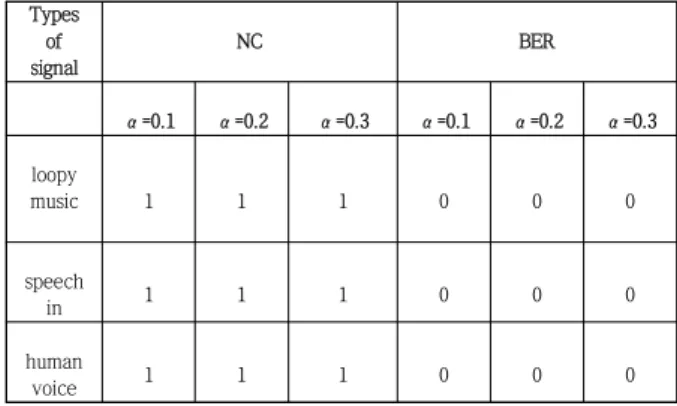
Following tables show the values of NC and BER of our experiment for different audio signals with various attacks. In maximum case, we get NC = 1 and BER = 0 for different α values, which is so better for any audio watermarking scheme.
Table 3. NC and BER without Attack
Types of signal
NC BER
α=0.1 α=0.2 α=0.3 α=0.1 α=0.2 α=0.3
loopy
music 1 1 1 0 0 0
speech
in 1 1 1 0 0 0
human
voice 1 1 1 0 0 0
Table 4. NC and BER against Re-sampling
Types of
signal NC BER
α=0.1 α=0.2 α=0.3 α=0.1 α=0.2 α=0.3
loopy
music 1 1 0.9990 0 0 0
speech in
1 1 1 0 0 0
human
voice 1 1 1 0 0 0
Table 5. NC and BER against Low pass Filter
Types of
signal NC BER
α=0.1 α=0.2 α=0.3 α=0.1 α=0.2 α=0.3 loopy
music 1 1 0.9996 0 0 0
speech
in 1 1 1 0 0 0
human
voice 1 1 1 0 0 0
Table 6. NC and BER against Echo
Types of signal
NC BER
α=0.1 α=0.2 α=0.3 α=0.1 α=0.2 α=0.3
loopy music
1 1 0.9992 0 0 0
speech in 1 1 1 0 0 0
human voice 1 1 1 0 0 0
Table 7. NC and BER against Re-quantization
Types of
signal NC BER
α=0.1 α=0.2 α=0.3 α=0.1 α=0.2 α=0.3
loopy music
1 1 1 0 0 0
speech in
1 1 1 0 0 0
human voice
1 1 1 0 0 0
Table 8. NC and BER against Delay
Types of signal
NC BER
α=0.1 α=0.2 α=0.3 α=0.1 α=0.2 α=0.3
loopy music 1 1 1 0 0 0
speech in 1 1 1 0 0 0
human voice 1 1 1 0 0 0
Table 9. NC and BER against Cropping
Types of
signal NC BER
α=0.1 α=0.2 α=0.3 α=0.1 α=0.2 α=0.3 loopy
music 1 1 1 0 0 0
speech
in 1 1 1 0 0 0
human
voice 1 1 1 0 0 0
Table 10. NC and BER against Amplitude scaling
Types of
signal NC BER
α=0.1 α=0.2 α=0.3 α=0.1 α=0.2 α=0.3 loopy
music 1 1 0.9997 0 0 0
speech
in 1 1 1 0 0 0
human
voice 1 1 1 0 0 0
Table 11. NC and BER Pitch shifting
Types of
signal NC BER
α=0.1 α=0.2 α=0.3 α=0.1 α=0.2 α=0.3
loopy
music 1 1 0.9992 0 0 0
speech
in 1 1 1 0 0 0
human
voice 1 1 1 0 0 0
Table 12. NC and BER against MP3 compression
Types of
signal NC BER
α=0.1 α=0.2 α=0.3 α=0.1 α=0.2 α=0.3
loopy music
1 1 1 0 0 0
speech in 1 1 1 0 0 0
human
voice 1 1 0.9994 0 0 0
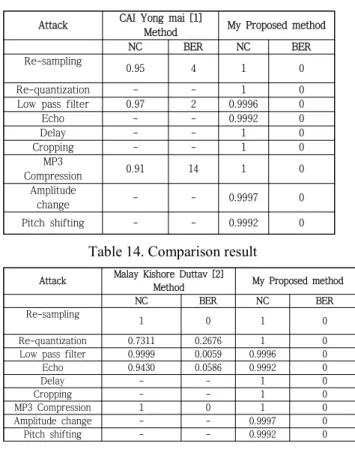
In table XIII, this table shows some comparison results of extracted audio from different attack watermarked audio
between the proposed method and CAI Yong mai [1]
method. Again, table XIV shows some comparison results of extracted audio from different attack watermarked
audio between the proposed method and Malay Kishore Duttay [2] method.
Table 13. Comparison result
Attack CAI Yong mai [1]
Method My Proposed method
NC BER NC BER
Re-sampling
0.95 4 1 0
Re-quantization - - 1 0
Low pass filter 0.97 2 0.9996 0
Echo - - 0.9992 0
Delay - - 1 0
Cropping - - 1 0
MP3
Compression 0.91 14 1 0
Amplitude
change - - 0.9997 0
Pitch shifting - - 0.9992 0
Table 14. Comparison result
Attack Malay Kishore Duttav [2]
Method My Proposed method
NC BER NC BER
Re-sampling
1 0 1 0
Re-quantization 0.7311 0.2676 1 0
Low pass filter 0.9999 0.0059 0.9996 0
Echo 0.9430 0.0586 0.9992 0
Delay - - 1 0
Cropping - - 1 0
MP3 Compression 1 0 1 0
Amplitude change - - 0.9997 0
Pitch shifting - - 0.9992 0
Overall, our proposed watermarking scheme gives best result in terms of SNR, NC or BER values for different watermarked sounds.
In this paper, we propose an audio watermarking scheme based on DCT and DWT. Our experimental results have shown that the proposed watermarking scheme has strong robustness to common signal processing operations.
Moreover, the proposed scheme achieves low error probability rates and high SNR. We have compared the performance of our algorithm with other recent audio watermarking algorithms. Overall, our proposed algorithm has high embedding capacity and achieves low BER against several attacks, such as noise addition, re-sampling, re-quantization, cropping, low-pass filtering, and MP3 compression. The proposed method is sensitive for some attack such as re-sampling, low pass filter, Amplitude scaling, Pitch shifting, MP3 Compression. In future we will try to solve this problem.
[1] CAI Yong-mei, GUO Wen-qiang, DING Hai-yang,
“An Audio Blind Watermarking Schema Based on DWT-SVD,” Journal of Software, VOL. 8, No. 7,July 2013.
[2] Malay Kishore Dutta, Phalguni Gupta and Vinay K Pathak, “Audio Watermarking Using Pseudorandom Sequences Based on Biometric Templates” Journal of Computers, Vol.5, pp. 372-379, Mar. 2010.
[3] I.Cox,M.Miller, J.Bloom, J.Fridrich, T.Kalke, Digital Watermarking and Steganography, seconded., Morgan Kaufmann, Burlington, MA, 2007.
[4] S.Bhattacharya, T.Chattopadhyay, A.Pal, A survey on different video watermarking techniques and comparative analysis with reference to H. 264/AVC, in: IEEE 10th International Symposium on Consumer Electronics (ISCE’06), 2006, pp.1–6.
[5] V.M.Potdar, S.Han, E.Chang, A survey of digital image watermarking techniques, in: 3rd IEEE International Conference on Industrial Informatics (INDIN’05), 2005, pp.709–716.
[6] P.Bassia, l.Pitas, and N. Nikolaidis, “Robust audio watermarking in the time domain” IEEE Transactions on Multimedia, vol. 3, pp. 232-241, June 2001.
[7] S.Katzenbeisser, F.A.P.Petitcolas, Information Hiding Techniques for Steganography and Digital Watermarking, Artech House, Boston, 2000.
[8] M.D.Swanson, B.Zhu, A.H.Tewfik, L.Boney, Robust audio watermarking using perceptual masking, Signal Process. 66(3) (1998)337–35520.
[9] N.Cvejic, T.Seppanen, Digital Audio Watermarking Techniques and Technologies, Information Science Reference, USA,2007.
[10] P.Basia, I.Pitas, N.Nikolaidis, Robust audio watermarking in the time domain, IEEE Trans.
Multimedia3 (2)(2001)232–241.23.
[11] W.-N.Lie, L.-C.Chang, Robusthigh-quality time-domain audio watermarking based on low-frequency amplitude modification, IEEE Trans.Multime-dia8 (1)(2006)46–59.
[12] X.Y.Wang, H.Zhao, A novel synchronization in variant audio watermarking Scheme based on DWT and DCT, IEEE Trans. Signal Process.54 (12) (2006)4835–4840.
[13] S.Wu, J.Huang, D.Huang, Y.Q.Shi, Efficiently self synchronized audio watermarking for assured audio data transmission, IEEE Trans. Broadcasting 51(1)(2005)69–76.
[14] I.K.Yeo, H.J.Kim, Modified patch work algorithm: A novel audio watermarking scheme, IEEE Trans.
Speech Audio Process. 11(4)(2003)381–386.
Kaushik Deb received the B. Tech., and M. Tech. degrees from Department of Computer Science and Engineering of Tula State University, Tula, Russia, in 1999 and 2000, respectively. He received his Ph.D. degree in Electrical Engineering and Information System from University of Ulsan, Ulsan, SouthKorea, in 2011.
Since 2001, he has been serving as a faculty member in Department of Computer Science and Engineering, Chittagong University of Engineering and Technology (CUET), Chittagong, Bangladesh. He is currently an Associate Professor and Head of the Department of Computer Science and Engineering, Chittagong University of Engineering & Technology(CUET), Bangladesh. His research interests include computer vision, pattern recognition, intelligent transportation systems (ITSs) and human - computer interaction.
Md. Ashikur Rahman received B.Sc. (CSE) degree from Chittagong University of Engineering & Technology (CUET) in 2013. His research interest includes digital watermarking, digital signal processing, and computer vision and information security and computer graphics.
Kazi Zakia Sultana is employed as an Assistant Professor in the Department of Computer Science & Engineering of Chittagong University of Engineering &
Technology (CUET). She achieved MS in the Department of Computer Science (CS) at Wayne State University, Detroit, MI, USA in 2011.
She served as Graduate Student Assistant in the Department of Teaching and Evaluation Center of Wayne State University from January, 2008 to September, 2010. She completed B.Sc. in the Computer Science and Engineering (CSE) from Bangladesh University of Engineering and Technology (BUET) in 2006. She has total 14 publications in conferences and journals including 5 research papers during MS and 5 during her undergraduate study. Her research experience is based on Bioinformatics and Data Mining.
Md. Iqbal Hasan Sarker received B.Sc.
degree in Computer Science & Engineering from Chittagong University of Engineering
& Technology (CUET), Bangladesh in 2009.
Currently, he is pursuing M.Sc. in Computer Science & Engineering at the same university.
Since 2010, he has been serving as a faculty member in the same department and university. His research interest includes Digital Watermarking, Computer Vision, Cryptography and data mining
Dr. Ui-Pil Chong (Member) received the B. S. degree in Electrical Engineering from University of Ulsan, Korea, in1978, and M.S. degree in Electrical Engineering from Korea University, Seoul, Korea in 1980.
He studied in field of computer engineering of Oregon State University and received M. S. degree in 1985 and received Ph. D. degree at New York University(POLY), NY, USA 1997. In January of 1997, Dr. Chong joined the School of Computer Engineering and Information Technology of the University of Ulsan in Ulsan City, Korea. His research areas are digital signal processing, fault detection and diagnosis, and multimedia applications.
[15] D.Kirovski, H.S.Malvar, Spread-spectrum watermarking of audio signals, IEEE Trans. Signal Process.51(4)(2003)1020–1033.
[16] X.Li, H.H.Yu, Transparent and robust audio data hiding in cepstrum domain, in: IEEE International Conference on Multimedia and Expo, vol.1, 2000, pp.397–400.
[17] D.Gruhl, A.Lu, W.Bender, Echo hiding, in: Information Hiding (IH’96), in: Lecture Notes in Computer Science, vol.1174, Springer, Berlin, 1996, pp.295–315.
[18] R.Tachibana, S.Shimizu, S.Kobayashi, T.Nakamura, An audio watermarking method using a two-dimensional pseudo-random array, Signal Process. 82(10)(2002)1455–1469.
[19] M.F.Mansour, A.H. T ewfik, Times calein variant audio data embedding, EURASIPJ. Appl. Signal Process.
2003(1)(2003)993–1000.
[20] B.-S.Ko, R.Nishimura,Y.Suzuki, Time-spread echo method for digital audio watermarking using PN sequences, in:
IEEE International Conference on Acoustics, Speech, and signal Processing (ICASSP’02),vol.2,2002,pp.2001–2004.
[21] Md. Iqbal Hasan Sarker, Mohammad Ibrahim Khan, Kaushik Deb and Md. Faisal Faruque, “ FFT-Based Audio Watermarking Method with a Gray Image for Copyright Protection ”, International Journal of Advanced Science and Technology Vol. 47, October, 2012