DWT/RDWT/SVD 에 기반한 특이벡터를 사용한 블라인드 워터마킹 방안
융 녹 투이 덩a), 손 원a)‡
A Blind Watermarking Scheme Using Singular Vector Based On DWT/RDWT/SVD
Luong Ngoc Thuy Dunga) and Won Sohna)‡
요 약
우리는 컨텐츠 복제방지를 위하여 기존의 SVD와 DWT/RDWT를 결합한 워터마킹 시스템에 특이벡터를 추가로 사용하는 방안을 제안하였다. 우리는 SVD를 사용하는 워터마킹 시스템에 존재하는 오류긍정문제(false-positive problem)를 극복하기 위하여 기존의 SVD기반 알고리즘과 같이 특이값에 워트마크를 임베딩할 뿐만 아니라, 커버이미지의 첫 번째 좌/우 특이벡터를 워터마크 이미지의 첫 번째 좌/우 특이벡터와 교체하였다. 제안 방안은 오류긍정문제 (false-positive problem)가 발생하지 않는 워터마킹 시스템을 구현할 수 있었으며, 기존의 오류긍정문제가 없는 시스템과 비교하여 우수한 충실성과 강인성을 보여 주었을 뿐만 아니라, 오류긍정문제가 발생 하는 시스템에 비해서도 크게 성능차이가 나지 않음을 보여 주었다.
Abstracts
We proposed a blind watermarking scheme using singular vectors based on Discrete Wavelet Transform (DWT) and Redundant Discrete Wavelet Transform (RDWT) combined with Singular Value Decomposition (SVD) for copyright protection application. We replaced the 1st left and right singular vectors decomposed from cover image with the corresponding ones from watermark image to overcome the false-positive problem in current watermark systems using SVD. The proposed scheme realized the watermarking system without a false positive problem, and shows high fidelity and robustness.
Keyword : watermarking, singular value decomposition (SVD), DWT, RDWT
Ⅰ. Introduction
Currently multimedia contents are distributed over the Internet more and more, and protecting their legal copy- right ownership becomes critical gradually. There have been many studies about using digital watermarks to solve the copyright protection problem [1-4], and as a re- a)경희대학교 전자·전파공학과 (Kyung Hee University, Department of
Electronics and Radio Engineering)
‡Corresponding Author : 손원(Won Sohn) E-mail: [email protected] Tel: +82-31-201-2983
ORCID: http://orcid.org/0000-0001-9731-3107
※이 논문의 연구결과 중 일부는 “2015년 한국방송공학회 추계학술대회”
에서 발표한 바 있음.
・ Manuscript received January 18, 2016; Revised March 7, 2016; Accepted March 9, 2016.
특집논문 (Special Paper)
방송공학회논문지 제21권 제2호, 2016년 3월 (JBE Vol. 21, No. 2, March 2016) http://dx.doi.org/10.5909/JBE.2016.21.2.149
ISSN 2287-9137 (Online) ISSN 1226-7953 (Print)
sult contents owners can embed their logos or personal information into the multimedia contents to protect their copyrights.
SVD is widely used in digital watermarking schemes be- cause its features are not affected much by common attacks such as compression, geometric operations, etc. Nasrin et al. applied SVD to each sub-band generated by the RDWT transform [5], and they achieved high fidelity and strong robustness for JPEG compression, common filtering, and geometric attacks. However, it is not robust to noise addi- tion attack. Saeed et al. [6] proposed a scheme using three-level DWT, SVD, and Radon transform. Their scheme chose LH3 and HL3 sub-bands for embedding wa- termark, and its fidelity is very high, but its robustness is not strong for noise addition attack. In [7], Chih-Chin Lai used DWT and selected LH and HL sub-bands to apply SVD and embed watermark image directly into the singular values. To decrease the cost of computational complexity, Sushma et al. proposed a scheme of using lifting wavelet transform (LWT) and SVD [8]. The similarity among these studies is that the singular values are employed mainly in the embedding process. The singular values are rarely changed to a small change in image intensity and the val- ues are not much different among images. Because of the last feature, a scheme using singular values may cause the false positive problem. It means that adversaries can extract their fake watermark image to show their copyright ownership. Guo and Prasetyo proposed a scheme to avoid the false-positive problem by embedding principal compo- nent of watermark image into the cover image [9]. The DWT LL sub-band is divided into blocks and the maximal singular values of each block are chosen to embed the prin- cipal component of watermark image. This scheme cannot get strong robustness at high fidelity (more than 40dB), and the process of finding the optimal scale factor is a time-consuming job. Gupta and Raval proposed a scheme having no false-positive problem [10], and the scheme re-
places the singular values of HH sub-band of cover image by the singular values of watermark image. The false-pos- itive problem is overcome by generating and embedding digital signature into LL4 and HH4 sub-bands of cover im- age, but it is not robust enough.
We proposed an image watermarking scheme using sin- gular vectors based on DWT and RDWT combined with SVD. Specially, to solve the false positive problem gen- erated by using SVD, the proposed scheme replaces the 1st left and right singular vectors decomposed from the cover image by the corresponding vectors decomposed from the watermark image.
The paper is organized as follows: in section 2, the back- ground reviews including SVD, DWT and RDWT are illus- trated, and the problem to solve through our study is presented. The proposed scheme is presented in section 3, and section 4 shows the simulation results and the compar- ison between the proposed system and existing systems.
Ⅱ. Background Reviews and False Positive Problem
1. Background reviews
DWT and RDWT decompose an image into frequency channels of constant bandwidth on a logarithmic scale, and each transform can be implemented as a multistage transformation. An image is decomposed into four sub-bands denoted as LL, LH, HL and HH at the 1st level, where LH, HL, and HH represent the finest scale wavelet coefficients and LL stands for the coarse-level coefficients.
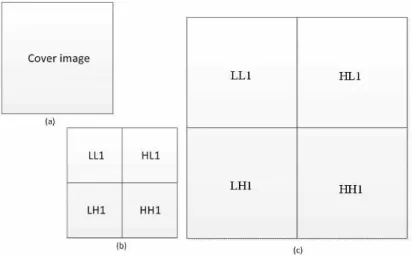
RDWT is similar to DWT but it does not use down-sam- pling, and the dimension of each sub-band by DWT be- comes a quarter of the cover image while the dimension of each sub-band by RDWT is same as the cover image as shown in Fig. 1.
SVD is an effective method to decompose an image into a set of linear independent components. Cover image is de- composed into a diagonal matrix, and two orthogonal ma- trices, and , Generally, the SVD technique can be ap- plied to a whole image or a sub-image. The SVD of an image is defined as Eq. (1)
(1)
where and are orthogonal matrixes, and diag is a diagonal matrix of singular values , , ..,, which are arranged in decreasing order. ′s and ′s are called left and right singular vectors of an image A.
It is observed that SVD decomposes an image into layers of as shown in Fig. 2.
Singular values of represent the image luminance, and increasing will increase the image luminance. Singular
그림 2. SVD에 의하여 분해된 영상 계층
Fig. 2. Decomposed layers of an image by SVD
그림 1. 카버 및 변환 영상의 크기 표현 (a) 카버 영상, (b) DWT 변환 영상, (c) RDWT 변환 영상
Fig. 1. Dimension presentation of cover and transformed images (a) original, (b) DWT transform, (c) RDWT transform
vectors represent the geometric properties of an image, and
contains the structural information of the image as shown in Fig. 3 [11, 12].
Most of the structural information is contained in the first layer . Through the SSIM (Structural Similarity) index which measures the similarity between two images [12], it is observed that the first layer contains most of the structural information. The SSIM index between the origi- nal image (Lena image with 512×512 resolution) and the 1st layer is about 0.5, and it is much bigger than the SSIM index between the original image and any other layer (for examples, 2nd layer is about 0.01).
2. False Positive Problem
The and orthogonal matrices of an original water- mark image are required for the watermark extraction algo- rithm to be combined with the diagonal matrix decom- posed from the received watermarked image. The false pos- itive problem originates from this step because the singular values are so stable that any change to image intensity can- not affect much to the singular values themselves. Moreover, the singular values of different images are quite similar to
each other, and attackers may use the diagonal matrix de- composed from the watermarked image to combine with their fake orthogonal matrices and to retrieve the watermark image. As a result, attackers can extract their fake watermark image successfully, and it can be a prob- lem for the copyright protection application.
Ⅲ. The proposed scheme 1. Watermark embedding algorithm
The proposed scheme applies 2DWT to the cover image
and RDWT to the watermark image , and then applies SVD to HL2 sub-band and to HL1 sub-band as
SVD
SVD (2) Secondly, it modifies the singular values of by embed- ding watermark directly, and then applies SVD to them as
SVD (3)
(a) (b)
그림 3. 원영상과 (a) 원영상 (b) 구조적 정보,
Fig. 3. Oiginal image and (a) original image (b) structural information
where is a scale factor.
Thirdly, it replaces 1st left and right singular vectors of the cover image with the corresponding vectors decom- posed from the watermark image as
and
(4)
where,
⋯
⋯
⋯
⋯
Finally, it obtains the modified DWT coefficients by
′
and it finds the watermarked image
by applying to the 2DWT of a cover image replaced with ′.
2. Watermark extraction algorithm
The proposed scheme applies 2DWT to the received wa-
termarked image , and then applies SVD to 2HL sub-band using (5). If we define as (6), the extracted watermark is obtained using (7).
SVD (5)
(6)
(7)
To overcome the false-positive problem, it is necessary to calculate and compare the correlation values between
and
, and between
and
.
Ⅳ. Simulation and results
The proposed scheme uses ‘Lena’ gray scale image with a 512×512 resolution as a cover image, and a watermark image, ‘Cameraman’, with a 128×128 resolution is em- bedded into the cover image by adjusting the scale factor to 0.005 to have a PSNR of 45.46 dB as shown in Figure 4.
(a) (b) (c)
그림 4. (a) 카버 영상 (b) 워트마크 영상 (c) 워트마크가 포함된 영상 (PSNR=45.46 dB) Fig. 4. (a) Cover image (b) Watermark image (c) Watermarked image (PSNR=45.46 dB)
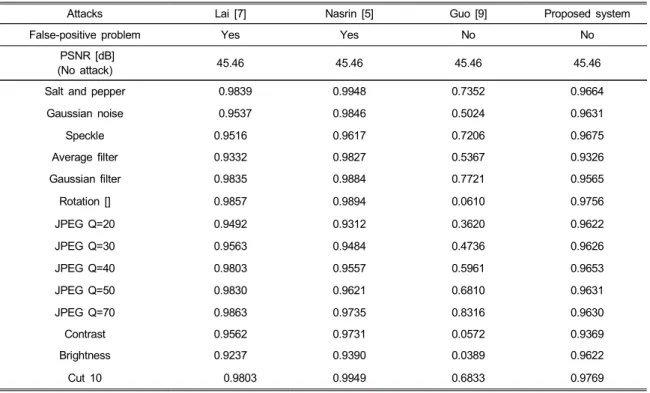
The watermarked image was tested against several at- tacks: salt and pepper noise (noise density = 0.001), Gaussian noise (=0, =0.005), speckle noise (noise den- sity = 0.001), average filter (3×3), Gaussian filter (3×3), rotation (45°), JPEG compression (Q=50, 70), brightness, contrast and cut (10 pixels for left side). In Table 1, we compared our scheme with Lai’s, Nasrin’s and Guo’s schemes at the same fidelity (PSNR = 45.46 dB).
Lai’s scheme uses DWT/SVD and Nasrin’s scheme uses RDWT/SVD, and their scheme shows a little better robust- ness than the proposed system but they have a false-pos- itive problem. The proposed system replaces the leftmost singular vectors of the unitary matrices of cover image with the ones of watermark image, but the replacement is lim- ited only to the HL2 sub-band of cover image and its ef- fects to fidelity and robustness are not critical. Therefore the proposed system can maintain high fidelity and strong robustness. Guo’s scheme has no false positive problem,
but robustness is much worse than the other systems be- cause it embeds principal component of watermark image into the cover image over the LL sub-band.
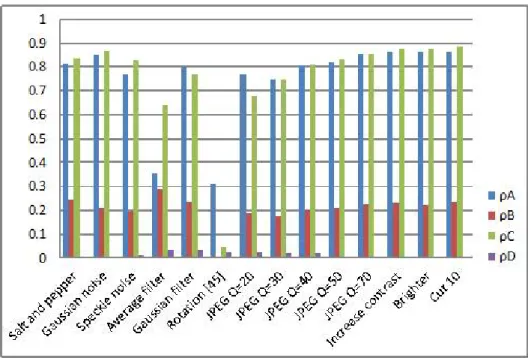
The false-positive problem can be solved by measuring correlation coefficient of the singular vectors of the original and extracted watermarks in our proposed scheme. In Figure 5, we define A as the correlation coefficient be- tween
and
, B as the correlation co- efficient between
and
, c as the correla- tion coefficient between
and
, and D as the correlation coefficient between
and
. When a fake watermark is used to verify ownership (or to calculate correlation coefficient), is used as a sub- scription instead of like
and
. The true watermark is used to compute A and C, but a fake watermark is used to compute B and D.
Figure 5 illustrates that A and C obtained by using a
Attacks Lai [7] Nasrin [5] Guo [9] Proposed system
False-positive problem Yes Yes No No
PSNR [dB]
(No attack) 45.46 45.46 45.46 45.46
Salt and pepper 0.9839 0.9948 0.7352 0.9664
Gaussian noise 0.9537 0.9846 0.5024 0.9631
Speckle 0.9516 0.9617 0.7206 0.9675
Average filter 0.9332 0.9827 0.5367 0.9326
Gaussian filter 0.9835 0.9884 0.7721 0.9565
Rotation [] 0.9857 0.9894 0.0610 0.9756
JPEG Q=20 0.9492 0.9312 0.3620 0.9622
JPEG Q=30 0.9563 0.9484 0.4736 0.9626
JPEG Q=40 0.9803 0.9557 0.5961 0.9653
JPEG Q=50 0.9830 0.9621 0.6810 0.9631
JPEG Q=70 0.9863 0.9735 0.8316 0.9630
Contrast 0.9562 0.9731 0.0572 0.9369
Brightness 0.9237 0.9390 0.0389 0.9622
Cut 10 0.9803 0.9949 0.6833 0.9769
표 1. 제안 방안과 기존 방안간의 충실도 및 강인성의 비교
Table 1. Fidelity and robustness comparison of the proposed scheme with previous schemes
true watermark are much bigger than B and D obtained by using a fake watermark. If we choose max(A,C) as an additional measure to verify ownership, the false posi- tive problem can be solved. The proposed scheme shows strong robustness to most of attacks, except the rotation at- tack because the singular vector has most of geometric information.
Ⅴ. Conclusion
This paper proposed a false-positive-free watermarking scheme based on DWT/RDWT/SVD for the copyright pro- tection application. Cover and watermark images are trans- formed by 2DWT and RDWT separately, and SVD is ap- plied to a sub-band of each image. The diagonal matrix from cover image is embedded with watermark image di- rectly, and the components of the leftmost singular vectors
of and of cover image are replaced with the ones of watermark image to overcome the false positive problems, which exist in watermark system using SVD. The proposed method gives higher robustness than previous false-pos- itive-free system, and competitive robustness compared with SVD-based systems having a false positive problem.
참 고 문 헌 (References)
[1] C. H. Huang, Ja-Ling. Wu, “Attacking Visible Watermarking Schemes,” IEEE Transactions on Multimedia, vol. 6, no. 1, February 2004.
[2] P. Dong, J. G. Brankov, N. P. Galatsanos, Y. Yang, F. Davoine,
“Digital Watermarking Robust to Geometric Distortions”, IEEE Transactions on Image Processing, vol.14, no.12, December 2005.
[3] C. H. Huang, S. C. Chuang, J. L. Wu, “Digital-Invisible-Ink Data Hiding Based on Spread-Spectrum and Quantization Techniques”, IEEE Transactions on Multimedia, vol.10, no.4, June 2008.
[4] M. Alghoniemy, H. Tewfik, “Geometric Invariance in Image Watermarking,” IEEE Transactions on image processing, vol.13, no.2, February 2004.
[5] Nasrin M. Makbol, Bee Ee Khoo, “Robust Blind image watermarking 그림 5. 다수 공격에 대한 추출 워트마크와 원(또는 위조) 워트마크의 특이벡터간의 상관계수값
Fig. 5. The correlation coefficient values of singular vectors of extracted watermark and original (or fake) watermark for several attacks
scheme bases on Redundant Discrete Wavelet Transform and Singular Value Decomposition”, International Journal of Electronics and Communications (AEU), vol. 67, issue 2, February 2013, pp. 102-112.
[6] Saeed Rastegar, Fateme Namazi, Khashayar Yaghmaie, Amir Aliabadian, “ Hybrid Watermarking Algorithm Based on Singular Value Decomposition and Radon Transform”, International Journal of Electronics and Communications (AEU), vol. 65, issue 7, July 2011, pp. 658-663.
[7] Chih-Chin Lai, Cheng-Chih Tsai, “Digital Image Watermarking Using Discrete Wavelet Transform and Singular Value Decomposition”, IEEE Transactions on Instrumentation and Measurement, vol. 59, no.11, Nov. 2010.
[8] Sushma G. Kejgir, Manesh Kokare, “Lifting Wavelet Transform with Singular Value Decomposition for Robust Digital Image Watermark-
ing”, International Journal of Computer Applications (0975-887), vol.
39, no. 18, Feb. 2012, pp. 10-18.
[9] J.M. Guo, H. Prasetyo, “False-positive-free SVD-based image water- marking”, Journal of Visual Communication and Image Representa- tion, vol. 25, Issue 5, July 2014, pp. 1149-1163.
[10] A.K. Gupta, M.S. Raval, “A Robust and Secure Watermarking Scheme Based on Singular Values Replacement”, Sadhana, vol.37, part 4, August 2012, pp 425-440, Springer Verlag.
[11] R. Wang, Y. Z. Cui, Y. Yuan, “Image quality assessment using full-pa- rameter singular value decomposition”, Optical Engineering, vol. 50, issue 5 (057005), May 2011.
[12] M. Narwaria, W. Lin, “Scalable Image Quality Assessment Based on Structural Vectors,” IEEE International Workshop on Multimedia Signal Processing (MMSP ’09), Oct. 5-7, 2009, Rio de Janeiro, Brazil.
저 자 소 개
융 녹 투이 덩 (Luong Ngoc Thuy Dung)
- 2009년 8월 : BSEE, The Posts and Telecommunications Institute of Technology, Viet Nam - 2010년 2월 : Kyung Hee University, MS in Dept. of Electronics and Radios Engineering
- 2012년 8월 ~ 현재 : Kyung Hee University, Ph.D. candidate in Dept. of Electronics and Radio Engineering - ORCID : http://orcid.org/0000-0002-4961-448X
- 주관심분야 : Satellite Communications, Digital Signal Processing, Image Processing
손 원
- 1982년 2월 : BSEE, Kyung Pook National University - 1982년 ~ 1987년 : R&D engineer, ADD
- 1990년:MSEE, Texas A&M University - 1993년 : Ph.D., Texas A&M University - 1993년 ~ 1999년:senior R&D engineer, ETRI
- 1999년 ~ 현재:Professor, Dept. of Electronics and Radio Engineering, Kyung Hee University - ORCID : http://orcid.org/0000-0001-9731-3107
- 주관심분야 : Satellite Broadcast/Communication Systems, Signal Processing