2012 년도 한국멀티미디어학회 춘계학술발표대회 논문집 제 15 권 1 호
- 340 -
3 차원 집적영상에서의 요소영상 압축을 위한 DCT 및 DWT 성능분석
인바라산무니라흐, 문인규*조선대학교 컴퓨터공학부
*corresponding author: [email protected]
Performance Analysis of Compression Techniques Using DCT and DWT on
Elemental Images in 3D Integral Imaging
Inbarasan Muniraj, Inkyu Moon
School of Computer Engineering, Chosun University
Abstract
Integral Imaging (II) is an attractive technique for three-dimensional (3D) image, video display and recording. Inherently, the high resolution II requires an enormous amount of data for storing and transmitting of 3D scenes. Compression techniques attempt to evade this issue. In this study, we made a comparative performance analysis of popular transforming/compression techniques such as the Discrete Cosine Transform (DCT) and the Discrete Wavelet Transform (DWT) in order to compress 3D-II. The standard baseline JPEG (Joint Photographic Experts Group) using DCT and JPEG 2000 using DWT methods were manipulated in our experiments. In our analysis, we have shown that the DWT based JPEG 2000 compression methodology could be a good alternative for 3D-II.
1. Introduction
Integral imaging (II) system was first invented by G. Lippmann in 1908. Later, it has been a vigorous research field as a promising technique for future 3D TV [1]. Generally, the II exist some redundancies between neighboring pixels. Additionally, to display 3D image with adequate resolution and precise depth it demands enormous amount of data. Transformation techniques can address this issue by discarding those redundancies. Thus, the compulsion for compression encountered. In this study, we made a comparative performance analysis between the standard transform techniques such as the DCT and the DWT. Experimental results are shown using the JPEG using DCT and the JPEG 2000 using DWT. In our analysis, it is shown that the DWT can compress 3D-II with better compression efficiency and with better PSNR.
2. Principles of Integral Imaging
The pickup and reconstruction are the core process of the II system for acquisition and visualization of 3D objects [1]. In the pickup process, the light rays emitted or reflected from the 3D object are captured through an array of micro convex lenses or pinholes and then it recorded by a conventional 2D image sensor such as charged couple device (CCD) in the form of
elemental image (EI), which representing different perspectives of the 3D object. Whereas in the reconstruction process, the recorded EIs are displayed on a display panel such as the liquid crystal display (LCD), and then a 3D object image can be optically reconstructed and observed through a lenslet array. The size of II data set can be colossal, especially with the full color components. Therefore, it has become a critical issue to handle such a large data for storing on a media device or transmitting in real time. Thus, the necessity arises for II compression.
3. How DCT compress an Image
An orthogonal transformation is defined to map the spatial (correlated) data into transformed (uncorrelated) coefficients. So, the redundancies between neighboring pixels can be removed. Similarly, the discrete cosine transform (DCT) [2] transforms an image from its spatial domain into frequency domain. Literally, the lower frequencies have rich information than the higher frequencies. So, if we transform an image into its frequency domain and throw away the higher frequency coefficients, eventually we can reduce the amount of data needed to represent an image and most importantly without much degradation in the image quality.
2012 년도 한국멀티미디어학회 춘계학술발표대회 논문집 제 15 권 1 호
- 341 - The two-dimensional (2D) DCT (2D-DCT) and inverse two-dimensional DCT (2D-IDCT) for an image f(x, y) are shown in equations (1) and (2) respectively. 1 1 0 0 (2 1) (2 1) ( , ) ( ) ( ) ( , ) cos cos . 2 2 N N x y x u y v T u v u v f x y N N p p a a - -= = + + é ù é ù = ê ú ê ú ë û ë û
åå
(1) where u, v = 0, 1, 2,…,N-1; the first transform coefficient is the average value of the input sample sequence. In literatures, this value is referred to as DC coefficient and all the other transformed coefficients are known to ACcoefficients. 1 1 0 0 (2 1) (2 1) ( , ) ( , ) cos cos . 2 2 N N u v u v x u y v f x y T u v N N p p a a - -= = + + é ù é ù = ê ú ê ú ë û ë û
åå
(2) where x, y = 0,1,2,…,N-1; α(u) is defined inequation (3) and α(v) value is same as α(u). 1 , 0 ( ) 2 , 0 u N u u N a ì = ï ï = í ï ¹ ï î (3) Furthermore, the DCT exhibits good decorrelation properties. The DCT provided almost good energy compaction in the transformed lower frequency domain. But, DCT produces blocking artifacts at the lower bit rate.
4. How DWT compress an Image
The DCT is blocked transformation which decorrelates the image pixels by blocks. This transformation is not cautious about the correlation across the block boundaries. The Wavelet transform [3] is a multi-scale signal analysis method, which overcomes the weakness of fixed resolution in Fourier transform. The basis functions ψr,s(x) are the translations and
dilations functions of mother wavelet called ψ(x). The 2D forward DWT function can be defined as, 0 1 1 0 , , 0 0 1 ( , , ) ( , ) ( , ). M N j m n x y W j m n f x y x y MN j j - -= = =
å å
(4) 1 1 , , 0 0 1 ( , , ) ( , ) ( , ). M N i i j m n x y W j m n f x y x y MN y y - -= = =å å
(5) Where, i = {H, V, D} and j0 is an arbitrarystarting scale and Wφ(j0,m,n) coefficients
defining an approximation of f(x ,y) at scale j0
the ( , , )
i
Wy j m n coefficients are horizontal,
vertical, and diagonal details for scales j≥j0.
Using (4) and (5) together the inverse two dimensional discrete wavelet transform can be derived as follows: 0 0, , 1 ( , ) ( , , ) j m n( , ) m n f x y W j m n x y MN j j =
åå
0 , , , , 1 ( , , ) ( , ). i i j m n i H V D j j m n W j m n x y MN y ¥ = = +å å åå
Y (6) The wavelets are localized in frequency/scale and also in time. This localization offers an advantage, since fewer wavelet basis functions are usually needed to represent the signal f(x)to a given level of approximation. This property is of great importance in the compression of the image.
5. JPEG versus JPEG 2000
JPEG 2000 has shown plenty of advantages over JPEG [4]. The main features of the JPEG 2000 standards are: superior low bit rate performance, continuous-tone and bi-level compression, progressive transmission by pixel accuracy and resolution, lossy and lossless compression, random code stream access and processing, robustness to bit errors.
(a)
(b)
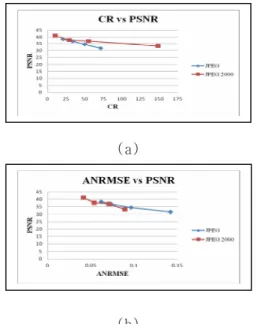
Fig. 1. (a) CR versus PSNR (b) ANRMSE versus PSNR 6. Experiments and results
In our experiments we have taken two hundred and fifty six (16×16=256) EI’s. The resolution of each EI was 756×1136 pixels and they were recorded in JPG format. In order to show the prominent comparison between DCT and DWT on II coding, we made few changes in the DCT based JPEG’s standard normalization array and in the quantization values of DWT based JPEG 2000. Figure 1 shows the comparison results between compression ratio (CR) and PSNR. In addition, we used the average normalized RMSE (ANRMSE) [5] to find the normalized error between compressed and uncompressed II.
2012 년도 한국멀티미디어학회 춘계학술발표대회 논문집 제 15 권 1 호
- 342 - 7. Conclusion
In this paper, we have carried out a comparative performance analysis of DCT and DWT coding techniques on Integral Image. Results show that the DWT can compress II in efficient way. We conclude with an acknowledgment the main factors in image compression are quantizer and entropy coder rather than the difference between the DWT and the DCT.
References
[1] A. Stern, B. Javidi, “Three dimensional sensing, visualization, and processing using integral imaging,” Proc. IEEE, vol. 94, Special Issue on 3-D Technologies for Imaging and Display, no. 3, pp. 591– 607, 2006.
[2] T.Ahmed, T. Natarajan, K. R. Rao, “Discrete cosine transform”, IEEE Trans. Comm., C-23, 90-93, 1974.
[3] J.Schmeelk, “Wavelet Transforms on Two-Dimensional Images”, Mathematical and computer Modelling 36, 939-948, 2002.
[4] K.M. Au, N.F. Law, and W.C. Siu, “Unified feature analysis in JPEG and JPEG 2000-compressed domains”, Pattern Recognition 40, 2049-2062, 2007.
[5] C.M. Do, and B. Javidi, “3D Integral Imaging Reconstruction of Occluded Objects Using Independent Component Analysis-Based K-Means Clustering”, Journal of display technology, Vol. 6, No. 7, 2010.