119
무선센서네트워크를 위한 신호 에너지 기반 사이클로스테이셔너리 스펙트럼 검출
Quoc Kien Nguyen*, 전태현* 정회원
Signal Energy-based Cyclostationary Spectrum Sensing for Wireless Sensor Networks
Quoc Kien Nguyen*, Taehyun Jeon* Regular Member
요 약
특징 검출 기법은 원하는 신호에 대한 부분적인 정보가 수신단에 알려진 상황에서 정확도 높은 검출이 가능한 기법으로 알려져 있다.
이러한 방식의 검출 기법은 잡음이 강한 환경을 위해 제안되었다. 사이클로스테이셔너리 검출은 인지 무선 시스템에서 스펙트럼 검출 기법의 하나의 예이다. 그러나 이 기법은 원하는 신호에 대한 많은 양의 정보와 처리 시간을 요구한다. 반면, 에너지 검출 기반 의 스펙트럼 검출은 단순한 기법으로 널리 알려져 있다. 그러나 에너지 검출은 잡음의 영향을 많이 받으며 이로 인한 검출 오류가 많이 발생하게 된다. 본 논문에서는 에너지와 사이클로스테이셔너리 기반의 기법을 결합하여 검출의 정확도를 높이는 한편 계산량 과 처리 시간을 감소시키는 기법을 제안한다. 2단계의 문턱값을 이용하여 사이클로스테이셔너리 기법의 복잡도와 처리시간을 단축 하여 시스템의 전송 효율을 증가시킨다. 시뮬레이션 결과 에너지 기반 사이클로스테이셔너리 검출 기법은 신호 검출에 소요되는 시간을 상당히 감소시키는 반면 시스템의 성능을 향상시킴을 보여준다.
Key Words : Cyclostationary detection, radiometric, feature detection, spectrum sensing
ABSTRACT
Feature detection is recognized as an accurate spectrum sensing approach when the information of the desired signal is partly known at the receiver. This type of detection was proposed to overcome large noise environment. Cyclostationary detection is an example of feature detection in spectrum sensing technique in cognitive radio. However, the cyclostationary process calculation requires a lot of processing time and information about the designed signals. On the other hand, energy detection spectrum sensing is widely known as a simple and compact spectrum sensing technique. However, energy detection is highly affected by large noise and lead to high detection error probability. In this paper, the combination of energy detection and cyclostationary is proposed in order to increase the accuracy and decrease the calculation and processing time. The two-layer threshold is utilized in order to reduce the complexity of computation and processing time in cyclostationary which can lead to the improved throughput of the system. The simulation result shows that the implementation of energy-based cyclostationary detector can help to improve the performance of the system while it can considerably reduce the required time for signal detection.
※ 이 연구는 서울과학기술대학교 교내연구비의 지원으로 수행되었음.
*서울과학기술대학교 전기정보공학과, 교신저자: 전태현 ([email protected]) 접수일자 : 2016년 9월 22일, 최종게재확정일자 : 2016년 9월 26일
I. Introduction
Spectrum sensing is deployed widely in wireless communication to detect the presence of the signal [1]. It is popular with non-licensed and licensed bands in order to efficiently share the frequency resource. There are
plenty of approaches of spectrum sensing. Cyclostationary based method is one of the feature detection approaches.
This detection method is a highly accurate approach in which the receiver has a partial information about the desired interference. In real applications, better performance of the system is achieved by considering the modulation 한국위성정보통신학회논문지 제11권 제3호 (K11-3-21)
한국위성정보통신학회논문지 제11권 제3호
120 algorithm, pulse shaping and packet format of the received signal [2]. Furthermore, cyclostationary based scheme is an approach in spectrum sensing that allows to detect the interference from different sources. The cyclostationary detection in cognitive radio is considered to be a solution to improve the energy detector.
However, the cyclostationary based method may take long time for processing a received signal. Furthermore, cyclostationary detection process also needs a lot of computations at the receiver side, therefore we need to consider the cases in which this approach is suitable for application [2-4]. In this paper, we consider an addition of an extra energy-based detection before cyclostationary detection. With this approach, the accuracy and simplicity of the detection can be improved with the combination of energy-based process and cyclostationary. The result of the simulation demonstrates that the energy-based detection process requires significantly less time than that of the conventional cyclostationary detection. The remaining part of this paper is organized as follows. In section II, the description of the system model is presented. The main idea of the energy-based detection is discussed in III.
Simulation scenario and results are shown in IV and V, respectively. Finally, conclusions are given in section VI.
Ⅱ. System Model
A single carrier is utilized to transmit the modulated signal from the transmitter to the receiver. Moreover, channel is assumed to experience the additive Gaussian white noise. The signal, using fixed modulation method, is transmitted over the channel. The mission of the receiver is to detect the presence of the signal in the channel. The receiver has to accurately make decision before the transmitter starts to access the channel and transmit data.
The overall block diagram for the system model is shown in Fig. 1.
Fig. 1. Block diagram of detection procedure.
In this paper, we assume that the channel noise can be calculated at the receiver. The experiment is done for different SNR scenarios, then the probability of detection is compared to the conventional detection approach. In the simulation procedure, the strength of the received signal is calculated first, then it is calculated in frequency domain.
The cyclostationary process is detected by autocorrelation of the received signal with its shifted version.
Ⅲ. Energy-based Threshold Selection
The SNR is assumed to be calculated at the receiver, and the SNR at the receiver has to be higher than a threshold before we start the cyclostationary detection.
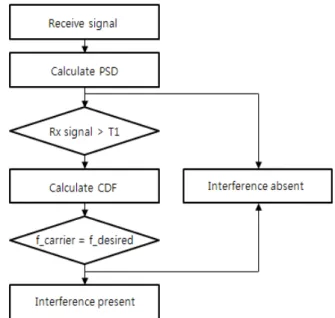
The noise power is assumed to be unchanged during the data communication. If the signal over noise ratio is larger than one, cyclostationary detection will be initiated. The signal energy is first calculated and compared with the threshold. If the received energy is below the threshold, the receiver will decide that there is no signal transmitting over the channel. Otherwise, if the received energy is larger than the threshold, the cyclostationary detection part examines the received signal to confirm that there is the signal in the channel. As a result, the rate of wrong detection and false alarm are decreased. Furthermore, the processing time is also reduced due to the quick decision even when SNR is low. The overall detection process is summarized in Fig. 2.
Fig. 2. Detection procedures with two-layer threshold check.
Signal Energy-based Cyclostationary Spectrum Sensing for Wireless Sensor Networks
121
Ⅳ. Simulation Scenario
The simulation focuses on the performance comparison of cyclostationary and energy-based cyclostationary detection.
The most important part is the processing time for each detection. As the first step, the signal with noise is sent to the receiver and the signal is assumed to be interference. The receiver is supposed to detect the interference and avoid transmitting over the channel. The wrong detection depends on the strength of the noise in the channel. In other words, it may be caused by too much noise at the receiver or when the signal is too weak. The main goal of the simulation is to analyse the effect of high noise on different receivers.
V. Results
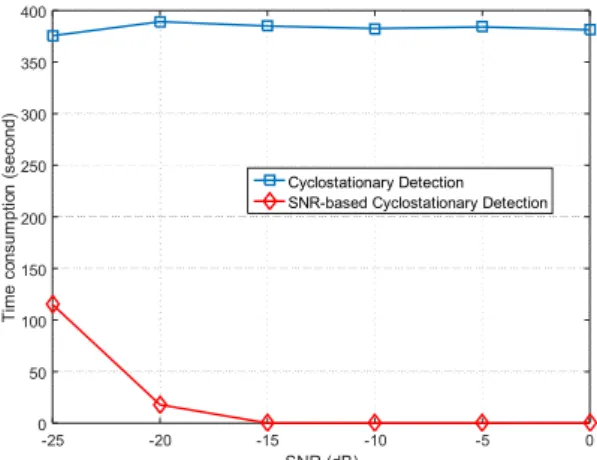
In Fig. 3, the energy-based cyclostationary detection outperforms the cyclostationary with fixed threshold for all SNR ranges. The probability of detection based on SNR provides better detection performance of the detection especially when the SNR is low. In Fig. 4, the required processing time for energy-based and fixed-threshold cyclostationary detection is compared. The energy-based approach takes less time to make decision than the fixed-threshold detection for all cases. In addition, the performance of the detection remains the same even with a bigger noise level environments. Table. 1 describes in detail on how many times the cyclostationary detection is used in order to detect the signal. It can be shown that the energy-based cyclostationary detection requires less calculation process than the cyclostationary detection with large number gap.
SNR (dB)
-25 -20 -15 -10 -5 0
Probability of Detection
0 0.1 0.2 0.3 0.4 0.5 0.6 0.7 0.8 0.9 1
Cyclostationary Detection SNR-based Cyclostationary Detection
Fig. 3. Comparison of detection performance for varying SNR.
SNR (dB)
-25 -20 -15 -10 -5 0
Time consumption (second)
0 50 100 150 200 250 300 350 400
Cyclostationary Detection SNR-based Cyclostationary Detection
Fig. 4. Comparison of probability of detection for varying SNR.
SNR(dB)
Relative processing time Energy-based
Cyclostationary Detection
Conventional Cyclostationary Detection
-25 21 70
-20 3 70
-15 0 70
-10 0 70
-5 0 70
0 0 70
Table 1. Comparison of relative processing time for detection.
VI. Conclusion
The energy-based cyclostationary detection helps to reduce the processing time and maintain the performance of the detector. Simulation results in various scenarios confirm the benefit of the energy-based cyclostationary detection in terms of detection performance and processing time. This detection approach can be deployed in a system with low-cost processor while keeping the accuracy level of the detection procedure.
References
[1] T. Yucek, and H. Arslan, “A Survey of Spectrum Sensing Algorithms for Cognitive Radio Applications,” IEEE Communications Surveys & Tutorials, vol. 11, no. 1, pp.
116-130, 2009.
[2] D. Cabric, S .M. Mishra, and R. W. Brodersen,
“Implementation Issues in Spectrum Sensing for Cognitive Radios,” Conference Record of the Thirty-Eighth Asilomar Conference on Signals, Systems and Computers, vol. 1, pp.
772-776, November, 2004.
[3] Q. K. Nguyen and T. Jeon, “Cyclostationary detection for
한국위성정보통신학회논문지 제11권 제3호
122 channels with low SNR,” International Symposium on Advanced and Applied Convergence (ISAAC 2015), Seoul, Korea, p. 84, November, 2015.
[4] W. Ejaz, N. Hasan, and H. S. Kim, “SNR-Based Adaptive Spectrum Sensing for Cognitive Radio Networks,”
International Journal of Innovative Computing, Information and Control, vol. 8, no. 9, pp. 6095-6105, 2012.
저자
응웬 꽉 끼엔(Quoc Kien Nguyen)
․2008년: Hanoi University of Science and Technology Electronic and Telecommunication Department 졸업 (학사)
․2013년:서울과학기술대학교 전기정
보공학과 졸업(석사)
․2015년 ∼ 현재:서울과학기술대학교 전기정보공학과 재학 (박사)
<관심분야> : Cognitive radio, 5G, Wireless sensor network
전 태 현(Taehyun Jeon) 정회원
․1989년:연세대학교 전기공학과 졸업 (학사)
․1993년:미네소타대학교 전기공학과 대학원 졸업(석사)
․1997년:미네소타대학교 전기공학과 대학원 졸업(박사)
․1997년 ∼ 1998년:Motorola 연구원
․1998년 ∼ 2001년:Texas Instruments 연구원
․2002년 ∼ 2005년:한국전자통신연구원(ETRI) 선임연구원
․2005년 ∼ 현재:서울과학기술대학교 전기정보공학과 교수 <관심분야> : 유무선 통신시스템, 근거리 무선통신, 이동통
신