Growth Characteristics of a Pyruvate Decarboxylase Mutant Strain of Zymomonas mobilis
Xun Zhao
1, Peter L. Rogers
1, Eilhann E. Kwon
2, Sang Chul Jeong
3and Young Jae Jeon
1,4*
1School of Biotechnology and Biomolecular Sciences, The University of New South Wales, Kensington 2052, Australia
2Department of Environment and Energy at Sejong University, Seoul 143-747, Korea
3Freshwater Bioresources Utilization Division, Nakdonggang National Institute of Biological Resources, SangJu-si 37242, Korea
4Department of Microbiology, Pukyong National University, Busan 608-737, Korea
Received August 19, 2015 /Revised September 18, 2015 /Accepted October 13, 2015
Studies of the inactivation of a gene encoding pyruvate decarboxylase, pdc, in an ethanol-producing bacterium, Zymomonas mobilis, identified a mutant strain with 50% reduced PDC activity. To evaluate the possibility of a carbon-flux shift from an ethanol pathway toward higher value fermentation prod- ucts, including pyruvate, succinate, and lactate, fermentation studies were carried out. Despite at- tempts to silence pdc expression in the wild-type strain ZM4 using cat-inserted pdc and pdc-deleted homologs by electroporation, the strain isolated showed partial gene activation. Fermentation experi- ments with the PDC mutant strain showed that the reduced expression level of PDC activity resulted in decreased rates of substrate uptake and ethanol production, together with increased pyruvate accu- mulation of 2.5 g l-
1, although lactate and succinate concentrations were not significantly enhanced in these modified strains. Despite numerous attempts, no strains were isolated in which complete pdc inactivation occurred. This result indicates that the ethanol fermentation pathway of this bacterium is totally dependent on the activity of the PDC enzyme. To ensure a redox balance of intracellular NAD and NADH levels, other enzymes, such as lactate dehydrogenase for lactate, and enzymes in- volved in the production of succinic acid, such as pyruvate dehydrogenase (PDH) and malic enzymes, may be needed for their increased end-product production.
Key words :
Fermentation, gene inactivation, higher value products, pyruvate decarboxylase, Zymomonas mobilis
*Corresponding author
*Tel : +82-51-629-5612, Fax : +82-51-629-5619
*E-mail : [email protected]
This is an Open-Access article distributed under the terms of the Creative Commons Attribution Non-Commercial License (http://creativecommons.org/licenses/by-nc/3.0) which permits unrestricted non-commercial use, distribution, and reproduction in any medium, provided the original work is properly cited.
Journal of Life Science 2015 Vol. 25. No. 11. 1290~1297 DOI : http://dx.doi.org/10.5352/JLS.2015.25.11.1290
Introduction
There is current interest in the facultative anaerobic bacte- rium, Zymomonas mobilis, not only for ethanol production from lignocellulosic materials, but also for its potential for production of higher value chemicals [7, 12, 13, 16, 17, 18].
This results from its higher specific rates of sugar uptake, ethanol production and lower biomass yields when com- pared to yeasts or other ethanologenic bacteria [4, 19, 26].
Furthermore, the successful genetic engineering of Z. mobilis has become more feasible following characterization of its DNA restriction and modification system [10], its improved genome annotation [28] and genome-scale in silico analysis
[12, 27] based on the earlier publication of the genome of Z. mobilis ZM4 by Seo et al. [22].
Pyruvate, succinic and lactic acids are potential target chemicals that might be produced via the successful meta- bolic engineering of Z. mobilis, as they are industrially im- portant intermediates in the food, pharmaceutical and plas- tics industries. Wild-type strains of Z. mobilis produce very small amounts of these organic acids [9, 29] as glucose taken up via the Entner-Doudoroff (ED) pathway, or xylose metab- olized via a modified pentose phosphate pathway, is usually rapidly and efficiently converted into ethanol.
Pyruvate decarboxylase (PDC) is a member of a large fam- ily of enzymes that catalyze the decarboxylation of pyruvate producing CO
2and acetaldehyde. The latter is subsequently reduced by alcohol dehydrogenase to ethanol as the major end product of Z. mobilis fermentation [2]. It comprises upto 4-6% of soluble cell protein in Z. mobilis [15] and influences upto 95% of the carbon metabolites through its activity.
Other authors have reported on high expression level of pyr-
uvate decarboxylase (PDC) in Z. mobilis as well as its high
substrate affinity for pyruvate [2]. Through the reduced PDC
activity in this ethanologen, it may be possible to redirect significant carbon flux from ethanol and towards several higher value metabolites.
Here, we report the growth characteristics of such mutant strains with modified PDC activities on Z. mobilis, including its effect on ethanol production and related fermentation products.
Materials and Methods
Microbial strains and plasmids
The bacterial strains used were Zymomonas mobilis ZM4 (ATCC31821), E. coli strain BL21 (DE3) pLysS (Invitrogen) and JM109. Z. mobilis cultures were incubated at 30
oC in RM medium [5] without shaking. When appropriate, chlor- amphenicol and/or tetracycline were added at 100 μg ml
-1and/or 20 μg ml
-1, respectively to isolate PDC mutant strains of Z. mobilis. The plasmids used were pNSW812 (a suicide plasmid harboring a homolog of pdc insertionally inactivated by a cat gene encoding chloramphenicol acetyltransferase) and pNSW813 (a suicide plasmid harbouring a pdc-deleted homolog replaced with tet gene coding for tetracycline resist- ance) derived with the pGEM-T Easy vector (Promega, Madison, USA).
Strain constructions
Genomic DNA was isolated from Z. mobilis cultures using a Puregene
®genomic DNA isolation kit (Qiagen, USA).
In the first method for inactivation of PDC expression in Z. mobilis, insertional inactivation of pdc was carried out by introduction of the gene encoding chloramphenicol acetyl- transferase (cat) via homologous recombination. PCR pri- mers used for the cloning of pdc were pdcF (5’ ATGAGTT- ATACTGTCGGTAC 3’) and pdcR (5’ CTAGAGGAGCTTGT- TAACAG 3’). PCR primers used for cat cloning were catFncoI (5’CCATGGTTGCTTTCGAATTTCTGCCATTC3’) and catRncoI (5’CCATGGTGACGGAAGATCACTTCGCAG 3’) with NcoI restriction recognition sequence included at the 5’ ends of the each primer. In this procedure, an 1,800 base pair (bp) fragment of pdc was isolated from the chromosome of Z. mobilis ZM4 by PCR using the pdcF and pdcR primers.
The PCR product was cloned into pGEM
®T-Easy via T/A cloning. To construct the pdc-disrupted gene, the 1,800 bp pdc gene in the pGEM T-Easy plasmid was cleaved by NcoI.
The cleaved pdc fragment was ligated with a 1 kb-cat NcoI fragment from PCR using the catFncoI and catRncoI primers
and was derived from the plasmid pLys S (Novogen, Co., USA). The constructed plasmid for insertion inactivation of pdc was named pNSW812.
The other suicide vector, pNSW813 with a pdc deleted ho- molog, was also constructed by means of a deletion-in- activation strategy. For the construction of the gene deletion homolog, the PCR primers pdcHomFor (5’GTCGGATAGG- AAGTATAGCGAGG3’) and pdcHomRev (5’GATCCGGTA- TGTTCTTGCTTT3’) were used. For cat cloning, the PCR primers catFor (5’ GTTAACTTGCTTTCGAATTTCTGCCAT- TC3’) and catRev (5’ GGTACCTGACGGAAGATCACTTCG- CAG3’) were used. A 3811 base pair-DNA homolog frag- ment including the pdc gene together with each of the 5’
and 3’ ends of the pdc flanking regions, was amplified by PCR from ZM4 genomic DNA using the pdcHomFor and pdcHomRev primers, and the amplicon was cloned into the pGEM-T Easy vector. KpnI and HpaI were used to delete the pdc gene from the intermediate plasmid and the KpnI/HpaI cleaved plasmid was subsequently ligated together with the KpnI/HpaI cleaved cat gene cassette amplified from pdc-cat.
Consequently in the constructed plasmid, pNSW813, the marker cat gene was substituted with pdc and was linked to a 1 kb pdc homologous flanking region.
Electroporation was performed according to methods de- scribed by Kerr et al. [10] to disrupt pdc with these two sui- cide vectors. DNA manipulation techniques were performed as described by Sambrook et al. [20].
Confirmation for pdc gene inactivation
Recombinant colonies isolated after electroporation were
subsequently purified three times on RM plates containing
100 μg chloramphenicol ml
-1at 30
oC to avoid contamination
with the background cells prior to the genotyping assay with
PCR. Individual colonies were cultured on RM broth con-
taining the selective concentrations of antibiotics at 30
oC
overnight and genomic DNA extracted from these cultures
were used as a template for PCR analysis. For confirmation
of insertional inactivation of pdc, PCR analysis was carried
out using a primer set of pdcUPGF(5’AGCTGTCATTTATG-
TTTCAATAAGAC3’) and pdcDWGR (5’CAGAAGAGGTT-
CATCATGAACA3’) which hybridize outside the homolo-
gous region in the genome of mutant strains not present
in the pNSW812 vector. For confirmation of deletion in-
activation of pdc, PCR analysis was carried out using a pri-
mer set of pdc5cFor (5’GCGTCAGGTCATTACGAAAA3’)
and pdc6cRev (5’TTGAAGCCTAAATAACAGACTCAAA
3’). Percent similarity and identity of DNA sequences of pdc found in ZM4812 and ZM4813 were determined using Basic Local Alignment Search Tool (BLAST) from the National Centre for Biotechnology Information (NCBI, NIH).
Measurement of PDC activity
Cells of Z. mobilis were harvested in the exponential phase of growth (0.8~1.0 OD
660nm). The harvested cells were re- suspended in lysis buffer containing 30 mM sodium citrate buffer (pH= 6.0), 20 mM MgCl
2and 1.5 mM thiamine pyrophosphate. The resuspended cells were then lysed using 0.5 g of 0.15 mm glass-beads by vortexing for 1 min followed by incubation for 1 min on ice. This cycle was repeated 5 times to achieve effective cell lysis. The crude cell extract was separated by centrifugation at 4
oC, 16,000× g for 5 min.
The extracted supernatant was collected for subsequent en- zymatic assay and total protein determination. Determina- tion of pyruvate decarboxylase activity was performed using previously reported methods [23]. The enzymatic assay for PDC (EC: 4.1.1.1) activity was based on the principle of cou- pling the decarboxylation reaction with an alcohol de- hydrogenase-mediated reaction and monitoring a decrease of NADH at a wavelength of 340 nm. One unit of enzyme activity is defined as the formation of 1µmol of acetaldehyde per min. The protein concentrations of the cell free crude extracts were quantified according to Smith et al. [24] with bovine serum albumin (Promega, U.S.A) as a standard reference.
Fermentation studies
Fermentation studies were carried out using medium composed of 50 g glucose l
-1, 5 g yeast extract l
-1, 2 g KH
2PO
4l
-1, 2 g (NH4)
2SO
4l
-1, and 1 g MgSO
4· 7H
2O l
-1as described previously by Jeon et al., [8]. Seed cultures were prepared in10ml of medium containing 20 g glucose l
-1, 10 g yeast extract l
-1, 2 g KH
2PO
4l
-1, 2 g (NH4)
2SO
4l
-1, 1 g MgSO
4· 7H
2O l
-1. When an optical density of A
660= 1.0 was reached, a 10%(v/v) aliquot of the seed culture was used for inoculation. Fermentations were carried out in 200 ml Erlenmeyer flasks with working volumes of 100 ml and per- formed at 30
oC and an initial pH 5.0, without agitation.
Samples were taken at various times to determine biomass, as well as glucose, pyruvate, lactate, succinate and ethanol concentrations.
Analytical procedures
Samples taken from fermentation flasks were analyzed for glucose, ethanol, pyruvate, succinate and lactate concen- trations by HPLC using an Aminex column HPX-87H (300
×7.8) (Bio-Rad, Richmond, CA) equipped with a refractive index detector and a computer interfaced electronic in- tegrator. Separations were performed at 50
oC with elution at 0.6 ml min
-1using 5 mM H
2SO
4.Growth was measured turbidometrically at 660 nm (1 cm light path). Dry cell mass was determined by conversion of optical density values at 660 nm to dry cell weight concentrations using a conversion constant for ZM4 (OD
660 nm0.05= 15 mg l
-1) [11]. Standards containing analytical grade components were used periodi- cally to confirm the calibration accuracy for the HPLC analyses. The concentration of succinic acid was checked with an enzymatic assay from a commercial kit (Megazyme, Ireland) according to the Manufacturer’s Instructions.
Calculation of kinetic parameters
The maximum specific growth rates were calculated from the exponential phase. The maximum specific glucose up- take rates (q
s max,glucose) and maximum specific ethanol pro- duction rates (q
pmax,) were calculated over the exponential phase of growth and based on the following formulae:
q
smax,glucose= (1/x
av) (∆s/Δt) and q
pmax,= (1/x
av) (Δp/Δt), where ∆s and ∆p are the changes in the glucose and etha- nol concentrations respectively, over the time period Δt, and x
avis the average biomass concentration over Δt, where x, s and p are the concentrations of biomass, glucose and etha- nol respectively.
The overall yields for biomass (Y
x/s) and ethanol (Y
p/s) were based on the initial and final concentrations of biomass, glucose and ethanol.
Results
Strain construction for PDC inactivation Insertion inactivation
The DNA of pNSW812 was transferred into ZM4 via elec-
troporation to facilitate a homologous recombination event
between the homologous regions in pNSW812 and its com-
plementary region in the ZM4 genome. The construction
strategy is shown in Fig. 1(A) and the strain isolated with
this strategy was designated as ZM4812. Chloramphenicol
resistant colonies were selected on RM agar plates contain-
ing 100 μg choramphenicol ml
-1. Genomic DNA extraction
A
B
Fig. 1. Insertional inactivation of pdc in Z. mobilis ZM4. A:
Schematic diagram of the insertional inactivation strat- egy for pdc in ZM4 by introduction of cat gene. B: PCR analysis for insertional inactivation for pdc using ge- nomic DNA of ZM4812 with the primer set pdcugF and pdcdwgR . Lane 1, DNA size marker (Fermentas 1 kb Gene Ruler); lane 2, ZM4812-1, lane 3, ZM4812-2; lane 4, ZM4812-3, lane 5, ZM4 wild type.
A
B
Fig. 2. Deletion inactivation of pdc in Z. mobilis ZM4. A:
Schematic diagram of the deletion inactivation strategy for pdc in ZM4 by replacement of cat gene. B: PCR anal- ysis for deletion inactivation for pdc using genomic DNA of ZM4813 with the primer set pdc5cFor and pdc6cRev. Lane 1, DNA size marker (Fermentas 1kb Gene Ruler); lane 2, ZM4 the wild type l strain, lane 3, ZM4813-1; lane 4, ZM4813-2.
from the selected strains and from ZM4 as a control was carried out to determine whether or not successful gene in- activation had occurred. For confirmation, PCR analysis was carried out using a primer set of pdcUPGR and pdcDWGR which targeted the outside homologous region on the ge- nome of ZM4812 which was not present in the pNSW812 vector. The genotyping experiment identified a DNA frag- ment of approximately 1.8 kb in size in the parent strain ZM4, while in ZM4812 an additional band of 2.9 kb was present (see lanes 2-4 for ZM4812-1, 2, and -3 in Fig. 1(B)).
DNA sequencing analysis was carried out with the two PCR products derived from the constructed strain. The results in- dicated that cat was present in the 2.9 kb DNA band as expected. The confirmed that successful insertion of the marker cat from pNSW812 had occurred via homologous recombination into the native pdc of the ZM4 genome.
Unexpectedly however, a copy of an intact pdc gene, identi- fied for the 1.8 kb fragment, still remained in ZM4812 (see Fig. 1 (B)). The sequence of this residual pdc in ZM44812
was compared with the previously reported pdc sequence for ZM4 [22], and its sequence similarity at nucleotide level was 100% to that for ZM4.
Deletion inactivation
The strategy for deletion inactivation is shown in Fig. 2A.
The DNA of pNSW813 was transferred into ZM4 with a sim-
ilar manner for ZM4812 and form this experiment the strains
of ZM4813-1 and -2 were isolated. Genotypic analysis for
the knockout strains was carried out with a primer set of
pdc5cForand pdc6cRev. For the chloramphenicol resistant
colonies derived from letter strategy, the same procedure
was followed for their genotype confirmation using a primer
setpdc5cFor and pdc6cRev. A PCR product of approximately
Fig. 3. Comparison of the PDC activity of the parental strain ZM4, the mutant strain ZM4812 (PDC insertional in- activation) and the mutant strain ZM4813 (PDC deletion inactivation). Data is average of three sets of analyses each carried out in duplicate. The error bars show stand- ard deviations.
Table 1. Kinetic analysis of parent ZM4 and PDC mutant strains
Kinetic parameters Strains
ZM4812 ZM4813 ZM4
Maximum specific growth rate
max (hr-1)Maximum specific glucose uptake rate qsmax, glucose (g g-1 hr-1) Maximum specific EtOH rate qpmax (g g-1 hr-1)
Yx/s (g g-1) Yp/s EtOH (g g-1)
0.23a 6.6 2.7 0.025
0.43
0.24a 6.3 2.7 0.0027
0.43
0.48 9.7 4.5 0.036
0.48
aValues are averages from duplicate experiments for both ZM4812, ZM4813 and the wild type strain ZM4. The results from the kinetic analysis of ZM4813 were very similar to those for ZM4812.
3.8 kb in size appeared in the parent strain ZM4 (Fig. 2B, lane 2), while ZM4813 also similar results as appeared in ZM4812 were found, two bands with sizes of approximately 3.8 kb and 3.1 kb, respectively were observed (Fig. 2B).
Similar results to those for ZM4812 were found with both a deleted pdc and an intact pdc present in ZM4813. The se- quence of this extant pdc in ZM4813 was compared with the native pdc sequence for ZM4 and 100% similariy at nu- cleotide levels was confirmed . and the wild-type pdc gene (Fig. 2B, lane 3 and 4, upper band, 3.8 kb). The results were similar to those for ZM4812 showing both a deleted pdc and another copy of intact pdc in the genome.
As a further investigation, we attemped to inactivate the existing intact pdc in ZM4813 by introducing another homo- logues this time containing a tetracycline resistance gene as the selection maker. However, no transformants expression both tetracycline and chloramphenicol resistance were found following repeated attempts.
Inactivation of the second intact pdc gene present in strain ZM4813was also attempted by introducing another pdc homolog. However, no transformants were generated.
Pyruvate decarboxylase (PDC) activity on the constructed strains
As genotype analyses for the mutant strains showed in- activation of pdc in both ZM4812 and ZM4813, their PDC activities were determined for comparison with that of the parent ZM4 strain. As shown in Fig. 3, the specific PDC ac- tivities of both ZM4812 and ZM4813 were both approx- imately 50% less than that of ZM4, with values of 1.1 and 1.2 U mg total protein
-1compared to 2.1 U mg total protein
-1
for the parent strain. The partial PDC inactivation was maintained by the presence of 100 μg chloramphenicol ml
-1. However, it was found after growth on the RM medium in the absence of chloramphenicol for 24 generations that the PDC activities of both strains increased to approximately
2.0 U mg total protein
-1, approximately the same as for ZM4 grown under same conditions.
Fermentation studies
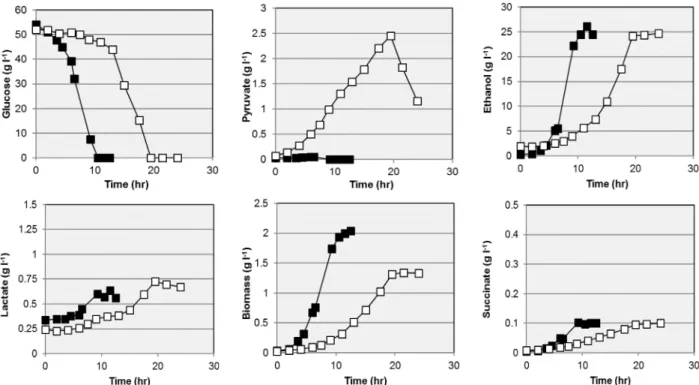
Fermentation studies with ZM4813 and ZM4 as a control were carried out with the medium containing 50 g glucose l
-1as described previously. The medium also contained 100 μg chloramphenicol ml
-1for strain stability. As shown in Fig.
4, ZM4813 required approximately twice the time to fully utilize 50 g glucose l
-1compared to ZM4, and its growth resulted in lower biomass production although inoculums concentrations were similar. Final ethanol concentrations were similar although transient pyruvate accumulation up to 2.5 g l
-1occurred in ZM4813 presumably reflecting its de- creased PDC activity. Lactate and succinate reached similar concentrations when compared to those of ZM4, although their accumulation occurred at slower rates for ZM4813.
Kinetic analyses of the fermentation results were per-
formed for both strains and the results are summarized in
Table 1. Lower biomass yield and lower specific rates of
Fig. 4. Fermentation profiles for the wild type ZM4 (closed squares) and the insertion-inactivation mutant ZM4812 (open squares).
A similar profile to the latter was found for ZM4813.
growth, glucose uptake and ethanol production were evi- dent for both of the mutants constructed. Ethanol yields were similar, indicating that despite the reduced specific rates, only minimal redirection of metabolism had resulted from a 50% reduction in PDC activity.
Discussion
Despite numerous attempts, no strains were isolated in which complete pdc inactivation occurred and this may be a consequence of the energetic imbalance which would then exist in such strains. During the normal metabolism of Z.
mobilis for the conversion of glucose to ethanol via the Enter-Doudoroff pathway, there is a net gain of 1 mole of ATP per mole of glucose metabolised, as well as reduction of 1 mole of each of NAD (P) [1]. These latter would nor- mally be reoxidized in Z. mobilis by reduction of the ace- taldehyde formed after decarboxylation of pyruvate to form 2 moles each of ethanol and carbon dioxide per mole of glucose. In the absence of any PDC activity in Z. mobilis, the reduction of pyruvate to acetaldehyde could not occur thereby preventing the reoxidation of NADH. Under these conditions such strains would be unable to grow [25].
In the present study, strains were isolated following in- sertion- and deletion-inactivation of pdc which had approx-
imately 50% of their usual PDC activity. One possibility is the presence of multiple copies of pdc in the genome of Z.
mobilis ZM4. However, this was not found in the earlier anal- ysis of the sequence data of the chromosomal DNA by Seo et al. [22]. In previous studies on yeasts as reported by Schmitt and Zimmermann [21] it was found that a pdc gene inactivated strain of S. cerevisiae could maintain partial PDC activity due to the presence of a second structural gene.
Other authors have proposed possible mechanisms for gene duplication in various microorganisms [3, 6, 14, 30,]. The oc- currence of gene duplication has been focused in the ge- nomes of a number of bacteria, archaea and eukaryotes, and in some cases of significant number of genes have been gen- erated by gene duplication: for example, in M. pneumonia and H. influenza in bacteria, A. flugidus in archaea, and S.
crevisiae, C. elegans, D. melanogaster in eukaryotes. The most
obvious contribution of gene duplication to evolution is in
providing additional genetic material following mutation or
drift, and in compensating for specific gene knockout or
knockdowns in the various microorganism [30]. Therefore,
the present results would suggest an adaptive mechanism
in Z. mobilis whereby pdc inactivation has only partially oc-
curred in ZM4812 and ZM4813. As evident from the PCR
analyses, both inactivated and complete pdc genes are pres-
ent in the above strains, and without the latter, the cells
would be unable to generate sufficient energy for cell growth. PDC enzyme activities were markedly decreased in both ZM4812 and ZM4813, although in the absent of se- lection pressure (100 μg chloramphenicol ml
-1), the PDC ac- tivities returned to normal levels after approximately 24 gen- erations with no selection pressure to retain inactivated pdc.
The present study provides an interesting insight into the metabolism of Z. mobilis with its higher ethanol yields and specific ethanol production rates compared to the traditional fermentation yeasts. As the potential exists for the re- direction of metabolism in Z. mobilis from pyruvate to higher value fermentation products, both gene insertion-inactivation and gene-deletion strategies have been used in the present study to influence PDC activity. From the fermentation data with the resultant strains, it was evident that increased pyr- uvate accumulation occurred, although the effect was transi- tional and final ethanol concentrations were similar to those for the parent strain. The strain with trace amounts of lactate and succinate accumulation implicated that other enzymes such as pyruvate dehydrogenase (PDH) and lactate de- hydrogenase and enzymes involved in production of suc- cinic acid might serve as metabolic bottlenecks for their end-product production, and these enzyme may need to be heterologously expressed to increase the level of these higher value products.
Acknowledgement
This work was supported by the Pukyong National University Research fund in 2014(C-D-2014-1069).
References
1. Aiba, S., Humphrey, A. E. and Millis, N. 1973. Biochemical Engineering, pp. 65-66. 2nd Edition, Academic Press, Massa- chusetts.
2. Bringer-Meyer, S., Schimz, K. L. and Sahm, H. 1986. Pyruvate decarboxylase from Zymomonas mobilis. Isolation and partial characterization. Arch. Microbiol. 146, 105-110.
3. Bubunenko, M., Baker, T. and Court, D. L. 2007. Essentiality of ribosomal and transcription antitermination proteins ana- lyzed by systematic gene replacement in Escherichia coli. J.
Bacteriol. 189, 2844-2853.
4. Fuhrer, T., Fischer, E. and Sauer, U. 2005. Experimental identification and quantification of glucose metabolism in seven bacterial species. J. Bacteriol. 187, 1581-1590.
5. Goodman, A. E., Rogers, P. L. and Skotnicki, M. L. 1982.
Minimal medium for isolation of auxotrophic Zymomonas mutants. Appl. Environ. Microbiol. 44, 496-498.
6. Hannay, K., Marcott, E. M. and Vogel, C. 2008. Buffering
by gene duplicates: an analysis of molecular correlates and evolutionary conservation. BMC Genomics 9, 609.
7. He, M. X., Wu, B. and Qin, H., et al. 2014. Zymomonas mobi- lis: a novel platform for future biorefineries. Biotechnol.
Biofuels 7, 101.
8. Jeon, Y. J., Svenson, C. J. and Rogers, P. L. 2005. Over-ex- pression of xylulokinase in a xylose-metabolising recombi- nant strain of Zymomonas mobilis. FEMS Microbiol. Lett. 244, 85-92.
9. Johns, M. R., Greenfield, P. F. and Doelle, H. W. 1991.
Byproducts from Zymomonas mobilis. Adv. Biochem. Eng. Bio- technol. 44, 97-121.
10. Kerr, A. L., Jeon, Y. J., Svenson, C. J., Rogers, P. L. and Neilan, B. A. 2011. DNA restriction-modification systems in the ethanologen, Zymomonas mobilis ZM4. Appl. Microbiol.
Biotechnol. 89, 761-769.
11. Kim, I. S., Barrow, K. D. and Rogers, P. L. 2000. Kinetic and nuclear magnetic resonance studies of xylose metabo- lism by recombinant Zymomonas mobilis ZM4 (pZB5). Appl.
Environ. Microbiol. 66, 186-193.
12. Lee, K. Y., Park, J. M., Kim, T. Y., Yun, H. S. and Lee, S.
Y. 2010. The genome-scale metabolic network analysis of Zymomonas mobilis ZM4 explains physiological features and suggests ethanol and succinic acid production strategies.
Microb. Cell. Fact. 9, 94.
13. Linger, J. G., Adney, W. S. and Darzins, A. 2010. Heterolo- gous expression and extracellular secretion of cellulolytic enzymes in Zymomonas mobilis. Appl. Environ. Microbiol. 76, 6360-6369.
14. Lupski, J. R., Roth, J. R. and Weinstock, G. M. 1996. Chromo- somal duplications in bacteria, fruit flies, and humans. Am.
J. Human Genetics. 58, 21-27.
15. Neale, A. D., Scopes, R. K., Wettenhall, R. E. and Hoogen- raad, N. J. 1987. Pyruvate decarboxylase of Zymomonas mobi- lis: isolation, properties, and genetic expression in Escherichia coli. J. Bacteriol. 169, 1024-1028.
16. Panesar, P. S., Marwaha, S. S. and Kennedy, J. F. 2006.
Zymomonas mobilis: an alternative ethanol producer. J. Chem.
Technol. Biotechnol. 81, 623-635.
17. Jeon, Y. J., Zhao, X. and Rogers, P. L. 2010. Comparative evaluations of cellulosic raw materials for second generation bioethanol production. Lett. Appl. Microbiol. 51, 518-524 18. Rogers, P. L., Jeon, Y. J., Lee, K. J. and Lawford, H. G. 2007.
Zymomonas mobilis for fuel ethanol and higher value products. Adv. Biochem. Eng. Biotechnol. 108, 263-288.
19. Rogers, P. L., Lee, K. J., Skotnicki, M. L. and Tribe, D. E.
1982. Ethanol production by Zymomonas mobilis. Adv. Bio- chem. Eng. Biotechnol. 23, 37-84.
20. Sambrook, J., Fritsch, E. F. and Maniatis, T. 1989. Molecular cloning: a laboratory manual, 2nd ed. Cold Spring Laborato- ry Press, Cold Spring Harbor, NY.
21. Schmitt, H. D and Zimmermann, F. K. 1982. Genetic analysis of the pyruvate decarboxylase reaction in yeast glycolysis.
J. Bacteriol. 151, 1146-1152.
22. Seo, J. S., Chong, H. Y. and Park, H. S., et al. 2005. The genome sequence of the ethanologenic bacterium Zymomo-
초록:Pyruvate decarboxylase 돌연변이 Zymomonas mobilis 균주의 생장 특성 연구 순 자오
1․피터 로저스
1․권일한
2․정상철
3․전용재
1,4*
(1호주 뉴사우스 웨일즈 대학 생물분자 생명공학부, 2세종대학교 환경에너지융합학과, 3국립낙동강생물자원관 담수
생물특성연구실, 4부경대학교 미생물학과)
에탄올 생산 세균 Zymomonas mobilis에서 에탄올 생산 경로의 핵심으로 작용하는 효소인, pyruvate de- carboxylase (pdc) 유전자의 불활성 실험을 통해, PDC 활성이 50% 감소된 PDC 활성 변형균주가 분리되었다. 이러 한 균주들의 에탄올 탄소대사 흐름이 고부가가치 화합물인 피루브산, 숙신산 및 젖산 등으로 전환되는지를 발효 실험을 통해 평가하였다. 하지만 pdc의 발현을 중지시키기 위해 cat-삽입형-pdc와 pdc-결손형 아형 유전자를 전기 천공법을 이용해 야생형 균주 ZM4의 염색체에 이식하기 위한 다수의 시도에도 불구하고, 이러한 방법을 통해 분리된 균주들은 대부분 부분적 유전자 불활성 특성을 보였으며, PDC 활성이 완전히 손실된 삭제 돌연변이 균주 를 획득할 수는 없었다. PDC활성이 변형된 돌연변이 균주의 발효 실험에서, 야생형 균주와 비교 시 감소된 PDC
효소 활성의 변화로 인해 기질 흡수율과 에탄올 생산율이 감소되어 피루브산 생산이 약 2.5 g l
-1정도로 증가함을
확인하였으나, 젖산과 숙신산의 생산에 현저한 농도 변화를 보이지 못했다. 이러한 결과는 Z. mobilis의 산화환원 에너지가 PDC 효소 활성에 의한 에탄올 생산 경로에 전적으로 의존하여 발생한다는 것을 암시하였다. 상기 결과 를 토대로 pdc 유전자의 완전한 불활성 유도와 산화환원 에너지의 균형은, 젖산 생산을 위한 lactate dehydrogen- ase, 숙신산 생산을 위한 pyruvate dehydrogenase와 malic enzyme과 같은 효소의 활성 증가를 통해, 세포내 NAD와 NADH 농도의 산화환원 균형이 이루어져야 발생할 수 있음을 시사하였다.
nas mobilis ZM4. Nat. Biotechnol. 23, 63-68.
23. Shin, H. S. and Rogers, P. L. 1995. Biotransformation of ben- zeldedyde to L-phenylacetylcarbinol, an intermediate in L-ephedrine production, by immobilized Candida utilis.
Appl. Microbiol. Biotechnol. 44, 7-14.
24. Smith, P. K., Krohn, R. I., Hermanson, G. T., Mallia, A. K., Gartner, F. H., Provenzano, M. D., Fujimoto, E. K., Goeke, N. M., Olson, B. J. and Klenk, D. C. 1985. Measurement of protein using bicinchoninic acid. Anal. Biochem. 150, 76-85.
25. Tsantili, I. C., Karim, M. N. and Klapa, M. I. 2007.
Quantifying the metabolic capabilities of engineered Zymomonas mobilis using linear programming analysis.
Microb. Cell Fact. 6, 8.
26. Weber, C., Farwick, A., Benisch, F., Bart, D., Dietz, H., Subtil, T. and Boles, E. 2010. Trends and challenges in the microbial production of lignocellulosic bioalcohol fuels.
Appl. Microbiol. Biotechnol. 87, 1303-1315.
27. Widiastuti, H., Kim, J. Y., Selvarasu, S., Karimi, I. A., Kim, H., Seo, J. S. and Lee, D. Y. 2011. Genome-scale modeling and in silico analysis of ethanologenic bacteria Zymomonas mobilis. Biotechnol. Bioeng. 108, 655-665.
28. Yang, S., Pappas, K. M. and Hauser, L. J., et al. 2009a.
Improved genome annotation for Zymomonas mobilis. Nat.
Biotechnol. 27, 893-4.
29. Yang, S., Tschaplinski, T. J., Engle, N. L., Carroll, S. L., Martin, S. L., Davison, B. H., Palumbo, A. V., Jr Rodriguez, M. and Brown, S. D. 2009b. Transcriptomic and metab- olomic profiling of Zymomonas mobilis during aerobic and anaerobic fermentations. BMC Genomics 10, 34.
30. Zhang, J. 2003 Evolution by gene duplication: an update.
Trends Ecol. Evol. 18, 292-298.