* Corresponding author: (E-mail) [email protected]
In vitro Propagation and Ex vitro Rooting of Tectona grandis (L. f ), APNBV-1 Clone
Kommalapati Ramesh1, Mouli Kalla Chandra1, and Tartte Vijaya1*
1Department of Biotechnology, S.V.University.Tirupati-517 502, A.P. India
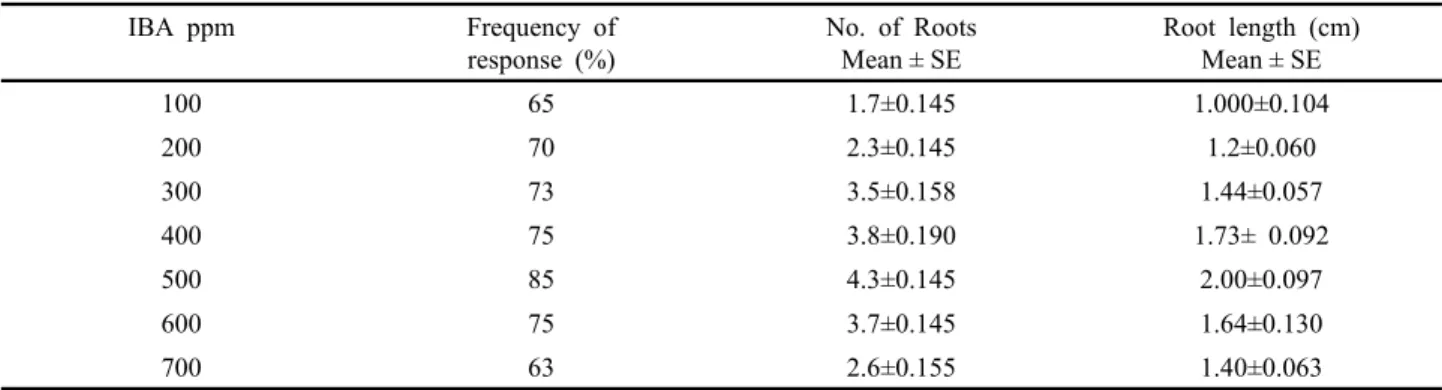
ABSTRACT : An efficient in vitro plant regeneration system was developed through shoot proliferation from axillary buds of Tectona grandis (L.f), APNBV-1 (Andhra Pradesh North Badrachalam Venkatapuram-1) clone. Multiple shoots of high quality were produced in vitro from axillary bud explants. An average of 4.39 shoots/explant were obtained on Murashige and Skoog’s (MS) medium supplemented with plant growth regulators (PGRs) benzyl amino purine (BA), kinetin (KN), indole acetic acid (IAA), gibberillic acid (GA3), growth adjuvants casein hydrolysate (CH), adenine sulphate (Ads) and antioxidants ascorbic acid, polyvinyl pyrrollidine (PVP). Eighty five percent of rooting was observed in ex vitro rooting media containing IBA and vermiculite. In ex vitro rooting, single shoots with 2 to 3 nodes were subjected to IBA of different concentrations at different periods of time intervals. Direct rooting in vermiculite at 500 ppm concentration of IBA resulted in 4.3 number of roots with 2 cm length. Minimum response of rooting and length of roots were recorded at 100 ppm concentration of IBA. Planlets were transferred to plastic bags for short acclimatization stage in green house where they survived at 95%.
Keywords : In vitro micropropagation, ex vitro rooting, Tectona grandis, APNBV-1 clone
INTRODUCTION
Teak (Tectona grandis L.f) is one of the important high quality timber yielding tree species in the world belong to family Verbanaceae. Micropropagation of tree species offers a rapid means to produce clonal planting stock for affo- restation, woody biomass production and conservation of elite germplasm. In general, the tree species are difficult to regenerate under in vitro conditions but previously some successes were achieved in a few leguminous species (Nanda et al., 2004, Gonzalvez et al., 2007). Teak (Tectona grandis L.), a leafy tree species, native to India, Myanmar, Laos and Thailand, is one of the world’s premier hardwood timbers, attractive for its mellow colour, fine grain and durability. It is highly sought after for shipbuilding as well as interior and exterior luxury furnishings. The species is reported to cover 27.5 million ha as natural forests and more than 3.3 million ha as plantations in Asia. At pre- sent, teak ranks among the top five tropical hardwood species in terms of plantation area established worldwide
(Dah and Baw, 2001). Teak traditionally reproduces through seeds, but in most cases, germination is difficult due to the hard seed coat and low seed quality. Poor germination rate, low fertility of soils leading to a low production of seedlings further contributes to the paucity of planting material (Tiwari et al., 2002). However, the regeneration rates of the trees in natural surroundings is quite low, therefore, methods for rapid in vitro micropropagation and genetic improvement are urgently warranted.
In vitro propagation technique has become an efficient way for producing plants as uniform as possible on a large scale and in a short time for the plantation industry (Krishnapillay, 2000). However, although numerous authors have been experimented to establish an efficient, reprodu- cible and simple system for micropropagating teak (Yasodha et al., 2005), it still remains problematic due to the poor capacity of shoot proliferation, high susceptibility of shoots to vitrification and browning and the low frequency of in vitro rooting. The reports on the ex vitro rooting of the micropropagated teak plants is scanty.
Hence, in the present study teak APNBV-1 a superior clone which ensures full growth of the tree 30 m in height and 127 m girth in 25-30 years as against the usual 60 years forest trees of India is selected as a plus tree. High frequency regeneration potential and ex vitro rooting of Teak APNBV-1 clone has been standardized by using, axillary bud harvested from mature elite trees for the first time.
MATERIALS AND METHODS Explant source and sterilization
Actively growing shoots with 2-3 nodes were excised from 2-3 months grafted plant growing in Biotechnology Research Centre, Tirupati, Hedge garden, A.P. India during the period of January-April. The cuttings were dissected into axillary buds with subtending first and second terminal nodes and basal mature single axillary buds. Surface fungal decontamination of the explants were performed by passing through a solution of 1% Bavastin (w/v) for 15-20 minutes and followed by bacterial decontamination of the explants with solution of 0.1% Streptomycin (w/v) for 15-20 minutes and were surface sterilized with ethanol (70% v/v) for 60 s and then dipped in a 0.05% mercuric chloride solution for 5−10 min. After rinsing three times with sterile distilled water, explants were dipped in 5−10% commercial blea- ching solution containing 5% sodium hypochloride and a few drops of Tween-80 for 5−10 min, followed by three rinses in sterile distilled water.
Culture initiation
The axillary buds were then singly placed in culture bottles (500 mL) with basal MS (Murashige and Skoog, 1962) medium fortified with 6- benzyl amino purine (0.5-4 mg L-1), Kinetin (1 mg L-1) along with IAA (1 mg L-1), sucrose (3%) and solidified with 0.8% agar to induce bud sprout and to select sterile shoots. Ascorbic acid (50 mg), polyvinyl pyrrollidine (50 mg) was added to the medium to reduce browning. Medium pH was adjusted to 5.8 prior to autoclaving. After 30 days, the aseptic
axillary shoots were transferred to a fresh medium of the same composition for three subcultures to produce a large number of shoots, then they were transferred to MS medium (devoid of growth regulators) for two weeks in an attempt to eliminate any residual prior to placing the explants on several proliferation media. The aseptic shoots were cut into single nodes with their respective two leaves and placed, randomly distributed, into the different proliferation media.
Shoot multiplication
The culture media was MS medium, containing 3% sucrose, 0.8% (w/v) agar, MS vitamins and PGR’s (BA-0.5-4 mg L-1, KN-1 mg L-1, IAA-1 mg L-1, GA3-0.5 mg L-1). pH was adjusted to 5.8 before autoclaving. Ten glass bottles (500 mL) with plastic lid were used per treatment. Each bottle contained 5 explants in 100 mL of medium. The cultures were covered with a polyethylene film and incubated at approximately 24°C, 16-h light (fluorescent lamps with photon lux light intensity of 40 μmol m-2 s-1). The per- centage of explants initiating shoots, the number of shoots per explant, shoot length were recorded after 6 weeks of culture. The micropropagation cycle consisted of a monthly subculture of axillary buds after removal of the new shoots onto fresh medium.
Ex-vitro rooting
For induction of roots, microshoots measuring 2-4 cm in length were dissected from proliferated shoot cultures and inoculated on vermiculite containing 500 ppm IBA.
Experiments for root initiation and its maintaints were carried out in plastic tubs. After 6-8 weeks rooting frequency and number of roots were recorded.
Field establishment
Eight weeks after root initiation rooted plantlets were removed from rooting medium and transferred into polythene bags containing autoclaved red soil, vermicompost (1:1)
Table 1. Effect of BAP and Kinetin in combination with Auxins on MS medium for direct shoot regeneration from Axillary bud explants of Tectona grandis (L.f), APNBV-1 Clone.
PGRs mg/L Frequency of shoot
regeneration (%)
No. of shoots/explant Mean ± SE
Length of shoots (cm) Mean ± SE
BA KN IAA Ads CH GA3
0.5 1 1 250 1000 0.5 60 2.530±0.194 2.470±0.098
1 1 1 250 1000 0.5 65 3.0±0.346 3.080±0.156
1.5 1 1 250 1000 0.5 70 3.60±0.253 3.9±0.127
2.0 1 1 250 1000 0.5 75 4.8±0.190 4.650± 0.151
2.5 1 1 250 1000 0.5 80 5.8±0.237 6.060±0.210
3.0 1 1 250 1000 0.5 85 6.4±0.253 7.680±0.224
3.5 1 1 250 1000 0.5 65 4.9±0.221 5.720±0.122
4.0 1 1 250 1000 0.5 60 4.1±0.263 5.4±0.098
in order to harden the root system. Different experimental methods were conducted to harden in vitro raised plants.
Plants were irrigated with half strength MS nutrient salts.
Then the plants were transferred to the garden and kept under shade till the first leaf was initiated. The survival of the transplanted plants at each condition was assessed periodically. Established plants were maintained in the same potting mixture for 5-6 weeks and then repotted in earthen pots and kept under nursery shade for further growth.
RESULTS AND DISCUSSION
Culture initiation and shoot multiplication
In the present study, the morphogenic responses of ex- plant were studied under identical cultural conditions and comparative account of the cultures on percentage of res- ponse and shoot length were presented in Table 1.
Axillary bud explants were excised from mature plants and are inoculated on MS medium with various concen- trations of cytokinins and auxins. The cytokinins are indis- pensable for sprouting of axillary bud as said by Purohit and Dave (1996). In the present investigation highest number of shoots with maximum shoot length and frequency of shoot regeneration were obtained from KN and BA, when employed in combination. The regeneration obtained with only BA containing media were stunted, hard, short internodes with comparatively small leaves. BA and KN supplemented medium produced normal dark green and
broad leaves with long internodal space and showed better growth. Similar results were observed in Tylophora indica (Faisal and Anis, 2003) and Wattakaka volublis (Chakradhar, 2004). The propagation rate and morphogenetic response significantly varied to a greater extent according to the explant time. Various experiments conducted on shoot organogenesis from axillary bud explants revealed that MS medium supplemented with BA 3 mg/L, KN 1 mg/L, IAA 1 mg/L, GA3 0.5 mg/L, Ads 250 mg/L, CH 1000 mg/L was found to be the optimum for maximum shoot proliferation. At this concentration average number of shoots were 6.4 and length of shoots were 7.68 cm. Minimum shoot length were observed in MS (BA 0.5 mg/L, KN 1 mg/L, IAA 1 mg/L, GA3 0.5mg/L, Ads 250 mg/L, CH 1000 mg/L) with the average number of shoots (2.53) and length of shoots (2.47 cm).
Earlier, shoot multiplication of mature teak was reported with interactions of 6-benzyladenine (BA) and a commercial formulation of triacontanol called Vipul available on the Indian market (Sharma et al., 2000), BA and NAA (Shirin et al., 2005) and BA and NAA (Baghel et al., 2008). However, clonal plantation of teak is not operational in India owing to lack of suitable clonal propagation methods, despite five decades of work on vegetative propagation using micro- propagation (Palanisamy et al., 1995). Considering the above the present investigation aimed to assess the effects of benzyl amino purine (BA), kinetin (KN), indole acetic acid (IAA), gibberillic acid (GA3) on shoot multiplication. BA (0.5-4
a. b. c.
d. e. f.
g.
Fig. 1. Regeneration of plants from axillary bud culture. a. Inoculation of axillary bud explants on MS media; b. Response of axillary bud after one week of initiation; c. Response of axillary bud after two weeks of initiation; d. Response of axillary bud after three weeks of initiation; e. Response of axillary bud after four weeks of initiation; f Multiple shoots from axillary bud explants; g. Elongation of Teak plantlets on MS media
Table 2. Effect of different concentrations of IBA on rhizogenesis of individual shoots inoculated. Observations: After 4 weeks (The results are mean ± SE of 10 independent determinations).
IBA ppm Frequency of
response (%)
No. of Roots Mean ± SE
Root length (cm) Mean ± SE
100 65 1.7±0.145 1.000±0.104
200 70 2.3±0.145 1.2±0.060
300 73 3.5±0.158 1.44±0.057
400 75 3.8±0.190 1.73± 0.092
500 85 4.3±0.145 2.00±0.097
600 75 3.7±0.145 1.64±0.130
700 63 2.6±0.155 1.40±0.063
mgL-1), KN (1 mgL-1), IAA (1 mgL-1), GA3 (0.5 mgL-1) in MS medium significantly improved multiple shoot for- mation in teak. The synergistic effect of cytokinin and auxin has been reported in teak (Shirin et al., 2005). Shirin et al., (2005) also achieved multiple shoots (6.33 folds than the control) on BA (10 MM) and NAA (1.0 MM) using nodal explants from mature teak shoots. The reported values offer better in terms of 6.4 (shoots/explant) and 7.68 (shoot length cm) in the present investigation.
Surender and Narender (2009) reported induction of multiple shoots on MS (1962) medium supplemented with various cytokinins and auxins. Rout et al., (2008) reported that addition of BA, Ads, IAA in the medium proved as the most effective for promoting shoot multiplication.
Cytokinins stimulate cell division and induce axillary bud proliferation and also promote adventitious shoot formation. Moreover addition of PVP to the medium substantially reduced the intensity of phenolic compounds in in vitro teak cultures.
In the present study rapid micropropagation was achieved through induction of multiple shoots from axillary bud explants. A rapid rate of propagation depends on the sub culturing of proliferating shoot cultures. In the case of prolonged cultures the nutrients in the medium gradually depleted. Upadhyaya et al., (1989) reported propagation profile for Picrorhiza kurroa and observed that the shoot multiplication rate gradually improved as the number of subcultures increased. The shoot multiplication is enhanced by subsequent cultures the observations in this study are in agreement with reports such as Gymnema sylvestre (Ko-
malavalli and Rao, 2000), Hemidesmus indicus (Sreekumar et al., 2000) and Holostemma ada kodien (Martin, 2002).
With regard to PGRs, as a general principle, high con- centration of cytokinin and low concentration of auxin in a medium promotes the induction of shoot morphogenesis, in vitro culture by Chitra et al., (2009) is holding good.
The present study showed rapid and active induction of axillary buds. Mature axillary bud explants were initiated at all combinations of BA, KN, IAA and with GA3. Induction of rooting
In ex vitro rooting, single shoots with 2 to 3 nodes were subjected to IBA of different concentrations at di- fferent periods of time intervals. Lastly direct rooting in vermiculite for a period of four weeks, roots grown to a length of 2 cm and number of roots were 4.3 at 500 ppm concentration of IBA. Minimum response of rooting i.e., number of roots were 1.7 and length of roots were recorded 1 cm at 100 ppm concentration of IBA. The principle role of IBA is to favour the conjugation between endogenous IAA, amino acids, which leads to synthesis of specific proteins necessary for the function of root initials. They promote growth through cell elongation rather than cell division. Auxins function in increasing cell wall plasticity, and so extensibility. The rooting potential of auxin might be depending on the availability of necessary receptors or binding sites for auxins present in cell systems. The state- ment was also collaborated by the studies Pardhasaradhi and Alia (1994).
a. b.
Fig. 2. Rhizogenesis of in vitro raised shoots. a. Rooting of in vitro raised shoots pretreated with IBA on vermiculite; b. Ex vitro raised Teak plantlet
The use of either IAA or IBA in the culture medium influences the higher rate of root induction (Rout et al., 2008). In Tectona grandis among all the treatments tested higher rooting response was observed in IBA 500 ppm.
Dipping of basal ends of shoots in IBA solution (2.46 µM) for 7 days induced 100% rooting in Rotula aquatica (Martin, 2003a, b). Successful induction of rooting by dipping of in vitro developed shoots in IBA solution has also reported in Lagerstromia parviflora (Tiwari et al., 2002) and Ceratonia siliqua (Romano et al., 2002). The observation is in agreement with that of Rout and Das (1993) in Madhuca latifolia, where the addition of auxin has become essential for rooting.
Ex vitro rooting accounts for 35-75% reduction of the total cost of plants propagated through tissue culture (Martin, 2003a, b). As there is a reduction in time, cost and labor and a capability of inducing quality roots in microshoots of T. grandis IBA dipped ex-vitro rooting is the most effective method for root initiation.
Acclimatization
Plantlets with well developed roots were successfully acclimatized and eventually established in a green house.
Acclimatization of these in vitro plants was done in mist chamber where high humidity is maintained also gave the better survival percentage (95%). Gradual exposure of plants from polythene covering, which was used to conserve and develop proper balance of relative humidity during the establishment of these plants helped to ensure weaning as for as humidity concerned. Gradual removal of the poly- thene covering day by day during the acclimatization was also reported in Verbena and Tenera (Hosaki and Katanira, 1994) for better survival. Among the various hardening media used for acclimatization of rooted plants, a mixture of red soil and vermicompost (1:1) (v/v) supported maximum percentage of survival. During the initial stage of hardening half strength MS salts without sucrose were supplied to the plants. It is supported by in vitro cultivated plants lack the necessary anatomical features to withstand vari- ations in the natural environment (Thakur et al., 1998).
Gradual acclimatization was done with decreasing humid during transition to the field condition. The rooted plants gradually acclimatized with an increase in temperature from 25°C to 30°C and decrease in a relative humidity from 80 to 50%, high humidity of environment does not allow the synthesis of cuticle on the epidermis of the leaves of regenerated plants.
Fig. 3. Acclimatized plants regenerated from axillary bud explants of T.grandis.
Our results offer better performance in terms of number of shoots/explant, shoot length, rooting percentage (85%), plant survival (95%) and rapid growth.
LITERATURE CITED
Baghel, R.S., Tiwari, S. and M. K. Tripathi. 2008. Comparison of morphogenic and plant regeneration ability of some explants of teak (Tectona grandis Linn. F). Journal of Agricultural Technology.
4(2): 125-136.
Chakradhar, T. (2004). In vitro culture, physiological, phytochemical and antimicrobial studies of a medicinal plant Wattakaka volubilis (L.f) sapf (Asclepiadaceae). Ph.D. thesis, S.K.University, Anantapur, India.
Chitra, R., Rajamani, K. and E. Vadivel. 2009. Regeneration of plantlets from leaf and internode explants of Phyllanthus amarus Schum. and Thonn. Afri. J. Biotech. 8(10): 2209-221.
Dah, U.S. and U.S. Baw. 2001. Regional teak marketing and trade, Proceedings of third regional seminar on teak. Indonesia, pp. 1–
14.
Faisal, M. and M. Anis. 2003. Rapid mass propagation of Tylo- phora indica (Burm. f.). Merrill via leaf callus culture. Plant cell Tiss Org Cult. 1: 1-5.
Gonzalvez, B., Orozco-Villafuerte, J., Cruz-Sosa, F., Chavez-Avilla, V.M. and E.J.Vernon-Carter. 2007. Clonal propagation of mesquite tree (Prosopis laevigata Humb. And Bonpl. Ex willd. M.C.
Johnston).I. via cotyledonary nodes. In vitro Cell Dev Biol Plant.
43: 260-266.
Hosaki, T. and S. Katanira. 1994. Micro propagation of Verbena tenera by node culture. Plant Cell Tissue Org Cult. 36: 373-375.
Komalavalli, N. and M.V.Rao. 2000. In vitro micropropagation of Gymnema sylvestre-a multipurpose medicinal plant. Plant cell Tiss Org Cult. 61: 97-105.
Krishnapillay, B. 2000. Silviculture and management of teak plan- tations, in: Unasylva, No. 201, Teak, Int. J. Forestry Forest Ind (FAO) 51- 2000/2.
Martin, K.P. 2002. Rapid propagation of Holostemma ada-koiden Schult. a rare medicinal plant, through axillary bud and bud multi- plication and indirect organogenesis. Plant Cell Rep. 21: 112 -117.
Martin, K.P. 2003a. Rapid axillary bud proliferation and ex vitro rooting of Eupatorium triplinerve. Biologia plantarum. 47(4): 589 -591.
Martin, K.P. 2003b. Rapid propagation in vitro multiplication and ex vitro rooting of Rotula aquatica Lour. a rare rheophytic woody medicinal plant. Plant Cell Rep. 21: 415-420.
Murashige, T. and F. Skoog. 1962. A revised medium for rapid growth and bioassay with tobacco cultures. Physiol plant. 15:
473-497.
Nanda, R.M., Das, P. and G.R. Rout. 2004. In vitro clonal pro- pagation of Acacia mangium Willd. and its evaluation of genetic stability through RAPD marker. Annals of Forest Science. 61:
381–386.
Palanisamy, K., Ansari, S.A. and A.K. Mandal. 1995. Standardi- zation of vegetative propagation technology of teak, sissoo, neem, karanj and bamboos. Proceedings of International Workshop on Forestry Research Methods. Tropical Forest Research Institute, Jabalpur. 22-23 March 1995. Vani Printers, Dehra Dun, pp. 18- 19.
Pardhasaradhi, P. and Alia. 1994. Production and selection of soma- clonal variants of Leucaena leucocephala with high CO2 assi- milating potential. Energy conservation management. 36: 759-762.
Purohit, S.D. and A. Dave. 1996. In vitro propagation of Wrightia tinctoria. Biologia Plantarum 36: 519-526.
Romano, A., Barros, S. and M.A. Martin-Laoucao. 2002. Micropro- pagation of the Mediterranean tree Ceratonia siliqua. Plant Cell Tissue Organ Culture 68: 35-41.
Rout, C.R. and P, Das. 1993. Micropropagation of Madhuca longi- folia. Plant Cell Rep. 12: 513-516.
Rout, G.R, Senapati, S.K and S. Aparajeta. 2008. Micropropagation of Acacia chundra (Roxb.) DC. Hort Sci (Prague). 35 (1): 22–26.
Sharma, S., Rana, P.K., Mandal, A.K. and S.A. Ansari. 2000. Pro- motion of shoot multiplication by vipul (triacontanol) and adven- titious rhizogenesis by rice bran extract in Tectona grandis. J Plant Biol. 27:265–269.
Shirin, F., Prem Kumar, R. and A.K. Mandal. 2005. In vitro clonal propagation of mature Tectona grandis through axillary bud proli- feration. J For Res. 10:465–469.
Sreekumar, S., Seeni, S. and P. Pushpangadan. 2000. Micropropagation of Hemidesmus indicus for cultivation and production of 2- hydroxy 4-methoxy benzaldehyde. Plant Cell Tiss Org Cult. 62:
211-218.
Surender, K. and S. Narender. 2009. Micropropagation of Prosopis Cineraria (L.) Druce – A Multipurpose Desert Tree. Researcher.
1(3): 28-32.
Thakur, R., Rao, P.S. and V.A. Bapat. 1998. In vitro plant regene- ration in Melia azadarech L. Plant Cell Rep. 18: 127-131.
Tiwari, S. K., Tiwari, K.P. and E.A. Siril. 2002. An improved mic- ropropagation protocol for teak. Plant Cell Tiss Org Cult. 71:
1-6.
Upadhyaya, R., Arumugam, N. and S.S. Bhojwani. 1989. In vitro propagation of Picrorhiza kurroa Royle ex. Benth. An endangered species of medicinal importance. Phytomorphology. 39: 235-242.
Yasodha, R., Sumathi, R. and K. Gurumurthi. 2005. Improved mic- ropropagation methods for teak. J Trop For Sci. 17: 63-75.
(Received August 3, 2009; Accepted August 26, 2009)