Cupriavidus sp. strain SW-Y-13 is an aerobic, Gram-negative, rod-shaped bacterium isolated from river water in South Korea, in 2019. Its draft genome was produced using the PacBio RS II platform and is thought to consist of five circular chromosomes with a total of 7,307,793 bp. The genome has a G + C content of 63.1%. Based on 16S rRNA sequence similarity, strain SW-Y-13 is most closely related to Cupriavidus metallidurans (98.4%). Genome annotation revealed that the genome is comprised of 6,613 genes, 6,536 CDSs, 12 rRNAs, 61 tRNAs, and 4 ncRNAs. Resistance to Co
2+is primarily mediated by the efflux system encoded by the SW-Y-13 genome, which includes the czcCBA operons, czcD genes, and czcN genes, among others.
This study may provide useful information on the heavy-metal resistance mechanisms of strain SW-Y-13.
Keywords: Cupriavidus sp., draft genome, heavy-metal-resistant bacterium, PacBio RS II
Cupriavidus belongs to the family Burkholderiaceae, from which the type species Cupriavidus necator was isolated from soil (Makkar and Casida, 1987). Currently, the genus comprises 16 species that inhabit diverse environments (http://www.
bacterio.net/cupriavidus). Some Cupriavidus species have been
found to survive in close association with pollution-causing heavy metals, for example, Cupriavidus metallidurans, which successfully grows in the presence of Cu, Hg, Ni, Ag, Cd, Co, Zn, and As (Goris et al., 2001; Vandamme and Coenye, 2004;
Janssen et al., 2010). Several bacteria found in polluted environments have been shown to adapt to the presence of toxic heavy metals. Identification of novel bacterial mechanisms facilitating growth in heavy-metal-polluted environments provides useful information for the development of novel technologies (Ayangbenro and Babalola, 2017). In the present study, we describe the draft genome sequence of a heavy- metal-resistant bacterium, Cupriavidus sp. strain SW-Y-13.
Cupriavidus sp. strain SW-Y-13 is a novel organism and was isolated from the surface of the Nakdong River in South Korea (36.432178 N, 128.250770 E) using a standard dilution plating method on YPD agar (BD Difco). This collection was screened for heavy metal (Co
2+and Cu
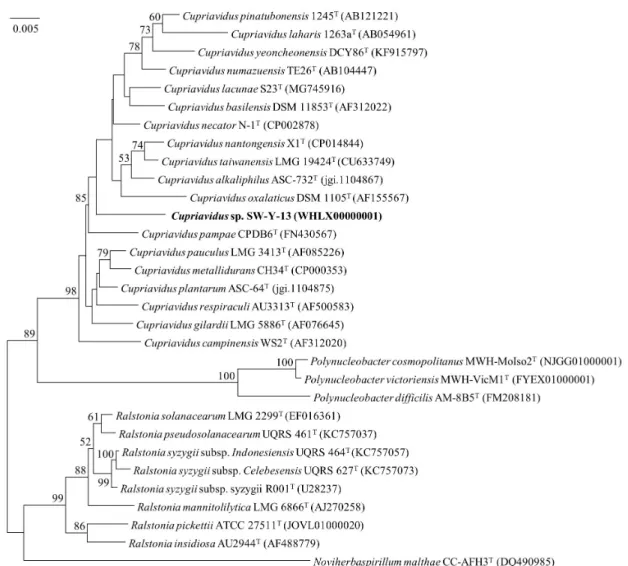
2+) resistance. Genomic DNA was extracted using the DNeasy Blood and Tissue kit (Qiagen) according to the manufacturer’s instructions. Phylogenetic analysis based on 16S rRNA gene sequences revealed that strain SW-Y-13 is closely related to Cupriavidus metallidurans strain CH34
Twith 98.4% sequence similarity (Fig. 1).
To produce sequencing data for the generation of a high-
Korean Journal of Microbiology (2020) Vol. 56, No. 3, pp. 343-346 pISSN 0440-2413
DOI https://doi.org/10.7845/kjm.2020.0061 eISSN 2383-9902
Copyright ⓒ 2020, The Microbiological Society of Korea
Draft genome of a heavy-metal-resistant bacterium,
Cupriavidus sp. strain SW-Y-13, isolated from river water in Korea
Kiwoon Baek , Young Ho Nam , Eu Jin Chung , and Ahyoung Choi*
Nakdonggang National Institute of Biological Resources (NNIBR), Sangju 37242, Republic of Korea
강물에서 분리한 중금속 내성 세균 Cupriavidus sp. SW-Y-13 균주의 유전체 해독
백기운 ・ 남영호 ・ 정유진 ・ 최아영*
국립낙동강생물자원관 담수생물연구본부
(Received July 6, 2020; Revised September 18, 2020; Accepted September 18, 2020)
*For correspondence. E-mail: [email protected];
Tel.: +82-54-530-0712; Fax: +82-54-530-0719
344
∙ Baek et al.미생물학회지 제56권 제3호
quality genome, the genomic DNA from strain SW-Y-13 was extracted and further purified from a pure culture isolate grown on YPD agar at 25°C, using the DNeasy Blood and Tissue kit and Wizard Genomic DNA Purification Kit (Promega), respectively. Whole-genome sequencing was performed on the PacBio RS II platform (Menlo Park). Single-molecule real-time sequencing (SMRT) yielded a total of 136,681 subreads (1,4 Gb, mean subread length: 10,333 bp, N50 value: 14,631) and de novo assembly of the SW-Y-13 genome was completed using the Hierarchical Genome Assembly Process 3 (HGAP3) within the PacBio SMRT analysis 2.3.0 software (Chin et al., 2013). Contigs were annotated via Rapid Annotation using the Subsystem Technology (RAST v2.0) server (Aziz et al., 2008) and the NCBI Prokaryotic Genome Annotation Pipeline
(PGAP v4.8) (Tatusova et al., 2016). Potential coding sequences were evaluated using the Basic Local Alignment Search Tool (BLAST) and the UniProt (Wu et al., 2006), Pfam (Punta et al., 2012), and COG (Tatusov et al., 2003) databases. rRNA and tRNA genes as well as other miscellaneous features, were predicted using the RNAmmer 1.2 (Lagesen et al., 2007) and tRNAscan-SE 1.21 (Lowe and Eddy, 1997) servers and the Rfam v. 12.0 database (Nawrocki et al., 2015).
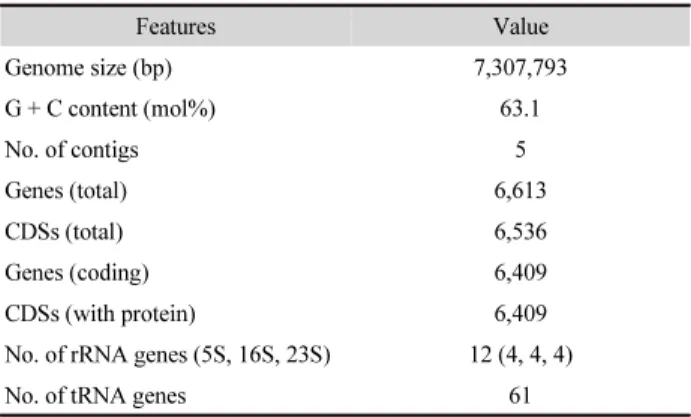
The basic genome statistics are provided in Table 1. The draft genome of strain SW-Y-13 comprised 5 contigs with a G + C content of 63.1% and a genome size of 7,307,793 bp (N50, 2,677,351 bp; sequencing depth of coverage, 68.7×). The genome contained 6,536 CDSs, 12 rRNAs (5S, 16S, 23S), 61 tRNAs, and 4 ncRNAs genes (Fig. 2). A total of 4,088 genes
Fig. 1. Neighbor-joining phylogenetic tree based on 16S rRNA sequences showing the relationship among isolates belonging to the Cupriavidus sp.
SW-Y-13 and related taxa. Numbers at each node indicate bootstrap values (above 50%) based on 1,000 resampled data sets. Scale Bar represents 0.005 substitutions per nucleotide position.
Draft genome sequence of Cupriavidus sp. SW-Y-13∙
345
Korean Journal of Microbiology, Vol. 56, No. 3 were functionally assigned to COG categories.
The genome annotation analysis revealed several genes known to be involved with metal resistance, including cobalt–
zinc–cadmium resistance protein (czcB; CUSW19178_03307, czcC; CUSW19178_03308, CUSW19178_03498, CUSW19 178_04266, CUSW19178_06060, and czcN; CUSW19178_
06057), cobalt efflux system protein (czcA; CUSW19178_
04268, czcD; CUSW19178_03032, and CUSW19178_06063), copper resistance protein (copD; CUSW19178_06088), nickel –cobalt–cadmium resistance protein (nccB; CUSW19178_
04822), nickel and cobalt resistance protein (cnrR; CUSW 19178_04825 and cnrY; CUSW19178_04826), and arsenic resistance protein (arsB; CUSW19178_04162). The draft genome sequence of SW-Y-13 will contribute to our under- standing of the underlying mechanism of heavy metal resistance in Cupriavidus species.
Nucleotide sequence accession number
The whole genome sequence of Cupriavidus sp. strain SW-Y-13 was deposited in DDBJ/ENA/GenBank under the accession number WHLX00000000. The strain was deposited at the Korean Culture Center for Microorganisms under the accession number KCCM 43367.
Fig. 2. Circular map of the Cupriavidus sp. strain SW-Y-13 genome. From outside to the center; the colored bands in ring 1 represent contigs; ring 2 represents the annotated genes on the forward strand (color determined by COG category); ring 3 shows the annotated genes on the reverse strand (color determined by COG category); ring 4 displays the RNA genes (rRNAs are displayed in red and tRNAs are displayed in purple); ring 5 shows the GC skew (higher-than-average values are displayed in green, while lower-than-average values are displayed in red) and ring 6 shows the GC ratio (higher-than-average values in blue and lower-than-average values in yellow).
Table 1. General genomic features of Cupriavidus sp. SW-Y-13
Features Value
Genome size (bp) 7,307,793
G + C content (mol%) 63.1
No. of contigs 5
Genes (total) 6,613
CDSs (total) 6,536
Genes (coding) 6,409
CDSs (with protein) 6,409
No. of rRNA genes (5S, 16S, 23S) 12 (4, 4, 4)
No. of tRNA genes 61
346
∙ Baek et al.미생물학회지 제56권 제3호
적 요
Cupriavidus sp. SW-Y-13 균주는 2019년 한국의 강물에서 분리된 호기성 그람 음성 막대 모양의 세균이다. PacBio RS II 플 랫폼을 사용하여 초안 유전체를 얻었으며, 5개의 원형 염색체로 구성되어있다. SW-Y-13 균주의 유전체 크기는 총 7,307,793 bp, G + C 함량은 63.1%이다. 16S rRNA 유사도에 따르면 SW-Y- 13 균주는 Cupriavidus metallidurans (98.4%)와 가장 밀접한 관련이 있다. 유전체 분석을 통해 총 6,613개의 유전자와 6,539 개의 CDS, 12개 rRNA, 61개 tRNA, 4개 ncRNA를 포함하였 다. CO
2+에 대한 내성은 주로 czcCBA 오페론, czcD 유전자 및 czcN 유전자를 포함하는 SW-Y-13 게놈에 의해 인코딩된 유 출 시스템에 의해 매개된다. 이 연구는 SW-Y-13 균주의 중금 속 저항 메커니즘에 대한 유용한 정보를 제공할 수 있다.
Acknowledgments
This work was supported by a grant from the Nakdonggang National Institute of Biological Resources (NNIBR), funded by the Ministry of Environment (MOE) of the Republic of Korea (grant NNIBR202002103).
Conflict of Interest
There are no conflicts of interest to declare.
References
Ayangbenro AS and Babalola OO. 2017. A new strategy for heavy metal polluted environments: A review of microbial biosorbents.
Int. J. Environ. Res. Public Health 14, 94.
Aziz RK, Bartels D, Best AA, DeJongh M, Disz T, E dwards RA, Formsma K, Gerdes S, Glass EM, Kubal M, et al. 2008. The RAST server: rapid annotations using subsystems technology.
BMC Genomics 9, 75.
Chin CS, Alexander DH, Marks P, Klammer AA, Drake J, Heiner C,
Clum A, Copeland A, Huddleston J, Eichler EE, et al. 2013.
Nonhybrid, finished microbial genome assemblies from long- read SMRT sequencing data. Nat. Methods 10, 563–569.
Goris J, De Vos P, Coenye T, Hoste B, Janssens D, Brim H, Diels L, Mergeay M, Kersters K, and Vandamme P. 2001. Classification of metal-resistant bacteria from industrial biotopes as Ralstonia campinensis sp. n ov., Ralstonia metallidurans sp. n ov. an d Ralstonia basilensis Steinle et al. 1998 emend. Int. J. Syst. Evol.
Microbiol. 51, 1773–1782.
Janssen PJ, Van Houdt R, Moors H, Monsieurs P, Morin N, Michaux A, Benotmane MA, Leys N, Vallaeys T, Lapidus A, et al. 2010.
The complete genome sequence of Cupriavidus metallidurans strain CH34, a master survivalist in harsh and anthropogenic environments. PLoS ONE 5, e10433.
Lagesen K, Hallin P, Rødland E A, Staerfeldt HH, Rognes T, and Ussery DW. 2007. RNAmmer: consistent and rapid annotation of ribosomal RNA genes. Nucleic Acids Res. 35, 3100–3108.
Lowe TM and Eddy SR. 1997. tRNAscan-SE: a program for improved detection of transfer RNA genes in genomic sequence. Nucleic Acids Res. 25, 955–964.
Makkar NS and Casida LE, Jr. 1987. Cupriavidus necator gen. nov., sp. nov.: a nonobligate bacterial predator of bacteria in soil. Int.
J. Syst. Bacteriol. 37, 323–326.
Nawrocki EP, Burge SW, Bateman A, Daub J, Eberhardt RY, Eddy SR, Floden EW, Gardner PP, Jones TA, Tate J, et al. 2015. Rfam 12.0: updates to the RNA families database. Nucleic Acids Res.
43, D130–D137.
Punta M, Coggill PC, Eberhardt RY, Mistry J, Tate J, Boursnell C, Pang N, Forslund K, Ceric G, Clements J, et al. 2012. The Pfam protein families database. Nucleic Acids Res. 40, D290–D301.
Tatusov RL, Fedorova ND, Jackson JD, Jacobs AR, Kiryutin B, Koonin EV, Krylov DM, Mazumdr R, Mekhedov SL, Nikolskaya AN, et al. 2003. The COG database: an updated version includes eukaryotes. BMC Bioinformatics 4, 41.
Tatusova T, DiCuccio M, Badretdin A, Chetvernin V, Nawrocki EP, Zaslavsky L, Lomsadze A, Pruitt KD, Borodovsky M, and Ostell J. 2016. NCBI prokaryotic genome annotation pipeline. Nucleic Acids Res. 44, 6614–6624.
Vandamme P and Coenye T. 2004. Taxonomy of the genus Cupriavidus:
a tale of lost and found. Int. J. Syst. Evol. Microbiol. 54, 2285–
2289.
Wu CH, Apweiler R, Bairoch A, Natale DA, Barker WC, Boeckmann B, Ferro S, Gasteiger E, Huang H, Lopez R, et al. 2006. The universal protein resource (UniProt): an expanding universe of protein information. Nucleic Acids Res. 34, D187–D191.