• 검색 결과가 없습니다.

A Case of Partial Congenital Pericardial Defect Presenting as Acute Coronary Syndrome

N/A
N/A
Protected

Academic year: 2022

Share "A Case of Partial Congenital Pericardial Defect Presenting as Acute Coronary Syndrome"

Copied!
4
0
0

로드 중.... (전체 텍스트 보기)

전체 글

(1)

845 Copyright © 2013 The Korean Society of Cardiology

Korean Circulation Journal

Introduction

Congenital pericardial defects are rare. They are observed in rou- ghly 1 in 14000 patients who undergo thoracotomies and necrop- sies.

1)

Patients with congenital pericardial defects are either asym- ptomatic or occasionally present with varied symptoms, chest pain being the most prevalent symptom.

2)

The chest pain may be caused by compromised blood flow by herniation and dynamic compres- sion or torsion of a heart structure including the coronary arteries.

However, the diagnosis of congenital pericardial defect may be dif- ficult or delayed because of various diseases that present with ch- est pain.

Case Report

http://dx.doi.org/10.4070/kcj.2013.43.12.845 Print ISSN 1738-5520 • On-line ISSN 1738-5555

A Case of Partial Congenital Pericardial Defect Presenting as Acute Coronary Syndrome

Jae Hoon Chung, MD, Rak Kyeong Choi, MD, Sam Se Oh, MD, Tae Sik Kim, MD, Suk Jin Lee, MD, and Dae Sung Ahn, MD

Division of Internal Medicine, Sejong General Hospital, Bucheon, Korea
Congenital pericardial defects are rare and asymptomatic for both partial and complete defects. However, some patients can experience syncope, arrhythmia, and chest pain. When a patient experiences a symptom, it may be caused by herniation and dynamic compression or torsion of a heart structure including the coronary arteries. Diagnosis of a congenital pericardial defect may be difficult, especially in old patients with concomitant coronary artery disease. The clinical importance of congenital pericardial defect has not been stressed and congenital pericardial defects are regarded as benign, but in this case, pericardial defect was responsible for myocardial ischemia. The au- thors report a case of partial congenital pericardial defect causing herniation and dynamic compression of the coronary arteries, present- ing as an acute coronary syndrome in an old man, with an emphasis on the unique features of the coronary angiogram that support the diagnosis of partial pericardial defects. (Korean Circ J 2013;43:845-848)

KEY WORDS: Heart defects, congenital; Pericardium; Coronary artery disease.

Received: February 13, 2013 Revision Received: May 7, 2013 Accepted: July 17, 2013

Correspondence: Rak Kyeong Choi, MD, Division of Internal Medicine, Se- jong General Hospital, 28 Hohyeon-ro 489beon-gil, Sosa-gu, Bucheon 422- 711, Korea

Tel: 82-32-340-1103, Fax: 82-32-340-1236 E-mail: [email protected]

• The authors have no financial conflicts of interest.

This is an Open Access article distributed under the terms of the Creative Commons Attribution Non-Commercial License (http://creativecommons.

org/licenses/by-nc/3.0) which permits unrestricted non-commercial use, distribution, and reproduction in any medium, provided the original work is properly cited.

This case report summarizes our experience in the diagnosis and treatment of a patient who had a congenital pericardial defect with concomitant coronary artery disease.

Case

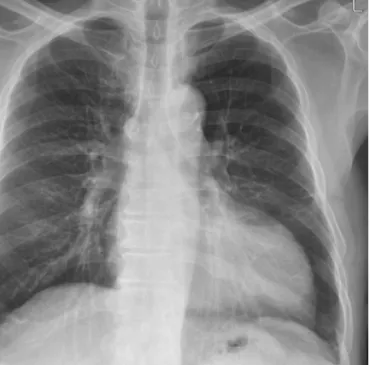
A 61-year-old man visited our hospital with the chief complaints of chest pain on exertion and an intermittent chest pain that was aggravated when he rested in a left decubitus position. He had risk factors for coronary artery disease: dyslipidemia, hypertension, and diabetes. He also had a history of chest trauma, a left rib fracture that occurred in a traffic accident 15 years previously. An initial ev- aluation of his chest radiograph showed levoposition of his heart and an unusual cardiac contour with a bulging left ventricle (Fig. 1).

An electrocardiography showed an incomplete right bundle branch

block and a clockwise rotation in the precordial leads. An echocar-

diography showed an estimated left ventricular ejection fraction

of 50-55%, with regional wall motion abnormalities of the basal to

mid inferior and inferolateral walls. It also showed a focal external

compression of the basal posterolateral wall. His serum troponin-T

level was also slightly elevated (0.023 ng/mL). As he had coronary

risk factors including elevation of the serum troponin-T level and

complained of chest pain on exertion with echocardiographic regio-

nal wall motion abnormalities, we performed early elective coronary

(2)

846 Congenital Pericardial Defect

http://dx.doi.org/10.4070/kcj.2013.43.12.845 www.e-kcj.org

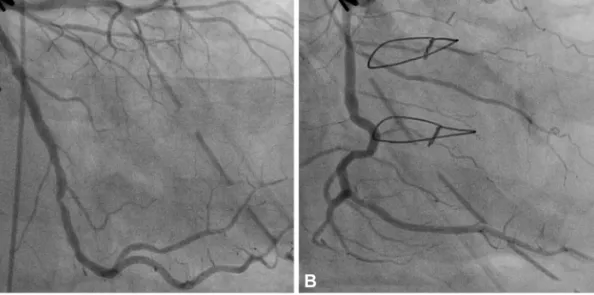
angiography without noninvasive testing. The angiogram showed two-vessel coronary artery disease involving the left anterior desc- ending artery (LAD) and left circumflex artery (LCX), with a geogra- phically circumferential phasic diastolic compression of three ob- tuse marginal branches, right ventricular branches, and the posterior descending artery (PDA) (Fig. 2).

At first, we considered stenting the LAD as the significant culprit lesion. However, there was a possibility that phasic diastolic obstruc- tion of the epicardial coronary arteries could have caused the chest pain. This feature was consistent with the echocardiographic find-

ings showing regional wall motion abnormalities of the LCX and ri- ght coronary artery territories. In addition, a geographically circum- ferential phasic diastolic compression of the coronary arteries like myocardial bridging suggested a linear extracardiac constriction like a band strangulating the heart between the basal and the mid-ven- tricular level. Because he had a previous chest trauma history, there was a possibility that cicatrical changes could have caused extra- cardiac constriction. We decided against performing percutaneous coronary intervention for the mid-LAD lesion. Therefore, to confirm our assumption, a computed tomography (CT) was done, which showed a left-sided movement of the heart, adherence of the he- art to the chest wall, and a partial pericardial defect around the mid- ventricular level with strangulation of the mid-LAD, LCX, and PDA (Fig. 3). There was no specific intracardiac abnormality other than the pericardial defect on cardiac CT. Myocardial single photon emis- sion computerized tomography was also done and it showed a re- versible perfusion defect at the mid anterior, entire anterolateral and mid inferolateral walls.

The operative findings revealed a partial congenital pericardial de- fect just around the middle ventricular level. Both ventricles were herniated to the left pleural cavity, and there was no epicardial ad- hesion or scar change. There were also multiple coronary arteries strangulated on the epicardial surface of both ventricles caused by the thickened hard circumferential pericardial edge (Fig. 4). The an- terior portion of this band-like thickened pericardial edge was ex- cised in order to release the external compression of multiple coro- nary arteries. The posterior portion of the pericardial edge was left to prevent phrenic nerve injury. An off-pump coronary artery by- pass surgery (CABG) of the left internal thoracic artery (free graft to ascending aorta) to the mid-LAD was done concomitantly consid- Fig. 1. Chest radiograph. Chest posteroanterior view shows levoposition of

heart with a bulging of the left ventricle.

Fig. 2. Diagnostic coronary angiography. Coronary angiogram shows geographically circumferential phasic diastolic external compression of the obtuse marginal branches of the left circumflex artery (white arrows), right ventricular branches and the posterior descending artery of the right coronary artery (black arrows). A: left anterior oblique-caudal view. B: right anterior oblique-caudal view.

A B

(3)

847 Jae Hoon Chung, et al.

http://dx.doi.org/10.4070/kcj.2013.43.12.845 www.e-kcj.org

ering the presence of significant stenosis with heavy calcification of the mid-LAD, which can cause ischemia.

After the CABG with partial pericardiectomy, a follow-up coronary angiogram was performed to evaluate the possibility of remaining strangulation by chronic cicatricial changes of the epicardium be- neath the thickened hard circumferential pericardial edge, but there was no finding of previous dynamic obstruction of the coronary ar- teries (Fig. 5). A follow-up transthoracic echocardiography was also done and the regional wall motion abnormalities and external com- pression which were observed in the previous study were no longer seen. The patient was discharged without complications, and he is currently symptom free.

Discussion

Patients with congenital pericardial defects are usually asympto- matic and have a good prognosis. However some patients experi- ence syncope, arrhythmia, and chest pain. The most prevalent symp- tom is angina-like chest pain that can also appear after postural ch- anges.

3)4)

The exact mechanism of the chest pain is unclear. Fisher and Ehrenhaft

3)

suggested possible etiologies as 1) strangulation of the fibrous pericardial rim on the coronary arteries causing myocar- dial ischemia; 2) torsion or strain of the great vessels; 3) lack of a cushioning effect of the pericardium, allowing the heart to pound freely on the overlying lung or chest; and 4) tension in the pleuro- pericardial adhesions that form in the absence of the parietal pleu- ropericardium.

5)

The diagnosis of a congenital pericardial defect may be especially difficult in patients with concomitant coronary artery disease like in this case. In a partial pericardial defect case, chest radiography shows a convex prominence of the left cardiac border without elec- trocardiographic evidence of left ventricular hypertrophy.

6)7)

The electrocardiography displays an incomplete right bundle branch block pattern with clock wise rotation in left sided congenital peri- cardial defect cases.

6)7)

Cardiac CT, magnetic resonance imaging and thoracoscopy are the usual confirmative diagnostic tools.

8)

Coronary angiography can show dynamic obstruction of the coronary artery during the diastolic phase that is relieved during the systolic phase.

In conclusion, patients with congenital pericardial defects usu- ally have a good prognosis. However, coronary arteries strangulated by the dense fibrous rim of a pericardial defect can produce clinical symptoms, suggesting that this feature was the cause of cardiac ischemia in our case. The clinical diagnosis may be suggested by the Fig. 3. Computed tomography of the heart. Cardiac CT shows a circumferential groove of the heart caused by external compression and impingement of the coronary arteries (arrows). A: cross sectional view. B: three-dimensional reconstruction view.

A B

Fig. 4. The operative findings. The operative findings shows a rolled up

thickened circumferential pericardial edge and the epicardial groove creat-

ed by the dense fibrous rim of the pericardium just around the mid-level of

the left ventricle.

(4)

848 Congenital Pericardial Defect

http://dx.doi.org/10.4070/kcj.2013.43.12.845 www.e-kcj.org

characteristic coronary angiographic findings such as the geograph- ically circumferential diastolic compression of the coronary arteries.

Most of all, clinicians should strongly suspect this condition when a combination of these symptoms and findings is present to make a confirmative diagnosis of congenital pericardial defect.

References

1. Rusk RA, Kenny A. Congenital pericardial defect presenting as chest pain. Heart 1999;81:327-8.

2. Sunao K, Taishi N, Seigo S, et al. Cardiac displacement with a congeni- tal complete left-sided pericardial defect in a patient with exertional angina pectoris. Angiology 2004;55:445-9.

3. Fisher FD, Ehrenhaft JL. Congenital pericardial defect. JAMA 1964;188:

78-81.

Fig. 5. A follow-up coronary angiography. Coronary angiogram show no features of the previous dynamic occlusion of the coronary arteries which were shown in Fig. 2. A: left anterior oblique-caudal view. B: right anterior oblique-caudal view.

A B

4. Amiri A, Weber C, Schlosser V, Meinertz TH. Coronary artery disease in a patient with a congenital pericardial defect. Thorac Cardiovasc Surg 1989;37:379-81.

5. Nguyen DQ, Wilson RF, Bolman RM 3rd, Park SJ. Congenital pericardial defect and concomitant coronary artery disease. Ann Thorac Surg 2001;

72:1371-3.

6. Connolly HM, Click RL, Schattenberg TT, Seward JB, Tajik AJ. Congenital absence of the pericardium: echocardiography as a diagnostic tool. J Am Soc Echocardiogr 1995;8:87-92.

7. Spodik D. Congenital abnormalities of the pericardium. The Pericardium:

A Comprehensive Review. 1st ed. New York: Marcel Dekker;1997. p.65- 75.

8. Spodik D. Pericardial diseases. In: Braunwald E, Zipes DP, Libby P, edi- tors. Heart Disease: A Textbook of Cardiovascular Medicine. 6th ed.

Philadelphia: Saunders;2001. p.1823-76.

수치

Fig. 2. Diagnostic coronary angiography. Coronary angiogram shows geographically circumferential phasic diastolic external compression of the obtuse  marginal branches of the left circumflex artery (white arrows), right ventricular branches and the posteri
Fig. 4. The operative findings. The operative findings shows a rolled up  thickened circumferential pericardial edge and the epicardial groove  creat-ed by the dense fibrous rim of the pericardium just around the mid-level of  the left ventricle.
Fig. 5. A follow-up coronary angiography. Coronary angiogram show no features of the previous dynamic occlusion of the coronary arteries which were  shown in Fig

참조

관련 문서

조선대학교는 저작물의 이용허락 이후 해당 저작물로 인하여 발생하는 타인에 의한 권리 침해에 대하여 일체의 법적 책임을

A and E, In control group, a small amount of new bone was observed at the margin of bone defect (40×); B and F, In experimental group 1, a large amount of new bone was formed

Histopathologic findings of control group at 4 weeks show little bone- implant contact (BIC) around the implant (asterisks) and new-bone formation in the defect

In 4-week group, the group filled with bone graft with decortication revealed larger new bone formation area than shown in the group that had a defect area

Therefore, cTnT is a recommended biomarker for use in the detection of myocardial infarction (MI) and in acute coronary syndromes.[8] Indeed, several authors

ƒ Monosaccharide may be present in the form of Monosaccharide may be present in the form of a linear or ring structure. ƒ In solution it is in the form of

Serum uric acid levels and risk for vascular disease in patients with metabolic syndrome... Prevalence if the metabolic syndrome in a Turkish

The lateral size of the defect obtained from the deformation amount and the defect detection test using the shearing interferometer, width and depth of