원 저
Korean Circulation J 2004;34(12):1188-1193
급성 심근경색의 진단에서 ESC/ACC 새로운 정의의 임상적 의의
경북대학교 의과대학 내과학교실
이현상·채성철·권용섭·장병진·신재국·김형섭·신승철 허정호·양동헌·박헌식·조용근·전재은·박의현
The Clinical Significance of Redefinition of Acute Myocardial Infarction by ESC/ACC
Hyun Sang Lee, MD, Shung Chull Chae, MD, Yong Seop Kwon, MD, Byoung Jin Chang, MD, Jae Kook Shin, MD, Hyung Seop Kim, MD, Seung Chul Shin, MD,
Jung Ho Heo, MD, Dong Heon Yang, MD, Hun Sik Park, MD, Yong Keun Cho, MD, Jae Eun Jun, MD and Wee Hyun Park, MD
Department of Internal Medicine, Kyungpook National University School of Medicine, Daegu, Korea
ABSTRACT
Background and Objectives:Epidemiologic studies and clinical trials require a more precise definition of acute myocardial infarction (AMI). The advent of sensitive and specific serologic biomarkers can identify those patients with small areas of myocardial necrosis. Acute myocardial infarction was redefined and approved by the ESC/ACC on September, 2000. To investigate the clinical implications of the revised criteria, the clinical features, the in-hospital outcomes and the 18 months outcomes were compared between the AMI patients who were diagnosed using the definition of the WHO criteria and those AMI patients added by the revised criteria.
Subjects and Methods:One hundred and seventy four consecutive patients diagnosed as AMI by the new cri- teria were included in the study. These patients with positive cardiac enzymes and ischemic symptoms or signs (n=174) were divided into two groups. The patients of group 1 (n=105) were the patients who were diagnosed with AMI by the WHO criteria, and the patients of group 2 (n=69), were the additional patients who were diag- nosed with AMI only by the new criteria. Results:The new criteria of AMI by ESC/ACC increased the numbers of AMI by 66%. As compared with group 1, women and patients with hypertension and a past history of ische- mic heart disease were more common in group 2 (p<0.05). Percutaneous coronary intervention (PCI) was used less frequently and Angiotensin converting enzyme inhibitors (ACEIs), beta blockers and aspirin were pres- cribed less frequently in group 2. The total cardiac events and cumulative survival rate in group 1 were higher than in Group 2 (12.3% vs 7.2%, 89% vs 94%, respectively) but these differences were not statistically signifi- cant. Conclusion:The new criteria results in a substantial increase in the diagnosis of AMI, and the new criteria helps identify patients who were missed by the old criteria. The patients with AMI who were added by the new criteria had a similar risk of adverse outcome. (Korean Circulation J 2004;34(12):1188-1193)
KEY WORDS:Myocardial infarction;Prognosis.
서 론
급성 심근경색은 과거에 비해 한국사회에서 현저히 증
가하고 있는 질병으로 주요한 사망과 장애의 원인이 되 고 있으며 과거부터 다양하게 정의되어 왔고 이에 따른 치료 계획이 계속 변화되어 오고 있다.1)2) 대부분의 역
논문접수일:2004년 8월 20일 수정논문접수일:2004년 9월 13일 심사완료일:2004년 10월 26일
교신저자:채성철, 700-721 대구광역시 중구 삼덕2가 50 경북대학교 의과대학 내과학교실 전화:(053) 420-5527·전송:(053) 426-2046·E-mail:[email protected]
학적인 연구들에서 최근까지 사용된 급성 심근경색의 진 단은 세계보건기구(World Health Organization)의 기 준인 심허혈성 증상, 심허혈에 합당한 심전도 소견, 심효 소의 증가(CK-MB) 중 2개를 만족하는 경우로 정하고 있다.3) 그러나 급성심근경색의 적절한 치료를 위해서는 더욱 빠르고 정확한 진단이 필요하게 되고, 작은 심근 괴사까지도 발견할 수 있는 민감성과 특이성을 가진 심 효소 진단법이 개발됨에 따라 급성 심근경색의 진단 기준 의 개정이 필요하게 되었다.4) 유럽심장학회와 미국심장 학회의 공동위원회(Joint committee of the ESC/ACC) 는 2000년 9월 심근경색 진단의 새로운 기준을 제안했 다.4) 이 기준에 따르면 심근허혈에 의한 급성 증상이 있 거나 허혈에 해당하는 심전도의 변화가 있으면서 심효소 의 증가(Troponin I or T or CK-MB)가 있으면 급성 심근경색이 진단된다. 새로운 정의에서 트로포닌(Tropo- nin)이 포함된 것은 트로포닌의 증가가 병리학적으로 증 명된 심근괴사와 관계가 있고 급성관동맥증후군(Acute coronary syndrome)이 의심되는 환자에게 나쁜 예후 를 가져온다는 상당수의 증거들에 근거하고 있다.5-12) 이 로서 과거 CK-MB로는 진단할 수 없었던 환자들이 트 로포닌의 등장으로 새로이 급성 심근경색으로 진단되게 되 었다. 본 연구에서는 이렇게 새로이 진단된 환자들과 과 거 기준에 의한 환자들 사이에 임상적으로 어떠한 차이 가 있는 지를 알아보기 위해 환자들의 특성, 위험인자, 재원 중 치료와 투약 등의 임상양상과 재원 중 그리고 퇴원 후의 예후를 비교하였다.
대상 및 방법
2002년 1월 1일부터 2002년 6월 30일까지 흉통을 주소로 경북대학교 병원에 내원하여 급성관동맥증후군이 의심되었던 환자들 가운데 트로포닌 I가 0.15 μg/L 이 상인 경우를 대상으로 하였다(n=174). 대상을 두 군으 로 구분하였는데 1군은 CK-MB를 이용한 과거의 세계 보건기구 기준(WHO criteria)을 만족하는 군이고(n=
105), 2군은 트로포닌 I에 근거를 둔 새로운 기준에 의 해서만 급성 심근경색으로 진단된 군이었다(n=69).
입원 당시 의무 기록을 통해 환자들의 특성(나이, 성별), 위험 인자(고혈압, 당뇨, 고지혈증, 흡연 등), 입원 시 증 상과 증후(심전도 포함), 재원 중 치료, 재원 중 투약과 재원 중 사망 등을 수집하였다. 퇴원 후 급성 심근경색,
퇴원 후 사망 등을 포함한 최대 18개월간의 추적 결과 자료는 외래 의무 기록을 통해 수집하였고 추적 관찰이 중도에 끊어진 환자들은 전화 통화로 조사하였다. 심특 이 트로포닌 I와 CK-MB의 분석은 Heterogeneous Im- munoassay Module(DADE BEHRING Dimesion cli- nical chemistry system, USA)에 의해서 시행되었다.
급성 심근경색에 대한 심효소의 진단기준은 cut-off 치의 2배를 초과하는 수치로 하였고 급성 심근경색 진단을 위 한 CK-MB 치는 7.2 μg/L이상, 트로포닌 치는 0.15 μg/L 이상이 이에 해당하였다. 관상동맥조영술을 시행 한 환자에서 50% 이상의 협착이 있는 혈관을 병변이 있 는 것으로 정의하였다. 평균 추적관찰의 기간은 17개월 이었다(최소 1년에서 최대 18개월).
모든 통계치는 Windows SPSS version 10.0 한글판 프로그램을 이용하여 분석하였다. 1군과 2군의 차이에 대해 연속변수의 평균비교는 independent t test 이용 하였고, 그 외의 비연속변수의 비교는 chai-square test 를 이용하였으며 p값이 0.05 미만인 경우를 통계적 유 의 수준으로 정하였다. 누적생존율은 Kaplan-Meier me- thod를 이용하였다.
결 과
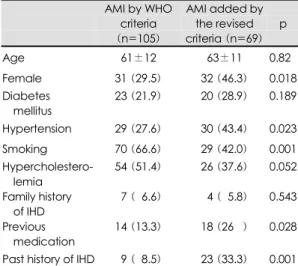
대상 환자 174명 중 트로포닌 I에 관계없이 CK-MB 가 증가하여 과거의 세계보건기구 기준을 만족하는 환자 (1군)는 105명, CK-MB 증가 없이 트로포닌만 증가 하여 새로운 ESC/ACC 정의로 추가된 환자(2군)은 69 명이었다. 제 1 군 환자에서는 남자는 74명, 여자는 31 명이었으며 평균연령은 61±12세였다. 2군 환자에서는 남자 37명, 여자 32명이었으며 평균연령은 63±11세로 1군에 비해 나이에서는 유의한 차이가 없었으나 여자가 더 많았다.
위험인자 중에 고혈압은 29명(27.6%)과 30명(43.4%) (p=0.023), 허혈성 심질환의 과거투약 병력은 14명 (13.3%)과 18명(26%)(p=0.028), 허혈성 심질환의 과 거력은 9명(8.5%)과 23명(33.3%)(p<0.001)으로 2군 에서 많았으며, 흡연은 70명(66.6%)와 29명(42.0%) (p=0.001)으로 1군에서 많았다. 그리고 당뇨는 23명 (21.9%)과 20명(28.9%)(p=0.189), 고지혈증은 54명 (51.4%)과 26명(37.6%)(p=0.052), 가족력은 7명 (6.6%)과 4명(5.8%)(p=0.543)으로 유의한 차이가 없
었다(Table 1).
관상동맥조영술은 총 174명 중 120명에서 시행하였 으며 1군에서는 84명(80%) 2군에서는 36명(52%)으 로 1군에서 더 많이 시행되었다(p=0.001). 관상동맥 조 영술상 유의한 협착이 없는 경우는 3명(3.6%)과 12명 (33.3%)(p=0.001)으로 2군에서 유의하게 많았으며 관 상동맥질환의 빈도는 1군에서 81명(96.4%)과 2군에서 24명(66.7%)로 1군에서 유의하게 많았다(p<0.001) (Table 2). 단일혈관 질환은 49명(46.6%)과 11명 (15.9%)(p<0.001)으로 1군에서 더 많았다. 이혈관 질 환과 삼혈관 질환은 각각 19명(18.0%)과 9명(13.0%) (p=0.251), 13명(12.3%)과 4명(5.7%)(p=0.120)으
로 유의한 차이가 없었다.
재원 중 치료에 있어서는 2군에서 1군보다 시술이 더 적게 시행 되었다. 약물치료만 한 경우가 33명(47.8%) 과 38명(69.5%)(p<0.001)으로 2군에서 더 많았고 스 텐트는 53명(50.4%)과 15명(21.7%)(p<0.001), 혈전 용해제는 11명(10.4%)과 0명(0%)(p=0.003)으로 1 군에서 더 많았다. 관상동맥 우회로술은 4명(3.8%)과 2명(2.8%)(p=0.552)로 차이가 없었다(Table 3). 약 물치료에서 안지오텐신전환효소 억제제는 86명(81.9%) 과 31명(44.9%)(p<0.001), 베타 차단제 79명(75.2%) 과 30명(43.4%)(p<0.001), 나이트레이트는 89명 (84.7%)과 48명(69.5%)(p=0.014), 아스피린은 94 명(89.5%)과 50명(72.4%)(p=0.004)으로 제 1 군 에서 더 많이 처방되었다(Table 2). 칼슘 길항제는 8 Table 1. Patient demographics and cardiac risk factors
AMI by WHO criteria (n=105)
AMI added by the revised criteria (n=69)
p
Age 61±12 63±11 0.820 Female 31 (29.5) 32 (46.3) 0.018 Diabetes
mellitus 23 (21.9) 20 (28.9) 0.189 Hypertension 29 (27.6) 30 (43.4) 0.023 Smoking 70 (66.6) 29 (42.0) 0.001 Hypercholestero-
lemia
54 (51.4) 26 (37.6) 0.052 Family history
of IHD
07 (06.6) 04 (05.8) 0.543
Previous medication
14 (13.3) 18 (260.) 0.028
Past history of IHD 09 (08.5) 23 (33.3) 0.001 Figures in parentheses are percentages. AMI: acute myo- cardial infarction, WHO: world health organization, IHD:
ischemic heart disease
Table 4. Medication in the hospital
AMI by WHO criteria (n=105)
AMI added by the revised criteria (n=69)
p
ACEI 86 (81.9) 31 (44.9) <0.001
ARB 04 (03.8) 04 (05.8) <0.396
Diuretics 14 (13.3) 16 (23.1) <0.071 Beta blocker 79 (75.2) 30 (43.4) <0.001 α-β blocker 07 (06.6) 04 (05.8) <0.553 Nitrate 89 (84.7) 48 (69.5) <0.014 Aspirin 94 (89.5) 50 (72.4) <0.004 Calcium channel
blocker
08 (07.6) 14 (20.2) <0.014 Figures in parentheses are percentages. AMI: acute myo- cardial infarction, WHO: world health organization, ACEI:
angiotensin converting enzyme inhibitor, ARB: angioten- sin II receptor blocker
Table 2. Coronary angiographic finding
Angiography (n=120/174)
AMI by WHO criteria (n=84/105)
AMI added by the revised
criteria (n=36/69)
p
Normal 03 (03.6) 12 (33.3) Coronary artery
disease
81 (96.4) 24 (66.7) 1 vessel
disease 49 (46.6) 11 (15.9) 2 vessel
disease
19 (18.0) 09 (13.0) 3 vessel
disease
13 (12.3) 04 (05.7)
<0.001
Figures in parentheses are percentages. AMI: acute myo- cardial infarction, WHO: world health organization
Table 3. Comparison of management in the hospital
AMI by WHO criteria (n=105)
AMI added by the revised criteria
(n=69)
p
PTCA 12 (11.4) 04 (05.8) <0.161 STENT 53 (50.4) 15 (21.7) <0.001 CABG 04 (03.8) 02 (02.8) <0.552 Thrombolytic
therapy
11 (10.4) 00 (0. .0) <0.003 Medical
treatment only
33 (47.8) 48 (69.6) <0.001
Figures in parentheses are percentages. AMI: acute myo- cardial infarction, WHO: world health organization, PTCA:
percutaneous transluminal coronary angioplasty, CABG:
coronary artery bypass graft
명(7.6%)과 14명(20.2%)(p=0.014)으로 2군에서 많 았으며 안지오텐신 Ⅱ 수용체 차단제는 4명(3.8%)과 4명(5.8%)(p=0.396), 이뇨제는 14명(13.3%)과 16 명(23.1%)(p=0.071) 그리고 알파베타차단제는 7명 (6.6%)과 4명(5.8%)(p=0.553)은 유의한 차이가 없 었다(Table 4).
재원 중 사망은 1군과 2군 각각 4명(3.8%)와 2명 (2.9%)이었고 퇴원 후 사망은 4명(3.8%)와 2명(2.9%) 이었으며 총사망은 8명(7.6%)와 4명(5.8%)이었다. 하 지만 재원 중의 사망과 퇴원 후의 사망의 차이는 두 군 간에 유의하지는 않았다. 퇴원 후 심근경색은 5명(4.7%) 과 2명(2.9%)이고 총심장사건은 13명(12.3%)과 5명 (7.2%)으로 차이가 통계적으로 유의한 것은 아니었다 (p=0.204)(Table 5). 이 두 군간의 Kaplan-Meier
method에 의한 1년이상 최대 18개월간(평균 17개월) 의 누적생존율은 1군이 89%였고 2군이 94%로 유의한 차이가 없었다(p=0.66)(Fig. 1).
고 찰
급성 심근경색의 정의는 과거 여러 기관에서 독립적으 로 정의가 되었고 수차례 개정되어 왔으며 그 임상적 의의를 찾기 위한 연구가 계속되고 있다.1)2)13)14) 급성 심근경색의 정의에서 CK-MB, Troponin I, Troponin T 등 심효소의 측정이 점차로 비중이 커져 왔음은 주 지의 사실이다. 과거의 세계보건기구 기준3)에서와 다른 점은 심효소 중 트로포닌(Troponin)이 등장했으며 트 로포닌의 민감도와 특이도에 의해 작은 병변의 심근괴 사라도 진단할 수 있게 되었다는 점이다.19) 이로 인해 과거 기준에서는 급성 심근경색으로 진단되지 않던 군 이 이제는 급성 심근경색으로 진단된다는 것이다. 그러 나 새로운 급성 심근경색의 정의가 임상적으로 어떤 의 미가 있는지 한국에서는 아직 알려진 바가 없다.
본 연구에서는 Meier 등14)21)23)의 연구에서와 같이 트 로포닌 I를 기준으로 하는 새로운 정의에 의해 급성심 근경색 환자를 나누었다. 이때 트로포닌 I의 cut-off 치 는 ESC/ACC 새로운 정의에서는 99 퍼센타일(DADE BEHRING Dimension clinical chemistry system- 0.07 μg/L)이상으로 정하였으나 저자 들은 The Com- mittee for the Standardization of Markers of Myo- cardial Damage of the International Federation of Clinical Chemistry and Laboratory Medicine에서 제 안한 기준에 의해 0.15 μg/L 이상으로 정하였다.20) 왜 냐하면 다른 연구들에서 ESC/ACC 기준에서 정한대로 99 퍼센타일로 적용한 경우 false positive의 증가 등 임상적으로 논란이 많았기 때문이었다.21) 하지만 아직도 cut-off 치에 대해서는 논란이 많으며 앞으로 이에 대한 대규모의 연구가 필요할 것으로 생각된다.
Galvani 등21)에 의한 Italian Health system의 gui- deline에서는 ESC/ACC 새로운 정의를 적용 하였을 때 급성 심근경색 환자가 약 30% 증가할 것으로 예상하였고 Meier 등14)의 연구에서는 23% 그리고 Ferguson 등23) 의 연구에서는 30%의 증가가 있었다. 본 연구에서는 66%가 증가하여 다른 연구들에 비해 높았는데 이는 진 단기준을 Ferguson 등의 연구에서는 99 퍼센타일인 0.07 Table 5. Prognosis
AMI by WHO criteria (n=105)
AMI added by the revised criteria
(n=69)
p Total cardiac
death
08 (07.6) 4 (5.8) 0.445
In-hospital death
04 (03.8) 2 (2.9) 0.552
Death after discharge
04 (03.8) 2 (2.9) 0.552
AMI after discharge
05 (04.7) 2 (2.9) 0.425
Total cardiac events
13 (12.3) 5 (7.2) 0.204 Figures in parentheses are percentages. AMI: acute myo- cardial infarction, WHO: world health organization
Fig. 1. Cumulative suvival (median duration follow-up: 17 months); 89% of AMI diagnosed by WHO criteria, 94% of AMI added by the revised criteria. There was no statisti- cally significant difference in cumulative survival between the two groups (p=0.66). AMI: acute myocardial infarc- tion, WHO: world health organization.
Cumulative survival (%)
100 090 080 070 060 050 040 030 020 010 000
0 2 4 6 8 10 12 14 16 18 Duration
AMI by WHO criteria
AMI added by the revised criteria
μg/L(Dade Behring stratus CS)이상으로, Meier 등 은 2.0 μg/L(Abbott Dianosis Dimension, Abbott part
Ⅲ) 그리고 Galvani 등은 본 연구와 같이 0.15 μg/L (Dade Dimension RxL 2nd generation)으로 정한 것 과 연구 대상의 차이와 관계있을 것으로 생각되나 더 많 은 예를 대상으로한 연구가 필요하다.
Meier 등14)의 연구에서 재원 중 사망의 발생은 과거 기준에 의한 급성 심근경색 환자 224명 중에서는 17명 (7.6%)이었고 새로운 기준에 의해서만 추가된 51명 중 에서는 2명(3.9%) 이었으며, 퇴원 후 6개월의 사망은 각 각 12명(5.8%)과 8명(16.3%), 총사망은 27명(12.9%) 과 10명(19.6%) 그리고 총심장사건은 35명(15.6%)과 10명(19.6%)으로 퇴원 후 6개월의 사망(p=0.03)은 유 의한 차이있었으나 재원 중 사망을 포함한 사건들은 두 군간에 유의한 차이가 없었다(p>0.05).14) 본 연구에서 는 양군 간에 사망 그리고 18개월 동안의 생존율 모두 유 의한 차이가 없었다. 본 연구에서는 총사망이 1군 7.6%, 2군 5.8% 였으며 Meier 등14)의 연구에서는 과거 세계 보건기구 기준의 A군에서는 12.9%, 새로운 기준에 의해 추가된 B군에서는 19.6%로 본 연구에서 더 낮은 사망 률을 보였는데 이는 연구 대상의 나이가 본 연구에서는 평균 62.5세 그리고 Meier 등의 연구에서는 64.5세로 후자에서 더 많았으며 안지오텐신전환효소 억제제의 사 용이 본 연구에서 67%로 후자(49%)보다 많았다. 그리 고 위험인자인 당뇨와 고혈압은 각각 24%와 32%, 34%
와 60%로 후자에서 더 많았다. PCI(Percutaneous Co- ronary Intervension)에 있어서는 두 연구에서 48%와 47%로 큰 차이가 없었으나 본 연구의 2군에서는 27.5%
가 시행된 데 반해서 Meier 등의 연구에서는 B군에서 17.7%로 더 적게 시행된 것을 알 수 있었다. 이와 같은 차이가 사망률의 차이와 연관이 있을 것으로 생각된다.
Meier 등14)의 연구에서 보면 새로운 정의에서만 급성 심근경색으로 진단 받은 환자가 저분자량헤파린과 Gp
Ⅱb-Ⅲa 수용체 길항제는 더 적게 투약 되었으나 아스 피린, beta-blocker, 안지오텐신전환효소 억제제의 처 방은 차이가 없었다. 그리고 경피적 관상동맥 중재술과 관상동맥 우회로술 등의 침습적인 치료는 더 적게 시행 되었다. 본 연구에서는 안지오텐신전환효소 억제제, 베 타 차단제와 아스피린이 더 적게 처방되었고 칼슘 길항 제는 더 많이 처방 되었다. 또 관상동맥 조영술과 풍선 성형술 등의 침습적인 시술이 더 적게 시행되었다. 이에
비해 Walletin 등22)의 연구에서 보면 더 적극적인 치 료를 한 경우에 더 좋은 예후를 보였었다.
결론적으로 ESC/ACC에 의한 급성심근경색의 새로운 정의는 66%까지 급성심근경색환자의 수를 증가시켰고 새로운 급성심근경색의 정의에 의해서만 진단받은 환자 들은 임상양상이 심하지 않아 침습적 치료보다는 me- dical treatment를 한 예가 많았으며 침습적 치료가 많 이 이루어진 과거 세계보건기구 기준의 급성심근경색 환 자들과 비교할 때 그 예후는 비슷하였다.
요 약
배경 및 목적
:최근 ESC/ACC에 의해 급성 심근경색이 새로이 정의 되었다. 이는 역학적인 조사와 임상분야에서 더 신속하 고 정확한 진단이 필요하게 되었고 여기에 작은 심근괴 사라도 발견할 수 있는 민감하고 특이성 있는 심효소가 개발됨에 따른 것이었다.
WHO 정의에 의한 급성 심근경색과 ESC/ACC 새로운 정의에 의해 추가된 급성 심근경색사이에서의 임상양상 과 재원 중 그리고 평균 17개월 동안의 예후를 비교하 여 새로운 정의의 임상적 의의를 알아보았다.
방 법
:대상은 2002년 1월 1일부터 2002년 6월 30일 사이 에 경북대학교 병원에 급성관동맥증후군으로 내원한 환 자로 새로운 정의에 의해 진단된 급성심근경색환자 174 명이었다. 이들 중 WHO criteria에 의해 진단된 환자는 105명이고 새로운 정의에 의해 추가된 환자는 69명이 었다. CK-MB와 트로포닌 I는 DADE BEHRING Di- mension clinical chemistry system에 의해 측정되었 다. 그리고 통계분석은 SPSS 10.0 한글판을 이용한 in- dependent t test와 chai-square test에 의해 비교되 었으며 누적생존율은 Kaplan-Meier method를 이용하 여 구하였다.
결 과
:ESC/ACC에 의한 새로운 정의는 급성 심근경색 환자 의 수를 66%까지 증가 시켰다. 새로운 정의에서 추가된 군에서 여성, 고혈압 그리고 허혈성 심질환의 과거력이 더 많았으며 경피적 관상동맥중재술은 더 적게 시행되 었다. 안지오텐신전환효소 억제제, 베타 차단제와 아스 피린은 더 적게 처방되었다. 총 심장 사건과 누적생존율
은 새로운 정의에 의해서 추가된 군과 WHO 정의에 의 한 군 사이에서(12.3%와 7.2%, 89%와 94%) 통계적 으로 유의한 차이는 없었다(p>0.05).
결 론
:새로운 정의는 급성 심근경색 환자의 수를 과거의 WHO 진단기준에서 보다 증가시켰다. 그리고 새로운 정의에 의해서만 진단 받은 환자들은 임상 양상이 심하지 않아 침습적 치료를 시행한 예가 적었고, 과거기준의 급성 심 근경색 환자들과 그 예후는 비슷하였다.
중심 단어
:심근경색;예후.REFERENCES
1) Gillum RF, Fortmann SP, Prineas RJ, Kottke TE. Internatio- nal diagnostic criteria for acute myocardial infarction and acute stroke. Am Heart J 1984;108:150-8.
2) WHO-MONICA Project MONICA Mannual. Geneva: World Health Organization; 1999.
3) Joint International Society and Federation of Cardiology/
World Health Organization Task-Force on Standardization of Clinical Nomenclature. Nomenclature and criteria for dia- gnosis of ischemic heart disease: report of the Joint Interna- tional Society and Federation of Cardiology/World Health Organization Task-Force on Standardization of Clinical No- menclature. Circulation 1979;59:607-9.
4) Alpert JS, Thygesen K, Antman E, Bassand JP. Myocardial infarction redefined: a consensus document of The Joint Eu- ropean Society of Cardiology/American College of Cardio- logy Committee for the redefinition of myocardial infarction.
J Am Coll Cardiol 2000;36:959-69.
5) Galvani M, Ottani F, Ferrini D, Ladenson JH, Destro A, Baccos D, Rusticali F, Jaffe AS. Prognostic influence of ele- vated values of cardiac troponin I in patients with unstable angina. Circulation 1997;95:2053-9.
6) Newby LK, Christenson RH, Ohman EM, Armstrong PW, Thompson TD, Lee KL, Hamm CW, Katus HA, Cianciolo C, Granger CB, Topol EJ, Califf RM. Value of serial troponin T measures for early and late risk stratification in patients with acute coronary syndromes. Circulation 1998;98:1853-9.
7) Lindahl B, Venge P, Wallentin L. Relation between troponin T and the risk of subsequent cardiac events in unstable co- ronary artery disease. Circulation 1996;93:1651-7.
8) Ohman EM, Armstrong PW, Christenson RH, Granger CB, Katus HA, Hamm CW, O’Hanesian MA, Wagner GS, Klei- man NS, Harrell FE Jr, Califf RM, Topol EJ. Cardiac troponin T levels for risk stratification in acute myocardial ischemia.
N Engl J Med 1996;335:1333-41.
9) Antman EM, Tanasijevic MJ, Thompson B, Schactman M, McCabe CH, Cannon CP, Fischer GA, Fung AY, Thompson C, Wybenga D, Braunwald E. Cardiac-specific troponin I levels to predict the risk of mortality in patients with acute
coronary syndromes. N Engl J Med 1996;335:1342-9.
10) Hamm CW, Ravkilde J, Gerhardt W, Jorgensen P, Peheim E, Ljungdahl L, Goldmann B, Katus HA. The prognostic value of serum troponin T in unstable angina. N Engl J Med 1992;
327:146-50.
11) Stubbs P, Collinson P, Moseley D, Greenwood T, Noble M.
Prospective study of the role of cardiac troponin T in patients admitted with unstable angina. BMJ 1996;313:262-4.
12) Fuchs S, Kornowski R, Mehran R, Satler LF, Pichard AD, Kent KM, Hong MK, Slack S, Stone GW, Leon MB. Cardiac troponin I levels and clinical outcomes in patients with acute coronary syndromes: the potential role of early percutaneous revascularization. J Am Coll Cardiol 1999;34:1704-10.
13) Siaplaouras J, Thul J, Will JC, Bauer J, Kreuder J, Valeske K, Akinturk H, Schranz D. Cardiac troponin I after heart sur- gery corrective operation in infancy and childhood. Z Kardiol 2001;90:408-13.
14) Meier MA, al-Badr WH, Cooper JV, Kline-Rogers EM, Smith DE, Eagle KA, Mehta RH. The new definition of myocardial infarction: diagnostic and prognostic implications in patients with acute coronary syndromes. Arch Intern Med 2002;162:
1585-9.
15) Mehta RH, Eagle KA. Missed diagnoses of acute coronary syndromes in the emergency room: continuing challenges. N Engl J Med 2000;342:1207-10.
16) Pope JH Aufderheide TP, Ruthazer R, Woolard RH, Feldman JA, Beshansky JR, Griffith JL, Selker HP. Missed diagnoses of acute cardiac ischemia in the emergency department. N Engl J Med 2000;342:1163-70.
17) Apple FS, Falahati A, Paulsen PR, Miller EA, Sharkey SW.
Improved detection of minor ischemic myocardial injury with measurement of serum cardiac troponin I. Clin Chem 1997;
43:2047-51.
18) Apple FS, Wu AH. Myocardial infarction redefined: role of cardiac troponin testing. Clin Chem 2001;47:377-9.
19) Jaffe AS, Ravkilde J, Roberts R, Naslund U, Apple FS, Gal- vani M, Katus H. It’s time for a change to a troponin standard.
Circulation 2000;102:1216-20.
20) Panteghini M, Gerhardt W, Apple FS, Dati F, Ravkilde J, Wu AH. Quality specifications for cardiac troponin assays.
Clin Chem Lab Med 2001;39:175-9.
21) Galvani M, Panteghini M, Ottani F, Cappelletti P, Chiarella F, Chiariello M, Crea F, Dolci A, Golino P, Greco C, Nicolosi GL, Plebani M, Tubaro M, Zaninotto M. The new definition of myocardial infarction: analysis of the ESC/ACC Consen- sus Document and reflections on its applicability to the Italian Health System. Ital Heart J 2002;3:543-57.
22) Wallentin L, Lagerqvist B, Husted S, Kontny F, Stahle E.
Outcome at 1 year after an invasive compared with a non- invasive strategy in unstable coronary artery disease. Lancet 2000;356:9-16.
23) Ferguson JL, Beckett GJ, Stoddart M, Walker SW, Fox KA.
Myocardial infarction redefined: the new ACC/ESC definition, based on cardiac troponin, increases the apparent incidence of infarction. Heart 2002;88:343-7.