The Influence of Exogenous Fat and Water on Lumbar Spine Bone Mineral Density in Healthy Volunteers
Kyu-Nam Kim, Bom-Taeck Kim, Kwang-Min Kim, Sat-Byul Park, Nam-Seok Joo, Sang Hyeon Je, Young-Sang Kim, and Duck-Joo Lee
Department of Family Practice and Community Health, Ajou University School of Medicine, Suwon, Korea.
Received: April 6, 2011 Revised: May 17, 2011 Accepted: May 26, 2011
Corresponding author: Dr. Duck-Joo Lee, Department of Family Practice and Community Health, Ajou University School of Medicine, 164 Worldcup-ro, Yeongtong-gu, Suwon 443-721, Korea.
Tel: 82-31-219-5324 , Fax: 82-31-217-2418 E-mail: [email protected]
∙ The authors have no financial conflicts of interest.
© Copyright:
Yonsei University College of Medicine 2012 This is an Open Access article distributed under the terms of the Creative Commons Attribution Non- Commercial License (http://creativecommons.org/
licenses/by-nc/3.0) which permits unrestricted non- commercial use, distribution, and reproduction in any medium, provided the original work is properly cited.
Purpose: Changes in human body composition can affect the accuracy of spine bone mineral density (BMD) measurements. The purpose of this study was to evaluate whether fat and water in the soft tissue of the abdomen influence lumbar spine BMD measurements obtained using dual energy X-ray absorptiometry (DXA). Materials and Methods: Duplicate BMD measurements were carried out on healthy volunteers (10 men and 10 women) and the Hologic anthropomorphic spine phantom had on the same day before and after placement of following 3 ma- terials in the abdominal area: lard 900 g, 1.5 cm thick; oil 1.4 liters in a vinyl bag;
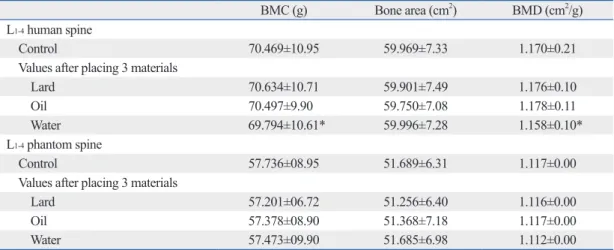
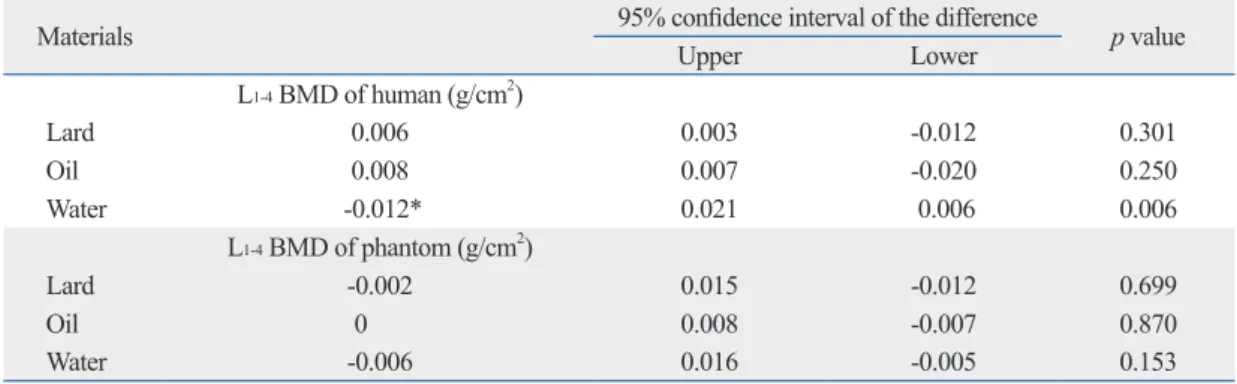
and water 1.2 liters in a vinyl bag. Results: In the case of human participants, fol- lowing the placement of exogenous water to mimic extracellular fluid (ECF), there was a significant decrease in lumbar spine BMD (-0.012 g/cm2, p=0.006), whereas the placement of exogenous lard and oil to mimic abdominal fat produced a slight increase in lumbar spine BMD (0.006 g/cm2, p=0.301; 0.008 g/cm2, p=0.250, re- spectively). The average percentage of lumbar spine BMD change with and with- out exogenous lard, oil, and water showed increase of 0.51%, and 0.67%, and de- crease of 1.02%, respectively. Using the phantom, BMD decreased with the placement of both lard (-0.002 g/cm2, p=0.699) and water (-0.006 g/cm2, p=0.153);
however, there was no difference in BMD after oil placement. Conclusion: These results suggest that in cases where changes in fat and ECF volume are similar, ECF exerts a greater influence than fat on DXA lumbar BMD measurements.
Key Words: Bone mineral density, lard, extracellular fluid, dual energy X-ray ab- sorptiometry (DXA)
INTRODUCTION
Lumbar spine bone mineral density (BMD) measured by dual energy X-ray ab- sorptiometry (DXA) is known to be the best predictor of fracture risk:1-3 DXA beam is attenuated by bone and its surrounding soft tissue. However, it is not known how much of the attenuation is influenced by bone and soft tissue. DXA is based on the assumption of homogeneity of soft tissue composition in bone and its adjacent soft tissue. Thus, some inaccuracies can result from DXA measurements, because of
tioning, which was performed on 20 healthy adults. The precision (CV%) of these measurements was 0.9% for lum- bar spine BMD. The following 3 materials were then placed consecutively on the abdominal area, and measurements were repeated: lard 900 g to mimic solid fat (20×15×1.5 cm), oil 1.2 liters (25×15 cm) to mimic liquid fat (purely 100% fat), and water 1.4 liters (25×15 cm) to mimic ECF volume. The same procedure was applied using the Holog- ic anthropomorphic spine phantom with BMD measured twice under each condition. The phantom which was made of calcium hydroxyapatite enclosed in an epoxy resin was composed of four vertebrae to simulate soft tissue. Four vertebrae have similar densities and areas. All measure- ments were performed between 3 and 6 pm. The Ethical Committee of Ajou University Hospital approved this study.
Statistics
Data were analyzed using the statistical software package SPSS for Windows 13.0 version. Paired t-tests were used to examine the significance between changes in BMD mea- surements before and after placing lard, oil, and water on the abdominal area. The independent t-test was used to check for a significant difference in BMD changes in lum- bar spine with and without exogenous lard and oil. Results were considered significant at a 2-tailed level of 0.05.
RESULTS
The average participants’ age was 30.3±3.5 (mean±SD) years and the average body mass index (BMI) was 21.4±1.2 it’s assumptions on the homogeneity of soft tissue. The in-
fluence of ascites on lumbar spine bone density measure- ments was reported by some researchers,4,5 and the fat in the adipose capsules of the kidney has also been found to lead to overestimation of the bone mineral content (BMC) in spinal BMD DXA measurements.6 The shape of verte- brae as well as thickness and amount of its covering soft tissue varies not only between subjects but also within the same person. Therefore, identifying more influencing fac- tors for DXA measurements are important for lumbar spine BMD interpretation in order to decrease DXA measure- ment error.
To our best knowledge, no study has been carried out to examine the change in DXA measured lumbar spine BMC and BMD due to changes in the different soft tissue compo- sition of the abdominal area. The purpose of this study was to evaluate how similar changes in fat and extracellular fluid (ECF) volume in the abdominal area influence lumbar spine BMC and BMD, measured with DXA, and differences due to the type of fat (solid versus liquid) were also evaluated.
MATERIALS AND METHODS
Study subjects and design
Following informed consent, healthy volunteers (10 men and 10 women) were enrolled in the study. Control BMD of L1 to L4 was measured for each participant with a LU- NAR iDXA scan (GE Healthcare, Waukesha, WI, USA).
The scanning precision (coefficient of variance, CV%) was calculated from two repeated measurements with reposi-
Table 1. BMC, Bone Area and BMD (Mean±SD) of Lumbar Spine and Phantom with and without Exogenous Lard, Oil, and Water (n=20)
BMC (g) Bone area (cm2) BMD (cm2/g) L1-4 human spine
Control 70.469±10.95 59.969±7.33 1.170±0.21
Values after placing 3 materials
Lard 70.634±10.71 59.901±7.49 1.176±0.10
Oil 70.497±9.90 59.750±7.08 1.178±0.11
Water 69.794±10.61* 59.996±7.28 1.158±0.10*
L1-4 phantom spine
Control 57.736±08.95 51.689±6.31 1.117±0.00
Values after placing 3 materials
Lard 57.201±06.72 51.256±6.40 1.116±0.00
Oil 57.378±08.90 51.368±7.18 1.117±0.00
Water 57.473±09.90 51.685±6.98 1.112±0.00
BMC, bone mineral content; BMD, bone mineral density; SD, standard deviation.
*p<0.05.
decreased 1.02% with water. The difference in lumbar spine BMD change between lard and oil, representing solid fat and liquid fat, respectively, was not statistically significant.
These materials showed similar influence on BMD, when measured with a DXA scanner made from Lunar Corp.
(Madison, WI, USA) using a phantom particularly in the case of water placement. Consequently, these results sug- gest that if changes in fat and ECF volume of the human body are similar, ECF exerts a greater influence on lumbar BMD measurements by DXA than fat.
A study showed that total-body bone mineral change, simulated by homogenously placing 8.8 kgs of porcine lard on the bodies of women, increased approximately 1.3%,7 and an other study showed also that there were some chang- es in soft tissue heterogeneity with weight loss (11.3±6.9 kg), which falsely decreased the anterior-posterior (AP) spi- nal BMD 1-2% by DXA.8 On the other hand, there was a significant increase in the spine BMD of 4.2%4 after para- centesis (6.4±2.0 L) and there was a significant increase in the spine bone mineral content of 1.5% after drainage of peritoneal dialysate (1,908±508 mL),5 in support of the present results.
To our best knowledge, this is the first report on the im- pact of human body fluid changes, because of changes in abdominal soft tissue heterogeneity on the accuracy of BMD measurements, measured by DXA. A subtraction or addition of 1 kg of ECF to Reference Man would result in roughly 0.6% over- or under-estimation of total body fat mass in a theoretical model.9 However, there was no signif- icant difference in the data obtained by DXA before and af- ter dialysis.10,11 Of note is the fact that these studies mea- sured body composition with DXA, but not BMD. Lumbar spine BMD could be measured in patients with fluid reten- tion or removal. Significant ascites can cause falsely lower kg/m2. Tables 1 and 2 show BMC, bone area and BMD dif-
ferences in lumbar spine and phantom with and without ex- ogenous lard, oil, and water. Bone density of L1 to L4 in hu- man subjects increased with the placement of lard and oil (0.006 g/cm2, p=0.301; 0.008 g/cm2, p=0.250, respective- ly); however, this was not statistically significant. In the case of water placement, BMC and BMD showed a statistically significant decrease (-0.675 g/cm2, p=0.035; -0.012 g/cm2, p=0.006, respectively). The average percentage of lumbar spine BMD change with and without exogenous lard, oil, and water showed increase of 0.51% and 0.67% and de- crease of 1.02%, respectively. With the phantom, bone den- sity decreased after placing both lard (-0.002 g/cm2, p=0.699) and water (-0.006 g/cm2, p=0.153) but there was no differ- ence in bone density after placing oil (0 g/cm2, p=0.870). In men, BMD decreased statistically significantly only when water was placed (-0.019 g/cm2, p=0.040, data not shown).
In women, when lard or oil was placed, BMD increased statistically significantly (0.016 g/cm2, p=0.039; 0.03 g/cm2, p=0.040 respectively, data not shown). Differences in lum- bar spine BMD between lard and oil, representing solid fat and liquid fat respectively, were not statistically significant (p=0.607, data not shown).
DISCUSSION
The present results indicate that fat, oil, and water influence lumbar BMD values measured by DXA. Lumbar BMD showed a statistically significant decrease upon water place- ment on the abdominal area and tended to increase slightly with the placement of lard and oil. The average percentage of lumbar spine BMD change with and without exogenous lard, and oil, increased 0.51% and 0.67%, respectively, and
Table 2. BMD Difference of Lumbar Spine and Phantom with and without Exogenous Lard, Oil, and Water (Paired t-test, n=20)
Materials 95% confidence interval of the difference
p value
Upper Lower
L1-4 BMD of human (g/cm2)
Lard 0.006 0.003 -0.012 0.301
Oil 0.008 0.007 -0.020 0.250
Water -0.012* 0.021 0.006 0.006
L1-4 BMD of phantom (g/cm2)
Lard -0.002 0.015 -0.012 0.699
Oil 0 0.008 -0.007 0.870
Water -0.006 0.016 -0.005 0.153
BMD, bone mineral density.
*p value<0.05.
ment of lard. It is quite possible that the thickness of lard used is responsible for these conflicting results.
The limitation of this study is its relatively small sample size compared with other studies, and this might be the rea- son of why lumbar BMD failed to show a significant de- crease after placing water on the abdominal area of women.
Nevertheless, the present study is the first pilot study to ex- amine the impact of human body composition change on the accuracy of BMD measurements by DXA: body com- position change may result from simultaneous heteroge- nous changes in abdominal soft tissue, i.e. changes in fat % and volume of soft tissue and ECF of the human body as they correspond to bone and non-bone pixels detected by DXA.
In conclusion, there are differences in spinal BMD mea- sured by DXA before and after placement of oil and lard, especially water, on the abdominal area to mimic abdomi- nal fat and ECF, respectively. If changes in fat and ECF vol- ume are similar, ECF influences the changes in lumbar BMD measurements more than fat; therefore, lumbar BMD mea- surements need to be interpreted carefully when there is a change, especially in fluid composition, in the soft tissue of the abdominal area.
REFERENCES
1. Marshall D, Johnell O, Wedel H. Meta-analysis of how well mea- sures of bone mineral density predict occurrence of osteoporotic fractures. BMJ 1996;312:1254-9.
2. Cauley JA, Wu L, Wampler NS, Barnhart JM, Allison M, Chen Z, et al. Clinical risk factors for fractures in multi-ethnic women: the Women’s Health Initiative. J Bone Miner Res 2007;22:1816-26.
3. Siris ES, Chen YT, Abbott TA, Barrett-Connor E, Miller PD, Wehren LE, et al. Bone mineral density thresholds for pharmaco- logical intervention to prevent fractures. Arch Intern Med 2004;
164:1108-12.
4. Labio ED, Del Rosario DB, Strasser SI, McCaughan GW, Craw- ford BA. Effect of ascites on bone density measurement in cirrho- sis. J Clin Densitom 2007;10:391-4.
5. Mann ML, Thornley-Brown D, Campbell R, Bell E, Burroughs L, Nunnally N, et al. The effect of peritoneal dialysate on DXA bone densitometry results in patients with end-stage renal disease. J Clin Densitom 2008;11:532-6.
6. Roos BO, Hansson TH, Sköldborn H. Dual photon absorptiome- try in lumbar vertebrae. Evaluation of the baseline error. Acta Ra- diol Oncol 1980;19:111-4.
7. Svendsen OL, Haarbo J, Hassager C, Christiansen C. Accuracy of measurements of body composition by dual-energy x-ray absorp- tiometry in vivo. Am J Clin Nutr 1993;57:605-8.
8. Svendsen OL, Hendel HW, Gotfredsen A, Pedersen BH, Andersen T. Are soft tissue composition of bone and non-bone pixels in spi- nal bone mineral measurements by DXA similar? Impact of
BMD measurements in the spine.4 There was a significant difference in the BMC of the spine before and after the drainage of dialyzate.5 ECF distorts tissue boundaries be- tween bone and soft tissue, resulting in an increased mea- surement of soft tissue composition and hence a smaller difference between the soft tissue and bone compartments, and consequently underestimating spinal BMD.4 In regards to gender, lumbar BMD was significantly decreased by plac- ing water on the abdominal area in men, but not women.
However, these findings should further be confirmed in fu- ture by multiple DXA scans of the same subjects as well as a larger numbers of subjects.
In the case of fat and oil used to mimic abdominal fat, the present results show that spinal BMD measurements, fol- lowing the placement of lard and oil on the abdominal area, were higher, though not significant, than without lard and oil. These results are supported by previous reports that het- erogeneity in body fat distribution may theoretically cause inconsistency in the measurements of BMD by DXA due to extrapolation of thickness and fat % of soft tissue in non- bone pixels to bone pixels.12 The present results are also in accordance with a previous cross-sectional study of post- menopausal women with a wide range of BMI,13 which in- dicated that a difference in fat % between bone and none- bone pixels may lead to overestimation of AP spinal BMD.
Higher BMD was obtained when an aluminum phantom surrounded by a 30 : 70 oil/water mixture was used to depict increased truncal thickness,14 and a significant increase in BMD measurement error was observed when ashed bone surrounded by an oil/water mixture representative of 50%
body fat was scanned.15 The possible mechanism behind these results has been explained by the study, which showed, the greater the thickness of soft tissue, the greater the result- ing X-ray attenuation and interference with bone edge de- tection, when layers of lard at a thickness of less than 9 cm were placed on a spine phantom.16 However, a previous study demonstrated different BMD’s, depending on the brands of DXA scanners used to study the changes of bone mineral measurements during weight change.17 For example, with the Lunar instruments, the total-body BMD was reduced with weight loss, whereas it appeared to increase with the Hologic scanners, indicating that differences in the brands of DXA scanners used may influence BMD value, though there is no real bone change. As for the gender, lumbar BMD was significantly increased by placing lard and oil on the abdominal area of women. However, we found that BMD assessed by DXA using a phantom decreased with the place-
women by dual energy X-ray absorptiometry and anthropometry:
comparison with computerized tomography. Int J Obes Relat Metab Disord 1993;17:45-51.
14. Johnson J, Dawson-Hughes B. Precision and stability of dual-en- ergy X-ray absorptiometry measurements. Calcif Tissue Int 1991;49:174-8.
15. Wahner HW, Dunn WL, Brown ML, Morin RL, Riggs BL. Com- parison of dual-energy x-ray absorptiometry and dual photon ab- sorptiometry for bone mineral measurements of the lumbar spine.
Mayo Clin Proc 1988;63:1075-84.
16. Compston JE, Laskey MA, Croucher PI, Coxon A, Kreitzman S.
Effect of diet-induced weight loss on total body bone mass. Clin Sci (Lond) 1992;82:429-32.
17. Tothill P. Dual-energy x-ray absorptiometry measurements of to- tal-body bone mineral during weight change. J Clin Densitom 2005;8:31-8.
weight loss. Clin Physiol Funct Imaging 2002;22:72-7.
9. Pietrobelli A, Formica C, Wang Z, Heymsfield SB. Dual-energy X-ray absorptiometry body composition model: review of physi- cal concepts. Am J Physiol 1996;271:E941-51.
10. Formica C, Atkinson MG, Nyulasi I, McKay J, Heale W, Seeman E. Body composition following hemodialysis: studies using dual- energy X-ray absorptiometry and bioelectrical impedance analy- sis. Osteoporos Int 1993;3:192-7.
11. Stenver DI, Gotfredsen A, Hilsted J, Nielsen B. Body composition in hemodialysis patients measured by dual-energy X-ray absorpti- ometry. Am J Nephrol 1995;15:105-10.
12. Svendsen OL, Hassager C, Skødt V, Christiansen C. Impact of soft tissue on in vivo accuracy of bone mineral measurements in the spine, hip, and forearm: a human cadaver study. J Bone Miner Res 1995;10:868-73.
13. Svendsen OL, Hassager C, Bergmann I, Christiansen C. Measure- ment of abdominal and intra-abdominal fat in postmenopausal