A Pilot Study of APN-led Self-management Program to Improve Cardiovascular Health Status among Korean Women with Risk Factors
Shin, Nah-Mee1 · Yoon, Ji-Won2 · Choi, Jiwon3 · Park, Younghee4 · Jeon, Songi1
1College of Nursing, Korea University, Seoul
2College of Nursing, Shinhan University, Dongducheon
3School of Nursing, University of California, San Francisco
4Department of Nursing, College of Medicine, Dongguk University, Gyeongju, Korea
Purpose: The aim of this study was to examine the effects of an Advanced Practice Nurse (APN)-led self-man- agement program on cardiovascular health status among Korean women at risk of developing or progressing cardiovascular disease. Methods: This pilot study used one-group pre- and post- test experimental design. At health fairs in a community, 30 women who had one or more risk factors for metabolic syndrome were recruited and agreed to participate in the study. A total of 25 women completed the study. The intervention consisted of weekly follow-up calls and self-monitoring diary after an hour of individual counseling regarding risk factors, fast walking, and healthy diet tailored to the participants’ needs. Physical activity was assessed with the World Health Organization International Physical Activity Questionnaire and a pedometer. Results: Participants showed statistically significant improvements in blood pressure, body mass index, levels of triglyceride, total cholesterol and low density lipoprotein, numbers of metabolic syndrome factors, and the 10-year CV risk esti- mate after one month of concentrated intervention. In addition, their physical activity behavior significantly im- proved after the intervention. Conclusion: This APN-led self-management program targeting modifiable risk factors by offering tailored counseling and concentrated support during the transition might be effective in pre- venting progression to the cardiovascular disease.
Key Words: Cardiovascular disease, Diet, Physical activity, APN, Metabolic syndrome
Corresponding author: Shin, Nah-Mee
College of Nursing, Korea University, 145 Anam-ro, Seongbuk-gu, Seoul 02841, Korea.
Tel: +82-3290-4924, Fax: +82-927-4676, E-mail: [email protected]
- This study was funded by the Korea Institute for Health & Social Affairs, Management Center for Health Promotion (General 09-46) and Nursing Research Institute of Korea University.
- A part of the paper was presented at Women’s Health 2011: The 19th Annual Congress, Washington D.C., April 2011.
Received: Mar 16, 2016 / Revised: Apr 11, 2016 / Accepted: Apr 18, 2016
This is an open access article distributed under the terms of the Creative Commons Attribution Non-Commercial License (http://creativecommons.org/licenses/
by-nc/3.0), which permits unrestricted non-commercial use, distribution, and reproduction in any medium, provided the original work is properly cited.
INTRODUCTION
Due to Koreans’rapid adaptation to westernization and urbanization in their lifestyles, fast growing incidence and prevalence of cardiovascular disease (CVD) became a ma- jor public health concern in Korea. Specifically, the in- cidence of coronary heart disease (CHD) continued to in- crease and its mortality rate increased more than ten times during the last two decades[1]. Furthermore, recent reports found increased rate of CVD among women, particularly post menopausal women[2],challenging health care pro-
viders and researchers to give more attention to women for better CVD prevention and management. Considering the fact that Korean women’s life expectancy is 84 years old and about 7 years longer than men’s[3], programs aiming at heart healthy lifestyle and risk factor management should be developed for those women at risk of developing CVD.
Yet the significant determinants of health require hard work by health care consumers since health behaviors ac- count for 50% of the causes of illness while environment, genetics, and access to health care account for 20%, 20%, and 10% of the causes of illness, respectively[4]. Therefore,
helping individuals to become aware of their modifiable risk factors and engaged in their personal health can be the best way to promote healthy behavior change. Healthy be- haviors require health education that can be best done by individual counseling[5]and by nurses, especially advan- ced practice nurses (APNs) because one of the APN’s com- petencies is to provide patient-centered care that recog- nizes the patient as the source of control and full partner in providing compassionate and coordinated care based on respect for the patient’s preferences, values, and needs[6].
Of well-known modifiable risk factors of CVD, physical inactivity and unhealthy eating behaviors are often found in women[7]. Various exercise programs including walk- ing, sport dance, and Tai Chi were, in general, found to have positive effects on cardiovascular health, serum lip- ids, or blood glucose although there were some mixed or insignificant findings among Korean women[8-12]. A tra- ditional Korean dance program consisting of nutrition ed- ucation was reported as effective in improving dietary be- haviors and some of the serum lipid profiles after the 10-weeks program in elderly women living in residential homes[13]. However, all of the above exercise programs and nutrition education were delivered through group teaching. In addition, recent study of meta-analysis about people with metabolic syndrome (MS) found that com- bined interventions of both dietary and physical activity (PA) management reduced abdominal obesity[14].
Lifestyle changes such as increasing PA and healthy diet requires strategies to help participants maintain newly learned healthy behaviors. This study examined effects of APN-led intervention tailored to meet the educational needs of individual women at risk of CVD and to encourage self-management of health behaviors including fast walk- ing and healthy eating. Also, the self-management program, designed to help women in transition to change health be- haviors, offered weekly follow-up calls and self-monitoring diary after an hour of individual counseling regarding risk factors, fast walking, and healthy eating tailored to the wo- man’s needs. Therefore, it was hypothesized that educating participants about their risk factors and supporting them in self-management behaviors of fast walking and healthy eat- ing will significantly improve their PA, dietary behavior, and cardiovascular health status.
METHODS
1. DesignThis experimental study used one-group pretest and posttest design to examine effects of an APN-led inter-
vention supporting self-management on women’s cardio- vascular health status over a one month period. Data were collected at two time points, one month apart.
2. Sample
Participants were community residing Korean women who agreed to participate in a self-management support- ing intervention designed to improve cardiovascular health status. Eligibility criteria for the study were adult women, age of 20 or older, who had one or more risk factors for MS.
Of possible candidates for participation, women who did not follow the instruction to fast at least ten hours for blood tests were excluded. Women with cancer, a history of stroke or heart attack, mental or cognitive disorders, or physical limitations that would preclude walking, were excluded. 30 women were recruited and analyses were li- mited to 25 women who completed posttest.
3. Instruments 1) General characteristics
Sociodemographic background and menopausal status were collected by self-report. Illness information includ- ing family history, past medical history, and current medi- cations were collected. Smoking status was assessed, too.
2) Physical activity and dietary behaviors
The amount of PA for the past seven days was meas- ured by frequency and duration based on the two items from the World Health Organization International Physi- cal Activity Questionnaire (WHO IPAQ)[15], days of con- tinued walking at least for ten minutes and duration of average walking per day. Also, items regarding frequency and duration of being inactive per day were also assessed.
In addition, the amount of fast walking was measured by a pedometer in terms of steps per day, duration per day, and days per week.
The Food Habit Questionnaire (FHQ)[16]was translated using a back-translation method. A bilingual and bicultu- ral nurse with a PhD degree translated the questionnaire from English into Korean, and a bilingual and bicultural psychologist with a PhD degree translated the Korea ver- sion of the questionnaire into English. The original FHQ and the back-translated English version of the FHQ were compared by these translators, and any discrepancies were discussed and revised. The translators agreed on an in- tegrated version of the translation. The FHQ with 20 items measured fat intake based on frequency over the past month. The score for each question ranges from 0 to 4 and
average scores 2.0 and above were interpreted as high fat intake representing more than 29% of fat in the diet.
In this study, Cronbach’s coefficient ⍺ was .65 and the test and retest reliability Pearson correlation coefficient was .48 (p=.014) with one month interval. Sodium intake was estimated by intake frequency of sodium containing foods over the past month, which was developed by one of the authors for this study based on the information avail- able at the National Hypertension Center[17]. The range of response choice for the 17 items was from 0 to 4, and total scores above 2.0 were regarded as high sodium intake.
Cronbach’s coefficient ⍺ was .92 and the test and retest re- liability Pearson correlation coefficient was .85 (p=.010) with one month interval.
3) Cardiovascular health status
Blood pressure. According to the seventh report of the joint national committee (JNC 7)[18] in the United States on prevention, detection, evaluation, and treatment of high blood pressure (BP), participants rested in a chair at least ten minute before taking their BP twice, at least five mi- nutes apart. If one of their BP measures was higher than 120/80mmHg, an additional BP was taken. Only when BP measures were equal to or higher than 120/80 mmHg twice was it determined as prehypertensive; BP equal to or high- er than 140/90 mmHg was determined as hypertensive;
and BP equal to or higher than 160/100 mmHg was deter- mined as severe hypertension. Automatic BP machine (FT 500R, Jawon medical., Incheon, Korea) was used to mini- mize inter-rater errors.
Obesity. In order to determine obesity, body mass index (BMI) and waist circumference (WC) were measured. Ac- cording to the guideline of the BMI interpretation by the Korean Society for the Study of Obesity, values greater than 23 kg/m2 was classified as overweight; values greater than 25 kg/m2, as obese. Korean women’s WC greater than 85cm were interpreted as abdominal obese[19].
Fasting blood tests. Blood cholesterol profile (Total cho- lesterol [TC], triglyceride, high density lipoprotein [HDL], low density lipoprotein [LDL]) and fasting blood glucose (FBG) were measured. Interpretation of each test result is summarized in Table 2 and values of HDL, triglyceride, and FBG were based on the cut off points for the MS. For example, a FBG value greater than 126 mg/dL indicates diabetes, but a value higher than 100 mg/dL regarded ab- normal as a MS risk factor[20].
Metabolic syndrome. In 1998, World Health Organiza- tion defined MS as a cluster of three or more (of five) risk factors that are associated with an increased risk of devel- opment of CHD or diabetes[19]. The cut-off point of the
risk factors of MS for women is suggested as triglycerides higher than 150 mg/dL; HDL lower than 50 mg/dL; BP higher than 130/85 mmHg; FBG higher than 100 mg/dL;
and WC greater than 85 cm.
Estimate of 10-year risk of hard coronary event. This tool developed from the Framingham Heart Study esti- mates the probability of coronary events such as heart at- tack or CHD death within 10 years. This tool is available on-line at the National Heart, Lung, and Blood Institute [http://www.nhlbi.nih.gov/health/dci/Diseases/cscan/
cscan_links.html]. Six factors needed for risk assessment include age, systolic BP, TC and HDL values, smoking, and taking BP medication.
4. Procedures
1) Recruitment and pretest
Women were recruited at the free health fair events held on Saturdays in June 2009. Health screening and health education were offered and BP, obesity indicators, and fasting blood tests were obtained. On the site, the inves- tigator invited women to participate in the intervention if they had one or more risk factors of MS based on the tests results and their responses to screening questions. After participants understood the purpose of the study and sign- ed the consent form, they completed questionnaires for collecting further information.
2) Intervention
Tailored counseling. Based on the test results and ques- tionnaires answered, the APN analyzed each participant’s risk factors and unhealthy lifestyles. Then participants were contacted to set up an appointment for an hour-long individual counseling tailored to each participant’s educa- tional needs and risk factors. In the beginning of the coun- seling, each participant’s test results and risk factors were reviewed. The APN encouraged to maintain healthy life- style and discouraged identified unhealthy behaviors.
Then, she introduced self-managed lifestyle modification of fast walking exercise and healthy eating to reduce risk of developing CVD or progressing in CVD, and offered tailored teaching and demonstration.
Fast walking exercise and DASH diet. Fast walking has been known to be beneficial for cardiovascular health, low risk for injury, easy to perform, and free of cost[8,12]. Re- commendations for the healthy eating are based on the guideline of dietary approach to stop hypertension (DASH);
a diet that limits salt and fat intake and encourages fiber intake[22]. The APN introduced fast walking exercise and DASH diet to the participants and educated them on what
to do and how. Especially, education about food choice from the DASH guideline has been modified to Korean foods choice and Korean ways of cooking. Educational booklet and refrigerator magnets developed for this study were given to them so that they could use them as easy ref- erences and daily reminders. Also, supportive materials such as a pedometer and a diary for self-monitoring were provided to each participant. Instructions and demon- strations for the fast walking exercise including warm-up and cool-down, the use of the pedometer, and the use of the diary for accurate record were given.
Weekly follow-up calls and self-monitoring diary. Fol- lowing the individual counseling done by the APN, week- ly follow-up calls from a nurse was continued for four weeks. A nurse-led telephone follow-up intervention has been reported to improve the physical dimension of health- related quality of life in patients after myocardial infarc- tion[23]. During the calls, nurses checked the participants’
compliance and barriers to behavior modifications and an- swered their questions. This was an opportunity to moti- vate them and provide reinforcement for their complian- ce. Each follow-up call also reminded them of keeping the diary for accurate recording and self-monitoring.
3) Posttest
Of 30 women who had at least one MS risk factor, 25 women (83.3%) remained in the study after four weeks of intervention and returned their diaries to the investigator.
All tests done at pretest were repeated. Main reasons for dropping-out they reported include lack of motivation to change lifestyle, overload of housework, and lack of time for exercise.
5. Ethical Consideration and Data Analysis This intervention study is done as a part of original stu- dy published elsewhere[21] that was approved by the in- stitutional review board (KU-IRB-09-16-R-2). Collected data were analyzed by descriptive statistics to describe the par- ticipants’ general characteristics and health behaviors. Ef- fects of APN-led self-management program on partici- pants’ cardiovascular health status and health behaviors were demonstrated by using paired t-test.
RESULTS
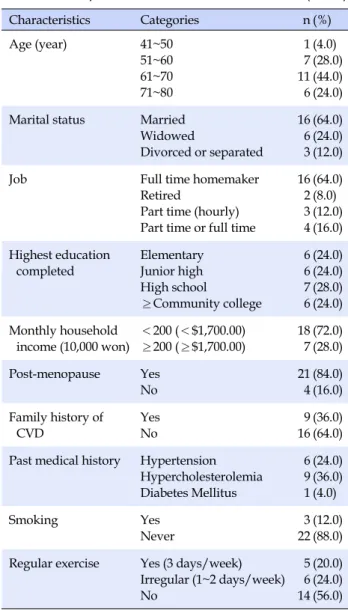
1. General CharacteristicsThe participants’ mean age was 63.8±7.5 years ranged from 48 to 76 years. About two third of them were mar-
ried. Only 28.0% reported having either a full-time or part- time job. 48% of them completed less than high school and 72.0% of them had a monthly household income of less than 2 million Korean won (≈$1,700.00). They reported son (72.0%), husband (52.0%), and daughter (40.0%) as their supportive persons when they were in need. Most of them (84.0%) were post-menopausal., The proportions of participants who were taking antihypertensive agents and lipid lowering agents were 20.0% and 8.0%, respectively.
Significant associations were found between age and past medical histories of hypertension (x2=3.950, p=.047) and hy- percholesterolemia (x2=5.00, p=.025). Other common con- ditions they had were knee arthritis (32.0%), osteoporosis (28.0%), low back pain (24.0%), obesity (16.0%) and depres- sion (8.0%). Although musculoskeletal problems were common, none reported difficulty with walking (Table 1).
Table 1. Participants’ Characteristics (N=25)
Characteristics Categories n (%)
Age (year) 41~50
51~60 61~70 71~80
1 7 11 6
(4.0) (28.0) (44.0) (24.0) Marital status Married
Widowed
Divorced or separated 16
6 3
(64.0) (24.0) (12.0)
Job Full time homemaker
Retired
Part time (hourly) Part time or full time
16 2 3 4
(64.0) (8.0) (12.0) (16.0) Highest education
completed
Elementary Junior high High school
≥Community college 6 6 7 6
(24.0) (24.0) (28.0) (24.0) Monthly household
income (10,000 won)
<200 (<$1,700.00)
≥200 (≥$1,700.00)
18 7
(72.0) (28.0) Post-menopause Yes
No
21 4
(84.0) (16.0) Family history of
CVD
Yes No
9 16
(36.0) (64.0) Past medical history Hypertension
Hypercholesterolemia Diabetes Mellitus
6 9 1
(24.0) (36.0) (4.0)
Smoking Yes
Never
3 22
(12.0) (88.0) Regular exercise Yes (3 days/week)
Irregular (1~2 days/week) No
5 6 14
(20.0) (24.0) (56.0) CVD=cardiovascular disease.
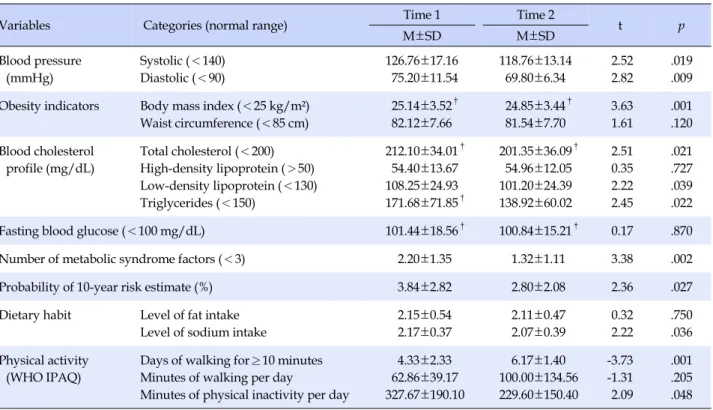
Table 2. Cardiovascular Health Status, Physical Activity, and Diet at Time 1 and Time 2 (N=25)
Variables Categories (normal range) Time 1 Time 2
t p
M±SD M±SD
Blood pressure (mmHg)
Systolic (<140) Diastolic (<90)
126.76±17.16 75.20±11.54
118.76±13.14 69.80±6.34
2.52 2.82
.019 .009 Obesity indicators Body mass index (<25 kg/m²)
Waist circumference (<85 cm)
25.14±3.52† 82.12±7.66
24.85±3.44† 81.54±7.70
3.63 1.61
.001 .120 Blood cholesterol
profile (mg/dL)
Total cholesterol (<200) High-density lipoprotein (>50) Low-density lipoprotein (<130) Triglycerides (<150)
212.10±34.01† 54.40±13.67 108.25±24.93 171.68±71.85†
201.35±36.09† 54.96±12.05 101.20±24.39 138.92±60.02
2.51 0.35 2.22 2.45
.021 .727 .039 .022
Fasting blood glucose (<100 mg/dL) 101.44±18.56† 100.84±15.21† 0.17 .870
Number of metabolic syndrome factors (<3) 2.20±1.35 1.32±1.11 3.38 .002
Probability of 10-year risk estimate (%) 3.84±2.82 2.80±2.08 2.36 .027
Dietary habit Level of fat intake Level of sodium intake
2.15±0.54 2.17±0.37
2.11±0.47 2.07±0.39
0.32 2.22
.750 .036 Physical activity
(WHO IPAQ)
Days of walking for≥10 minutes Minutes of walking per day
Minutes of physical inactivity per day
4.33±2.33 62.86±39.17 327.67±190.10
6.17±1.40 100.00±134.56 229.60±150.40
-3.73 -1.31 2.09
.001 .205 .048
†Means higher than normal range.
2. Health Behaviors
More than a half (56.0%) of participants were sedentary and 20% reported at least 15 minutes of PA per day more than three days a week at pretest. However, the most com- mon type of their regular PA was stroll (40.0%). The most common barrier to regular PA was having too many "pri- ority things" to do (40.0%). Self-monitoring diary was ana- lyzed if completed more than 21 days out of 28 days; 19 of 25 diaries (76.0%) were included for analysis. According to the diary, 80.0% of women performed fast walking exercise more than three days a week for a month, with average of 5.40±1.24 days per week ranged from 3.97 to 7 days. Their average amount of fast walking was 6,624.80±2,564.20 steps per day range from 2,765.1 to 10,961.1 steps based on their records using the pedometer. The duration of fast walking per day ranged from 29.8 to 125.3 minutes (M=51.10, SD=
25.69).
According to the two items from the WHO IPAQ, the amount of walking determined by duration and frequency was improved, and the amount of being inactive for the past seven days was significantly diminished in a month of fast walking intervention. That is, 48% of women who walked more than 30 minutes a day on average at pretest increased to 68.0% at posttest. The proportion of the wom-
en who spent more than four hours a day sitting dropped from 60.0% to 48.0%. Days of being active by walking for more than 10 minutes continuously was increased signi- ficantly from about 4 days to 6 days (t=-3.73, p=.001) along with increase in duration of walking from about 63 to 100 minutes per day on average. Conversely, the average mi- nutes of being sedentary per day was reduced from 328 to 230 minutes (t=2.09, p=.048) following the one-month in- tervention as summarized in Table 2.
The majority of participants (92.0%) reported that they prepared the meals for themselves and their families, and 84% answered they never had diet counseling in the past.
The most common barriers to diet modification reported included lack of awareness (28.0%), being too busy (28.0
%), and financial burden (24.0%). A month later, the partici- pants who reported having irregular mealtime reduced from 24% to 12% as the proportion of high fat intake (32.0
%) and high sodium intake (28.0%) decreased to 20.0% and 16%, respectively. Most (92.0%) reported that they were compliant to the low fat, low sodium diet more than 50.0%
of time during the four weeks. The proportion of women who preferred salty taste was also changed from 36.0% to 20.0% over the one month. However, only the change in sodium intake was statistically significant (t=2.22. p=.036) as shown in Table 2.
3. Cardiovascular Health Status
The proportion of women with hypertension decreased to 8.0% from 20.0% after a month of self-management pro- gram. As shown in Table 2, systolic BP significantly de- creased from 126.76±17.16 mmHg to 118.76±13.14 mmHg (t(24)=2.52, p=.019) as well as diastolic BP in a month (t(24)
=2.82, p=.009). Although 16.0% of the participants report- ed that they had been diagnosed with obesity in past, 44.0
% of the participants were found obese. The participants’
mean BMI, 25.14±3.52 kg/m2 indicating obesity significan- tly changed to 24.85±3.44 kg/m2 interpreted as overweight one month later (t=3.63, p=.001). The mean values of WC remained less than 85 cm and the proportion of women with WC was greater than 85cm was reduced from 32% to 8.0% in one month.
Although 64% of participants’ TC values were higher than the normal range at pretest and 60.0% of women re- mained abnormal at posttest, the mean value was reduced significantly to 201.35±36.09 mg/dL over the one month.
Also, 56.0% of participants’triglyceride values were great- er than 150 mg/dL at pretest and 24% at posttest as the ab- normal mean value of triglyceride significantly decreased to 138.92±60.02 mg/dL, which is within the normal range.
Although values of HDL less than 50 mg/dL were found in 44% of the participants at pretest and 32% at posttest, its mean values remained within the normal range. A reduc- tion in the mean values of LDL was significant (t=2.22, p=.039). Although reduction in the mean values of FBG was not significant, the values remained around 100 mg/dL and the proportion of women within normal range increa- sed to 60.0%.
The proportion of women found to have MS in the be- ginning of this study (44.0%) decreased to 12.0% at posttest.
Changes in the mean number of MS risk factors was statis- tically significant (t=3.38, p=.002). The estimated probabi- lity of 10-year risk of having hard coronary events showed a significant reduction (t=2.36, p=.027) from 3.84±2.82%
(1.02~6.66%) to 2.80±2.08%(0.72~4.88%) over the one month.
DISCUSSION
Considering that the participants’ mean age was in their early 60s, one third lived alone and three quarters had low household income, it is suggested that aged women might be more vulnerable and marginalized in accessing health care services for disease prevention and health promotion.
Thus, the APN-led health services which is available, ac- cessible, affordable, accountable, and acceptable commu- nity-based health programs might be a promising approa-
ch to serve the population in need. Unlike Unites States where 55% of APNswere engaged in primary care practice [24] making them visible to public and health care con- sumers, a limited numbers of APNs in Korea works main- ly in tertiary care settings. In the United States, the most common chronic illnesses for which APN primary care has been studied include diabetes, hypertension, and dys- lipidemia[25].
Hypertension, hypercholesterolemia, and obesity, the three major risk factors of CVD in Koreans can be correct- ed by prompt treatment and interventions[26]. Findings from this study, associations of aging with hypertension and hypercholesterolemia and low compliance in taking medications for the most common chronic illnesses, call for better follow-up management for aged women to pre- vent CVD related complications. Similar to the report that the obesity rate in Korean women was highest in their 50s and 60s and the incidence of obesity in women increases with age[27], almost a half of this study participants was obese and one third had abdominal obesity. Considering the mean age of the participants indicating post-meno- pause which increases the risk of developing CVD and well-known relationship of obesity to hypertension and hypercholesterolemia, women at advanced age deserve attention from health professionals.
It is important to note that only 8% of women with hy- percholesterolemia take lipid lowering agents as prescrib- ed. Reasons of low compliance rate of taking lipid low- ering agents were not explored since they are beyond the scope of this study. Furthermore, every other woman’s triglyceride values which is associated with obesity, was greater than the normal, and two thirds of the women’s TC values remained higher than normal. Since hypercholes- terolemia was associated with high fat intake[28], elevated values might be explained, in part, by dietary habits. How- ever, it was surprising that there was no woman who had followed low fat diet or received diet counseling from die- titians in the past. Thus, diet counseling tailored to one’s educational needs and risk factors should be available.
As a result of one month of self-monitoring after the tail- ored counseling including diet behaviors review with the APN, unhealthy diet behaviors were improved and TC and triglyceride values were improved significantly. Diet interventions to modify hypertension, hypercholesterole- mia, and obesity utilizing diverse resources and concen- trated individual counseling might be more effective in leading to desirable eating attitude and healthy eating be- havior than a group teaching emphasizing just informa- tional gain[29]. Since most of the participants prepared meals for themselves and their families, support for diet
modification for women may improve not only their own health but also their families’ health.
A reason why knee arthritis, osteoporosis, and low back pain were common in the participants can be explained by their mean age. Thus, exercise interventions should be age-sensitive and easy and safe to perform so that they can maximize the benefit of exercise while minimize potential risk or bodily harm. The proportion of women who per- formed regular exercise increased from one fifth to four fifths. This was a remarkable change since more than a half of the participants were sedentary and what most of them did was stroll originally. Therefore, fast walking appeared easy and low risk to those women who were physically in- active or have limited physical conditions due to age or illness. On average, they walked 6,625 steps for 51 minutes per day and five days a week for four weeks. With this high compliance to fast walking for a month as well as to low fat and low sodium diet, they showed a significant im- provement in the BMI and values of BP, TC, triglycerides, and LDL. Eventually, numbers of MS risk factors and 10-year risk estimate of coronary event showed a signifi- cant reduction since they were influenced by their assess- ment factors such as BP, TC, triglycerides although changes in WC, HDL, and FBG values were not significant. From these findings, targeting a couple of risk factors with prior- ity might be strategic to improve cardiovascular health status and reduce risk of developing CVD.
Evidence of high compliance to diet and exercise mod- ifications as recorded in their daily diary was supported by changes in diet behaviors and PA evaluated by ques- tionnaires measured at pre- and post-intervention. They were also linked to significant improvements in cardiova- scular health indicators of BP, BMI, TC, triglycerides, and LDL values and eventually reduced the prevalence of MS and the probability of 10-year risk estimate of coronary event. Using diary with the purpose of accurate data col- lection and self-monitoring appeared helpful in raising participants’awareness of their performance level of heal- thy behaviors in daily routine and in offering a chance for self-reflection.
Changing one’s lifelong habits over one month period may not be easy. Furthermore, comprehensive informa- tion regarding heart healthy lifestyle modification might be overwhelming by nature for lay persons to apply to their daily routines. Therefore, impact of individual teach- ing tailored to a person’s need on behavior change might be significant. An interesting finding from this study that the most reliable person Korean women reported was their sons, may imply their traditional family orientation which remained dominant in expecting their grown-up
sons to support them when they get old. Thus, family in- volvement in teaching for women, especially son’s encou- ragement needs to be considered to support healthy beha- vior modifications in this generation of Korean women.
Also, weekly follow-up calls from their nurses during the transition of behavior modification appeared to provide consistent support including reinforcement, encourage- ment, repetitive teaching as needed, and emotional sup- port. Even though time given for self-management with healthy behaviors was relatively short, concentrated ap- proaches showed beneficial impact on lowering partici- pants’ CVD risk factors and improving cardiovascular health status.
CONCLUSION
This pilot study examined effects of APN-led self-man- agement program promoting healthy behaviors of fast walking exercise and healthy diet on Korean women with one or more MS risk factors. Significant improvements were found in BPs, BMI, triglyceride, TC, and LDL levels, and the number of MS factors, and the 10-year risk esti- mate of coronary event after a one-month of concentrated intervention. That is, APN’s strategies of tailored counsel- ing and support used in this community-based program appeared effective to modify cardiovascular risk factors.
Suggestions for future study include cost-effectiveness an- alysis of the intervention and satisfaction with the quality of service. Limitations of this pilot study include absence of control group for comparison, limited generalizability with small sample size, and relatively short-term interven- tion period for newly learned healthy behaviors. However, the study findings suggest promising implications for wo- men at risk of developing CVD and for APNs who are com- petent to perform evidence-based practice and in-depth teaching with effective communication skills.
REFERENCES
1. Korea National Statistical Office. 2008 Annual Report for the Cause of Mortality [Internet] Seoul: [cited 2010 April, 4]. Avail- able from:
http://kosis.kr/statHtml/statHtml.do?orgId=101&tblId=DT _1B34E02&vw_cd=&list_id=&scrId=&seqNo=&lang_mode=
ko&obj_var_id=&itm_id=&conn_path=K1&path=.
2. American Heart Association (2013). Special report-fifteen-year trends in awareness of heart disease in women: results of a 2012 American Heart Association National Survey.
http://dx.doi.org/10.1161/CIR.0b013e318287cf2f
3. United Nations Population Fund. State of World Population
2012 [Internet]. New York: United Nations Population Fund;
2012 [cited 2014 June, 25]. Available from:
http://www.unfpa.org/sites/default/files/pub-pdf/EN_S WOP2012_Report.pdf
4. Shen. B. Top ten impediments to better health & health care in the United States [Internet]. California: Institute for the Future;
2005 [cited 2011 May, 18]. Available from:
http://www.iftf.org/uploads/media/SR-900_Top_Ten_Imp ediments.pdf
5. Ebrahim S, Beswick A, Burke M, Smith GD. Multiple risk fac- tor interventions for primary prevention of coronary heart di- sease. Cochrane Database of Systemic Reviews 2006 4: CD0015 61
6. Cronenwett L, Sherwood G, Pohl J, Barnsteiner J, Moore S, Sullivan DT, et al. Quality and safety education for advanced nursing practice. Nurse Outlook. 200957:338-48.
http://dx.doi.org/10.1016/j.outlook.2009.07.009
7. Trost SG, Owen N, Bauman AE, Sallis JF, Brown W. Correlates of adults' participation in physical activity: review and update.
Medicine and Science in Sports and Exercise. 2002;34(12):
1996-2001.
8. Ahn S. Effects of walking on cardiovascular risk factors and psychosocial outcomes in postmenopausal obese women. Jour- nal of Korean Academy of Nursing. 2007;37:519-28.
9. Park NH. Effects of lifestyle modification program on body composition, metabolicsyndrome markers, and depression in obese postmenopausal women. Journal of Korean Public Health Nursing. 2013;27(2):313-26.
http://dx.doi.org/10.5932/JKPHN.2013.27.2.313
10. Heo YH, Kim EJ, Seo HS, Kim SM, Choi KM, Hwang TG, et al.
The effect of 16 week exercise program on abdominal fat, se- rum lipids, blood glucose, and blood pressure in obese women.
Korean Journal of Obesity. 2010;19:16-23.
11. Lee YW, Lee, JH. Effects of 12 weeks of sports dance on cardio- vascular risk factors in abdominally obese middle-aged women.
Korean Journal of Obesity. 2007;16:16-22.
12. Song R, Ahn S, So H, Park I, Kim H, Joo K, et al. Effects of Tai Chi exercise on cardiovascular risk factors and quality of life in post-menopausal women. Journal of Korean Academy of Nurs- ing. 2009;39:136-44.
13. Kim H, June K, Song R. Effects of nutrition education and ex- ercise programs on perceived dietary behaviors, food intake and serum lipid profiles in elderly Korean women living in residential homes. Asian Nursing Research. 2007;1:35-47.
14. Lee G, Choi H, Yang S. Effects of dietary and physical activity interventions on metabolic syndrome: a meta-analysis. Journal of Korean Academy of Nursing. 2015;45:484-94.
http://dx.doi.org/10.4040/jkan.2015.45.4.483
15. Craig CL, Marshall AL, Sjostrom M, Bauman AE, Booth ML, Ainsworth BE, et al. International physical activity question-
naire: 12-country reliability and validity. Medicine and Science in Sports and Exercise. 2003;35:1381-95.
16. Kristal AR, Shattuck AL, Henry HJ. Patterns of dietary behav- ior associated with selecting diets low in fat: reliability and val- idity of a behavioral approach to dietary assessment. Journal of the American Dietetic Association. 1990;90:214-20.
17. National Hypertension Center. Diet modification [Internet].
Seoul: National Hypertension Center; 2009 [cited 2009 May, 15]. Available from:
http://www.hypertension.or.kr/viewC.php?vCode=305001
&main_num=3&sub_num=5&sub_num=2=1
18. Chobanian AV, Bakris GL, Black HR, Cushman WC, Green LA, Izzo JL, et al. National high blood pressure education pro- gram: the seventh report of the joint national committee on prevention, detection, evaluation, and treatment of high blood pressure. U. S. Department of Health & Human Services: Na- tional Institutes of Health Publication No. 04-5230 2004.
19. Lee S, Park H, Kim S, Kwon H, Kim D, Kim D, et al. Cut-off points of waist circumference for defining abdominal obesity in the Korean population. Korean Journal of Obesity. 2006;15:
1-9.
20. Grundy SM. Metabolic syndrome scientific statement by the American Heart Association and the National Heart, Lung, &
Blood institute. Arteriosclerosis, Thrombosis, & Vascular Bio- logy. 2005;25:2243-4.
http://dx.doi.org/10.1161/01.ATV.0000189155.75833.c7 21. Park YJ, Shin NM, Yoon JW, Choi JW, Lee SJ. Comparison of
cardiovascular health status and health behaviors in Korean women based on household income. Journal of Korean Acad- emy of Nursing. 2010;40(6):831-43.
http://dx.doi.org/10.4040/jkan.2010.40.6.831
22. Moore TJ, Svetkey L, Appel L, Bray G, Vollmer W. The DASH diet for hypertension. 2001. New York: Simon & Schuster.
23. Hanssen TA, Nordrehaug JE, Eide GE, Hanestad BR. Impro- ving outcomes after myocardial infarction: a randomized con- trolled trial evaluating effects of a telephone follow-up inter- vention. European Journal of Cardiovascular Preventive Reha- bilitation. 2007;14:429-37.
http://dx.doi.org/10.1097/HJR.0b013e32801da123
24. Agency for Healthcare Research and Quality(AHRQ). The number of nurse practitioners and physician assistants prac- ticing primary care in the United States. Primary Care Work- force Facts and StatsNo.2. [Internet]. U. S., 2011 [cited 2016 April, 5]. Available from
http://www.ahrq.gov/research/findings/factsheets/primary /pcwork2/index.html
25. Hart AM. The advanced practice registered nurse in chronic illness care. In: Larsen PD, editor. Lubkin’s chronic illness im- pact and intervention. 9thed. Burlington, MA: Jones & Bartlett Learning; 2016. p. 397-424.
26. Kim T, Juon H, Hill M, Post W, Kim K. Cardiovascular disease risk factors in Korean American elderly. Western Journal of Nursing Research. 2001;23(3):269-82.
http://dx.doi.org/10.1177/01939450122045140
27. Ministry of Health & Welfare. 2010 National health and nu- trition survey [Internet]. Seoul, 2011 [cited 2013 September, 19]. Available from http://knhanes.cdc.go.kr/
28. Kim S, Sohn C, Chung WY. Effects of medical nutrition therapy on food habits and serum lipid levels of hypercholesterolemic patients. Journal of Korean Dietetic Association. 2005;11:125-32.
29. Ju K, So H. Effects of the nutrition education program on self- efficacy, diet behavior pattern and cardiovascular risk factors for the patients with cardiovascular disease. Journal of Korean Academy of Nursing. 2008;38:64-73.