대한내분비외과학회지:제 1 권 제 2 호
□ 원 저 □
Vol. 1, No. 2, October, 2001
255
서 론
타이로글로불린(thyroglobulin, Tg)은 갑상선 기능이 정 상적인 모든 피검자의 혈중에서 탐지되는,(1) 오직 갑상선 의 여포세포에서 생산되고 분비되는 일종의 당단백질이 다.(2) 이러한 특성으로 말미암아, Tg는 분화성 갑상선암 종(differentiated thyroid carcinoma, DTC)의 수술요법 후 하 나의 종양표지로서 임상에도 널리 이용되고 있다.(3) 이때 요법에 의한 갑상선 조직의 완전한 제거는 혈청 Tg 측정 검사의 특이도를 높혀주며,(4) 그 민감도는 갑상선자극호 르몬(TSH) 자극 상태 하에서 측정할 때 더욱 높은 것으로 알려져 있다.(5) 그러나, 갑상선호르몬(L-T4)요법 하(TSH 억제 상태)의 혈청 Tg 측정검사라 할지라도, 연속적으로 장기간에 걸쳐 시행될 때는 종양의 진퇴를 감시하는 데 효과적이라는 것이 밝혀져 있다.(6) 게다가, L-T4요법 하 혈청 Tg 측정검사는 다른 검사에서처럼 번거로운 절차가 필요 없을 뿐만 아니라, 환자에게 불편을 주지 않는다는 장점이 있다. 이러한 의미에서, 분화성 갑상선암종 환자들 의 수술요법 후 초기에 기초 혈청 Tg 농도의 변화 양상을 알아보는 것은 환자의 장기적 추적 관리를 위하여 필요한 조치라고 생각된다.
저자는 37예의 유두상 갑상선암종 환자 집단에서 갑상 선전절제술 후 초기 2년간 L-T4요법 하 혈청 Tg 농도를 후향적으로 관찰하여 약간의 흥미있는 소견을 얻었기에 보고하고자 한다.
방 법
1996년 1월 1일부터 12월 31일까지 부산대학교병원 일 반외과에서 갑상선전절제술을 시행받았던 37예의 분화성 갑상선암종 환자를 대상으로 하였다. 이들 암종은 병리조 직학적으로 모두 유두암종이었다. 23예는 촉진되는 목림 프절 전이가 없었고(이하 Group 1으로 분류함), 14예는 한
유두상 갑상선암종 환자의 수술요법 후 혈청 타이로글로불린
부산대학교 의과대학 일반외과 최인석․예병국․한군택․심문섭
Postoperative Serum Thyroglobulin in Patients with Papillary Thyroid Carcinoma
In Seok Choi, M.D., Byung Kook Yea, M.D., Koon Taek Han, M.D. and Mun Sup Sim, M.D.
Purpose: Postoperative serial serum thyroglobulin (Tg) mea-
surements on levothyroxine (L-T4) therapy in patients with differentiated thyroid carcinoma (DTC) is known to be useful in monitoring tumor progression or regression. The objective of this study was to evaluate the significance of serum Tg levels on L-T4 therapy after surgery.Methods: To determine the basal serum Tg levels on L-T
4therapy after surgery in patients with DTC, Tg levels during the initial 2 year-period after surgery were analyzed retro- spectively in 37 patients who had undergone a total thyr- oidectomy for papillary thyroid carcinoma with (Group 2) or without (Group 1) palpable cervical lymph node metastasis.
The Tg levels had been measured 1 to 4 times for each patient with total of 53 and 35 times in Group 1 and Group 2 respectively.
Results: The basal Tg levels in Group 1 were all less than
4 ng/mL with 79.3% less than 2 ng/mL, and those in Group 2 were all less than 9 ng/mL with 71.4% less than 2 ng/mL.Conclusion: The data suggests that the postoperative
serum Tg level of 10 ng/mL can be a useful reference value in long-term follow-up after total thyroidectomy for patients with DTC. (Korean J Endocrine Surg 2001;1:255-258)Key Words: Thyroglobulin, Papillary Thyroid Carcinoma, Total
thyroidectomy
중심 단어:타이로글로불린, 유두상 갑상선암, 갑상선
전절제술
ꠏꠏꠏꠏꠏꠏꠏꠏꠏꠏꠏꠏꠏꠏꠏꠏꠏꠏꠏꠏꠏꠏꠏꠏꠏꠏꠏꠏꠏꠏꠏꠏꠏꠏꠏꠏꠏꠏꠏꠏꠏꠏꠏꠏꠏ Department of General Surgery, Pusan National University Hospital, Busan, Korea
책임저자:한군택, 부산시 서구 아미동 1가 10번지 ꂕ 602-739, 부산대학교병원 일반외과 Tel: 051-240-7238, Fax: 051-247-1365 게재승인일:2001년 10월 23일
본 논문의 요지는 2001년도 추계 대한내분비외과학회 학술대회 에서 구연되었음.
본 논문은 부산대학교병원(051-254-0171)의 지원으로 이루어 졌음.
256
대한내분비외과학회지:제 1 권 제 2 호 2001ꠏꠏꠏꠏꠏꠏꠏꠏꠏꠏꠏꠏꠏꠏꠏꠏꠏꠏꠏꠏꠏꠏꠏꠏꠏꠏꠏꠏꠏꠏꠏꠏꠏꠏꠏꠏꠏꠏꠏꠏꠏꠏꠏꠏꠏꠏꠏꠏꠏꠏꠏꠏꠏꠏꠏꠏꠏꠏꠏꠏꠏꠏꠏꠏꠏꠏꠏꠏꠏꠏꠏꠏꠏꠏꠏꠏꠏꠏꠏꠏꠏꠏꠏꠏꠏꠏꠏꠏꠏꠏꠏꠏꠏꠏꠏꠏꠏꠏ 쪽(13예) 또는 양쪽(1예)에 촉진되는 목림프절 전이를 수
반하고 있었다(이하 Group 2로 분류함). 수술요법의 내역 은 Group 1의 경우, 단순한 갑상선전절제술이 7예, 갑상선 전절제술과 한쪽(14예) 또는 양쪽(2예)의 중심 목림프절청 소술이 16예이었고, Group 2의 경우, 갑상선전절제술과 한 쪽(13예) 또는 양쪽(1예)의 변형 목림프절청소술이 14예이 었다. 수술요법 후 모든 예가 초기에 일차 131I 전신 스캐 닝을 실시받았으며, 이때 원격 전이 소견은 한 예도 없었 다. 혈청 Tg 측정검사는 수술요법 후 8주 이후부터 L-T4요 법(1일 150∼200 mcg) 하에 방사면역계측법(radioimmuno- assay, RIA)에 의하였고, 요법 후 2년 기간에 한 환자당 1∼4회, 총 88회(Group 1에서 53회, Group 2에서 35회) 실 시되었다. 환자들의 평균 나이는 47.6세(14∼75세)이었고, 여자가 33예, 남자가 4예이었다. Group 1과 Group 2의 평 균 나이는 각각 49.9세(27∼72세)와 43.9세(14∼75세)이었다.
결 과
Table 1은 Group 1과 Group 2, 그리고 전체 환자들의 수 술요법 후 L-T4요법 하 혈청 Tg 측정값들의 수준별 도수 분포를 나타낸 것이다. Group 1의 경우(23예에서 53회 측 정), 탐지 불가능이 19회(35.9%), 1 ng/mL 미만이 37회 (69.8%), 2 ng/mL 미만이 42회(79.3%), 3 ng/mL 미만이 52 회(98.1%)이었고, 4 ng/mL를 초과하는 경우는 없었다.
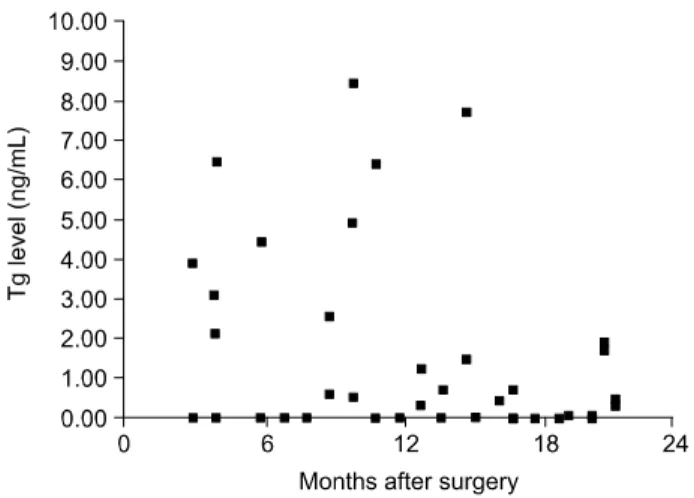
Group 2의 경우(14예에서 35회 측정), 탐지 불가능이 16회 (45.7%), 1 ng/mL 미만이 21회(60.0%), 2 ng/mL 미만이 25 회(71.4%), 3 ng/mL 미만이 27회(77.1%), 5 ng/mL 미만이
31회(88.6%)이었고, 9 ng/mL를 초과하는 경우는 없었다.
전체적으로(37예에서 88회 측정), 탐지 불가능은 35회 (39.8%), 1 ng/mL 미만은 58회(65.9%), 2 ng/mL 미만은 67 회(76.1%), 3 ng/mL 미만은 79회(89.8%)이었고, 5 ng/mL 미만은 84회(95.5%)이었다.
Fig. 1과 Fig. 2는 Group 1과 Group 2의 수술요법 후 L-T4
요법 하 혈청 Tg 측정값을 시간 경과에 따라 1개월 간격 으로 각각 표시한 것이다. Group 1의 경우, 혈청 Tg 값은 수술요법 후 2개월 이후부터 4 ng/mL 미만에서 안정적이 었으나, Group 2의 경우, 요법 후 6개월 이후, 12개월 이후 까지 9 ng/mL 미만에서 상대적으로 불안정한 양상을 나타 내었다.
Table 1. Postoperative serum thyrolglobulin (Tg) measurements on L-T4 therapy in 37 patients with papillary thyroid car- cinoma with (Group 2, n=14) or without (Group 1, n=23) palpable cervical lymph node metastasis
ꠚꠚꠚꠚꠚꠚꠚꠚꠚꠚꠚꠚꠚꠚꠚꠚꠚꠚꠚꠚꠚꠚꠚꠚꠚꠚꠚꠚꠚꠚꠚꠚꠚꠚꠚꠚꠚꠚꠚꠚꠚꠚꠚꠚꠚꠚꠚꠚꠚꠚꠚꠚꠚꠚꠚ Tg levels
Group 1 Group 2 Overall
(ng/mL)
ꠏꠏꠏꠏꠏꠏꠏꠏꠏꠏꠏꠏꠏꠏꠏꠏꠏꠏꠏꠏꠏꠏꠏꠏꠏꠏꠏꠏꠏꠏꠏꠏꠏꠏꠏꠏꠏꠏꠏꠏꠏꠏꠏꠏꠏꠏꠏꠏꠏꠏꠏꠏꠏꠏꠏ Non-detectable 19 (35.9%) 16 (45.7%) 35 (39.8%)
<1 37 (70.0%) 21 (60.0%) 58 (65.9%)
<2 42 (79.3%) 25 (71.4%) 67 (76.1%)
<3 52 (98.1%) 27 (77.1%) 79 (89.8%)
<4 53 (100.0%) 29 (82.9%) 82 (93.2%)
<5 0 31 (88.6%) 84 (95.5%)
<6 0 32 (91.4%) 85 (96.6%)
<7 0 33 (94.3%) 86 (97.7%)
<8 0 34 (97.1%) 87 (98.9%)
<9 0 35 (100.0%) 88 (100.0%)
ꠏꠏꠏꠏꠏꠏꠏꠏꠏꠏꠏꠏꠏꠏꠏꠏꠏꠏꠏꠏꠏꠏꠏꠏꠏꠏꠏꠏꠏꠏꠏꠏꠏꠏꠏꠏꠏꠏꠏꠏꠏꠏꠏꠏꠏꠏꠏꠏꠏꠏꠏꠏꠏꠏꠏ The serum Tg levels were measured 1 to 4 times for each patient with total of 53 and 35 times in Group 1 and Group 2 respectively.
Fig. 2. Postoperative serum thyroglobuin (Tg) concentration on L- T4 therapy in 14 patients who had a papillary thyroid carcinoma and palpable cervical lymph node metastasis.
Fig. 1. Postoperative serum thyroglobuin (Tg) concentration on L- T4 therapy in 23 patients who had a papillary thyroid carcinoma and no palpable cervical lymph node metastasis.
최인석 외:유두상 갑상선암종 환자의 수술요법 후 혈청 타이로글로불린
257
ꠏꠏꠏꠏꠏꠏꠏꠏꠏꠏꠏꠏꠏꠏꠏꠏꠏꠏꠏꠏꠏꠏꠏꠏꠏꠏꠏꠏꠏꠏꠏꠏꠏꠏꠏꠏꠏꠏꠏꠏꠏꠏꠏꠏꠏꠏꠏꠏꠏꠏꠏꠏꠏꠏꠏꠏꠏꠏꠏꠏꠏꠏꠏꠏꠏꠏꠏꠏꠏꠏꠏꠏꠏꠏꠏꠏꠏꠏꠏꠏꠏꠏꠏꠏꠏꠏꠏꠏꠏꠏꠏꠏꠏꠏꠏꠏꠏꠏ고 찰
타이로글로불린(Thyroglobulin, Tg)은 민감도가 높은 측 정 방법을 사용할 경우, 모든 정상인의 혈청에서 탐지가 가능하다.(1) 현재, 혈청 Tg의 정상 기준치의 한계는 3∼
40 ng/mL이다.(5) 혈청 Tg 농도에는 주간 혹은 계절간의 변이가 없으며,(7) 측정 기간의 간격에 따른 동일 개체내 의 생물학적 변차는 작으나, 개체간의 변차는 높은 것으 로 알려져 있다.(8) 대체로, 다음의 세 가지 요인이 혈청 Tg 농도를 결정한다. 갑상선 세포의 양, 갑상선의 물리적 손상, 그리고 갑상선자극호르몬 수용체의 자극이다.(9-20) 혈청 Tg 농도는 갑상선자극호르몬(TSH)이 억제되어 있을 때는, 갑상선의 양적 변화와 상관관계를 나타내며, 갑상선 의 크기가 일정할 때는, 혈청 TSH와 병행하여 하강하거나 상승한다.(21,22)
Tg는 대다수의 분화성 갑상선암종에서 탐지되며, 소수 의 이형성 갑상선암종에서도 그 존재가 확인된다.(23,24) 드물게는, 수질성 갑상선암의 어떤 변종도 Tg를 발현하는 것으로 알려져 있다.(25) 같은 분화성 갑상선암종이라 할 지라도, 여포성 갑상선암종 환자들에서 유두상 갑상선암 종 환자들보다 혈청 Tg 농도는 더욱 높은 경향이 있으며, 종양의 양과 분화도, 그리고 이들 양자의 총화와 함수관 계에 있는 것으로 보인다.(26,27) 특히, 골 전이가 있는 분 화성 갑상선암종 환자들의 경우, 혈청 Tg 농도는 대단히 높다.(28) 수술요법 전의 이러한 혈청 Tg 농도의 상승 소 견은 수술요법 이후에도 혈청 Tg가 종양의 표지로서 유용 성이 있음을 입증한다. 저자는 분화성 갑상선암종 가운데 유두상 갑상선암종 환자들(37예)을 대상으로 수술요법 이 후 초기 2년간 측정한 혈청 Tg값을 후향적으로 조사하였 으며, 수술요법 후에 예외 없이 시행된 131I 전신 스캐닝에 서 골 전이 등의 원격 전이 소견을 보인 예는 없었다.
수술요법 후의 혈청 Tg 값은 수술에 의한 갑상선 조직 의 제거 범위와 관계가 있으므로, 분화성 갑상선암종 환 자들의 Tg 값을 판독할 때는 이러한 점을 감안하여야 한 다.(6,29) 수술요법 후 혈청 Tg 측정검사의 특이도는 잔존 하는 정상 갑상선 조직이 전무할 때 가장 높다.(4) 갑상선 자극호르몬(TSH) 억제 상태하의 기초 혈청 Tg 농도는 갑 상선 조직의 양과 Tg 분비능의 총화가 나타내는 하나의 지표라고 할 수 있다. 갑상선근전절제술 혹은 갑상선전절 제술 후의 기초 혈청 Tg 값이 갑상선호르몬요법 하에 2 ng/mL 미만이면, 다른 종류의 검사에서도 종양은 더 이상 탐지되지 않으며, 이러한 경우, 병은 사실상 근치된 것으 로 간주된다.(30) 기초 혈청 Tg가 탐지 가능한 수준에 있 을 때는, 연속적인 혈청 Tg 측정이 종양의 진행과 퇴행을 감시하는 데 유용한 도구가 될 수 있다.(6) 저자의 경우, 갑상선전절제술 후의 기초 혈청 Tg 값은 전체 측정 회수
의 76.1%에서 2 ng/mL 미만이었고, 100.0%에서 9 ng/mL를 초과하지 않았다. 촉지성 목림프절 전이가 없었던 환자군 의 경우, 기초 혈청 Tg값이 4 ng/mL를 초과하는 경우가 없었다. 이러한 결과는 유두상 갑상선암종 환자들의 갑상 선전절제술 후 장기 추적에 유용한 하나의 기준이 될 것 으로 사료된다.
결 론
저자는 37예의 유두상 갑상선암종 환자들에서 갑상선전 절제술 시행 후 초기 2년간 갑상선호르몬(L-T4)요법 하에 혈청 Tg 농도의 변화 양상을, 촉진성 목림프절 전이가 없 는 환자군(23예)과 있는 환자군(14예)으로 나누어 후향적 으로 관찰하였다. 기간 중 혈청 Tg는 환자 당 1∼4회, 총 88회 측정되었다. 목림프절 전이가 없었던 환자군에서는 4 ng/mL를 초과하는 경우가 없었고, 목림프절 전이가 있 었던 환자군에서 9 ng/mL를 초과하는 경우가 없었다. 결 론적으로, 분화성 갑상선암종 환자에서 수술요법 후 L-T4
요법 하의 혈청 Tg 측정검사는, 연속적으로 장기간에 걸 쳐 시행될 경우, 암종의 진퇴를 감시하는 데 효과적이고 도 간편한 한 가지 보조 수단이 될 수 있으며, 그 판단 기 준치는 10 ng/mL이 적절할 것으로 사료된다.
REFERENCES
1) Spencer CA, TM, Kararosyan M. Current status and perfor- mance goals for serum thyroglobulin assays. Clin Chem 1996;
42:164-73.
2) Van Herle AJ, Vassart G, Dumont JE. Control of thyroglobulin synthesis and secretion (second of two parts). N Engl J Med 1979;301:307-13.
3) Schlumberger M, Baudin E. Serum thyroglobulin in the follow- up of patients with differentiated thyroid carcinoma. Eur J Endocrinol 1998;138:249-54.
4) Ozata M, Suzuki S, Miyamoto T, et al. Serum thyroglobulin in the follow-up of patients with treated differentiated thyroid cancer. J Clin Endocrinol Metab 1994;79:98-103.
5) Haugen BR, Pacini F, Reiners C, et al. A comparison of recombinant human thyrotropin and thyroid hormone with- drawal for the dectection of thyroid remnant or cancer. J Clin Endocrinol Metab 1999;84:3877-82.
6) Harvey RD, Matheson NA, Grabowski PS, et al. Measurement of serum thyroglobulin is of value in detecting tumor recur- rence following treatment of differentiated thyroid carcinoma by lobectomy. Br J Surg 1990;77:334-39.
7) Premanwardhana LDKE, Phillips DW, Prentice LM, et al.
Variability of serum thyroglobulin levels is determined by a major gene. Clin Endocrinol 1994;41:725-31.
8) Feldt-Rasmussen U, Petersen PH, Blaabjerg O, et al. Long-
258
대한내분비외과학회지:제 1 권 제 2 호 2001ꠏꠏꠏꠏꠏꠏꠏꠏꠏꠏꠏꠏꠏꠏꠏꠏꠏꠏꠏꠏꠏꠏꠏꠏꠏꠏꠏꠏꠏꠏꠏꠏꠏꠏꠏꠏꠏꠏꠏꠏꠏꠏꠏꠏꠏꠏꠏꠏꠏꠏꠏꠏꠏꠏꠏꠏꠏꠏꠏꠏꠏꠏꠏꠏꠏꠏꠏꠏꠏꠏꠏꠏꠏꠏꠏꠏꠏꠏꠏꠏꠏꠏꠏꠏꠏꠏꠏꠏꠏꠏꠏꠏꠏꠏꠏꠏꠏꠏ term variability in serum thyroglobulin and thyroid related hor-
mones in healthy subjects. Acta Endocrinol (Copenh) 1980;
95:328-34.
9) Kung AW, Collison K, Banga JP, et al. Effect of Graves' IgG on gene transcription in human thyroid cell cultures. Thyro- globulin gene activation. FFBS Lett 1988;232:12-8.
10) Telgler L, Ericsson UB, Gillquist J, et al. Basal and thyrotro- pin-stimulated secretion rates of thyroglobulin from the human thyroid gland during surgery. Thyroid 1993;3:213-9.
11) Fernandez-Soto ML, Jovanovic LG/Gonzalez-Jimenez A, et al.
Thyroid function during pregnancy and the postpartum period:
iodine metabolism and disease states. Endocrinol Pract 1998;4:
97-102.
12) Bayraktar M, Ergin M, Boyacioglu A, et al. A preliminary report of thyroglobulin release after fine-needle aspiration biopsy of thyroid nodules. J Int Med Res 1990;18:253-60.
13) Djurica S, Djordjevic DJ, Sinadinovic J. Long-term follow-up of serum thyroglobulin levels and its clinical implications in subjects after surgical removal of “cold” thyroid nodules. Exp Clin Endocrinol 1992;99:137-43.
14) Muller E, Franke WG, Koch R. Thyroiglobulin and violent asphyxia. Forensid Sci Int 1997;90:165-72.
15) Kawamura S, Kishino B, Tajima K, et al. Elevated serum thyroglogulin as a manifestation of acute haemorrhage into the thyroid gland. Clin Endocrinol 1984;20:213-9.
16) Van Herle AJ, Demeester-Mirkine N, Van Heuverswyn B, et al. The effect of 131-I for diagnostic purpose on serum thyro- globulin (hTg) levels in subjects with thyroid disorders. J Endocrinol Invest 1981;4:107-14.
17) Schlumberger M, Seba M, De Vathaire F, et al. Thyroid iodine content and serum thyroglobulin level following external irradiation to the neck for Hodgkin's disease. J Endocrinol invest 1990;13:197-203.
18) Madeddu G, Casu AR, Costanza C, et al. Serum thyroglobulin levels in the diagnosis and follow-up of subacute “painful”
thyroiditis. Arch Intern Med 1985;145:243-52.
19) Vassaart G, Drumont J. The thyrotropin receptor and the regu-
lation of thyrocyte function and growth. Endocr Rev 1992;13:
596-603.
20) Kraiem Z, Sadeh O, Blithe DL, et al. Human chorionic gona- dotropin stimulates thyroid hormone secretion, iodide uptake, organification, and adenosine 3',5'-mono-phosphate formation in cultured human thyrocytes. J Clin Endocrinol Metab 1994;
79:595-601.
21) Sato K, Okamura K, Ikennoue H, et al. TSH dependent eleva- tion of serum thyroglobulin in reversible primary hypothyroi- dism. Clin Endocrinol (Oxf) 1988;29:231-8.
22) Namba H, Yamashita S, Kimura H, et al. Evidence of thyroid volume increase in normal subjects receiving excess iodide. J Clin Endocrinol Metab 1993;76:605-12.
23) Heldin NE, Westermark B. The molecular biology of the hu- man anaplastic thyroid carcinoma cell. Thyroidology 1991;3:
127-36.
24) Ain K. Anaplastic thyroid carcinoma: behaviour, biology, and therapeutic approaches. Thyroid 1998;8:715-24.
25) Noel M, Delehye MC, Segond N, et al. Study of calcitonin and thyroglobulin gene expression in human mixed follicular and medullary thyroid carcinoma. Thyroid 1991;1:249-55.
26) Schlumberger M. Follow-up of patients with differentiated thyroid cancer. In: Didolkar JJAM, ed. Head neck cancer. Vol.
III. New York: Elsevier Science, 1993. p.903-912.
27) Sharma AK, Sarda AK, Chattopadhyay TK, et al. The role of estimation of the ratio of preoperative serum thyroglobulin to the tyroid mass in predicting the behaviour of well differ- entiated thyroid cancers. J Postgrad Med 1996;42:39-47.
28) Shah DH, Dandekar SR, Jeevanram RK, et al. Serum thyro- globulin in differentiated thyroid carcinoma: histological and metastatic classification. Acta Endocrinol (Copenh) 1981;98:
222-31.
29) Van Wyngaarden K, McDougall R. Is serum thyroglobulin a useful marker for thyroid cancer in patients who have not had ablation of residual thyroid tissue? Thyroid 1997;7:343-9.
30) Rosen IB, Luk S, Katz I. Hurthle cell tumor behavior: Dilem- ma and resolution. Surgery 1985;98:777-783.