The Value of Postoperative Serum Carcinoembryonic Antigen and Carbohydrate Antigen 19-9 Levels for the Early Detection
of Gastric Cancer Recurrence after Curative Resection
Eung-Chang Lee1, Jun-Young Yang1, Kyung-Goo Lee1, Seung-Young Oh1, Yun-Suhk Suh1, Seong-Ho Kong1, Han-Kwang Yang1,2, and Hyuk-Joon Lee1,2
1Department of Surgery, 2Cancer Research Institute, Seoul National University College of Medicine, Seoul, Korea
Purpose: This study aimed to evaluate the value of serum carcinoembryonic antigen (CEA) and carbohydrate antigen 19-9 (CA19-9) levels to detect gastric cancer recurrence.
Materials and Methods: We retrospectively reviewed 154 patients who developed recurrence within 2 years after curative gastric cancer surgery and analyzed the relationship between postoperative CEA and CA19-9 levels and recurrence. We readjusted the cut-off values to improve the detection of recurrence. Subgroup analysis according to clinicopathologic variables was performed to further investigate the relationship between recurrence and CEA and CA19-9 levels.
Results: The sensitivity and specificity for elevated CEA levels to detect recurrence were 40.6% and 89.5%, respectively, and those for CA19-9 were 34.2% and 93.6%, respectively. The sensitivity and specificity for elevation of either tumor marker were 54.3% and 84.0%, respectively; those for elevation of both tumor markers were 19.2% and 98.4%, respectively. By readjusting the cut-off values from 5.0 ng/ml to 5.2 ng/ml for CEA and from 37.00 U/ml to 30.0 U/ml for CA19-9, the sensitivity was increased from 34.2% to 40.2% for CA19-9, while there was no increase in sensitivity for CEA. In subgroup analysis, the sensitivity of CEA was higher in patients with elevated preoperative CEA levels than in patients with normal preoperative CEA levels (86.7% versus 33.7%; P<0.001). Further- more, the sensitivity of CA19-9 was higher in patients with elevated preoperative CA19-9 levels than in patients with normal preopera- tive CA19-9 levels (82.61% versus 26.83%; P<0.001).
Conclusions: CEA and/or CA19-9 measurement with the readjusted cut-off values allows for more effective detection of gastric cancer recurrence.
Key Words: Stomach neoplasms; Tumor marker; Carcinoembryonic antigen; Carbohydrate antigen 19-9; Recurrence
Correspondence to: Hyuk-Joon Lee
Department of Surgery and Cancer Research Institute, Seoul National University College of Medicine, 101 Daehak-ro, Jongno-gu, Seoul 110- 744, Korea
Tel: +82-2-2072-1957, Fax: +82-2-766-3975 E-mail: [email protected]
Received August 26, 2014 Revised October 4, 2014 Accepted October 5, 2014
Copyrights © 2014 by The Korean Gastric Cancer Association www.jgc-online.org
This is an open-access article distributed under the terms of the Creative Commons Attribution Non-Commercial License (http://creativecommons.org/
licenses/by-nc/3.0) which permits unrestricted noncommercial use, distribution, and reproduction in any medium, provided the original work is properly cited.
Introduction
Numerous gastric cancer tumor markers related to staging, diagnosis, assessing treatment response, and determining patient
prognosis have been used clinically.1-12 In addition to traditional tumor markers such as carcinoembryonic antigen (CEA), carbohy- drate antigen 19-9 (CA19-9), and CA72-4, there are tumor mark- ers specific to gastric cancer, including alpha-fetoprotein, CA-125, CA-195, CA-50, pepsinogen I/II, soluble E-cadherin, and REG4.
However, stomach cancer tumor markers are not sufficient in terms of sensitivity and specificity5 and are rarely implemented when as- sessing diagnosis and treatment.
After radical gastric cancer surgery, computed tomography (CT), esophagogastroduodenoscopy (EGD), and ultrasonography are the primary methods used to evaluate recurrence.13 However, these methods are relatively expensive and involve potentially hazardous
radiation, particularly in the case of CT. Therefore, there are certain limitations to using these methods to routinely assess disease recur- rence.
There have been few prior studies evaluating the relationship between postoperative serum tumor marker levels and recurrence after radical gastric cancer surgery;6,11,12,14 conversely, most of these reports demonstrated the relationship between preoperative serum tumor marker levels and diagnosis or prognosis of gastric cancer.1-10
The aims of this study were to evaluate the association between gastric cancer recurrence and postoperative serum tumor marker levels and to assess the suitability of current serum CEA and CA19-9 cut-off values for the early detection of gastric cancer re- currence. In addition, we performed a subgroup analysis according to clinicopathologic variables to further investigate the relationship between recurrence and levels of CEA and CA19-9.
Materials and Methods
1. Study population
This retrospective study included 1,515 patients who underwent curative (R0) gastric cancer surgery from January 1, 2005 to De- cember 31, 2006 at Seoul National University Hospital. Patients who underwent gastric cancer surgery for recurrence or metastasis were excluded. Of the 1,515 patients, 154 had confirmed disease recur- rence during the 2-year observation period.
2. Follow-up
Patient follow-up included measurement of serum CEA and CA19-9 levels, along with physical examination, abdominopelvic CT or abdominal sonography, and gastrofiberoscopy, conducted every 6 months. Because disease recurrence in most cases occurs within the first 2 years after surgery, the follow-up period for this study was 2 years.15,16 During that period, 201 patients were lost to the follow-up. The remaining 1,314 patients were included in the final analyses. Clinicopathologic and surgical characteristics, in- cluding sex, age, operation type, histological type, stage, recurrence time, recurrence sites, and preoperative tumor marker levels, were obtained through review of medical records. Gastric cancer staging was based on the American Joint Committee on Cancer classifica- tion guidelines (7th edition).
3. Tumor markers
Serum levels of CEA and CA19-9 were measured using the immunoradiometric method (the ‘sandwich’ method) with io-
dine-125. Cut-off values were 5.0 ng/ml for CEA and 37 U/ml for CA19-9.
In patients with recurrence, confirmed by imaging or pathologic findings, during the follow-up period, postoperative tumor marker levels measured <3 months before or after the time of recurrence were considered. For those without recurrence, the postoperative tumor marker levels considered were the highest levels measured during the follow-up period.
4. Statistical analysis
The sensitivity, specificity, positive predictive value, and negative predictive value of each tumor marker to detect recurrence were analyzed using the chi-square test. In addition, we also analyzed the predictive value of the combination of tumor markers.
In order to increase the utility value of serum CEA and CA19-9 levels for the early detection of recurrence after radical gastric can- cer surgery, we readjusted the cut-off values of each tumor maker using receiver operating characteristic (ROC) curves and evaluated the clinical utility of these readjusted cut-off values.
For statistical analyses, the statistical software PASW Statistics ver. 18.0 (IBM Co., Armonk, NY, USA) was used. For the deter- mination of significance, P-values less than 0.05 were considered statistically significant.
This study was approved by Institutional Review Board of Seoul National University Hospital (1404-119-575).
Results
1. Demographics
Among 1,314 patients, 154 patients had confirmed disease re- currence during the observation period. Tumor marker levels were measured within 3 months before recurrence in 74.1% of these cases and within 3 months after recurrence in 25.9% of these cases.
The number of patients who underwent a partial gastrectomy and total gastrectomy were 1,038 (79.0%) and 276 (21.0%), respectively.
There were 835 (63.5%) patients with stage I disease, 233 (16.5%) with stage II disease, and 246 (17.7%) with stage III disease. The mean recurrence time was 10.8 months. The most common recur- rence sites were the lymph nodes (n=49; 26.2%), peritoneum (n=45;
24.1%), and liver (n=32; 17.1%). In terms of preoperative tumor maker levels, CEA was elevated in 46 patients (3.5%), CA19-9 was elevated in 55 patients (4.2%), ≥2 tumor markers were elevated in 95 patients (7.2%), and both CEA and CA19-9 were elevated in 6 patients (0.5%) (Table 1).
2. The relationship between recurrence and levels of carcinoembryonic antigen and carbohydrate antigen 19-9
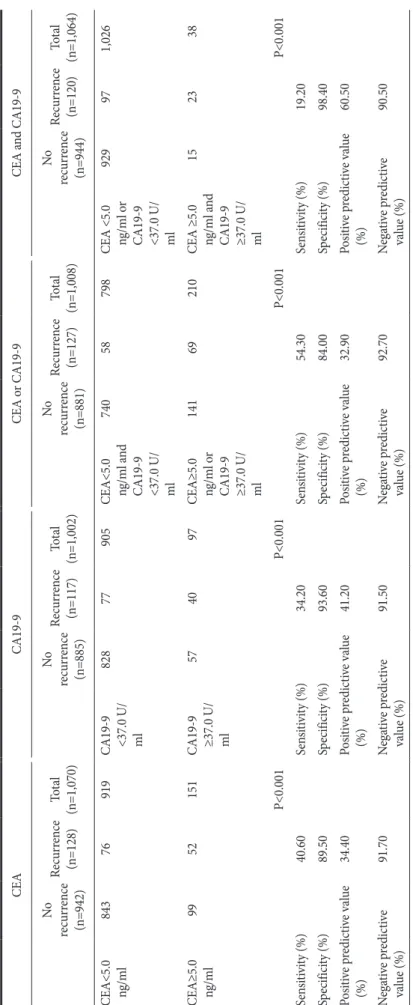
We then analyzed the relationship between disease recurrence after radical gastric cancer surgery and postoperative serum levels of CEA and CA19-9. With regard to levels of CEA, the sensitivity was 40.6%, the specificity was 89.5%, the positive predictive value was 34.4%, and the negative predictive value was 91.7%. With re- gard to levels of CA 19-9, the sensitivity was 34.2%, the specificity was 93.6%, the positive predictive value was 41.2%, and the nega- tive predictive value was 91.5%.
For the combination of both CEA and CA19-9, in the case of increased levels of a single marker, the sensitivity was 54.3%, the specificity was 84.0%, the positive predictive value was 32.9%, and the negative predictive value was 92.7%. In the case of increased levels of both markers, the sensitivity was 19.2%, the specificity was 98.4%, the positive predictive value was 60.5%, and the negative predictive value was 90.5% (Table 2).
3. Readjusting cut-off values
Our results demonstrated a relationship between recurrence after radical gastric cancer surgery and postoperative serum tumor marker levels when using cut-off values of 5.0 ng/ml for CEA and 37 U/ml for CA19-9, as these cut-off values are commonly uti- lized in clinical practice.
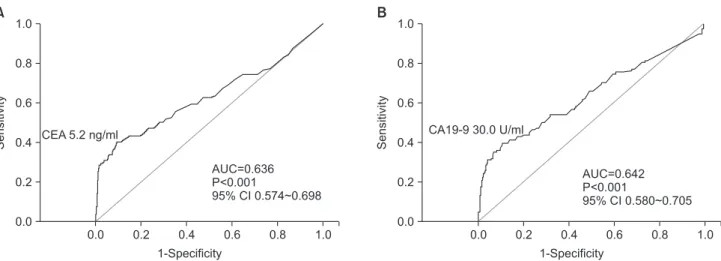
Using ROC curve analysis, we readjusted these cut-off values to 5.2 ng/ml for CEA (Fig. 1A) and to 30.0 U/ml for CA19-9 (Fig.
1B).
We then applied these readjusted cut-off values for early detec- tion of recurrence after radical gastric cancer surgery. In the case of CEA, the sensitivity was 40.6%, the specificity was 90.2%, the positive predictive value was 36.1%, and the negative predictive value was 91.8%. In the case of CA19-9, the sensitivity was 40.2%, the specificity was 89.4%, the positive predictive value was 33.3%, and the negative predictive value was 91.9% (Table 3).
4. Subgroup analysis
Next, we evaluated whether the sensitivity of postoperative serum CEA and CA19-9 levels for the early detection of recur- rence differed according to patients’ clinicopathologic and surgical variables. The cut-off values of CEA and CA 19-9 were based on the readjusted values in our study. The results demonstrated that sex, age, operation type, histological type, and stage were not sig- nificantly associated with differences in the sensitivity of CEA and Table 1. Patient characteristics (n=1,314)
Variable Value
Sex ratio (male/female) 2.03 : 1 (881/433)
Age (yr) 57.0±11.6
Operation type
Partial gastrectomy 1,038 (79)
Total gastrectomy 276 (21)
Tumor differentiation
Differentiated 663 (50.5)
Undifferentiated 637 (48.5)
Other 14 (1.1)
Tumor stage*
I 835 (63.5)
II 233 (16.5)
III 246 (17.7)
Recurrence time (mo) 10.8±6.8
Recurrence sites (154 patients, 187 specific sites)
Lymph node 49 (26.2)
Peritoneum 45 (24.1)
Liver 32 (17.1
Anastomosis site 11 (5.9)
Colon 10 (5.3)
Lung 8 (4.3)
Ureter 8 (4.3)
Abdominal wall 5 (2.7)
Bone 4 (2.1)
Ovary 4 (2.1)
Adrenal gland 3 (1.6)
Brain 3 (1.6)
Gall bladder 2 (1.1)
Rectum 2 (1.1)
Pancreas 1 (0.5)
Preoperative tumor markers
CEA (normal/elevated) 1,099/46 (unknown/169) (83.6/3.5 [unknown/12.9]) CA19-9 (normal/elevated) 1,087/55 (unknown/172) (82.7/4.2 [unknown/13.1]) CEA or CA19-9 (normal/elevated) 1,044/95 (unknown/175) (79.5/7.2 [unknown/13.3]) CEA and CA19-9 (normal/elevated) 1,142/6 (unknown/166)
(86.9/0.5 [unknown/12.6]) Values are presented as ratio (number/number), mean±standard deviation, or number (%). CEA = carcinoembryonic antigen; CA19-9
= carbohydrate antigen 19-9. *This stage was based on the 7th edition on AJCC cancer staging system.
Table 2. The Relationship between CEA, CA19-9, and recurrence CEACA19-9CEA or CA19-9CEA and CA19-9 No recurrence (n=942)Recurrence (n=128)Total (n=1,070) No recurrence (n=885)Recurrence (n=117)Total (n=1,002) No recurrence (n=881)Recurrence (n=127)Total (n=1,008) No recurrence (n=944)Recurrence (n=120)Total (n=1,064)
CEA<5.0 n84376919 g/ml
CA19-9 <37.0 U/ m
l
82877905
CEA<5.0 ng/ml and
CA19-9 <37.0 U/ ml
74058798
CEA <5.0 ng/ml or
CA19-9 <37.0 U/ ml
929971,026
CEA≥5.0 n9952151 g/ml
CA19-9 ≥37.0 U/ m
l
574097
CEA≥5.0 ng/ml or
CA19-9 ≥37.0 U/ ml
14169210
CEA ≥5.0 ng/ml and
CA19-9 ≥37.0 U/ ml
152338 P<0.001P<0.001P<0.001P<0.001 Sensitivity (%)40.60Sensitivity (%)34.20Sensitivity (%)54.30Sensitivity (%)19.20 Specificity (%)89.50Specificity (%)93.60Specificity (%)84.00Specificity (%)98.40 Positive predictive value (%)34.40Positive predictive value (%)41.20Positive predictive value (%)32.90Positive predictive value (%)60.50 Negative predictive value (%)91.70Negative predictive value (%)91.50Negative predictive value (%)92.70Negative predictive value (%)90.50 CEA = carcinoembryonic antigen; CA19-9 = carbohydrate antigen 19-9.
CA19-9 levels.
However, the sensitivity of postoperative CEA levels for early detection of recurrence was significantly higher in patients with elevated preoperative CEA levels than in patients with normal pre- operative CEA levels (33.66% versus 86.67%; P<0.001). Similarly, the sensitivity of postoperative CA19-9 for the early detection of recurrence was much higher in patients with elevated preoperative CA19-9 levels than in patients with normal preoperative CA19-9 levels (26.83% versus 82.61%; P<0.001). Similar trends were ob- served for the combination of CEA and CA19-9 (Table 4).
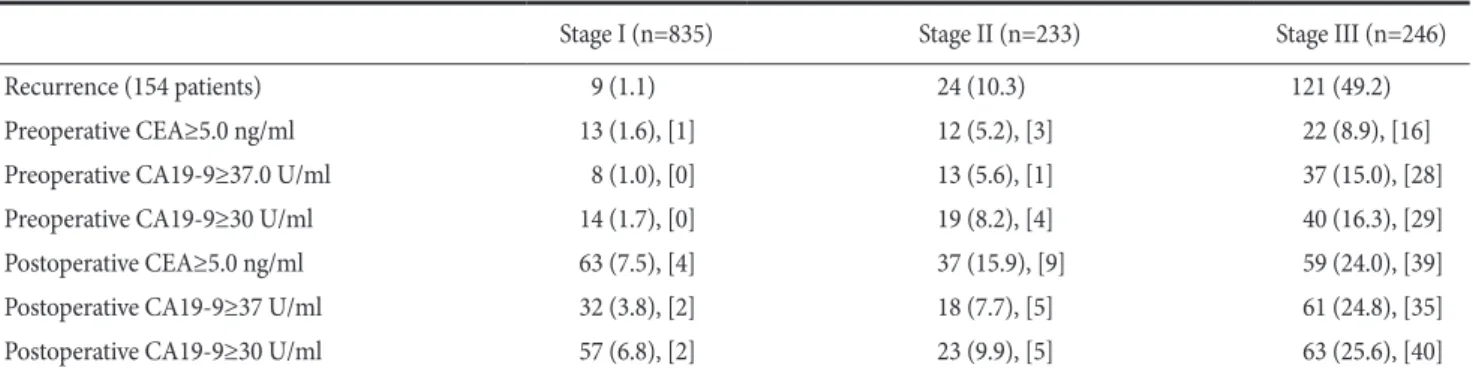
Most of the tumor marker elevation and recurrence were ob- served for Stage III cancer. Of the 154 patients who displayed re- currences within the observation period of 2 years, 9 patients had Stage I, 24 patients Stage II, and 121 patients Stage III disease.
For Stage III disease, the number of patients with postoperative CEA elevation was 59 (24.0%). The number of patients with post- operative CA19-9 elevation above 37 U/ml was 61 (24.8%), and 63 (25.6%) patients showed CA19-9 levels above 30 U/ml (Table 5).
Discussion
Various methods have been proposed to detect early recurrence of gastric cancer following radical surgery. However, with the ex- ception of CT, EGD, ultrasonography, and measurement of blood tumor markers, few methods have shown promise for clinical use.
Moreover, CT, EGD, and ultrasonography are relatively expensive methods and may be too burdensome to patients.
Similar to the majority of tumor markers, there are certain limi- tations to using CEA and CA19-9 levels to detect recurrence after radical gastric cancer surgery; particularly, these markers have low sensitivity. According to Marrelli et al.,6 the sensitivity in patients with recurrences was 44% for CEA and 56% for CA 19-9, while the specificity was 79% for CEA and 74% for CA 19-9. The posi- tive predictive value was 73% for CEA and 74% for CA19-9 and the negative predictive value was 52% for CEA and 57% for CA19- 9.
In addition, the cut-off values of CEA and CA19-9 used pri- Fig. 1. Readjusted cut-off values for carcinoembryonic antigen (CEA) and carbohydrate antigen 19-9 (CA19-9). The curves depict the readjusted cut-off values for CEA (A) and CA19-9 (B) for early detection of recurrence, following radical gastrectomy. AUC = area under the curve; CI = con- fidence interval.
A
0.0 0.2 0.4 0.6 0.8 1.0
1.0
0.8
0.6
0.4
0.2
Sensitivity
1-Specificity 0.0
B
0.0 0.2 0.4 0.6 0.8 1.0
1.0
0.8
0.6
0.4
0.2
Sensitivity
1-Specificity 0.0
CEA 5.2 ng/ml
AUC=0.636 P<0.001
95% CI 0.574~0.698
CA19-9 30.0 U/ml
AUC=0.642 P<0.001
95% CI 0.580~0.705
Table 3. Comparison between current and readjusted cut-off values of serum CEA and CA19-9 for early detection of recurrence after radical gastric cancer surgery
CEA CA19-9
5 ng/ml (current) 5.2 ng/ml (readjusted) 37 U/ml (current) 30.0 U/ml (readjusted)
Sensitivity (%) 40.60 40.60 34.20 40.20
Specificity (%) 89.50 90.20 93.60 89.40
Positive predictive value (%) 34.40 36.10 41.20 33.30
Negative predictive value (%) 91.70 91.80 91.50 91.90
CEA = carcinoembryonic antigen; CA19-9 = carbohydrate antigen 19-9.
Table 4. Subgroup analysis
Variable Postoperative CEA Postoperative CA19-9
Sensitivity (%) P-value Sensitivity (%) P-value
Sex 0.1 0.882
Male 35.16 38.82
Female 52.63 42.42
Age (yr) 0.697 0.224
≥60 42.47 45.45
<60 37.50 32.69
Operation 0.919 0.256
Partial gastrectomy 40.00 45.31
Total gastrectomy 40.68 33.33
Tumor histology 0.124 0.428
Differentiated 51.28 47.06
Undifferentiated 34.88 37.04
Preoperative CEA <0.001 0.894
Normal 33.66 39.36
Elevated 86.67 36.36
Preoperative CA19-9 0.131 <0.001
Normal 36.56 26.83
Elevated 56.52 82.61
Preoperative CEA or CA19-9 <0.001 <0.001
Normal 27.85 26.39
Elevated 67.57 66.67
Preoperative CEA and CA19-9 0.852 0.822
Normal 40.35 38.46
Elevated 100.00 100.00
CEA = carcinoembryonic antigen; CA19-9 = carbohydrate antigen 19-9.
Table 5. The relationship between cancer stage and recurrence or CEA, CA19-9
Stage I (n=835) Stage II (n=233) Stage III (n=246)
Recurrence (154 patients) 9 (1.1) 24 (10.3) 121 (49.2)
Preoperative CEA≥5.0 ng/ml 13 (1.6), [1] 12 (5.2), [3] 22 (8.9), [16]
Preoperative CA19-9≥37.0 U/ml 8 (1.0), [0] 13 (5.6), [1] 37 (15.0), [28]
Preoperative CA19-9≥30 U/ml 14 (1.7), [0] 19 (8.2), [4] 40 (16.3), [29]
Postoperative CEA≥5.0 ng/ml 63 (7.5), [4] 37 (15.9), [9] 59 (24.0), [39]
Postoperative CA19-9≥37 U/ml 32 (3.8), [2] 18 (7.7), [5] 61 (24.8), [35]
Postoperative CA19-9≥30 U/ml 57 (6.8), [2] 23 (9.9), [5] 63 (25.6), [40]
Values are presented as number (%). Numbers in the brackets are the number of patients with gastric cancer recurrence. CEA = carcinoembryonic antigen; CA19-9 = carbohydrate antigen 19-9.
marily in colorectal disease and pancreatic disease have been ap- plied to gastric cancer.17-20 Therefore, these current cut-off values have not been properly validated for use in the early detection of gastric cancer recurrence. In this study, we established new cut-off values to improve the low sensitivity of these tumor markers for gastric cancer and to evaluate whether currently used cut-off values of CEA and CA19-9 are appropriate for detection of recurrence.
Consequently, in the case of CEA, there was only a slight change in sensitivity after readjusting the cut-off value. Conversely, in the case of CA19-9, there was an increase in sensitivity of ap- proximately 6% after readjustment of the cut-off value. Even though there were some improvements in sensitivity, further tests are necessary to confirm these results.
Because of the aforementioned limitations, it is important to identify more sensitive and specific tumor markers to detect disease recurrence. However, based on the results of this study, we believe that using the readjusted cut-off value presented here, CA19-9 lev- els may be useful to monitor and screen for recurrence after radical gastric cancer surgery. Nevertheless, this study was performed ret- rospectively, so additional prospective studies are needed to confirm these results.
In addition, among patients with elevated preoperative levels of CEA or CA19-9, elevated postoperative CEA and CA19-9 levels had a higher sensitivity for the early detection of recurrence. Ex- pression of CEA and CA 19-9 in gastric cancer, as determined by immunohistochemistry (IHC), was present in 50% to 70% and ap- proximately 30% of cases, respectively.21-23 Thus, postoperative IHC staining for CEA and CA19-9 may be an effective and valuable screening tool to detect gastric cancer recurrence. However, IHC staining in all cases of gastric cancer is both ineffective and waste- ful. Performing IHC only in cases with normal preoperative and elevated postoperative tumor marker levels would allow for more efficient confirmation of disease recurrence.
On the other hand, we followed patients for 2 years after radical gastric cancer surgery in this study. During that period, 201 (13.3%) patients were lost to follow-up. According to long-term follow up studies, 79% of recurrences after radical gastric cancer surgery oc- cur within 2 years.15,16 In addition, in our hospital in Seoul, South Korea, early gastric cancer patients are followed up every 6 months for 2 years. Moreover, many cases transferred to nearby hospitals after 2 years of follow-up. Therefore, in this study, a follow-up period of 2 years was considered a reasonable amount of time to evaluate the relationship between serum tumor marker levels and recurrence after radical gastric cancer surgery.
In conclusion, measurement of postoperative CEA and/or CA19-9 levels with readjusted cut-off values allows for more ef- fective detection of gastric cancer recurrence. However, our re- search has limitations: we did not perform a validation of our findings and our data include a low positive predictive value for the new CA19-9 range.
Acknowledgments
This study was supported by research grant from Cancer Re- search Institute, Seoul National University (2012) and by a grant from the National R&D Program for Cancer Control, Ministry of Health & Welfare, Republic of Korea (1320270).
This study was orally presented at the 85th Annual Meeting of Japanese Gastric Cancer Association and the results were displayed as a poster at the Korea International Gastric Cancer Week 2014, 65th Annual Congress of the Korean Surgical Society.
References
1. Carpelan-Holmström M, Louhimo J, Stenman UH, Alfthan H, Haglund C. CEA, CA 19-9 and CA 72-4 improve the diagnos- tic accuracy in gastrointestinal cancers. Anticancer Res 2002;
22:2311-2316.
2. Pectasides D, Mylonakis A, Kostopoulou M, Papadopoulou M, Triantafillis D, Varthalitis J, et al. CEA, CA 19-9, and CA-50 in monitoring gastric carcinoma. Am J Clin Oncol 1997;20:348- 353.
3. Ishigami S, Natsugoe S, Hokita S, Che X, Tokuda K, Nakajo A, et al. Clinical importance of preoperative carcinoembryonic antigen and carbohydrate antigen 19-9 levels in gastric cancer.
J Clin Gastroenterol 2001;32:41-44.
4. Ychou M, Duffour J, Kramar A, Gourgou S, Grenier J. Clinical significance and prognostic value of CA72-4 compared with CEA and CA19-9 in patients with gastric cancer. Dis Markers 2000;16:105-110.
5. Shimada H, Noie T, Ohashi M, Oba K, Takahashi Y. Clinical significance of serum tumor markers for gastric cancer: a sys- tematic review of literature by the Task Force of the Japanese Gastric Cancer Association. Gastric Cancer 2014;17:26-33.
6. Marrelli D, Pinto E, De Stefano A, Farnetani M, Garosi L, Roviello F. Clinical utility of CEA, CA 19-9, and CA 72-4 in the follow-up of patients with resectable gastric cancer. Am J Surg 2001;181:16-19.
7. Marrelli D, Pinto E, De Stefano A, de Manzoni G, Farnetani M, Garosi L, et al. Preoperative positivity of serum tumor mark- ers is a strong predictor of hematogenous recurrence of gastric cancer. J Surg Oncol 2001;78:253-258.
8. Marrelli D, Roviello F, De Stefano A, Farnetani M, Garosi L, Messano A, et al. Prognostic significance of CEA, CA 19-9 and CA 72-4 preoperative serum levels in gastric carcinoma. On- cology 1999;57:55-62.
9. Gaspar MJ, Arribas I, Coca MC, Díez-Alonso M. Prognostic value of carcinoembryonic antigen, CA 19-9 and CA 72-4 in gastric carcinoma. Tumour Biol 2001;22:318-322.
10. Tocchi A, Costa G, Lepre L, Liotta G, Mazzoni G, Cianetti A, et al. The role of serum and gastric juice levels of carcinoem- bryonic antigen, CA19.9 and CA72.4 in patients with gastric cancer. J Cancer Res Clin Oncol 1998;124:450-455.
11. Choi SR, Jang JS, Lee JH, Roh MH, Kim MC, Lee WS, et al.
Role of serum tumor markers in monitoring for recurrence of gastric cancer following radical gastrectomy. Dig Dis Sci 2006;
51:2081-2086.
12. Takahashi Y, Takeuchi T, Sakamoto J, Touge T, Mai M, Ohkura H, et al; Tumor Marker Committee. The usefulness of CEA and/or CA19-9 in monitoring for recurrence in gastric cancer patients: a prospective clinical study. Gastric Cancer 2003;6:
142-145.
13. Whiting J, Sano T, Saka M, Fukagawa T, Katai H, Sasako M.
Follow-up of gastric cancer: a review. Gastric Cancer 2006;9:
74-81.
14. Qiu MZ, Lin JZ, Wang ZQ, Wang FH, Pan ZZ, Luo HY, et al.
Cutoff value of carcinoembryonic antigen and carbohydrate antigen 19-9 elevation levels for monitoring recurrence in pa- tients with resectable gastric adenocarcinoma. Int J Biol Mark- ers 2009;24:258-264.
15. Lee HJ, Kim YH, Kim WH, Lee KU, Choe KJ, Kim JP, et al.
Clinicopathological analysis for recurrence of early gastric can- cer. Jpn J Clin Oncol 2003;33:209-214.
16. D'Angelica M, Gonen M, Brennan MF, Turnbull AD, Bains M, Karpeh MS. Patterns of initial recurrence in completely re- sected gastric adenocarcinoma. Ann Surg 2004;240:808-816.
17. Steinberg WM, Gelfand R, Anderson KK, Glenn J, Kurtz- man SH, Sindelar WF, et al. Comparison of the sensitivity and specificity of the CA19-9 and carcinoembryonic antigen assays in detecting cancer of the pancreas. Gastroenterology 1986;90:343-349.
18. Takasaki H, Uchida E, Tempero MA, Burnett DA, Metzgar RS, Pour PM. Correlative study on expression of CA 19-9 and DU-PAN-2 in tumor tissue and in serum of pancreatic cancer patients. Cancer Res 1988;48:1435-1438.
19. Wanebo HJ, Rao B, Pinsky CM, Hoffman RG, Stearns M, Schwartz MK, et al. Preoperative carcinoembryonic antigen level as a prognostic indicator in colorectal cancer. N Engl J Med 1978;299:448-451.
20. Kondo N, Murakami Y, Uemura K, Hayashidani Y, Sudo T, Hashimoto Y, et al. Prognostic impact of perioperative serum CA 19-9 levels in patients with resectable pancreatic cancer.
Ann Surg Oncol 2010;17:2321-2329.
21. Lee HS, Choi SI, Lee HK, Kim HS, Yang HK, Kang GH, et al.
Distinct clinical features and outcomes of gastric cancers with microsatellite instability. Mod Pathol 2002;15:632-640.
22. Imada T, Rino Y, Takahashi M, Hatori S, Shiozawa M, Tanaka J, et al. Expression of CA19-9, SLX, STN and CEA in relatively early gastric carcinoma. Oncol Rep 1997;4:899-904.
23. Lee HS, Lee HK, Kim HS, Yang HK, Kim WH. Tumour sup- pressor gene expression correlates with gastric cancer progno- sis. J Pathol 2003;200:39-46.