c Korean Medical Association
This is an Open Access article distributed under the terms of the Creative Commons Attribution Non-Commercial License (http://creativecommons.
서 론
신
체활동 부족(physical inactivity)은 명백하고 독립적 인 건강 위험으로 관상동맥질환의 주요 위험요인으 로 규정되었다[1]. 신체활동은 한국인의 건강결정요인 분석 에서 과체중과 비만을 제외하고도 3.75%의 기여도를 보여 2003년 기준 약 1조 2,213억 원의 질병비용이 발생된다고 하였다[2]. 그런데도 19세 이상 한국인의 70.4%가‘비 운동군’혹은‘낮은 운동량’의 신체활동량을 보였고, 고혈압, 당뇨병, 고지혈증, 대사증후군 등 신체활동 관련 질환이 있 는 경우는 신체활동 정도가 더 낮았다[3]. 따라서 의료법 제 2조[4]에 의해‘의료와 보건지도를 임무로’하여‘국민보건 향상을 이루고 국민의 건강한 생활 확보에 이바지할 사명을 가지’는 의사들은 세계적인 새 접근 틀에 의한 신체활동 권 고와 지침의 동향을 파악하여 의료현장에서의 적용을 모색 할 필요가 있다. 또 전문적 운동검사처방지침[5] 외에도 일
새 접근틀에 의한 신체활동 권고와 지침의 동향
고 광 욱1,2*| 1고신대학교 의과대학 예방의학교실, 2한국운동지도협회
Physical activity recommendations and guidelines based on a new paradigm
Kwang Wook Koh, MD1,2*
1Department of Preventive Medicine, Kosin University College of Medicine, Busan, 2Korean Exercise Instruction Association, Seoul, Korea
* Corresponding author: Kwang Wook Koh, E-mail: [email protected] Received July 23, 2010 Accepted October 1, 2010
A
s new physical activity recommendations and guidelines have spread globally since 1996, scrutiny of the evolution of national physical activity recommendations and guidelines for application to the Korean medical field iare needed. Retrieving literatures and electric database confined to aerobic activity of adult. Most findings were based on the results of epidemiological and behavioral studies of physical activity and health. Most national physical activity recommendations and guidelines have a‘physical activity for health’paradigm instead of an ‘exercise for fitness’paradigm. Most stressed the health benefits of accumulation of moderate intensity of a wide variety of physical activity and the importance of the total amount rather than the specific frequency, intensity, time, or type of physical activity. Some used scientific health behavior theories. Research- based applications of evidence based physical activity policy to Korean medical practice are suggested. Korean medical field could have initiatives in comprehensive physical activity policy in Korean health promotion if actively adopting the new physical activity for health paradigm.
Keywords: Physical activity; Public policy; Moderate intensity
Abstract
상적 진료현장에서 원활한 적용을 위해서는 세계적 신체활 동 권고와 지침의 변천사항과 그 접근 틀 변화의 주요 내용 에 대한 이해가 필요하다.
전 세계적 신체활동기준 변화의 분수령은 1996년 신체 활동과 건강에 관한 미국의무감보고서[6]였다. 이후 1998 년 캐나다[7]와 1999년 호주[8]에서 국가신체활동지침이 개발된 이후, 2004년 영국을 거쳐 세계보건기구 지역사무 처[9]와 그 지역 내 국가[10]에까지 유사한 패러다임의 지 침이 보급되는 등 다양한 변화와 발전을 보여왔으나 국내 에서는 그 전반적 변화의 흐름과 접근 틀에 대한 소개가 미 진하다. 따라서 일선 의료현장에서의 적용을 염두에 두고 신체활동기준과 지침의 전반적 변천사항과 그 접근 틀을 살펴본다면 최신 건강의학정보 제공과 일선의료발전에 기 여할 것이다.
방 법
연구대상 문헌은 저자의‘건강증진 신체활동 활성화 전 략연구[11]’,‘생활양식 접근법에 의한 활동적 생활전략 개 발[12]’, 신체활동 정보체계 개발[13] 그리고 신체활동 리더 쉽 개발관련 선행연구[14] 결과에서 찾은 신체활동지침과 권고를 기본으로 하였다. 추가로 Medline, PubMed 및 Google 학술검색 등 전자 데이터베이스를 탐색하였다. 검 색어는 신체활동 지침, 신체활동 권고였다. 검토대상국은 국가신체활동기준이 있는 나라를 대상으로 하였다. 또한 미국 스포츠의학회의 입장선언처럼 국가적 차원의 문헌이 아니라 도 역사적으로 중요한 권고 혹은 지침은 포함하고 국가적 지 침이나 권고라도 타국과 유사한 내용을 보이거나 자체적 근거 문헌이 부족한 스위스, 피지, 뉴질랜드의 경우는 제외하였다.
검토대상 인구집단은 성인으로 한정하였다. 국가별로 소 아, 청소년, 성인, 노인에 대한 별도의 신체활동 지침을 제 시한 경우도 있지만, 소수에 그치고 성인의 경우가 가장 보 편적이었기 때문이다. 조사대상 신체활동의 종류는 변화과 정의 추적이 가능한 유산소 신체활동을 대상으로 하였다.
조사연대는 세계적으로 국민 신체활동의 기준의 변화가 일 어난 1990년대 이후의 문헌을 중심으로 하되 배경지식이 필요한 경우 등에는 그 이전의 문헌도 참조하였다.
결 과
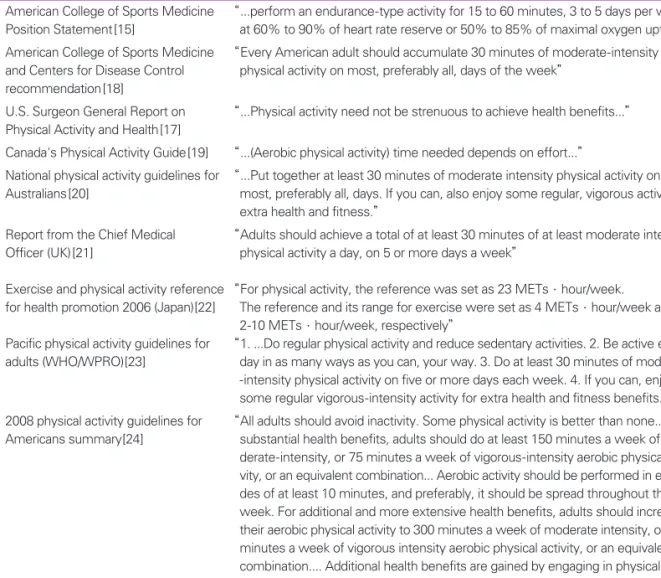
성인 유산소 신체활동에 대한 각국의 대표적 신체활동 권 고 혹은 지침을 종합검토 후 연도 순서로 정리한 결과는 Table 1과 같다. 1990년대 초반까지의 대다수 운동 권고와 지침들은 운동생리학적 실험연구에 기반하여“심폐적성과 신체구성 유지와 개발을 위해 주 3- 5회, 최대심박수의 60- 90%의 훈련강도로 15- 60분간 대근육을 이용한 율동적 유 산소운동을 하라”는 1978년의 미국스포츠의학회 입장선언 [15]을 기초로 하였다[16]. 이후 직업상의 신체 활동을 포함 한 다양한 신체활동에 대한 행태역학적(behavioral epide- miologic) 연구에 의해 적당량의 신체활동 참여만으로도 심폐지구력 개선과 건강유익을 얻는다는 연구결과들이 축 적되면서 1993년에 미국스포츠의학회와 질병관리본부에 서“모든 성인은 총 30분 이상의 중강도 신체활동을 일주일 의 거의 매일, 가능한 매일 축적하여야 한다[17]”고 권고하 였다. 그 후 각국의 신체활동 지침과 권고는 이 내용을 기초 로 변화와 발전을 이루어 나가게 되었다.
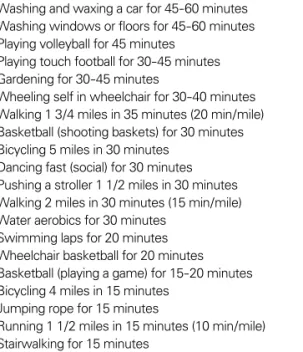
1990년대 중반까지 신체활동과 건강에 관해 알려진 지식 을 집대성하였던 신체활동과 건강에 관한 미국의무감보고 서에서는“비활동적인 성인은 규칙적 중강도 신체활동만으 로도 건강향상이 가능하며, 건강유익을 얻기 위한 신체활동 이 굳이 고강도일 필요가 없고 이미 신체적으로 활동적인 성인들은 신체활동량(지속시간, 빈도, 혹은 강도)을 늘려 더욱 많은 유익을 얻을 수 있다”고 요약하여 적당한 신체활 동량에 대하여 용량반응 관계를 Table 2와 같이 예시하였 다[6]. 즉 규칙적인 적당한 신체활동은 매일 150칼로리(매 주 1,000칼로리)정도의 에너지소모를 위해 주 5회 이상의 중강도 신체활동과 주 3회 이상의 고강도 신체활동을 실천 하는 것으로 정의하여[22] 신체활동량과 건강유익간의 용 량반응관계를 공식적으로 제시하였다.
1998년 캐나다 국민보건청은 많은 관련 기관과 단체들과 협력하여 전문가들에 의한 과학적 검토과정을 거쳐 캐나다 신체활동지침[23]을 개발하여 다양한 경로의 무료보급을 시작하였는데, 저강도, 중강도, 고강도의 유산소 신체활동 을 망라한 용량반응 형태의 적당한 신체활동량 축적 개념을
도식화하여 제시하였다(Figure 1).
1999년 호주 연방정부 건강노화부에서는 국가신체활동 지침을 Table 3과 같이 4가지로 제시하였다[8]. 지침 1에서 3까지는 건강증진을 위한 최소한의 신체활동량을 제시하여 3가지를 혼용하여 실행하도록 하고 고도의 체력, 스포츠 트 레이닝 혹은 체중감량을 목표로 하는 경우에는 지침 4를 실 행하도록 하였다. 그 내용을 보면 지침 1에서는‘몸 움직이 는 것을 귀찮게 생각 말고 기회로 생각하시오’라고 하였다.
지침 2에서는‘매일 가능한 많은 방법으로 신체활동을 하시 오’라고 하였다. 지침 3에서는‘일주간 거의 매일, 가능한
매일 모두 합해 총 30분 이상 중강도 신체활동을 실행하시 오’라고 하였다. 지침 4에서는‘할 수 있다면 더 나은 건강 과 체력을 위해 규칙적 고강도 신체활동을 하시오’라고 하 였다(Table 3).
영국은 1990년대에 전문가 합의를 통해 도출된“모든 성 인은 일주일에 5일 이상 중강도 이상의 신체활동 수행을 목 표로 하여야 한다”는 신체활동 권고를 2004년 책임의무관 보고서를 통해 공표하였다[18]. 즉 구체적 질병 예방이나 치료를 위해서는 일반적 신체활동 권고를 조정하여 사용할 필요가 있지만, 일반적 권고만으로도 심혈관질환, 2형 당
Table 1.Representative physical activity recommendation or guide for public health Year Name of recommendation or guide Major contents
1978 American College of Sports Medicine “...perform an endurance-type activity for 15 to 60 minutes, 3 to 5 days per week, Position Statement[15] at 60% to 90% of heart rate reserve or 50% to 85% of maximal oxygen uptake”
1993 American College of Sports Medicine “Every American adult should accumulate 30 minutes of moderate-intensity and Centers for Disease Control physical activity on most, preferably all, days of the week”
recommendation[18]
1996 U.S. Surgeon General Report on “...Physical activity need not be strenuous to achieve health benefits...”
Physical Activity and Health[17]
1998 Canada's Physical Activity Guide[19] “...(Aerobic physical activity) time needed depends on effort...”
1999 National physical activity guidelines for “...Put together at least 30 minutes of moderate intensity physical activity on Australians[20] most, preferably all, days. If you can, also enjoy some regular, vigorous activity for
extra health and fitness.”
2004 Report from the Chief Medical “Adults should achieve a total of at least 30 minutes of at least moderate intensity Officer (UK)[21] physical activity a day, on 5 or more days a week”
2006 Exercise and physical activity reference“For physical activity, the reference was set as 23 METs·hour/week.
for health promotion 2006 (Japan)[22] The reference and its range for exercise were set as 4 METs·hour/week and 2-10 METs·hour/week, respectively”
2008 Pacific physical activity guidelines for “1. ...Do regular physical activity and reduce sedentary activities. 2. Be active every adults (WHO/WPRO)[23] day in as many ways as you can, your way. 3. Do at least 30 minutes of moderate -intensity physical activity on five or more days each week. 4. If you can, enjoy some regular vigorous-intensity activity for extra health and fitness benefits.”
2008 2008 physical activity guidelines for “All adults should avoid inactivity. Some physical activity is better than none... For Americans summary[24] substantial health benefits, adults should do at least 150 minutes a week of mo-
derate-intensity, or 75 minutes a week of vigorous-intensity aerobic physical acti- vity, or an equivalent combination... Aerobic activity should be performed in episo- des of at least 10 minutes, and preferably, it should be spread throughout the week. For additional and more extensive health benefits, adults should increase their aerobic physical activity to 300 minutes a week of moderate intensity, or 150 minutes a week of vigorous intensity aerobic physical activity, or an equivalent combination.... Additional health benefits are gained by engaging in physical activity beyond this amount....”
뇨, 정신건강, 근골격계 질환과 일부 암에 대해서는 충분히 좋은 효과가 있으면서 참여율을 높이고 위험은 최소화할 수 있다고 하였다.
일본은‘건강증진을 위한 운동지침 2006’을 제정하여 대 사당량(metabolic equivalent)과 시간을 결합한‘엑서사이 즈’단위의 신체활동량을 단위로 하여“1주간 23 엑서사이 즈(대사당량×시간)의 활동적 신체활동(운동과 생활활동) 을!, 그 중에서 4 엑서사이즈는 활동적 운동으로! ”라는 신 체활동 목표를 제시하였다(Figure 2)[19]. 특히 신체활동량 과 체력을 평가하여 목표를 설정하고 달성하는 방법을 무관 심기 단계, 관심기 단계, 준비 단계, 실행 단계, 유지 단계 등의 행동변화의 단계에 따라‘운동’과‘생활활동’으로 나 누어 체계적으로 제시하여 특정보건지도라는 이름으로 병 의원의 외래에서 지도하기 쉽도록 제시하였다.
미국은 2008년도에 연방정부 차원에서 기존의 신체활동지
침들을 집대성하여 일주일간 유산소 신체활동량을 Table 4 와 같이 4가지로 분류하여 일주일간 총량 개념과 중고강도 신체활동의 결합한 계산방식을 택한 종합적 방식의 지침을 제공하고 있다[16]. 즉 비활동적 수준과 낮은 수준의 신체 활동을 넘어 중간 수준의 신체활동 수준을 근거에 기초한 신체활동량으로 제시하고 있다.
또 미연방 신체활동지침[21]에서는 중강도 150분과 고강 도 75분의 일주간 유산소 신체활동 목표를 섞어서 실행해도 환산하기 쉽도록 제시하여 일 주간의 총량 목표를 달성하도 록 하였다. 더 나은 건강 유익을 위해서는 중강도 300분과 고강도 75분의 일 주간 유산소 신체활동의 상한선까지 제시 하여 안전한 범위 내에서 신체활동량을 선택할 수 있도록 하였다. 한국은 아직 국가 차원의 공식적 신체활동 지침이 없고 여러 단체와 연구자들이 개별적인 신체활동지침들을 제정 및 홍보해 오고 있는데, 이 중 Yang 등[24]이 제시한 연구결과가 호주의 신체활동 지침과 유사한 내용을 보여주 고 있다.
고 찰
새로운 신체활동지침과 권고들이 전통적인‘운동-체력 모델’을 넘어 넓은 의미의 다양한‘신체활동-건강 패러다 임’으로 변하면서 이전과 중요한 차별점을 보였다. 즉, 중저 강도 신체활동의 건강유익이 강조된 것이고 또한 단기간 간 헐적 신체활동의 축적이 신체활동 목표 달성을 위한 적법한 접근법으로 인정받은 점이다[17]. 이러한 변화는 신체활동 의 건강유익이 신체활동을 실행하는 특정 방법(종류, 강도,
Table 2.Examples of moderate amount of physical activity Less vigorous activity needs more time Washing and waxing a car for 45-60 minutes Washing windows or floors for 45-60 minutes Playing volleyball for 45 minutes
Playing touch football for 30-45 minutes Gardening for 30-45 minutes
Wheeling self in wheelchair for 30-40 minutes Walking 1 3/4 miles in 35 minutes (20 min/mile) Basketball (shooting baskets) for 30 minutes Bicycling 5 miles in 30 minutes
Dancing fast (social) for 30 minutes Pushing a stroller 1 1/2 miles in 30 minutes Walking 2 miles in 30 minutes (15 min/mile) Water aerobics for 30 minutes
Swimming laps for 20 minutes Wheelchair basketball for 20 minutes Basketball (playing a game) for 15-20 minutes Bicycling 4 miles in 15 minutes
Jumping rope for 15 minutes
Running 1 1/2 miles in 15 minutes (10 min/mile) Stairwalking for 15 minutes
More vigorous activity needs less time
From U.S. Department of Health and Human Services, Centers for Disease Control and Prevention, National Center for Chronic Disease Prevention and Health Promotion, President’s Council on Physical Fitness. Physical activity and health: a report of the surgeon general. Sudbury, MA: Jones and Bartlett Publishers;
1996 [6].
Table 3.National physical activity guidelines for Australian adults Guide 1 Think of movement as an opportunity, not an
inconvenience.
Guide 2 Be active every day in as many ways as you can.
Guide 3 Put together at least 30 minutes of moderate intensity physical activity on most, preferably all, days.
Guide 4 If you can, also enjoy some rehular, vigorous activity for extra health and fitness.
From Department of Health and Ageing of Australian Govern- ment. National physical activity guidelines for Australians. Can- berra: Department of Health and Ageing of Australian Govern- ment; 1999 [8].
혹은 1회 실행의 길이)보다는 실행한 신체활동의 총량에 관 계된다는 연구결과가 축적되어 도출되었다. 즉 신체활동의 건강유익은 신체활동의 총량이 칼로리 소모량 혹은 신체활 동 실행시간으로 측정된 여러 연구에서 나타났고[25,26], 간헐적 신체활동의 축적효과도 실험연구를 통해 입증되었 다[27,28]. 또 직업활동을 포함한 다양한 신체활동을 포괄 하여‘생활활동’또는 생활 속의 신체활동(lifestyle physi- cal activity) 개념이 도입되었다.
무엇보다도 신체활동과 관련된 용어 와 정의를 재확인할 필요도 있다고 생각 된다. 1990년대 중반 이후 각국의 신체 활동지침에서는‘여가 시간의 계획된 구조의 반복적 신체활동’이라는 뜻의
‘운동(exercise)’개념을 넘어서‘골격 근의 에너지 소모를 초래하는 신체의 모 든 움직임’을 지칭하는‘신체활동(phy- sical activity)’개념과‘신체활동을 일 상생활에서 생활화시키는 생활’이라는 뜻의‘활동적 생활(active living)’개념 이 도입되었다. 이는 다소 의도적으로 종래의 운동 개념을 넘어 패러다임 전환 을 꾀하고자 하는 의도도 있다고 하였다 [19]. 일본에서는 신체활동을 운동과
‘생활활동’으로 구분하여 사용하였다.
우리나라에서는 국민체육진흥법 제2조 (정의)에서‘신체활동을 통하여 건전한 신체와 정신을 기르고 여가를 선용하는 것’을 체육이라 하고, ‘건강 및 체력증 진을 위하여 행하는 자발적이고 일상적 인 체육활동’을‘생활체육’이라고 정의 하였다[11]. 그러나 국제기준에 의한 이 동, 가사, 직업, 여가를 망라하는 포괄 적 범위의 신체활동이 포함되기 보다는 여가시간 신체활동만 강조되고,‘건강 체력(health-related fitness)’과‘운동 기술체력(skill-related fitness)’의 개념 이 명확히 구분되어 있지 않아‘신체활동’이라는 용어를 활 용하는 것이 바람직하다고 생각된다.
미국의 경우 국가 건강증진 및 질병예방 목표인‘건강한 국민 2000’에서 이미 일차 진료를 할 때 환자들의 신체활동 실천빈도, 기간, 형태와 강도를 묻고 지도하는 것을 제시한 이후[6] 현재 수립 중인‘건강한 국민 2020’계획의 신체활 동과 체력 분야의 목표에서 만성질환자가 외래를 방문할 때 운동과 관련된 상담이나 교육을 하도록 하고 있다[29]. 이
Time needed depends on effort
Range nddede to stay healthy Very light
effort
Strolling Dusting
Light walking Volleyball Easy gardening Stretching
Brisk walking Biking Raking leaves Swimming Dancing Water aerobics
Aerobics Jogging Hockey Basketball Fast swimming Fast dancing
Sprinting Racing
Light effort Moderate effort Vigorous effort Maximum effort 60 minutes 30-60 minutes 20-30 minutes
Figure 1.Dose-response concept between physical activity time needed and effort (From Public Health Agency of Canada. Canadian physical activity guide to health active living [Internet]. Ottawa: Public Health Agency of Canada; [cited 2010 Jan 2]. Available from: http://www.phac-aspc.gc.ca/pau-uap/paguide/
back1e.html [23]).
Physical activity Exercise
Low-intensity exercise stretching...
(3METs or more)Moderate orhigh-intensity Low-intensity
Low-intensity nonexercise activity standing, cooking, doing laundry.
playing piano..
Nonexercise activity Moderate or high-
intensity exercise brisk walking, jogging, tennis, swimming...
Moderate or high-intensity nonexercise activity walking, cleaning floors, gardening, car washing, walking up and down stairs, playing with children...
Figure 2.Classification of exercise and physical activity, and their intensity from recom- mended physical activity and exercise of Japan (From National Institute of Health and Nutrition. Exercise and Physical Activity Reference for Health Pro- motion 2006 (EPAR 2006): physical activity, exercise, and physical fitness.
Tokyo: Ministry of Health, Labour and Welfare of Japan; 2006 [19]).
와 관련하여 현재까지 외래에서 활용할 수 있는 있는 신체활 동과 운동평가 및 상담에 대한 다양한 연구가 이루어져 온 결과, 일본과 미국에서는 신체활동 지침 자료에서 행동변화 단계의 모형을 활용한 도구가 제시되고 있어 참조할 만하다.
즉 미국의 경우 신체활동 지침과 별도로 더 쉬운 형태의 신 체활동 안내문을[30] 통해 행동변화의 단계에 따라 시작해 보기, 생활화 하기, 유지발전하기, 평생지속하기의 4단계에 따른 워크북 형태의 자료를 제시하고 있다. 일본도 전문가 를 위한‘건강증진을 위한 운동기준’외에 주로 일반 국민을 대상으로 한‘건강증진을 위한 운동 지침[31]’에서 행동변화 의 단계별 어드바이스와 함께 사례를 제시하고 있다. 캐나 다의 경우에는 간단한 신체활동 지침 홍보자료 외에 무료로 제작 보급하는 별도의 핸드북을 통해 실생활 속의 인물로 구 성된 다양한 사례를 워크북의 형태로 제시하고 있다[7].
우리나라에서는 우선적으로 국가신체활동지침의 제정이 시급하여 의료계 차원에서의 선도적 참여가 필요하다. 또한 다양한 외국의 사례를 참조하여 의료계 차원에서 실행이 가 능한 근거 기반의 정책을 연구하고 개발하여 실행해 나갈 필요가 있다. 건강관리서비스 도입이 논의되고 있는 현실을 감안하여 외래를 내원하는 환자들뿐 아니라 입원환자 대상 의 다양한 신체활동 정책을 선도해 나가야 할 것이다. 특히 중강도 신체활동의 생활 속에서의 축적을 행동변화이론에 따라 지도하는 근거기반의 정책 등은 의료계의 정책으로 가 장 적합도가 높을 것으로 생각되고 이를 위한 연구와 개발 은 시급할 것으로 판단된다. 또한 일반 국민까지 염두에 둔
다양한 근거 기반의 신체활동 정책에 대한 연구와 개발도 순차적이고 선도적으로 실행해 나갈 필요가 있을 것이다.
1996년 이후 새 접근틀에 따라 세계 각국의 국가신체활 동지침이 제정되어 한국의료계 적용을 위한 체계적 검토가 필요하였다. 성인의 유산소 신체활동에 관한 각국의 문헌과 전자데이터베이스를 성인의 유산소 신체활동위주로 조사하 였다. 접근틀의 가장 큰 변화는 종래의 운동과 체력 모형을 넘어 신체활동과 건강 모형에 기초하여 직업과 이동을 포함 한 다양한 중강도 신체활동의 적당량 축적 개념을 도입해 온 것이 각 국 신체활동 권고 및 기준들의 공통분모이었다.
미국, 일본 등 선진국은 행동변화의 단계이론에 따른 지도 자료를 제공하였다. 따라서 한국에서도 여가활동을 포함한 다양한 종류의 중강도 신체활동 축적을 행동변화의 단계에 맞도록 의료현장에 도입하고 이를 위한 연구개발과 교육훈 련을 활성화하도록 제언한다.
핵심용어: 신체활동; 공공정책; 중강도
REFERENCES
11. Fletcher GF, Blair SN, Blumenthal J, Caspersen C, Chaitman B, Epstein S, Falls H, Froelicher ES, Froelicher VF, Pina IL. Sta- tement on exercise: benefits and recommendations for phy- sical activity programs for all Americans: a statement for health professionals by the Committee on Exercise and Car- diac Rehabilitation of the Council on Clinical Cardiology, Ameri- can Heart association. Circulation 1992; 86: 340-344.
12. Jeong YH, Seo MK, Lee JT, Jeong HS, Koh SJ, Chae SM, Kim Table 4.Classification of total weekly amounts of aerobic physical activity into four categories
Levels of Range of moderate- Summary of
Comment physical activity intensity minutes a week overall health benefit
Inactive No activity beyond baseline None Being inactive is unhealthy.
Low Activity beyond baseline but Some Low levels of activity are clearly preferable to an fewer than 150 minutes a week to an inactive lifestyle.
Medium 150 minutes to 300 Substantial Activitu at the high end of this range has additional
minutes a week and more extensive health benefits than activith
at the low end.
High More than 300 minutes Additional Current science does not allow researchers to
a week identify an upper limit of activity above which
there are no additional health benetits.
From U.S. Department of Health and Hu-man Services. Physical Activity Guidelines Advisory Committee report. Washington, DC: US De- partment of Health and Human Services; 2008 [16].
MH. Analysis of health determinants of Korean. Seoul: Korea Institute for Health and Social Affairs, Management Center for Health Promotion; 2006.
13. Korea Centers for Disease Control and Prevention. In-depth analyses of the Third National Health and Nutrition Exami- nation Survey: the health interview and health behavior survey part. Seoul: Korea Centers for Disease Control and Prevention;
2007.
14. Medical Law of Republic of Korea. No. 9386. Article 2 [modi- fied 2009 Jan 30].
15. American College of Sports Medicine. ACSM’s guidelines for exercise testing and prescription. 8th ed. Philadelphia: Lippi- ncott Williams&Wilkins/Woltes Kluwer Health Inc.; 2010.
16. U.S. Department of Health and Human Services, Centers for Disease Control and Prevention, National Center for Chronic Disease Prevention and Health Promotion, President’s Council on Physical Fitness. Physical activity and health: a report of the surgeon general. Sudbury, MA: Jones and Bartlett Publishers;
1996.
17. Public Health Agency of Canada. Canada’s physical activity guide to healthy active living. Ottawa: Public Health Agency of Canada, 1998.
18. Department of Health and Ageing of Australian Government.
National physical activity guidelines for Australians. Canberra:
Department of Health and Ageing of Australian Government;
1999.
19. Western Pacific Regional Office of World Health Organization.
Pacific physical activity guidelines for adults. Manila: Western Pacific Regional Office of World Health Organization; 2008.
10. Ministry of Health of New Zealand. DHB toolkit: physical ac- tivity. Wellington: Ministry of Health of New Zealand; 2003.
11. Koh KW, Lee MS, Kim DK, Park EJ, Jo EJ, Kim HS, Song SE, Kim YJ, Kim JM. Korean strategies for promotion of health enhancing physical activity. Busan: Kosin University, Manage- ment Center for Health Promotion; 2007.
12. Koh KW, Park JB, Kim Y, Bae SK, Yee YH, Yoo BC, Jeon MJ, Jo EJ, Song SE, Kim YJ, Kim JM. Developement of active li- ving strategy through lifestyle approach. Busan: Kosin Univer- sity, Management Center for Health Promotion; 2006.
13. Koh KW, Yee MW, Kim YJ, Park JS, Song SE. Construction of physical activity information system for community health initiatives. Busan: Kosin University, Management Center for Health Promotion; 2003.
14. Koh KW, Park JS, Kim MA, Kim JH, Jo EJ, Song SE. Develo- pement of physical activity promotion program through capa- city building by leadership and participation. Busan: Kosin University, Management Center for Health Promotion; 2005.
15. American College of Sports Medicine. The recommended quantity and quality of exercise for developing and maintaining
fitness in healthy adults. Med Sci Sports Exerc 1978; 10: 7-10.
16. U.S. Department of Health and Human Services. Physical Activity Guidelines Advisory Committee report. Washington, DC: US Department of Health and Human Services; 2008.
17. Pate RR, Pratt M, Blair SN, Haskell WL, Macera CA, Bouchard C, Buchner D, Ettinger W, Heath GW, King AC, Kriska A, Leon AS, Marcus BH, Morris J, Paffenbarger RS Jr, Patrick K, Pol- lock ML, Rippe JM, Sallis J, Wilmore JH. Physical activity and public health: a recommendation from the Centers for Disease Control and Prevention and the American College of Sports Medicine. JAMA 1995; 273: 402-407.
18. Department of Health. At least five a week: evidence on the impact of physical activity and its relationship to health. Lon- don: Department of Health, Physical Activity; 2004.
19. National Institute of Health and Nutrition. Exercise and Phy- sical Activity Reference for Health Promotion 2006 (EPAR 2006): physical activity, exercise, and physical fitness. Tokyo:
Ministry of Health, Labour and Welfare of Japan; 2006.
20. World Health Organization Western Pacific region. Pacific physical Activity Guidelines for adults. Manila; 2008.
21. U.S. Department of Health and Human Services. 2008 Phy- sical Activity Guidelines for Americans. Washington, DC: U.S.
Department of Health and Human Services; 2008.
22. U.S. Department of Health and Human Services, Centers for Disease Control and Prevention, National Center for Chronic Disease Prevention and Health Promotion Division of Nutrition and Physical Activity. Promoting physical activity: a guide for community action. Champaign: Human Kinetics; 1999.
23. Public Health Agency of Canada. Canadian physical activity guide to health active living [Internet]. Ottawa: Public Health Agency of Canada; [cited 2010 Jan 2]. Available from: http://
www.phac-aspc.gc.ca/pau-uap/paguide/back1e.html.
24. Yang YJ, Jin YS, Cho SI, Kim YS, Park RH. Development of physical activity questionnaire and guideline for Korean adults.
Management Center for Health Promotion; 2007.
25. Paffenbarger RS Jr, Hyde RT, Wing AL, Hsieh CC. Physical activity, all-cause mortality, and longevity of college alumni. N Engl J Med 1986; 314: 605-613.
26. Blair SN, Kohl HW 3rd, Paffenbarger RS Jr, Clark DG, Cooper KH, Gibbons LW. Physical fitness and all-cause mortality: a prospective study of healthy men and women. JAMA 1989;
262: 2395-2401.
27. DeBusk RF, Stenestrand U, Sheehan M, Haskell WL. Training effects of long versus short bouts of exercise in healthy sub- jects. Am J Cardiol 1990; 65: 1010-1013.
28. Ebisu T. Splitting the distance of endurance running: on cardio- vascular endurance and blood lipids. Jpn J Phys Educ 1985;
30: 37-43.
29. U.S. Department of Health and Human Services. Physical
activity and fitness. Washington, DC: U.S. Department of Health and Human Services; 2009 [cited 2010 Jan 6].
Available from: http://www.healthypeople.gov/hp2020/
Objectives/TopicArea.aspx?id=39&TopicArea=Physical+Activi ty+and+Fitness.
30. U.S. Department of Health and Human Services. Be active
your way: a guide for adults based on the 2008 physical acti- vity guidelines for Americans 2008. Washington, DC: U.S. De- partment of Health and Human Services; 2008.
31. Ministry of Health, Labour and Welfare of Japan. Exercise and physical activity guide for health promotion 2006. Tokyo: Mini- stry of Health, Labour and Welfare of Japan; 2006.
Peer Reviewers’ Commentary
본 논문은 건강증진을 위해 최근 그 중요성이 부각되고 있는 여가활동을 포함한 다양한 종류의 중강도 신체활동 권고와 지 침의 국제적 동향을 새 접근틀에 따라 문헌고찰을 하고 있다. 특히 캐나다, 호주, 일본, 미국 등 선진 각국의 중강도 신체활동 축적을 행동변화의 단계에 맞도록 도입한 변천사를 제시하고 있어 국내 의료현장에서의 적용가능성에 새로운 전환점을 촉 구하고 있는 점이 돋보인다. 향후 이 분야에 대한 보다 포괄적인 체계적 고찰을 통한 권고와 지침을 도출할 수 있다면“국민 건강증진종합계획 2020”수립 및 개정에 중요한 근거를 제공하며, 국내 의료계에 최신 의학정보 제공을 통한 의학발전에도 기여할 수 있으리라 판단된다.
[정리:편집위원회]