Korean J Gastroenterol Vol. 67 No. 2, 103-106 http://dx.doi.org/10.4166/kjg.2016.67.2.103 pISSN 1598-9992 eISSN 2233-6869
CASE REPORT
Korean J Gastroenterol, Vol. 67 No. 2, February 2016 www.kjg.or.kr
급성신부전을 동반한 급성대장가성폐색
표정의, 민양원, 이풍렬
성균관대학교 의과대학 삼성서울병원 내과학교실
Effective and Safe Use of Neostigmine in Treatment of Acute Kidney Injury Associated with Colonic Pseudo-obstruction after Cardiac Surgery
Jeung Hui Pyo, Yang Won Min, and Poong-Lyul Rhee
Department of Medicine, Samsung Medical Center, Sungkyunkwan University School of Medicine, Seoul, Korea
Neostigmine can successfully decompress patients with acute colonic pseudo-obstruction (ACPO) who are unresponsive to conservative therapy. However, neostigmine is contraindicated in renal failure, so it is underused in ACPO patients with renal failure who would be otherwise appropriate candidates. We described the first successfully treated case of acute kidney injury (AKI) with neostigmine in a patient with ACPO. A 72-year-old man who underwent a coronary artery bypass graft surgery 11 days prior presented to the emergency room with abdominal distension, peripheral edema, and dyspnea on exertion. Plain abdominal radiographs and abdomen computed tomography scan showed diffuse colonic dilatation without obstruction. Serum creatinine level was increased five-fold over baseline. We diagnosed the patient as ACPO with AKI. With conservative treatment, renal function failed to improve because the ACPO was not corrected. Administration of neostigmine rapidly resolved ACPO and renal function, avoiding more invasive procedures such as colonoscopic decompression and hemodialysis. Neostigmine appears to be an effective and safe treatment option for ACPO patients with renal failure. Prospective large-scale studies should be carried out to determine the safety and efficacy of neostigmine in ACPO patients with renal failure. (Korean J Gastroenterol 2016;67:103-106)
Key Words: Neostigmine; Colonic pseudo-obstruction; Acute kidney injury
Received June 15, 2015. Revised September 30, 2015. Accepted October 14, 2015.
CC This is an open access article distributed under the terms of the Creative Commons Attribution Non-Commercial License (http://creativecommons.org/licenses/
by-nc/4.0) which permits unrestricted non-commercial use, distribution, and reproduction in any medium, provided the original work is properly cited.
Copyright © 2016. Korean Society of Gastroenterology.
교신저자: 민양원, 06351, 서울시 강남구 일원로 81, 성균관대학교 의과대학 삼성서울병원 내과학교실
Correspondence to: Yang Won Min, Department of Medicine, Samsung Medical Center, Sungkyunkwan University School of Medicine, 81 Irwon-ro, Gangnam-gu, Seoul 06351, Korea. Tel: +82-2-3410-3409, Fax: +82-2-3410-6983, E-mail: [email protected]
Financial support: None. Conflict of interest: None.
INTRODUCTION
Patients presenting with acute colonic pseudo-ob- struction (ACPO) have underlying medical and surgical pre- disposing conditions.1 Coronary artery bypass graft (CABG) surgery is reported as a rare cause of ACPO.2 Pharmaco- logical or colonoscopic decompression is indicated for pa- tients unresponsive to conservative treatment, as they may rapidly undergo further distension.3 Neostigmine is rapidly effective, provides immediate relief, and is well tolerated and
safe.4,5 However, the medication should be administered with caution due to the anticholinergic side effects, including bradyarrythmia. Patients with severe renal insufficiency may have an increased or prolonged vagomimetic response; thus, its use is contraindicated in such cases.1,3,4,6 Acute kidney in- jury (AKI) may be exacerbated or develop because of the ACPO.2,7,8 However, because neostigmine is contraindicated in renal insufficiency, there is no clinical data guiding the treatment of ACPO with AKI. We described a case of ACPO with AKI after CABG surgery, which dramatically resolved with
104 표정의 등. 급성신부전을 동반한 급성대장가성폐색
The Korean Journal of Gastroenterology
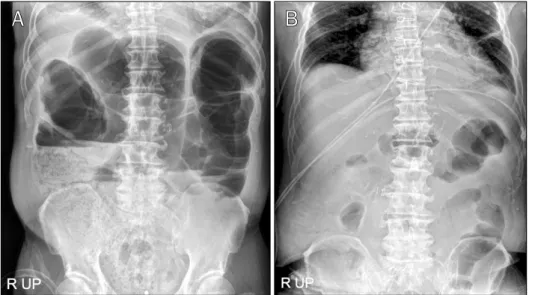
Fig. 1. Plain abdominal radiographs.
(A) Upon arrival at the emergency room, plain abdominal radiograph demonstrated diffuse dilated loops and dilatation of the cecum up to 11.5 cm in diameter. (B) A plain abdominal radiograph obtained 24 hours after administration of neostigmine showed evacuation of stool and complete resolution of bowel distension.
rapid return of renal function without hemodialysis after neo- stigmine administration.
CASE REPORT
A 72-year-old male with a history of type II diabetes melli- tus, hypertension, chronic renal disease, and prostatectomy for prostate cancer underwent CABG surgery for three-vessel disease 11 days before visiting the emergency room (ER).
Results of the pre-operative blood analyses were within nor- mal limits, except for anemia with hemoglobin/hematocrit of 8.7 g/dL (24.9%) and estimated glomerular filtration rate that had declined at a rate of 52.9 mL/min with a serum crea- tinine of 1.3 mg/dL. From day 4 after surgery, the patient complained of infrequent bowel movements and on day 6 af- ter surgery he was discharged from the hospital with pre- scribed laxatives (bisacodyl). After discharge, he had no bow- el movement and experienced abdominal distension. His urine output decreased gradually and he developed periph- eral edema and dyspnea on exertion, which prompted his vis- it to the ER.
On arrival at the ER, the patients’ vital signs were as fol- lows: body temperature 36.2oC, pulse rate 70 beats/min, respiratory rate 24 breaths/min, and blood pressure 117/56 mmHg. Physical examination revealed 2+ pitting edema in both lower legs without crackles on the pulmonary exami- nation. The bowel sounds were diminished and the abdomen was markedly distended, but the patient complained only of mild abdominal pain and there was no sign of peritoneal
inflammation. Rectal examination showed normal sphincter tone and no apparent tumor. Laboratory tests revealed an elevated white blood cell count at 13,010/mm3, blood urine nitrogen at 104.2 mg/dL, and creatinine at 5.31 mg/dL. A plain abdominal radiography (Fig. 1A) revealed significant diffuse colonic dilatation with a maximal diameter of 11.5 cm in the cecum. A non-contrast CT scan followed, to rule out me- chanical obstruction, and showed dilated colonic segments full of flatus and feces, with no organic obstruction.
Based on these findings, we suspected ACPO. A nephrolo- gist was consulted for the evaluation of AKI. Urinalysis was negative and urine microscopy was nondescript. Lower than normal blood pressure, dry tongue, and CT scan of dilated co- lonic segments full of feces suggested pre-renal AKI asso- ciated with third space loss, ACPO, and worsened pre-existing chronic kidney disease. Treatment of the underlying cause of renal failure was recommended for the patient, instead of hemodialysis.
Therefore, supportive measures were undertaken includ- ing nil per os with fluid and electrolyte supplements, and placement of a rectal tube to decompress the dilated colonic segments. Despite supportive measures for 24 hours, no passage of flatus or stool was observed. Furthermore, the ab- dominal distention failed to resolve and serum creatinine progressively increased to 5.54 mg/dL. We concluded that renal function failed to improve because the underlying cause, ACPO, was not corrected. Therefore, we decided to ad- minister intravenous neostigmine. The patient was con- tinuously monitored for electrocardiographic and vital signs.
Pyo JH, et al. Neostigmine for ACPO with AKI 105
Vol. 67 No. 2, February 2016 Fig. 2. Time course of serum creatinine. Creatinine level increased
up to 5.54 mg/dL and rapidly decreased after administration of neostigmine. Six days after treatment with neostigmine, the patient’s renal function recovered to basal level.
HD, hospital day.
A physician administered 2 mg of intravenous neostigmine, atropine at the bedside. Twenty minutes later, we observed the passage of stool and gradual relief of the abdominal distention. The patient did not manifest bradycardia during the one hour observation period. AKI also rapidly resolved af- ter the resolution of ACPO (Fig. 2). On the tenth day after ad- mission, the patient was discharged from the hospital and re- ported no abdominal problems upon follow-up.
DISCUSSION
ACPO is a rare complication with an incidence of 4.6 per 10,000 cases undergoing CABG surgery.2 Although the fre- quent use of beta-blocker or a history of recent myocardial in- farction in patients who undergo CABG surgery may increase the risk of bradycardia,3 rapid and effective treatment is gen- erally possible with neostigmine.9 Therefore, continuous car- diac monitoring is required for detection of bradycardia that may require treatment with atropine as well as for anti- cholinergic side effects. In addition, a slow intravenous in- fusion of neostigmine may lower the risk of bradycardia.10
The success rate of neostigmine treatment in patients un- responsive to conservative treatment ranges from 73% to 94% after the first dose, and up to 100% after the second dose.11 Although colonoscopic decompression is successful in 77% of patients, colonoscopy is technically difficult, not al- ways successful, and may cause complications such as
perforation. Additionally, colonic distention may recur in up to 40% of patients, despite initial successful decompres- sion.2 Furthermore, the cost of colonoscopy is substantially higher than that of parenteral neostigmine. Surgical inter- vention is associated with high morbidity and mortality rates.8 Therefore, colonoscopic or surgical decompression needs to be reserved for situations wherein conservative treatment fails.
Although neostigmine was associated with a favorable safety profile in the reported clinical trials, caution should be used when administering the medication. Webb12 first re- ported a case of a child with renal failure who developed type I second-degree atrioventricular block after neostigmine administration. Since then, many studies indicate that renal insufficiency (serum creatinine >3 mg/dL) contraindicates its use.1,3,4,6 Renal excretion accounts for approximately 50%
of plasma clearance of neostigmine and therefore, it is not recommended in cases of severe renal insufficiency, since elimination half-life is significantly prolonged and serum clearance decreases.12-14 Thus, reports on the use of neo- stigmine alone in ACPO with AKI are rare. Instead of neo- stigmine, such patients undergo hemodialysis,9 or colono- scopic decompression.15,16 One case report described an ACPO patient with AKI who received conservative treatment and subsequent hemodialysis.9 Neostigmine was used to avoid further deterioration, and ACPO and renal failure were resolved. Thus, neostigmine can avert the need for hemodial- ysis in ACPO patients with AKI. Furthermore, no life-threat- ening side effects related to use of neostigmine in ACPO have been reported, although the risk in the presence of renal in- sufficiency might be different. In a randomized clinical trial of 21 patients, only two had symptomatic bradycardia requir- ing atropine.4 In addition, a review of 51 studies indicated that only four patients experienced bradycardia requiring atropine, which also resolved without significant complication.5
A recent review of ACPO17 did not include renal in- sufficiency as a contraindication for neostigmine, as dose ad- justments are recommended according to creatinine clearance.18 We administered neostigmine without dose ad- justment to the study patient with renal insufficiency, since the adjusted dose may have been insufficient to relieve ACPO and because anticholinergic side effects can be controlled with atropine. However, dose adjustment to 1 mg and addi-
106 표정의 등. 급성신부전을 동반한 급성대장가성폐색
The Korean Journal of Gastroenterology
tional 1 mg in the event that the previous dose was ineffective might have been an effective and safer choice.
In conclusion, when ACPO is the cause of AKI, a vicious cy- cle of worsening AKI and ACPO can occur if the ACPO is not resolved. As expected, administration of neostigmine rapidly resolved ACPO and AKI without any significant complications.
For the appropriate patient, neostigmine with cardiac mon- itoring could be an effective, safe, and inexpensive treatment option of ACPO with renal failure. Further prospective large studies are required to determine the efficacy and safety of neostigmine in ACPO patients with renal failure.
REFERENCES
1. Saunders MD. Acute colonic pseudo-obstruction. Best Pract Res Clin Gastroenterol 2007;21:671-687.
2. Tenofsky PL, Beamer L, Smith RS. Ogilvie syndrome as a post- operative complication. Arch Surg 2000;135:682-686; dis- cussion 686-687.
3. De Giorgio R, Barbara G, Stanghellini V, et al. Review article: the pharmacological treatment of acute colonic pseudo-obstruc- tion. Aliment Pharmacol Ther 2001;15:1717-1727.
4. Ponec RJ, Saunders MD, Kimmey MB. Neostigmine for the treat- ment of acute colonic pseudo-obstruction. N Engl J Med 1999;
341:137-141.
5. Kayani B, Spalding DR, Jiao LR, Habib NA, Zacharakis E. Does ne- ostigmine improve time to resolution of symptoms in acute co- lonic pseudo-obstruction? Int J Surg 2012;10:453-457.
6. Loftus CG, Harewood GC, Baron TH. Assessment of predictors of response to neostigmine for acute colonic pseudo-obstruction.
Am J Gastroenterol 2002;97:3118-3122.
7. Anuras S, Shirazi SS. Colonic pseudoobstruction. Am J Gastroen-
terol 1984;79:525-532.
8. Vanek VW, Al-Salti M. Acute pseudo-obstruction of the colon (Ogilvie's syndrome). An analysis of 400 cases. Dis Colon Rectum 1986;29:203-210.
9. Guler A, Sahin MA, Atilgan K, Kurkluoglu M, Demirkilic U. A rare complication after coronary artery bypass graft surgery: Ogilvie's syndrome. Cardiovasc J Afr 2011;22:335-337.
10. Abeyta BJ, Albrecht RM, Schermer CR. Retrospective study of ne- ostigmine for the treatment of acute colonic pseudo-obstruc- tion. Am Surg 2001;67:265-268; discussion 268-269.
11. De Giorgio R, Knowles CH. Acute colonic pseudo-obstruction. Br J Surg 2009;96:229-239.
12. Webb MD. Type I second-degree AV block after neostigmine ad- ministration in a child with renal failure. Anesth Prog 1995;42:
21-22.
13. Cronnelly R, Stanski DR, Miller RD, Sheiner LB, Sohn YJ. Renal function and the pharmacokinetics of neostigmine in anes- thetized man. Anesthesiology 1979;51:222-226.
14. Murphy GS, De Boer HD. Reversal (Antagonism) of neuromus- cular blockade. In: Miller RD, ed. Miller's anesthesia. 8th ed.
London, UK: Elsevier Health Sciences, 2014:995-1027.
15. Saunders MD. Case-based management of acute colonic pseu- do-obstruction. American Society for Gastrointestinal Endosco- py Leading Edge 2011;1:1-6.
16. Strodel WE, Dent TL, Nostrant TT, Eckhauser FE, Campbell DA, Marks WH. Treatment alternatives in renal failure and renal transplantation patients with nonobstructive colonic dilatation.
Transplantation 1983;36:37-40.
17. Camilleri M. Acute colonic pseudo-obstruction (Ogilvie's syn- drome). [Internet]. UpToDate [updated 2015 Mar 26; cited 2015 Sep 1]. Available from: http://www.uptodate.com/contents/acute- colonic- pseudo-obstruction-ogilvies-syndrome
18. Aronoff GR. Drug prescribing in renal failure: dosing guidlines for adults and children. 5th ed. Philadelphia: American College of Physicians, 2007.