서 론
비소세포폐암은 종양의 진행정도, 림파절 전이 정도, 원 격전이 유무 등의 기준에 따라 유사한 생존율을 보이는 군을 묶어 병기를 분류하였으나, 각 병기 내에서도 여러 가지 특성에 따라 서로 예후가 다른 것으로 보고되고 있
다. N1 비소세포폐암의 경우에도 T 요인에 따라 IIa에서 IIIb기까지 다양한 병기로 분류되고 있으며, 특히 II기 N1 (T1/2N1) 비소세포폐암은 림파절 전이 양상(폐문부 림프 절 침범 여부, 전이 림프절 개수 등)에 따라서도 서로 다 른 예후를 보이는 것으로 알려져 있다[1-5]. II기 N1 비소 세포폐암에서는 I기 비소세포암에서와 마찬가지로 완전
완전 절제된 pT1/2N1 비소세포폐암에서 수술 후 재발의 위험 인자
박인규*․김대준*․정경영*․김길동**․주현철*
Risk Factors for Recurrence in Completely Resected pT1/2N1 Non-small Cell Lung Cancer
Inkyu Park, M.D.*, Dae Joon Kim, M.D.*, Kyung Young Chung, M.D.*
Kil Dong Kim, M.D.**, Hyun Chul Joo, M.D.*
Background: Complete surgical resection is the most effective treatment for pT1/2N1 non-small cell lung cancer, however 5 year survival rate of these patients is about 40% and the major cause of death is recurrent disease.
We intended to clarify the risk factors of recurrence in completely resected pT1/2N1 non-small cell lung cancer.
Material and Method: From Jan. 1990 to Jul. 2003, total of 117 patients were operated for pT1/2N1 non-small cell lung cancer. The risk of recurrence according to patients characteristics, histopathologic findings, type of re- section, pattern of lymph node metastasis, postoperative adjuvant treatment were evaluated retrospectively. Result:
Mean age of patients was 59.3 years. There were 14 patients with T1N1 and 103 patients with T2N1 disease.
Median follow-up time was 27.5 months and overall 5 year survival rate was 41.3%. 5 year freedom-from recur- rence rate was 54.1%. Recurrence was observed in 44 (37.6%) patients and distant recurrence developed in 40 patients. 5 year survival rate of patients with recurence was 3.3%, which was significantly lower than patients without recurrence (61.3%, p=0.000). In multi-variate analysis of risk factors for freedom-from recurrence rate, multi-station N1 (hazard ratio=1.997, p=0.047) was a poor prognostic factor. Conclusion: Multi-station N1 is the risk factor for recurrence in completely resected pT1/2N1 non-small cell lung cancer.
(Korean J Thorac Cardiovasc Surg 2005;38:421-427) ꠏꠏꠏꠏꠏꠏꠏꠏꠏꠏꠏꠏꠏꠏꠏꠏꠏꠏꠏꠏꠏꠏꠏꠏꠏꠏꠏꠏꠏꠏꠏꠏꠏꠏꠏꠏꠏꠏꠏꠏꠏꠏꠏꠏꠏꠏꠏꠏꠏꠏꠏꠏꠏꠏꠏꠏꠏꠏꠏꠏꠏꠏꠏꠏꠏꠏꠏꠏꠏꠏꠏꠏꠏꠏꠏꠏꠏꠏꠏꠏꠏꠏꠏꠏꠏꠏꠏꠏꠏꠏꠏꠏ Key words: 1. Carcinoma, non-small cell lung
2. Neoplasm staging 3. Neoplasm recurrence
*연세대학교 의과대학 흉부외과학교실
Department of Thoracic and Cardiovascular Surgery, Yonsei University College of Medicine
**을지대학교 의과대학 흉부외과학교실
Department of Thoracic and Cardiovascular Surgery, Eulji University School of Medicine
†본 논문은 대한흉부외과학회 제 36차 추계학술대회에서 발표되었음.
논문접수일:2005년 1월 17일, 심사통과일:2005년 5월 7일
책임저자:김대준 (120-752) 서울시 서대문구 신촌동 134번지, 연세대학교 의과대학 흉부외과학교실 (Tel) 02-2228-2140, (Fax) 02-393-6012, E-mail: [email protected]
본 논문의 저작권 및 전자매체의 지적소유권은 대한흉부외과학회에 있다.
절제가 가장 효과적인 치료 방법이지만 수술 후 5년 생존 율이 약 40%로 I기(60∼80%)에 비해 낮게 보고되고 있다 [1]. 완전절제 후 치료 실패의 주요 원인은 재발이며, 국소 재발 보다는 원격전이가 많은 것으로 보고되고 있다. 따라 서 재발을 막고 생존율을 높이기 위한 연구들이 진행되어 왔으며, 최근의 연구결과들은 수술 후 항암화학 요법으로 생존율의 향상를 기대할 수 있을 것으로 보고되고 있다[6].
하지만 모든 환자가 재발의 위험이 있는 것은 아니므로 위험요인을 알 수 있다면 좀 더 선택적으로 보조요법을 시행하여 합병증을 줄이고 치료효과를 높일 수 있으리라 생각된다. 이에 저자들은 완전 절제된 pT1/2N1 비소세포 폐암 환자들의 재발의 양상과 위험인자에 대해 알아보고 자 하였다.
대상 및 방법
1990년 1월부터 2003년 7월까지 연세대학교 의과대학 세브란스병원 흉부외과에서 비소세포폐암으로 완전 절제 술을 받고 pT1/2N1기로 진단된 환자 120명 중 수술 사망 2예, 유암종(carcinoid) 1예를 제외한 117명을 대상으로 후 향적 연구를 하였다. 환자의 특성, 수술 방법, 조직병리학 적 소견, 림프절 전이 양상, 술 후 보조요법 등과 무재발 률의 관계를 후향적으로 연구하였다. 모든 환자에서 단엽 절제술 이상의 폐절제와 광범위 종격동 림프절 박리술을 시행하였으며, 림프절 분류는 Naruke 등[7]의 림프절 분류 법을 따랐다. 폐암의 조직학적 분류는 1999년에 발표된 WHO 분류[8]를 따랐으며, TNM 병기의 분류는 개정된 American Joint Committee on Cancer (AJCC)의 분류[1]를 따랐다. 재발은 국소재발과 원격전이로 나누었으며 국소 재발은 기관지 절단면, 동측 종격동 림프절에서 병변이 발견된 경우로 정의하였고, 동측 또는 반대편 폐실질, 반 대편 림프절, 기타 다른 부위에서 병변이 발견된 경우에 는 원격전이로 정의하였다. 수술 후 처음 2년간은 3개월 마다 이후에는 6개월마다 외래에서 혈액검사, 단순흉부촬 영, 흉부전산화단층촬영, 복부초음파 및 골주사스캔을 시 행하여 재발여부를 평가하였다. 최종 관찰시점은 2004년 8월 31일까지로 하였으며 모든 환자에서 추적관찰이 가능 하였고, 추적관찰기간의 중앙값은 27.5개월이었다. 생존율 및 무재발률의 계산은 Kaplan-Meier 방법을, 예후인자간의 비교에는 log rank test를 이용하였으며, 다변량 분석에는 Cox's proportional hazard model을 이용하였다. p 값이 0.05 미만일 때 통계학적으로 유의하다고 판정하였다.
결 과
1) 환자군의 임상 특성
전체 환자의 평균 연령은 59.3±9.1세였고 남자가 97명 (82.9%) 여자가 20명(17.1%)이었다. 68명(58.1%)에서 전폐 절제술을 시행하였고 엽절제술은 33명(28.2%), 이엽절제 Table 1. Characteristics of patients (n=117)
ꠚꠚꠚꠚꠚꠚꠚꠚꠚꠚꠚꠚꠚꠚꠚꠚꠚꠚꠚꠚꠚꠚꠚꠚꠚꠚꠚꠚꠚꠚꠚꠚꠚꠚꠚꠚꠚꠚꠚꠚꠚꠚꠚꠚꠚꠚꠚꠚꠚꠚꠚꠚꠚꠚꠚ
Age (mean±SD) 59.3±9.1
Sex
Male 97 (82.9%)
Female 20 (17.1%)
Operation
Pneumonectomy 68 (58.1%)
Lobectomy 33 (28.2%)
Bilobectomy 16 (13.7%)
Histological diagnosis
Squamous cell carcinoma 78 (66.7%)
Adenocarcinoma 28 (23.9%)
Adenosquamous cell carcinoma 8 (6.8%) Large cell carcinoma 3 (2.6%) Degree of differentiation
Well 33 (28.3%)
Moderate 49 (41.8%)
Poor 35 (29.9%)
T factor
T1 14 (12%)
T2 103 (88%)
Hilar LN involvement
No 72 (61.5%)
Yes 45 (38.5%)
Extent of node involvement
Intraparenchymal 46 (39.3%)
Extrapraenchymal 71 (60.7%)
Number of involved node
Single 50 (42.7%)
Multiple 67 (57.3%)
Number of involved nodal station
Single 97 (82.9%)
Multiple 20 (17.1%)
Adjuvant therapy
None 23 (19.7%)
Chemotherapy 15 (12.8%)
Radiation therapy 44 (37.6%)
Combined therapy 35 (29.9%)
ꠏꠏꠏꠏꠏꠏꠏꠏꠏꠏꠏꠏꠏꠏꠏꠏꠏꠏꠏꠏꠏꠏꠏꠏꠏꠏꠏꠏꠏꠏꠏꠏꠏꠏꠏꠏꠏꠏꠏꠏꠏꠏꠏꠏꠏꠏꠏꠏꠏꠏꠏꠏꠏꠏꠏ
술은 16명(13.7%) 에서 시행되었다. 조직학적 분류로는 편평상피세포암이 78예(66.7%)으로 가장 많았으며, 선암 이 28예(23.9%), 대세포암이 3예(2.6%), 그리고 선편평상 피세포암이 8예(6.8%)있었다. T1N1이 14명(12%), T2N1이 103명(88%)이었다.
폐문부 림프절 전이가 있는 경우가 45예(38.5%) 있었고, 폐실질 내 림프절(intraparenchymal lymph node; lobar, seg- mental, parenchymal) 전이가 있는 경우가 46예(39.3%), 폐 실질외 림프절(extraparenchymal lymph node; interlobar, hi- lar) 전이가 있는 경우가 71예(60.7%) 있었다. 단일 림프절 에만 전이된 경우(single node involvement)는 50예(42.7%) 이었고 나머지 67명(57.3%) 환자에서는 두개 이상 림프절 전이(multiple node involvement)를 보였다. 97명(82.9%)의
환자에서는 단일림프절군 N1 (single station N1)이었고, 두 군데 이상의 림프절군에 전이가 있는 다림프절군 N1인 환자는 20명(17.1%)이었다. 23명은 수술 후 보조요법을 받 지 않았고, 15명은 항암화학요법을, 44명은 방사선치료를 받았으며, 35명은 항암화학요법과 방사선치료를 모두 받 았다(Table 1).
2) 생존 및 재발 분석
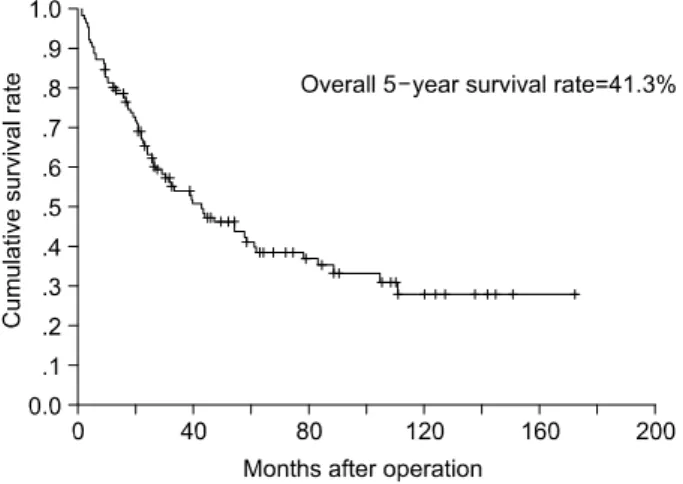
전체 환자의 5년 생존율은 41.3%였으며 생존기간의 중 앙값은 42.9개월이었다(Fig. 1). 추적관찰 기간 중 44명 (37.6%)의 환자에서 재발이 발견되었는데, 재발한 환자의 5년 생존율(3.3%)은 재발이 없는 환자(61.3%)에 비해 유 의하게 낮았으며(p=0.000), 전체 환자의 5년 무재발률은 54.1%였다(Fig. 2). 재발은 국소 재발이 4명(3.4%), 원격전 이가 40명(34.2%)으로 원격전이가 재발의 91%를 차지하 였다. 국소재발은 기관지 절단면 재발 2예, 동측 종격동림 프절 재발 1예, 수술 부위 흉벽 재발이 1예 있었다. 원격 전이는 폐 12예, 뇌 12예, 골 10예, 간에 4예에서 발생하였 고 그 외에 부신, 신장에서 1예씩 발견되었다(Table 2). 재 발한 경우 수술 후 재발 진단까지 기간의 중앙값은 12.0개 월이었으며, 2년 이내에 86.4%의 환자가 재발을 보였고 모 든 환자가 4년 내에 재발을 보였다(Fig. 3). 재발 후 2년 생 존율은 16.1%였고, 생존기간의 중앙값은 6.53개월이었다.
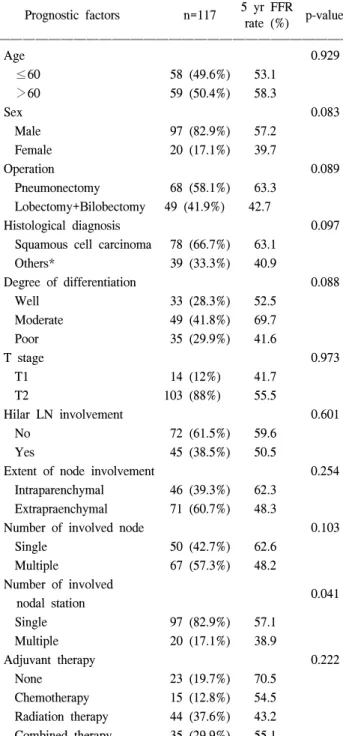
환자군의 특성, 수술 방법, T 병기, 조직병리학적 소견, 림프절전이 양상, 술 후 보조요법등에 따른 무재발률의 차이에 대해 분석하였다(Table 3). 단변량 분석 결과 다림 프절군 N1인 경우 5년 무재발률이 38.9%로 단일림프절군 Fig. 1. Overall survival rate curve of completely resected
pT1/2N1 patients.
Fig. 2. Freedom-from recurrence rate curve of completely resected pT1/2N1 patients.
Table 2. Pattern of recurrences
ꠚꠚꠚꠚꠚꠚꠚꠚꠚꠚꠚꠚꠚꠚꠚꠚꠚꠚꠚꠚꠚꠚꠚꠚꠚꠚꠚꠚꠚꠚꠚꠚꠚꠚꠚꠚꠚꠚꠚꠚꠚꠚꠚꠚꠚꠚꠚꠚꠚꠚꠚꠚꠚꠚꠚ
Site of recurrence Number
ꠏꠏꠏꠏꠏꠏꠏꠏꠏꠏꠏꠏꠏꠏꠏꠏꠏꠏꠏꠏꠏꠏꠏꠏꠏꠏꠏꠏꠏꠏꠏꠏꠏꠏꠏꠏꠏꠏꠏꠏꠏꠏꠏꠏꠏꠏꠏꠏꠏꠏꠏꠏꠏꠏꠏ
Local recurrence 4
Stump site 2
Ipsilateral mediastinal lymph node 1
Wound 1
Distant metastasis 40
Lung 12
Brain 12
Bone 10
Liver 4
Adrenal gland 1
Kidney 1
ꠏꠏꠏꠏꠏꠏꠏꠏꠏꠏꠏꠏꠏꠏꠏꠏꠏꠏꠏꠏꠏꠏꠏꠏꠏꠏꠏꠏꠏꠏꠏꠏꠏꠏꠏꠏꠏꠏꠏꠏꠏꠏꠏꠏꠏꠏꠏꠏꠏꠏꠏꠏꠏꠏꠏ
N1 (57.1%)에 비해 유의하게 낮았으며(p=0.041)(Fig. 4), 다 변량분석에서도 유의한 위험인자(HR=1.997, 95% CI=
1.009∼3.955, p=0.047)로 나타났다.
고 찰
다른 병기에서와 마찬가지로 pT1/2N1 병기 비소세포폐 암의 예후인자는 여러 가지가 제안되고 있다. Mountin[1]
은 T 요인(T1 or T2)에 따라 생존율의 차이가 있다고 보고 하였으나 Naruke 등[9]은 두 병기간에 유의한 생존율의 차 이를 발견하지 못하였다고 보고하였다. 편평상피세포암이 다른 종류의 암에 비해 예후가 좋다고 보고되기도 하며 [5,10,11] 장측 흉막의 전이 여부가 나쁜 예후인자로 보고 되기도 하였다[5,10]. 림프절 전이 양상이 예후에 미치는 Table 3. Univariate analysis of prognostic factors for freedom-
from recurrence (FFR)
ꠚꠚꠚꠚꠚꠚꠚꠚꠚꠚꠚꠚꠚꠚꠚꠚꠚꠚꠚꠚꠚꠚꠚꠚꠚꠚꠚꠚꠚꠚꠚꠚꠚꠚꠚꠚꠚꠚꠚꠚꠚꠚꠚꠚꠚꠚꠚꠚꠚꠚꠚꠚꠚꠚꠚ 5 yr FFR
Prognostic factors n=117 p-value
rate (%)
ꠏꠏꠏꠏꠏꠏꠏꠏꠏꠏꠏꠏꠏꠏꠏꠏꠏꠏꠏꠏꠏꠏꠏꠏꠏꠏꠏꠏꠏꠏꠏꠏꠏꠏꠏꠏꠏꠏꠏꠏꠏꠏꠏꠏꠏꠏꠏꠏꠏꠏꠏꠏꠏꠏꠏ
Age 0.929
≤60 58 (49.6%) 53.1
>60 59 (50.4%) 58.3
Sex 0.083
Male 97 (82.9%) 57.2
Female 20 (17.1%) 39.7
Operation 0.089
Pneumonectomy 68 (58.1%) 63.3 Lobectomy+Bilobectomy 49 (41.9%) 42.7
Histological diagnosis 0.097
Squamous cell carcinoma 78 (66.7%) 63.1
Others* 39 (33.3%) 40.9
Degree of differentiation 0.088
Well 33 (28.3%) 52.5
Moderate 49 (41.8%) 69.7
Poor 35 (29.9%) 41.6
T stage 0.973
T1 14 (12%) 41.7
T2 103 (88%) 55.5
Hilar LN involvement 0.601
No 72 (61.5%) 59.6
Yes 45 (38.5%) 50.5
Extent of node involvement 0.254
Intraparenchymal 46 (39.3%) 62.3 Extrapraenchymal 71 (60.7%) 48.3
Number of involved node 0.103
Single 50 (42.7%) 62.6
Multiple 67 (57.3%) 48.2
Number of involved
0.041 nodal station
Single 97 (82.9%) 57.1
Multiple 20 (17.1%) 38.9
Adjuvant therapy 0.222
None 23 (19.7%) 70.5
Chemotherapy 15 (12.8%) 54.5
Radiation therapy 44 (37.6%) 43.2 Combined therapy 35 (29.9%) 55.1
ꠏꠏꠏꠏꠏꠏꠏꠏꠏꠏꠏꠏꠏꠏꠏꠏꠏꠏꠏꠏꠏꠏꠏꠏꠏꠏꠏꠏꠏꠏꠏꠏꠏꠏꠏꠏꠏꠏꠏꠏꠏꠏꠏꠏꠏꠏꠏꠏꠏꠏꠏꠏꠏꠏꠏ
*=Including adenocarcinoma, adenosquamous carcinoma and large cell carcinoma.
Fig. 3. Cumulative risk of recurrence in 44 patients with re- currence after complete resection.
Fig. 4. Freedom-from recurrence rate curves of patients with single station N1 (solid line) and multi-station N1 (dash line). 5 year freedom-from recurrence rate of the multi-station N1 group (38.9%) was significantly lower than the single station N1 group (57.1%).
영향에 대한 연구가 많이 보고되고 있는데 일반적으로 폐 문부 림프절 전이가 있는 경우가 엽간 림프절 이하의 림 프절에 전이가 있는 경우 보다 예후가 나쁜 것으로 보고 되고 있으며[2,12], Rea 등[13]은 폐문부 림프절 전이가 있 는 N1 군과 한 개의 종격동림프절에만 전이가 있는 N2 군과 생존율의 차이가 없다고 보고하였다. 페엽내 림프절 (intralobar lymph node)에 전이가 있는 경우가 폐엽외 림프 절(extralobar lymph node-폐문부 림프절, 엽간림프절)에 전 이가 있는 경우에 비해 예후가 좋다는 보고도 있다[14].
Osaki 등[3]은 단일림프절에만 전이가 된 경우가 여러 개 의 림프절에 전이가 있는 경우보다 예후가 좋다고 보고하 였으며, Sayer 등[4]은 단일림프절군 N1이 다림프절군 N1 에 비해 예후가 좋다고 보고한바 있다. 또한 Velzen 등[5]
은 종괴에 의해 폐실질 림프절이 직접 침범된 경우가 전 이에 의한 경우보다 예후가 좋다고 보고하였다.
재발의 양상에 대해서는 대부분의 연구에서 국소 재발 보다는 원격 전이가 더 많은 것으로 보고되고 있다. Saw- yer 등[15]은 평균 2.3년의 추적관찰기간 동안 107명의 환 자들에서 61.7%의 재발을 관찰하였는데, 국소재발이 38%, 원격전이가 47%였으며, 기관지 내시경상 기관지 내 병변 이 있던 경우가 국소재발의 위험이 높았고, 절제된 N1 림 프절 개수가 10개 미만인 환자들에서 원격전이의 위험성 이 높다고 보고하였다. Yano 등[12]은 국소재발이 10.3%, 원격전이가 33.3%로 보고하였으며, 주로 폐, 뇌, 뼈에 원 격전이가 나타나는 것으로 보고하였다. Osaki 등[3]은 35.1 개월 간 82명의 환자 중에서 34명(41.5%)의 재발을 관찰 하였는데, 이 중 국소재발은 10명으로 종격동 림프절전이 가 많았고, 원격전이는 17명으로 뼈 전이가 가장 많았다.
Marra 등[16]은 전체 N1 환자에서 45%의 재발률을 보고하 였고, 그 가운데 국소재발은 35%, 원격전이는 65%였다.
본 연구에서도 원격 전이가 대부분(91%)으로 국소재발은 4예에 불과하였다. 국소재발은 모두 8개월 이내에 발생하 였으며 기관지 절단면에 재발을 보인 2례 모두 기관지내 병변이 있던 경우였으며, 동측 종격동 림프절에 재발을 보인 환자는 좌상엽 폐암으로 폐문부 림프절에 전이가 있 었던 환자로 전종격동 림프절(3A)에서 재발이 발견되었 다. 수술 부위 흉벽에 재발을 보인 예는 절제된 검체를 꺼 내는 과정에서 암세포의 파종이 있었던 것으로 추측된다.
타 연구들에 비해 국소재발이 상대적으로 적은 이유는 접 근 가능한 모든 종격동 림프절에 대한 근치적 절제가 이 루어졌으므로 국소재발의 많은 부분을 차지하는 동측 종 격동 림프절에서의 재발이 없었던 것이 원인으로 생각된
다. Keller 등[17]도 완전 절제가 가능하였던 II기와 IIIa기 비소세포폐암에서 근치적 종격동림프절 절제한 경우가 종격동림프절검사(mediastina lymph node sampling)만 한 경우 종격동림프절의 재발율이 낮았다고 보고하였다. 원 격 전이가 발생하는 장기는 다른 연구에서와 마찬가지로 폐, 뇌, 뼈 등이 대부분이었으며 간, 부신, 신장에도 전이 가 발생하였다.
재발의 대부분(86.4%)은 수술 후 2년 이내에 발생하였 고 4년 이후에는 새로운 재발이 없었던 것으로 보아 수술 후 처음 2년간은 집중적인 추적 관찰이 필요할 것으로 보 인다.
재발의 위험인자 분석시 환자군의 특성, 수술 방법, T 병기, 조직병리학적 소견, 술 후 보조요법등에 따른 차이 는 관찰되지 않았다. 림프절 전이 양상에 따라 재발의 위 험도를 알아본 결과 폐문부 림프절 전이 여부, 폐실질 내 림프절 전이여부, 림프절 전이 개수 등에 따른 차이는 발 견할 수 없었으나, 단일림프절군 N1에 비해 다림프절군 N1에서 재발의 위험도가 의미 있게 높았다(HR=1.997 p=
0.047).
최근 연구들에 의하면 초기 비소세포폐암에서 platinum 을 바탕으로 한 항암요법이 환자의 생존율을 증가시킬 수 있는 것으로 보고되고 있으며[18-20], 특히 Winton 등[19]
은 T2N0와 T1/2N1기의 초기 비소세포폐암에서 완전절제 후 vinorelbine과 cisplatin으로 시행한 항암화학요법이 생존 기간과 무재발생존기간을 증가시킨다고 발표하였다[19].
림프절전이가 있는 pT1/2N1 환자의 경우 수술 당시 이미 미세전이에 의한 재발의 가능성이 있으므로 재발을 줄이 고 생존률을 높이기 위해 항암 화학요법을 시행하는 것이 도움이 될 것으로 생각되며, 특히 상대적으로 재발의 위 험성이 높은 다림프절군 N1에서는 수술 후 적극적인 항 암화학요법과 추적관찰이 필요하다고 생각된다.
결 론
완전 절제된 pT1/2N1 비소세포폐암에서 수술 후 재발은 원격전이가 대부분이었고, 주로 2년 이내에 발생하였으며, 다림프절군 N1이 재발의 위험인자였다. 재발의 위험이 높 은 다림프절군 N1 pT1/2N1 비소세포폐암 환자에서 완전 절제 후 재발을 줄이고 생존률을 향상시키기 위한 보조 항암화학요법이 필요할 것으로 생각되며, 그 효과에 대해 서는 추가적인 연구가 필요하다고 생각된다.
참 고 문 헌
1. Mountain CF. Revision in the international system for stag- ing lung cancer. Chest 1997;111:1710-7.
2. Tanaka F, Yanagihara K, Otake Y, et al. Prognostic factors in patients with resected pathologic (p) T1-2N1M0 non-small cell lung cancer. Eur J Cardio Thorac Surg 2001;19:555-61.
3. Osaki T, Nagashima A, Yoshimatsu T, Tashima Y, Yasumo- to K. Survival and characteristics of lymph node involvement in patients with N1 non-small cell lung cancer. Lung Cancer 2004;43:151-7.
4. Sayar A, Turna A, Solak O, Urer N, Gurses A. Prognostic significance of surgical-pathologic multistation N1 disease in non-small cell carcinoma of the lung. Eur J Cardiothorac Surg 2004;25:434-8.
5. van Velzen E, Snijder RJ, de la Riviere AB, Elbers HRJ, van den Bosch JMM. Lymph node type as a prognostic factor for survival in T2N1M0 non-small cell lung car- cinoma. Ann Thorac Surg 1997;63:1436-40.
6. Scott WJ, Howington J, Movsaa B. Treatment of stage II non-small cell lung cancer. Chest 2003;123:188S-201S.
7. Naruke T, Suemasu K, Ishogawa S. Lymph node mapping and curability at various level of metastasis in resected lung cancer. J Thorac Cardiovasc Surg 1978;76:832-9.
8. Travis WD, Colby TV, Corrin B, Shimosato Y, Brambilla E.
World health organization international histologic classi- fication of tumours. 3rd ed. Springer-Verlag. 1999.
9. Naruke T, Tsuchiya R, Kondo H, Asamura H. Prognosis and survival after resection for bronchogenic carcinoma. Based on the 1997 TNM-staging Classificaiton: The Japanese ex- perience. Ann Thorac Surg 2001;71:1759-64.
10. van Rens MTM, de la Riviere AB, Elbers HRJ, van den Bosch JMM. Prognostic assessment of 2361 patients who underwent pulmonary resection for non-small cell lung cancer, Stage I,II, and IIIA. Chest 2000;117:374-9.
11. Ichinose Y, Yano T, Asoh H, Yokoyama H, Yoshino I, Kay- suda Y. Prognostic factors obtained by a pathologic exami- nation in completely resected non-small cell lung cancer. An analysis in each pathologic stage. J Thorac Cadiovasc Surg
1995;110:601-5.
12. Yano T, Yokoyama H, Inoue T, Asoh H, Tayama K. Ichino- se Y. Surgical results and prognostic factors of pathologic N1 disease in non-small cell carcinoma of the lung. J Thorac Cardiovasc Surg 1994;107:1398-402.
13. Rea F, Marulli G, Callegaro D, et al. Prognostic significance of main bronchial lymph nodes involvement in non-small cell lung carcinoma: N1 or N2? Lung Cancer 2004;45:215-20.
14. Riquet M, Manac'h D, Le Pimpec-Barthes F, Dujon A, Che- hab A. Prognostic significance of surgical-pathologic N1 disease in non-small cell carcinoma of the lung. Ann Thorac Surg 1999;67:1572-6.
15. Sawyer TE, Bonner JA, Gould PM, et al. Factors predicting patterns of recurrence after resection of N1 non-small cell lung carcinoma. Ann Thorac Surg 1999;68:1171-6
16. Marra A, Hillejan L, Zaboura G, Fujimoto T, Greschuchna A, Stamatis G. Pathologic N1 non-small cell lung cancer:
Correlation between pattern of lymphatic spread and pro- gnosis. J Thorac Cardiovasc Surg 2003;125:543-53.
17. Keller S, Adak S, Wagner H, Johnson DH. Mediastinal lymph node dissection improves survival in patients with Stage II and IIIa non-small cell lung cancer. Ann Thorac Surg 2000;70:358-66.
18. Arriagata R, Bergan B, Dunant A, Le Chevalier T, Pignon JP, Vansteenkiste J. The International Adjuvant Lung Cancer Trial Collaborative Group. Cisplatin based adjuvant chemo- therapy in patients with completely resected non-small cell lung cancer. N Engl J Med 2004;350:351-60.
19. Winton TL, Livingston R, Johnson D, et al. A prospective randomised trial of adjuvant vinorelbine (VIN) and cisplatin (CIS) in completely resected stage IB and II non small cell lung cancer. Intergroup JBR.10. J Clin Oncol (Meeting Abstracts) 2004;22:7018.
20. Strauss M, Herndon J, Maddaus MA, et al. Randomized clinical trial of adjuvant chemotherapy with paclitaxel and carboplatin following resection in Stage IB non-small cell lung cancer: Report of Cancer and Leukemia Group B (CA- LGB) Protocol 9633. J Clin Oncol (Meeting Abstracts) 2004;
22:7019.
=국문 초록=
배경: 완전절제는 pT1/2N1 비소세포폐암의 가장 효과적인 치료 방법이지만 수술 후 5년 생존율은 40% 정도이며 많은 환자가 암의 재발로 사망하게 된다. 완전 절제된 pT1/2N1 비소세포폐암에서 재발 에 영향을 주는 인자를 규명하고자 하였다. 대상 및 방법: 1990년 1월부터 2003년 7월까지 연세대학 교 의과대학 세브란스병원 흉부외과에서 pT1/2N1 비소세포폐암으로 수술받은 환자 117명을 대상으 로 환자의 특성, 조직병리학적 소견, 수술방법, 림프절 전이 양상, 술 후 보조요법등과 재발과의 관계 를 후향적으로 연구하였다. 결과: 전체 환자의 평균 연령은 59.3±9.1세였으며 T1N1이 14명, T2N1이 103명이었다. 추적관찰기간은 27.5개월이었으며 5년 생존율은 41.3%였다. 수술 후 재발은 44명(37.6%) 에서 관찰되었으며 원격전이가 40명이었다. 재발한 환자의 5년 생존율은 3.3%로 재발이 없는 환자 (61.3%)에 비해 유의하게 낮았으며(p=0.000), 전체 환자의 5년 무재발률(freedom-from recurrence rate)은 54.1% 였다. 무재발률에 영향을 미치는 요인에 대한 다변량 분석 결과 다림프절군 N1 (multi-station N1)이 단일림프절군 N1 (single station N1)에 비해 재발의 위험도가 1.997배 높았다(p=0.047). 결론: 완 전 절제된 pT1/2N1 비소세포폐암 환자들에서 다림프절군 N1이 수술 후 재발의 위험인자였다.
중심 단어:1. 비소세포폐암 2. 종양병기 3. 종양재발