Optimization of Streptococcus macedonicus MBF10-2 Lysate Production in Plant-based Medium by Using Response Surface Methodology
Dini Andyanti1, Fatin M. Dani1, Wibowo Mangunwardoyo2, Muhamad Sahlan3,and Amarila Malik1*
1Pharmaceutical Microbiology and Biotechnology Research Group, Faculty of Pharmacy, 2Department of Biology, Faculty of Mathematics and Natural Science, 3Bioprocess Research Group, Department of Chemical Engineering, Faculty of Engineering, Universitas Indonesia, UI Campus Depok, Depok 16424, Indonesia
Received: December 17, 2018 / Revised: February 6, 2019 / Accepted: February 8, 2019
Introduction
Recently, lysates of lactic acid bacteria (LAB) carrying a Generally Recognized As Safe classification (GRAS) have been commonly used as a raw material in various health and skin care products. Some studies have reported that the application of some LAB extracts (e.g., Lactobacillus johnsonii, Lactobacillus casei, Lactobacil-
lus plantarum, and Lactobacillus acidophilus) have antimicrobial and anti-adhesive effects on cutaneous and mucosal surfaces [1]. This antimicrobial effect is thought to occur due to a peptide known as bacteriocin [1−3]. Its biological action may be either bactericidal or bacteriostatic [4, 5] and it is known as Bacteriocin Like Inhibitory Substance for this reason (BLIS) [6]. Addi- tionally, the lactic acid produced by these bacteria has also been shown to inhibit the growth of various dermal pathogens [7], interfere with essential metabolic func- tions, eliminate cell membrane permeability, and reduce intracellular pH [7]. As one of the α-hydroxy acids, lactic Bacterial lysates have become a common ingredient for natural health care. Lactic acid bacteria (LAB) could serve as potential candidates for lysate production: the lactic acids produced by LAB have been uti- lized for their moisturizing, antimicrobial, and rejuvenating effects, while other substances provide topical benefits and health effects for the skin. Our study aimed to obtain lysate from a LAB S. macedonicus MBF 10-2 through an optimized fermentation using the Response Surface Methodology. Strain MBF10-2 was cul- tivated in a 2L fermenter tank in de Man Rogosa and Sharpe (MRS) medium and in plant-based peptone modified MRS, i.e. Soy-peptone and Vegitone. The duration and the medium composition (dextrose and soy peptone or proteose peptone) were adjusted to obtain an optimum production of cell lysate. Central Com- posite Design was employed for Design Expert 7.0.0 by adjusting 3 factors: dextrose (1%, 1.5%, 2%, 2.5%, 3%), soy or proteose peptone (0.5%, 0.75%, 1%, 1.25% and 1.5%), and duration of fermentation (8, 10, 12 14, and 16 h for MRS-Soy peptone and 15, 17, 19, 21, and 23 h for MRS Vegitone). Bacteriocin-Like Inhibitor Substance activity of lysate and pH were used as indicators. The optimum condition for lysate production using MRS Soy Peptone and Vegitone are as follows: dextrose concentration 2.5%, plant-based peptone 1.25%, while optimum fermentation duration were 11.18 h (MRS Soy Peptone) and 17 h (MRS Vegitone) with a starter concentration of 10% at OD600nm 0.2 ± 0.05. However, the standard MRS medium produced better quality lysate compared to MRS plant-based peptones.
Keywords: Bacterial lysate, bacteriocin, lactic acid bacteria, MRS, response surface methodology, Streptococcus macedonicus
*Corresponding author
Tel: +62-21-7270031, Fax: +62-21-7863433 E-mail: [email protected]
© 2019, The Korean Society for Microbiology and Biotechnology
acid also has the potential to improve stratum corneum barrier function and enhance the production of ceramide by keratinocytes [7]. Ceramide, one of the main compo- nents of the intracellular lipid lamellar layer in the stra- tum corneum, plays a role in skin defense and maintains skin hydration [8].
Bacterial lysates may have an adjuvant effect and also reinforce the body’s natural barriers [9] by modulating the balance of lipid inflammatory mediators. These lysates are made by blending inactivated or killed whole bacteria depending on the application. For vaccine or pharmaceutical applications, bacterial lysates are derived from inactivated pathogenic bacteria that trigger immune surveillance, while in some cosmetic applications, the bacteria used may be commensal or environmental [9].
Cream containing Bifidobacterium longum SP lysate was reported to give a significant effect in reducing skin sen- sitivity and dryness, while improving skin barrier function, compared to placebo [10]. A study on the application of Vitreoscilla filiformis lysates in a topical treatment for- mulation for atopic dermatitis (AD) showed significantly reduced AD-like inflammation in NC/Nga mice [11].
LAB constitute a physiologically related group of fac- ultative anaerobic, nonsporulating, catalase-negative, Gram-positive, low G+C cocci and rods, which share the capacity to ferment sugars primarily into lactic acid via homo- or heterofermentative metabolism [12]. S. mace- donicus was isolated during a survey of the LAB micro- biota of naturally fermented Greek Kasseri cheese [12, 13] and belongs to the thermophilic, homofermentative LAB strains. It is nutritionally fastidious (multiple amino acid auxotrophies, restricted proteolytic system), requiring the addition of appropriate nitrogen sources (yeast extract) to grow in de Man, Rogosa and Sharpe (MRS) medium and to perform well in milk media [12, 14, 15]. Growth of the bacteria is sustained between 25℃ and 45℃ (optimal growth at 42.3℃) and between pH 5.0 and 8.5 (optimal growth at pH 6.4) [14].
In our previous study, Streptococcus macedonicus MBF10-2 strain, referred to as BLIS (MBF10-2) with p- type 636 and isolated from a tofu byproduct collected from a home industry in Tangerang, Indonesia, showed a single broad-spectrum bacteriocin and multiple bac- teriocin activities. BLIS (MBF10-2) inhibits the growth of Micrococcus luteus, Streptococcus pyogenes and Lac- tococcus lactis, and also strains of Leuconostoc mesen-
teroides and Weissella confusa [16]. The scalable potential of this specific lysate has not been reported yet, although Streptococcus, as one of the most prolific bacte- riocin-producing genera, has been reported to have some clinical benefits [5, 16−18].
In order to achieve high performance production of bacteriocin, lactic acid, and other substances at commer- cial scale, optimization of the fermentation conditions is important. The influencing factors could vary with dif- ferent types of bacteriocin and may be strain-dependent [19]. This current study aims to determine the optimum lysate fermentation production conditions and identify the best medium composition for producing lysate that will yield large amounts of bacteriocin and lactic acid.
Two modified MRS media that use plant-based pep- tones—MRS-Soy peptone and MRS- Vegitone—were used in this study and were compared with standard MRS medium. Optimization was carried out using Response Surface Methodology (RSM).
Materials and Methods
Bacterial strains and growth condition
Streptococcus macedonicus MBF 10-2, strain obtained from our previous studies [16, 20] was used as bacterium for lysate production. MBF10-2 was grown anaerobically in each media within anaerobic jars at 37℃. Standard MRS medium [21] and modified mediums MRS-Soy Pep- tone and MRS-Vegitone were used as both inoculum and fermentation mediums. The MRS-Soy peptone medium consisted of 10 g/l soy peptone, 8 g/l LAB-Lemco (Oxoid, UK), 4 g/l yeast extract (Difco, USA), 2 g/l dipotassium hydrogen phosphate, 5 g/l sodium acetate, 2 g/l ammo- nium citrate, 0.2 g/l magnesium sulfate, 0.05 g/l manga- nese sulfate, 0.05% (v/v) Tween 80 (Merck, German), and 20 g/l dextrose (Wako, Japan). MRS Vegitone was composed of 10 g/l proteolyzed vegetable peptone (Wako), 5 g/l yeast extract (Difco), 2 g/l dipotassium hydrogen phosphate, 5 g/l sodium acetate, 2 g/l ammonium citrate, 0.1 g/l magnesium sulfate, 0.05 g/l manganese sulfate, 0.01% (v/v) Tween 80 (Merck, Germany), 3 g/l 2-phenyl- ethyl alcohol, 0.004 g/l bromocresol green, 0.0004 g/l Captan (Wako), and 20 g/l dextrose (Wako). For solid media, Bacto agar (Difco) was added to a final concen- tration of 15 g/l. Incubation was carried out at 37℃ for 24 h in anaerobic jars using AnaeroGen (Oxoid) [16].
Frozen stock of Streptococcus macedonicus MBF 10-2 was stored at 80℃ in MRS Broth with 85% (v/v) of sterile glycerol. To obtain a fresh culture, the strain was culti- vated (37℃, 24 h in anaerobic conditions) in the new medium before experimental use.
Leuconostoc mesenteroides TISTR 120 was used as indicator bacteria for bacteriocin activity by disc diffu- sion method and was grown in MRS medium [22] at 32℃ for 24 h under anaerobic conditions. As a non-lactic acid- producing bacterial indicator, Bacillus subtilis ATCC 6633 was grown in Nutrient Agar or Broth at 37℃ for 24 h [23] in aerobic conditions.
Strain confirmation and growth curve
Prior to use, strain confirmation of S. macedonicus MBF10-2 was carried out by performing visual inspec- tion of morphology, Gram staining, and 16S rDNA molecular identification. Molecular identification 16S rDNA was determined with PCR and DNA sequencing.
For the PCR, a pair of primers, that specifically targets the 16S rRNA gene of LAB, were used: 1 μl LABfw (5’- AGA GTT TGA TYM TGG CTC AG-3’) 20 pmol/μl and 1μl LABrv (5’-CAC CGC TAC ACA TGG AG-3’) 20 pmol/μl. PCR mix was done with KAPA HiFi Hot- Start PCR Kit (Kapa Biosystem, USA), which consisted of 13.5 μl of ddH2O, 5 μl of KAPA HiFi GC buffer (5X), 0.5 μl of 1 U/μl KAPA HiFi HotStart DNA Polymerase, 1μl KAPA dNTP Mix (10 mM each) and 3 μl of genomic DNA of MBF10-2. PCR reaction was performed as described in a a previous report [20]. Electrophoresis was used for DNA visualization with 1% agarose gel in 1X TAE buffer and using a UV transilluminator. DNA sequencing was used to confirm PCR products followed by analysis with BLAST (http://www.ncbi.nlm.nih.gov/
BLAST) for species identification.
To obtain optimum bacterial growth conditions, S.
macedonicus MBF 10-2 was incubated for 24 h at 37℃ under anaerobic conditions. Absorbance values at 600 nm were taken until stationary phase was reached and each value was preceded by a moderate shaking step [24]. Three independent replicates were carried out for each condition; data were then used to make bacterial growth curves.
Cultivation condition and lactic acid monitoring
The preparation of seed cultures was as follows; a sin-
gle colony from the agar plate was cultivated at 37℃ for 24 h anaerobically using 7 ml of MRS-Soy Peptone medium and 7 ml of MRS Vegitone. Approximately 1 ml of seed culture was transferred into 9 ml of broth medium and was incubated at 37℃ for 24 h anaerobi- cally. This seed culture was subsequently re-transferred into 100 ml of new broth medium and continued anaero- bic incubation at 37℃ for 24 h. Culture samples were taken at 0, 6, 12, 18, and 24 h, then bacterial cells were collected by centrifugation at 5000 ×g for 30 min at 4℃.
Culture pH was measured to monitor lactic acid produc- tion against the negative indicator Bacillus subtilis ATCC 6633. Furthermore, samples of culture were har- vested at 5, 7, 9, 11, and 13 h timepoints and then centri- fuged to collect the cells. The cells were washed using sterile ddH2O before cell lysis.
Production of bacterial lysate
Optimization of cell lysis was done using two methods:
first, by a mechanical process using an ultrasonicator and second, by an enzymatic process using lysozyme. An Ultrasonic Homogenizer (Sartorius Stedim, Germany) was used for ultrasonication with the bacterial cells sus- pended in lysis buffer (750 mM, ε-amino caproic acid, 1 mM PMSF, 50 mM Tris-HCl [pH 7.4]) on ice. Repeti- tion (5x, 10x, and 15x), duration (60 s, 75 s, and 90 s), and the amplitude (25%, 30%, 35%) of the cell lysis con- ditions were optimized. Repeating 15 duty cycles of 0.5 sec for 75 sec with 15-sec intervals were apparently sufficient enough to lyse the bacterial cells as reported [25]. In the second method, 2 mg/ml lysozyme was used as previously reported [26] followed by 30 min of incuba- tion at 30℃, which was repeated once. In both cases, lysis was confirmed by visual inspection and microscopy.
Lysate from both methods were separated by centrifu- gation at 10000 ×g for 15 min at 4℃ as previously reported [25]. Concentrated bacterial lysates were obtained by filtration with a 10-kDa cutoff Amicon (Merck Millipore, Germany) ultracentrifugal filter. The lysate was freeze-dried and kept at 4℃ to avoid degrada- tion.
BLIS activity assay
BLIS activity assays reference to [16]. The clear zone area observed was measured using calipers. Interval sampling of bacterial culture was done at 5, 7, 9, 11, and
13 h in triplicate.
Experimental design
We used Design Expert version 7.0.0 for a response surface methodology (RSM) study using central compos- ite design (CCD). We chose three factors as variables or independent variables, namely, the amounts of dextrose (%w/v), plant-based peptone source (proteose peptone (Vegitone) or soy peptone), and fermentation duration (h). Durations of fermentation were 8, 10, 12, 14, and 16 h for MRS-Soy peptone and 15, 17, 19, 21, and 23 h for MRS Vegitone. Our two responses as dependent vari- ables were the BLIS activities of S. macedonicus MBF 10-2 lysates (in zone of inhibition diameter; mm) and the pH.
Our CCD matrix consisted of 23 (8) factorial points with 6 star points and 6 replications at the center points with a total experimental number of 20. The midpoints of dextrose, proteose peptone vegetable, and soy peptone were determined based on the standard percentage used in MRS medium: 2% for dextrose and 1% each for soy and vegetable peptones. The fermentation duration mid- point was determined from the late log phase of the growth curve. Dextrose experimental amounts were 1%, 1.5%, 2%, 2.5%, and 3% while the peptone experimental amounts were 0.5%, 0.75%, 1%, 1.25%, and 1.5%.
Optimization of medium composition and fermenta- tion duration were carried out with a working volume of 50 ml in a tightly-sealed 50 ml Erlenmeyer container to mimic microaerophilic conditions. After fermentation, the bacterial cells were lysed, lysate pH was measured, and BLIS activity was assayed for incorporation into the RSM. Expected bacteriocin activity was shown as an increase in diameter of the inhibitory zone.
The BLIS activity and pH of S. macedonicus MBF 10-
2 lysates using standard MRS medium was compared to the BLIS activity and pH of lysate from plant-based modified media.
Results
Bacterial strains confirmation
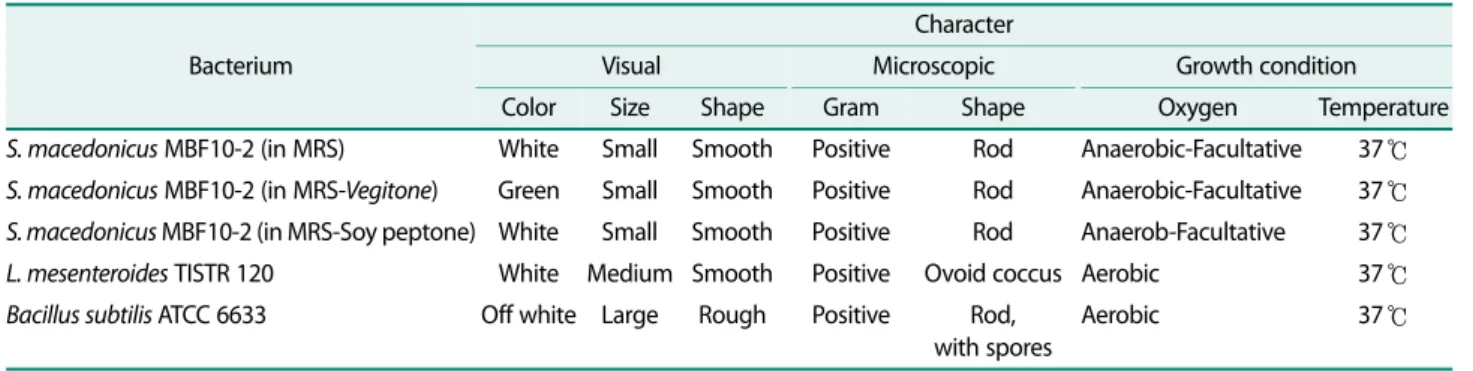
Morphological characteristics were confirmed by visual and microscopic observations as listed in Table 1.
S. macedonicus MBF 10-2 colonies grown in MRS medium and modified colonies showed similar charac- teristics. L. mesenteroides and Bacillus subtilis, as indi- cator bacteria, showed typical colony formation [27] as presented in Fig. 1. Molecular identification using 16S rDNA polymerase chain reaction (PCR) and sequencing was used to confirm the starter culture as S. macedoni- cus MBF10-2 at 99% homology.
Cultivation of MBF10-2 and lactic acid product monitor- ing
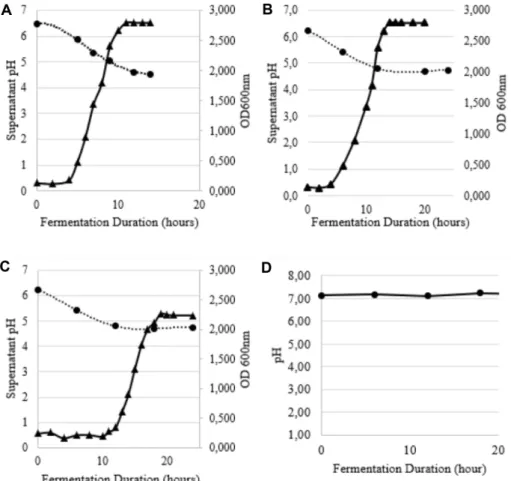
During fermentation in MRS medium at 37℃ and pH 6.4, S. macedonicus MBF 10-2 grew exponentially for about 4 h after a short lag phase (Fig. 2A). The lag phase in modified medium (MRS Soy Peptone and MRS Vegitone) was found to be longer than in standard MRS medium (Figs. 2B, 2C).
Lactic acid product synthesized by S. macedonicus MBF 10-2 grown in MRS, MRS-Soy peptone, and MRS- Vegitone media increased as the pH lowered. All S.
macedonicus MBF 10-2 cultivation in this study showed a decrease in pH. In comparison, Bacillus subtilis con- trols had no pH changes during the cultivation period (Fig. 2D). This indicates that the S. macedonicus grown in all MRS media demonstrated an increase of lactic acid production.
Table 1. Morphological characteristic for confirmation of bacteria used in this study.
Bacterium
Character
Visual Microscopic Growth condition
Color Size Shape Gram Shape Oxygen Temperature
S. macedonicus MBF10-2 (in MRS) White Small Smooth Positive Rod Anaerobic-Facultative 37℃ S. macedonicus MBF10-2 (in MRS-Vegitone) Green Small Smooth Positive Rod Anaerobic-Facultative 37℃ S. macedonicus MBF10-2 (in MRS-Soy peptone) White Small Smooth Positive Rod Anaerob-Facultative 37℃
L. mesenteroides TISTR 120 White Medium Smooth Positive Ovoid coccus Aerobic 37℃
Bacillus subtilis ATCC 6633 Off white Large Rough Positive Rod, with spores
Aerobic 37℃
Optimum cell lysis condition
Optimization of cell lysis was carried out using an ultrasonicator and lysozyme. Optimization of the cell lysis was performed by modifying the following vari- ables: 1) cycle repetition (5x, 10x, and 15x repetitions); 2) percentage of amplitude (25%, 30%, and 35%); and 3) duration of each repetition (60, 75, and 90 sec). Results
showed that the best ultrasonic lysis condition was the 15x replication, 35% amplitude, and 75 sec duration for each repetition, and also by the reduction of cell num- bers to 1/8th of the initial cell number. However, after optimization, not all cells were lysed. In addition, the ultrasonication cell lysis process was time-consuming so it was considered ineffective due to the thickness of the
Fig. 2. Bacterial growth curves and pH condition during fermentation. (A) MRS, (B) MRS-Vegitone, (C) MRS-Soy Peptone, (D) pH condition of Bacillus subtilis ATCC 6633 fermentation as negative control; ▲ growth curve, ● pH.
Fig. 1. Colony of Streptococcus macedonicus MBF 10-2. (A) MRS Agar, (B) MRS Soy Peptone Agar, (C) MRS Vegitone Agar.
peptidoglycan wall of S. macedonicus MBF 10-2. The subsequent cell separation was therefore carried out enzymatically with lysozyme.
In contrast to mechanical destruction, enzymatic cell destruction using lysozyme resulted in white debris and a clear supernatant. By microscopic observation, it can be assumed that the cell lysis process using lysozyme was more effective than ultrasonication (Fig. 3).
Central point value for CCD during cultivation using RSM The midpoint of dextrose and soy peptone composition was determined based on the standard percentage used in the MRS medium, i.e. 2% for dextrose and 1% for soy peptone. While the midpoint of fermentation duration was determined based on the growth phases of S. mace- donicus MBF 10-2 in Medium. The value of CCD pre- sented in Table 2.
Optimizing the fermentation conditions with Design Expert 7.0.0 analysis: Results showed that the probability (P) value < 0.05 of the model treated by using both data responses, i.e. BLIS activity and pH, indicate as signifi- cant, and the model was claimed as good with probabil- ity value (Prob > F) < 0.05 or significant, while the lack
of fit test wass not significant (more than 0.05). From the model, we chose a 50 ml working volume at 37℃ with initial pH 6.79 (Tables 3 and 4).
BLIS activity response: Results obtained by performing Design Expert 7.0.0. using Analysis of variant (ANOVA) of S. macedonicus MBF 10-2 lysate in response to BLIS activity of MRS-Soy Peptone culture (Fig. 4A) were anal- ysed and the regression model was given as follows:
Y= + 6,77 + 0,26 A + 0,054 B + 0,033 C + 0,15 AB + 8,333E-003 AC + 0,046 BC + 0,13 A2 + 0,044 B2 + 0,017 C2 with R2 74,13%.
Results of BLIS activity of S. macedonicus MBF 10-2 lysate in response to BLIS activity of MRS-Vegitone cul- ture (Fig. 4B) were analyzed and the regression model was given as follows:
Y = +8.93 − 0.15A − 0.056B − 0.10C + 0.54AB − 0.18AC − 0.43BC + 0.018A2 − 0.12B2 − 0.11C2 with R2= 74,60%.
Where A was the percentage of dextrose, B was percent- age of soy peptone/proteose peptone vegetable, and C was duration of fermentation.
Fig. 3. Cells Lysis of Streptococcus macedonicus MBF 10-2. (A) whole cells, (B) destruction cell using ultrasonic, (C) destruction cell using lysozyme. Dense cell represent broken cell is shown by solid arrow; clear intact cell showed by dash arrow.
Table 2. Determination of middle point value of three factors in optimization of medium composition and duration of fer- mentation with RSM.
Factors Name Coded Level
-α -1 0 1 Α
A Dextrose (%) 1 1,5 2 2,5 3
B Soy Peptone or Proteose Peptone (Vegetable) (%) 0,5 0,75 1 1,25 1,5
C Duration of Fermentation (Hour) in MRS-Soy Peptone 8 10 12 14 16
Duration of Fermentation (Hour) in MRS Vegitone 15 17 19 21 23
-α: Low Actual, -1: High Actual, 0: Actual, 1: Low Coded, A: High Coded
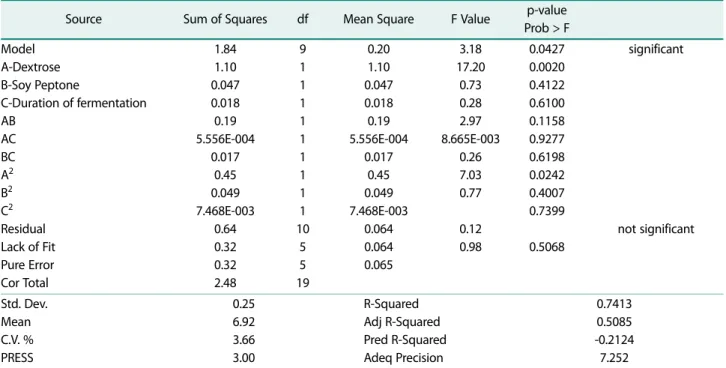
Analysis of variant results for BLIS Activity response of MRS-Soy Peptone and MRS Vegitone cultures are listed in Tables 5 and 6. The quadratic model for MRS- Soy peptone and MRS Vegitone cultures showed that error did not play an important role at 4.27% and 3.97%
chance, respectively. Dextrose is the most significant component in MRS-Soy peptone culture while in MRS- Vegitone culture, a significant interaction effect of com- ponents were shown. The probability value of Lack of Fit testing in MRS-Soy peptone was 0.5068, while in MRS Vegitone it was slightly lower at 0.4145.
Values of pH: Results obtained by performing Design Expert 7.0.0. using ANOVA of S. macedonicus MBF 10-2 lysate response to pH value of MRS-Soy Peptone culture (Fig. 5A) were analyzed and the regression model was given as follows:
Yi = +7.32 − 6.250E-003 A − 0.068 B − 0.020 C + 0.038 AB + 0.025 AC + 0.048 BC − 0.44 A2 + 3.977E-0.03 B2 + 0.033 C2
with R2 = 0.7338
Results of lysate pH of S. macedonicus MBF 10-2 lysate in response to BLIS activity of MRS-Vegitone cul- ture (Fig. 5B) were analyzed and the regression model was given as follows:
Yi = +7.40 + 3.672E-003A − 0.036B − 0.011C − 3.333E
− 003AB − 5.833E − 003AC − 1.000E − 002BC
− 0.034A2 − 0.027B2 − 0.030C2 with R2 = 78,73%.
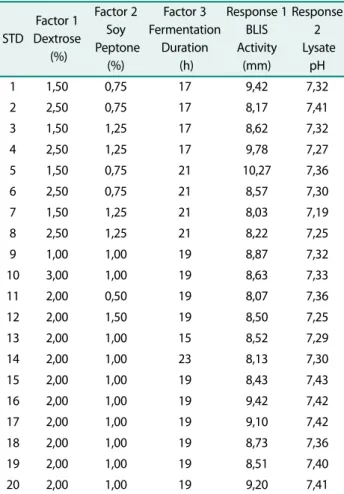
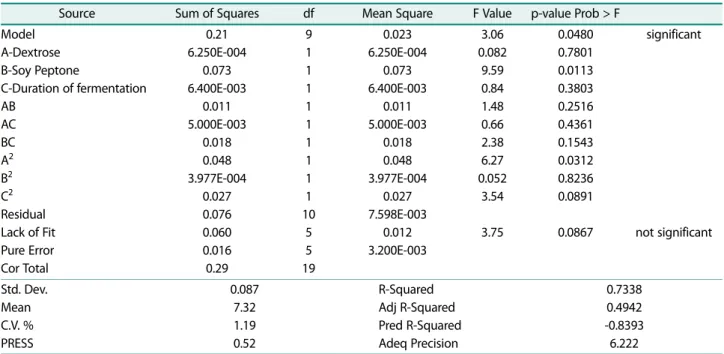
Analysis of variant results for pH value response of MRS-Soy Peptone and MRS Vegitone cultures are shown in Tables 7 and 8. The p-value of quadratic modeling in MRS-Soy peptone and MRS Vegitone were 0.048 and Table 3. BLIS activity and pH of lysate in MRS-Soy peptone
with working volume of 50 ml, Temperature 37℃, and initial pH 6.79.
STD
Factor 1 Dextrose
(%)
Factor 2 Soy Peptone
(%)
Factor 3 Fermentation
Duration (h)
Response 2 BLIS Activity
(mm)
Response 1 Lysate
pH
1 1.50 0.75 10.00 6,60000 7,55
2 2.50 0.75 10.00 7,21667 7,38
3 1.50 1.25 10.00 6,53333 7,33
4 2.50 1.25 10.00 7,38333 7,29
5 1.50 0.75 14.00 6,81667 7,29
6 2.50 0.75 14.00 7,08333 7,20
7 1.50 1.25 14.00 6,55000 7,24
8 2.50 1.25 14.00 7,81667 7,32
9 1.00 1.00 12.00 6,96667 7,11
10 3.00 1.00 12.00 7,56667 7,17
11 2.00 0.50 12.00 6,83333 7,54
12 2.00 1.50 12.00 6,98333 7,12
13 2.00 1.00 8.00 6,80000 7,40
14 2.00 1.00 16.00 6,80000 7,49
15 2.00 1.00 12.00 6,46667 7,39
16 2.00 1.00 12.00 7,16667 7,25
17 2.00 1.00 12.00 6,78333 7,35
18 2.00 1.00 12.00 6,51667 7,31
19 2.00 1.00 12.00 6,86667 7,26
20 2.00 1.00 12.00 6,73333 7,36
Table 4. BLIS activity and pH of lysate in MRS Vegitone with working volume of 50 ml, temperature 37℃, and Initial pH 6.79.
STD
Factor 1 Dextrose
(%)
Factor 2 Soy Peptone
(%)
Factor 3 Fermentation
Duration (h)
Response 1 BLIS Activity
(mm)
Response 2 Lysate
pH
1 1,50 0,75 17 9,42 7,32
2 2,50 0,75 17 8,17 7,41
3 1,50 1,25 17 8,62 7,32
4 2,50 1,25 17 9,78 7,27
5 1,50 0,75 21 10,27 7,36
6 2,50 0,75 21 8,57 7,30
7 1,50 1,25 21 8,03 7,19
8 2,50 1,25 21 8,22 7,25
9 1,00 1,00 19 8,87 7,32
10 3,00 1,00 19 8,63 7,33
11 2,00 0,50 19 8,07 7,36
12 2,00 1,50 19 8,50 7,25
13 2,00 1,00 15 8,52 7,29
14 2,00 1,00 23 8,13 7,30
15 2,00 1,00 19 8,43 7,43
16 2,00 1,00 19 9,42 7,42
17 2,00 1,00 19 9,10 7,42
18 2,00 1,00 19 8,73 7,36
19 2,00 1,00 19 8,51 7,40
20 2,00 1,00 19 9,20 7,41
0.0189, respectively. Soy peptone and Vegitone were sig- nificant components. The probability value of Lack of fit test in MRS-Soy peptone was 0.0867 and in MRS Vegit- one was 0.0650.
The highest desirability value of the numerical optimi- zation in MRS Soy Peptone was 0.702 with 2.5% of dex- trose; 1.25% of soy peptone; and 11.18 h of fermentation duration with a lysate pH of 7.23 and a BLIS activity of 7.38 mm (Tabel 9). The optimum condition for lysate production in MRS Vegitone showed an optimal dextrose concentration of 2.5% with optimal proteose peptone vegetable 1.25%, while the optimal fermentation process duration was 17 h with a desirability value of 0.639, a lysate pH of 7.30 and a BLIS activity of 9.76 mm.
Comparison of lysate production in standard MRS and modified MRS
The comparison of optimum medium composition,
duration of fermentation and responses are shown in Table 9. BLIS activity of S. macedonicus MBF 10-2 lysate from RSM optimization with 2.5% dextrose, 1.25% proteolytic vegetable peptone, and 17 h of fermen- tation showed an inhibition zone of 9.76 mm, whereas 2.5% dextrose, 1.25% soy peptone, and 11.18 h showed a narrowed zone of 7.38 mm. However, lysates of S. mace- donicus MBF 10-2 obtained from standard MRS medium showed a larger zone, 10.3 mm (Table 9). It can be concluded that lysate of S. macedonicus MBF 10-2 obtained from standard MRS possessed the best BLIS activity. Intracellular lactic acid retention was not a fac- tor as pH of lysates were about the same for standard MRS, MRS Vegitone and MRS Soy peptone.
Discussion
To efficiently refine metabolic products such as lactic Fig. 4. Interaction between independent factors with BLIS activity presented as a 3 dimenional graphs. (A) dextrose, soy pep- tone, and fermentation duration; (B) dextrose, proteose peptone vegetable, and fermentation duration. (Ai) Effects of dextrose and soy peptone; (Aii) Effects of dextrose and duration of fermentation; (Aiii) Effects of soy peptone and duration of fermentation; (Bi) Effects of dextrose and proteose peptone vegetable (Vegitone); (Bii) Effects of dextrose and duration of fermentation; (Biii) Effects of proteose peptone vegetable (Vegitone) and duration of fermentation.
acid from bacterial biomass, high cell density is critical for large scale production [29]. To discover the optimum conditions for this fermentation process, we underwent confirmation of the growth curve of MBF10-2. We found
that the MBF10-2 lag phases in both kinds of plant- based modified media (MRS Vegitone and MRS Soy Pep- tone) were longer than in standard MRS medium. We presumed this to be an effect of the nitrogen source, Table 5. Results of ANOVA from Design Expert 7.0.0. Software for BLIS activity response in MRS-Soy peptone.
Source Sum of Squares df Mean Square F Value p-value
Prob > F Model
A-Dextrose B-Soy Peptone
C-Duration of fermentation AB
AC BC A2 B2 C2 Residual Lack of Fit Pure Error Cor Total
1.84 1.10 0.047 0.018 0.19 5.556E-004
0.017 0.45 0.049 7.468E-003
0.64 0.32 0.32 2.48
9 1 1 1 1 1 1 1 1 1 10
5 5 19
0.20 1.10 0.047 0.018 0.19 5.556E-004
0.017 0.45 0.049 7.468E-003
0.064 0.064 0.065
3.18 17.20
0.73 0.28 2.97 8.665E-003
0.26 7.03 0.77
0.12 0.98
0.0427 0.0020 0.4122 0.6100 0.1158 0.9277 0.6198 0.0242 0.4007 0.7399
0.5068
significant
not significant
Std. Dev.
Mean C.V. % PRESS
0.25 6.92 3.66 3.00
R-Squared Adj R-Squared Pred R-Squared Adeq Precision
0.7413 0.5085 -0.2124 7.252
Table 6. Results of ANOVA from Design Expert 7.0.0. Software for BLIS activity response in MRS Vegitone.
Source Sum of Squares df Mean Square F Value p-value
Prob> F Model
A-Dextrose
B-Proteose Peptone (vegetable) C-Duration of Fermentation AB
AC BC A2 B2 C2 Residual Lack of Fit Pure Error Cor Total
5.16 0.29 0.051
0.17 2.31 0.26 1.45 4.499E-003
0.37 0.31 1.76 0.97 0.79 6.92
9 1 1 1 1 1 1 1 1 1 10 5 5 19
0.57 0.29 0.051
0.17 2.31 0.26 1.45 4.499E-003
0.37 0.31 0.18 0.19 0.16
3.26 1.65 0.29 0.99 13.16
1.46 8.23 0.026
2.13
1.78 1.23
0.0397 0.2273 0.6031 0.3436 0.0046 0.2544 0.0167 0.8760 0.1753
0.2120 0.4145
significant
not significant
Std. Dev.
Mean C.V. % PRESS
0.42 8.76 4.79 9.05
R-Squared Adj R-Squared Pred R-Squared Adeq Precision
0.7460 0.5174 -0.3086 6.875
namely, the peptone.
The role of the amount of total nitrogen contained in different peptones of the modified media affected the 2 response indicators used in this study, BLIS activity and pH. Total nitrogen in peptone from animal that used in standard MRS medium was ≥10%. While, total nitrogen in plant-based peptone was ≥8%, soy peptone and prote- ose peptone vegetable (Vegitone) were ≥11%, but the lat- ter was later replaced by LAB-Lemco as another nitrogen source. Interestingly, 2-phenylethyl alcohol contained in MRS Vegitone may also responsible for pro- longing the lag time because of its potential antimicro- bial activity (microbial biocontrol) as reported [30] that inhibits mold, yeast, and Gram positive/negative bacte- ria. It was also reported that 2-phenylethyl alcohol apparently regulates genes involved in peroxisomes, autophagy regulation, the phosphatidylinositol signaling system, and fatty acid synthesis while also inhibiting
ribosomes, RNA polymerase, DNA replication, amino acid biosynthesis, aminoacyl-tRNA biosynthesis, and cell cycling [30].
Duration of fermentation is significant as the late log phase is thought to be the highest production phase of lysate active substances, including bacteriocin [14]. In contrast, lysate pH response did not show a significant response as acid is secreted into the milieu during culti- vation. S. macedonicus MBF 10-2 lysate grown in stan- dard MRS medium showed a slightly lower pH but a greater inhibitory zone than S. macedonicus MBF 10-2 lysate grown in modified MRS. Hence, it appeared that lysate from S. macedonicus MBF 10-2 grown in stan- dard MRS medium tends to produce more BLIS product.
The LAB lysate produced was intended not only for its BLIS activity and lactic acid production, but also to pro- duce the lysate as a whole ingredient such as acid pro- duction, proteolytic and lipolytic activity, citrate Fig. 5. Interaction between independent factors with pH presented as a 3 dimensional graphs. (A) dextrose, soy peptone, and fermentation duration; (B) dextrose, proteose peptone vegetable, and fermentation duration. (Ai) Effects of dextrose and soy pep- tone; (Aii) Effects of dextrose and duration of fermentation; (Aiii) Effects of soy peptone and duration of fermentation; (Bi) Effects of dextrose and proteose peptone vegetable (Vegitone); (Bii) Effects of dextrose and duration of fermentation; (Biii) Effects of pro- teose peptone vegetable (Vegitone) and duration of fermentation.
metabolism, exopolysaccharide production, antimicro- bial activity (macedocin, macedovicin) and biogenic amines production [12, 15, 31].
Bacterial lysates have proven to be effective in the pre- vention and management of various infections with their immunomodulatory potential. As an example, Bifido-
bacterium longum lysate (BL), strain Bifida ferment lysate, at 5% in total suspension, has an International Nomenclature of Cosmetic Ingredients code for commer- cial use. It is prepared as an ultrasound-inactivated sus- pension in aqueous medium and is filter sterilized to remove any remaining whole bacteria. Although an Table 7. Results of ANOVA from Design Expert 7.0.0. Software for lysate pH response in MRS-Soy peptone.
Source Sum of Squares df Mean Square F Value p-value Prob > F
Model A-Dextrose B-Soy Peptone
C-Duration of fermentation AB
AC BC A2 B2 C2 Residual Lack of Fit Pure Error Cor Total
0.21 6.250E-004
0.073 6.400E-003
0.011 5.000E-003
0.018 0.048 3.977E-004
0.027 0.076 0.060 0.016 0.29
9 1 1 1 1 1 1 1 1 1 10
5 5 19
0.023 6.250E-004
0.073 6.400E-003
0.011 5.000E-003
0.018 0.048 3.977E-004
0.027 7.598E-003
0.012 3.200E-003
3.06 0.082
9.59 0.84 1.48 0.66 2.38 6.27 0.052
3.54
3.75
0.0480 0.7801 0.0113 0.3803 0.2516 0.4361 0.1543 0.0312 0.8236 0.0891
0.0867
significant
not significant
Std. Dev.
Mean C.V. % PRESS
0.087 7.32 1.19 0.52
R-Squared Adj R-Squared Pred R-Squared Adeq Precision
0.7338 0.4942 -0.8393 6.222
Table 8. Results of ANOVA from Design Expert 7.0.0. Software for Lysate pH response in MRS Vegitone.
Source Sum of Squares df Mean Square F Value p-value Prob > F Model
A-Dekstrosa
B-Proteose Pepton (vegetable) C-Duration of Fermentation AB
AC BC A2 B2 C2 Residual Lack of Fit Pure Error Cor Total
0.067 1.842E-004
0.021 2.025E-003 8.889E-005 2.722E-004 8.000E-004
0.016 0.019 0.023 0.018 0.015 3.365E-003
0.085
9 1 1 1 1 1 1 1 1 1 10
5 5 19
7.466E-003 1.842E-004
0.021 2.025E-003 8.889E-005 2.722E-004 8.000E-004
0.016 0.019 0.023 1.815E-003 2.958E-003 6.730E-004
4.11 0.10 11.58
1.12 0.049
0.15 0.44 8.94 10.47 12.83 4.39
0.0189 0.7566 0.0067 0.3157 0.8293 0.7067 0.5218 0.0136 0.0089 0.0050 0.0650
significant
not significant
Std. Dev.
Mean C.V. % PRESS
0.043 7.33 0.58 0.12
R-Squared Adj R-Squared Pred R-Squared Adeq Precision
0.7873 0.5959 -0.4533 6.030
ultrasonicator is standard in preparation of these lysates, several reports have described preparations of probiotic lysates employing a bead beater and filter ster- ilization to remove any remaining whole bacteria after growth in anaerobic conditions. These include: Bifido- bacterium longum ATCC 51870, Lactobacillus planta- rum ATCC 10241, Lactobacillus reuteri ATCC 55730, Lactobacillus rhamnosus Goldin and Gorbach [GG]
ATCC 53103, and Lactobacillus fermentum ATCC 14932. In the case of Vitreoscilla filiformis cell lysate, heat can be used by performing steam treatment at 121℃ for 30 min [32]. V. filiformis lysate has shown potential application for atopic dermatitis therapy as it reduces pruritus, improves lesions, and stabilizes the skin [32]. In our study, we decided not to lyse bacterial cells via exposure to high temperatures to avoid creation or destruction of therapeutic lysis components.
Bacteriocin activity is first detected in the mid-expo- nential growth phase and increases rapidly until the end of the exponential growth phase, confirming primary metabolite kinetics [14]. Bacteriocin activity reaches a maximum level at the end of the exponential growth phase and remains constant during the stationary phase, implying that bacteriocin is stable and/or is syn- thesized de novo, which in line with reports regarding macedocin [14]. With this in mind, we chose the mid- point based on our calculations as the peak of active bac- teriocin production.
We chose a quadratic model for both modified medi- ums because it showed greater R2 values, the p-values were significant, and the lack of fit testing was not sig- nificant. In this study, BLIS activity assay and pH of lysate using RSM was conducted on a small scale only in order to determine optimum conditions. These two data responses were used to analyze the ratio of dextrose and proteose peptone (vegetable) or soy peptone as the
medium composition optimized using RSM. In LAB lysate preparation, lactic acid is an important factor, we regularly monitored the activity of this acid by pH mea- surement of the culture and lysate.
The optimization of plant-based MRS composition via RSM showed that optimum lysate production is obtained when using 2.5% dextrose and 1.25% soy pep- tone, but the duration of fermentation varied at 11.18 h and 17 h, for MRS-Soy peptone and MRS Vegitone, respectively. Interestingly, the BLIS activity zone of inhibition lysate produced in MRS Vegitone was higher than in MRS-Soy peptone whereas the pH of lysates did not significantly differ. However, S. macedonicus MBF 10-2 lysate showed a slightly lower pH and much greater BLIS activity zone, when fermented on a standard MRS medium. Hence, MRS Vegitone is recommended as a plant-based medium in MBF10-2 lysate production. The use of plant-based medium rather than animal based- materials, especially in strict vegetarian food products [33], is becoming a preference. In addition, Moslems tend to avoid non-halal materials as much as possible.
Some reports also described the use of vegetable N- source instead in an attempt to lower the cost of the cul- ture medium for larger scale [33, 34, 36, 37].
Acknowledgments
This work was supported by Research Grant Hibah PDUPT no. 261/
UN2.R3.1/HKP.05.00/2018 from the Ministry of Research, Technology and Higher Education Republic of Indonesia to AM. Authors are greatly thanks Dr. Thomas D. Mayers, Assist. Prof. at the Faculty of Med- icine, Medical English Communications Center, University of Tsukuba, Japan, for English supervision of this manuscript.
Conflict of Interest
The authors have no financial conflicts of interest to declare.
Table 9. Comparison of responses based on optimum fermentation condition.
Response
MRS MRS Vegitone MRS Soy Peptone
2%
Dx
1%
P
9 h F
2.5%
Dx
1.25%
PP
17 h F
2.5%
Dx
1.25%
SP
11 h F
BLIS Activity (mm) 10,3 7,38
Lysate pH 7,21 7,23
Dx: Dextrose; P: Peptone; F: Duration of Fermentation; PP: Proteose Peptone Vegetable; SP: Soy Peptone; h: hours.
References
1. Gueniche A, Benyacoub J, Blum S, Breton L, Castiel I. 2009. Probi- otics for skin benefits, pp. 421-439. In Nutritional Cosmetics.
Elsevier.
2. Lahtinen S. 2012. Lactic acid bacteria : microbiological and func- tional aspects. 4th ed. Boca Raton. FL, CRC Press.
3. Cotter PD, Hill C, Ross RP. 2005. Bacteriocins: developing innate immunity for food. Nat. Rev. Microbiol. 3: 777-788.
4. Sidek NL, Halim M, Tan JS, Abbasiliasi S, Mustafa S, Ariff AB. 2018.
Stability of bacteriocin-like inhibitory substance (BLIS) produced by Pediococcus acidilactici kp10 at different extreme conditions.
BioMed. Res. Int. 2018: 5973484.
5. De Vuyst L, Leroy F. 2007. Bacteriocins from lactic acid bacteria:
production, purification, and food applications. J. Mol. Microbiol.
Biotechnol. 13: 194-199.
6. Tagg J, Bannister LV. 1979. Fingerprinting β-haemolytic strepto- cocci by their production of and sensitivity to bacteriocine-like inhibitors. J. Med. Microbiol. 12: 397-411.
7. Lew LC, Gan CY, Liong MT. 2012. Dermal Bioactives from Lactoba- cilli and Bifidobacteria. Ann. Microbiol. 63: 1047-1055.
8. Meckfessel MH, Brandt S. 2014. The structure, function, and importance of ceramides in skin and their use as therapeutic agents in skin-care products. J. Am. Acad. Dermatol. 71: 177-184.
9. Sanchez C, Villemeur MD. 2018. From Pharma to Beauty: The Potential of Bacterial Lysates The Potential of Bacterial Lysates.
Available from http://www.lallemandpharma.com/wp-content/
uploads/2018/04/EBR-April2018-Bacterial-lysates-potential.pdf.
Accessed April 20, 2018.
10. Guéniche A, Bastien P, Ovigne JM, Kermici M, Courchay G, Cheva- lier V, et al. 2010. Bifidobacterium longum lysate, a new ingredient for reactive skin. Exp. Dermatol. 19: e1-e8.
11. Volz T, Skabytska Y, Guenova E, Chen KM, Frick JS, Kirschning S, et al. 2014. Nonpathogenic bacteria alleviating atopic dermatitis inflammation induce IL-10-producing dendritic cells and regula- tory Tr1 cells. J. Invest. Dermatol. 134: 96-104.
12. Georgalaki MD, Van Den Berghe E, Kritikos D, Devreese B, Van Beeumen J, Kalantzopoulos G, et al. 2002. Macedocin, a food- grade lantibiotic produced by Streptococcus macedonicus ACA- DC 198. Appl. Environ. Microbiol. 68: 5891-903.
13. Vuyst LD, Tsakalidou E. 2008. Streptococcus macedonicus, a multi- functional and promising species for dairy fermentations. Int.
Dairy J. 18: 476-485.
14. Van den Berghe E, Skourtas G, Tsakalidou E, De Vuyst L. 2006.
Streptococcus macedonicus ACA-DC 198 produces the lantibiotic, macedocin, at temperature and pH conditions that prevail during cheese manufacture. Int. J. Food Microbiol. 107: 138-147.
15. Georgalaki MD, Sarantinopoulos P, Ferreira ES, De Vuyst L, Kalant- zopoulos G, Tsakalidou E. 2000. Biochemical properties of Strep- tococcus macedonicus strains isolated from Greek Kasseri cheese.
J. Appl. Microbiol. 88: 817-825.
16. Grazia SE, Sumayyah S, Haiti FS, Sahlan M, Heng NCK, Malik A.
2017. Bacteriocin-like inhibitory substance (BLIS) activity of
Streptococcus macedonicus MBF10-2 and its synergistic action in combination with antibiotics. Asian Pac. J. Trop. Med. 10: 1140- 1145.
17. Lorenz TC. 2012. Polymerase chain reaction: basic protocol plus troubleshooting and optimization strategies. J. Vis. Exp. (63):
e3998.
18. Silva CCG, Silva SPM, Ribeiro SC. 2018. Application of bacteriocins and protective cultures in dairy food preservation. Front. Micro- biol. 9: 594.
19. Abbasiliasi S, Tan JS, Tengku Ibrahim TA, Bashokouh F, Ramakrishnan NR, Mustafa S, et al. 2017. Fermentation factors influencing the production of bacteriocins by lactic acid bacteria:
a review. RSC Adv. 7: 29395-29420.
20. Malik A, Radji M, Kralj S, Dijkhuizen L. 2009. Screening of lactic acid bacteria from Indonesia reveals glucansucrase and fructan- sucrase genes in two different Weissella confusa strains from soya. FEMS Microbiol. Lett. 300: 131-138.
21. De Man J, Rogosa M, Sharpe M. 1960. A Medium for the cultiva- tion of Lactobacilli. J. Appl. Bacteriol. 23: 130-135.
22. Pujato SA, Guglielmotti DM, Martínez-García M, Quiberoni A, Mojica FJM. 2017. Leuconostoc mesenteroides and Leuconostoc pseudomesenteroides bacteriophages: Genomics and cross-species host ranges. Int. J. Food Microbiol. 257: 128-137.
23. Ng HS, Chai CXY, Chow YH, Loh WLC, Yim HS, Tan JS, et al. 2018.
Direct recovery of Bacillus subtilis xylanase from fermentation broth with an alcohol/salt aqueous biphasic system. J. Biosci. Bio- eng. 125: 585-589.
24. Kareb O, Champagne CP, Jean J, Gomaa A, Aïder M. 2018. Effect of electro-activated sweet whey on growth of Bifidobacterium, Lactobacillus, and Streptococcus strains under model growth con- ditions. Food Res. Int. 103: 316-325.
25. Salzano AM, Novi G, Arioli S, Corona S, Mora D, Scaloni A. 2013.
Mono-dimensional blue native-PAGE and bi-dimensional blue native/urea-PAGE or/SDS-PAGE combined with nLC-ESI-LIT-MS/
MS unveil membrane protein heteromeric and homomeric com- plexes in Streptococcus thermophilus. J. Proteomics. 94: 240-261.
26. Cappannella E, Benucci I, Lombardelli C, Liburdi K, Bavaro T, Esti M. 2016. Immobilized lysozyme for the continuous lysis of lactic bacteria in wine: Bench-scale fluidized-bed reactor study. Food Chem. 210: 49-55.
27. Dimic G. 2006. Characteristics of the Leuconostoc mesenteroides subsp. mesenteroides strains from fresh vegetables. Acta. Period Technol. 37: 3-11.
28. Othman M, Ariff AB, Wasoh H, Kapri MR, Halim M. 2017. Strate- gies for improving production performance of probiotic Pedio- coccus acidilactici viable cell by overcoming lactic acid inhibition.
AMB Express. 7: 215.
29. Liu W, Pang H, Zhang H, Cai Y. 2014. Biodiversity of lactic acid bacteria, pp.103-203. in Lactic Acid Bacteria. Springer.
30. Georgalaki M, Papadimitriou K, Anastasiou R, Pot B, Van Driess- che G, Devreese B, et al. 2013. Macedovicin, the second food- grade lantibiotic produced by Streptococcus macedonicus ACA- DC 198. Food Microbiol. 33: 124-130.
31. Colla LL, Mangano A, Mangano A, Albertin A. 2009. Effects of nonpathogenic gram‐negative bacterium Vitreoscilla filiformis lysate on atopic dermatitis: a prospective, randomized, double- blind, placebo-controlled clinical study. Br. J. Dermatol. 161: 477- 478.
32. Pathak M, Martirosyan D. 2012. Optimization of an effective growth medium for culturing probiotic bacteria for applications in strict vegetarian food products. FFHDJ. 2: 369-378.
33. Bustos G, Moldes AB, Cruz JM, Domínguez JM. 2004. Formulation
of low-cost fermentative media for lactic acid production with Lactobacillus rhamnosus using vinification lees as nutrients. J.
Agric. Food Chem. 54: 801-808.
34. Rodrigues LR, Teixeira JA, Oliveira R. 2006. Low-cost fermentative medium for biosurfactant production by probiotic bacteria.
Biochem. Eng. J. 32: 135-142.
35. Zhao Y, Wang Y, Song Z, Shan C, Zhu R, Liu F. 2016. Development of a simple, low-cost and eurytopic medium based on Pleurotus eryngii for lactic acid bacteria. AMB Express. 6: 65.