Received January 22, 2014, Revised February 23, 2014, Accepted March 10, 2014 Corresponding author: Sun-Mi Choi
Department of Medical Research, Korea Institute of Oriental Medicine, 1672 Yuseongdae-ro, Yuseong-gu, Daejeon 305-811, Korea Tel: +82-42-868-9485, Fax: +82-42-863-9464, E-mail: [email protected]
This study was supported by the Korea Institute of Oriental Medicine(K13203).
CCThis is an open access article distributed under the terms of the Creative Commons Attribution Non-Commercial License(http://creativecommons.org/licenses/ by-nc/3.0) which permits unrestricted non-commercial use, distribution, and reproduction in any medium, provided the original work is properly cited.
Acupuncture for Prehypertension and Stage 1 Hypertension in Postmenopausal Women:
Protocol for a Randomized Controlled Pilot Trial
Jung-Eun Kim, Jin-Bong Choi1, Hyeong-Jun Kim2, Kyung-Won Kang, Yan Liu, Hee-Jung Jung, Min-Hee Lee, Mi-Suk Shin, Jae-Hong Kim1, Sun-Mi Choi
Acupuncture, Moxibustion & Meridian Research Group, Korea Institute of Oriental Medicine,
1College of Korean Medicine, Dongshin University, 2College of Korean Medicine, Semyung University
폐경 후 여성의 전단계 및 1기 고혈압에 대한 침 치료:
다기관 무작위 대조 예비연구
김정은ㆍ최진봉1ㆍ김형준2ㆍ강경원ㆍ류 연ㆍ정희정ㆍ이민희ㆍ신미숙ㆍ김재홍1ㆍ최선미
한국한의학연구원 침구경락연구그룹, 1동신대학교 한의과대학, 2세명대학교 한의과대학
Objectives : This study aims to evaluate the effectiveness and safety of acupuncture and explore the appropriate number of treatment for postmenopausal women diagnosed with prehypertension and stage 1 hypertension. Methods : A 4-arm randomized open label pilot trial will be performed at 2 centers. Sixty participants will be divided into 2 treatment groups and 2 control groups.
Treatment groups will receive acupuncture at 8 points(bilateral GB20, LI11, ST36, SP6) for 4 weeks(treatment group A, 10 total sessions) or 8 weeks(treatment group B, 20 total sessions), while maintaining usual care. Control groups will not receive acupuncture but will be under usual care for 16 weeks(control group C) or 20 weeks(control group D). Each patient’s living habits will be corrected and drugs that may affect blood pressure(BP) will be prohibited. Treatment group A and control group C will be evaluated at 4, 8, 12, and 16 weeks after randomization, while treatment group B and control group D will be evaluated at 4, 8, 12, 16, and 20 weeks after randomization. The major outcome variable is the magnitude of change in diastolic BP levels at 4 weeks after randomization; auxiliary outcome variables are (1) diastolic BP change at 8, 16, and 20 weeks, (2) systolic BP change, (3) BP control rate, (4) lipid profiles, and (5) high-sensitivity C-reactive protein. Patient safety will be assessed at every visit. Results and Conclusions : The study findings may help develop evidence for the effectiveness and safety of acupuncture for BP control.
Key words : acupuncture, prehypertension, hypertension, randomized controlled trial
Introduction
Hypertension is a chronic circulatory system disease with
a very high incidence. In 2011, the prevalence of hyper- tension in South Korea was 28.5% among adults 30 years of age or older. Hypertension is more prevalent in men than in
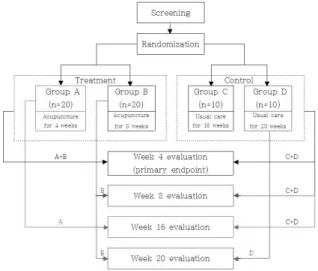
Fig. 1. Study flow chart.
women aged 30∼50 years, but women over the age of 60 years exhibit a higher prevalence than men1,2). According to previous reports, women experience increased blood pres- sure(BP) in the first decade after menopause3). And after stratification by age and body mass index(BMI), the odds of hypertension for post- compared with pre-menopausal women were 2.24).
In the 7th hypertension report published by the U.S. Hyper- tension Joint National Committee(JNC-VII) in 2003, a systolic blood pressure(SBP) of 120∼139 mmHg and a diastolic blood pressure(DBP) of 80∼89 mmHg, previously classified as
“high-normal” and “above normal,” were reclassified as representing prehypertension5). Prehypertension frequently precedes hypertension and involves a greater number of risk factors for cardiovascular disease than does normal BP;
therefore, prevention of prehypertension is emphasized at present6,7).
Treatment and management of hypertension greatly de- creases the incidence and mortality from cardiovascular disease as well as total mortality8). Medication is broadly used to treat and manage high BP, but poor patient compliance occurs for a variety of reasons, including side effects and dosing problems9). Meanwhile, interest in using comple- mentary and alternative medicine(CAM) to treat cardio- vascular disease has been rising, but its effect on cardio- vascular disease has not yet been established10).
Acupuncture is one of the most commonly administered CAM. In systematic reviews of studies evaluating treatment of high BP with acupuncture, Lee at al. and Jung et al. both report that the effect of acupuncture was inconclusive in most trials owing to methodological flaws or small sample size11,12). Therefore, it is necessary to establish evidence that indicates a positive effect of acupuncture on high BP to ensure that reliable medical recommendations can be made and are supported by objective data.
The purpose of this study is to evaluate the effectiveness of acupuncture for BP control with respect to postmeno- pausal women diagnosed with prehypertension and stage 1 hypertension. The safety and appropriate treatment number of acupuncture will be evaluated additionally.
Materials and Methods
1. Design
A multicenter(2 centers) randomized controlled trial will be conducted at Gwangju Oriental Hospital of Dongshin University and Jecheon Oriental Hospital of Semyung Uni- versity.
Participants will be randomly assigned to either a treat- ment group(acupuncture and usual care) or a control group(usual care only). Patients in the treatment groups will receive acupuncture at 8 points(bilateral GB20(Pungji), LI11(Gokji), ST36(Joksamni), and SP6(Sameumgyo)) 2∼3 times per week for either 4 weeks(group A, 10 total sessions) or 8 weeks(group B, 20 total sessions); patients will receive a follow-up evaluation at 12 weeks. Patients in the control groups will receive usual care for a period of either 16 weeks(group C) or 20 weeks(group D)(Fig. 1). The reason for the multicenter trial is to collect a sufficient number of participants in a given time. The trial is registered at the Clinical Research Information Service(registration number:
KCT0000771).
2. Randomization and allocation concealment A total of 60 participants, 30 patients recruited from each hospital, will be randomly allocated into 1 of 4 treatment or
control groups by using block randomization. Allocation will be determined using statistical software(Strategic Applica- tions Software(SAS), version 9.1.3) and distributed to each center in a sealed, opaque envelope containing the randomly allocated participant number.
Prior to randomization, a clinical research coordinator (CRC) at each center will record each patient’s basic infor- mation(name, participant code, date of inclusion) in case report form and will prepare a copy of the informed consent form. Randomization will be conducted at the 3rd visit for participants who provide written consent and meet all selection criteria. The researcher will open the envelopes in front of participants. The CRC will provide participant identification codes and record them in the case report form;
the opened envelopes will be stored in double-locked cabinets.
3. Blinding
The participants, practitioners and outcome assessors will know the allocation, but data analysts will be blinded to this information. The data analysts will receive only coded infor- mation but will not know about which is the treatment and which is the control group.
4. Ethics
Each participant will provide written consent. Moreover, the study protocol is approved by all relevant institutional review boards: Gwangju Oriental Hospital of Dongshin Uni- versity and Jecheon Oriental Hospital of Semyung University.
5. Participants 1) Inclusion criteria
Participants who satisfy the following conditions will be included:
(1) Women aged 45 to 65 years
(2) Menstruation ended 1 year or longer prior to the study and follicle-stimulation hormone concentration is over 40 mIU/mL
(3) Resting BP measured from the selected arm during screening is in the prehypertension stage(SBP of 120∼139
mmHg or DBP of 80∼89 mmHg) or at stage 1 hyper- tension(SBP of 140∼159 mmHg or DBP of 90∼99 mmHg).
(4) Provide consent to participate in this trial and sign an informed consent statement after listening to a clear expla- nation of the purpose and characteristics of this clinical trial.
2) Exclusion criteria
Participants who have received or been diagnosed with one or more of the following conditions will be excluded13,14):
(1) Received antihypertensive drugs within the past 3 months.
(2) Received herbal medication or functional food used for involutional disorder in the past 3 months.
(3) Received hormone therapy, such as estrogen or progestin, in the past 1 month.
(4) Measured BP difference from the selected arm during screening of SBP ≥20 mmHg or DBP ≥10 mmHg.
(5) History of secondary hypertension or are suspected of secondary hypertension(for example, coarctation of the aorta, renal artery stenosis, primary aldosteronism, pheochro- mocytoma, Cushing’s syndrome, polycystic renal disease, hyperthyroidism [thyroid stimulating hormone <0.35 μIU/
mL, free thyroxine ≥1.76 ng/dL].
(6) Orthostatic hypotension and accompanying symptoms.
(7) Uncontrolled diabetes mellitus.
(8) Severe heart disease, ischemic heart disease during the recent 6 months(angina pectoris, myocardial infarction), or peripheral vascular disease, or have received percutaneous transluminal coronary angioplasty or a coronary artery bypass graft.
(9) Clinically significant ventricular tachycardia, atrial fib- rillation, atrial flutter, or other arrhythmia judged by the examiner as significant on electrocardiogram
(10) Hypertrophic obstructive cardiomyopathy, severe obstructive coronary artery disease, aortostenosis, or hemo- dynamically significant aortic or mitral valve stricture
(11) Severe cerebrovascular disease, or have experienced a cerebral infarction or cerebral hemorrhage within the past 6 months.
(12) Moderate or malignant retinosis, retinal hemorrhage, visual disturbance, or retinal microaneurysm within the past
6 months.
(13) Consumptive disease(tuberculosis, malignant tumors) or autoimmune disease(systemic lupus erythematosus, rheu- matoid arthritis, dermatomyositis, systemic sclerosis, or thy- roiditis).
(14) Clinically significant kidney or liver disease or who exhibit a creatinine level of ≤1.5 mg/dL and alanine ami- notransferase and aspartate aminotransferase levels greater than 2.5 times the normal upper limit on hematological testing.
(15) Confirmed or suspected history of drug or alcohol abuse.
(16) Chronic inflammatory conditions that require chronic anti-inflammatory treatment.
(17) Currently participating in other clinical trials.
(18) Currently an inmate at a group facility, such as a social welfare institution.
(19) Did not provide informed consent.
(20) Anyone considered inappropriate for participating in this trial by the clinical trial conductors.
6. Hypothesis and sample size
Null hypothesis(H0): there will be no difference in the magnitude of DBP change from baseline between the treatment group(A+B) and the control group(C+D) at 4 weeks after randomization.
Alternative hypothesis(H1): not H0.
The reason for the selection of primary outcome as DBP refers to a description in the BP evaluation method in the
‘Guideline on clinical trial of medical products in the treatment of hypertension’ published by the Ministry Of Food And Drug Safety saying that ‘In general, changes in seated DBP before and after treatment are evaluated as the primary evaluation outcome for the evaluation of BP lowering effect’
described13).
The present experiment is a pilot study to evaluate the feasibility and effectiveness of acupuncture and to explore appropriate treatment duration; therefore, a sample size calculation was not performed. Randomization will be per- formed at a ratio of 2:2:1:1(treatment group A : treat-
ment group B : control group C : control group D) for a total sample size of 60 participants(groups of 20, 20, 10, and 10, respectively). This unequal randomization will increase patient acceptability and experience with the acupuncture treatment15).
7. Intervention
1) Treatment groups A and B(acupuncture with usual care):
Eight acupuncture points at the bilateral GB20, LI11, ST36, and SP6 sites were selected by researchers who specialize in traditional Korean medicine based on a text book and literature reviews. They were selected to harmonize qi and blood, circulate the meridian system smoothly, maintain healthy qi, and enhance the original qi11,12,16-18)
.
The treatment groups will receive acupuncture a total of 10 times in 4 weeks(group A) or 20 times in 8 weeks(group B), while maintaining usual care for hypertension(group A: 16 weeks, group B: 20 weeks).
The reason for the selection of the primary outcome as 10 times treatments for four weeks refers to a description in the acupuncture treatment of hypertension in Acupuncture and Moxibustion textbook saying that ‘a patient receives acupuncture one time daily or every other day for 20 to 30 minutes while 10 times acupunctures are regarded as one treatment16).
Acupuncture will be performed with the patients in a supine position. The practitioner will insert the needles at the acupuncture points and induce a sensation of obtaining qi.
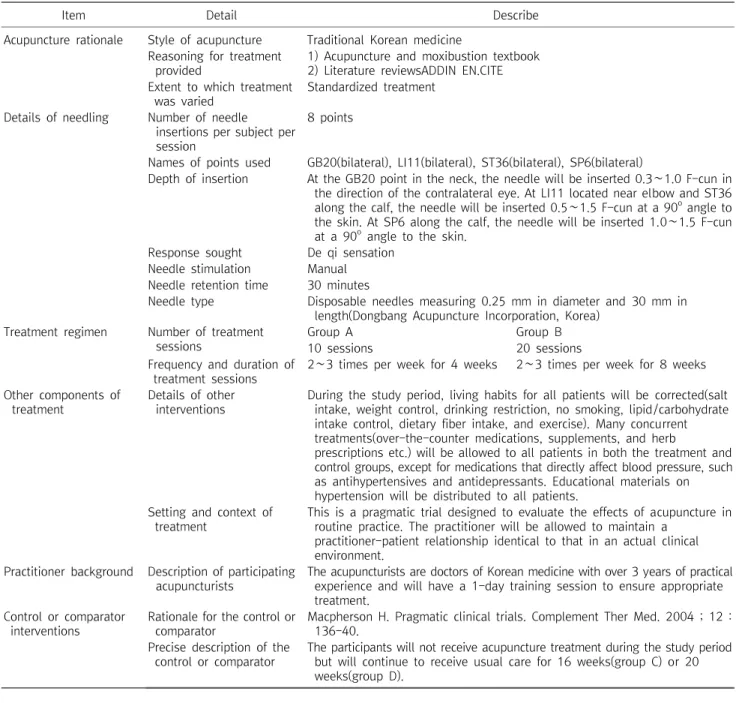
The needles will be left in place for 30 minutes(Table 1)19). 2) Control groups C and D(usual care only): The par- ticipants in the 2 control groups will not receive acupuncture treatment during the study period but will continue to receive usual care for 16 weeks(group C) or 20 weeks(group D). If only 1 control group was used, the participants would require a blood test 3 times during the study(baseline, 16 weeks, and 20 weeks) for comparison to the 2 treatment groups. To avoid this, the control group will be divided into 2 groups(control groups C and D), and each of the subgroups will have blood tests performed twice during the study(Table 1).
Item Detail Describe Acupuncture rationale Style of acupuncture Traditional Korean medicine
Reasoning for treatment provided
1) Acupuncture and moxibustion textbook 2) Literature reviewsADDIN EN.CITE Extent to which treatment
was varied
Standardized treatment
Details of needling Number of needle insertions per subject per session
8 points
Names of points used GB20(bilateral), LI11(bilateral), ST36(bilateral), SP6(bilateral)
Depth of insertion At the GB20 point in the neck, the needle will be inserted 0.3∼1.0 F-cun in the direction of the contralateral eye. At LI11 located near elbow and ST36 along the calf, the needle will be inserted 0.5∼1.5 F-cun at a 90o angle to the skin. At SP6 along the calf, the needle will be inserted 1.0∼1.5 F-cun at a 90o angle to the skin.
Response sought De qi sensation Needle stimulation Manual Needle retention time 30 minutes
Needle type Disposable needles measuring 0.25 mm in diameter and 30 mm in length(Dongbang Acupuncture Incorporation, Korea)
Treatment regimen Number of treatment sessions
Group A Group B
10 sessions 20 sessions
Frequency and duration of treatment sessions
2∼3 times per week for 4 weeks 2∼3 times per week for 8 weeks
Other components of treatment
Details of other interventions
During the study period, living habits for all patients will be corrected(salt intake, weight control, drinking restriction, no smoking, lipid/carbohydrate intake control, dietary fiber intake, and exercise). Many concurrent treatments(over-the-counter medications, supplements, and herb
prescriptions etc.) will be allowed to all patients in both the treatment and control groups, except for medications that directly affect blood pressure, such as antihypertensives and antidepressants. Educational materials on hypertension will be distributed to all patients.
Setting and context of treatment
This is a pragmatic trial designed to evaluate the effects of acupuncture in routine practice. The practitioner will be allowed to maintain a
practitioner-patient relationship identical to that in an actual clinical environment.
Practitioner background Description of participating acupuncturists
The acupuncturists are doctors of Korean medicine with over 3 years of practical experience and will have a 1-day training session to ensure appropriate treatment.
Control or comparator interventions
Rationale for the control or comparator
Macpherson H. Pragmatic clinical trials. Complement Ther Med. 2004 ; 12 : 136-40.
Precise description of the control or comparator
The participants will not receive acupuncture treatment during the study period but will continue to receive usual care for 16 weeks(group C) or 20 weeks(group D).
Table 1. Revised Standards for Reporting Interventions in Clinical Trials of Acupuncture(STRICTA) Checklist
8. Permitted and prohibited concomitant treat- ments
This is a pragmatic trial designed to evaluate the effects of acupuncture in routine practice20). During the study period, many concurrent treatments will be allowed to all patients in both the treatment and control groups, except for medications that directly affect BP, such as antihypertensives and antidepressants. At the third visit, hypertension-related brochure will be distributed to all patients including daily
living habit improvement consulting21). For more details about intervention, please refer to Table 1.
9. Collection of baseline information
This study will collect information on each participant’s age, height, weight, BMI, marital status, job, history of smoking and drinking, frequency of exercise, and past health history related to BP. This will be conducted at the first visit.
10. Outcome measures
1) BP measurement: For the screening BP measurement, patients will visit two times, and three times of seated BP measurement value in each visit are averaged based on the Seventh Report of the Joint National Committee on Preven- tion, Detection, Evaluation, and Treatment of High Blood Pressure(JNC 7) recommendation22).
Prior to the study, education on the BP measurement method and standardization between testers will be com- pleted. The standardization criteria is set as no more than 2 mmHg difference between measurement values of testers, which are measured at the same time. Until there is no significant difference between measurers, education will con- tinue23).
During the screening, after each patient rests for at least 5 minutes in a sitting position, the same tester measures BP of both arms using a baumanometer(U.S.A. standard type) and selects an arm that shows higher BP followed by measuring two times more with two minutes interval from the selected arm thereby obtaining a mean value of the three measurements. Both of the BP values measured at two times visits(first and second visits) should meet the selection criteria. During the acupuncture treatment period, BP of the subjects assigned to the treatment group will be measured after the treatment. A patient should avoid intake of caffeine beverage, smoking and exercise for 30 minutes prior to BP measurement as well as heavy drink a day before the visit.
2) Primary outcome variable: Magnitude of DBP change at 4 weeks after randomization for both treatment groups(A and B) and control groups(C and D) will be compared.
3) Secondary outcome variables
(1) Magnitude of DBP change at 8(treatment group B vs.
control groups C+D), 16(treatment group A vs. control groups C+D), and 20 weeks(treatment group B vs. control group D) after randomization
(2) Magnitude of SBP change at 4(treatment groups A+B vs. control groups C+D), 8(treatment group B vs. control groups C+D), 16(treatment group A vs. control groups C+D), and 20 weeks(treatment group B vs. control group D) after randomization
(3) BP control rates at 4(treatment groups A+B vs. control groups C+D), 8(treatment group B vs. control groups C+D), 16(treatment group A vs. control groups C+D), and 20 weeks(treatment group B vs. control group D)
(4) Magnitude of change in lipid profiles(low-density lipoprotein-cholesterol, high-density lipoprotein-cholesterol, total cholesterol, and triglyceride) at 16(treatment group A vs.
control group C) and 20 weeks(treatment group B vs. control group D) after randomization
(5) Magnitude of change in high-sensitivity C-reactive protein(hs-CRP) at 16(treatment group A vs. control group C) and 20 weeks(treatment group B vs. control group D) after randomization.
The BP control rate is the ratio between the number of participants at the prehypertension or stage 1 hypertension at baseline and the number of participants with a decrease in BP below the target level. The target BP is 120/80 mmHg for participants initially at the prehypertension stage and 140/90 mmHg for those beginning at stage 1 hypertension.
BP control rate will be calculated at every BP measurement after randomization.
The blood test is conducted for treatment group A and control group C at visit 2 and 16 weeks after random assignment while it is conducted for treatment group B and control group D at visit 2 and 20 weeks after the random assignment. The test items of visit 2 are follicle stimulating hormone(FSH), thyroid stimulating hormone(TSH), free thyroxine(T4), hemoglobin A1c(HbA1c), creatinine, as- partate aminotransferase(AST), alanine aminotransferase(ALT), lipid profile(low density lipoprotein cholesterol, high density lipoprotein cholesterol, total cholesterol, triglyceride), and hs-CRP. The follow-up test items are lipid profile and hs-CRP. The blood is collected after more than 8 hours fasting. Hs-CRP is a marker that can serve as a reference when predicting cardiovascular disease risk in Korean populations24,25).
4) Other assessments: Treatment expectancy and syn- drome differentiation for each subject will also be assessed at visit 3. Subjects record their expectancy of the treatment on the treatment expectancy questionnaire with numeric
rating scale. Subjects choose a number from 1 to 9. The higher the score is, the higher the expectancy is. The syndrome differentiation questionnaire consists of 116 ques- tions for qi, blood, yin, yang, fluid and humor as well as five viscera and four-constitution26,27).
11. Statistical methods
The analysis set will consist of a full analysis set and a per protocol set28). Both sets will be analyzed, however the full analysis set will be used for the primary data analysis. In the per protocol set, ‘pre-specified minimal exposure to the treatment regimen’ means taking more than 80% treatment.
An analysis of covariance(ANCOVA) will be performed on evaluation primary outcome variable; the magnitude of DBP change at 4 weeks after randomization will form the depen- dent variable, the groups will be fixed factors, and the baseline value and age will be the covariates.
The test of DBP, SBP, lipid profile, and hs-CRP as the secondary outcome variables is conducted using the same methods with the first outcome variables. The percentage of each group achieving BP control, as previously defined, will be determined.
For information summarizing the socio-demographic cha- racteristics and treatment expectancy, continuous data will provide the mean and standard deviation, while categorical data will provide the frequency and percent. An analysis of variance(ANOVA) will be performed on responses from the treatment expectancy questionnaire. When there is a signi- ficant between-group difference, we will investigate it by performing a post-hoc analysis. The number and percentage of participants corresponding to each syndrome differen- tiation pattern will be calculated from the associated que- stionnaire responses.
The magnitude of change in each variable before and after treatment in each group will be analyzed using a paired t-test or a Wilcoxon signed rank test at a significance level of 5%
and a 95% confidence interval. SAS will be used for statistical analysis.
12. Data and safety monitoring
Regular monitoring will be conducted for data quality control. The monitor will confirm whether the data are correct compared to the source document and ensure that the research follows the protocol.
Adverse events are defined as any undesirable and unintentional clinical sign, symptom, or disease that appears after the study commences. Adverse events do not have to be causally related to the treatment. Safety will be evaluated based on the frequency, severity, and symptoms of the adverse events.
Discussion and Conclusion
Clinical researches can be designed to be either expla- natory or pragmatic. Explanatory studies are designed to find out whether a treatment has any efficacy compared with a placebo. Pragmatic studies are designed to answer about how effective a treatment is in actual practice. The choice of the control is determined by the purpose of the trial20).
Placebos are used to show that a treatment has a specific effect. Of three randomized sham(placebo)-controlled acu- puncture trials on hypertension, two reported significant results29,30), but one showed a non-significant between-group difference31). There is really no inert placebo for acu- puncture32) and it is not easy to interpret the results of the studies.
The present study is a pragmatic trial comparing a treatment group in addition to usual care with a control group of usual care alone. It is expected to provide the overall effectiveness of acupuncture and to explore appli- cability of acupuncture in real clinical fields. This study searches for the appropriate treatment number of acupunc- ture additionally by dividing the number of treatment into 10 and 20 and comparing this with control group. The results of this study will help to provide fundamental data and calculate the sample size for future large-scale research.
Acknowledgements
This study was supported by the Korea Institute of Oriental Medicine(K13203). We would like to acknowledge the following people for their help in the study: Gwang-Chen Park, Sun-Hwa Lee at Gwangju Oriental Hospital, and Sun-Mi Cha at Jecheon Oriental Hospital gave suggestions for addressing problems encountered during the protocol design;
Joo-Hee Kim, Seunghoon Lee, Kyung-Min Shin, Sung-Phil Kim, So-Young Jung, Ae-Ran Kim, and Hyo-Ju Park provided helpful advice on the research design.
References
1. Division of Health Policy, Ministry of Health & Wellfare. 2011 National Health Statistics. Bokjiro website. 2012[cited 2013 December 6]. Available from: URL: http://www.bokjiro.go.
kr/data/statusView.do?board_sid=297&data_sid=5951029 2. Chun BY, Shin JY. The scientific evidence for the management
of prehypertensives and high risk group. J Korean Med Assoc.
2011 ; 54(10) : 1013-9.
3. Barton M, Meyer MR. Postmenopausal hypertension: mecha- nisms and therapy. Hypertension. 2009 ; 54(1) : 11-8.
4. Staessen J, Bulpitt CJ, Fagard R, Lijnen P, Amery A. The influ- ence of menopause on blood pressure. J Hum Hypertens. 1989
; 3(6) : 427-33.
5. Chobanian AV, Bakris GL, Black HR, Cushman WC, Green LA, Izzo JL Jr, et al. Seventh report of the Joint National Committee on prevention, detection, evaluation, and treatment of high blood pressure. Hypertension. 2003 ; 42(6) : 1206-52.
6. Kim YM, Hong KS, Choi YH, Choi MG, Jeong JY, Lee JM, et al.
Rates and related factors of progression to hypertension among prehypertensive local residents ageed 45 or over in Chuncheon city: Hallym aging study from a community-based cross-sec- tional study. Korean Circ J. 2008 ; 38(1) : 43-50.
7. Liszka HA, Mainous AG 3rd, King DE, Everett CJ, Egan BM.
Prehypertension and cardiovascular morbidity. Ann Fam Med.
2005 ; 3(4) : 294-9.
8. Kim KI, Kim CH. Recent advance in the treatment of
hypertension. J Korean Med Assoc. 2010 ; 53(3) : 208-13.
9. Elliott WJ. What factors contribute to the inadequate control of elevated blood pressure? J Clin Hypertens(Greenwich). 2008 ; 10(1 Suppl 1) : 20-6.
10. Rabito MJ, Kaye AD. Complementary and alternative medicine and cardiovascular disease: an evidence-based review. Evid Based Complement Alternat Med. 2013 ; 2013 : 672097.
11. Lee HS, Kim SY, Park JB, Kim YJ, Lee HJ, Park HJ. Acupuncture for lowering blood pressure: systemic review and meta- analysis. American J hypertens. 2009 ; 22(1) : 122-8.
12. Jung SY, Park JE, Kim JE, Kim AR, Choi SM. Review of acu- puncture treatment for hypertension in clinical trials. J Korean Orient Med. 2012 ; 33(1) : 12-23.
13. Pharmaceutical Safety Bureau. Guideline on clinical trial of medical products in the treatment of hypertension. Korea Food
& Drug Administration website. 2009[cited 2013 December 6].
Available from: URL: http://drug.mfds.go.kr/Data/KO_DU/
20100803175403_0.pdf
14. European Medicines Agency. Principles for clinical evaluation of new antihypertensive drugs. EMEA website. 2006[cited 2013 December 6]. Available from: URL: http://www.ema.eur- opa.eu/docs/en_GB/document_library/Scientific_guide- line/2009/09/WC500002927.pdf.
15. Dumville JC, Hahn S, Miles JN, Torgerson DJ. The use of unequal randomisation ratios in clinical trials: a review. Contemp Clin Trials. 2006 ; 27(1) : 1-12.
16. Korean Acupuncture and Moxibustion Society. Acupuncture and Moxibustion. 2nd ed. Paju : Jipmoondang. 2008 : 29, 63, 80, 234.
17. Kim HG, Jung KG, Kim SM, Min YK, Kim CH, Youn HM, et al.
Literary review on the acupuncture and moxibustion therapy of hypertension. J Spine Joint Korean Med. 2006 ; 3(1) : 15-23.
18. World Health Organization. WHO standard acupuncture point locations in the Western Pacific Region. 1st ed. Seoul : Elsevier Korea. 2008 : 43, 67, 76, 185.
19. MacPherson H, Altman DG, Hammerschlag R, Youping L, Taixiang W, White A, et al. Revised STandards for Reporting Interventions in Clinical Trials of Acupuncture(STRICTA):
Extending the CONSORT statement. J Evid Based Med. 2010 ; 3(3) : 140-55.
20. Macpherson H. Pragmatic clinical trials. Complement Ther Med. 2004 ; 12 : 136-40.
21. Appel LJ, Champagne CM, Harsha DW, Cooper LS, Obarzanek E, Elmer PJ, et al. Effects of comprehensive lifestyle modification on blood pressure control: main results of the PREMIER clinical trial. JAMA. 2003 ; 289(16) : 2083-93.
22. Pickering TG, Hall JE, Appel LJ, Falkner BE, Graves J, Hill MN, et al. Recommendations for blood pressure measurement in hu- mans and experimental animals: part 1: blood pressure meas- urement in humans: a statement for professionals from the Subcommittee of Professional and Public Education of the American Heart Association Council on High Blood Pressure Research. Circulation. 2005 ; 111 : 697-716.
23. Korea Centers for Disease Control and Prevention(KCDC).
Results of the Secondary Follow-up Survey of the Anseong and Ansan Cohorts. KCDC website. 2008[cited 2014 February 22].
Available from: URL: http://www.cdc.go.kr/CDC/contents/
CdcKrContentView.jsp?cid=24667&viewType=CDC&
menuIds=HOME001-MNU1136-MNU1223-MNU1353.) 24. Seo SM, Baek SH, Jeon HK, Kang SM, Kim DS, Kim WS, et al.
Correlations between the level of high-sensitivity C-reactive protein and cardiovascular risk factors in Korean adults with cardiovascular disease or diabetes mellitus: the CALLISTO study. J Atheroscler Thromb. 2013 ; 20(7) : 616-22.
25. Ryu SY, Lee YS, Park J, Kang MG, Kim KS. Relations of plasma high-sensitivity C-reactive protein to various cardiovascular
risk factors. J Korean Med Sci. 2005 ; 20(3) : 379-83.
26. Devilly GJ, Borkovec TD. Psychometric properties of the credi- bility/expectancy questionnaire. J Behav Ther Exp Psychiatry.
2000 ; 31(2) : 73-86.
27. Moon JS, Park KM, Choi SM. Study on the development of a questionnaire software for health examination in oriental medicine. J Korea Institute Orient Med. 2007 ; 13(2) : 135-42.
28. ICH Expert Working Group. Statistical principles for clinical tri- als E9. ICH harmonized tripartite website. 2005[cited 2013 December 6]. Available from: URL: http://www.ich.org/fil- eadmin/Public_Web_Site/ICH_Products/Guidelines/Efficacy/
E9/Step4/E9_Guideline.pdf.
29. Flachskampf FA, Gallasch J, Gefeller O, Gan J, Mao J, Pfahlberg AB, et al. Randomized trial of acupuncture to lower blood pressure. Circulation. 2007 ; 115(24) : 3121-9.
30. Yin C, Seo B, Park HJ, Cho M, Jung W, Choue R, et al.
Acupuncture, a promising adjunctive therapy for essential hy- pertension: a double-blind, randomized, controlled trial.
Neurol Res. 2007 ; 29(Suppl 1) : S98-103.
31. Macklin EA, Wayne PM, Kalish LA, Valaskatgis P, Thompson J, Pian-Smith MC, et al. Stop Hypertension with the Acupuncture Research Program(SHARP): results of a randomized, controlled clinical trial. Hypertension. 2006 ; 48(5) : 838-45.
32. Adrian W, Mike C, Jacqueline F. An introduction to western medical acupuncture. 1st ed. Seoul : Elsevier Korea. 2010 : 102.
국문초록
목적 : 본 연구는 전단계 및 1기 고혈압에 해당하는 폐경 후 여성을 대상으로 침 치료의 유효성과 안전성을 평가하고 적정 치료 횟수를 탐색할
목적으로 실시하는 연구이다. 방법 : 네 군, 무작위 배정, 공개 예비연구가 두 임상연구센터에서 진행될 것이다. 총 60명의 대상자가 두 치료군
과 두 대조군에 배정되게 된다. 치료군의 대상자는 통상적 관리와 함께 8개 혈위(양측 풍지, 곡지, 족삼리, 삼음교)에 치료군 A는 4주간 10회, 치료군 B는 8주간 20회 침 치료를 받을 것이다. 대조군의 대상자는 침 치료를 받지 않고 대조군 C는 16주간, 대조군 D는 20주간 통상적 관리를 하게 된다. 각 대상자의 생활습관은 교정될 것이며 혈압에 영향을 줄 수 있는 약물은 금지될 것이다. 치료군 A와 대조군 C는 무작위 배정 4, 8, 12, 16주 후에, 치료군 B와 대조군 D는 무작위 배정 4, 8, 12, 16, 20주 후에 평가를 받을 것이다. 주요결과변수는 무작위 배정 4주 후 이완기 혈압 변화량이다. 보조결과변수는 (1) 무작위 배정 8, 16, 20주 후 이완기 혈압 변화량, (2) 수축기 혈압 변화량, (3) 혈압 조절률, (4) 지질대사지
표, (5) 고감도 C-반응단백이다. 결론 : 본 연구의 결과는 혈압 조절에 대한 침의 유효성 및 안전성에 관한 근거 구축에 도움이 될 것이다.