INTRODUCTION
Once symptoms or signs of a disease manifest, most people seek diagnosis and treatment. Korean people of- ten use over-the-counter drugs and folk remedies, or they visit health care facilities such as a drugstores, pub- lic health agency, herbal clinic, or hospital depending on their health care decision making. The behavior of indi- viduals generally involves a process of perceiving and judging symptoms after experiencing physical discom- fort, followed by the taking of appropriate measures.
Thus, appropriate measures are realized mainly within
treatment-seeking behaviors.
Stroke is the second most-common cause of death in South Korea after malignant neoplasm, and is the most- common cause of death involving one organ. Stroke is more common in the elderly, and hence its prevalence has increased dramatically as the proportion of elderly has increased. The prevalence of stroke among people in their 60s and over 70 years old were 29.7 and 56.7 per 1,000 respectively and the mortality rate in the same age group of 253.4 and 1080.4 per 100,000 respectively in Korea (National Statistics Office, 2002). Stroke is caused by disruption of the blood supply to part of the brain that results in loss of brain function. The function of
Decision-tree Model of Treatment-seeking Behaviors after Detecting Symptoms by
Korean Stroke Patients
Hyo-Sook Oh, RN, PhD1, Hyeoun-Ae Park, RN, PhD2
Purpose. This study was performed to develop and test a decision-tree model of treatment-seeking behaviors about when Korean patients visit a doctor after experiencing stroke symptoms.
Methods. The study used methodological triangulation. The model was developed based on qualitative data col- lected from in-depth interviews with 18 stroke patients. The model was tested using quantitative data col- lected from interviews and a structured questionnaire involving 150 stroke patients. The predictability of the decision-tree model was quantified as the proportion of participants who followed the pathway predict- ed by the model.
Results. Decision outcomes of the model were categorized into immediate and delayed treatment-seeking behavior. The model was influenced by lowered consciousness, social-group influences, perceived serious- ness of symptoms, past history of hypertension or stroke, and barriers to hospital visits. The predictability of the model was found to be 90.7%.
Conclusions. The results from this study can help healthcare personnel understand the education needs of stroke patients regarding treatment-seeking behaviors, and hence aid in the development of educational strategies for stroke patients.
Key Words : Decision making, Stroke, Health care-seeking behavior
1. Assistant Professor, Department of Nursing, Daebul University 2. Professor, College of Nursing, Seoul National University
This work was supported by a grant from the Korea Research Foundation (no. KRF-2002-041-E00261).
Corresponding author: Hyo-Sook Oh, RN, PhD, Department of Nursing, Daebul University, 72, Sanho-ri, Samho-up, Youngam-gun, Jeonnam, Korea Tel: 82-61-469-1478 Fax: 82-61-469-1317 E-mail: [email protected]
Received March 6, 2006 ; Accepted June 12, 2006
damaged sections of the brain cannot be fully recovered, and hence treatment at the acute stage is crucial. The stroke results from thrombosis, embolism, ischemia or hemorrhage. For cerebral hemorrhage, surgery can be used to remove a hematoma depending on the location of the lesion. Nonsurgical treatments are also available, such as blood pressure control and the use of osmotic di- uretics. More rapid treatment after the onset of stroke results in a better treatment prognosis, with the timing being particularly important for ischemic stroke. Tissue damage by cerebral infarction is reversible for 4 6 hours depending on the collateral blood supply (Fieschi et al., 1988). Emerging thrombolytic therapies for the treat- ment of ischemic stroke have shown good results (Barsan et al., 1994; Hickenbottom & Barsan, 2000), but only if reperfusion is achieved within the time for re- versibility after the onset of the stroke (Cho, 1996).
Thrombolytic therapy for acute stroke ? in the form of the administration of rt-PA (recombinant tissue plas- minogen activator) within 3 hours of the onset of symp- toms - has been shown to improve the neurological out- come (NINDS, 1995). Hence, for the treatment of acute stroke, the most important factor is how fast the patient arrives at a hospital after the onset of symptoms.
Unlike other countries, a dual health care system of Western and Oriental medicines operates in Korea.
Korean patients experiencing stroke symptoms tend to seek treatment from Oriental medicine and other folk remedies rather than from Western medicine (Cho, 1996; Byun, 2000). However, the types of treatment- seeking behavior exhibited by stroke patients in order to obtain diagnosis and treatment once they feel symp- toms, how fast they visit a doctor, and the decision-mak- ing strategy used by the stroke patients when they visit a doctor are still unclear.
The present study attempted to construct and verify a decision-tree model describing the delay between the initial onset of stroke and visiting a doctor, and the fac- tors influencing the delay. The results from this study will contribute to reducing the time to diagnosis and treatment, and hence minimizing stroke-related disor- ders.
BACKGROUND
A survey of treatment-seeking behavior upon the on- set of stroke in Korea has revealed that many stroke pa- tients did not undergo medical examination and treat-
ment; instead, they relied on Oriental herbal medicine and folk remedies (Kim, 1989). In particular, the lack of neurological knowledge on stroke made stroke patients unaware of the disease prognosis. Furthermore, the sur- vey revealed that due to the misconception that visiting a doctor made things worse, 14.6% received no treat- ment and 37% of treated people received Oriental med- icine or acupuncture (Choi, Kim, & Cho, 1991).
Until recently, supportive care has been the main treat- ment for acute stroke. There is proof that thrombolytic therapy for acute stroke can improve neurological out- comes, but this treatment is time-dependent. The current guideline of NINDS (1995) recommends that throm- bolytic therapy is received within 3 hours of the onset of stroke, emphasizing the importance of prompt and effi- cient treatment. Hence, the appropriate treatment of stroke requires the prompt arrival at a hospital.
Various studies have analyzed hospital arrival delays and related factors among stroke patients, and found that the median time interval between the onset of stroke symptoms and arrival at a hospital was 6 hours: 6 hours in Taiwan (Chang, Tseng, & Tan, 2004), 6 hours in Australia (Broadley & Thompson, 2003), 2.6 3 hours in the United States (Morris, Rosamond, Madden, Schultz,
& Hamilton, 2000; Rosamond, Gorton, Hinn, Hohenhaus, & Morris, 1998), 6 hours in the United Kingdom and Dublin (Harraf et al., 2002), 4.8 hours in Sweden (Wester, Radberg, Lundgren, & Peltonen, 1999) and 5.2 hours in China (Wang, Niu, Wang, & Zhang, 2002). The factors that reportedly influence the delay to arriving at hospital included lowered consciousness, recognition of stroke by bystanders, the use of emer- gency ambulance services, expressions about sense of ur- gency, and greater neurological deficit when arriving at hospital. The factors delaying the arrival at hospital were referral of primary health care agencies, cerebral infarc- tion, gradually developed symptoms of onset of stroke, mild neurological deficit, living alone, no contact with other people during the onset of stroke, and less concern about stroke onset (Chang et al., 2004; Broadley &
Thompson, 2003; Morris et al., 2000; Rosamond et al., 1998; Harraf et al., 2002; Wester et al., 1999; Wang et al., 2002).
Few studies have been conducted in Korea on the fac- tors influencing the delay to arrival at hospital for acute stroke (Cho, 1996; Jung, 1995). This study attempted to construct and verify a model describing the treatment- seeking behavior for a prompt arrival at hospital after
the onset of stroke symptoms.
METHODS
This study used methodological triangulation, applying qualitative and quantitative research methodologies.
Methodological triangulation employs a variety of re- search methods simultaneously, and the purpose is to compare and verify the results from one study method with those acquired through the use of other study methods (Kimchi, Polivka, & Stevenson, 1991). The type of methodological triangulation used in this study was hybrid blending as proposed by Gladwin (1989), who described the ethnographic method using qualita- tive research paradigms and the cognitive ethnographic decision-tree model methodology embodying quantita- tive research paradigms. This study was thus carried out in two phases: the first phase of developing models through the use of a qualitative research method, and the second phase of verifying models using a quantita- tive research method.
In the first phase, data were collected on the decision- making experiences of stroke patients on treatment- seeking behavior using the developmental research se- quence of Spradley (1979). The research procedure was a cyclic process involving a repetition of collecting ethnographic data, analyzing data, developing better questions, and asking further ethnographic questions.
Data were collected using open and descriptive ques- tions in the early stage of the study, and using more structural and comparative questions in the later stage.
According to Gladwin (1989), there are two ways of conducting the first phase of study: direct and indirect.
Using the direct method, the researcher can develop a decision tree for each individual interviewed and then build a composite tree at the end; whereas in the indirect method, the researcher builds the decision tree as the in- terviews proceed. The present study adopted the indirect method: the decision tree was built and modified step by step as interviews proceeded, thereby improving the pre- dictability of the model. A new pathway was added to the decision tree if a new theme as a decisional factor was found from the interview and kept it if it appears more than three times, otherwise deleted it to simplify the model.
Qualitative research method for developing the deci- sion tree model
Data for qualitative analysis were collected through se- mi-structured in-depth interviews conducted from January to June 2003 with 18 stroke patients from a general hospital. Most interviews were performed in a closed area inside a hospital room. Patients who are over 18 years were recruited with the help of head nurses.
Patients without knowledge of their diagnoses and ver- bal communication skill were excluded.
The purpose of the study was explained to the partici- pants prior to interviews. They were also informed that the interview would be recorded, that they could refuse to answer any of the questions or terminate the inter- view at any time, and that their anonymity was guaran- teed. The study was approved by the internal review board at the hospital from which the selected study par- ticipants were recruited.
The interview began with an open question, such as
“Can you explain the treatment process from the time you discovered symptoms to now?” Interviews lasted 60 120 minutes using prearranged open questions as a reference such as ‘Please tell me what you did for diag- nosis and treatment after you felt the symptoms of stroke?, ‘How did you feel after you were diagnosed of a stroke?’. The data were analyzed using domain analysis and taxonomic analysis, which are the ethnographic analysis methods introduced by Spradley (1980).
Domain analysis was used first to analyze data through descriptive questions. The researcher attempted to find semantic relations between meaningful vocabularies, phrases, and clauses while reading related qualitative da- ta. Cultural domains were determined by reflective thinking on the interview data. Line-by-line analyses and highlighting analyses were conducted for searching inclusion relations between cultural domains and the de- cision theme. The results of this analysis were written down, with similar contents being classified into the same categories. A long written list of cultural domains was prepared, and general terms were selected including the domains while examining the similarities and differ- ences among the domains.
Taxonomic analysis determines how the study pro- ceeds, and determines the organization of the cultural domains. The theme of decision making was selected by analyzing study data covering these domains through additional questions. Data collection was stopped and the model was considered complete when no more new
information was collected during the process of compos- ing and correcting the decision-tree model. The details of interviews held with each participant and the out- comes of questions were checked continuously while constructing the decision-tree model.
Quantitative research method for testing the deci- sion-tree model
For the model-testing phase, data were collected through the use of a questionnaire and interviews from July 2003 to March 2004. One hundred and fifty stroke patients were identified based on the medical records maintained by the five Oriental-medicine centers and general hospitals in Seoul and Mokpo. Patients without knowledge of their diagnoses or patients who could not communicate were excluded.
The researchers developed data-collection tools center- ing round the factors that affect the decision making identified from qualitative investigations and a literature review. The questionnaire consisted of the subjects’ de- mographic characteristics (7 items), the current hospital treatment (11 items), decision factors regarding the delay to arrival at hospital (9 items) including lowered con- sciousness, social group influence, perceived seriousness, and the subjects’ perceptions regarding the treatment of stroke (5 items) such as perceived cause of disease, cur- ability, perceived stress. The questionnaire consisted of 32 items with yes/no and open questions.
The models of the treatment-seeking behavior of stroke patients were verified through interviews using
the decision-tree model developed during the qualitative part of the study. Next, The data from the stroke patients were then collected using a questionnaire, with each in- terview lasting 20 to 40 minutes.
The predictability of the decision-tree model was mea- sured by its success rate as calculated by dividing the number of participants who followed the pathway pre- dicted by the model by the total number of participants.
Data were analyzed using SPSS (V10.0). Frequencies were counted and logistic regression analyses were per- formed.
RESULTS
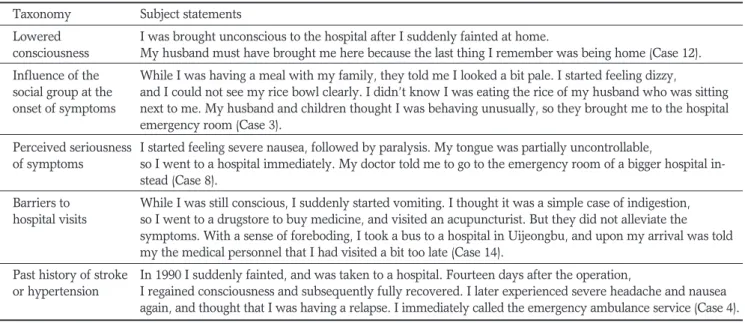
Decision factors affecting treatment-seeking behaviors The decision factors influencing treatment-seeking time after the first symptom onset included lowered consciousness, influence of the social group when symp- toms appear, perceived seriousness of symptoms, past history of hypertension or stroke, and barriers to hospi- tal visits. The treatment-seeking time - the delay be- tween the onset of symptoms and the hospital visit - was categorized into immediate type (within 4 hours) and delayed type (more than 4 hours). A cutoff of 4 hours was chosen because the interviews revealed that the decision criteria of patients clearly differed for de- lays shorter and longer than this time. Also, arriving at hospital within 4 hours of the onset of symptoms allows treatments that minimize brain damage, such as throm- bolytic therapy (Table 1).
Table 1.Decision Factors Affecting Treatment-seeking Behavior Taxonomy Subject statements
Lowered I was brought unconscious to the hospital after I suddenly fainted at home.
consciousness My husband must have brought me here because the last thing I remember was being home (Case 12).
Influence of the While I was having a meal with my family, they told me I looked a bit pale. I started feeling dizzy,
social group at the and I could not see my rice bowl clearly. I didn’t know I was eating the rice of my husband who was sitting onset of symptoms next to me. My husband and children thought I was behaving unusually, so they brought me to the hospital
emergency room (Case 3).
Perceived seriousness I started feeling severe nausea, followed by paralysis. My tongue was partially uncontrollable,
of symptoms so I went to a hospital immediately. My doctor told me to go to the emergency room of a bigger hospital in- stead (Case 8).
Barriers to While I was still conscious, I suddenly started vomiting. I thought it was a simple case of indigestion, hospital visits so I went to a drugstore to buy medicine, and visited an acupuncturist. But they did not alleviate the
symptoms. With a sense of foreboding, I took a bus to a hospital in Uijeongbu, and upon my arrival was told my the medical personnel that I had visited a bit too late (Case 14).
Past history of stroke In 1990 I suddenly fainted, and was taken to a hospital. Fourteen days after the operation,
or hypertension I regained consciousness and subsequently fully recovered. I later experienced severe headache and nausea again, and thought that I was having a relapse. I immediately called the emergency ambulance service (Case 4).
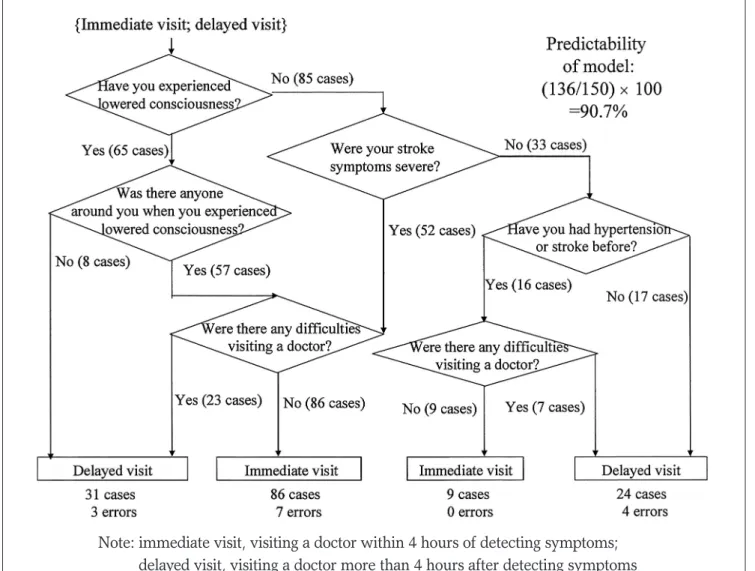
Decision-tree model of treatment-seeking behaviors The decision-making model of the delay between the detection of the first symptom to seeking treatment from a doctor is shown in Figure 1. The predictability of this model was 90.7%: only 14 of the 150 interviewed patients did not follow the pathway predicted by the model.
Comparison of the demographic characteristics and decision factors between the two types of treatment- seeking behavior
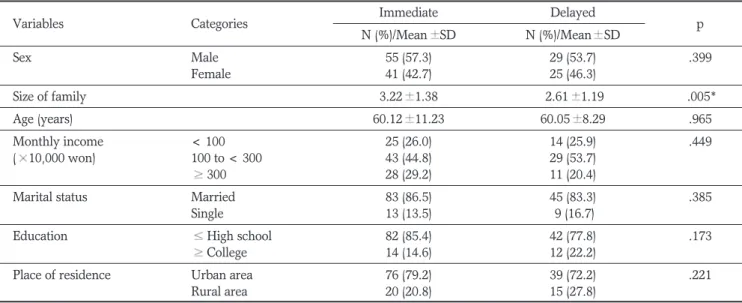
The analysis of the demographic and decision factors between the two treatment-seeking times revealed that a large family, perceived seriousness of symptoms, pres- ence of bystanders, lowered consciousness, regular health concerns, absence of barriers to hospital visits, use of an emergency ambulance service, and past history
of hypertension or stroke were statistically significant decision factors in immediate treatment-seeking (Table 2, Table 3).
Logistic regression analysis of factors influencing the types of treatment-seeking behavior
Logistic regression analysis was performed to elucidate the factors that influence treatment-seeking time. The model fitted well, with a probability value of less than 0.0001, and the success rate of the model was 86.0%.
The probability of immediate treatment-seeking was increased by lowered consciousness, influence of the so- cial group (presence of bystanders), perceived serious- ness of symptoms, and past history. Only barriers to vis- iting a doctor were negatively correlated with immediate treatment-seeking. All the variables except lowered con- sciousness were statistically significant at the 0.05 level.
Note: immediate visit, visiting a doctor within 4 hours of detecting symptoms;
delayed visit, visiting a doctor more than 4 hours after detecting symptoms
Figure 1. Decision-tree model of treatment-seeking behavior after detecting symptoms of stroke (N = 150)
Table 3. Comparison of Decision Factors Between the Two Types of Treatment-seeking Behavior (immediate and delayed)
Variables Categories Immediate Delayed
N (%)/Mean SD N (%)/Mean SD p
Perceived seriousness of Severe 80 (83.3) 28 (51.9) .001*
initial symptoms Not severe 16 (16.7) 26 (48.1)
Social-group Yes 88 (91.7) 34 (63.0) .001*
Influence No 8 ( 8.3) 20 (37.0)
Lowered consciousness Yes 51 (53.1) 14 (25.9) .001*
No 45 (46.9) 40 (74.1)
Regular health concerns Yes 58 (60.4) 23 (42.6) .027*
before onset of symptoms No 38 (39.6) 31 (57.4)
Barriers to visiting a Doctor Yes 3 ( 3.1) 36 (66.7) .001*
No 93 (96.9) 18 (33.3)
Transportation Emergency ambulance 56 (58.3) 15 (27.8) .001*
Automobile, taxi, others 40 (41.7) 39 (72.2)
Past history of hypertension Yes 69 (71.9) 24 (44.4) .001*
orStroke No 27 (28.1) 30 (55.6)
Family history of hypertension Yes 40 (41.7) 24 (44.4) .436
or stroke No 56 (58.3) 30 (55.6)
Medical diagnosis Ischemic stroke 62 (64.6) 39 (72.2) .220
Hemorrhagic stroke 34 (35.4) 15 (27.8)
*p < 0.05
Table 4. Logistic Regression Analysis of Factors Related to Immediate Treatment-seeking After the Onset of Symptoms
Parameter Estimate Odds ratio 95% Wald confidence limits
Lowered consciousness 0.417 1.517* 0.581 03.959
Social-group influence 1.282* 3.603* 1.181 10.993
Perceived seriousness 1.242* 3.462* 1.260 09.516
Past history 1.023* 2.782* 1.107 06.991
Barriers to visiting a doctor 3.384* 0.034* 0.012 00.093
*p < 0.05
Table 2. Comparison of Demographic Characteristics Between the Two Types of Treatment-seeking Behavior (immediate and delayed)
Variables Categories Immediate Delayed
N (%)/Mean SD N (%)/Mean SD p
Sex Male 55 (57.3) 29 (53.7) .399
Female 41 (42.7) 25 (46.3)
Size of family 3.22 1.38 2.61 1.19 .005*
Age (years) 60.12 11.23 60.05 8.29 .965
Monthly income < 100 25 (26.0) 14 (25.9) .449
( 10,000 won) 100 to < 300 43 (44.8) 29 (53.7)
300 28 (29.2) 11 (20.4)
Marital status Married 83 (86.5) 45 (83.3) .385
Single 13 (13.5) 9 (16.7)
Education High school 82 (85.4) 42 (77.8) .173
College 14 (14.6) 12 (22.2)
Place of residence Urban area 76 (79.2) 39 (72.2) .221
Rural area 20 (20.8) 15 (27.8)
*p < 0.05
The odds ratio of immediate treatment-seeking in the presence of bystanders compared to the absence of by- standers after controlling for other variables in the logis- tic regression model was 3.6. Similarly, the odds ratio of immediate treatment-seeking for recognizing the seri- ousness of symptoms compared to not recognizing the seriousness of symptoms was 3.4 (Table 4).
DISCUSSION
This study examined the time interval between the on- set of initial symptoms and arrival at a hospital, since early diagnosis is extremely important in the prognosis of stroke patients. The studies conducted in Korea by Cho (1996) and Jung (1995) revealed that 39.9% and 52.6% of subjects visited the emergency room of a gen- eral hospital within 6 hours of the onset of stroke symp- toms, respectively. The median time interval between the onset of acute stroke symptoms and arriving at hos- pital in other countries has varied from 3 to 6 hours, with most studies using 3 hours as a baseline (Broadley
& Thompson, 2003; Chang et al., 2004; Rosamond et al., 1998) because the American Heart Association rec- ommends that thrombolytic therapy be performed with- in 3 hours of the onset of symptoms in order to improve neurological results for acute ischemic stroke. Thus arriv- ing at a hospital within 2 hours of the onset of symp- toms is necessary to allow for diagnosis and evaluation by doctors.
The predictability of the developed treatment-seeking model was 90.7%, which is at the upper bound of the range considered by Gladwin (1989) to indicate a suc- cessful model (85 90%). The present study showed that the factors influencing the delay to seeking treatment af- ter the onset of symptoms among stroke patients includ- ed lowered consciousness, social-group influences, per- ceived seriousness of symptoms, past history of hyper- tension or stroke, and barriers to hospital visits.
This study showed that lowered consciousness was an important factor in an early hospital visit. In many other studies, consciousness disturbance had the greatest effect on an early hospital visit (Derex, Adeleine, Nighoghossian, Honnorat, & Trouillas, 2002; Cho, 1996).
In addition, the social group influenced the treatment- seeking behavior. That is, when stroke symptoms in- clude lowered consciousness or a self-control disorder, the presence of bystanders reduced the delay to arriving
at hospital. This study showed that arriving at hospital was delayed for elderly people living alone and patients without access to outside help at the onset of symptoms.
These findings are similar to previous results: that recog- nition of symptoms by bystanders facilitated an early ar- rival at hospital (Derex et al., 2002; Rosamond et al., 1998); and elderly people living alone, patients without access to outside help, and patients who do not maintain contact with others experience a delayed arrival at hos- pital (Wester et al., 1999). Hence, the difficulties experi- enced by many stroke patients in taking quick and ap- propriate action by themselves makes it necessary to comprehensively educate families, friends, neighbors, and community as well as the patients themselves.
This study showed that the perceived seriousness of symptoms influenced the delay to arrival at hospital. A sudden onset of stroke, rapidly progressing symptoms, and continuous symptoms resulted in a higher serious- ness of symptoms. These findings are similar to those other studies: a higher NIHSS (National Institutes of Health Stroke Scale Score) (Derex et al., 2002; Chang et al., 2004; Bohannon, Silverman, & Ahlquist, 2003) and more severe neurological symptoms when arriving at hospital (Wester et al., 1999; Goldstein, Edwards, &
Wood, 2001; Wang et al., 2002) facilitated an earlier ar- rival at hospital.
On the other hand, patients with a past history of hy- pertension or stroke recognized the symptoms more quickly and had fewer emotional difficulties with decid- ing to visit a doctor because of their past experience of visiting a doctor; thus they visited the hospital early. This finding is similar to the studies that a past history of my- ocardial infarction (Smith et al., 1998) and strokes (Bohannon et al., 2003) shortened the delay to arriving at a hospital. Accordingly, thoroughly educating stroke patients on taking prompt action in response to the on- set of symptoms for hypertension or stroke is necessary before they are discharged from hospital. On the other hand, another study showed that the past history of stroke did not influence the delay to the hospital visit (Cho, 1996), and even though patients who had previ- ously experienced stroke quickly recognized the symp- toms, this did not influence the delay to the hospital visit (Williams, Bruno, Rouch, & Marriott, 1997). Hence, this issue still requires verification.
Finally, this study has shown that barriers to hospital visits increased the delay to arriving at hospital. Such barriers include a lack of knowledge regarding stroke
symptoms, absence of bystanders, visiting a hospital af- ter visiting a drugstore or a herbal clinic, a long distance to a hospital, and nonuse of the emergency ambulance service.
In particular, lack of knowledge of bystanders as well as patients regarding stroke symptoms delayed the hos- pital visit. Patients did not consider it necessary to visit a doctor if a symptom was not severe, which delayed their arrival at hospital until the symptoms worsened. This was consistent with the finding of Bohannon et al.
(2003) that the awareness of stroke shortened the delay in arriving at hospital. Moreover, Alberts, Bertels, and Dawson (1990) showed that not recognizing stroke symptoms delayed the arrival at hospital.
A few of the subjects in the present study stated that being far from a hospital delayed the hospital visit, whereas the use of the emergency ambulance service fa- cilitated an early visit. This finding was consistent with the results of other studies (Broadley & Thompson, 2003; Tan, Chang, & Liou, 2002). Similarly, many stud- ies have shown that the use of the emergency ambulance service was the most important factor in an early hospi- tal visit (Bohannon et al., 2003; Derex et al., 2002; Lacy, Suh, Bueno, & Kostis, 2001; Wester et al., 1999).
Therefore, an effective patient transport system such as an emergency ambulance - and not public transportation - forms a necessary part of the appropriate treatment of stroke.
Some patients visited drugstores or herbal doctors in addition to visiting a traditional doctor during the initial stage of treatment seeking. A patient should first visit a hospital for early diagnosis and appropriate treatment, since drugstores and herbal doctors can only relieve symptoms, and hence visiting drugstores or herbal doc- tors act as barriers to the early arrival at a hospital. In particular, stroke has been known in Korea as ‘palsy’
due to the long-term influence of Oriental medicine, and many stroke patients still first visit an Oriental-medicine center or a herbal clinic. The resulting delays in arriving at hospital and acute treatment are likely to affect many patients in Korea. Thus, a multidimensional program and educational intervention involving medical personnel, patients, and their communities is necessary to increase the number of Korean patients who receive the appro- priate acute stroke treatment.
CONCLUSION AND RECOMMENDATIONS
This study employed methodological triangulation to develop and test a model of treatment-seeking time after the onset of symptoms in stroke patients. The outcomes of the model were categorized into immediate treat- ment-seeking and delayed treatment-seeking. The model was influenced by lowered consciousness, social-group influences, perceived seriousness of symptoms, past his- tory of hypertension or stroke, and barriers to hospital visits. The predictability of the model was 90.7%. By providing an understanding of the comprehensive educa- tional needs relating to the treatment-seeking time after the onset of symptoms in stroke patients, the results from this study could be used to establish a nursing edu- cation strategy to guide the correct treatment-seeking behaviors.
Based on the study results, we recommend that the following work is performed:
1. The relationship between the degree of functional recovery of stroke patients and the delay to arriving at hospital after the onset of symptoms needs to be eluci- dated.
2. A comprehensive nursing intervention program to ensure the early arrival at hospital of acute ischemic stroke patients should be developed and evaluated.
References
Alberts, M.J., Bertels, C., & Dawson, D.V. (1990). An analysis of time of presentation after stroke. JAMA, 263(1), 65-68.
Barsan, W.G., Brott, T.G., Broderick, J.P., Haley, E.C. Jr, Levy, D.E., & Marler, J.R. (1994). Urgent therapy for acute stroke.
Effects of a stroke trial on untreated patients. Stroke, 25(11), 2132-2137.
Bohannon, R.W., Silverman, I.E., & Ahlquist, M. (2003). Time to emergency department arrival and its determinants in patients with acute ischemic stroke. Conn Med, 67(3), 145-148.
Broadley, S.A., & Thompson, P.D. (2003). Time to hospital admis- sion for acute stroke: an observational study. Med J Aust, 178(7), 329?331.
Byun, Y.S. (2000). Pathway of stroke patients seeking medical care.
J Korean Fund Nurs, 7(2), 149-163.
Chang, K.C., Tseng, M.C., & Tan, T.Y. (2004). Prehospital delay af- ter acute stroke in Kaohsiung, Taiwan. Stroke, 35(3), 700-704.
Cho, Y.J. (1996). Factors related to hospital arrival time of acute stroke patients who visited a university hospital in Seoul.
Department of Medicine, Seoul National University Graduate School, Master’s thesis.
Choi, S.M., Kim, Y.H., & Cho, E.S. (1991). Survey on rehabilitation status and need of out-patients with stroke in rural area. J Korean Acad Rehabil Med, 15(2), 67-73.
Derex, L., Adeleine, P., Nighoghossian, N., Honnorat, J., & Trouillas, P. (2002). Factors influencing early admission in a French stroke unit. Stroke, 33(1), 153-159.
Fieschi, C., Argentino, C., Lenzi, G.L., Fantozzi, L., Sacchetti, M.L., Pace, A., Rasura, M., Bastianello, S., Bozzao, L., & Zanette, E., et al. (1988). Therapeutic window for pharmacological treat- ment in acute focal cerebral ischemia. Ann NY Acad Sci, 522, 662-666.
Gladwin, C.H. (1989). Ethnographic decision tree modeling: quali- tative research methods, series 19. Newbury Park, CA: Sage.
Goldstein, L.B., Edwards, M.G., & Wood, D.P. (2001). Delay be- tween stroke onset and emergency department evaluation.
Neuroepidemiology, 20(3), 196-200.
Harraf, F., Sharma, A.K., Brown, M.M., Lees, K.R., Vass, R.I., &
Kalra, L. (2002). A multicentre observational study of presen- tation and early assessment of acute stroke. BMJ, 325(7354), 17.
Hickenbottom, S.L., & Barsan, W.G. (2000). Acute ischemic stroke therapy. Neurol Clin, 18(2), 379-397.
Jung, K.Y. (1995). Variables associated with delayed hospital ar- rival of stroke patients living in Taejon and its suburban areas.
Department of Medicine, Chungnam National University Graduate School, Master’s thesis.
Kim, Y.H. (1989). Survey on status in patients with motor impair- ment and residents’ attitude in rural community. Yonsei University Graduate School, Master’s thesis.
Kimchi, J., Polivka, B., & Stevenson, J.S. (1991). Triangulation: op- erational definitions. Nurs Res, 40(6), 364-366.
Lacy, C.R., Suh, D.C., Bueno, M., & Kostis, J.B. (2001). Delay in presentation and evaluation for acute stroke: Stroke Time Registry for Outcomes Knowledge and Epidemiology (S.T.R.O.K.E.). Stroke, 32(1), 63-69.
Morris, D.L., Rosamond, W., Madden, K., Schultz, C., & Hamilton, S. (2000). Prehospital and emergency department delays after
acute stroke: the Genentech Stroke Presentation Survey.
Stroke, 31(11), 2585-2590.
NINDS (1995). Tissue plasminogen activator for acute ischemic stroke. National Institute of Neurological Disorders and Stroke rt-PA Stroke Study Group. N Engl J Med, 333(24), 1581-1587.
National Statistical Office (2002). Annual report on the cause of death statistics: based on vital registration. Seoul: National Statistical Office.
Rosamond, W.D., Gorton, R.A., Hinn, A.R., Hohenhaus, S.M., &
Morris, D.L. (1998). Rapid response to stroke symptoms: the Delay in Accessing Stroke Healthcare (DASH) study. Acad Emerg Med, 5(1), 45-51.
Smith, M.A., Doliszny, K.M., Shahar, E., McGovern, P.G., Arnett, D.K., & Luepker, R.V. (1998). Delayed hospital arrival for acute stroke: the Minnesota Stroke Survey. Ann Intern Med, 129(3), 190-196.
Spradley, J.P. (1979). The ethnographic interview. Toronto: Holt, Rinehart and Winston.
Spradley, J.P. (1980). Participation observation. New York: Holt, Rinehart, and Winston.
Tan, T.Y., Chang, K.C., & Liou, C.W. (2002). Factors delaying hos- pital arrival after acute stroke in southern Taiwan. Chang Gung Med J, 25(7), 458-463.
Wang, S., Niu, S., Wang, Y., & Zhang, G. (2002). Evaluation of the factors leading to delay from stroke to arrival at hospital.
Zhonghua Nei Ke Za Zhi, 41(11), 728-731.
Wester, P., Ra dberg, J., Lundgren, B., & Peltonen, M. (1999).
Factors associated with delayed admission to hospital and in- hospital delays in acute stroke and TIA: a prospective, multi- center study.Seek- Medical-Attention-in-Time Study Group.
Stroke, 30(1), 40-48.
Williams, L.S., Bruno, A., Rouch, D., & Marriott, D.J. (1997).
Stroke patients’ knowledge of stroke. Influence on time to pre- sentation. Stroke, 28(5), 912-915.