서 론
표고버섯 (Lentinus edodes)은 현재까지 식용 및 약용으로 널리 이용되고 있으며, 표고버섯의 생리활성기능으로는 항 산화력, 항균 및 항암, 혈당강하, 체중 및 콜레스테롤저하
등에 대한 다양한 보고가 있다.1
한편 신반흔 (renal scarring)은 역류성 신우신염의 마지막 단계에 발생하는 것으로 신장 내 균의 성장보다는 감염으 로 인한 신염증 (renal inflammation)의 정도와 밀접한 관계 를 가지고 있다.2Slotki와 Asscher3는 쥐를 통한 동물실험에 서 감염 후 24시간 이내 적절한 항생제를 투여했을 경우 신
억제효과
The Suppressive Effect of Lentinus Edodes on Renal Scarring Secondary to Pyelonephritis
Young Guk Lee, Kwan Kyu Park1, Jung Im Shin2, Im Hee Shin3, Jae Shin Park
From the Departments of Urology, 1Pathology, 2Microbiology and 3Biomedical Statistics, Daegu Catholic University College of Medicine, Daegu, Korea
Purpose: Lentinus edodes is used in both foods and drugs, and is also known to be an antioxidant agent. Some investigators have noted that renal scarring following pyelonephritis is closely related to inflammation or free oxygen radicals, rather than to direct injury due to bacterial infec- tion. The efficiency of the antioxidant agent, lentinus edodes, in preventing the renal scarring caused by experimental pyelonephritis was evaluated in rats.
Materials and Methods: Twenty eight male Sprague Dawley rats (n=28) were injected into both renal parenchyma with 0.1ml of a solution con- taining Escherichia coli(108/ml). The control group, consisting of 4 rats, received an injection of isotonic saline instead of the bacterial solution.
Three days after surgery, the animals were given the following treatments:
in the pyelonephritis group, 7 rats received isotonic saline for 5 days; in the antibiotics treatment group, 6 rats were treated with an antibiotic only, ciprofloxacin, for 5 days. In the lentinus edodes treatment group, 5 rats were treated with lentinus edodes only. In the combined group, 6 rats received both lentinus edodes and ciprofloxacin. The kidneys were harvested 6 weeks after infection, and histopathologically examined for renal scarring.
Results: Delayed treatment with antibiotics-only or lentinus edodes-only had no effect on the scarring compared with the untreated controls.
However, the addition of lentinus edodes to the delayed antibiotic therapy significantly inhibited the renal scarring compared with the pyelonephritis, antibiotic-only treated and the lentinus edodes-only treated groups (p<
0.05).
Conclusions: The administration of lentinus edodes in combination with antibiotics significantly reduced the renal scar formation in pyelonephritis.
(Korean J Urol 2007;48:315-320)
Key Words: Lentinus edodes, Pyelonephritis
대한비뇨기과학회지 제 48 권 제 3 호 2007
대구가톨릭대학교 의과대학
비뇨기과학교실, 1병리학교실,
2조직공학교실, 3의학통계학교실
이영국 박관규1 신정임2
신임희3 박재신
접수일자:2006년 12월 29일 채택일자:2007년 1월 13일
교신저자: 박재신
대구가톨릭대학교 의과대학 비뇨기과학교실
대구광역시 남구 대명 4동 3056-6
705-034
TEL: 053-650-4662 FAX: 053-623-4660 E-mail: [email protected]
315
316 대한비뇨기과학회지:제 48 권 제 3 호 2007
반흔의 정도를 의미 있게 줄일 수 있다고 보고하였다. 그러 나 감염 후 72시간이 지난 후에는 항생제만으로는 신반흔 을 예방할 수 없다는 보고도 있다.4
과거 이러한 신반흔을 예방하기 위해 신장 내 염증을 줄 이는 많은 시도들이 있었다. Haraoka 등4과 Pohl 등5은 치료 가 지연된 신우신염 흰쥐에게 항생제와 cytokine분비를 억 제하는 prednisolone을 병용 투여한 결과 신반흔의 형성을 의미 있게 감소시킬 수 있었다고 하였고, aspirin이나 ibu- profen같은 nonsteroidal anti-inflammatory drug 제제도 신염 증을 줄이는 데 효과적이라는 보고도 있었다.6또한 항산화 제인 allopurinol이나 superdioxide dismutate (DMSO)를 항생 제와 섞어 주입하면 신손상을 예방하는 데 효과가 있다는 보고도 있었다.7,8
이에 저자들은 최근 항산화기능을 가지는 것으로 알려진 표고버섯 추출물을 신우신염이 야기된 실험동물 쥐에게 투 여하여 신반흔을 줄일 수 있는지 알아보고자 하였다.
재료 및 방법 1. 실험동물
실험동물은 생후 12주, 체중 280-320gm의 Sprague Dawley 수컷백서 (대한 바이오 링크, 충청북도, 한국) 28마리를 한 우리에 3마리씩 사육하며 1주일간의 적응기간을 가진 뒤 Escherichia coli (O2:K1:H-) P69를 사용하여 신우신염을 야 기하였다.
2. 신우신염 유발
Enflurane (GerolanR)으로 실험동물을 흡인마취시킨 후 복 부를 절개하여 신장을 노출시켰다. Yagmurlu 등9의 방법으 로 E. coli현탁액 (1x10⁸cells/ml) 0.1ml를 26G needle로 양측 신장 실질, 특히 신우에 주입하였다. 이때 주입방향은 외측 에서 신우쪽으로 하였으며 1cm 깊이로 주입하였다.
3. 표고버섯 추출법
표고버섯을 믹스기 (큐피티골드, 엔젤, 한국)를 이용해 작 은 입자로 분쇄하여 정량한 후 1g당 증류수 20ml를 첨가하 였다. 상온에서 24시간 진탕한 후 Whatmann filter를 이용하 여 잔사를 제거하고 여과액을 얻었다. 이를 진공건조기 (Rotavapor, Buchi, Switzerland)를 이용해 수분을 상당부분 제거한 후 농축된 샘플을 각각 동결건조기 (Freezone plus 6, Labconco, USA)를 이용하여 분말화한 후 정량하였다.
4. 실험군
대조군 (control group, n=4)은 normal saline (N/S) 0.1ml를
신장 실질에 주입하였다. 신우신염군 (pyelonephritis group, n=7)은 E. coli 현탁액 (1x10⁸cell/ml) 0.1ml를 신장 실질에 주 입하고 난 뒤, 3일 후 N/S 3ml를 하루에 두 번 나누어 5일 동안 근육주사하였다. 항생제 투여군 (antibiotics treatment group, n=6)은 E. coli 현탁액 (1x10⁸cell/ml) 0.1ml를 신장 실 질에 주입하고 난 뒤, 3일 후 항생제 ciprofloxacin (15mg/kg) 를 하루에 두 번 나누어 5일 동안 근육주사하였다. 표고버 섯 투여군 (lentinus edodes treatment group, n=5)은 E. coli 현 탁액 (1x10⁸cell/ml) 0.1ml를 신장 실질에 주입하고 난 뒤, 3 일 후 표고버섯 (10mg/kg)을 하루에 두 번 나누어 5일 동안 복막투여 하였다. 그리고 병용투여군 (combined treatment group, n=6)은 E. coli 현탁액 (1x10⁸cell/ml) 0.1ml를 신장 실 질에 주입하고 난 뒤, 3일 후 항생제 ciprofloxacin (15mg/kg) 를 하루에 두 번 나누어 5일 동안 근육주사하면서 표고버섯
(10mg/kg)을 하루에 두 번 5일 동안 복막투여하였다.
5. 관찰항목
모든 쥐들은 만성 신우신염을 관찰하기 위해 6주 뒤 희생 되었다. 적출한 양측 신장을 10% 완충 formalin용액에 24시 간 고정 후 신장 장축을 따라 균을 주입한 부위를 기준으로 양분 후 통상적인 조직제조 과정을 거치고, 파라핀에 포매 하여 절편을 얻어 hematoxylin-eosin 염색을 시행하여 광학 현미경으로 관찰하였다.
Yagmurlu 등9이 이용한 방법인 조직학적 변화 중 간질 단 핵염증세포 침윤, 세뇨관 위축, 간질 섬유화 및 중성백혈구 침윤을 위주로 조사하고, 병리 신반흔 점수로 수치화하였 다. 간질 단핵염증세포, 세뇨관 위축 및 간질의 섬유화는 신 장실질의 침범정도에 따라 각각 0-3점으로 나누었는데, 0%
일 때 0점, 5% 미만일 때 1점, 5-10%일 때 2점, 10% 이상일 때 3점으로 분류하였다. 중성백혈구 침윤은 신장실질의 침 범정도에 따라 각각 0-2점으로 나누었는데, 전혀 없을 때 0점, 드문 경우 1점, 흔한 경우 2점으로 분류하였다.
6. 통계분석
통계분석은 Kruskal-Wallis test를 이용하였고 통계적 유의 수준을 p값이 0.05 미만인 경우로 하였다.
결 과
1. 육안적 관찰 및 병리조직학 검사
1) 육안적 관찰에서 신우신염군, 항생제 투여군, 표고버 섯 투여군에서 균 주입 부위를 중심으로 신피막의 함몰, 미 세농양, 불규칙적인 경계면이 관찰되었다. 정상군이나 병용 투여군에서는 백색 혹은 황색으로의 변색이 다소 있을 뿐
다른 특이소견은 관찰되지 않았다.
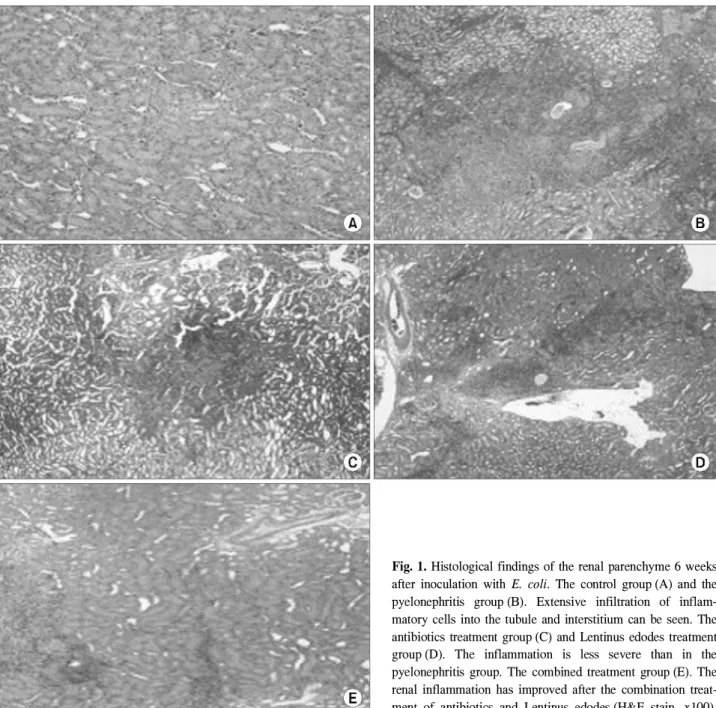
2) 현미경적 관찰에서 정상 대조군의 경우 미미하게 간질 단핵염증세포와 중성 백혈구 침윤이 관찰되었지만 세뇨관 의 위축과 간질의 섬유화는 관찰되지 않았다. 신우신염군 의 경우 신장 전반에 걸쳐 간질 단핵염증세포와 중성 백혈 구의 침윤이 나타났으며 간질 섬유화와 세뇨관 위축도 빈 번하게 관찰되었다. 반면 병용 투여군의 경우 신우신염군 에 비해 간질 섬유화와 세뇨관 위축이 많이 회복되었고 간 질 단핵염증세포 침윤도 많이 감소되어 있었다. 항생제 투 여 및 표고버섯 투여군의 경우는 신우신염군 및 병용 투여
군의 중간 정도로 관찰되었다 (Fig. 1).
각 군의 전체 신반흔 점수를 살펴보면 신우신염군이 7.33
±1.63으로 가장 높았으며 항생제 투여군과 표고버섯 투여 군이 각각 5.50±1.00, 5.57±1.61로 신우신염군보다 낮게 측정되었지만 통계학적으로 유의하게 차이가 나지는 않았 다. 하지만 병용투여군의 신반흔 점수는 2.60±1.14로 가장 낮게 측정되었으며 신우신염군에 비해 통계학적으로 유의 하게 차이가 있었다 (p<0.05) (Table 1).
Fig. 1. Histological findings of the renal parenchyme 6 weeks after inoculation with E. coli. The control group (A) and the pyelonephritis group (B). Extensive infiltration of inflam- matory cells into the tubule and interstitium can be seen. The antibiotics treatment group (C) and Lentinus edodes treatment group (D). The inflammation is less severe than in the pyelonephritis group. The combined treatment group (E). The renal inflammation has improved after the combination treat- ment of antibiotics and Lentinus edodes (H&E stain, x100).
318 대한비뇨기과학회지:제 48 권 제 3 호 2007
고 찰
신우신염은 신장 및 신우주변에 생긴 염증으로 임상적으 로 진단되며 일시적 혹은 영구적으로 신실질을 파괴하고 신기능을 악화시킨다. 특히 소아에서의 급성 신우신염은 성인과 달리 10-40%에서 신반흔으로 진행한다.10신반흔의 형성은 방광요관역류의 정도, 나이, 세균독성, 치료지연 및 반복감염 등과 관련되며 소아에서 말기 신부전과 고혈압의 중요한 원인이 된다.11,12조기에 항생제로 치료하는 것이 신 반흔을 줄이는 데 가장 중요하나 실제로는 신우신염의 발 생 후 병원으로 오기까지 시간이 많이 걸릴 수가 있어 치료 에 어려움이 있다.
한편 급성 신우신염의 병변이 세포고사와 신반흔으로 진 행하는 과정에는 감염군의 내독소, verocytotoxin, lipopoly- saccharide (LPS) 등에 의한 직접적인 손상,13감염 시 증가하 는 cytokine인 IL-6와 IL-8,14TNF-α,15TGF-β1,16신허혈-재 관류 시 생성되는 산소자유기,7cytokine을 매개로 활성화되 는 Fas/Fas ligand,17 세포주기 조절단백18등 다양한 원인이 제시되어 있다. Glauser 등19은 E. coli를 투여한 쥐 실험에서 72시간이 지난 후 항생제를 투여한 군과 항생제를 투여하 지 않은 군 사이의 신반흔의 차이는 없었다고 보고하여 신 반흔은 균 감염보다는 염증과 관련이 있다는 것을 증명하 였다.
따라서 급성 신우신염이 신반흔으로 진행되는 것을 예방 하기 위해서는 세균을 제거하는 항생제 외에 숙주의 염증 반응과 면역반응을 조절하는 강력한 항염증제의 역할이 필
요하다.
과거 이러한 신반흔을 예방하기 위해 신염증을 줄이는 여러 가지 많은 연구들이 있었다. Haraoka 등4은 상행성 급 성 신우신염 쥐 동물에서 prednisolone을 항생제와 같이 투 여하여 항생제만 투여한 군과 비교하여 신염증 빈도가 50%
에서 10%로 줄었다고 보고하였다. 그리고 Huang 등6은 상 행성 신우신염을 유발한 쥐실험에서 ibuprofen을 항생제와 병용투여 시 신염증 억제에 효과가 있다고 보고하였고 Bennett 등20은 항생제와 비타민 A와 E를 병용투여한 군에 서 신염증이 줄었음을 보고하였다. 국내에서도 많은 연구 가 진행되어 Park 등21은 상행성 신우신염을 유발한 쥐 실험 에서 72시간이 지난 후 항생제와 젖소 초유의 병용투여 시 신염증 억제효과를 보고하였다. Yeom 등22은 신장의 피질 에 세균을 직접 주사하여 신우신염을 유발시킨 후 selenium 을 항생제와 병용투여 시 신염증 억제에 효과가 있다고 보 고하였다. 저자들도 신장의 피질에 세균을 직접 주사하여 신우신염을 유발시켰으며 Matsumoto 등23은 상행성 감염에 의해 유발된 신우신염의 조직학적 결과와 동일하다고 보고 하였다.
급성 신우신염이 신반흔으로 진행하는 것을 예방하기 위 한 한 방편으로 표고버섯 추출물을 사용할 수 있다. 표고버 섯 (Lentinus edodes)은 담자균류 주름버섯목 느타리과 잣버 섯속에 속하는 식용버섯으로 봄에서 가을에 걸쳐 주로 참 나무류 등 활엽수의 나무토막, 그루터기 위에 단생 또는 군 생하는 목재 백색부후균이다. 표고버섯은 각종 아미노산과 ergosterol을 많이 함유하고 있고 생리활성기능으로는 항산 화력, 항균 및 항암, 혈당강하, 체중 및 콜레스테롤 저하 등 Table 1. The mean histopathological renal scarring score
Control Pyelonephritis Antibiotics Lentinus edodes Combined
(n=4) (n=7) (n=6) (n=5) (n=6)
Interstitial mononuclear 0.33* 2.83 2.00 2.00 1.20*
inflammatory cell (0.516) (0.408) (<0.001) (0.577) (0.447)
<0.01* 1.50 1.25 1.29 0.60*
Tubular atrophy
(<0.001) (0.548) (0.500) (0.488) (0.548)
<0.01* 1.50 1.25 1.14 0.40*
Interstitial fibrosis
(<0.001) (0.837) (0.500) (0.378) (0.548)
0.17* 1.50 1.00 1.14 0.40*
Neutrophil infiltration
(0.408) (0.548) (<0.001) (0.378) (0.548)
0.50* 7.33 5.50 5.57 2.60*
Total
(0.548) (1.633) (1.000) (1.618) (1.140)
( ): standard deviation. *: statistically significant difference compared to the pyelonephritis group using the Kruskal-Wallis test (p<0.01).
n: number of rat
에 대한 다양한 보고가 있다. 특히 표고버섯의 추출물에는 항산화제로 알려진 selenium이 다량 함유되어 있다고 알려 져 있으며24 Ma1가 표고버섯으로부터 추출한 성분의 식용 대두유에 대한 peroxide value와 thiobarbituric acid (TBA) value의 변화를 측정하여 항산화능을 확인하였다. 저자들은 사전에 thiobarbituric acid법으로 항산화 시험을 하고 물과 methanol 등의 유기용매를 추출용매로 이용하여 hydroxyl radical 소거능을 측정하여 표고버섯 추출물의 항산화력을 검증하였다. 추출용매를 증류수를 이용한 경우가 항산화력 이 가장 높게 측정되어 본 실험에서는 증류수를 이용하였 다. E. coli를 포함한 여러 병원균에 대한 항균효과는 표고버 섯의 물 및 에탄올 추출물에서 여지 (disc) 방법을 이용하여 확인하였다.25 표고버섯의 투여용량은 아직 정립되지 않아 Zheng 등26이 표고버섯의 면역조절작용에 대한 연구에서 이 용한 쥐에 kg당 10mg을 투여했을 때 가장 효과적이었다는 보고를 근거로 용량을 결정하였다. 앞으로 투여용량 및 투 여방법에 대해서는 더 연구가 필요하다고 생각한다.
저자들은 실험적으로 신장의 피질에 세균을 주사하여 유 발한 신우신염에서 항생제와 더불어 표고버섯추출물을 투 여하였을 때 신염증의 정도가 감소함을 관찰할 수 있었다.
이러한 효과는 향후 더 구체적인 연구가 필요하겠지만 표 고버섯의 항산화작용에 의한 것으로 생각한다.
결 론
신우신염을 유발한 백서에서 치료가 지연된 경우 항생제 치료만으로는 신염증을 줄일 수 없었다. 그러나 항생제를 표고버섯과 같이 투여하였을 경우 다른 군들보다 신 조직 소견이 좋아지는 것을 관찰할 수 있었다. 즉 표고버섯이 치 료가 늦어진 급성 신우신염에서 신염증의 정도를 줄임으로 써 신반흔의 예방에 효과적으로 작용한다고 생각한다. 하 지만 실제 임상적용을 위해서는 투여용량, 투여방법, 정확 한 작용기전 등의 추가적인 연구가 필요할 것으로 생각한다.
REFERENCES
1. Ma SJ. Effects of the substances extracted from dried mush- room (Lentinus edodes) by several organic solvents on the stability of fat. Korean J Food SCI Technol 1983;15:150-4 2. Scott JE, Stansfeld JM. Ureteric reflux and kidney scarring in
children. Arch Dis Child 1968;43:468-70
3. Slotki IN, Asscher AW. Prevention of scarring in experimental pyelonephritis in the rat by early antibiotic therapy. Nephron 1982;30:262-8
4. Haraoka M, Matsumoto T, Takahashi K, Kubo S, Tanaka M, Kumazawa J. Suppression of renal scarring by prednisolone
combined with ciprofloxacin in ascending pyelonephritis in rats. J Urol 1994;151:1078-80
5. Pohl HG, Rushton HG, Park JS, Chandra R, Majd M.
Adjunctive oral corticosteroids reduce renal scarring: the piglet model of reflux and acute experimental pyelonephritis. J Urol 1999;162:815-20
6. Huang A, Palmer LS, Hom D, Anderson AE, Kushner L, Franco I. Ibuprofen combined with antibiotics suppresses renal scarring due to ascending pyelonephritis in rats. J Urol 1999;
162:1396-8
7. Roberts JA, Kaack B, Fussell EN, Baskin G. Immunology of pyelonephritis. VII. Effect of allopurinol. J Urol 1986;136:
960-3
8. Roberts JA, Roth JK Jr, Dominque G, Lewis RW, Kaack B, Baskin G. Immunology of pyelonephritis in the primate model.
V. Effect of superoxide dismutase. J Urol 1982;128:1394-400 9. Yagmurlu A, Boleken ME, Ertoy D, Ozsan MI, Gokcora IH, Dindar H. Preventive effect of pentoxifylline on renal scarring in rat model of pyelonephritis. Urology 2003;61:1037-41 10. Jakobsson B, Berg U, Svensson L. Renal scarring after acute
pyelonephritis. Arch Dis Child 1994;70:111-5
11. Smellie JM, Ransley PG, Normand IC, Prescod N, Edwards D. Development of new renal scars: a collaborative study. Br Med J (Clin Res Ed) 1985;290:1957-60
12. Rushton HG, Majd M, Jantausch B, Wiedermann BL, Belman AB. Renal scarring following reflux and non-reflux pye- lonephritis in children: evaluation with 99m technetium-dimer- captosuccinic acid scintigraphy. J Urol 1882;147:1327-32 13. Serlachius E, Sundelin B, Eklof A, Jahnke M, Laestadius A,
Aperia A. Pyelonephritis provokes growth retardation and apo- ptosis in infant rat renal cortex. Kidney Int 1997;51:1855-62 14. Tallus K, Fituri O, Burman LG, Wretlind B, Brauner A.
Interleukin-6 and interleukin-8 in the urine of children with acute pyelonephritis. Pediatr Nephrol 1994;8:280-4
15. Messmer UK, Briner VA, Pfeilschifter J. Tumor necrosis factor-α and lipopolysaccharide induce apoptotic cell death in bovine glomerular endothelial cells. Kidney Int 1999;66:2322- 37
16. Border WA, Noble NA. Transforming growth factor-β in tissue fibrosis. N Engl J Med 1994;331:1286-92
17. Saez-Lorens X, McCracken GH Jr. Antimicrobial and anti- inflammatory treatment of bacterial meningitis. Infect Dis Clin North Am 1999;13:619-36
18. Schelling JR, Nkemere N, Kopp JB, Cleveland RP. Fas- dependant fratricidal apoptosis is a mechanism of tubular epithelial cell deletion in chronic renal failure. Lab Invest 1998;78:813-24
19. Glauser MP, Meylan P, Bille J. The inflammatory response and tissue damage. The example of renal scars following acute renal infection. Pediatr Nephrol 1987;1:615-22
20. Bennett RT, Mazzaccaro RJ, Chopra N, Melman A, Franco I.
Suppression of renal inflammation with vitamin A and E in
320 대한비뇨기과학회지:제 48 권 제 3 호 2007
ascending pyelonephritis in rats. J Urol 1999;161:1681-4 21. Park JK, Park HJ, Joo KJ. The suppressive effect of bovine
colostrum combined with antibiotics on renal inflammation.
Korean J Urol 2006;47:1111-6
22. Yeom MH, Park JB, Park JS. The suppressive effect of selenium on renal inflammtion in a rat model of pyelonephritis with delayed treatment. Korean J Urol 2005;46:1348-53 23. Matsumoto T, Mitzunoe Y, Ogata N, Tanake M, Takahashi K,
Kumazawa J. Antioxidant effect on renal scarring following infection of mannose-sensitive-piliated bacteria. Nephron 1992;
60:210-5
24. Gerqelv V, Kubachka KM, Mounicou S, Fodor P, Caruso JA.
Selenium speciation in Agaricus bisporus and Lentinula edodes mushroom proteins using multi-dimensional chromatography coupled to inductively coupled plasma mass spectrometry. J Chromatogr A 2006;1101:94-102
25. Kim YD, Kim KJ, Cho DB. Antimicrobial activity of lentinus edodes extract. Korean J Food Preserv 2003;10:89-93 26. Zheng R, Jie S, Hanchuan D, Moucheng W. Characterization
and immunomodulating activities of polysaccharide from Lentinus edodes. Int Immunopharmacol 2005;5:811-20