• 검색 결과가 없습니다.

The Effects of Academic Stress and Self-Control on Temporomandibular Disorder of Adolescents

N/A
N/A
Protected

Academic year: 2021

Share "The Effects of Academic Stress and Self-Control on Temporomandibular Disorder of Adolescents"

Copied!
9
0
0

로드 중.... (전체 텍스트 보기)

전체 글

(1)

ISSN 2288-9272 J Oral Med Pain 2014;39(2):46-54 http://dx.doi.org/10.14476/jomp.2014.39.2.46

The Effects of Academic Stress and Self-Control on Temporomandibular Disorder of Adolescents

Hee-Soo Bang

1

, Dong-Jun Son

2

, Mee-Ae Khim

2

1

Cheongna Dalton School, Incheon, Korea

2

Mie Dental Clinic, Incheon, Korea

Received March 3, 2014 Revised March 21, 2014 Accepted April 7, 2014

Purpose: The aim of this study was to investigate the effects of academic stress and self-control ability on temporomandibular disorder (TMD) of adolescents.

Methods: Participants were 1,112 teenagers who were 1st grade students of middle and high school. After checking their academic stress and self-control ability through a self-administrat- ed questionnaire, the students were examined their TMD by two trained dentists. We drew a comparison the level of their academic stress and self-control ability between the students with and without TMD. We divided them to four groups according to the level of academic stress and self-control. And we checked prevalence of TMD in each level.

Results: The group of students with TMD was higher academic stress score level than the stu- dents without TMD (p<0.05). And they had lower self-control score level than the students without TMD (p<0.05). Even if they were under the same academic stress, the group of students with higher self-control score was less TMD prevalence than the students with lower score.

Conclusions: Academic stress makes adolescents to increase TMD and high ability of self- control makes them to decrease it. And these tendencies are seemed to have a great influence on young male student.

Key Words: Academic stress; Adolescent; Self-control; Temporomandibular joint; Temporo- mandibular joint disorders

Correspondence to:

Mee-Ae Khim

Mie Dental Clinic, 53, Gyeyang-daero, Gyeyang-gu, Incheon 407-824, Korea Tel: +82-32-543-1590

Fax: +82-32-543-1593 E-mail: [email protected]

may lead to high blood pressure (and subsequently heart disease), damage to muscle tissue, inhibition of growth and suppression of the immune system.

2)

So, the prolonged emotional stress can make physiologic change in the ner- vous system, hormones, and immune response.

3)

Researches have shown strong links between prolonged stress and oral disease also. Especially it has been asserted the stress is one of the precipitating factors in the devel- opment of temporomandibular disorder (TMD). A review of the scientific literature by Okeson

4)

reveals five major factors associated with TMD. These factors are the occlu- sal condition, trauma, parafunctional activities, deep pain input, and emotional stress. In most of the studies, they show that TMD symptoms are caused by a combination of

INTRODUCTION

Nowadays, it is a general concept that many diseases oc- cur by emotional stress or get worse by effect of that. After the introduction of Selye’s stress formulations, emotional stress has been a widespread assumption that psychological stress merely represents one component of a lager unitary category of biological stress phenomena.

1)

Chronic stress is the response to emotional pressure suf- fered for a prolonged period over which an individual per- ceives he or she has no control. It involves an endocrine system response in which occurs with a release of cortico- steroids. Long-term exposure to stress creates a high level of these hormones that remains constant. This condition

JOMP

Journal of Oral Medicine and Pain

(2)

TMD as like as mental health among adolescents. For these aims, we drew a comparison between the students with and without TMD according to the level of their academic stress and self-control. And we had done the correlation analysis between academic stress and self-control ability. Finally the group of students with higher self-control was compared to the group with lower self-control under the same academic stress.

MATERIALS AND METHODS

1. Subjects

The study group consisted of 1,112 teenagers consecu- tively seen students for oral examination in national health screening program for students in a dental clinic, Gyeyang- gu, Incheon, Korea. There were 618 male students and 494 female students. Oral examination was established about 2,000 students, but some of them had rejected to answer questionnaires, and the students with any medication and systemic disease and the students who have done duplicitous answer to questionnaires were eliminated from this study.

Collection of data for this study was done from April to December in 2012, in that time, the law of Institutional Review Board (IRB) was not enforced, so we didn’t pass IRB, and we had a mind of our own. But we were mindful of protection personal information and right. The examinations of TMD were established as a national program of oral health for students and the questionnaires were not extend personal information and students could reject to answer freely.

Middle school students were 758 (male, 457; female, 301) and high school students were 354 (male, 161; female, 193).

Both groups were first grade, so there was interval of 3 years in both groups.

2. Methods

Prior to visit for clinical examination, students com- pleted self-report questionnaire that was 10-items to check academic stress and self-control ability at the school. The questionnaire of academic stress and self-control was ad- ministered to each student. We used same questionnaire of the Korean Youth Panel Survey that survey was conducted by the National Youth Policy Institute.

20)

We sent question- naire to schools for the students were surveyed and induced the disharmony of masticatory system and psychological

stress.

5-7)

According to the 2013 Korean youth white paper by Ministry of Gender Equality and Family,

8)

the recognition rate of stress in Korean teenagers is 41.9% and the rate of suicide attempt is 5.5% in girls and 2.8% in boys. The recognition rate of depression of adolescents is twice of adult’s.

9)

As these reports, we can guess that Korean adoles- cents are exposed to heavy stress in these times.

What is the most common fact of stress to Korean stu- dents in modern times? In the researches about stress of Korean students, it is answered that is career and academic concern.

10,11)

According to an article about adolescents in 2013, 74.1% students of middle and high school are hav- ing serious worry relates to academic achievement. The stu- dents of 38.3% are having hardship with family, and 14.2%

of students are suffering from stress with friends.

11)

These results came up to expectation.

The students under high level academic stress have not only psychotic disorder like interpersonal sensitiveness, de- pression, anxiety, and hostility but also somatization disor- der like deterioration physical strength, fatigue, transform- ing of body shape and digestive troubles.

12)

But the effect of stress is not same to everybody, even if the strength and sort of stress are equal, it is applied dif- ferent way to mental and physical of individuals accord- ing to their stress coping behavior, personal characteristic, and interactional model of stress.

13)

In other words, there is very important factor, self-control, between stress and mental health and it makes individual difference of men- tal health.

14)

Furthermore it was validated that the academic stress is mediated by effect of self-control when works in individual mental health as well.

15)

TMD patients spread throughout in all ages; most of pa- tients range from 15 to 45 years. And the prevalence ra- tio of TMD increases from 15 year by year. It makes peak on late twenties. The prevalence ratio of TMD was reported broad range 12%-93%, and in the report about adolescents it is various also as 56%-81%.

16-19)

The purpose of this study was to evaluate the effect of

academic stress and ability of self-control on TMD of ado-

lescents. And we investigate the mediating effect of self-

control ability on relationship between academic stress and

(3)

Likert type scale of academic stress and self-control ability and made sum scores 5-25 individually. According to their scores, we made a classification to four groups of student;

scores 5-10, 11-15, 16-20, and 21-25.

Reliability estimation of the questionnaires of academic stress and self-control ability were up with Cronbach α. The Cronbach of coefficient was 0.744 on academic stress and 0.715 on self-control. So they have sufficient inter-item consistency.

Student t-tests were used to analyze differences of scores of academic stress and self-control between the students with TMD and without TMD in middle and high school of male and female separately. When the p-value was be- low 0.05, there was considered statistically significant difference.

A correlation analysis was established between the scores of academic stress and self-control, when the p-value was below 0.05, there was considered statistically signifi- cant. The analyses were carried out SPSS Statistics 17.0 for Windows (SPSS Inc., Chicago, IL, USA).

RESULTS

1. TMD Patient Number/Rate

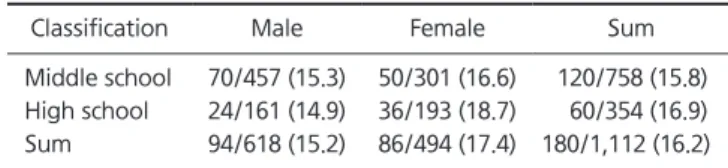
One hundred eighty students (16.2%) were TMD patients in whole research subject 1,112 students (Table 1). It was composed of 94 male students and 86 female students.

TMD prevalence rate of high school was 16.9% and the rate of middle school was 15.8%. The prevalence of TMD was 15.2% in male students and it was 17.4% in female. The TMD prevalence of high school students was higher than middle school students and female students higher than male in the result (Table 1).

2. The Score of Academic Stress and Self-Control

We checked the differences of the scores of academic to bring the answers after completing in comfortable state.

The academic stress questionnaires include five questions to check grade of stress intensity. It consists of Likert’s 5 scale (1, not at all; 5, very affirmation), the higher score is the greater academic stress intensity. The self-control ques- tionnaires include five questions also to check ability of self-control. It consists of Likert’s 5 scale (5, not at all; 1, very affirmation), the higher of the score is the greater abil- ity of self-control as well. The 10 individual items gener- ate 10 “component” scores, each weighted equally on a 1-5 scale. So the sum score of five questions of each part are from score 5 to score 25.

After the academic stress and self-control questionnaires were completed, clinical examination was performed by two trained dentists who finished education of National Health Insurance Corporation for oral examination.

In this study, the TMD patient means that student have one or more symptoms among jaw pain, temporoman- dibular joint (TMJ) sound, and mouth opening limitation.

Duration and intensity of symptom were not considered.

The group is consisting filed students with at least one symptom on TMJ within recent 1 year. The data obtained from the questionnaires, patient interview and clinical find- ing and processed score were statistically analyzed.

Through clinical examination and scoring of results of academic stress and self-control ability obtained from the questionnaire, we have completed the steps required to cre- ate a database. The steps are defined below.

1) We have got discrepancy sum of score in academic stress and self-control ability between the students with TMD and without TMD.

2) We divided them to four groups according to the score level of academic stress and self-control. And we checked rate of TMD prevalence in each level.

3) To investigate the effect of self-control ability in TMD patients, we checked the TMD prevalence under the same academic stress level and compared it in the higher and the lower self- control group.

3. Statistical Analysis

The results of questionnaire were used for statistical anal- ysis by univariate analysis variable. We presented each in- dividual with a 5 items questionnaire composed of both

Table 1. Number of TMD students and prevalence ratio (%)

Classification Male Female Sum

Middle school High school Sum

70/457 (15.3) 24/161 (14.9) 94/618 (15.2)

50/301 (16.6) 36/193 (18.7) 86/494 (17.4)

120/758 (15.8)

60/354 (16.9)

180/1,112 (16.2)

TMD, temporomandibular disorder.

(4)

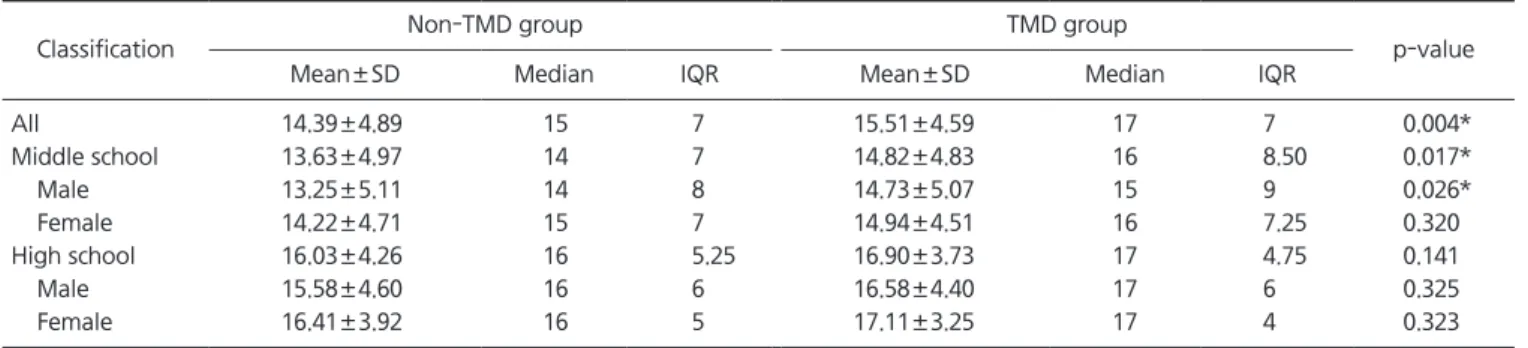
without TMD. But they were not significant (p>0.05). The score difference of male in middle school was only signifi- cantly higher (p=0.017) (Table 2).

In the aspect of self-control ability, the students with TMD had lower score than the students without TMD. It was significant difference (p=0.001). The mean of self-control score of the students with TMD was 17.83, and the student without TMD was 18.92 in entire students (p=0.001). The stress and self-control between the students with TMD and

without TMD (Tables 2, 3).

The mean of academic stress score in the students with TMD was 15.51. In the students without TMD, it was 14.39.

The score of students with TMD is higher than the students without TMD in whole students. It was significant (p=0.004).

High school students and female students of middle school with TMD had higher score academic stress than the group

Table 2. Score differences of academic stress in students with and without TMD

Classification Non-TMD group TMD group

p-value

Mean±SD Median IQR Mean±SD Median IQR

All

Middle school Male Female High school Male Female

14.39±4.89 13.63±4.97 13.25±5.11 14.22±4.71 16.03±4.26 15.58±4.60 16.41±3.92

15 14 14 15 16 16 16

7 7 8 7 5.25 6 5

15.51±4.59 14.82±4.83 14.73±5.07 14.94±4.51 16.90±3.73 16.58±4.40 17.11±3.25

17 16 15 16 17 17 17

7 8.50 9 7.25 4.75 6 4

0.004*

0.017*

0.026*

0.320 0.141 0.325 0.323 TMD, temporomandibular disorder; SD, standard deviation; IQR, interquartile range.

p-value determined by t-test.

*p<0.05.

Table 3. The score differences of self-control in students with and without TMD

Classification Non-TMD group TMD group

p-value

Mean±SD Median IQR Mean±SD Median IQR

All

Middle school Male Female High school Male Female

18.92±3.95 19.31±4.10 19.52±4.01 18.98±4.22 18.08±3.48 18.27±3.49 17.91±3.47

19 20 20 19 18 18 18

6 6 6 7 4 4 4

17.83±3.88 18.40±3.77 18.63±3.90 18.08±3.60 16.70±3.88 16.04±3.67 17.14±4.00

18 18.5 18 19 17 16 17

6 5 6 5 4.75 4 5.75

0.001*

0.025*

0.087 0.158 0.006*

0.005*

0.244 TMD, temporomandibular disorder; SD, standard deviation; IQR, interquartile range.

p-value determined by t-test.

*p<0.05.

Table 4. The score distribution of academic stress

Classification Score of academic stress 5-10 11-15 16-20 21-25 Sum

Middle school Male Female High school Male Female Sum

135 74 21 14 244

151 82 43 59 335

132 124 81 90 427

39 21 16 30 106

457 301 161 193 1,112 Values are presented as number.

Table 5. The score distribution of self-control

Classification Score of self-control 5-10 11-15 16-20 21-25 Sum

Middle school Male Female High school Male Female Sum

9 9 6 5 29

78 56 33 41 208

175 124 91 106 496

195 112 31 41 379

457

301

161

193

1,112

Values are presented as number.

(5)

academic stress and self-control, there was relatively strong negative correlation (p<0.001). Correlation coefficient of middle school is r=-0.468 (p<0.001) and correlation coeffi- cient of high school is r=-0.189 (p<0.001), both groups are significant negative correlation. Consequently, it seems that the more getting self-control ability the less academic stress is build up.

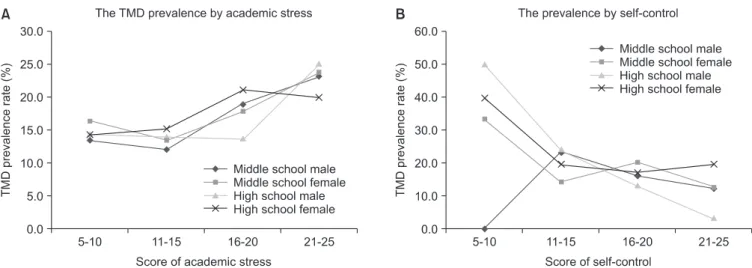
4. TMD Prevalence Rate according to Score Group TMD prevalence of students is rising as a share of aca- demic stress. In middle school students, except scores 5-10, increasing academic stress massively changed up TMD prevalence all over score groups. In a general tendency, the degree of TMD prevalence rate is meant to be proportional to the score of academic stress (Table 6).

difference of scores between TMD patients and normal stu- dents in male was big; it was significant in male of middle and high school. But female’s self-control scores were not significant difference in both middle and high school (Table 3).

3. Relationship between Academic Stress and Self- Control Score

Tables 4, 5 are distributions of the group according to the score of academic stress and self-control. While over 48%

of students were reported with high academic stress as over 16 scores, about 78% of students were reported with high self-control ability as over 16 scores. Students have consid- erable academic stress and comparatively stable and good self-control ability.

In the result of correlation analysis of the scores between

Table 6. TMD prevalence ratio according to academic stress

Classification Score of academic stress

5-10 11-15 16-20 21-25

Middle school Male Female High school Male Female

18/135 (13.3) 12/74 (16.2) 3/21 (14.3) 2/14 (14.3)

18/151 (11.9) 11/82 (13.4) 6/43 (14.0) 9/59 (15.3)

25/132 (18.9) 22/124 (17.7) 11/81 (13.6) 19/90 (21.1)

9/39 (23.1) 5/21 (23.8) 4/16 (25.0) 6/30 (20.0) TMD, temporomandibular disorder.

Values are presented as number (%).

Table 7. TMD prevalence ratio according to self-control

Classification Score of self-control

5-10 11-15 16-20 21-25

Middle school Male Female High school Male Female

0/9 (0.0) 3/9 (33.3) 3/6 (50.0) 2/5 (40.0)

18/78 (23.1) 8/56 (14.3) 8/33 (24.2) 8/41 (19.5)

28/175 (16.0) 25/124 (20.2) 12/91 (13.2) 18/106 (17.0)

24/195 (12.3) 14/112 (12.5) 1/31 (3.2) 8/41 (19.5) TMD, temporomandibular disorder.

Values are presented as number (%).

Table 8. TMD prevalence ratio according to self-control ability in same academic stress level

Self control ability Score of academic stress

5-10 11-15 16-20 21-25

Below 15 Above 16

5/24 (20.8) 30/220 (13.6)

11/67 (16.4) 33/268 (12.3)

20/105 (19.0) 57/349 (16.3)

14/41 (34.1)

10/65 (15.4)

TMD, temporomandibular disorder.

(6)

have been studies whether the myogenous pain patients have higher level of psychopathology than the arthrog- enous pain patients or not. Overall, many results support that the myogenous pain patients could be characterized as having more psychological distress than the arthrogenous pain patients.

25)

One of the most serious emotional stress-related in ado- lescents was academic problems in previous reports

11)

the result of this study, about 16% of 1,112 students have ap- peared as TMD patient. TMD prevalence of female is higher than male as like as other studies. It was said that preva- lence ratio of TMD increases from 15 years and it makes peak on late twenties.

16,18,19)

Just the same, prevalence of high school students was higher than middle school student in this study as well.

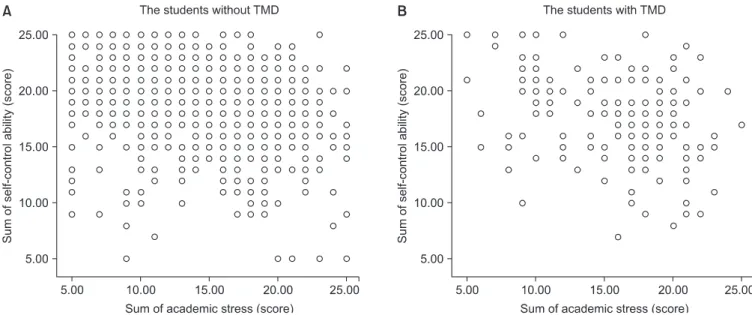
The scatter plot of the relationship between sum score of academic stress and self-control is Fig. 1. The vertical axis expressed total score of self-control which implies ques- tionnaire results. The mean±standard deviation (SD) of sum of self-control in the students with TMD was 17.83±3.88 and the mean±SD of sum of self-control without TMD was 18.92±3.95. The horizontal axis of scatter plot denotes total score of academic stress. The mean±SD of sum of academic stress is 15.51±4.59 in TMD students and 14.39±4.89 in stu- dents without TMD.

As it is showed in the scatter plot, the students without TMD prevalence according to self-control ability was de-

creased when self-control ability increased. It is tendency that the degree of TMD prevalence is in inverse proportion to the degree of self-control ability (Table 7).

5. The Effect of Self-Control Ability on TMD

To investigate the effect of self-control ability, we drew a line between the high ability (above 16 scores) and low ability (below 15 scores) group. And we made cross check- ing of TMD prevalence in same level academic stress. The group of lower self-control ability, below 15 scores, was more TMD prevalence than the group of higher self-control ability, above 16 scores, in all of the stress level (Table 8).

DISCUSSION

Disability is defined as any restriction or lack of ability to perform an activity in manner or within the range consid- ered normal for human.

21)

As the association between pain and disability is highly relevant, the assessment of disability is crucial in studies involving pain patients.

22)

The pain in patient with TMD negatively influences the quality of life especially in chronic phase.

23)

So the control of TMD is very important to teenagers for their life qual- ity. In previously researches, emotional stress is widely per- ceived as contributing to TMD

4,24)

and in recent years, there

Fig. 1. The scatter plot of the students. The students without TMD (A) were scattered on left upper part where is low academic stress and high

self-control area. On the other hand, the students with TMD (B) were scattered on right lower part where is high academic stress and low

self-control ability area. TMD, temporomandibular disorder.

(7)

stress tends to lead TMD and higher self-control ability tends to reduce TMD in middle and high school students.

Furthermore, the use of self-control is played an important role to prevent TMD of students. In same academic stressed group, the group of lower self-control ability, below 15 scores, was more TMD prevalence than the group of higher self-control ability, above 16 scores, in all of the stress level (Table 8).

As the result of those, we assume that the self-control ability is mediated to reduce TMD as like as it works in mental health. That tendency was more prominent in mid- dle school and male students.

The principle of high self-control ability works on TMD students with academic stress is guessed in interaction of self-control ability and academic stress. The results of Correlation Analysis between the scores of academic stress and self-control, there are relatively strong negative cor- relation (p<0.001). Both middle and high school groups are significant negative correlation (p<0.001), especially the correlation coefficient of middle school (r=-0.468) is more significant negative correlation than high school (r=-0.189).

Consequently, it seems that the more getting self-control ability the less academic stress is build up. So the self-con- trol ability can act as decreasing factor of TMD under same academic stress. Therefore, if we want to reduce TMD prev- alence of the students, it seems to be needed not only try- ing to reduce their academic stress but to develop self-con- trol ability. And if it is difficult to reduce academic stress, TMD are scattered on left upper area where it is low aca-

demic stress and high self-control (Fig. 1A). On the other hand, the students with TMD are scattered on right lower area where it is high academic stress and low self-control (Fig. 1B).

In detail a numerical statement, the mean of academic stress score is higher in the students with TMD than the students without TMD, and the difference was significant in whole students (p=0.004). Especially, male students in middle school are significant difference (p=0.017). In high school students, there is no significant even though the group of TMD has higher academic stress than normal group (Table 2).

On the contrary to academic stress, score of self-con- trol ability is significantly lower in TMD group than in the group without TMD in whole students (p=0.001). Both of middle and high school are significantly lower in TMD group (p<0.05). The difference of score was wider in male students (p<0.05) than female (p>0.05).

In the statistics, TMD prevalence of students is increasing as a share of academic stress, and according to self-control ability it is decreased (Table 6). Those statistical data are in graphic forms, in general tendency, the degree of TMD prevalence is meant to be proportional to the score of aca- demic stress (Fig. 2A). It is the tendency that the degree of TMD prevalence is in inverse proportion to the degree of self-control ability (Fig. 2B).

Looking the aforementioned statistics, higher academic

Fig. 2. The graphs of the degree of TMD prevalence. In a general tendency, the degree of TMD prevalence is meant to be proportional to the

score of academic stress (A) based on Table 6. The degree of TMD prevalence is in inverse proportion to the degree of self-control ability (B)

based on Table 7. TMD, temporomandibular disorder.

(8)

2. Carlson NR. Psychology of behavior. 11th ed. Cambridge: Pear- son; 2012. pp. 602-606.

3. Dunn AJ. The nervous system, hormones, and immune responses.

In: Friedman H, Klein TW, Friedman AL, eds. Psychoneuroimmu- nology, stress, and infection. 1st ed. Florida: CRC Press Inc.; 1991.

pp. 25-195.

4. Okeson JP. Management of temporomandibular disorders and oc- clusion. 6th ed. Amsterdam: Elsevier Mosby; 2007. pp. 141-156.

5. Orlando B, Manfredini D, Salvetti G, Bosco M. Evaluation of the effectiveness of biobehavioral therapy in the treatment of tem- poromandibular disorders: a literature review. Washington D.C.:

Behavioral Medicine; 2007. pp. 101-118.

6. Park KC, Lee WY. Psychological aspects of temporomandibular disorders. J Korean Dent Assoc 1995;33:581-591.

7. Kim KS. Temporomandibular disorders factor. J Korean Dent As- soc 1991;29:354-358.

8. Ministry of Gender Equality and Family. 2013 Korean youth white paper. Seoul: Ministry of Gender Equality and Family;

2013. pp. 196-202.

9. Min KS. The relationships of academic achievement pressure and academic self-efficacy on depression among foreign language high school students [master’s thesis]. Seoul: Graduate School of Education, Kookmin University, 2011.

10. Lee HO, Hyun OK. The level of stress and coping behavior of middle and high school students in Korea. J Korean Home Econ Educ Assoc 1996;8:59-78.

11. Kim J, Lee D, Chung Y. The moderating effects of volunteer par- ticipation between stressors and depression in youths. Stud Ko- rean Youth 2013;24:99-126.

12. Kang SH, Jung EJ. A study on the relationship among stress, aca- demic achievement and mental hygiene of high school students.

J Educl Psychol 1999;13:405-424.

13. Oh HS. The study on relationship between school stress and stress coping behavior & mental: physical health about students of high school [master’s thesis]. Chuncheon: Graduate School of Educa- tion, Kangwon National University; 2008.

14. Chang EC, Tugade MM, Asakawa K. Stress and coping among Asian Americans: Lazarus and Folkman’s model and beyond. In:

Wong PTP, Wong LCJ, Lonner WJ, eds. Handbook of multicul- tural perspective stress and coping. New York: Springer; 2006.

pp. 439-455.

15. Jung CS. How study stress of high school seniors affects their mental health: validation of mediation effect of self-control. J Youth Res 2011;18:1-18.

16. Jung SC, Kim YG. Orofacial pains and temporomandibular disor- ders. 2nd ed. Seoul: Sinhung International; 2006. pp. 17.

17. Abdel-Hakim AM. Stomatognathic dysfunction in the west- ern desert of Egypt: an epidemiological survey. J Oral Rehabil 1983;10:461-468.

18. Solberg WK, Woo MW, Houston JB. Prevalence of mandibular dysfunction in young adults. J Am Dent Assoc 1979;98:25-34.

19. Cha SL, Kim KW, Yoon YJ. The prevalence of temporomandibular disorders in 16~18 aged subjects at Yongin, Kyungkido, Korea.

Korean J Orthod 2000;30:223-233.

20. Lee KS. The Korean youth panel survey. Seoul: National Youth Policy Institute; 2008. pp. 149-176.

in that case it may be efficient for students to elevate self- control ability only. Especially it might be more efficient in young and male students. In that sense, inventing programs to develop self-control ability for students are very invalu- able. When we apply the efficient programs into real school life, the TMD prevalence rate of students will be reduced more easily.

To evaluate the effect of academic stress and self-control ability on TMD of adolescents, after investigating academic stress and self-control ability by self-report questionnaire, TMD symptom and clinical examination finding were as- sessed in 1,112 middle and high school students. We can get following results by those investigations.

1. The students with TMD were higher academic stress score than the students without TMD significantly (p=0.004).

2. The students with TMD were lower self-control score than the students without TMD significantly (p=0.001).

3. The degree of TMD prevalence tends to be proportional to the score of academic stress and be inverse proportion to the degree of self-control ability.

4. In same level academic stress, the group of high self- control ability is in lower rate of TMD prevalence than the group of low self-control ability.

5. There are no significant differences of scores between the students with TMD and without TMD in the case of fe- male students, but male students, especially males of middle school are significant.

6. In the results of correlation Analysis the scores be- tween academic stress and self-control, there was relatively strong negative correlation (p<0.001).

According to these results, it is considered that high aca- demic stress and low self-control ability are an aggravating factor for TMD and it seems to have a great influence on young male student.

CONFLICT OF INTEREST

No potential conflict of interest relevant to this article was reported.

REFERENCES

1. Mason JW. A historical view of the stress field. J Human Stress

1975;1:22-36.

(9)

24. Auerbach SM, Laskin DM, Frantsve LM, Orr T. Depression, pain, exposure to stressful life events, and long-term outcomes in tem- poromandibular disorder patients. J Oral Maxillofac Surg 2001;

59:628-633.

25. Park JS, Kim DH, Chung JW. Comparison of myogenous and arthrogenous pain patients of temporomandibular disorders us- ing research diagnostic criteria for temporomandibular disorders.

Korean J Oral Med 2012;37:233-242.

21. Chapireau F. The environment in the international classification of functioning, disability and health. J Appl Res Intellect Disabil 2005;18:305-311.

22. Mewes R, Rief W, Stenzel N, Glaesmer H, Martin A, Brähler E.

What is “normal” disability? An investigation of disability in the general population. Pain 2009;142:36-41.

23. Jung JS, Hur YK, Choi JK. Evaluation of quality of life in patient with temporomandibular disoders. Korean J Oral Med 2006;31:

127-139.

수치

Table 1. Number of TMD students and prevalence ratio (%)
Table 2. Score differences of academic stress in students with and without TMD
Table 8. TMD prevalence ratio according to self-control ability in same academic stress level
Fig. 1. The scatter plot of the students. The students without TMD (A) were scattered on left upper part where is low academic stress and high  self-control area
+2

참조

관련 문서

This intimate relationship has been demonstrated by finding that music helps adolescents to improve self-perception, empathy, self-control, and emotional

This study examines the relationship between self-efficacy and creativity of general characteristics of school dance classes of middle school students, and

The purpose of this study is to investigate the effects on elementary school students' academic English improvement, interest, and self-confidence through the

The purpose of this study is to analyze the interest and self-confidence of middle school students in learning English grammar and to examine the

In this study, a family of middle school students the health, self-resilience, recreation and leisure satisfaction and satisfaction with school life were

The purpose of study are analyzing the effects of dance majors' self-management on dance performance ability, self-efficacy and concentration, In the future,

Difference of microhardness values(M±SD) between control and experimental side in various groups ···

The program intervenes in self-efficacy, anxiety, and time-managing behavior, which respectively stands for cognitive, emotional, and behavioral variables verified to affect