Vol. 12, No. 12 pp. 5946-5956, 2011
A Study of Green Compact City Planning Strategies
- Focused on Ulaanbaatar city in Mongolia
Dalanjargal Sambuu
1*, Deog-Seong Oh
2and Joon-Sung Choi
21Department of Architecture Engineering, Chungnam National University,
2Department of Architecture, Chungnam National University
그린 컴팩트 시티 계획전략에 관한 연구 - 몽골의 울란바타르시를 중심으로
달란자갈 삼부
1*, 오덕성
2, 최준성
21충남대학교 건축공학과
2충남대학교 건축학과
Abstract The purpose of this study is to discourage urban sprawl that optimize the use of natural resources and reduce demand for transportation, energy consumption, and also protect green and blue networks. For this purpose, this study discusses about the Sustainable Development (SD), urban systems toward SD and defines the concepts and the goals of Green Compact City (GCC). It then finds out the basic planning strategies to agree with GCC. Based on these strategies, it reviews the foreign case study, to obtain a mainly significance development of these planning strategies. As well as then conducts a questionnaire survey to experts and residents of Ulaanbaatar (UB) city to obtain a better understanding of the current condition and the most significant planning strategies in UB city. Therefore the basic planning strategies which can more suits in UB city and it could be the GCC is derived from the most complied planning strategies in other developed countries compared with most significant planning strategies in UB city.
요 약 본 연구의 목적은 울란바타르시의 지속가능한 개발과 도시의 스프롤현상을 방지하기 위해, 자원의 효율적
이용과 교통, 에너지 소비의 최소화, 그린·블루네트워크를 조성하여 그린컴팩트 시티를 달성하는데 있다.
이를 위해, 본 연구에서는 첫째, 지속가능한 개발(SD)과 그린시티, 컴팩트시티의 개념을 고찰하여 그린컴팩트시티
(GCC)의 개념과 목표를 정의한다. 둘째, 정의된 그린컴팩트시티의 개념에 따라 계획의 전략을 도출한다. 셋째, 사례분
석을 통해 도출된 계획전략의 적용실태를 확인하여 주로 적용되는 전략을 파악한다. 넷째, 울란바타르시의 전문가 및
주민을 대상으로 설문을 실시하여 현재 울란바타르시에 계획전략별 필요성의 정도를 파악한다.
이를 종합하여 울란바타르시를 그린컴팩트시티로 계획하기 위해 우선적으로 적용해야 할 계획전략을 파악하고 시사 점을 도출하였다.
Key Words : Sustainable Development, Green Compact City, Ulaanbaatar city, planning strategies
*Corresponding Author: Dalanjargal Sambuu ([email protected])
Received November 23, 2011 Revised December 12, 2011 Accepted December 13, 2011
1. Introduction
1.1 Background and Objectives
The fast enlarge the world's population places huge strain on our ecological systems and gives to poverty global [1].
Due to growth patterns oriented expansion, resources such as land and energy, which must be conserved for future generations, are used excessively. Additionally, large areas are occupied by the structures of sprawl and the consumption of limited fossil fuels continues to increase, especially for energy usage and transport [2].
As well, specified the global limited ecological moving capacity and the massive need for further economic growth to reduce poverty and meet the basic needs of its vast and expanding population. Although economic growth alone does not guarantee a better quality of life [3].
Today, so many people come into an UB city likewise in other cities is the worsening and declining the living standards of the population due to lack of economic and labor markets in rural areas [4]. Its urban growth generates new employment opportunities, increases productivity and access to better services, but it has led to rapidly growing demand for natural resources and expanding urban sprawl. In order to solve problems of urban structures and systems in UB city, such as increased levels of private car use, energy consumption, makes infrastructure and services more costly and also increased air pollution and noise, it is necessary to change an existing urban structures and systems, we need to have new planning strategies and new models for Sustainable urban form. Therefore, this study defines principal objectives including the following: Firstly, it provides to polycentric, compact city structure and land usage to avoid urban sprawl.
Secondly, it develops as a top priority to pedestrian and cycle paths, public transport as the most important elements of a clear connection system. Thirdly, it strengthens to concerns for energy efficient and health building design.
Lastly, it provides to efficient plan in accordance with natural environment by control and preservation of green and blue networks.
1.2 Scope and Method
This study is divided into seven parts. The first part, gives a general introduction of this study. The second part is consists of the SD, sustainable urban form and GCC that is as a literature review. In the thirds part, it reviews the evaluation framework of this study which explains the main sector and main elements of GCC and finds out the basic planning strategies. The fourth part that is reviews the foreign case study to obtain the most significant development of these planning strategies. The fifth part, it reviews the current condition of UB city which is about mechanical growth, density and urban sprawl. And the sixth part, it conducts a questionnaire survey to experts and residents to obtain a better understanding of the current condition and the most significant planning strategies in UB city. In the last part, the basic planning strategies which can more suits in
UB city and it could be the GCC is derived from the most complied planning strategies in other developed countries compared with most significant planning strategies in UB city in conclusion of this study.
2. Literature review
2.1 Sustainable development
- The World Commission on Environment and Development in 1987 produced a book entitled Our Common Future that described sustainable development as -
"...to make certain that it assemble the needs of the current without compromising the skill of future generations to meet their own needs" [5] is certainly the normal description when judged by its widespread use and frequency of citation. In essence, it means that not pleasing so much for you that we remain too little for others. In pursuing economic increase, we have to also respect the charge of our natural surroundings. The most sustainable way is one that achieves a balance between urban economy, social equity, and the environment.
Before seeking a balance of the SD [see Fig. 1], it is rather advantageous that each axis ought to be evaluated with respect to its own functionality, i.e. sustainability of economical, social and environmental, respectively.
Sources: [5]
[Fig. 1] Scheme of SD: at the confluence of 3 constituent parts.
2.2 Sustainable urban form and GCC Creating towns sustainable is now a major purpose and claim of most cities. Even though, what about the question of sustainable urban form? Consistent with Næss [6], there are two opposing models of sustainable urban development.
Firstly, there are those who support compact cities. The idea here is that large, dense and concentrated cities will maintain the principles of sustainable development. However, secondly,
there are those who support the green city, i.e., a more open type of urban structure, where buildings, agricultural fields and other green areas.
The compact city is designed to make more efficient use of existing land and energy resources, as well as reducing car usage as public transportation becomes more viable at higher urban densities [7]. The main disagreement of the compact city is concerned about environmental sustainability. Though, draconian policies that reduce the quality of social and economic life in order to achieve environmental objectives are likely to be much detested and in consequences undermined [8]. The list of disagreements in opposition to the compact city is even longer than that of points in its favour; the compact city implies the negative response of suburban and semi-rural living, neglecting of rural communities, less green and open space, increased congestion, increased segregation, and less power for making local decisions [9].
This study maintains the idea of the compact city. On the other hand, the compact city urban structure implies demanding land use patterns and predominantly monocentric urban macrostructure (all urban function in a city center).
The compact city is an intransigent countermeasure against the laissez-faire urban development of deconcentration and dispersion. [10]. In some cases researchers have concluded that the concept of the compact city implies further centralization of the population pattern and that larger cities are favourable in a sustainable urban development [11];[12].
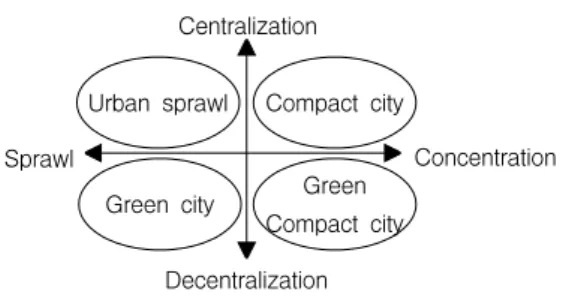
This study does not support such claims. On the opposing, more efficient condition of urban system results from having several smaller compact cities, rather than a few large or monolithic cities. This is termed a GCC or 'decentralized- concentration'. Fig. 2 shows a conceptual model of sustainable urban form summarizing the aforementioned design principles.
GCC is a new urban form towards sustainable. The concepts of GCC is composes of compact, pedestrian oriented, mixed use urban areas which are integrated into a polycentric urban system in public transport oriented locations; it allows its inhabitants to live within a pedestrian friendly environment that encourages pedestrian movements, the use of the public transit, and discourages the intensive us from automobiles; it is a city with clean and efficient energy source; and it is a city built and developed in balance with the natural environment.
And based on these documents, this study defines main goals of GCC. Firstly, it consumes less territory and allows a correct density. Secondly, it minimizes transport demand and allows the creation of an efficient network of public transportation. Thirdly, it minimizes energy consumption and allows the creation of an efficiency energy supply. Finally, it maximizes human well-being and maximizes green and blue networks.
Decentralization Urban sprawl Compact city
Green city Green Compact city Centralization
Sprawl Concentration
Sources: [13]
[Fig. 2] The models for Sustainable urban form
3. Evaluation framework
Table 1 presents a planning process for the evaluation framework of GCC. And this part arranged the framework throughout following processes: Firstly, it conducts concepts of the SD and sustainable urban form to consist of Compact city and Green city as formulated in part 2: literature review.
Secondly, it aims to define main requirements to fulfill the 4 main goals of GCC as also discussed in precedent part.
Thirdly, it describes 4 main sectors of GCC which are used for the urban system toward a more Sustainable city [14];[15]. The Compact Development is advanced to supply more transportation options, by providing opportunities for pedestrian access and to provide densities that can be efficiently served by transit. The pattern of people's activities is related to both space and time. Thus the structure of activity spots forces them to use transport and influences the mode they choose. Cities can create car free zones and develop park-like corridors that would allow movement through the city such as walking, cycling and also limit the use of small, light electric vehicles in vehicle corridors specially designed to be safe and efficient. These are termed Green Transport meaning.
And the Energy flows are an essential aspect of the
SD Urban system
towards SD Main Goals of GCC Main Sectors
of GCC Elements of GCC
Social
Economic
Environment
Compact city
Green city
It consumes less territory and allows a correct density.
Compact Development
1. Civic sites 2. Walkability 3. Connectivity 4. Mix of Land Uses It minimizes transport demand and
allows the creation of an efficient network of public utilities.
Green Transport
5. Slow modes/Public transport 6. Individual motorized travel 7. Transport of goods It minimizes energy consumption
and allows the creation of an efficiency energy supply.
Energy and Material flows
8. Energy 9. Water
10. Material and Waste Green and
Blue Network
11. Natural environment 12. Landscape and Public space It maximizes human well-being and
maximizes green and blue networks.
Sources: The Authors [Table 1] Planning process for the evaluation framework of GCC
sustainability and transport systems and the expenditure of energy can be influenced to a large extent through planning.
The same is true for Material flows in the construction and deconstruction phases (movement of soil and selection of building materials) of projects. And the Green and Blue Network is integrated into the urban project according to the same rules as both the historic and more recent rural elements, with water storage and irrigation in a closed cycle, natural green structures, canals and small lakes. Green areas, water and wind fill the city spaces, forming a continuous private and public network for the residents, from a natural green lounge to more architecturally built-up squares and streets. And finally, it conducts in-depth and comprehensive 12 elements from 4 sectors of urban systems. These elements each are comprised of basically 4 main sectors of GCC planning. Based on these elements, this study conducts the basic planning strategies to agree with GCC. [see Table 2]
In particular, it is very important to establish an urban system towards the more fundamental restructuring from internal and external factors related to characteristic of GCC.
Evaluation criteria are fully extracted planning strategies.
4. Case study
The elements and planning strategies for GCC as discussed in part 3: evaluation framework. This part that is reviews the foreign case study to obtain the most significant development of these planning strategies. They set planning
strategies and describe a target state, towards which urban development should head. The concepts for the model settlements developed within the Green, Global, Connected, Compact and Eco city projects encounter these planning strategies to different degrees but each have their specific strengths and show possible steps towards the GCC. The model settlements were planned in Sydney in Australia, Umbertide in Italy, Hammarby of Stockholm city in Sweden, Győr in Hungary, Daejeon in Korea and are introduced in the following project descriptions.
Firstly, this study reviews the Sydney, it is could be low carbon city to actively reduce the carbon footprints of its individual citizens through the Sustainable Sydney 2030 plan.
This plan conducts a survey questionnaire with the local community residents, business and government leaders, and experts in many field, were engaged in discussions about our city's future. Overwhelmingly, people told them they want a city that is sustainable - environmentally, economically, culturally and socially. Thus the Sustainable Sydney 2030 has the vision of a Green, Global and Connected Future [16].
Secondly, this study reviews the Umbertibe. This development begins by 35 workshop participants expressed their common consensus to the ‘city as power station of renewable energies’ followed by a progressive ‘city for pedestrians, cyclists and public transport’, a ‘city of bioclimatic comfort’ and a ‘city of cultural identity and social diversity’ [17]. After this, it organizes according to bioclimatic wind tunnel axes, which are also used as footpaths and cycle paths and corresponding with the
Elements Planning strategies Evaluation criteria
Civic Sites 1. The proportion of function, density : Strive for compact, mixed-use structure at building, block or neighborhood level
Walkability
2. Give priority to pedestrian and cycle paths as the main network for internal neighbourhood traffic
: It should offer direct access, as most pedestrians and cyclists have a limited tolerance for detours.
Connectivity 3. Develop structures of qualified high density
:A polycentric, compact and transit-oriented city structure : Concentration and decentralization for supply and disposal systems
Mix of
Land uses 4. Balanced mixed-use development
: Organize a balance of residential, employment and educational uses as well as distribution, supply and recreational facilities.
Slow modes/
Public transport
5. Minimize transport demand : Minimize distances (in time and space) between activities to reduce travel demand
6. Providing environmentally-friendly modes
: Provide mobility management measures to support modal shift to environmentally compatible modes
Individual motorized
travel
7. Reducing individual transport cycle
: Priority to pedestrian and cycle paths, public transport as the most important elements of a sustainable personal transport system
Transport of
goods 8. Integrated network and good accessibility : Identifying the integrated transport network
Energy
9. Maximizing efficiency of energy supply
and share of renewable energy sources : Optimize energy efficiency of the urban structure
10. Minimize energy demand of buildings
: To reduce the consumption of domestic electric use, a change in consumer buying habits is the most effective mechanism.
Water
11. Minimize primary water consumption
: To reduce the consumption of domestic water use, a change in consumer buying habits is the most effective mechanism.
12. Minimize impairment of the natural water cycle
: The rate of rain and gray water reuse, the rate of permeable block pavement
Material and Waste
13. Minimize the volume of waste
generated and of waste going to disposal : The rate of material reuse
14. Minimize primary material consumption : Minimize primary building material consumption and maximize recyclability of materials
15. Maximize the use of environmentally friendly and healthy building materials.
: Reduction of the demand for building materials, use of renewable, recycled and /or locally-sourced building materials
Natural environment
16. Integrate natural elements and cycles into the urban tissue
: The rate of green fields, growing stock and green space, the rate of rainwater use, the coefficient of utilization of gray water
17. Maximization of green and blue network : Establishing the green and blue network in urban area Landscape
and Public space
18. Provide attractive and liveable public spaces for everyday life
: Consider livability, legibility and connectivity of public space patterns.
19. Make a plan for urban climate and circulation of water
: Natural environmental plan in accordance with the climatic, topographical and geological setting.
Sources: Tabled by the Author using relevant documentation [Table 2] Planning strategies of GCC
architecture of public, semi-public and private open space.
And this is in accordance with the existing city's structural orientation.
Thirdly, this study reviews the Hummarby. The Hammarby Sjostad - a unique environmental project intends to achieve a compact urban community served by a express
train, pedestrian and bicycle-friendly environment with the aim of reduce the necessity for vehicles. All of these steps, in use as one, will ensure a more gorgeous, healthier and more environmentally friendly community. The city of Stockholm's environmental goals for Hammarby Sjostad, it consists to reprocess and redevelopment of land usage,
speedy and attractive public transport, healthy and environmentally construction materials, renewable and more efficient energies, new technology for water saving and dirt treatment and thoroughly sorted in practical systems for waste [18].
Fourthly, this study reviews the Győr city. The Győr Ecocity project aims to supply the opportunity of lengthens the centre, helping it to keep performance and at the same time preserving the central area with a number of protected historical monuments.
The principle goal is to create backbone of the urban structure; it provides cooling in summer, as the main winds pass along the 'green fingers' when they blow into the area [19]. A total pedestrian, cycle and bus network has been developed and rode along these green corridors. Furthemore energy and material flows is related to the passive utilization of solar energy, it consists to promote the utilization of solar energy through dissimilar building methods and create a road and pathway network which is designed so that the orientation and width of streets and paths and the planting structures implemented ensure that prevailing winds are interrupted to reduce the air-blast effect without blocking adequate ventilation of the quarter.
Finally, this study reviews the Daejeon city. The Daejeon Green City projects examined the possibility of implementing principals of the Low Carbon Green Growth city. The applied approach used was to investigate the principals of sustainable urban development in the integration of spatial restructuring and physical restructuring with the point of basically match urban planning strategies with environmental sustainability. There are urban planning systems structured according to 3 main goals based on sustainable development:
Green Compact, Green Community, and Green Business [14].
And then this study reviews the interrelations between these foreign case studies. Each checked cell in the Table 3 indicates that measure associated with achieving the objective in the columns will also have an impact on the level of achievement of the objective in the rows. And it derives from the most complied planning strategies of these 5 developed countries. These most complied planning strategies are more helpful to obtain the most significant development of GCC.
Planning strategies A B C D E 1. The proportion of function and density ● ● ● ● ○ 2. Give priority to pedestrian and cycle
paths as the main network for internal neighbourhood traffic
● ● ● ● ●
3. Develop structures of qualified high density
● ● ● ● ○
4. Balanced mixed-use development ● ● ● ● ● 5. Minimize transport demand ● ● ● ● ○ 6. Providing environmentally-friendly
modes
● ● ○ ● ○
7. Reducing individual transport cycle ● ● ● ● ○ 8. Integrated network and good
accessibility
● ● ● ● ○
9. Maximizing efficiency of energy supply and share of renewable energy sources
○ ● ● ● ●
10. Minimize energy demand of buildings ● ● ● ○ ○ 11. Minimize primary water consumption ● ● ● ○ ● 12. Minimize impairment of the natural
water cycle
● ● ● ○ ○
13. Minimize the volume of waste generated and of waste going to
disposal
● ○ ● ○ ○
14. Minimize primary material consumption ● ○ ○ ○ ○ 15. Maximize the use of environmentally
friendly and healthy building materials.
● ○ ● ○ ○
16. Integrate natural elements and cycles into the urban tissue
● ● ○ ● ○
17. Maximization of green and blue network
● ● ● ● ●
18. Provide attractive and liveable public spaces for everyday life
● ● ● ○ ○
19. Make a plan for urban climate and circulation of water
● ● ● ● ○
Note: A-Sydney B-Umbertide C-Hammarby D-Győr E-Daejeon
● - complied; ○ - not complied; Sources: The Authors [Table 3] Synthesized planning strategies of foreign case
studies
5. Current condition of UB city
5.1 Mechanical growth
Urbanization which started in the mid 20th century is a relatively new concept for Mongolia and is often interpreted in terms of population growth and development of UB city alone. For the reason that UB city is home to 40% of the overall population of Mongolia and of this about 50% of the manufacturing, 62% of entities, 57.2% of transportations, 87% of university students, 61% of doctors and 44% of all hospital beds are concentrated in the capital city, which
covers 0.3% of the total territory [20]. Dominant internal migration of Mongolian population is from rural areas to the capital city and this intensifies the urbanization and city growth. The main reason of this is spatial inequality or disparity between rural areas and city and it is proved by studies that the internal migration is people’s response to this difference and it plays a major strategically role for people to survive in a better living condition. Therefore, majority of the city inhabitants are rural and nomadic people migrated from the remote areas [see Table 4]. In terms of the mechanical growth in UB city, it is undermined by old and decaying urban structure and systems under the serious need of redevelopment caused by increased levels of private transport, increased energy consumption which makes infrastructure and services more costly, and has negative effect on the quality of the green area and the environment.
Years In- Migrants
Out- Migrants
Mechanical Growth
Mechanical Growth Coefficient
2000 19,918 592 19,326 25
2001 11,608 782 10,826 13.5
2002 23,677 578 23,099 27.9
2003 40,760 693 40,067 46.1
2004 68,808 1,346 67,462 74.1
2005 30,207 2,821 27,386 28.8
2006 29,633 6,523 23,110 23.8
2007 29,112 7,434 21,678 21.5
2008 33,407 10,199 23,208 22.2 2009 28,337 10,723 17,614 16.2
Sources: [21]
[Table 4] Mechanical growth of UB city
5.2 Population density and Sprawl
Even though the main reasons for the intense process of urbanization or population growth of a country include regular and mechanic population growth, and expansion of the city zone. In addition urbanization can be defined by percentage increase of city dwellers, urban density, and business or other activities.
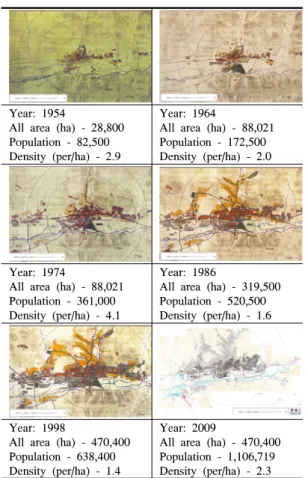
Table 5 shows that the expansion of urban areas to the fringe of the UB city also influenced the distribution of population density.
According to the land inventory (unified land territory) category, 50.9% of the UB’s territory is construction site, 21.2% is ger* district, 11.3% is mining site, 10.1% is public space and 6.4% is industry area. [21] But, the
average population density of central area constitutes 84 per/ha [23]. It is seen that as density had almost reached maximum limit in order to intensify the land use in this area.
Year: 1954
All area (ha) - 28,800 Population - 82,500 Density (per/ha) - 2.9
Year: 1964
All area (ha) - 88,021 Population - 172,500 Density (per/ha) - 2.0
Year: 1974
All area (ha) - 88,021 Population - 361,000 Density (per/ha) - 4.1
Year: 1986
All area (ha) - 319,500 Population - 520,500 Density (per/ha) - 1.6
Year: 1998
All area (ha) - 470,400 Population - 638,400 Density (per/ha) - 1.4
Year: 2009
All area (ha) - 470,400 Population - 1,106,719 Density (per/ha) - 2.3
Sources: [22]
[Table 5] Density and Sprawling process
As estimated in 2003 of the metropolitan land and territory, a total of 84,637 households lived in 67,929 yards covering 3,449 hectares, whereas in 2007 it quadrupled to 14,011 hectares [20]. Often considered as transitional settlement zone, ger districts have been expanding without any city planning creating obstacles in terms of socio-economic and administrative measures, as well as conditions which would negatively affect poverty, unemployment, land usage, environment, public health and safety. Therefore, it is necessary for us to reduce negative effects of intensive growth of urban population
*Ger is traditional dwelling well adapted to the nomadic life of Mongolia’s herders.
or population density, and to support the measures to increase positive effects by providing with policies and legal grounds.
In order to create comfortable living condition, it is necessary to strike a balance of socially, population and economy, to reduce pressure of industry and mass consumption on environment, and also to support environmentally friendly technology, products and service market growth, and to widely use means and tools which will increase environmentally friendly investment.
Therefore, we need to manage risk of environment, and maximize resilience in our city more sustainability. So this study conducts questionnaire with experts and residents aiming to explore existing conditions related to planning strategies of GCC next part.
6. Questionnaire and Findings
6.1 Questionnaire development
This part presents an overview of questionnaire development in this study. Questionnaire survey is one of the several data collecting techniques used to obtain information from people is questionnaire survey. Development of valid and reliable set of questions is essential. Questions must be capable of being answered easily and preferably not targeted information that is sensitive for respondents [24].
Questionnaire in this study, which is consisted of the 5 examined questions. These questions were developed in following different forms: open-ended questions and yes-no answers, checklists. Questions in this questionnaire were logically sequenced. The first question is about the current condition of existing urban structures and systems of UB city. The second question is about the GCC is very special aspect of this city for many reasons. In the third question is focused on different aspects of redevelopment of urban structure and systems. The fourth question is very important for this study, which is consisted of the 19 planning strategies of GCC, to obtain a better understanding of most suitable and influencing planning strategies in UB city. In the fifth question is about the environmentally friendly and livable urban systems.
A questionnaire’s length can affect the survey’'s success.
Long questionnaires require a lot of time and respondents
may avoid answering some questions [24]. On the other hand, to get more information researcher wants as much as possible answer to their questions. Also one stage survey approach was employed for the questionnaire survey. This approach is adopted to get data in short period of time.
6.2 Findings
The study is involved a sampling 60 residents and 40 experts by questionnaire. This study will accepts as 100%
that the respondents who answered the questions.
The purpose of conducting questionnaire with experts and residents was to explore current conditions related to planning strategies of GCC in urban redevelopment in UB city and identify some possible problems and their solutions.
Following are the highlights of the results of the questionnaire survey:
The first question is about the current condition of existing urban structures and systems of UB city. [Fig. 3] is comprised of basically 4 examined topics. The first topic is Compactness, 23% of our respondents said 'Good', 21% said 'Average' and 56% said 'Bad'. The second topic is Transportation, 2% of our respondents said 'Good', 37% said 'Average' and 61% said 'Bad'. The third topic is Energy and Material flows, 5% of our respondents said 'Good', 53% said 'Average' and 42% said 'Bad'. The last topic is Green and Blue networks, 1% of our respondents said 'Good', 10% said 'Average' and 89% said 'Bad'.
[Fig. 3] How can you assess current city structure and systems?
The second question is about the GCC. [see Fig. 4] As result of analysis made on the second question, 88% of total answers are very significant, 11% is average and 1% is insignificant.
[Fig. 4] How significant do you think that GCC planning for development of urban planning of UB city?
In the third question is focused on different aspects of redevelopment of urban structure and systems for UB city.
[see Fig. 5] As result of analysis made on the third question, 88% of total answers are very significant, 3% is average and 9% is insignificant.
[Fig. 5] How do you think that current city structure and systems needs a redevelopment?
The fourth question is very important this study. [Fig. 6]
is comprised of basically 19 main planning strategies of GCC [see Table 2], to obtain a better understanding of most suitable and influencing planning strategies in UB city.
[Fig. 6] How significant do you think that bottom planning strategies for development of urban planning of UB city?
And this study will choose the planning strategy that is very significant for UB respondents according to the highest percentage of responds.
In the last question is about the environmentally friendly and livable urban systems. [see Fig. 7] As result of analysis made on the last question, 37% of total answers are on green development, 25% is compact development, 9% is on other topics and 29% is none answered.
[Fig. 7] Do you have any idea how to deal with environmentally friendly and livable urban systems?
The results of this questionnaire development, it reviews current urban structure and systems of UB city are more percent of our respondents said "Bad" condition. The current condition of UB city needs to redevelopment of urban structure and systems. Accordingly, we need to environmental friendly GCC system. And this study strives to derive most significant planning strategies for UB city from the fourth question in questionnaires.
7. Conclusion
The aims of this study is to create a rich-interactive urban environment and discourage urban sprawl that optimize the use of natural resources and reduce demand for transportation, reduce energy consumption, and then protect green and blue networks.
For this purpose, this study defines the most primary planning strategies which can more suits in UB city and it could be the GCC. So as this study derives from the most complied planning strategies in other developed countries, and so these planning strategies compared with most suitable and influencing planning strategies in UB city. [see Table 6]
Herein, this study will accept as 100% when the planning strategies are completed in all 5 developed countries. As well as it has chosen the planning strategies that are very significant for UB respondents according to the highest percentage of responds. And this study reviews the interrelations between these planning strategies are more completed in foreign cities and planning strategies that is
very significant for UB city. Then it derives the planning strategies that is most percent from this comparative Table 6, there are included the following: Firstly, it develops structures of qualified high density; secondly, it balances mixed-use development; thirdly, it integrates network and good accessibility; fourthly, it maximizes efficiency of energy supply and share of renewable energy sources; fifthly, it maximizes of green and blue network; and lastly, it makes a plan for urban climate and circulation of water.
Planning strategies Foreign UB The proportion of function and density 4/80% 76%
Give priority to pedestrian and cycle paths as the main network for internal neighbourhood traffic
5/100% 58%
Develop structures of qualified high
density 4/80% 81%
Balanced mixed-use development 5/100% 71%
Minimize transport demand 4/80% 36%
Providing environmentally-friendly
modes 3/60% 84%
Reducing individual transport cycle 4/80% 39%
Integrated network and good
accessibility 4/80% 84%
Maximizing efficiency of energy supply
and share of renewable energy sources 4/80% 91%
Minimize energy demand of buildings 3/60% 43%
Minimize primary water consumption 4/80% 72%
Minimize impairment of the natural
water cycle 3/60% 93%
Minimize the volume of waste generated
and of waste going to disposal 2/40% 90%
Minimize primary material consumption 1/20% 45%
Maximize the use of environmentally
friendly and healthy building materials. 2/40% 84%
Integrate natural elements and cycles
into the urban tissue 3/60% 69%
Maximization of green and blue network 5/100% 88%
Provide attractive and liveable public
spaces for everyday life 3/60% 81%
Make a plan for urban climate and
circulation of water 4/80% 81%
Sources: The Authors [Table 6] The planning strategies for development of UB
city
As a result of this study, we can manage the current condition of existing urban structure and systems of UB city.
Therefore, we have to organize our urban structure and system with these 6 planning strategies in the near future.
Future research will be focused on defining detailed
planning for urban structure and systems in UB city based on these planning strategies.
References
[1] HKSAR (Hong Kong Special Administrative Region Government), Sustainable Development, published by Sustainable Development Unit, Administration Wing, page 5, April 2002.
[2] TRKC (Transport Research Knowledge Center), Ecocity, Urban Development towards Appropriate Structures for Sustainable Transport, 2002-2005. Available at:
www.transport-research.info
[3] HKSAR (Hong Kong Special Administrative Region Government), Sustainable Development, published by Sustainable Development Unit, Administration Wing, page 7, April 2002.
[4] ADB (Asian Development Bank), Country Synthesis Report on Urban Air Quality Management: Mongolia, Discussion Draft, December, 2006.
[5] WCED (World Commission on Environment and Development), Our Common Future, Oxford, New York:
Oxford University Press, note 3 above, page 8, 1987.
[6] Næss P, Tano Aschehoug, Oslo, Physical Planning and Energy Use, 1997.
[7] Joshua Arbury, From Urban Sprawl to Compact City, An analysis of urban growth management in Auckland, 2005.
[8] Breheny M, Sustainable Development and Urban Form, An Introduction, In: Sustainable Development and Urban Form, Pion, London, 1992.
[9] Frey, H. Designing the City, Towards a More Sustainable Form, E&FN Spon, page 25 for a supplementary list, 1999.
[10]Seungil Lee, Reconnaissances of Environmentally Sustainable Urban Structure, International Journal of Urban Science, 7(2), 148-168, 2003.
[11] Newman P and Kenworthy J, Gasoline Consumption and Cities, A Comparison of US Cities with a Global Survey, Journal of American Planning Association, 1989.
[12] CEC, Green Paper on the Urban Environment, Commission of the European Communities, European Commission, Brussels, 1990.
[13] Erling Holden, Ecological footprint and sustainable urban form, Journal of Housing and the Built Environment 19:
91-109, 2004.
[14] Deog-Seong Oh et al, Daejeon Metropolitan City, The Strategy of Daejeon Green City for Low Carbon Green
Growth, 2010.
[15] Philine Gaffron, Ge Huismans, Franz Skala, Ecocity, Urban Development towards Appropriate Structure, Umbertide Ecocity project, page 18, 2002-2005.
[16] Council of the City of Sydney for public exhibition and comment, Sustainable Sydney 2030 project, City of Sydney Strategic Plan Final Consultation Draft, 2008.
[17] Philine Gaffron, Ge Huismans, Franz Skala, Ecocity, Urban Development towards Appropriate Structure, Umbertide Ecocity project, page 55, 2002-2005.
[18] Glashus Ett, Hammarby Sjöostad -a unique environmental project, 2007. Available at: www.hammarbysjostad.se [19] Philine Gaffron, Ge Huismans, Franz Skala, Ecocity,
Urban Development towards Appropriate Structure, Győr Ecocity project, page 79, 2002-2005.
[20] NSO (National Statistics Office), Statistical Compilation of Mongolia, 2008. Available at: www.nso.mn
[21] NSO (National Statistics Office), Statistical Compilation of Mongolia, 2009. Available at: www.nso.mn
[22] Information technology agency, Ulaanbaatar capital of Mongolia, 2010. Available at: www.ulaanbaatar.mn [23] B.Chinbat, Investigation of the internal structure changes
of UB city using RS and GIS, 2006.
[24] Fink A & Kosecoff J, How to conduct surveys: a step by step guide, 2nd education, Sage, Publications, Thousand Oaks, CA, 1998.
Dalanjargal Sambuu
[Regular member]• June. 2003 : Science and Technological University in Mongolia, Department of Architecture, Urban planning, MS
• Feb. 2006 ~ current : Chungnam National Univ., Dept. of Architecture, Ph.D candidate
<Research Interests>
Urban Planning Responding Green Compact City
Deong-Seong, Oh
[Regular member]• Feb. 1977 : Hanyang Univ., Architecture Engineering, BS
• Feb. 1979 : Seoul Univ., Urban Planning, MS
• Jan. 1989 : Hannover Univ., Urban Planning, PhD
• Oct. 1981 ~ current : Chungnam Univ., Dept. of Architecture, Professor
<Research Interests>
Low Carbon Urban Planning, Urban Regeneration, Technopolis
Jun-Sung, Choi
[Regular member]• Feb. 1994 : Dankuk Univ., Architecture Engineering, BS
• May. 1996 : Pennsylvania Univ., Architecture, M.Arch.
• Dec. 2011 ~ current : Seoul Univ., PhD. Candidate
• Feb. 2005 ~ current : Chungnam Univ., Dept. of Architecture, Professor
<Research Interests>
Architecture Design, Urban Design, Sustainability