Vol. 16, No. 8 pp. 5522-5533, 2015
Effect of Leadership Style of CEO at Small and Medium-sized Enterprises on the Organizational Effectiveness
Sung-Pyo Choi
1*1Doctor´s Course, Korea University of Technology & Education Department of Human Resource Development
중소기업 CEO의 리더십 유형이 조직유효성에 미치는 영향
최성표1*
1한국기술교육대학교 인력개발학과
Abstract This study analyzes the effect of leadership styles (transformational leadership, transactional leadership, and servant leadership) of CEOs at small and medium-sized enterprises on the organizational effectiveness of the employees (organizational commitment and organizational citizenship behavior). A survey was conducted on 573 employees of domestic small and medium-sized enterprises in the electric, electronic, and IT industries, and the data was used to perform statistical analysis. As the result, charisma of transformational leadership, individual consideration, emotional healing of servant leadership, wisdom, and stewardship were shown to have positive effect on the organizational commitment. Furthermore, charisma of transformational leadership, exceptional management of transactional leadership, wisdom of servant leadership, and stewardship were shown to have positive effect on organizational citizenship behavior.
요 약 본 연구는 중소기업 CEO의 리더십 유형(변혁적 리더십, 거래적 리더십, 서번트 리더십)이 종업원의 조직유효성(조직 몰입, 조직시민행동)에 미치는 영향을 알아보기 위해 국내 중소기업 전기, 전자, IT업체 종사자를 대상(573명)으로 설문조사 를 실시하였고, 이를 바탕으로 통계분석을 실시하였다. 분석결과, 변혁적 리더십의 카리스마, 개별적 배려, 서번트 리더십의 감정적 치유, 지혜, 청지기 정신은 조직몰입에 정(+)의 영향을 미치는 것으로 나타났다. 그리고 변혁적 리더십의 카리스마, 거래적 리더십의 예외적 관리, 서번트 리더십의 지혜, 청지기 정신은 조직시민행동에 정(+)의 여향을 미치는 것으로 나타났 다. 이와 같은 분석결과를 바탕으로 CEO는 종업원의 조직몰입과 조직시민행동 향상을 위해 적절한 의사소통과 애로사항, 문제 등에 필요한 요구사항들을 적극 검토하고, 이를 CEO 리더십 역량 강화에 포함하여 시행해야 한다. 또한 종업원이 자신 과 함께 일하고 있다는 자긍심을 가질 수 있도록 가치관이나 신념 등을 강조하고, 장래 비전을 제시해 주며, 최종적으로 CEO 와 종업원이 같은 공동목표를 갖는 공동체라는 것을 인식시켜 줄 필요성을 시사한다.
Keywords : CEO Leadership, Transformational Leadership, Transactional Leadership, Servant Leadership, Organizational Commitment, Organizational Citizenship Behavior
*Corresponding Author : Sung-Pyo Choi(Korea University of Technology & Education) Tel: +82-10-4520-1959 email: [email protected]
Received July 15, 2015 Accepted August 6, 2015
Revised (1st August 4, 2015, 2nd August 5, 2015) Published August 31, 2015
1. Introduction
The leadership is a process of social influence where one person receives support and help from the
organization members in order to achieve the goal of the organization. Through this, a leader is able to directly make decisions for introducing new ideas into the organization, and the organization can produce
performances. In the 21st century, the business management activities of the business organizations have been drastically changing[1], and the uncertainty has been expanding along with the unpredictable new economic environment, which is requiring changes in the leadership paradigm[2].
The parts and whole of a business organization have inevitable relationship, and through the individual organization member’s activeness and participations, the organization can overcome the changes in order to achieve a common goal. It is most important to focus the effort on enhancing the organizational effectiveness. Since the year 2000, many researches are being conducted regarding the positive effects of various leadership styles of CEO on organizational effectiveness of the organization members[3,4,5,6]. An absolute cooperation between the leader, who is coordinating and operating the organization, and the organization members, is very important in order to effectively achieve the common goal of an organization. Therefore, the study of the relationship between organization members’ commitment and citizenship behavior is needed[7]. For achieving the organization’s goal or performances, a leadership that can maximally bring out the cooperation of the organization members is needed, and the CEO leadership is considered as the most important variable of the outcome[8].
Among the various leadership styles of CEO, there are transformational leadership, transactional leadership, and servant leadership. These have been verified by previous studies to effectively enhance the organization members’ sense of purpose and their organizational commitment[9,10,11]. However, there have been insufficient studies on how the CEO leadership styles can lead to organizational citizenship behavior, where the organization members autonomously perform various support activities outside of their officially assigned work and without certain reward, for the advancement of the organization. Furthermore, the studies on the causal
relationship between CEO leadership styles and organizational effectiveness were mainly on public enterprises[12,6], hotels[13], and sports centers[3,4];
and there have been insufficient studies on the small and medium-sized enterprises.
Therefore, the purpose of this study can be summarized as follows. First, the positive effect of CEO leadership styles (transformational leadership, transactional leadership, and servant leadership) were empirically examined, on the organizational commitment of the organization members in small and medium-sized businesses in the fields of electric, electronics, and IT. Second, the leadership styles(transformational leadership, transactional leadership, and servant leadership) of CEO at small and medium-sized enterprises in the fields of electric, electronics, and IT were empirically examined for their significant effect on organizational citizenship behavior of the organization members.
2. Theoretical Background
2.1 CEO Leadership
There are controversies on the CEO’s influence on the performances of a business organization[14,15,16];
however, in terms of determining strategies and directions which directly affects the advancement and survival of the business organization and taking responsibility in making critical decisions for the fate of an organization, CEO leadership largely influences on the organization performance[17]. This is because a CEO of a business organization can manage crisis by viewing the whole picture from a strategical perspective[18].
In the three styles of CEO leadership, as discussed previously in the Introduction, first, the theory of transformational leadership has started from the study by Burns[18]. The transformational leadership takes charge of the process of an organization’s major transformations; and the transformations include not
only the organization members’ changes in attitudes and basic premises, but it also includes the changes in the organization’s goal or strategies. Particularly, it has influences different from the traditional leaderships, such as transactional leadership on subordinates.
Transformational leadership emphasizes symbolic, visionary, and emotionally motivating activities on the subordinates, and takes interest in ideological and value-oriented activities and intellectual stimulations.
Consequently, the subordinates will commit to the organization and devote for the organization’s goal[19].
Secondly, transactional leadership refers to the traditional leaderships, which are contrary to the transformational leadership[20]. According to this theory of traditional leadership, transactions and exchanges between a leader and the subordinates are emphasized, where the activities, rewards, and incentives occur between a leader and the subordinates, in order to motivate desirable behaviors of the subordinates[21]. Therefore, transactional leadership can be considered as the process of transacting and exchanging rewards that the leader provides for the desirable behavior of the subordinate.
Thirdly, servant leadership is conflicting to the traditional leadership. In the traditional leadership, a leader has an exclusive authority and responsibility, and the subordinates are required to obey. As a result, the subordinates become more adept in carrying out the assigned tasks than developing creativity and diversity, which is disadvantageous for producing great outcomes in the complex environment that requires creativity and flexibility. On the other hand, servant leadership provides opportunities and respect for the subordinates, and the leader encourages the organization members to grow and develop to create an authentic community.
Therefore, servant leadership motivates growth and development by respecting the subordinates and providing them with opportunities to express their creativity, and it leads the department or team to become an authentic community[22,23,24].
2.2 Organizational Effectiveness
The organizational effectiveness can be categorized into organizational commitment and organizational citizenship behavior. First, the organizational commitment can be considered as the comprehensive attachment or loyalty of the organization members as they perform their tasks. The organization member with a strong organizational commitment would internalize the organization’s values, and they would actively participate in the activities. Therefore, organizational commitment consists of the strong agreement and trust in the organization’s goal and values, the effort to dedicate for the organization, and the strong desire to exist as an organization member[25]; or, it can be categorized into the concepts of affective commitment, continuance commitment, and normative commitment[26].
Finally, the organizational citizenship behavior emphasizes that the most important behavior of the organization members, in terms of organization efficiency, is creative and autonomous behavior which is currently one of the most important elements[27].
Generally, the organizational citizenship behavior is a voluntary behavior that is not directly or specifically recognized by the organization’s official reward system, and it can be defined as an individual behavior contributing positively to the operation of an organization[28]. It can be further identified as voluntarily helping the colleagues, suggesting new ideas for the development of the organization, voluntarily performing task that was not assigned to oneself, sharing the difficulties one’s colleagues are facing, and not wasting time while carrying out the assigned task[29].
2.3 Previous Studies
According to transformational leadership, a leader can gain trust by showing interest in the requests of the followers, having ability of carrying out the visions, and willing to sacrifice oneself for the organization. It was shown that these can contribute in enhancing the
organizational commitment[30], and the transformational leader would empower the subordinate, raise the status, and greatly influence on the motivation and organizational commitment.
Furthermore, it was shown that the more transformational the leader is, the stronger the organizational commitment could be maintained[31].
The two factors of intellectual stimulation and individual consideration can form trust among the organization members, which can create internal motivation finally leading to organizational citizenship behavior[32].
The conditional compensation, which is a construct of transactional leadership, has a positive effect on the organization members’ performances[19]. In the study on hotel employees, it was shown that transactional leadership has a positive effect on the organizational commitment[18].
In the transactional leadership of the hotel, the conditional compensation was shown to have a significant effect on the three factors of conscientiousness, altruism, and civic virtue of the organizational citizenship behavior[34]; and the conditional compensation was shown to have a significantly positive effect on the four factors of altruism, civic virtue, courtesy, and sportsmanship[19].
The emotional healing, which is among the sub-factors of servant leadership, was shown to have a positive effect on the affective commitment, continuance commitment, and normative commitment.
Furthermore, the following was shown with the significantly positive effects: wisdom on affective commitment and continuance commitment;
persuasiveness on normative commitment; and organizational stewardship on affective commitment[11]. The behavioral characteristics of servant leadership, such as recognition, service, and empowering, were shown to have a significant correlation with helping, participation, initiation, and self-development of the organizational citizenship behavior[35].
3. Research Methods
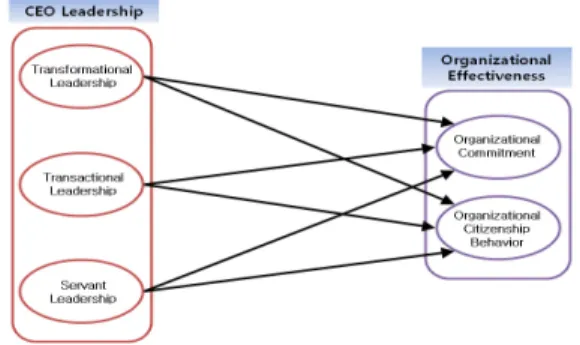
3.1 Research Models and Hypotheses As it was discussed above, based on theoretical background and previous studies on each variable, the independent variables were constructed with the three leadership styles of CEO which are transformational leadership, transactional leadership, and servant leadership. For the dependent variables, the two factors of organizational commitment and organizational citizenship behavior were included in the organizational effectiveness. Therefore, the research model of this study is as shown in Fig. 1.
Fig. 1 Research model
[Hypothesis 1] The transformational leadership of CEO will have a positive effect on the organizational commitment.
[Hypothesis 2] The transactional leadership of CEO will have a positive effect on the organizational commitment.
[Hypothesis 3] The servant leadership of CEO will have a positive effect on the organizational commitment.
[Hypothesis 4] The transformational leadership of CEO will have a positive effect on the organizational citizenship behavior.
[Hypothesis 5] The transactional leadership of CEO will have a positive effect on the organizational citizenship behavior.
[Hypothesis 6] The servant leadership of CEO will
have a positive effect on the organizational citizenship behavior.
3.2 Measurement Methods for Study Concepts
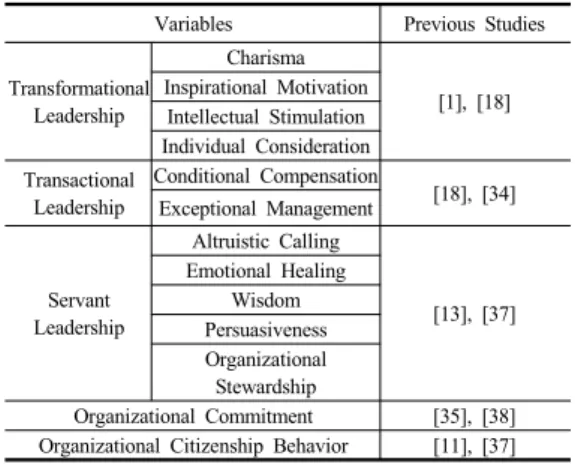
The transformational leadership was based on MLQ(Multifactor Leadership Questionnaire)-5X[18], and the following 13 items were used, which were tested for reliability and validity in the study by Minyoung Gong: 3 items on charisma, 4 items on inspirational motivation, 3 items on intellectual stimulation, and 3 items on individual consideration[36].
The transactional leadership was based on MLQ-5X[18], and the following 9 items were used by referring to the study by Sangoh Nah, in which their reliability and validity were tested: 4 items on conditional compensation and 5 items on management by exception[34].
The servant leadership was based on SLQ(Servant Leadership Questionnaire)[13], and the following 21 items were used, which were tested for reliability and validity in the study by Jinhyuck Kim: 2 items on altruistic calling, 4 items on emotional healing, 5 items on wisdom, 5 items on persuasiveness, and 5 items on organizational stewardship[37].
The organizational commitment was based on the measurement tool for organizational commitment[35], which was modified according to the purpose of this study; and 5 items were used, which were tested for reliability and validity in the study by Jinhyun Bae[38].
The organizational citizenship behavior was based on the measurement tool constructed and defined in the study by Podsakoff[30]. The 5 items, which were tested for reliability and validity in the study by Eunjoo Eum, were used after modifying according to the purpose of this study[11].
Therefore, the survey measurement items of the variables belonging to each factor are as shown in Table 1.
Table 1. Questionnaire Measuring Items for Variables Variables Previous Studies
Transformational Leadership
Charisma
[1], [18]
Inspirational Motivation Intellectual Stimulation Individual Consideration Transactional
Leadership
Conditional Compensation
[18], [34]
Exceptional Management
Servant Leadership
Altruistic Calling
[13], [37]
Emotional Healing Wisdom Persuasiveness Organizational
Stewardship
Organizational Commitment [35], [38]
Organizational Citizenship Behavior [11], [37]
3.3 Data Collection and Analysis
The survey in this study was conducted for 75 days, from July 1st to September 14th of 2013, in Seoul and Gyeonggi. The data were collected from the employees of small and medium-sized enterprises in the fields of electric, electronics, and IT, in the form of self-responded questionnaires (valid samples of 573). It was conducted on L Company and S Company in electronics, along with their partners and associated companies. The demographic characteristics were as follows. There were 365 males and 208 females, and 260 were in their 30s, which was the greatest in portion. There were 344 participants who were married, which was greater than the number of singles. The number of participant with college degrees was 311, which was the greatest in portion. For the work experience, there were 223 with 1-3 years of experience, and 117 with 4-6 years which was the majority.
4. Analysis Result
4.1 Reliability Analysis and Validity Test In this study, the factor analysis for independent variables and dependent variables was performed to test construct validity. In addition, Cronbach’s alpha coefficient was found to evaluate the reliability of the
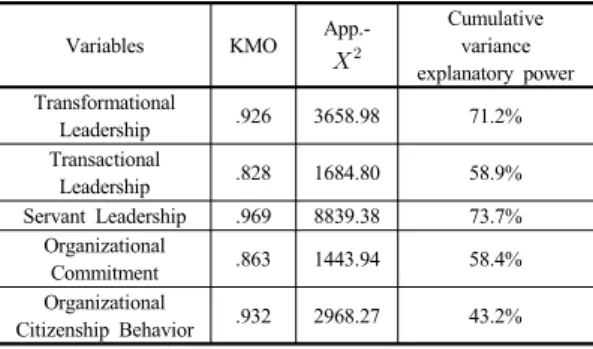
measurement tool. The result of factor analysis and reliability analysis are shown in Table 2 and Table 3.
KMO for all variables was close to 1, and App- was shown to be significant with < 0.05. Therefore, the collected data and measurement items were shown to be appropriate for factor analysis. Cumulative variance explanatory power was shown to be 58.4% at the least and 71.2% at the greatest, and the representation of variables through factor analysis was secured.
Variables KMO App.-
Cumulative variance explanatory power Transformational
Leadership .926 3658.98 71.2%
Transactional
Leadership .828 1684.80 58.9%
Servant Leadership .969 8839.38 73.7%
Organizational
Commitment .863 1443.94 58.4%
Organizational
Citizenship Behavior .932 2968.27 43.2%
*Factor extraction method (principal components analysis), Rotation method (Varimax)
*Significance probability for all App.- is .000 Table 2. Factor Analysis Result for Variables
In the reliability analysis, the load factor value for each measured item was shown to be > 0.5 in all items, and the eigenvalue was shown to be > 1.0. This was evaluated to show internal consistency, which secures the reliability of the measured items.
Table 3. Reliability Analysis Result for Variables
Variables Eigenvalue Alpha
Coefficient
Transformationa l Leadership
Charisma 2.122 .791
Inspirational Motivation 2.744 .828 Intellectual Stimulation 2.195 .770 Individual Consideration 2.192 .821 Transactional
Leadership
Conditional
Compensation 2.899 .865
Exceptional Management 2.405 .682
Servant Leadership
Altruistic Calling 1.877 .809 Emotional Healing 3.531 .900
Wisdom 3.813 .885
Persuasiveness 2.741 .904 Organizational
Stewardship 3.507 .886
Organizational Commitment 3.504 .852 Organizational Citizenship Behavior 2.731 .791
4.2 Confirmatory Factor Analysis
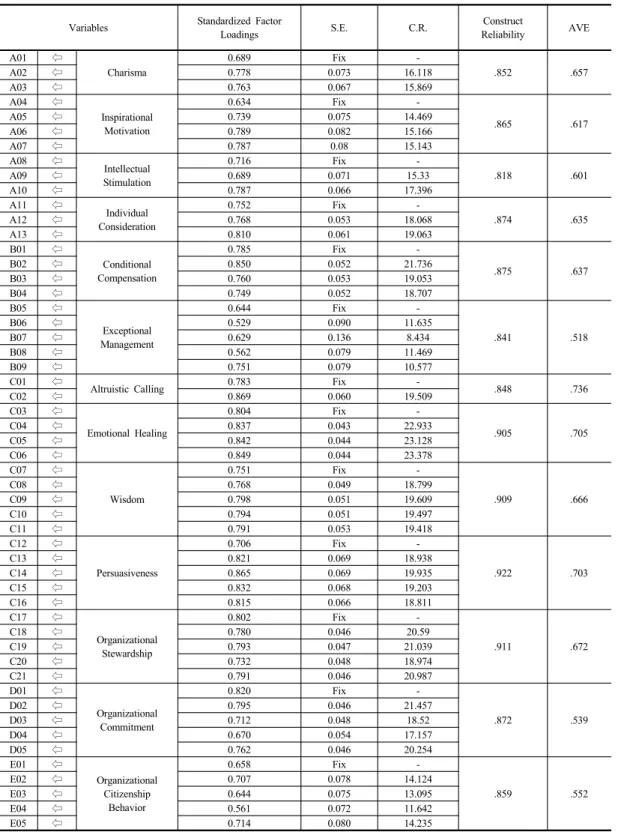
In this study, Confirmatory Factor Analysis (CFA) was conducted on the construct by using AMOS 16.0 in order to test convergent validity, and the results are as shown in Table 4. The goodness of fit index (GFI) for the measurement model was shown to be good, as the following: x2=2464.623(p=.000, df=1299), GFI=0.860, AGFI=0.840, CFI=0.938, NFI=0.879, IFI=0.939, TLI=0.932, RMR=0.038, and RMSEA=0.040. Therefore, the model in this study was determined to be fit; the load factor was λ >0.50, and all t-values (t value = non-standardized coefficient / standard error) were analyzed to be significant with the value> 1.965.
4.3 Hypothesis Testing Result
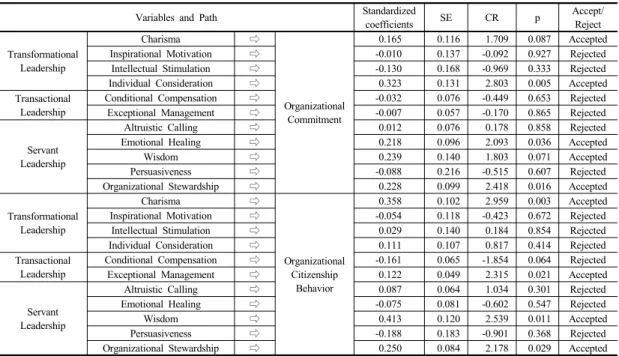
To test the hypothesis in this study, structural equation was used for the confirmation of standardized coefficients. The result of structural equation modeling analysis between the research units is as shown in Table 5. First, the fitness of research model was shown to be good, as the following: x2=2464.623(p=.000, df=1299), GFI=0.860, AGFI=0.840, CFI=0.938, NFI=0.879, IFI=0.939, TLI=0.932, RMR=0.038, RMSEA=0.040. Furthermore, the hypothesis testing result for the structural model was as follows.
First, as the result of hypothesis testing between transformational leadership and organizational commitment, the path coefficient of charisma was shown to be .165 (t-value =1.709, p<.10), and the path coefficient of individual consideration was shown to be .323(t-value =2.803, p<.01), which were significant.
However, the inspirational motivation and intellectual stimulation did not show significant effect.
Second, as the result of hypothesis testing between transactional leadership and organizational commitment, the two factors of conditional compensation and exceptional management did not show a statistically significant effect. Third, as the result of hypothesis testing between servant leadership and organizational commitment, the path coefficient of
Variables Standardized Factor
Loadings S.E. C.R. Construct
Reliability AVE
A01 ⇦
Charisma
0.689 Fix -
.852 .657
A02 ⇦ 0.778 0.073 16.118
A03 ⇦ 0.763 0.067 15.869
A04 ⇦
Inspirational Motivation
0.634 Fix -
.865 .617
A05 ⇦ 0.739 0.075 14.469
A06 ⇦ 0.789 0.082 15.166
A07 ⇦ 0.787 0.08 15.143
A08 ⇦
Intellectual Stimulation
0.716 Fix -
.818 .601
A09 ⇦ 0.689 0.071 15.33
A10 ⇦ 0.787 0.066 17.396
A11 ⇦
Individual Consideration
0.752 Fix -
.874 .635
A12 ⇦ 0.768 0.053 18.068
A13 ⇦ 0.810 0.061 19.063
B01 ⇦
Conditional Compensation
0.785 Fix -
.875 .637
B02 ⇦ 0.850 0.052 21.736
B03 ⇦ 0.760 0.053 19.053
B04 ⇦ 0.749 0.052 18.707
B05 ⇦
Exceptional Management
0.644 Fix -
.841 .518
B06 ⇦ 0.529 0.090 11.635
B07 ⇦ 0.629 0.136 8.434
B08 ⇦ 0.562 0.079 11.469
B09 ⇦ 0.751 0.079 10.577
C01 ⇦
Altruistic Calling 0.783 Fix -
.848 .736
C02 ⇦ 0.869 0.060 19.509
C03 ⇦
Emotional Healing
0.804 Fix -
.905 .705
C04 ⇦ 0.837 0.043 22.933
C05 ⇦ 0.842 0.044 23.128
C06 ⇦ 0.849 0.044 23.378
C07 ⇦
Wisdom
0.751 Fix -
.909 .666
C08 ⇦ 0.768 0.049 18.799
C09 ⇦ 0.798 0.051 19.609
C10 ⇦ 0.794 0.051 19.497
C11 ⇦ 0.791 0.053 19.418
C12 ⇦
Persuasiveness
0.706 Fix -
.922 .703
C13 ⇦ 0.821 0.069 18.938
C14 ⇦ 0.865 0.069 19.935
C15 ⇦ 0.832 0.068 19.203
C16 ⇦ 0.815 0.066 18.811
C17 ⇦
Organizational Stewardship
0.802 Fix -
.911 .672
C18 ⇦ 0.780 0.046 20.59
C19 ⇦ 0.793 0.047 21.039
C20 ⇦ 0.732 0.048 18.974
C21 ⇦ 0.791 0.046 20.987
D01 ⇦
Organizational Commitment
0.820 Fix -
.872 .539
D02 ⇦ 0.795 0.046 21.457
D03 ⇦ 0.712 0.048 18.52
D04 ⇦ 0.670 0.054 17.157
D05 ⇦ 0.762 0.046 20.254
E01 ⇦
Organizational Citizenship
Behavior
0.658 Fix -
.859 .552
E02 ⇦ 0.707 0.078 14.124
E03 ⇦ 0.644 0.075 13.095
E04 ⇦ 0.561 0.072 11.642
E05 ⇦ 0.714 0.080 14.235
Table 4. Confirmatory Factor Analysis Result
Variables and Path Standardized
coefficients SE CR p Accept/
Reject
Transformational Leadership
Charisma ⇨
Organizational Commitment
0.165 0.116 1.709 0.087 Accepted
Inspirational Motivation ⇨ -0.010 0.137 -0.092 0.927 Rejected
Intellectual Stimulation ⇨ -0.130 0.168 -0.969 0.333 Rejected
Individual Consideration ⇨ 0.323 0.131 2.803 0.005 Accepted
Transactional Leadership
Conditional Compensation ⇨ -0.032 0.076 -0.449 0.653 Rejected
Exceptional Management ⇨ -0.007 0.057 -0.170 0.865 Rejected
Servant Leadership
Altruistic Calling ⇨ 0.012 0.076 0.178 0.858 Rejected
Emotional Healing ⇨ 0.218 0.096 2.093 0.036 Accepted
Wisdom ⇨ 0.239 0.140 1.803 0.071 Accepted
Persuasiveness ⇨ -0.088 0.216 -0.515 0.607 Rejected
Organizational Stewardship ⇨ 0.228 0.099 2.418 0.016 Accepted
Transformational Leadership
Charisma ⇨
Organizational Citizenship
Behavior
0.358 0.102 2.959 0.003 Accepted
Inspirational Motivation ⇨ -0.054 0.118 -0.423 0.672 Rejected
Intellectual Stimulation ⇨ 0.029 0.140 0.184 0.854 Rejected
Individual Consideration ⇨ 0.111 0.107 0.817 0.414 Rejected
Transactional Leadership
Conditional Compensation ⇨ -0.161 0.065 -1.854 0.064 Rejected
Exceptional Management ⇨ 0.122 0.049 2.315 0.021 Accepted
Servant Leadership
Altruistic Calling ⇨ 0.087 0.064 1.034 0.301 Rejected
Emotional Healing ⇨ -0.075 0.081 -0.602 0.547 Rejected
Wisdom ⇨ 0.413 0.120 2.539 0.011 Accepted
Persuasiveness ⇨ -0.188 0.183 -0.901 0.368 Rejected
Organizational Stewardship ⇨ 0.250 0.084 2.178 0.029 Accepted
Table 5. Result of Hypothesis Testing for Structural Model
emotional healing was .218(t-value=2.093, p<.05), and the path coefficient of wisdom was .239 (t-value=1.803, p<.10), which were shown to be significant. The organizational stewardship was .228(t-value=2.418, p<.05), which was shown to be significant. However, altruistic calling and persuasiveness did not show a significant effect.
Fourth, as the result of hypothesis testing between transformational leadership and organizational citizenship behavior, the path coefficient for charisma was .358(t-value=2.959, p<.01), which was significant.
However, inspirational motivation, intellectual stimulation, and individual consideration did not show a significant effect. Fifth, between the transactional leadership and organizational citizenship behavior, the path coefficient of conditional compensation was -.161(t-value=-1.854, p<.10) and the exceptional management was .122(t-value=2.315, p<.05), which were shown to be significant. Sixth, between the servant leadership and organizational citizenship behavior, the path coefficient of wisdom was .413(t-value=2.539, p<.05) and the organizational
stewardship was .250(t-value=2.178, p<.05), which were shown to be significant. However, the altruistic calling, emotional healing, and persuasiveness did not shown a significant effect.
5. Conclusion
5.1 Result and Summary
This study was conducted to find the effect of leadership styles (transformational leadership, transactional leadership, and servant leadership) of CEO at small and medium-sized enterprises in the fields of electric, electronics, and IT on the organizational effectiveness (organizational commitment and organizational citizenship behavior).
The results are summarized as follows.
First, the charisma and individual consideration of the transformational leadership showed significantly positive effect on the organizational commitment, and the inspirational motivation and intellectual stimulation did not show significant effect. The elements of
transformational leadership can create positive emotions through organization’s goal achievement or citizenship behavior, which are one of the organization members’ activities, to effect on the organizational commitment. Especially, the behaviors of CEO, such as leading organization members and paying more attention to individuals, can be interpreted to be important in organizational commitment.
Second, the conditional compensation and exceptional management of the transactional leadership did not show a significant effect. This result shows that the elements of transactional leadership may and may not have a positively significant effect on the organizational commitment, depending on the employee’s organizational environment. The elements of employee’s work satisfaction, such as job description, work conditions, disposition of their peers, and promotion acts, do not have a considerable effect on organizational commitment, a component of transactional leadership.
Third, the emotional healing, wisdom, and organizational stewardship of the servant leadership were shown to have a significantly positive effect on the organizational commitment, and the altruistic calling and persuasiveness did not show a significant effect. In order for the servant leadership to have significantly positive effect on organizational commitment, it will need emotional healing, wisdom, and organizational stewardship. Furthermore, the leader should gain trust of the organization members in order to enhance the organizational commitment.
Fourth, the charisma of transformational leadership was shown to have a significantly positive effect on organizational citizenship behavior; and the inspirational motivation, intellectual stimulation, and individual consideration did not show a significant effect. Therefore, if the transformational leadership can inspirit charisma towards subordinates, which is an element boosting up the organizational effectiveness, and consistently strive to enhance organizational commitment and job satisfaction of organizational
effectiveness, it will produce positive effect on enhancing the organizational citizenship behavior.
Fifth, the conditional compensation of the transactional leadership was statistically shown to have a significantly negative effect, and the exceptional management was shown to have a significantly positive effect on organizational citizenship behavior. Such result may indicate that reward-oriented system, in which the reward is given either based on the set standard or at an ambiguous situation where the performance cannot be measured, should be considered with prudence.
Sixth, the wisdom and organizational stewardship of servant leadership were shown to have a significantly positive effect on the organizational citizenship behavior; and altruistic calling, emotional healing, and persuasiveness did not show a significant effect. For organizational members to work toward their common goal the servant leadership should take a role in providing environment that supports their physical and mental conditions, which satisfies their emotional needs; this will in turn motivate the organizational citizenship behavior.
5.2 Implications for Research
This study is an empirical research of analysis on the effect of leadership styles of CEO at small and medium-sized enterprises on the organizational commitment and organizational citizenship behavior.
The previous studies on CEO leadership have been mainly on public companies, hotels, and sports centers, in which the causal relationship between CEO leadership styles and organizational effectiveness were examined. In this study, the appropriate leadership style of CEO was suggested for enhancing organizational commitment and organizational citizenship behavior of the organizational effectiveness among the employees of small and medium-sized enterprises in the fields of electric, electronics, and IT. Furthermore, in the current business environment where building competitive advantage is critical, in terms of products and sales,
with various requests of employees, the deepening of enterprise competitions, and drastic changes in the markets, this study may be practically utilized by informing about desirable CEO leadership for positively effecting on organizational commitment and organizational citizenship behavior; this may in turn positively influence on the advancement of enterprises.
For enhancing organizational commitment and organizational citizenship behavior, a CEO should communicate with employees and actively attend to issues or requests, which should empower the CEO leadership. Furthermore, values and principles should be consistently emphasized for the employees to have pride in their work, as well as providing with visions, which consequently guide them to have strong belief that CEO and employees are all parts of the organization with the common goal. Instead of demanding performances from the employees, the CEO leadership would plan and execute ways to enhance organizational commitment and organizational citizenship behavior in order to inspire creativity and productivity of the employees, thereby advancing the organization as a whole.
5.3 Limitations and Directions for Future Research
There are many significant variables other than CEO leadership, such as promotions of enterprises, support of organization, human interaction with organization leaders, and supporting activities, which may influence on organizational commitment and organizational citizenship behavior that can also produce outcomes.
Despite of these many variables, this study only considered CEO leadership effecting on organizational effectiveness (organizational commitment and organizational citizenship behavior), which can be a limitation of this study. In the future study, variables in the performances of enterprises with organizational characteristics, other that the organizational effectiveness regarding CEO leadership styles used in this study, or elements of enterprise support and
organizational leadership should be included.
Furthermore, there is a limitation of sample in this study, because this research was conducted on electric, electronic, and IT small and medium-sized enterprises.
Therefore, the result of this study may not be generalized. In future study, data should be collected from more diverse industries to be included in the sample, and differences between industries may be examined.
References
[1] J. S. Yoo, “A study on the level of preparedness for crisis management to CEO`s leadership style”, Journal of Public Relations, 11(3), pp.197-248, 2007.
[2] I. J. Lee, Effects relationship between CEO's transformational leadership and organizational restructuring results”, Korean Business Education Association, 2, pp.139-161, 2002.
[3] S. Y. Kim, “The effects of CEO leadership style on the organizational culture, motivation, organizational effectives of public sports center staffs”, Korean Journal of Physical Education, 48(6), pp.291-300, 2009.
[4] K. K. Yang, “An influence of the type of leadership of CEO on organizational effectiveness”, Korean Journal of Physical Education, 17(3), pp.237-251, 2008.
[5] G. Y. Lee, G. M. Jo and J. G. Kim, “The effect of CEO`s leadership in professional sport team on subordinates` empowerment and organizational effectiveness”, Korean Journal of Physical Education, 44(4), pp.473-484, 2005.
[6] T. J. Han and H. Kim, “Effect of characteristics of public enterprise CEOs' leadership on the leader trust and organizational effectiveness of organizational members”, Journal of the Korea Contents Association, 8(11), pp.306-322, 2008.
DOI: http://dx.doi.org/10.5392/JKCA.2008.8.11.306 [7] S. J. Yoo, T. S. Yang and K. M. Yang, “The effects of
organizational communication environment on job satisfaction and commitment: A comparative study on CEO leadership style of service firms”, Journal of Korea Service Management Society, 7(2), pp.31-56, 2006.
[8] S. S. Hong, “The impact of CEO transformation-leadership on organizational innovativeness: The moderating roles of organizational
structure”, Korean Journal of Human Resources Development, 13(1), pp.99-129, 2010.
[9] Y. H. Seo and C. Lee, “The relationship among perceived CEO leadership, CEO trust, self-efficacy, job satisfaction and organizational commitment of employees in excellent small and medium-sized enterprises”, Journal of Agricultural Education and Human Resource Development, 41(4), pp.173-198, 2009.
[10] J. H. Suh, “Korea venture business CEO's charismatic leadership behaviors and followers' organizational commitment: The moderating effect of need for achievement, Journal of Organization and Management”, 29(3), pp.199-227, 2005.
[11] J. K. Yang and D. J. Lee, “The relationship among servant leadership, organizational commitment and organizational citizenship behavior of the public sports center”, Korean Society of Sports Science, 19(1), pp.141-152, 2010.
[12] G. J. Park and G. I. Han, “The effects on management innovation by leadership of the Korea public enterprise CEO”, Journal of Digital Convergence, 9(4), pp.77-89, 2011.
[13] B. K. Ham and J. J. Lee, “The effects of CEO leadership on the organization”, Korean Academic Society Of Culture And Tourism, 10(2), pp.113-125, 2008.
[14] B. J. Calder, “An attribution theory of leadership, In Staw”, B., Salancik, G. (Eds.) New directions in organizational behavior, Chicago, IL: St. Clair Press, pp.179-204, 1977.
[15] J. R. Meindl and S. B. Ehrlich, “The romance of leadership and the evaluation of organizational performance”, Academy of Management Journal, 30, pp.91-109, 1987.
DOI: http://dx.doi.org/10.2307/255897
[16] J. Pfeffer, “The ambiguity of leadership”, Academy of Management Review, 2, pp.104-112, 1977.
DOI: http://dx.doi.org/10.2307/257611
[17] E. Romanelli and M. L. Tushman, “Executive leadership and organizational outcome: An etionary perspective, In Hambrick, D. C. (Ed). The executive effect: Concepts and methods for studying top managers”, Greenwich, CT: JAI, 1990.
[18] G. H. Alfonso and B. Pratt Cornelius, “How to manage a crisis before or whenever-it hits”, Public Relations Quarterly, 40(1), pp.25-30, 1995.
[19] C. S. Choi, J. W. Kim and J. T. Ahn, “A study on the influence of transformational and transactional leadership on the OCB: Focusing on the mediating effect of the
empowerment”, Korean Journal of Business Administration, 19(6), pp.2435-2457, 2006.
[20] Y. K. Park, “A note on the scope and contents of organizational theory education”, Korean Review of Organizational Studies, 1(1), pp.101-134, 2004.
[21] Y. H. Yoon and K. C. Song, “Effect of organizational culture and CEO leadership on the organizational effectiveness”, Korean Journal of Human Resources Development”, 16(2), pp.65-100, 2013.
[22] P. Block, “From leadership to citizenship, In Spears, L.
C.(Ed). Insights on Leadership: Service, Stewardship, Spirits and Servant-Leadership”, New York: John Wiley
& Sons, 1998.
[23] P. M. Senge, “Robert creenleaf's legacy: A new foundation for twenty-first century institutions, In Spears, L. C.(Ed). Reflection on Leadership: How Robert K. Greenleaf's Theory of Servant-Leadership Influenced Today's Top Management Thinkers”, New York: John Wiley & Sons, 1995.
[24] B. J. Sims, “Servanthood: leadership for the third millennium”, Cambridge, Massachusetts: Cowley Publications, 1997.
[25] C. M. Choi and S. S. Kim, “The impacts of the operation of ethical management & trust of the leader on the organizational commitment”, Korean Corporation Management Review, 21, pp.89-119, 2005.
[26] J. P. Meyer and N. J. Allen, “A three-component conceptualization of organizational commitment”, Human Resource Management Review, 1, pp.61-98, 1991.
DOI: http://dx.doi.org/10.1016/1053-4822(91)90011-Z [27] D. Katz, “The motivational basis of organizational
behavior”, Behavioral Sciences, 9(2), pp.131-146, 1964.
DOI: http://dx.doi.org/10.1002/bs.3830090206
[28] T. S. Bateman and D. W. Organ, “Job satisfaction and the good soldier; The relationship between affect and employee citizenship”, Academy of Management Journal, 26, pp.587-595, 1983.
DOI: http://dx.doi.org/10.2307/255908
[29] C. A. Smith, D. W. Organ and J. P. Near,
“Organizational citizenship behavior: Its nature and antecedents”, Journal of Applied Psychology, 68, pp.653-663, 1983.
DOI: http://dx.doi.org/10.1037/0021-9010.68.4.653 [30] D. I. Jung and B. J. Ao, “Opening the blackbox: an
experimental investigation of the mediating effects of trust and value congruence on transformational and transactional leadership”, Journal of Organizational
Behavior, 21, pp.949-964, 2000.
DOI:http://dx.doi.org/10.1002/1099-1379(200012) 21:8<949::AID-JOB64>3.3.CO;2-6
[31] R. J. Masi and R. A. Cooke, “Effects of Transformational Leadership on Subordinate Motivation, Empowering Norms, and Organizational Productivity”, International Journal of Organizational Analysis, 8(1), pp.16-47, 2000.
DOI: http://dx.doi.org/10.1108/eb028909
[32] R. Kark and B. Shamir, “The influence of transformational leadership on followers’ relational versus collective self-concept”, Academy of Management Proceedings(Aug). Denver: Colorado, 2002.
[33] S. K. Lee, “ Impact of transactional leadership on organizational commitment: Focusing on equity perception”, Korean Journal of Tourism Research, 21(3), pp.1-17, 2006.
[34] W. J. Kim and K. J. Lee, “The effects of transformational leadership and transactional leadership on quality of LMX and organizational commitment of travel agency's employees”, Journal of Tourism and Leisure Research, 22(3), pp.211-232, 2010.
[35] D. R. Ebener, “The servant parish: A case study of servant leadership and organizational citizenship behaviors in high-performing catholic parishes”, Doctoral Dissertation. St. Ambrose University, 2007.
[36] M. Y. Kong and J. M. Kim, “The causal relationships among organizational learning, transformative leadership, learning culture and social networks in small and medium-sized enterprises”, Journal of Agricultural Education and Human Resource Development, 46(4), pp.113-140, 2014.
[37] J. H. Kim and E. S. Choi, E. S, “Structural relationships between middle managers’ servant leadership, learning organization, organizational citizenship behavior and organizational effectiveness”, Journal of Korean HRD Research, 8(4), pp.1-25, 2013.
DOI: http://dx.doi.org/10.3740/MRSK.2013.23.1.001 [38] D. S. Park and C. Y. Kim, Organizational culture, CEO
leadership, and organizational innovation in local public enterprises, Journal of Organization and Management, 32(4), pp.85-124, 2008.
Sung-Pyo Choi [Regular member]
• Aug. 2015 : Korea University of Technology & Education., Doctor´s Course
<Research Interests>
Leadership, OB, OCB