INTRODUCTION
Allergic diseases continue to increase in prevalence worldwide and many environmental factors contribute to their develop- ment such as allergens and exposure to air pollution.1 Sensiti- zation to an allergen is a critical step in the induction of aller- gy.2,3 Allergic diseases induced by aeroallergens can show vari- ous clinical manifestations such as rhinoconjuctivitis, eosino- philic bronchitis, and asthma. Airway inflammation and airway hyperresponsiveness (AHR) are major components of asthma.
Eosinophilic airway inflammation is a typical feature of asthma, although inflammation in asthma is known to be more hetero- geneous.4 Eosinophilic airway inflammation can lead to the de- velopment of bronchial hyperreactivity;5 however, unlike non- asthmatic eosinophilic bronchitis, it is not always accompanied with AHR. Occasionally, some patients with allergic rhinitis may also exhibit AHR or sputum eosinophilia, even though
Eosinophilic Airway Inflammation and Airway Hyperresponsiveness According to Aeroallergen Sensitization Pattern in Patients With Lower Airway Symptoms
Eun-Jung Jo,
1,2,3Mi-Yeong Kim,
1,2Seung-Eun Lee,
1,2,3Suh-Young Lee,
1,2Min-Hye Kim,
1,2Woo-Jung Song,
1,2Sae-Hoon Kim,
1,2,3* Hye-Ryun Kang,
1,2Yoon-Seok Chang,
1,2,3Sang-Heon Cho,
1,2Kyung-Up Min
1,21Department of Internal Medicine, Seoul National University College of Medicine, Seoul, Korea
2Institute of Allergy and Clinical Immunology, Seoul National University Medical Research Center, Seoul, Korea
3Department of Internal Medicine, Seoul National University Bundang Hospital, Seongnam, Korea
they have no asthmatic symptoms.6,7
Prior studies have reported an association between the spe- cific aeroallergen sensitization and the development of asthma or AHR. Sensitization to house dust mite or mold was associat- ed with increasing asthma.8 Cockroach allergy also has been re- ported as an important cause of asthma.9 There was also a trend in increasing AHR with increased cat allergen exposure.10 How- ever, sensitization to pollen was not significantly associated with the presence of asthma symptoms or AHR.11
Previous studies have generally focused on the prevalence of
Original Article
Allergy Asthma Immunol Res. 2014 January;6(1):39-46.
http://dx.doi.org/10.4168/aair.2014.6.1.39 pISSN 2092-7355 • eISSN 2092-7363
Purpose: Sensitization to specific allergens may be important in the development of allergic airway inflammation and airway hyperresponsiveness (AHR). We evaluated the effect of specific aeroallergen sensitization on eosinophilic airway inflammation and AHR. Methods: We reviewed retro- spectively the clinical data of subjects who underwent skin prick tests to aeroallergens, induced sputum analysis, and methacholine bronchial prov- ocation tests to evaluate lower airway symptoms as well as analyzed the associations between the pattern of aeroallergen sensitization and spu- tum eosinophilia or AHR. Results: Of the 1,202 subjects be enrolled, 534 (44.4%) were sensitized to at least one aeroallergen in skin tests. AHR was demonstrated in 23.5% and sputum eosinophilia in 38.8%. Sputum eosinophilia was significantly associated with sensitization to perennial al- lergens (OR, 1.9; 95% CI, 1.4-2.5), house dust mite (OR, 1.7; 95% CI, 1.3-2.3), dog (OR, 1.9; 95% CI, 1.1-3.3), and cat (OR, 2.1; 95% CI, 1.4-3.4). AHR was associated with sensitization to perennial allergens (OR, 2.7; 95% CI, 2.0-3.7), house dust mite (OR, 2.2; 95% CI, 1.6 3.2), Alternaria (OR, 2.3;
95% CI, 1.2-4.7), and cat (OR, 2.7; 95% CI, 1.7-4.3). Sensitization to more perennial allergens increased the risk for sputum eosinophilia and AHR.
There was no relationship with individual seasonal allergens. Conclusion: The development of airway eosinophilic inflammation and AHR in an adult Korean population was associated with sensitization to perennial allergens rather than seasonal allergens.
Key Words: Aeroallergen; airway eosinophilia; airway hyperresponsiveness
This is an Open Access article distributed under the terms of the Creative Commons Attribution Non-Commercial License (http://creativecommons.org/licenses/by-nc/3.0/) which permits unrestricted non-commercial use, distribution, and reproduction in any medium, provided the original work is properly cited.
Correspondence to: Sae-Hoon Kim, MD, PhD, Department of Internal Medicine, Seoul National University Bundang Hospital, 82 Gumi-ro 173 Beon- gil, Bundang-gu, Seongnam 463-802, Korea.
Tel: +82-31-787-7046; Fax: +82-31-787-4052; E-mail: [email protected] Received: January 17, 2013; Revised: March 4, 2013; Accepted: April 15, 2013
•There are no financial or other issues that might lead to conflict of interest.
allergen sensitization among the general population, among patients with allergic diseases, or on the development of asth- ma according to sensitization to some allergens.8,12-14 Limited studies have been conducted in regards to the risk of airway in- flammation and AHR according to the patterns of aeroallergen sensitization. Furthermore, allergen sensitization pattern and its influence on allergic disease may vary dependent on ethnic- ity and geography; however, this issue has rarely been explored in adult populations in Asia. Here, we investigated the relation- ship between patterns of aeroallergen sensitization and the de- velopment of eosinophilic airway inflammation and AHR in Korean adults who had allergic and lower airway symptoms.
MATERIALS AND METHODS Study subjects
We retrospectively reviewed the data of adult patients (age ≥ 15 years) who visited the asthma and allergy clinic at Seoul Na- tional University Bundang Hospital between January 2005 and June 2011. To investigate allergen sensitization patterns that af- fect airway hyperresponsiveness and airway inflammation, the clinical data were collected from patients who underwent skin prick tests to aeroallergens, a methacholine bronchial provoca- tion test, and induced sputum analysis in the evaluation of al- lergic and lower airway symptoms (such as dyspnea, chronic cough, wheezing, and chest discomfort).
Exposure of the subjects to relevant allergens was assessed at the time the tests were performed. Our clinic routinely asked patients about environmental conditions and allergen expo- sure before tests. The presence of fabrics or carpets at home was assumed to mean that the subjects had been exposed to house dust mites and exposure to cats or dogs was considered for subjects with pets at home. Exposure to sensitized pollen was assessed when the tests were performed during the pollen season and based on the Korean calendar for allergenic pollen.15 This study was approved by the hospital institutional review board.
Skin prick test
We analyzed the results of skin prick tests for 12 non-cross act- ing common inhalant aeroallergens in Korea: 6 perennial aller- gens that included house dust mite (D. pteronyssinus and D. fa- rinae), Alternaria, Aspergillus, cockroach, dog, and cat, 6 sea- sonal allergens that included birch, elm, poplar, grass pollen mix (grasses, barley, oat, rye, and wheat), ragweed, and mug- wort. Normal saline (0.9%) and histamine (1 mg/mL) were used as negative and positive controls. The skin prick test was performed after the withdrawal of antihistamines or antide- pressants for at least 72 hours prior to the test. The wheal diam- eter was measured 15 minutes after application. Skin prick test reactions were graded by the ratio of the allergen wheal diame- ter to the histamine wheal diameter (A/H ratio), as grade 1+ to
4+. Grade 2+ meant an A/H ratio of ≥0.5, and each additional plus indicated a doubling of the ratio. The test was considered positive when the A/H ratio was 1 or greater. Atopy was defined as a positive skin test response to at least 1 allergen.
Methacholine bronchial provocation test
The patients were instructed to withhold medications (such as beta-agonists, inhaled corticosteroids, leukotriene antago- nists, and antihistamines) that might interfere with the metha- choline bronchial provocation test 72 hours prior to testing and to avoid caffeine on the day of testing.
A baseline spirometry was performed using a Vmax 2130 spi- rometer (VIASYS Respiratory Care, Inc., Yorba Linda, CA, USA).
Forced expiratory volume in 1 second (FEV1) and forced vital capacity index were recorded. A bronchial provocation test was not administered for patients with FEV1 less than 70% of pre- dicted. Methacholine dilutions of 1, 4, 16, and 25 mg/mL were used. The methacholine challenge was performed using a five- breath protocol with a dosimeter (KoKo Dosimeter; nSpire Health, Inc., Louisville, CO, USA). After 90 seconds, spirometry was performed. The test was ended when a decrease of 20% or greater compared with baseline FEV1 was achieved or when the highest concentration of methacholine was inhaled. The provocation concentration that caused a decrease of 20% in FEV1 was expressed as the PC20 (provocation concentration dose of methacholine). AHR was defined as a PC20 of less than 16 mg/mL.
Induced sputum processing and analysis
Sputum induction and processing were conducted according to the previously described standardized protocol.16 Briefly, subjects inhaled nebulized 4.5% saline via an ultrasonic nebu- lizer (Omron NE-U17 Ultrasonic Nebulizer; Morton Medical, UK) for 5 minutes periods up to 20 minutes. Every 5 minutes af- ter the start of nebulization, subjects spat the sputum into a Pe- tri dish. After the addition of 0.01 M dithiothreitol, the samples were vortex-mixed, shaken for 30 minutes at room tempera- ture, and filtered through a 100-μm mesh. The cells were col- lected by centrifugation (2,000 rpm, 4°C, 10 minutes) and sus- pended in phosphate-buffered saline to a volume equal to the original sputum plus dithiothreitol. The cells were counted us- ing a hemocytometer, and cell concentrations were adjusted to 1.0×10⁶ cells/mL. Cytospins were prepared by adding 60 μL of cell suspension to Shandon II cytocentrifuge cups (Shandon Southern Instruments, Sewickley, PA, USA) and were spun for 5 minutes at 42×g. The cells were stained with Diff-Quik solu- tion (Sysmex Co., Kobe, Japan). Leukocytes, bronchial epitheli- al cells, and squamous cells were counted respectively. These counts were expressed as percentages of a total of 400 nucleat- ed cells counted per slide (excluding squamous epithelial cells) to determine cell differentiation. Sputum eosinophilia was re- garded as positive when the sputum eosinophil count was ≥3%.
Allergen Sensitization and Airway Allergic Disease AAIR
Statistical analysis
All statistical analyses were performed using SPSS software (ver. 18.0 for Windows; SPSS, Inc, Chicago, IL., USA). Pearson’s chi-squared test was used to assess the univariate association between clinical characteristics of the study population and sputum eosinophilia or AHR. Multiple logistic regression anal- ysis was performed to obtain the adjusted odds ratios (OR) and
95% confidence intervals (CI) for the independent effect that sensitization to each allergen had on airway eosinophilic in- flammation or AHR, adjusting for age, gender, current smoker, and the effect of relevant allergen exposure. Values of P<0.05 were considered to indicate statistical significance.
RESULTS
Characteristics of study population
In total, 1,202 subjects with a mean age of 50.0±16.4 were in- cluded and Table 1 summarizes their baseline characteristics.
Of the subjects, 520 (43.3%) were males and 534 (44.4%) had at least 1 positive skin test response to aeroallergens, considered as atopy. Sensitization to a perennial allergen was more frequent than sensitization to a seasonal allergen (40.1% vs 13.3%). The most commonly sensitized allergen was house dust mite, fol- lowed by cat and dog. AHR was demonstrated in 23.5% of the subjects and sputum eosinophilia in 38.8% (Table 1).
Sputum eosinophilia and airway hyperresponsiveness according to patterns of aeroallergen sensitization
Table 2 shows the univariate analyses that explores the rela- tionship between the clinical characteristics of the study popu- lation and sputum eosinophilia or AHR. Patients with AHR were younger, and current smokers were significantly more common.
There was also a significant association between exposure to pets and sputum eosinophilia or AHR.
Multivariate analyses showed significant relationships between sputum eosinophilia and sensitization to at least 1 perennial al- lergen (OR, 1.9; 95% CI, 1.4-2.5), house dust mite (OR, 1.7; 95%
CI, 1.3-2.3), dog (OR, 1.9; 95% CI, 1.1-3.3), and cat (OR, 2.1; 95%
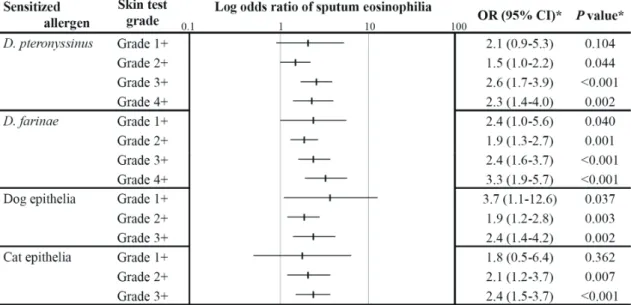
CI, 1.4 3.4; Table 3). Sputum eosinophilia showed increasing trends with higher grade responses in the skin prick test for D.
farinae and cat (Fig. 1). Airway hyperresponsiveness was asso- ciated with sensitization to at least one perennial allergen (OR, 2.7; 95% CI, 2.0-3.7), house dust mite (OR, 2.2; 95% CI, 1.6 3.2), Table 1. Clinical characteristics of the study population (N=1,202)
Characteristics Number (%)
Age (years) 50.0±16.4*
Male/Female 520 (43.3)/682 (56.7)
Smoking (1,157)
Never/Ex-smoker/Current smoker 803 (69.4)/177 (15.3)/177 (15.3)
Pets at home (919) 208 (22.6)
Fabrics or carpets at home (919) 148 (16.1)
Atopy 534 (44.4)
Positive to perennial allergen 482 (40.1)
House dust mite 429 (35.7)
Alternaria 42 (3.5)
Aspergillus 6 (0.5)
Cockroach 35 (2.9)
Dog epithelia 88 (7.3)
Cat epithelia 117 (9.7)
Positive to seasonal allergen 160 (13.3)
Birch 77 (6.4)
Elm 15 (1.2)
Poplar 16 (1.3)
Grass pollen mix 33 (2.7)
Ragweed 45 (3.7)
Mugwort 74 (6.2)
Positive to both perennial and seasonal 108 (9.0)
Airway hyperresponsiveness 282 (23.5)
Sputum eosinophilia 466 (38.8)
*mean±standard deviation.
Table 2. Relationship between baseline characteristics and sputum eosinophilia or airway hyperresponsiveness
Characteristics Sputum eosinophilia, N (%)* AHR, methacholine-PC20, N (%)*
≥3% <3% P value† ≤16 mg/mL >16 mg/mL P value†
Age (mean±SD) 49.2±16.6 50.4±16.2 0.188 46.5±17.6 51.0±15.8 <0.001
Male 201 (43.1) 319 (43.3) 0.943 135 (47.9) 385 (41.8) 0.074
Smoking
Ex-smoker 60 (13.3) 117 (16.5) 0.139 34 (12.5) 143 (16.2) 0.143
Current smoker 80 (17.8) 97 (13.7) 0.062 62 (22.8) 115 (13.0) <0.001
Smoking, PY (mean±SD) 5.4±12.4 5.3±12.6 0.836 5.4±13.1 5.3±12.3 0.906
Pets at home 95 (27.1) 113 (19.9) 0.015 64 (28.8) 144 (20.7) 0.013
Fabrics or carpets at home 61 (17.4) 87 (15.3) 0.409 32 (14.4) 116 (16.6) 0.431
*Percentage of subjects belonging to each group of sputum eosinophilia or AHR. †Pearson’s chi-squared test or Student’s t-test.
AHR, airway hyperresponsiveness; methacholine-PC20, provocation concentration dose of methacholine; SD, standard deviation; PY, pack-years.
Jo et al. Volume 6, Number 1, January 2014
Alternaria (OR, 2.3; 95% CI, 1.2-4.7), and cat (OR, 2.7; 95% CI, 1.7-4.3; Table 4). The risk for AHR was greater in subjects with higher grade responses in the skin prick test for D. farinae and Alternaria (Fig. 2).
The relationship between sensitization to a seasonal allergen and sputum eosinophilia or AHR was not significant, even after adjusting for specific allergen exposure in the pollen season (Tables 3 and 4). The development of sputum eosinophilia and AHR examined in the relevant pollen season did not increase significantly compared with testing outside the pollen season (data not shown).
Sputum eosinophilia and airway hyperresponsiveness according to multisensitization
Sensitization to three or more allergens was related to in- creased sputum eosinophilia (OR, 2.0; 95% CI, 1.3-3.2) and AHR (OR, 3.6; 95% CI, 2.1-5.8; Table 5), although sensitization to 2 allergens showed a lower risk compared with sensitization to 1 allergen. Sputum eosinophilia and AHR showed an increas- ing trend with an increased number of positive test responses to perennial allergens (Table 5); however, there was no relation- ship with an increased number of sensitized seasonal allergens.
Fig. 1. Adjusted odds ratios (95% CI) of airway eosinophilic inflammation in relation to grades of skin prick test. *Statistical comparison was performed with group with negative skin test response to each grade of allergen; the odds ratio and P value were adjusted according to age, gender, and smoking status.
Fig. 2.
Fig. 2. Adjusted odds ratios (95% CI) of airway hyperresponsiveness in relation to grades of skin prick test. *Statistical comparison was performed with group with negative skin test response to each grade of allergen; the odds ratio and P value were adjusted according to age, gender, and smoking status.
Allergen Sensitization and Airway Allergic Disease AAIR
DISCUSSION
In the present study, the development of sputum eosinophilia or AHR was significantly associated with sensitization to peren- nial allergens such as house dust mite, Alternaria, dog, or cat.
In addition, sputum eosinophilia and AHR showed increasing trends with sensitization to an increased number of perennial allergens.
Similar to the present study, many previous studies have shown relationships between specific allergen sensitization and bron- chial hyperresponsiveness, with perennial indoor allergens such as house dust mite and pets being the most influential al- lergens.10,12,17-21 The present analysis showed an association be- tween the sensitization to Alternaria and the development of AHR, as mentioned in some previous reports.22,23 The risk for AHR was greater in subjects with positive responses to perenni- al allergens compared to those who responded only to seasonal allergens;14 in addition, an increased wheal size in the skin test was significantly associated with asthma.24 The present results are consistent with previous results that showed that AHR in- creased as the number of sensitized allergens increased and the risk of eosinophilic airway inflammation and AHR increased with the increasing grades in skin prick test.14,24,25
In the present analysis, sensitization to seasonal allergens was not associated with airway eosinophilic inflammation or AHR.
Previous studies have revealed that pollen allergy does not in- crease AHR.12,21,26 Some studies have a limitation that the sub- jects were tested outside of the pollen season where only the sensitization to perennial allergen was the risk factor for AHR and pollen sensitization did not contribute to the development of AHR or asthma.26 However, some studies have reported an association between sensitization to some seasonal allergens and AHR.11,18,27 Exposure to seasonal allergen during the pollen season was demonstrated to induce an inflammatory response in the airway and aggravate symptoms in pollen-sensitive asth- matics.28 Inconsistent results may be attributed to various factors such as differences in study population (age, presence of aller- gic rhinitis, or asthma), season of testing, and the multiple sen- sitization status of subjects. Studies conducted on children or younger adults often show an association between seasonal al- lergen sensitization and AHR; however, studies of older adults fail to reveal an association. Most studies have consistently demonstrated the relationship of perennial indoor allergen and asthma. Old adults with a mean age of 50 years were enrolled in our study. There was no increase in sputum eosinophils and no decrease in PC20 even in the subgroup analysis of the subjects tested during the relevant pollen season. The data suggest that seasonal pollen did not play a role in the development of AHR Table 3. Relationship between aeroallergen sensitization and sputum eosino-
philia
Sensitized allergen
Sputum eosinophilia, N (%)
OR (95%CI)* P value*
(N=466)≥3% <3%
(N=736)
Perennial allergen 226 (48.5) 256 (34.8) 1.9 (1.4-2.5) <0.001 House dust mite 200 (42.9) 229 (31.1) 1.7 (1.3-2.3) 0.001 Alternaria 16 (3.4) 26 (3.5) 0.8 (0.4-1.6) 0.502 Aspergillus 2 (0.4) 4 (0.5) 0.7 (0.1-3.7) 0.629 Cockroach 14 (3.0) 21 (2.9) 0.9 (0.4-1.8) 0.739 Dog epithelia 48 (10.3) 40 (5.4) 1.9 (1.1-3.3) 0.014 Cat epithelia 63 (13.5) 54 (7.3) 2.1 (1.4-3.4) 0.001 Seasonal allergen 68 (14.6) 92 (12.5) 1.1 (0.8-1.6) 0.617
Birch 33 (7.1) 44 (6.0) 1.0 (0.6-2.0) 0.807
Elm 7 (1.5) 8 (1.1) 1.1 (0.4-3.5) 0.818
Poplar 6 (1.3) 10 (1.4) 0.6 (0.2-1.8) 0.331
Grass pollen mix 13 (2.8) 20 (2.7) 0.9 (0.4-2.0) 0.788
Ragweed 21 (4.5) 24 (3.2) 1.4 (0.7-2.9) 0.395
Mugwort 32 (6.9) 42 (5.7) 1.3 (0.8-2.3) 0.323
Both perennial and seasonal allergens respectively
48 (10.3) 60 (8.2) 1.1 (0.7-1.8) 0.528
*Adjusted odds ratio and P value according to age, gender, smoking status, and relevant allergen exposure.
Table 4. Relationship between aeroallergen sensitization and airway hyper- sensitivity
Sensitized allergen
AHR, methacholine- PC20, N (%)
OR (95%CI)* P value*
≤16 mg/mL
(N=282) >16 mg/mL (N=920)
Perennial allergen 169 (59.9) 313 (34.0) 2.7 (2.0-3.7) <0.001 House dust mite 147 (52.1) 282 (30.7) 2.2 (1.6-3.2) <0.001 Alternaria 21 (7.4) 21 (2.3) 2.3 (1.2-4.7) 0.001 Aspergillus 2 (0.7) 4 (0.4) 1.0 (0.2-5.6) 0.994 Cockroach 8 (2.8) 27 (2.9) 0.7 (0.3-1.6) 0.364 Dog epithelia 35 (12.4) 53 (5.8) 1.4 (0.8-2.5) 0.201 Cat epithelia 53 (18.8) 64 (7.0) 2.7 (1.7-4.3) <0.001 Seasonal allergen 45 (16.0) 115 (12.5) 1.1 (0.7-1.6) 0.800
Birch 19 (6.7) 58 (6.3) 0.9 (0.5-1.9) 0.928
Elm 4 (1.4) 11 (1.2) 1.0 (0.3-3.5) 0.988
Poplar 5 (1.8) 11 (1.2) 1.4 (0.4-4.3) 0.574
Grass pollen mix 9 (3.2) 24 (2.6) 0.9 (0.3-2.2) 0.782
Ragweed 11 (3.9) 34 (3.7) 0.9 (0.4-2.2) 0.871
Mugwort 25 (8.9) 49 (5.3) 1.4 (0.7-2.5) 0.324
Both perennial and seasonal allergens respectively
37 (13.1) 71 (7.7) 1.3 (0.8-2.1) 0.263
AHR, airway hyperresponsiveness; methacholine-PC20, provocation concentra- tion dose of methacholine.
*Adjusted odds ratio and P value according to age, gender, smoking status, and relevant allergen exposure.
and eosinophilic airway inflammation unlike perennial aller- gens in the old adult population.
Another possible reason for the seemingly conflicting results related to seasonal allergens may be regional variations in aller- gens. Some evidence supports the effect of geographical cli- mate variation on the prevalence and symptoms associated with respiratory allergic disease.29,30 Climate change can have an impact on the type, concentration, and allergenicity of aero- allergens as well as on the prevalence of allergic diseases.31 Geographic variation and regional types of allergens should be considered in the effect of allergic sensitization and the devel- opment of allergic disease.29
In respect to cockroach allergen, sensitization to cockroach was associated with the occurrence of asthma in other stud- ies.9,32 However, the association was not found in the present study. Recently, cockroach infestation rates and sensitization rates are decreasing as the garbage disposal system has im- proved and insecticides are more commonly used in Korea.33 Reduced cockroach exposure (due to the improvement of hy- gienic conditions) might influence the lack of association be- tween cockroach sensitization and AHR.
Different features of allergic diseases may be induced by the pattern of allergen sensitization. Compared to asthma patients, subjects with allergic rhinitis were more sensitized to allergens.13,25 Moreover, sensitization to outdoor allergens is associated with allergic rhinitis, rather than asthma;13,18 in particular, pollens
were major sensitizing allergens in patients with allergic rhini- tis.13,34 Factors that influenced the clinical significance of aeroal- lergens include concentration, particle size, and exposure du- ration of the aeroallergens.35,36 Airborne pollens with diameters larger than those of house dust mite particles may not reach the lower respiratory tract; however, conjunctival and upper respi- ratory tract mucosa can be exposed to large amounts of aeroal- lergens, even large allergens such as pollens. Additionally, in- door perennial allergens present in the environment year-round can induce chronic airway inflammation due to persistent chal- lenges to the airway; subsequently, (compared to outdoor sea- sonal allergens) they can be the dominant allergens associated with asthma.2 Despite particle size, limited exposure period, and other special properties, pollens are still likely to trigger airway inflammation and AHR in special circumstances. Exposure to highly allergenic, submicron pollen particles or exposure to high amounts of pollen over an extended period can provoke allergic responses, even in the lower respiratory tract mucosa.37,38
The differences among the above studies may also be ex- plained by an effect of protease activity from allergen sources on allergenicity.39-41 Proteases facilitate allergic sensitization by disrupting epithelial tight junctions and promoting the produc- tion of cytokines, chemokines, and adhesion molecules.37,42 Furthermore, proteases from mites and molds amplify IgE pro- duction, degranulate activated eosinophils, and can cause al- lergic inflammation in the respiratory system.39 Pollens also contain proteases and are thought to induce airway inflamma- tion through protease-dependent and protease-independent mechanisms.43,44 However, the production of cytokines induced by pollens was lower than that induced by mite dust and a higher concentration of pollen was needed to produce a maxi- mum concentration of cytokines.43 Thus, the protease activity of pollens in airway inflammation and AHR may be less potent than that of mite or mold allergens. A better understanding of the molecular characteristics of the allergenic properties of pol- len would be helpful to elucidate the pathogenesis of allergic diseases.
There are several limitations to our study. First, the present study assessed only whether the subjects had been exposed to different allergens. Environmental exposure doses of each al- lergen and the exposure duration could not be investigated due to the retrospective nature of the study.45 Second, we included only patients who underwent all of the skin prick tests, a metha- choline bronchial provocation test, and an induced sputum analysis. Patients who had no lower airway symptoms and had not undergone all of these tests were not included in the study.
Thus, sputum eosinophilia and AHR were not evaluated in pa- tients who had only rhinoconjuctivitis or asymptomatic aller- gen sensitization. Third, the risk of sputum eosinophilia and AHR was lower than sensitization to one allergen in subjects with sensitization to 2 allergens. This is thought to be because the subjects who were sensitized to 2 allergens had positive Table 5. Sputum eosinophilia and airway hyperresponsiveness according to at-
opy status
Atopy status Total N (%)
Sputum eosinophilia Airway hypersensitivity (95% CI)* P value*OR OR
(95%CI)* P value*
Atopy 534 (44.4) 1.8 (1.4-2.4) <0.001 1.8 (1.8-3.3) <0.001 Number of sensitized allergens
1 299 (24.9) 1.8 (1.3-2.4) <0.001 2.6 (1.8-3.6) <0.001 2 120 (10.0) 1.6 (1.0-2.6) 0.042 2.1 (1.2-3.5) 0.008 more than 3 115 (9.6) 2.0 (1.3-3.2) 0.004 3.6 (2.1-5.8) <0.001 Number of perennial allergens
1 315 (26.2) 1.7 (1.3-2.3) <0.001 2.7 (1.9-3.8) <0.001 2 112 (9.3) 1.7 (1.1-2.8) 0.022 3.0 (1.7-5.1) <0.001 more than 3 55 (4.6) 2.7 (1.4-5.1) 0.002 5.5 (2.7-
10.9) <0.001 Number of seasonal allergens
1 101 (8.4) 1.1 (0.7-1.7) 0.568 1.2 (0.8-1.9) 0.544 2 33 (2.7) 1.2 (.6-2.6) 0.558 0.6 (0.3-1.6) 0.326 more than 3 26 (2.2) 0.8 (0.3-1.9) 0.579 1.2 (0.5-3.0) 0.663
*Statistical comparison was performed with non-atopy group or group with negative skin test response to each type of allergen as reference group, and the odds ratio and P value were adjusted according to age, gender, and smok- ing status.
Allergen Sensitization and Airway Allergic Disease AAIR
skin test responses with a lower A/H ratio. However, similar to previous reports, sensitization to 3 or more allergens showed a significant correlation with the development of sputum eosino- philia and AHR. Finally, the analysis of sputum eosinophilia was performed only once. A study by Simpson et al. indicated that a cut-off point of 3% eosinophils allows the presence of eo- sinophilia to be reliably determined from a single sputum sam- ple.46 However, a recent study suggested that sputum inflam- matory types are not stable over time.47 Single induced sputum analysis may have a limitation to determine the presence of sputum eosinophilia.
In conclusion, the development of airway eosinophilic in- flammation and AHR in a Korean adult population was associ- ated with sensitization to perennial allergens, as opposed to outdoor seasonal allergens. Understanding the pattern of aller- gen sensitization would be helpful to determine which clinical features of allergic disease would be expected to develop.
ACKNOWLEDGMENTS
This study was supported by a grant of the Korea Healthcare Technology R&D Project, Ministry of Health and Welfare, Re- public of Korea (A102065).
REFERENCES
1. Levetin E, Van de Water P. Environmental contributions to allergic disease. Curr Allergy Asthma Rep 2001;1:506-14.
2. Platts-Mills TA, Blumenthal K, Perzanowski M, Woodfolk JA. De- terminants of clinical allergic disease. The relevance of indoor al- lergens to the increase in asthma. Am J Respir Crit Care Med 2000;
162:S128-33.
3. Dreborg S. Impact of allergen exposure on bronchial hyperrespon- siveness. Pediatr Allergy Immunol 1996;7:14-7.
4. Brightling CE. Clinical applications of induced sputum. Chest 2006;
129:1344-8.
5. Chung KF. Role of inflammation in the hyperreactivity of the airways in asthma. Thorax 1986;41:657-62.
6. Alvarez MJ, Olaguibel JM, García BE, Rodríquez A, Tabar AI, Urbio- la E. Airway inflammation in asthma and perennial allergic rhini- tis. Relationship with nonspecific bronchial responsiveness and maximal airway narrowing. Allergy 2000;55:355-62.
7. Corren J. Allergic rhinitis and asthma: how important is the link? J Allergy Clin Immunol 1997;99:S781-6.
8. Jaakkola MS, Ieromnimon A, Jaakkola JJ. Are atopy and specific IgE to mites and molds important for adult asthma? J Allergy Clin Im- munol 2006;117:642-8.
9. Arruda LK, Vailes LD, Ferriani VP, Santos AB, Pomés A, Chapman MD. Cockroach allergens and asthma. J Allergy Clin Immunol 2001;
107:419-28.
10. Chinn S, Heinrich J, Antó JM, Janson C, Norbäck D, Olivieri M, Svanes C, Sunyer J, Verlato G, Wjst M, Zock JP, Burney PG, Jarvis DL. Bronchial responsiveness in atopic adults increases with expo- sure to cat allergen. Am J Respir Crit Care Med 2007;176:20-6.
11. Sears MR, Herbison GP, Holdaway MD, Hewitt CJ, Flannery EM,
Silva PA. The relative risks of sensitivity to grass pollen, house dust mite and cat dander in the development of childhood asthma. Clin Exp Allergy 1989;19:419-24.
12. Omenaas E, Bakke P, Eide GE, Elsayed S, Gulsvik A. Serum house dust mite antibodies: predictor of increased bronchial responsive- ness in adults of a community. Eur Respir J 1996;9:919-25.
13. Boulet LP, Turcotte H, Laprise C, Lavertu C, Bédard PM, Lavoie A, Hébert J. Comparative degree and type of sensitization to common indoor and outdoor allergens in subjects with allergic rhinitis and/
or asthma. Clin Exp Allergy 1997;27:52-9.
14. Craig TJ, King TS, Lemanske RF Jr, Wechsler ME, Icitovic N, Zim- merman RR Jr, Wasserman S; National Heart, Lung, and Blood In- stitute’s Asthma Clinical Research Network. Aeroallergen sensiti- zation correlates with PC(20) and exhaled nitric oxide in subjects with mild-to-moderate asthma. J Allergy Clin Immunol 2008;121:
671-7.
15. Oh JW, Lee HB, Kang IJ, Kim SW, Park KS, Kook MH, Kim BS, Baek HS, Kim JH, Kim JK, Lee DJ, Kim KR, Choi YJ. The revised edition of Korean calendar for allergenic pollens. Allergy Asthma Immunol Res 2012;4:5-11.
16. Sohn SW, Lee HS, Park HW, Chang YS, Kim YK, Cho SH, Kim YY, Min KU. Evaluation of cytokine mRNA in induced sputum from patients with allergic rhinitis: relationship to airway hyperrespon- siveness. Allergy 2008;63:268-73.
17. Langley SJ, Goldthorpe S, Craven M, Morris J, Woodcock A, Cus- tovic A. Exposure and sensitization to indoor allergens: association with lung function, bronchial reactivity, and exhaled nitric oxide measures in asthma. J Allergy Clin Immunol 2003;112:362-8.
18. Tepas EC, Litonjua AA, Celedón JC, Sredl D, Gold DR. Sensitiza- tion to aeroallergens and airway hyperresponsiveness at 7 years of age. Chest 2006;129:1500-8.
19. Verdiani P, Di Carlo S, Baronti A. Different prevalence and degree of nonspecific bronchial hyperreactivity between seasonal and pe- rennial rhinitis. J Allergy Clin Immunol 1990;86:576-82.
20. Mete N, Sin A, Gulbahar O, Erdinc M, Sebik F, Kokuludag A. The determinants of bronchial hyperresponsiveness in patients with allergic rhinitis. Ann Allergy Asthma Immunol 2004;93:193-9.
21. Kerkhof M, Postma DS, Schouten JP, de Monchy JG. Allergic sensi- tization to indoor and outdoor allergens and relevance to bronchi- al hyperresponsiveness in younger and older subjects. Allergy 2003;
58:1261-7.
22. Peat JK, Tovey E, Mellis CM, Leeder SR, Woolcock AJ. Importance of house dust mite and Alternaria allergens in childhood asthma:
an epidemiological study in two climatic regions of Australia. Clin Exp Allergy 1993;23:812-20.
23. Downs SH, Mitakakis TZ, Marks GB, Car NG, Belousova EG, Leüp- pi JD, Xuan W, Downie SR, Tobias A, Peat JK. Clinical importance of Alternaria exposure in children. Am J Respir Crit Care Med 2001;
164:455-9.
24. Nelson HS. The importance of allergens in the development of asthma and the persistence of symptoms. J Allergy Clin Immunol 2000;105:S628-32.
25. Pallasaho P, Rönmark E, Haahtela T, Sovijärvi AR, Lundbäck B. De- gree and clinical relevance of sensitization to common allergens among adults: a population study in Helsinki, Finland. Clin Exp Al- lergy 2006;36:503-9.
26. Patelis A, Gunnbjörnsdottir M, Malinovschi A, Matsson P, Onell A, Högman M, Alving K, Janson C. Population-based study of multi- plexed IgE sensitization in relation to asthma, exhaled nitric oxide,
and bronchial responsiveness. J Allergy Clin Immunol 2012;130:
397-402.e2.
27. Chinn S, Burney P, Sunyer J, Jarvis D, Luczynska C. Sensitization to individual allergens and bronchial responsiveness in the ECRHS.
European Community Respiratory Health Survey. Eur Respir J 1999;
14:876-84.
28. Djukanović R, Feather I, Gratziou C, Walls A, Peroni D, Bradding P, Judd M, Howarth PH, Holgate ST. Effect of natural allergen expo- sure during the grass pollen season on airways inflammatory cells and asthma symptoms. Thorax 1996;51:575-81.
29. Zanolin ME, Pattaro C, Corsico A, Bugiani M, Carrozzi L, Casali L, Dallari R, Ferrari M, Marinoni A, Migliore E, Olivieri M, Pirina P, Verlato G, Villani S, Marco R; ISAYA Study Group. The role of cli- mate on the geographic variability of asthma, allergic rhinitis and respiratory symptoms: results from the Italian study of asthma in young adults. Allergy 2004;59:306-14.
30. Garcia-Marcos L, Garcia-Hernández G, Morales Suarez-Varela M, Batlles Garrido J, Castro-Rodriguez JA. Asthma attributable to ato- py: does it depend on the allergen supply? Pediatr Allergy Immu- nol 2007;18:181-7.
31. Beggs PJ. Impacts of climate change on aeroallergens: past and fu- ture. Clin Exp Allergy 2004;34:1507-13.
32. Sohn MH, Kim KE. The cockroach and allergic diseases. Allergy Asthma Immunol Res 2012;4:264-9.
33. Yong TS, Jeong KY. Household arthropod allergens in Korea. Kore- an J Parasitol 2009;47 Suppl:S143-53.
34. Sakashita M, Hirota T, Harada M, Nakamichi R, Tsunoda T, Osawa Y, Kojima A, Okamoto M, Suzuki D, Kubo S, Imoto Y, Nakamura Y, Tamari M, Fujieda S. Prevalence of allergic rhinitis and sensitiza- tion to common aeroallergens in a Japanese population. Int Arch Allergy Immunol 2010;151:255-61.
35. Platts-Mills TA, Heymann PW, Longbottom JL, Wilkins SR. Air- borne allergens associated with asthma: particle sizes carrying dust mite and rat allergens measured with a cascade impactor. J Allergy Clin Immunol 1986;77:850-7.
36. Schappi GF, Taylor PE, Pain MC, Cameron PA, Dent AW, Staff IA, Suphioglu C. Concentrations of major grass group 5 allergens in
pollen grains and atmospheric particles: implications for hay fever and allergic asthma sufferers sensitized to grass pollen allergens.
Clin Exp Allergy 1999;29:633-41.
37. Kauffman HF. Interaction of environmental allergens with airway epithelium as a key component of asthma. Curr Allergy Asthma Rep 2003;3:101-8.
38. D’Amato G, Cecchi L, Bonini S, Nunes C, Annesi-Maesano I, Beh- rendt H, Liccardi G, Popov T, van Cauwenberge P. Allergenic pol- len and pollen allergy in Europe. Allergy 2007;62:976-90.
39. Reed CE, Kita H. The role of protease activation of inflammation in allergic respiratory diseases. J Allergy Clin Immunol 2004;114:997- 1008.
40. Shakib F, Schulz O, Sewell H. A mite subversive: cleavage of CD23 and CD25 by Der p 1 enhances allergenicity. Immunol Today 1998;
19:313-6.
41. Gunawan H, Takai T, Ikeda S, Okumura K, Ogawa H. Protease ac- tivity of allergenic pollen of cedar, cypress, juniper, birch and rag- weed. Allergol Int 2008;57:83-91.
42. Holgate ST. Airway inflammation and remodeling in asthma: cur- rent concepts. Mol Biotechnol 2002;22:179-89.
43. Tomee JF, van Weissenbruch R, de Monchy JG, Kauffman HF. In- teractions between inhalant allergen extracts and airway epithelial cells: effect on cytokine production and cell detachment. J Allergy Clin Immunol 1998;102:75-85.
44. Hassim Z, Maronese SE, Kumar RK. Injury to murine airway epi- thelial cells by pollen enzymes. Thorax 1998;53:368-71.
45. Rosenstreich DL, Eggleston P, Kattan M, Baker D, Slavin RG, Gergen P, Mitchell H, McNiff-Mortimer K, Lynn H, Ownby D, Malveaux F.
The role of cockroach allergy and exposure to cockroach allergen in causing morbidity among inner-city children with asthma. N Engl J Med 1997;336:1356-63.
46. Simpson JL, McElduff P, Gibson PG. Assessment and reproducibil- ity of non-eosinophilic asthma using induced sputum. Respiration 2010;79:147-51.
47. Fleming L, Tsartsali L, Wilson N, Regamey N, Bush A. Sputum in- flammatory phenotypes are not stable in children with asthma.
Thorax 2012;67:675-81.