Efficacy of Uncross-Matched Type O Packed Red Blood Cell Transfusion to Traumatic Shock Patients: a Propensity Score Match Study
A new blood bank system was established in our trauma bay, which allowed immediate utilization of uncross-matched type O packed red blood cells (UORBCs). We investigated the efficacy of UORBC compared to that of the ABO type-specific packed red blood cells (ABO RBCs) from before the bank was installed. From March 2016 to February 2017, data from trauma patients who received UORBCs in the trauma bay were compared with those of trauma patients who received ABO RBCs from January 2013 to December 2015.
Propensity matching was used to overcome retrospective bias. The primary outcome was 24-hour mortality, while the secondary outcomes were in-hospital mortality and intensive care unit (ICU) length of stay (LOS). Data from 252 patients were reviewed and UORBCs were administered to 64 patients. The time to transfusion from emergency room admission was shorter in the UORBC group (11 [7–16] minutes vs. 44 [29–72] minutes, P < 0.001).
After propensity matching, 47 patients were included in each group. The 24-hour mortality (4 [8.5%] vs. 9 [13.8%], P = 0.135), in-hospital mortality (14 [29.8%] vs. 18 [38.3%], P = 0.384), and ICU LOS (9 [4–19] days vs. 5 [0–19] days, P = 0.155) did not differ significantly between groups. The utilization of UORBCs resulted in a faster transfusion but did not significantly improve the clinical outcomes in traumatic shock patients in this study. However, the tendency for lower mortality in the UORBC group suggested the need for a large study.
Keywords: Red Blood Cell Transfusion; Wounds and Injuries; Shock; Trauma Centers Byung Hee Kang,1 Donghwan Choi,1
Jayun Cho,1 Junsik Kwon,1 Yo Huh,1 Jonghwan Moon,1 Younghwan Kim,2 Kyoungwon Jung,1
and John-Cook Jong Lee1
1Department of Trauma Surgery, Ajou University School of Medicine, Suwon, Korea; 2Department of Trauma Surgery, National Medical Center, Seoul, Korea
Received: 28 June 2017 Accepted: 5 September 2017 Address for Correspondence:
John-Cook Jong Lee, MD
Department of Trauma Surgery, Ajou University School of Medicine, 164 World cup-ro, Yeongtong-gu, Suwon 16499, Republic of Korea
E-mail: [email protected]
https://doi.org/10.3346/jkms.2017.32.12.2058 • J Korean Med Sci 2017; 32: 2058-2063
INTRODUCTION
Initial management of trauma patients who require massive transfusion is important (1). Above all, packed red blood cell (pRBC) transfusion is essential for the treatment of hemorrhag- ic shock because it improves not only blood pressure but also oxygen debt (2). Because fast transfusion may improve clinical outcomes (3,4), the time for transfusion is important. Uncross- matched ABO type-specific pRBC (ABO RBC) is usually utilized in hemorrhagic shock patients but requires time for blood sam- pling, ABO typing, and pRBC delivery. Therefore, uncross-mat- ched type O pRBCs (UORBCs) can be utilized in urgent situa- tions for faster transfusions.
In developed countries, UORBCs have been utilized since the 1980s (5), and their safety has been reported (6). Moreover, even type O whole blood has been utilized in the United States Army (7). Nevertheless, UORBC transfusion is uncommon in Korea because of the transfusion system and the fear of adverse effects. However, a new blood storage system was established at our trauma center in March 2016 and 4–6 UORBCs were al- ways prepared in the trauma bay (Fig. 1). Before that, the blood
bank was located on another floor of the hospital. It took signif- icant amounts of time to deliver blood samples and product;
however, after the bank was established in the trauma bay, UO- RBCs could be administered immediately.
A preliminary study suggested the safety and efficacy of UO- RBC transfusion system in our center (8). We expected that fast- er transfusion would improve the clinical outcomes of traumat- ic shock patients compared with those of the ABO RBC transfu- sion system.
MATERIALS AND METHODS Patients and study design
In March 2016, a new blood bank was installed at the trauma bay and 4 to 6 UORBCs were prepared according to blood stor- age amount in hospital. UORBCs were stored for about 2 months and re-filled by the main blood bank in hospital when UORBC was utilized. The blood bank was strictly managed by nurses and trauma surgeons who participated in the committee of transfusion in hospital. From when the bank was established to February 2017, data from trauma patients who received UO- Emergency & Critical Care Medicine
2017-03-16 https://crossmark-cdn.crossref.org/widget/v2.0/logos/CROSSMARK_Color_square.svg
RBCs in the trauma bay and trauma patients who received ABO RBCs in the emergency room (ER) or trauma bay from January 2013 to December 2015 were retrospectively reviewed. To de- tect urgent transfusion, patients who received ABO RBCs with- in 90 minutes from admission to the ER or trauma bay were in- cluded. The ABO RBC transfusions followed the clinical guide- lines for transfusion from the Centers for Disease Control and Prevention in Korea (9). UORBCs were administered if the pa- tient presented unstable vital signs (more than three of the fol- lowing: heart rate >110 beats/min, systolic blood pressure <
100 mmHg, body temperature < 35°C, pH < 7.25 in arterial blood gas analysis, and lactate concentration > 4.0 mmol/L), with no response after the administration of 1–2 L of crystalloid fluid, required a massive transfusion, or had evidence of massive bleed- ing. However, not all cases followed these specific indications and transfusion was decided by the trauma team leader who was certificated by the Advanced Trauma Life Support program.
Before the transfusion, blood type sampling must be done. Af- ter the transfusion of 2–4 units of UORBCs, ABO RBCs were ad- ministered, if available. The exclusion criteria were as follows:
age under 19 years, uncertain trauma history, pulseless on ar- rival, and transferred from another hospital.
Because this study was a retrospective review and the indica- tions for UORBC and ABO RBC administration could differ, the clinical outcomes were compared using propensity score match- ing utilized using a 1:1 matching technique without replacement.
Data collection and outcome measurement
The data collected included demographic variables, vital signs, lactic acid concentration, Glasgow Coma Scale (GCS) score, In-
jury Severity Score (ISS), Abbreviated Injury Score (AIS), trans- fusion time, amount of transfusion in 24 hours after admission, injury mechanism, emergency operation, mortality, and inten- sive care unit (ICU) length of stay (LOS). The primary outcome was mortality in 24 hours, while the secondary outcomes were in-hospital mortality and ICU LOS. ICU LOS was calculated among the survivors.
The transfusion time was calculated from hospital arrival to the start of transfusion. Data on lactic acid levels were obtained from initial laboratory data before transfusion. An emergency operation was defined as any emergency surgery in the operat- ing room performed under general anesthesia. Massive trans- fusion was defined as the transfusion of more than 10 units of pRBCs in 24 hours.
Statistical analysis
The propensity scores were estimated using variables including age, sex, vital signs, lactic acid concentration, GCS score, ISS, AIS, emergency operation, and injury mechanism. Continuous data were expressed as median values and interquartile ranges (IQRs) because they were not followed a normal distribution, while categorical data were presented as frequencies and per- centages. After propensity matching, variables and outcomes between the two groups were compared by Mann-Whitney U and χ2 tests for continuous and categorical variables, respec- tively. All analyses were performed using IBM SPSS statistics for Windows, version 21.0 (IBM Corp., Armonk, NY, USA).
Ethics statement
The study was approved by the Institutional Review Board of Fig. 1. New blood bank in the trauma bay.
Ajou University Medical Center (IRB No. AJIRB-MED-OBS-17-156).
Informed consent was waived by the board.
RESULTS
Baseline characteristics
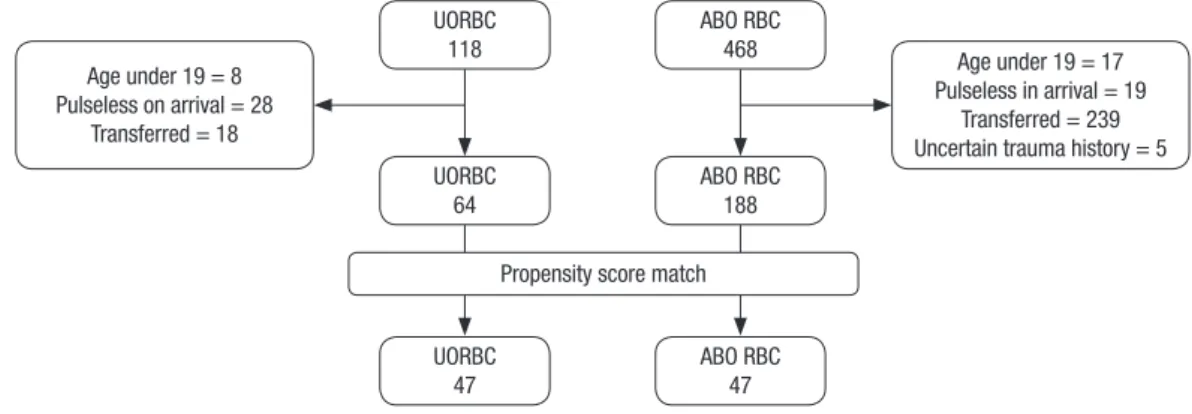
Data from 586 patients were included; after exclusion, data
from 252 patients were reviewed (Fig. 2). UORBCs and ABO RBCs were administered to 64 and 188 patients, respectively.
The median age was 47 years and men were dominant in both groups. The UORBC group was older and the vital signs differed significantly from those of the ABO RBC group. Transfusion time was much shorter in the UORBC group, about 11 minutes from admission to the ER. A total of 24 patients from UORBCs
Table 1. Patient baseline characteristics
Parameters Total (n = 252) UORBC (n = 64) ABO RBC (n = 188) P
Age, yr 48 (35–59) 53 (38–68) 46 (33–55) 0.004*
Sex M F
194 (77.0) 58 (23)
45 (70.3) 19 (29.7)
149 (79.3) 39 (20.7)
0.142
Transfusion time, min 35 (20–63) 11 (7–16) 44 (29–72) < 0.001*
Lactic acid, mmol/L 4.00 (2.78–5.89) 4.61 (3.12–6.80) 3.93 (2.73–5.82) 0.215
SBP, mmHg 108 (80–130) 98 (75–131) 109 (81–130) 0.327
HR, /min 95 (80–116) 100 (74–122) 94 (80–114) 0.834
RR, /min 20 (16–26) 21 (16–27) 19 (16–24) 0.040*
BT, °C 36.1 (36.0–36.7) 36.4 (36.0–37.0) 36.0 (35.9–36.6) 0.015*
GCS 12 (5–15) 10 (3–15) 13 (5–15) 0.074
ISS 25 (17–34) 27 (19–38) 25 (16–34) 0.122
Head AIS 2 (0–4) 3 (0–5) 1 (0–4) 0.135
Face AIS 0 (0–2) 0 (0–2) 0 (0–1) 0.567
Thorax AIS 3 (0–3) 3 (0–3) 3 (0–3) 0.237
Abdomen AIS 2 (0–3) 2 (0–3) 2 (0–3) 0.691
Extremity AIS 2 (0–3) 3 (2–3) 2 (0–3) 0.102
External AIS 0 (0–1) 0 (0–1) 0 (0–1) 0.896
pRBC in 24 hr, U 8 (4–17) 10 (4–18) 8 (3–17) 0.284
FFP in 24 hr, U 5 (2–12) 8 (3–14) 5 (1–11) 0.047*
Plt. in 24 hr, U 2 (0–16) 8 (0–16) 0 (0–9) 0.028*
ICU LOS, day 5 (0–16) 11 (5–23) 3 (0–14) < 0.001*
Emergency surgery 196 (77.8) 51 (79.7) 145 (77.1) 0.671
Mortality in 24 hr 30 (11.9) 8 (12.5) 22 (11.7) 0.865
Mortality in hospital 83 (32.9) 24 (37.5) 59 (31.4) 0.368
Injury Blunt
Penetrate 223 (88.5)
29 (11.5) 60 (93.8)
4 (6.3) 163 (86.7)
25 (13.3)
0.127
Values in parenthesis are median (quartile) or number (%).
*P < 0.05.
UORBC = uncross-matched type O packed red blood cell, ABO RBC = ABO type-specific packed red blood cell, SBP = systolic blood pressure, HR = heart rate, RR = respiratory rate, BT = body temperature, GCS = Glasgow Coma Scale score, ISS = Injury Severity Score, AIS = Abbreviated Injury Score, pRBC = packed red blood cell, FFP = fresh frozen plasma, Plt. = platelets, ICU LOS = intensive care unit length of stay.
Fig. 2. Diagram of the study population.
UORBC = uncross-matched type O packed red blood cell, ABO RBC = ABO type-specific packed red blood cell.
UORBC 118
UORBC 64
UORBC 47 Age under 19 = 8
Pulseless on arrival = 28 Transferred = 18
Age under 19 = 17 Pulseless in arrival = 19
Transferred = 239 Uncertain trauma history = 5 ABO RBC
188 ABO RBC
468
ABO RBC 47 Propensity score match
and 59 patients from ABO RBCs were deceased by as follow;
UORBC (bleeding 6, central nervous system 13, multi-organ failure/sepsis 5), ABO RBC (bleeding 14, central nervous sys- tem 25, multi-organ failure/sepsis 19, cardiogenic 1). Although mortality did not differ significantly between groups, but the ICU LOS was significantly longer in the UORBC group (Table 1).
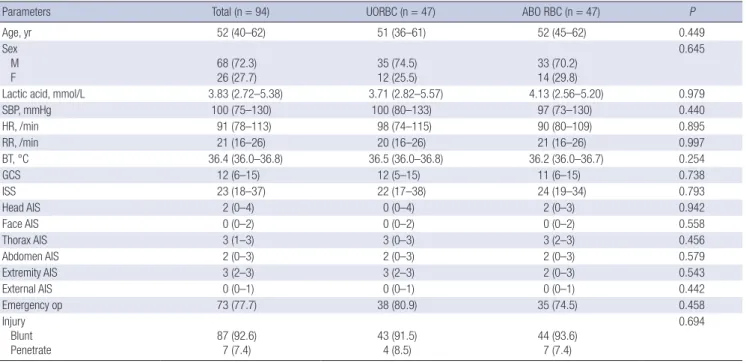
Clinical outcomes after propensity matching
After propensity matching, 47 patients were selected from each group; of these, the selected parameters did not differ signifi- cantly between groups (Table 2). Transfusion time was still short- er in UORBC group, but mortality, ICU LOS, and the amount of transfusion were not significantly different. However, although there was no statistical difference, the 24-hour mortality in UO- RBC group was more than half that of the ABO RBC group (4 [8.5%] vs. 9 [13.8%], P = 0.135) and the rate of massive transfu- sions was less in the UORBC group (21 [44.7%] vs. 29 [61.9%], P = 0.098) (Table 3).
Adverse effects of UORBCs
Of the 64 patients in the UORBC group, 48 showed discordant blood type (A = 25, B = 15, AB = 8, and O = 16). All patients were Rhesus (Rh)-positive. No transfusion-related critical adverse ef- fect occurred in either group.
DISCUSSION
The time to transfusion from arrival to the trauma bay was short-
er after the establishment of the new blood bank system. Alth- ough mortality was not statistically different between groups, it assumed that the UORBC group might have lower 24-hour mor- tality.
Transfusion is important in hemorrhagic shock patients and is emphasized in recent Advanced Trauma Life Support (10). In addition, Powell et al. (11) suggested that time to transfusion is important and that delay in time to pRBC administration of as short as 10 minutes was associated with increased mortality.
Brown et al. (12) reported that prehospital UORBC transfusion improved clinical outcomes in severe blunt trauma patients.
Hence, UORBCs are essential to traumatic shock patients for fast transfusion.
Table 2. Patient characteristics after propensity matching
Parameters Total (n = 94) UORBC (n = 47) ABO RBC (n = 47) P
Age, yr 52 (40–62) 51 (36–61) 52 (45–62) 0.449
Sex M
F 68 (72.3)
26 (27.7) 35 (74.5)
12 (25.5) 33 (70.2)
14 (29.8)
0.645
Lactic acid, mmol/L 3.83 (2.72–5.38) 3.71 (2.82–5.57) 4.13 (2.56–5.20) 0.979
SBP, mmHg 100 (75–130) 100 (80–133) 97 (73–130) 0.440
HR, /min 91 (78–113) 98 (74–115) 90 (80–109) 0.895
RR, /min 21 (16–26) 20 (16–26) 21 (16–26) 0.997
BT, °C 36.4 (36.0–36.8) 36.5 (36.0–36.8) 36.2 (36.0–36.7) 0.254
GCS 12 (6–15) 12 (5–15) 11 (6–15) 0.738
ISS 23 (18–37) 22 (17–38) 24 (19–34) 0.793
Head AIS 2 (0–4) 0 (0–4) 2 (0–3) 0.942
Face AIS 0 (0–2) 0 (0–2) 0 (0–2) 0.558
Thorax AIS 3 (1–3) 3 (0–3) 3 (2–3) 0.456
Abdomen AIS 2 (0–3) 2 (0–3) 2 (0–3) 0.579
Extremity AIS 3 (2–3) 3 (2–3) 2 (0–3) 0.543
External AIS 0 (0–1) 0 (0–1) 0 (0–1) 0.442
Emergency op 73 (77.7) 38 (80.9) 35 (74.5) 0.458
Injury Blunt
Penetrate 87 (92.6)
7 (7.4) 43 (91.5)
4 (8.5) 44 (93.6)
7 (7.4)
0.694
Values in parenthesis are median (quartile) or number (%).
UORBC = uncross-matched type O packed red blood cell, ABO RBC = ABO type-specific packed red blood cell, SBP = systolic blood pressure, HR = heart rate, RR = respiratory rate, BT = body temperature, GCS = Glasgow Coma Scale score, ISS = Injury Severity Score, AIS = Abbreviated Injury Score.
Table 3. Clinical outcomes after propensity score matching
Outcomes Total
(n = 94) O RBC
(n = 47) ABO RBC
(n = 47) P
Transfusion time, min 26 (10–47) 10 (6–15) 40 (28–71) < 0.001*
Mortality in 24 hr 13 (13.8) 4 (8.5) 9 (13.8) 0.135
Mortality 32 (34.0) 14 (29.8) 18 (38.3) 0.384
ICU LOS, day 8 (3–18) 9 (4–19) 5 (0–19) 0.155
Massive transfusion 50 (53.2) 21 (44.7) 29 (61.9) 0.098 pRBC in 24 hr, U 10 (4–18) 8 (4–18) 11 (5–18) 0.386
FFP in 24 hr, U 7 (2–14) 5 (2–13) 7 (3–14) 0.727
Plt in 24 hr, U 8 (0–15) 8 (0–16) 2 (0–8) 0.656
Values in parenthesis are median (quartile) or number (%).
*P < 0.05.
O RBC = type O packed red blood cell, ABO RBC = ABO type-specific packed red blood cell, ICU LOS = intensive care unit length of stay, pRBC = packed red blood cell, FFP = fresh frozen plasma, Plt. = platelets.
Lee et al. (13) described UORBC transfusions in Korea, but it took about 35 minutes for UORBC and 170 minutes for ABO RBC. In the current study, the new blood bank system in the trauma bay reduced the time for UORBC transfusion to about 11 minutes. Moreover, the time to ABO RBC administration was 44 minutes in this study, similar to the UORBC time in Lee’s re- port (13). Therefore, in order to more quickly utilize UORBCs, they should be prepared in the ER or trauma bay. Blood banks far from the ER or trauma bay would not be very effective com- pared to ABO RBCs. However, blood bank management may be difficult due to the lack of blood specialists in the trauma bay.
In our center, UORBCs were managed by nurses in the trauma bay, therefore, other blood products such as fresh frozen plas- ma or concentrated platelets could not be prepared.
The improved clinical outcomes following early transfusion in trauma patients remain controversial. Prehospital pRBCs transfusion has been tried, but the results were inconclusive (14,15). However, these studies had heterogeneous groups. In contrast, the present study used propensity score matching to make a homogenous group. The clinical outcomes were not significantly different in the current study, but all clinical out- comes were better in the UORBC group except for the ICU LOS, which was significantly longer in the UORBC group before mat- ching. Especially, the number of 24-hour mortality, which could reflect death due to bleeding, was more than double in ABO RBC groups. Because the condition of the patients in the UO- RBC group was more severe than that of the patients in the ABO RBC, the group might be homogenous even after matching. It was expected that UORBC group could be more severe. Never- theless, UORBC has potential benefits and non-inferior results at least; therefore, it seems acceptable to utilize UORBCs. Fur- ther study is required to determine the efficacy of UORBC trans- fusions and more specific inclusion criteria would be needed.
About half of the patients received massive transfusion after matching in this study. Unlike pRBCs, fresh frozen plasma or platelets could not be used immediately. However, early trans- fusion other than pRBCs was assessed (16,17) because blood product ratios of 1:1:1 have been emphasized in severe trauma patients (18-20). Recently, Yazer et al. (21) demonstrated the feasibility of cold-stored uncross-matched whole blood trans- fusion in civilian trauma patients, which resulted in faster 1:1:1 transfusions. Larger randomized trials are needed, but whole blood transfusion might be considered in the future.
In the current study, no transfusion-related critical adverse effects occurred in the UORBC group despite the fact that 75%
of patients had ABO blood type mismatch. ABO mismatch is a well-known factor for alloimmunization (22), but type O pRBCs rarely result in critical reactions (23). Mulay et al. (24) reported acute hemolytic adverse reactions in 0.02% of UORBC transfu- sions and other adverse reaction in less than 0.3% of cases. It was less than probability of hemolytic reaction related with ex-
cept ABO blood type (25). Moreover, the Rh negativity rate is about 0.1%–0.3% in Korea; thus, Rh-positive UORBCs could be safely utilized (26).
Our study had several limitations. First, there could be hid- den variables in the propensity matching, which could affect the group homogeneity after matching. Second, not all cases of UORBC followed the indications. Third, this retrospective study had an insufficient number of patients.
In conclusion, the utilization of UORBCs resulted in faster transfusions, but did not improve the clinical outcomes in hem- orrhagic shock patients in this study. However, there was a ten- dency for UORBC lower mortality and fewer massive transfu- sions. Larger studies are needed to assess the efficacy of UO- RBC transfusion.
ACKNOWLEDGMENT
The authors thank Dr. Young Ae Lim, Department of Laborato- ry Medicine, Ajou University School of Medicine, for her blood bank and blood product support in this study.
DISCLOSURE
The authors have no potential conflicts of interest to disclose.
AUTHOR CONTRIBUTION
Conceptualization: Kang BH, Lee JC. Data curation: Kang BH, Choi D, Kwon J, Huh Y, Moon J, Kim Y, Jung K, Lee JC. Investiga- tion: Kang BH, Choi D, Kwon J, Huh Y, Moon J, Kim Y, Jung K, Lee JC. Writing - original draft: Kang BH, Kwon J, Lee JC.
ORCID
Byung Hee Kang https://orcid.org/0000-0003-3204-3251 Donghwan Choi https://orcid.org/0000-0001-7596-4371 Junsik Kwon https://orcid.org/0000-0003-3164-4995 Yo Huh https://orcid.org/0000-0002-1220-1534
Jonghwan Moon https://orcid.org/0000-0002-4630-3301 Younghwan Kim https://orcid.org/0000-0003-3836-8743 Kyoungwon Jung https://orcid.org/0000-0001-7895-0362 John-Cook Jong Lee https://orcid.org/0000-0002-5468-3340
REFERENCES
1. Ahn E, Choi SH, Kim JY, Park JH, Cho YD. Analysis of trauma patients with massive transfusion in the emergency department. Korean J Blood Trans- fus 2016; 27: 130-6.
2. Bjerkvig CK, Strandenes G, Eliassen HS, Spinella PC, Fosse TK, Cap AP, Ward KR. “Blood failure” time to view blood as an organ: how oxygen debt contributes to blood failure and its implications for remote damage con- trol resuscitation. Transfusion 2016; 56 Suppl 2: S182-9.
3. Alarhayem AQ, Myers JG, Dent D, Liao L, Muir M, Mueller D, Nicholson S, Cestero R, Johnson MC, Stewart R, et al. Time is the enemy: mortality in trauma patients with hemorrhage from torso injury occurs long before the “golden hour”. Am J Surg 2016; 212: 1101-5.
4. Brown JB, Sperry JL, Fombona A, Billiar TR, Peitzman AB, Guyette FX.
Pre-trauma center red blood cell transfusion is associated with improved early outcomes in air medical trauma patients. J Am Coll Surg 2015; 220:
797-808.
5. Schwab CW, Shayne JP, Turner J. Immediate trauma resuscitation with type O uncrossmatched blood: a two-year prospective experience. J Trau- ma 1986; 26: 897-902.
6. Dutton RP, Shih D, Edelman BB, Hess J, Scalea TM. Safety of uncrossmatch- ed type-O red cells for resuscitation from hemorrhagic shock. J Trauma 2005; 59: 1445-9.
7. Auten JD, Lunceford NL, Horton JL, Galarneau MR, Galindo RM, Shepps CD, Zieber TJ, Dewing CB. The safety of early fresh, whole blood transfu- sion among severely battle injured at US Marine Corps forward surgical care facilities in Afghanistan. J Trauma Acute Care Surg 2015; 79: 790-6.
8. Kang BH, Jung KW, Heo YJ, Lee CJ. Safety and efficacy of type-O packed red blood cell transfusion in traumatic hemorrhagic shock patients: pre- liminary study. J Acute Care Surg 2017;7:50-55.
9. Korea Centers for Disease Control and Prevention. Transfusion. 2nd rev.
ed. [Internet]. Available at http://www.cdc.go.kr/CDC/contents/CdcKr- ContentLink.jsp?fid=51&cid=24064&ctype=1 [accessed on 6 June 2017].
10. ATLS Subcommittee; American College of Surgeons’ Committee on Trau- ma; International ATLS working group. Advanced trauma life support (ATLS®): the ninth edition. J Trauma Acute Care Surg 2013; 74: 1363-6.
11. Powell EK, Hinckley WR, Gottula A, Hart KW, Lindsell CJ, McMullan JT.
Shorter times to packed red blood cell transfusion are associated with decreased risk of death in traumatically injured patients. J Trauma Acute Care Surg 2016; 81: 458-62.
12. Brown JB, Cohen MJ, Minei JP, Maier RV, West MA, Billiar TR, Peitzman AB, Moore EE, Cuschieri J, Sperry JL, et al. Pretrauma center red blood cell transfusion is associated with reduced mortality and coagulopathy in severely injured patients with blunt trauma. Ann Surg 2015; 261: 997-1005.
13. Lee JH, Choa M, Cho J, Chung SP. Validity of transfusing group O+ unmat- ched packed red blood cells in hemorrhagic shock patients. J Korean Soc Traumatol 2009; 22: 167-71.
14. Holcomb JB, Swartz MD, DeSantis SM, Greene TJ, Fox EE, Stein DM, Bul- ger EM, Kerby JD, Goodman M, Schreiber MA, et al. Multicenter obser-
vational prehospital resuscitation on helicopter study. J Trauma Acute Care Surg 2017; 83: S83-91.
15. Smith IM, James RH, Dretzke J, Midwinter MJ. Prehospital blood product resuscitation for trauma: a systematic review. Shock 2016; 46: 3-16.
16. Blumberg N. ABO mismatched platelet transfusions in trauma patients.
CMAJ 2014; 186: 63.
17. Hagiwara A, Kushimoto S, Kato H, Sasaki J, Ogura H, Matsuoka T, Uejima T, Hayakawa M, Takeda M, Kaneko N, et al. Can early aggressive adminis- tration of fresh frozen plasma improve outcomes in patients with severe blunt trauma?--a report by the Japanese Association for the Surgery of Trauma. Shock 2016; 45: 495-501.
18. Holcomb JB, Tilley BC, Baraniuk S, Fox EE, Wade CE, Podbielski JM, del Junco DJ, Brasel KJ, Bulger EM, Callcut RA, et al. Transfusion of plasma, platelets, and red blood cells in a 1:1:1 vs a 1:1:2 ratio and mortality in pa- tients with severe trauma: the PROPPR randomized clinical trial. JAMA 2015; 313: 471-82.
19. Holcomb JB, Fox EE, Wade CE; PROMMTT Study Group. The PRospec- tive Observational Multicenter Major Trauma Transfusion (PROMMTT) study. J Trauma Acute Care Surg 2013; 75: S1-2.
20. Kim Y, Lee K, Kim J, Kim J, Heo Y, Wang H, Lee K, Jung K. Application of damage control resuscitation strategies to patients with severe traumatic hemorrhage: review of plasma to packed red blood cell ratios at a single institution. J Korean Med Sci 2014; 29: 1007-11.
21. Yazer MH, Jackson B, Sperry JL, Alarcon L, Triulzi DJ, Murdock AD. Initial safety and feasibility of cold-stored uncrossmatched whole blood trans- fusion in civilian trauma patients. J Trauma Acute Care Surg 2016; 81: 21-6.
22. Delaney M, Wendel S, Bercovitz RS, Cid J, Cohn C, Dunbar NM, Apelseth TO, Popovsky M, Stanworth SJ, Tinmouth A, et al. Transfusion reactions:
prevention, diagnosis, and treatment. Lancet 2016; 388: 2825-36.
23. Branch DR. Anti-A and anti-B: what are they and where do they come from? Transfusion 2015; 55 Suppl 2: S74-9.
24. Mulay SB, Jaben EA, Johnson P, Badjie K, Stubbs JR. Risks and adverse outcomes associated with emergency-release red blood cell transfusion.
Transfusion 2013; 53: 1416-20.
25. Goodell PP, Uhl L, Mohammed M, Powers AA. Risk of hemolytic transfu- sion reactions following emergency-release RBC transfusion. Am J Clin Pathol 2010; 134: 202-6.
26. Korean Red Cross. Title [Internet]. Available at http://www.bloodinfo.net/
bloodknowledge_bloodtype.do [accessed on 6 June 2017].