553
©The Korean Society of Food Science and Technology
마늘 특이 유기화합물의 분리 및 정제
오태영·경규항*
세종대학교 식품공학과
Isolation and Purification of Garlic Specific Organic Compounds
Tae Young Oh and Kyu Hang Kyung*
Department of Food Science and Technology, Sejong University
Abstract Garlic specific organic compounds were separated and purified using a recycling preparative high-performance liquid chromatography (HPLC) from blanched garlic cloves. Identification of the compounds involved comparing the previously reported HPLC retention times as well as other identification methods including 1H- and 13C-nuclear magnetic resonance and liquid chromatography-mass spectrometry. The yields of garlic specific organic compounds were 12.2, 42.5, 1.6, 1.2, and 4.8% on wet weight basis of garlic for alliin(S-allyl-L-cysteine sulfoxide), isoalliin(S-1-propenyl-L-cysteine sulfoxide), γ-glutamyl-S-allylcysteine, γ-glutamyl-S-1-propenylcysteine and γ-glutamyl-phenylalanine, respectively. All the compounds, except for γ-glutamylphenylalanine, contained sulfur.
Keywords: garlic, alliin, isoalliin, γ-glutamyl-S-allylcysteine, γ-glutamyl-S-1-propenylcysteine, γ-glutamylphenylalanine
서
론
마늘에는 다른 채소나 과일 등에 비해 매우 많은 유기황화합 물이 들어있는 것이 특징이며(1), 이들 유기황화합물 때문에 특 이한 냄새와 강력한 항균작용 등을 갖는다. 대표적인 유기황화합 물로는 알린(alliin), 이소알린(isoalliin) 및 메틴(methiin) 등 3종의 S-alk(en)yl-L-cysteine sulfoxides가 0.6-1.9% 정도 들어있으며, 비슷 한 양의 γ-glutamyl-L-cysteine 유도체인 peptide류 등이 특이성분 으로 들어있다(1-3).
마늘에는 알리신(allicin)의 전구물질인 알린 외에도 알린의 이 성체인 이소알린이 있으며(1,4,5), 유사한 구조를 가지는 물질 (homolog)로서 메틴(S-methyl-L-cysteine sulfoxide)이 있으나 이 물 질은 양배추나 브로콜리를 포함하는 십자화과 채소에 흔히 들어 있어서 마늘의 특이물질은 아니다. 알린은 전체 sulfoxides의 85% 정도를 차지하고 메틴은 10%, 이소알린은 5% 이내의 비율이라 고 알려져 있다(6). 마늘은 재배된 기후 조건에 따라서 sulfoxide 성분함량의 차이를 보이는데, 기후가 추운 지역에서 재배된 마늘 이 따뜻한 기후에서 재배된 마늘보다 알린 함량이 높고 메틴 함 량이 낮으며(7), 품종별, 재배 산지별로 마늘의 알린 함량은 0.6-1.7%로 다양한 범위를 나타내었다(8-10). 마늘 고유의 천연 성분 중 알린은 마늘 향미에 가장 기여도가 높은 대표적인 물질로서 알리신을 포함하는 여러 가지 종류의 thiosulfinate의 전구물질이며 수용성이다(11). 3가지 sulfoxide류는 alliinase효소의 작용을 받아 알리신 등의 thiosulfinates을 생성하며, 이 물질은 마늘 냄새의 주요 물질이다. 마늘의 thiosulfinates는 항 산화, 항암작용, 면역조절기능, 항심혈관질환, 콜레스테롤 감소 및 혈소판 응고 등의 건강증진작용이 있다고 알려져 있음은 물론 (12), 마늘의 항균작용(2,13)이나 가공 중에 나타나는 녹변(14,15) 에 직접적으로 관여한다. 따라서 이러한 연구 등의 목적으로 알 린을 포함하는 마늘 고유 성분의 필요성은 높으나 순수정제가 매 우 어렵기 때문에 구하기 쉬운 인공합성 라세미 혼합물(racemic mixture)을 사용하기도 한다. 마늘에는 이상에 언급한 3종의 sulfoxide 외에도 유기황화합물 로서 γ-glutamyl-L-cysteine의 유도체인 펩타이드류가 2 종류가 함 유되어 있는데, 이들 펩타이드는 이소알린의 전구물질이기도 하 다(16). 마늘은 저장되는 동안에 γ-glutamyl-S-allyl-L-cysteine과 γ-glutamyl-S-1-propenyl-L-cysteine은 transpeptidase에 의해 S-allyl-cysteine과 S-1-propenyl-cysteine으로 전환된다(8,17-20). γ-Glutamylphenylalanine은 γ-glutamyl peptide의 일종이지만 L-cys-teine의 유도체가 아니어서 황을 함유하지 않는 마늘 특이 물질이다. 본 논문에서는 마늘의 항균작용, 건강증진작용 및 변색작용의 연구에 활용하기 위해 마늘에 특이적으로 들어있는 유기물질들 의 분리 정제를 수행하였다.
재료 및 방법
재료 본 실험에 사용한 마늘은 인터넷을 통하여 전국 각 지역에서 구입하였다. L(+)Alliin은 LKT Laboratories, Inc.(St. Paul, MN, USA)에서 구입하였고, 물, 메탄올 및 dichloromethane 등의 용매 는 Burdick & Jackson(Ulsan, Korea)에서 구입하였다.마늘즙 제조
마늘즙 제조는 이전에 보고된 방법(21)을 사용하였다. 마늘을 박피한 후 80oC에서 15분간 데쳐 alliinase를 불활성화시킨 후 수
*Corresponding author: Kyu Hang Kyung, Department of Food Sci-ence and Technology, Sejong University, Seoul 143-747, Korea Tel: 82-2-3408-3225
Fax: 82-2-3408-4319
E-mail: [email protected]
Received April 6, 2011; revised July 13, 2011; accepted July 14, 2011
554 한국식품과학회지 제 43 권 제 5 호 (2011) 돗물로 냉각시켰으며, 동량의 증류수를 넣어 분쇄 후 착즙하였
다. 착즙액을 17,600×g에서 30분간 원심분리(HMR-2001V, Hanil Industrial Co., Inchon, Korea)하여 불용성 침전물을 제거하였고 상 층액에 최종농도가 70%가 되도록 에탄올을 첨가하여 당, 단백질 등을 침전을 시켜 제거한 후 상층액의 부피가 50%가 되도록 진 공농축(rotary vacuum evaporator, N-H Series, Eyela, Tokyo, Japan)하였다. 농축 마늘액에 dichloromethane을 동량 혼합하여 지 질을 제거하였으며, 잔여물층은 다시 부피가 50% 되도록 진공농 축였다. 농축마늘즙은 여과(0.2 µm nylon membrane filter, What-man International LTD, Kent, UK)하여 마늘 특이성분 분리용 원 료로 사용하였다.
Recycling preparative HPLC를 이용한 분리 및 정제 전처리를 마친 마늘즙을 재순환 분취(recycling preparative) HPLC(JAI-LC 908, Japan Analytical Industry Corp., Tokyo, Japan)와 JAI UV 3702 검출기를 사용하여 1차 분획하였다. 1차 분획시에는 gel permeation chromatography(GPC) column (Jaigel W-252 column, 500×20.0 mm i.d., Japan Analytical Industry Corp.)을 사용하였다. 100% 물을 이동상으로 3 mL/min의 유속으 로 4개의 구간으로 분획 받았으며, 매 회마다 마늘즙 시료 20 mL를 주입하였다. 1차 분획받은 4개의 구간을 재순환하여 순수 정제하였으며, 각 구간을 정제할 때 정제효율이 높일 수 있도록 해당 목적에 맞는 적절한 컬럼을 사용하였다. 1구간은 Polar-RP column(250×21.2 mm, Phenomenex Corp., Torrance, CA, USA)과 Luna 10U C-8 column(250×21.2 mm, Phenomenex Corp.)을 연속적으로 사용하였 다. 2구간은 C-18 column(Jaigel C-18 column, 250×20.0 mm i.d., Japan Analytical Industry Corp.)을 사용하였다. 3구간과 4구간은 gel permeation chromatography(GPC) column(Jaigel W-252 col-umn, 500×20.0 mm i.d., Japan Analytical Industry Corp.)으로 정 제 하였으며, 이동상은 10% methanol/water로 하여 3 mL/min의 유속으로 실시하였다. 주입량은 5 mL 이내로 하였다. 마늘 화합물의 확인 마늘 성분 분석용 HPLC의 용매와 조건은 Arnault 등(22)의 방 법을 변경하여 사용하였다. 재순환 분취 HPLC를 이용하여 분취 한 각 구간은 역상컬럼인 Luna 3U C18(4.6 mm×150 mm×3 µm, Phenomenex Inc.)이 장착된 P680 HPLC(Dionex Corp., Hessen, Germany)를 사용하여 분석하였고, 용매는 A용매(20 mM sodium phosphate monobasic dihydrate+10 mM sodium 1-heptane-sulfonic acid, pH 2.1(85% orthophosphoric acid로 pH 조정))와 B용매(A용 매:acetonitrile=50:50)를 사용하였다. 구배용리법을 이용하였으며, 이동상의 비율은 A/B가 93:7로 시작하였으며 50분이 될 때 50:50 의 비율이 되도록 일정한 속도로 증가시켰다. 50:50의 비율을 55 분까지 유지한 후 60분에 93:7이 되도록 조정한 후 이를 80분까 지 일정하게 유지시켰다. 유속은 0.5 mL/min, 주입량은 20 µL로 하였으며, 208 nm에서 정성분석하였다. 질량분석
순수분리한 물질을 질량분석기(Mass spectrometer; MS; Thermo Finnigan LCQ DECA XP, West Palm Beach, FL, USA)를 사용 하여 분자량을 측정하였으며 이온화는 전자분무이온화(electrospray ionization)방식을 사용하였고, positive polarity로 하였다. 분석타입 은 Ion trap analyzer, 스캔범위는 50-1000 m/z이였다.
NMR 분석
순수정제한 물질을 중수(D2O)에 용해시킨 뒤 1H-NMR와 13
C-NMR (Ultrashield, Avance 500 MHz, Bruker, Rheinstetten, Ger-many)분석을 실시하였다(23). 발진기의 주파수는 1H-NMR은 500 MHz, 13C-NMR은 125 MHz에서 실시하였으며, chemical shift(δ unit)는 ppm으로 표시하였다.
결과 및 고찰
마늘추출액의 성분 분석 전처리한 마늘로부터 얻은 마늘즙 시료를 HPLC로 분석한 결 과, 8개의 대표적인 성분이 나타났다(Fig. 1). 정제를 진행하면서 동시에 Fig. 1에 나타난 성분들과 비교하여 해당 성분의 동정을 수행하였다. 마늘 특이 유기성분의 분리 및 정제 마늘의 성분 분획 W-252 column을 장착한 분취 HPLC를 사용하여 마늘추출물을 1차로 4구간으로 분획하였고(Fig. 2) 각 구간의 획분을 다시 재순 환 분취 HPLC를 이용하여 각 구간마다 주요 피크들을 순수 정 제하였다. 제 3, 4구간은 각각 tyrosine과 phenylalanine으로, 그리 고 제 5구간은 tryptophan으로 확인되어 마늘 특이 성분이 아니 었으므로 분리정제에 포함시키지 않았다.Fig. 1. Analytical HPLC chromatogram of garlic extract heated at 85oC for 10min. 1; alliin, 2; isoalliin, 3; histidine, 4; γ-glutamyl-S-allylcysteine, 5; phenylalanine, 6; γ-glutamyl-S-1-propenylcysteine, 7; γ-glutamylphenylalanine, 8; tryptophan.
마늘성분 제 1구간의 분리 정제
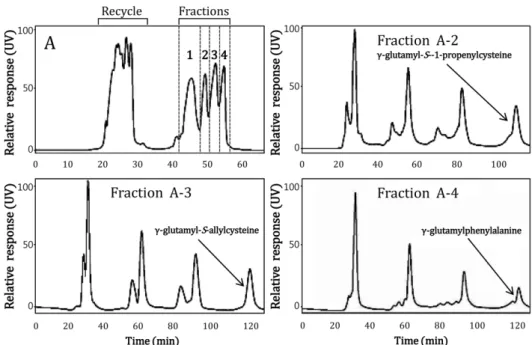
제 1구간을 polar RP 컬럼을 이용해 20분과 30분 사이의 머무 름 시간(retention time)을 가지는 획분을 1회 재순환하여 Fig. 3의 A와 같이 네 개의 구간으로 나누었다. 이들 각각을 HPLC 분석 하였을 때 가장 앞에 나오는 것은 제 2구간에서 혼입되어 들어 온 알린과 이소알린의 혼합물이었고 그 뒤로 연속해서 나오는 3 개의 피크들이 각각 γ-glutamyl-S-1-propenylcysteine(fraction A-2, Fig. 3), glutamyl-S-allylcysteine(fraction A-3, Fig. 3), γ-glutamylphenylalanine(fraction A-4, Fig. 3)등 3가지 펩타이드를 포 함하고 있었다. 각각의 펩타이드를 포함하고 있는 3개의 주요 구 간의 획분을 받아 C-8 컬럼을 이용하여 재순환하여 순수 정제되 었다. 제 2구간의 분리 정제 제 2구간(Fig. 2)을 C-8 컬럼을 이용하여 재순환하여 2개의 주 요 성분으로 분리하여(Fig. 4) Fig. 1의 마늘 성분과 비교하였을 때 1번과 2번 성분인 알린과 이소알린으로 동정되었다(22,24,25). 이상과 같은 방법으로 마늘 6 kg을 처리하여 얻은 마늘즙으로부 터 정제한 물질들을 동결건조한 뒤 수득율을 계산한 결과는 Table 1과 같다. 수득율은 마늘에 함유된 화합물의 평균함량을 기준으 로 마늘 6 kg에서 정제해 얻은 물질의 비율로 계산하였다. 마늘 의 고유성분으로 확인된 알린, 이소알린, γ-glutamyl-S-1-propenyl-cysteine, γ-glutamyl-S-allylcysteine, γ-glutamylphenylalanine만을 최 종 정제하였다. 대당 정제 효율은 높지 않아 대개 5% 범위에 속 하였으며, 단지 이소알린만은 정제수율이 40%를 초과하였다. 알 린과 이소알린을 분리정제한 재순환 분취 HPLC의 크로마토그램 을 보면, 이소알린이 많은 알린의 일부로 혼합되어 있다가 이소 알린이 최종적으로 알린으로부터 정제되기 때문에 손실이 적었 던 것으로 추정되었다. 마늘 특유물질 중에서 이소알린의 수득율이 비교적 가장 높았 으며, 알린의 수득율은 그에 미치지는 못하였으나 12%를 초과하 는 비교적 높은 %를 나타내었다. 마늘에는 γ-glutamyl 펩타이드 류의 함량이 매우 낮아서(6) 작은 손실이라고 하더라도 수득률에 큰 영향을 미치기 때문에 수득률이 5% 또는 그 이하로 낮게 나 타났다. 마늘에 이들 물질의 함량은 알린(0.5-1.5%), 이소알린(0.02-0.12%), γ-glutamyl-S-allylcysteine(0.2-0.6%), γ-glutamyl-S-1-prope-nylcysteine(0.3-0.9%) 및 γ-glutamylphenylalanine(0.04-0.11%)으로 보고되었다(6,10,24,26,27). 정제한 마늘 유기성분의 HPLC, LC/MS 분석 및 NMR을 이 용한 동정 본 연구에서 최종적으로 정제대상이 된 마늘 특유의 물질들은 알린, 이소알린, γ-glutamyl-S-1-propenylcysteine, γ-glutamyl-S-allyl-cysteine 등과 같이 황을 함유하는 아미노산이나 펩타이드류와, 황 을 함유하지 않는 일종의 다이펩타이드인 γ-glutamylphenylalanine 이었다. 황을 포함하는 펩타이드 중에서 γ-glutamyl-S-1-propenyl-cysteine는 그 함량이 매우 낮아서(6,8,24) 정제하지 않았다. 마늘에서 분리 정제한 마늘 특이 물질들은 HPLC 분석에 의해 Fig. 5와 같이 머무름 시간을 비교함으로서 동정하였고(22) 추가 로 LC/MS와 1H-NMR과 13C-NMR 구조분석을 실시하여 확인하 였다(Table 2). 마늘 성분들 중 1번과 2번 피크의 분자량은 177이었으며, 생 마늘즙에서는 나타나지 않지만 효소를 불활성화시킨 마늘에서는 Fig. 3. Separation and purification of γ-glutamyl peptides in the fraction #1 using recycling preparative HPLC.
Fig. 4. Separation and purification of alliin and isoalliin in the fraction #2 using recycling preparative HPLC.
556 한국식품과학회지 제 43 권 제 5 호 (2011) 분석되는 것으로 보아 알린과 이소알린으로 추정되었다. 4번과 6 번 피크는 분자량이 290으로 glutamyl-S-allylcysteine 또는 γ-glutamyl-S-1-propenylcysteine으로 추정되었다. 7번 피크는 분자량 294인 물질이었고 마늘에는 분자량 294인 물질이 γ-glutamylphe-nylalanine가 유일한 것이었기 때문에 성분의 추정이 용이하였다. LC/MS 분석을 통하여 알린과 이소알린으로 추정된 분자량 177 의 물질 두 개는 1H-NMR로 분석한 결과(23) 두 개의 물질은 다 른 것으로 확인되었다. 분자량 177을 가지는 물질 중 분석용 HPLC로 분석하였을 때 Fig. 2의 1번 피크는 알린으로 그리고 2 번 피크는 이소알린으로 확인되었다. 이 두 물질의 중요한 차이 점은 이중결합의 위치에 따라 1.99 ppm과 3.68 ppm에 나타나는 피크가 달랐다(Table 2). 특히 알린은 L(+)alliin 표준물질과 비교 하여 능동적으로 동정할 수 있었으나, 다른 마늘 특이물질은 표 준물질이 없으므로 능동적 동정이 불가능하였다. 분자량 290의 물질 중 Fig. 2의 4번 피크는 γ-glutamyl-S-allyl-cysteine로 확인되었고 이어서 나타나는 6번 피크는 γ-glutamyl-S-Table 1. Purification yields of garlic specific organic compounds
Garlic compounds Amounts (g) obtained from 6 kg garlic
Average contents in garlic (6,10,24,26,27)
Yield
(%; w/w on wet weight basis)
Alliin 7.32 1.00 15.6
Isoalliin 1.53 0.06 21.6
γ-Glutamyl-S-allylcysteine 0.38 0.40 6.67
γ-Glutamyl-S-1-propenylcysteine 0.42 0.60 10.0
γ-Glutamylphenylalanine 0.23 0.08 4.8
Fig. 5. Analytical HPLC chromatogram of purified garlic specific organic compounds.
Table 2. Purified organic compounds from garlic and their chemical information
Garlic compounds MW NMR Alliin 177 1H-NMR δ ppm 3.23 (d, 1H), 3.39-3.49 (m, 1H), 3.68 (dd, 1H), 3.88 (dd, 1H), 4.14 (br.s., 1H), 5.48-5.62 (m, 2H), 5.91-6.02 (m, 1H) Isoalliin 177 1H-NMR δ ppm 1.99 (d, 3H), 3.30 (dd, 1H), 3.49 (dd. 1H), 4.11-4.16 (m, 1H), 6.57 (d, 1H), 6.72-6.81 (m, 1H) γ-Glutamyl-S-allylcysteine 290 1H-NMR δ ppm 2.14-2.27 (m, 2H), 2.51-2.57 (m, 2H), 2.85 (dd, 1H), 3.00 (d, 1H), 3.03 (d, 1H), 3.23 (d, 2H), 3.78-3.84 (m, 1H), 4.39 (dd, 1H), 5.17-5.26 (m, 2H), 5.81-5.91 (m, 1H) 13C-NMR δ ppm 26.44, 31.77, 32.41, 34.12, 54.32, 54.39, 117.80, 133.90, 173.08, 174.19, 176.98 γ-Glutamyl-S-1-propenylcysteine 290 1H-NMR δ ppm 1.73-1.79 (m, 3H), 2.12-2.26 (m, 2H), 2.50-2.57 (m, 2H), 2.96 (dd, 1H), 3.20 (dd, 1H), 3.27 (t, 1H), 3.78-3.85 (m, 1H), 4.41 (dd, 1H), 5.82-5.91 (m, 1H), 6.02 (d, 1H) 13C-NMR δ ppm 17.71, 26.42, 31.85, 34.80, 54.37, 54.80, 121.45, 129.87, 174.02, 174.20, 176.86 γ-Glutamylphenylalanine 294 1H-NMR δ ppm 1.90-2.09 (m, 2H), 2.32-2.43 (m, 2H), 2.93 (dd, 1H), 3.22-3.29 (m, 1H), 3.61 (dd, 1H), 4.51 (dd, 1H), 7.29-7.35 (m, 3H), 7.37-7.42 (m 2H) 13C-NMR δ ppm 26.24, 31.83, 37.70, 54.25, 56.40, 126.80, 128.60, 129.22, 137.89, 173.82, 174.35, 178.22
1-propenylcysteine으로 확인되었다. 이 두 물질은 서로 구조이성 질체의 관계에 있으면서 이중결합을 가지는 탄소의 위치만 다르 고 다른 부분은 모두 같았다. 7번 피크(분자량 294)의 물질은 NMR 분석결과와 LC/MS의 결과를 종합하여 분석한 결과 γ-glutamylphenylalanine으로 판단되었다.
요
약
마늘의 천연 성분을 분석하였을 때 8개의 주요 성분이 나타났 으며, 가장 크게 나타난 피크는 알린이었고 실제로 함량도 가장 높게 나타났다. 이소알린은 알린의 뒤를 이어 큰 피크를 나타내 었고 함량도 알린에 이어 많은 양이 얻어졌다. 기타 마늘 특유의 함황유기화합물로서 γ-glutamyl peptide류가 있으며 함량이 충분 하여 분리 정제를 수행한 것으로는 glutamyl-S-allylcysteine, γ-glutamyl-S-1-propenylcysteine, γ-glutamylphenylalanine 등 3가지였 다. 기타 마늘 특유의 성분은 아니지만 UV 208 nm에서 흡광도 를 크게 나타내는 것으로 arginine, tyrosine, phenylalanine, tryp-tophan과 같은 일반적인 아미노산류가 있었지만, 본 연구에서는 마늘 특유의 아미노산과 펩타이드만을 정제하였다. 마늘 특이 아 미노산과 펩타이드의 분리정제는 재순환 분취 HPLC를 이용하여 순수하게 정제하였으며, 생마늘 6 kg으로부터 알린, 이소알린, γ-glutamyl-S-allylcysteine, γ-glutamyl-S-1-propenylcysteine, γ-glutamylphenylalanine이 각각 7.32, 1.53, 0.38, 0.42, 0.23 g을 얻 었으며 이를 마늘 함유량 대비 수율로 계산하면 각각 12.2, 42.5, 1.6, 1.2, 4.8%이었다. 정제한 물질들의 동정방법은 HPLC 머무름 시간의 비교 및 LC/MS를 이용한 분자량 측정이었다. 동일한 분 자량을 가지는 알린과 이소알린을 분별하기 위해 1H-NMR를 그 리고 γ-glutamyl-S-allylcysteine과 γ-glutamyl-S-1-propenylcysteine을 구별하기 위해 1H-NMR과 13C-NMR분석을 수행하였다.감사의 글
본 연구는 농림수산식품부 농림기술개발사업 지원을 받아 수 행한 연구로서 지원에 감사드립니다.문
헌
1. Reuter HD, Koch HP, Lawson LD. Therapeutic effects and appli-cations of garlic and its preparations. pp. 135-212. In: Garlic. The Science and Therapeutic Application of Allium sativum L. and Related Species, second edition. Koch HP, Lawson LD (eds). Williams & Wilkins, Baltimore, MD, USA (1996)
2. Lawson LD. Garlic: A review of its medicinal effects and indi-cated active compounds. In: Phytomedicines of Europe: Chemis-try & Biological Activity. Lawson LD, Bauer B (eds). ACS Symposium Series 691: 176-209 (1998)
3. Raghavan B, Abraham KO, Shankaranarayana ML. Chemistry of garlic and garlic products. J. Sci. Ind. Res. 42: 401-409 (1983) 4. Virtanen AI, Matikkala EJ. The isolation of
S-methylcysteine-sul-phoxide and S-n-propylcysteine sulS-methylcysteine-sul-phoxide from onion (Allium cepa) and the antibiotic activity of crushed onion. Acta Chem. Scand. 13: 1898-1900 (1959)
5. Fujiwara M, Yoshimura M, Tsuno S, Murakami F. “Allithimine”, A newly found derivative of vitamin B1. IV. On the alliin homo-logues in the vegetables. J. Biochem. 45: 141-149 (1958)
6. Lawson LD. The composition and chemistry of garlic cloves and processed garlic. pp. 37-107. In: Garlic: The Science and Thera-peutic Applications of Allium sativum L. and Related Species, 2nd
edition. Koch HP, Lawson LD (eds). William & Wilkins,
Balti-more, MD, USA (1996)
7. Block E, Naganathan S, Putman D, Zhao SH. Allium chemistry: HPLC analysis of thiosulfinates from onion, garlic, wild garlic (Ramsons), leek, scallion, shallot, elephant (greek-heated) garlic, chive, and Chinese chive. Uniquely high allyl to methyl ratios in some garlic samples. J. Agr. Food Chem. 40: 2418-2430 (1992) 8. Lawson LD, Wang ZJ, Hughes BG. γ-Glutamyl-S-alkylcysteines
in garlic and other Allium spp.: Precursors of age-dependent trans-1-propenyl thiosulfinates. J. Nat. Prod. 54: 436-444 (1991) 9. Hong GH, Lee SK, Koo MW. Alliin and fructan contents in
gar-lics, by cultivars and cultivating areas. J. Korean Soc. Hortic. 38: 483-488 (1997)
10. Hornikova J, Kubec R, Cejpek K, Velisek J, Ovesna J, Stavelik-ova H. Profiles of S-alk(en)ylcysteine sulfoxides in various garlic genotypes. Czech J. Food Sci. 28: 298-308 (2010)
11. Lawson LD. Allicin and other thiosulfinates and their precursors and transformation products from garlic and garlic products. pp. 306-320. In: Human Medicinal Agents from Plants. Kinghorn AD, Balandrin MF (eds). American Chemical Society, Washing-ton, DC, USA (1993)
12. Iciek M, Kwiecien I, Wlodek L. Biological properties of garlic and garlic-derived organosulfur compounds. Environ. Mol. Mutagen. 50: 247-265 (2009)
13. Walton L, Herbold M, Lindegren CC. Bactericidal effects of vapors from crushed garlic. Food Res. 1: 163-169 (1936)
14. Lukes TM. Factors governing the greening of garlic puree. J. Food Sci. 51: 1577, 1582 (1986)
15. Wang D, Nanding H, Han N, Chen F, Zhao G. 2-(1 H-pyrro-lyl)carboxylic acids as pigment precursors in garlic greening. J. Agr. Food Chem. 56: 1495-1500 (2008)
16. Virtanen AI. Studies on organic sulphur compounds and other labile substances in plants. Phytochemistry 4: 207-228 (1965) 17. Iberl B, Winkler G, Muller B, Knobloch K. Quantitative
determi-nation of allicin and alliin from garlic by HPLC. Planta Med. 56: 320-326 (1990)
18. Lawson LD, Wang ZJ. Changes in the organosulfur compounds released from garlic during aging in the water, dilute ethanol, or dilute acetic acid. J. Toxicol. 14: 214 (1995)
19. Matsuura H. Phytochemistry of garlic horticultural and processing procedure. pp. 55-69. In: Neutraceuticals: Designer Foods III. Garlic, Soy, and Licorice. Lachance PA (ed). Food & Nutrition Press, Trumbull, CN, USA (1997)
20. Lancaster JE, Shaw ML. γ-Glutamyl peptides in the biosynthesis of S-alk(en)yl-L-cysteine sulphoxides (flavour precursors) in Allium. Phytochemistry 28: 455-460 (1989)
21. Kyung KH, Kim MH, Park MS, Kim YS. Alliinase-independent inhibition of Staphylococcus aureus B33 by heated garlic. J. Food Sci. 67: 780-785 (2002)
22. Arnault I, Chrisrides JP, Mandon N, Haffner T, Kahane R, Auger J. High-performance ion-pair chromatography method for simulta-neous analysis of alliin, deoxyalliin, allicin and dipeptide precur-sors in garlic products using multiple mass spectrometry and UV detection. J. Chromatogr. A 991: 69-75 (2003)
23. Gunther H. NMR Spectrometry. John Wiley & Sons, Inc., New York, USA. pp. 15-49 (1980)
24. Ichikawa M, Ide N, Yoshida J, Yamaguchi H, Ono K. Determina-tion of seven organosulfur compounds in garlic by high-perfor-mance liquid chromatography. J. Agr. Food Chem. 54: 1535-1540 (2006)
25. Ziegler SJ, Sticher O. HPLC of S-alk(en)yl-L-cysteine derivatives in garlic including quantitative determination of (+)-S-allyl-L -cys-teine sulfoxide (alliin). Planta Med. 55: 372-378 (1989)
26. Yoo KS, Pike LM. Determination of flavor precursor compound S-alk(en)yl-L-cysteine sulfoxides by an HPLC method and their distribution in Allium species. Sci. Hortic.-Amsterdam 75: 1-10 (1998)
27. Kubec R, Dadakova E. Quantitative determination of S-alk(en)ylcysteine-S-oxides by micellar electrokinetic capillary chromatography. J. Chromatogr. A 1212: 154-157 (2008)