INTRODUCTION
Chronic alcohol consumption is the most prevalent etio- logic factor of hepatic fibrogenesis and cirrhosis (1). Ethanol is metabolized primarily by the alcohol dehydrogenase and the cytochrome P450 systems (2). Acetaldehyde generated by these oxidative pathways is accumulated due to slow kinetics of its oxidizing enzyme aldehyde dehydrogenase (3). Ethanol and acetaldehyde affect liver with directly generating reactive oxygen species (ROS) and indirectly producing transforming growth factor beta (TGF-β) (3). Patients with alcohol induced liver cirrhosis had significantly more leucine homozygous genotype polymorphism of TGF-β1 at codon 10 in Korean (4). TGF-βis a growth factor whose function is promotion of cell differentiation, fibrosis, angiogenesis, apoptosis, and suppression of cell proliferation (5, 6). TGF-βalso mediates alcoholic liver diseases by hepatic apoptosis, hepatic fibroge- nesis and suppression of hepatocyte proliferation (7, 8). Among three of its subtypes TGF-β1 is the most abundant and uni- versally expressed isoform (9). In animal study, ethanol meta- bolite acetaldehyde increase autocrine TGF-β1 expression in
hepatic stellate cells (10). This TGF-β1 increases the produc- tion of extracellular matrix proteins and decreases the matrix- degrading proteolytic enzymes (11). In addition to these liver fibrosis inductions, TGF-βdamages alcoholic liver with trig- gering hepatocyte apoptosis, and inhibiting hepatocyte pro- liferation (7, 8). In nervous system, TGF-β1 controls neuronal migration and neurite outgrowth by regulating cell adhesion proteins (12, 13).
There were many reports of increased TGF-βin ethanol treated rats in previous animal studies (14, 15). But human alcoholism study comparable has not been. In order to veri- fy the relation between alcohol dependence and TGF-β, we measured TGF-βin patients with alcohol dependence, and compared it with control subjects.
MATERIALS AND METHODS Human subjects
We assessed the peripheral TGF-β1 levels in the plasma
941
Yong-Ku Kim1, Boung Chul Lee2, Byung Joo Ham2, Byung-Hwan Yang3, Sungwon Roh3, Joonho Choi3, Tae-Cheon Kang4, Young-Gyu Chai5, and Ihn-Geun Choi2
Department of Psychiatry1, College of Medicine, Korea University, Ansan Hospital, Ansan; Department of Neuropsychiatry2, Hallym University Hangang Sacred Heart Hospital, Seoul; Department of Neuropsychiatry3, Hanyang University Hospital, Seoul; Department of Anatomy and Neurobiology4, College of Medicine, Hallym University, Chuncheon; Division of Molecular &
Life Science5, Hanyang University College of Sciences, Seoul, Korea
Address for correspondence Ihn-Geun Choi, M.D.
Department of Neuropsychiatry, Hallym University Hangang Sacred Heart Hospital, 94-200 Yeoungdeungpo-dong, Yeoungdeungpo-gu, Seoul 150-719, Korea
Tel : +82.2-2639-5460, Fax : +82.2-2677-9095 E-mail : [email protected]
*This study was supported by a grant of the Korea Healthcare technology R&D Project, Ministry for Health, Welfare &Family Affairs, Republic of Korea (A084589).
J Korean Med Sci 2009; 24: 941-4 ISSN 1011-8934
DOI: 10.3346/jkms.2009.24.5.941
Copyright � The Korean Academy of Medical Sciences
Increased Transforming Growth Factor-beta1 in Alcohol Dependence
Ethanol and its metabolite acetaldehyde increase transforming growth factor beta1 (TGF-β1) expression in animal studies. TGF-β1 is related with the hepatic stellate cell (the key element of hepatic fibrogenesis) and the radial glia (the key element of neuronal migration). Blood samples were collected from 41 patients with alcohol dependence, TGF-β1 levels measured by ELISA were compared with 41 normal subjects. Plasma TGF-β1 levels in the patients with alcohol dependence (1,653.11
±532.45 pg/mL) were significantly higher than those of healthy subjects (669.87
±366.53 pg/mL) (P=0.000). Patients with or without liver pathology showed no dif- ference in TGF-β1 (P=0.36). Increased TGF-β1 may mediate deleterious effect of alcohol such as hepatic fibrosis and suppressed neuronal developments in alcohol dependence patients.
Key Words : Alcohols; Transforming Growth Factor beta1
Received : 12 June 2008 Accepted : 1 October 2008
of alcohol dependence patients and healthy controls. Forty- one male patients who met the Diagnostic and Statistical Manual of Mental Disorder IV (DSM-IV) criteria for alco- hol dependence were interviewed and sampled. They were all admitted to psychiatric closed ward in Hangang Sacred Heart Hospital. Two or more psychiatrists at the hospital carried out the diagnosis in a consensus procedure using all available clinical material, including a semi-structured inter- view based on DSM-IV. Patients were excluded from the study if they had a history of comorbid psychiatric illness, addic- tion to drugs other than alcohol or nicotine, physical disor- ders other than alcohol-related medical illness, and any neu- rological disease. Medical consultation were done to find any liver pathology which could affect TGF-β1 level. The com- parison subjects comprised 41 unrelated healthy males who were employees of Hangang Sacred Heart Hospital. Most of the participating employees were nondrinkers; only some were occasional light drinkers (persons who drink occasionally but have lower score than cut-off value of AUDIT-K), as revealed by a drinking-habit questionnaire. The study was approved by the hospital ethics committee (Han-Gang Sacred Heart Hospital).
TGF-β1 plasma levels
Ten mL of venous blood was collected within 24 hr after admission and stored at -70℃. Plasma TGF-β1 level was determined by capture ELISA using monoclonal anti-human TGF-β1 antibody according to manufacturer’s instructions (R&D Systems Inc., Minneapolis, MN, U.S.A.). In short, 100 μL of the capture antibody was transferred to ELISA plate and incubated overnight at room temperature. After washing wells with wash buffer, the plates were blocked by 300 μL of PBS containing 5% Tween 20, 5% sucrose and 0.05% NaN3 to each well and incubated at room temperature for 1 hr. Blood plasma was added 100 μL per each well. The ELISA plate was covered with an adhesive strip and incubated 2 hr at room temperature. Streptavidin HRP (R&D Systems, 1/200 in
appropriate diluent) was added 100 μL per each well. Then the plate was covered and incubated for 20 min at room tem- perature. After subsequent addition of substrate solution and stop solution (R&D Systems), the optical density of each well was determined within 30 min at 450 nm.
Statistical analysis
Numerical values are expressed as mean±standard devia- tion. The Kolmogorov-Smirnov test showed that the TGF- β1 values did not fit a standard distribution curve, i.e. the distribution of the TGF-β1 levels were positively skewed.
We used nonparametric Mann-Whitney test, Kruskal-Wal- lis test and correlation analysis with Statistica 7.0 (StatSoft Inc., Tulsa, OK, U.S.A.). The statistical significance level was set at P<0.05.
RESULTS
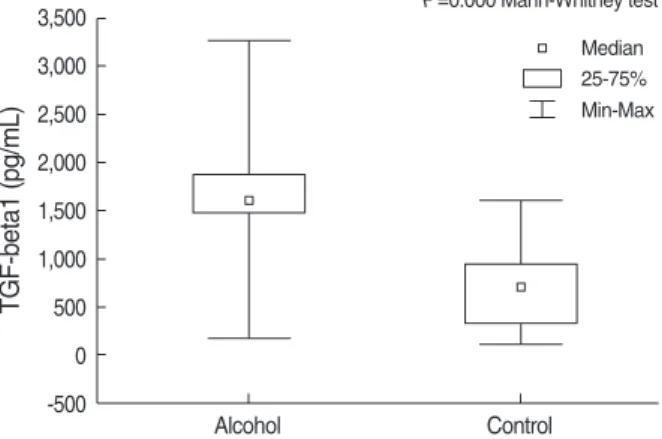
The mean age of patients with alcohol dependence and healthy controls were 45.2±9.2 and 48.3±10.1 yr, respec- tively (Table 1). There were no difference between patients of alcohol dependence and control subjects in age (P=0.15), in weight (P=0.13) and in height (P=0.84). As seen in Fig. 1, mean plasma TGF-β1 levels in the patients with alcohol depen- dence (1,653.11±532.45 pg/mL) were higher than in the control subjects (669.87±366.53 pg/mL) (P=0.000). Alco- hol induced liver pathology were found with 16 patients after ultrasonography or computed tomography and consultation.
Fatty liver was diagnosed in 2, alcoholic hepatitis was diag- nosed in 8. Six turned out to be alcoholic cirrhosis patients.
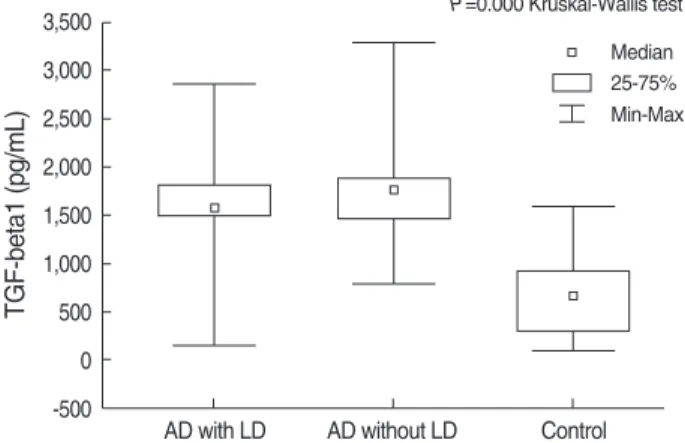
Comparison TGF-β1 level between alcohol dependence pati- ents with or without liver pathology showed no difference (z=-0.91, P=0.36) (Fig. 2) However, when compared with control group, TGF-β1 levels showed significant difference (P=
0.00) in alcohol dependence patients disregarding the pres- ence or abseuce of liver pathology (P=0.00). Levels of TGF-
942 Y.-K. Kim, B.C. Lee, B.J. Ham, et al.
Clinical characteristics
Range Patients with alcohol depen-
dence (n=41)
Normal controls (n=41) Mean±S.D.
Mean±S.D.
Age (yr) 48.3±10.1 45.2±9.2
Height (cm) 167.3±7.0 167.7±7.5
Weight (kg) 59.7±11.7 65.2±11.7
Alcohol use
Age of first use (yr) 21±5.0 15-33 -
Average daily consumption 10.6±4.8 2.1-25.8 - (standard drinks)
Duration of dependence (yr) 12.1±10.4 1-28 - Table 1. Characteristics of the normal controls and the patients with alcohol dependence
Fig. 1. Plasma TGF-β1 level between alcohol dependence patients and normal controls.
TGF-beta1 (pg/mL)
3,500 3,000 2,500 2,000 1,500 1,000 500 0 -500
Alcohol Control
P=0.000 Mann-Whitney test
Median 25-75%
Min-Max
β1 had no correlation with mean daily alcohol consumption, age of first use, and duration of dependency (P=0.97, P=0.79, P=0.77).
DISCUSSION
Our finding verified that TGF-β1 is increased also in human alcoholism. Mean plasma TGF-β1 levels in the patients with alcohol dependence were higher than in the control subjects.
There had been an increased TGF-β1 mRNA in the patients with alcoholic hepatitis and alcoholic cirrhosis. But no dif- ference had been found between alcohol abuser and normal controls (16). We found that alcohol dependence without liver pathology (no proof of fatty liver, hepatitis, cirrhosis with ultrasonography or computed tomography) had as high TGF-β1 as patients with liver pathology (Fig. 2). It may be possible to consider TGF-β1 increase as a predictor of alco- hol induced liver damage.
Chronic alcohol drinking impairs intestinal barrier and decreases hepatic clearance, resulting in increased endotoxin levels in the liver (3, 17). These endotoxin bind with lipopoly- saccharide (LPS)-binding protein which binds CD14 recep- tor at the Kupffer cell (18). Activated Kupffer cell releases TGF-β1 in paracrine pattern that activates hepatic stellate cell which is a major fibroblastic cell type in liver. In early stage hepatic stellate cell is highly responsive to TGF-β1 and transdifferentiate into myofibroblasts (19, 20). Receptor bind- ed TGF-β1 activate Smad family which in turn translocate into nucleus and regulates target gene expressions (21).
Increased TGF-β1 induce hepatocyte apoptosis by produc- ing oxidative stress in rat study (8). This effect is enhanced by ethanol stimulated CYP2E1 increase, especially in perive- nous area of liver (22, 23).
Neuronal migration and neurite outgrowth are mediated by cell adhesion proteins (CAPs) such as neural cell adhesion molecule L1, and isoforms of integrin, which are regulated
by TGF-β(24). Radial glia, which is a key element of guid- ing neuronal migration, mainly expresses TGF ligands and receptors (25-27) and also expresses cell adhesion proteins (28).
TGF-β1 promotes CAP transcription and expression in low concentration, but at much higher concentration it decrease neuronal migration (12, 24). Thus, increased plasma TGF-β1 in alcoholism may suppress normal brain function.
Limitation of our study is that we checked only plasma TGF-β1 but did not checle the levels in cerebrospinal fluid.
TGF-β1 does not cross the intact blood-brain barrier (29).
However in normal condition only choroid plexus epithelial and meningeal cells express TGF-β1, but with brain lesion much induction occurs in other cell types (30). Another lim- itation of our study is that all of the subjects of our study were men. So we need a study in female patients to general- ize our results.
Our result, increased plama TGF-β1 in alcohol dependence patients, suggests that alcohol induced liver damage and sup- pression of normal brain function may be mediated by TGF- β1. Alcohol induced liver fibrosis, heptocyte apoptosis, and neuronal suppression may be mediated by increased TGF-β1 in alcohol dependent patients. Further study about optimal suppression of TGF-β1 that can possibly prevent alcohol in- duced liver damage and cognitive impairment is needed.
REFERENCES
1. Breitkopf K, Haas S, Wiercinska E, Singer MV, Dooley S. Anti-TGF- beta strategies for the treatment of chronic liver disease. Alcohol Clin Exp Res 2005; 29 (11 Suppl): 121S-31S.
2. Arteel GE. Oxidants and antioxidants in alcohol-induced liver dis- ease. Gastroenterology 2003; 124: 778-90.
3. Lieber CS. Metabolism of alcohol. Clin Liver Dis 2005; 9: 1-35.
4. Kwon OS, Song SH, Ju KT, Chung MG, Park DK, Kim SS, Kim YS, Koo YS, Kim YK, Choi DJ, Kim JH, Hwang YJ, Byun KS, Lee CH.
Polymorphism in codons 10 and 25 of the transforming growth fac- tor-beta1 gene in Korean population and in patients with liver cir- rhosis and hepatocellular carcinoma. Korean J Gastroenterol 2003;
42: 212-9.
5. Blobe GC, Schiemann WP, Lodish HF. Role of transforming growth factor beta in human disease. N Engl J Med 2000; 342: 1350-8.
6. Pepper MS. Transforming growth factor-beta: vasculogenesis, angio- genesis, and vessel wall integrity. Cytokine Growth Factor Rev 1997;
8: 21-43.
7. Ravitz MJ, Wenner CE. Cyclin-dependent kinase regulation during G1 phase and cell cycle regulation by TGF-beta. Adv Cancer Res 1997; 71: 165-207.
8. Schuster N, Krieglstein K. Mechanisms of TGF-beta-mediated apop- tosis. Cell Tissue Res 2002; 307: 1-14.
9. Elliott RL, Blobe GC. Role of transforming growth factor beta in human cancer. J Clin Oncol 2005; 23: 2078-93.
10. Chen A. Acetaldehyde stimulates the activation of latent transform- ing growth factor-beta1 and induces expression of the type II recep-
Increased Transforming Growth Factor-beta1 in Alcohol Dependence 943
Fig. 2. Plasma TGF-β1 levels of alcohol dependence patients with or without liver pathology and normal controls.
AD, alcohol dependence; LD, liver disese.
TGF-beta1 (pg/mL)
3,500 3,000 2,500 2,000 1,500 1,000 500 0 -500
AD with LD AD without LD Control P=0.000 Kruskal-Wallis test
Median 25-75%
Min-Max
tor of the cytokine in rat cultured hepatic stellate cells. Biochem J 2002; 368: 683-93.
11. Maehara Y, Kakeji Y, Kabashima A, Emi Y, Watanabe A, Akaza- wa K, Baba H, Kohnoe S, Sugimachi K. Role of transforming growth factor-beta 1 in invasion and metastasis in gastric carcinoma. J Clin Oncol 1999; 17: 607-14.
12. Luo J, Miller MW. Transforming growth factor beta1-regulated cell proliferation and expression of neural cell adhesion molecule in B104 neuroblastoma cells: differential effects of ethanol. J Neurochem 1999;
72: 2286-93.
13. Miller MW, Luo J. Effects of ethanol and transforming growth fac- tor beta (TGF beta) on neuronal proliferation and nCAM expression.
Alcohol Clin Exp Res 2002; 26: 1281-5.
14. Kuhn P, Sarkar DK. Ethanol induces apoptotic death of beta-endor- phin neurons in the rat hypothalamus by a TGF-beta 1-dependent mechanism. Alcohol Clin Exp Res 2008; 32: 706-14.
15. Nanji AA, Tahan SR, Golding M, Khwaja S, Rahemtulla A, Lalani EN. Role of transforming growth factor-[beta]1 in inhibiting endothe- lial cell proliferation in experimental alcoholic liver disease. Am J Pathol 1996; 148: 739-47.
16. Chen WX, Li YM, Yu CH, Cai WM, Zheng M, Chen F. Quantitative analysis of transforming growth factor beta 1 mRNA in patients with alcoholic liver disease. World J Gastroenterol 2002; 8: 379-81.
17. Nieto N, Friedman SL, Cederbaum AI. Stimulation and proliferation of primary rat hepatic stellate cells by cytochrome P450 2E1-derived reactive oxygen species. Hepatology 2002; 35: 62-73.
18. Su GL. Lipopolysaccharides in liver injury: molecular mechanisms of Kupffer cell activation. Am J Physiol Gastrointest Liver Physiol 2002; 283: G256-65.
19. Dooley S, Delvoux B, Lahme B, Mangasser-Stephan K, Gressner AM. Modulation of transforming growth factor beta response and signaling during transdifferentiation of rat hepatic stellate cells to myofibroblasts. Hepatology 2000; 31: 1094-106.
20. Dooley S, Delvoux B, Streckert M, Bonzel L, Stopa M, ten Dijke P, Gressner AM. Transforming growth factor beta signal transduction in hepatic stellate cells via Smad2/3 phosphorylation, a pathway that is abrogated during in vitro progression to myofibroblasts. TGFbe-
ta signal transduction during transdifferentiation of hepatic stellate cells. FEBS Lett 2001; 502: 4-10.
21. Stopa M, Anhuf D, Terstegen L, Gatsios P, Gressner AM, Dooley S.
Participation of Smad2, Smad3, and Smad4 in transforming growth factor beta (TGF-beta)-induced activation of Smad7. THE TGF-beta response element of the promoter requires functional Smad binding element and E-box sequences for transcriptional regulation. J Biol Chem 2000; 275: 29308-17.
22. Fang C, Lindros KO, Badger TM, Ronis MJ, Ingelman-Sundberg M.
Zonated expression of cytokines in rat liver: effect of chronic ethanol and the cytochrome P450 2E1 inhibitor, chlormethiazole. Hepatol- ogy 1998; 27: 1304-10.
23. Tsutsumi M, Lasker JM, Shimizu M, Rosman AS, Lieber CS. The intralobular distribution of ethanol-inducible P450IIE1 in rat and human liver. Hepatology 1989; 10: 437-46.
24. Siegenthaler JA, Miller MW. Transforming growth factor beta1 mod- ulates cell migration in rat cortex: effects of ethanol. Cereb Cortex 2004; 14: 791-802.
25. Flanders KC, Ludecke G, Engels S, Cissel DS, Roberts AB, Konda- iah P, Lafyatis R, Sporn MB, Unsicker K. Localization and actions of transforming growth factor-beta s in the embryonic nervous sys- tem. Development 1991; 113: 183-91.
26. Krieglstein K, Strelau J, Schober A, Sullivan A, Unsicker K. TGF- beta and the regulation of neuron survival and death. J Physiol Paris 2002; 96: 25-30.
27. Pelton RW, Saxena B, Jones M, Moses HL, Gold LI. Immunohisto- chemical localization of TGF beta 1, TGF beta 2, and TGF beta 3 in the mouse embryo: expression patterns suggest multiple roles dur- ing embryonic development. J Cell Biol 1991; 115: 1091-105.
28. Gressens P. Mechanisms and disturbances of neuronal migration.
Pediatr Res 2000; 48: 725-30.
29. Kastin AJ, Akerstrom V, Pan W. Circulating TGF-beta1 does not cross the intact blood-brain barrier. J Mol Neurosci 2003; 21: 43-8.
30. Unsicker K, Strelau J. Functions of transforming growth factor-beta isoforms in the nervous system. Cues based on localization and experi- mental in vitro and in vivo evidence. Eur J Biochem 2000; 24: 6972-5.
944 Y.-K. Kim, B.C. Lee, B.J. Ham, et al.