INTRODUCTION
With the introduction of ovulation-inducing agents in the late 1960s and assisted-reproductive techniques in the 1970s, the frequency of multiple pregnancies and multiple birth have been increasing (1-5). In Korea, the frequency of twins has recently been increased by three times for the past 20 yr (6).
To date, however, no studies have been conducted to examine the triplets. In cases of multiples, as compared with single- tons, the morbidity and mortality of fetus or newborns were relatively high. This has therefore been of increasing inter- est (5-8). Particularly in cases of multiples with the intrauter- ine growth retardation, the morbidity and mortality have been reported to be relatively high (9, 10).
According to Blickstein (9, 10) there were differences in the intrauterine growth pattern between singletons, twins and triplets. The author therefore noted that the differential criteria for birth weight depending on the gestational age should be established. In addition, criteria for birth weight depending on the gestational age vary depending on coun-
try, ethnicity and sex. Accordingly, the differential criteria for birth weight depending on the gestational age should be established. In Korea, there are established baseline values for singletons and twins (11-14). But no definite criteria exist for triplets yet. We conducted this study to establish the nor- mal value of birth weight depending on the gestational age in Korean triplets.
MATERIALS AND METHODS
Of the data about the population status, which was collect- ed by The Korean National Statistics Office, we used a raw data about birth records of a 10-yr period from January 1 1998 to December 31 2007. The total number of newborns who were born during this period was 5,278,646. Of these, exclud- ing 20,519 newborns (0.4%) with unknown gestational age, birth weight or plurality, 840 triplets, aged between gesta- tional weeks 27 and 38, were finally enrolled in the current study. The number of triplets, whose gestational age was short-
900
Jeong Ho Kim, Seung Wan Park, and Jung Ju Lee
Department of Pediatrics, Chung-Ang University College of Medicine, Seoul, Korea
Address for Correspondence Jung Ju Lee, M.D.
Department of Pediatrics, Chung-Ang University College of Medicine, 29 Heukseok-ro, Dongjak-gu, Seoul 156-755, Korea
Tel : +82.2-6299-1480, Fax : +82.2-6263-2167 E-mail : [email protected]
Birth Weight Reference for Triples in Korea
An estimation of the baseline value of birth weight depending on gestational age is helpful for reducing morbidity and mortality following the early diagnosis and treat- ment of intrauterine growth retardation. In Korea, there are established baseline val- ues for singletons and twins. But no definite criteria exist for triplets yet. Given the above background, we obtained the baseline value of birth weight depending on the gestational age in triplets with a gestational age of 27-38 weeks using a raw data about birth records which had been obtained during a 10-yr period from 1998 to 2007.
This baseline value was compared with those of singletons and twins. During the 10-yr period, the total number of newborns who were born between gestational age 27 and 38 was 1,330,822. Of these, the number of singletons, twins and triplets was 1,330,822, 90,245, and 840, respectively. A mean gestational age was 37.3±1.5 weeks, 36.0±2.0 weeks and 33.3±2.4 weeks in the corresponding order. A mean birth weight was 3,071±490 g, 2,414±455 g, and 1,836±454 g in the correspond- ing order. A comparison of the birth weight depending on the gestational age of triplets was made with the normal value of singletons and twins. According to this, in the overall gestational age ranging from weeks 27 to 38, it was relatively smaller as compared with the birth weight of twins and singletons. The current study was of significance in that it first obtained the normal value of birth weight of triplets in the overall gestational age ranging from weeks 27 to 38, whose results are expected to be helpful for studies or treatments of triplets.
Key Words : Triplets; Birth Weight; Gestational Age; Korea
Received : 3 December 2009 Accepted : 11 December 2009
ⓒ 2010 The Korean Academy of Medical Sciences.
This is an Open Access article distributed under the terms of the Creative Commons Attribution Non-Commercial License (http://creativecommons.org/licenses/by-nc/3.0) which permits unrestricted non-commercial use, distribution, and reproduction in any medium, provided the original work is properly cited.
er than 27 weeks, as present at an extremely small. Accord- ingly, these triplets were not enrolled in the current study.
Triplets whose gestational age was longer than 38 weeks were also not enrolled in the current study. We obtained mean birth weight, standard deviation and 10th, 25th, 50th, 75th, and 90th percentile values for each gestational age group by one week increment. Then, we investigated the birth weight dis- tribution of each gestational age group by the normal Gaus- sian model. To establish final standard value of birth weight distribution by gestational age, we used the finite mixture model to eliminate erroneous birth weights for respective gestational age (15-18). Then we made percentile curve of birth weight distribution by gestation for triples.
A baseline value of birth weight depending on the gesta- tional age in triplets, which was established as described here- in, was compared with 10th, 50th, and 90th percentile val- ues in singletons and twins (12). A comparison was also made with criteria for triplets which have been established in other countries (19, 20).
A statistical analysis was performed using STATA 8.0E (Stata Corp., College Station, TX, USA) for an analysis and an estimation of finite mixture model.
RESULTS
During a 10-yr period from 1998 to 2007, the total num- ber of newborns who were born between gestational weeks
27 and 38 was 1,330,822. Of these, the number of single- tons, twins and triplets was 1,330,822, 90,245, and 840, res- pectively. A mean gestational age was 37.3±1.5 weeks, 36.0
±2.0 weeks, and 33.3±2.4 weeks in the corresponding order. A mean birth weight was 3,071±490 g, 2,414±455 g, and 1,836±454 g in the corresponding order. These results indicate that gestational age and birth weight decreased de- pending on the plurality (Table 1). Mean age of mothers was 29.7 yr in cases of singletons, 30.2 yr in cases of twins and 30.5 yr in cases of triplets. These results indicate that age of mother increased significantly depending on the plurality (Table 1). The birth rate of triplets was increased from 0.06%
in 1998 to 0.1% in 2007.
GA, gestational age; BW, birth weight.
Factors Singletons Twins Triplets P value
Total birth 1,330,822 90,245 840
Mean GA (weeks) 37.3±1.5 36.0±2.0 33.3±2.4 <0.05
Mean BW (g) 3,071±490 2,414±455 1,836±454 <0.05
Sex (male) 0.55 0.51 0.5 <0.05
Mean maternal age (yr) 29.7±4.1 30.2±3.9 30.5±3.6 <0.05
Table 1. Comparison of birth outcome by plurality
Gestational age (weeks)
Standard deviation Mean
(g) Observations
(Numbers) 10th 25th 50th 75th 90th
Percentile
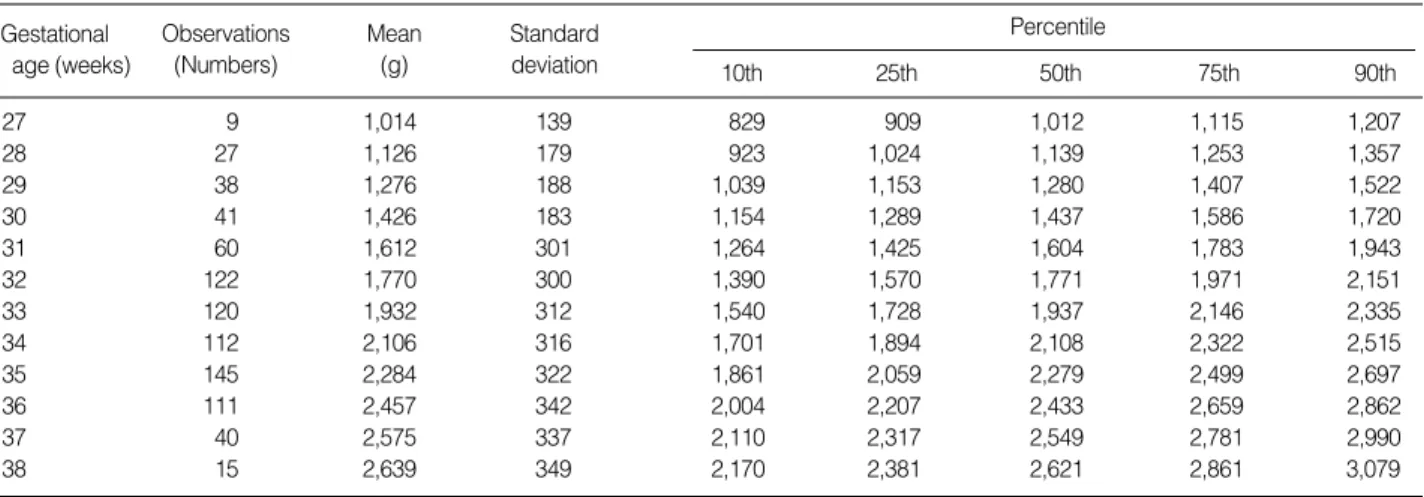
27 9 1,014 139 829 909 1,012 1,115 1,207
28 27 1,126 179 923 1,024 1,139 1,253 1,357
29 38 1,276 188 1,039 1,153 1,280 1,407 1,522
30 41 1,426 183 1,154 1,289 1,437 1,586 1,720
31 60 1,612 301 1,264 1,425 1,604 1,783 1,943
32 122 1,770 300 1,390 1,570 1,771 1,971 2,151
33 120 1,932 312 1,540 1,728 1,937 2,146 2,335
34 112 2,106 316 1,701 1,894 2,108 2,322 2,515
35 145 2,284 322 1,861 2,059 2,279 2,499 2,697
36 111 2,457 342 2,004 2,207 2,433 2,659 2,862
37 40 2,575 337 2,110 2,317 2,549 2,781 2,990
38 15 2,639 349 2,170 2,381 2,621 2,861 3,079
Table 2. The baseline value of birth weight depending on gestational age for triplets
Fig. 1. Percentile curves of birth weight distribution by gestational age for triplets.
P, percentile.
Birth weight (g)
3,500 3,000 2,500 2,000 1,500 1,000 500
27 28 29 30 31 32 33 34 35 36 37 38 Gestational age (weeks)
90 P 75 P 50 P 25 P 10 P
Table 2 and Fig.1 presents birth weight percentiles for ges- tational age in triplets. A mean gestational age of male triplets was 33.3±2.6 weeks and that of female triplets was 33.3± 2.3 weeks. This difference did not reach a statistical signifi- cance (P=0.388). However, mean birth weight of male babies was 1,872±495 g and that of female babies was 1,799±407 g. This difference reached a statistical significance (P=0.001).
In addition, birth weight percentile for gestational age was compared between male and female triplets. This showed
that male triplets had a significantly greater birth weight per- centile for the gestational age as compared with female tri- plets in overall gestational age (Table 3).
Birth weight percentile for gestational age in triplets was compared with the normal value which we obtained using the same methods in singletons and twins in our previous study (12). According to this, in the overall gestational age rang- ing from gestational week 27 to 38, it was relatively smaller as compared with birth weight obtained from twins and sin-
Gestational
age (weeks) 10th 50th 90th
Male
10th 50th 90th
Famale
28 942 1,048 1,154 943 1,099 1,255
29 1,025 1,163 1,301 988 1,172 1,396
30 1,143 1,327 1,512 1,074 1,310 1,577
31 1,281 1,516 1,752 1,198 1,487 1,784
32 1,391 1,684 1,977 1,344 1,648 1,950
33 1,478 1,828 2,177 1,486 1,779 2,069
34 1,576 1,969 2,359 1,592 1,896 2,198
35 1,694 2,115 2,521 1,672 2,014 2,358
36 1,856 2,251 2,628 1,755 2,135 2,517
37 2,068 2,369 2,670 1,837 2,246 2,655
Table 3. The value of birth weight depending on by gestational age in triplets between male and female
Gestational
age (weeks) 10th 50th 90th
Singletons
10th 50th 90th
Twins
10th 50th 90th
Triplets
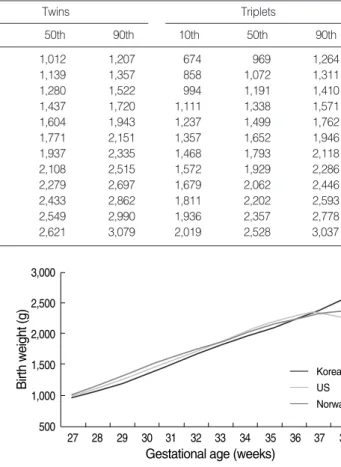
27 849 1,062 1,275 829 1,012 1,207 674 969 1,264
28 935 1,188 1,441 923 1,139 1,357 858 1,072 1,311
29 1,034 1,329 1,624 1,039 1,280 1,522 994 1,191 1,410
30 1,151 1,485 1,819 1,154 1,437 1,720 1,111 1,338 1,571
31 1,284 1,661 2,038 1,264 1,604 1,943 1,237 1,499 1,762
32 1,428 1,871 2,314 1,390 1,771 2,151 1,357 1,652 1,946
33 1,586 2,105 2,624 1,540 1,937 2,335 1,468 1,793 2,118
34 1,777 2,338 2,900 1,701 2,108 2,515 1,572 1,929 2,286
35 1,999 2,565 3,131 1,861 2,279 2,697 1,679 2,062 2,446
36 2,239 2,798 3,352 2,004 2,433 2,862 1,811 2,202 2,593
37 2,472 3,023 3,560 2,110 2,549 2,990 1,936 2,357 2,778
38 2,660 3,194 3,720 2,170 2,621 3,079 2,019 2,528 3,037
Table 4. Comparison of birth weight depending on gestational age in triplets by plurality
Fig. 2. Comparison of the 50th percentile curve by plurality.
Birth weight (g)
3,500 3,000 2,500 2,000 1,500 1,000 500
27 28 29 30 31 32 33 34 35 36 37 38 Gestational age (weeks)
Singletons Twins Triplets
Korea
Fig. 3. Comparison of the 50th percentile curve among different countries.
Birth weight (g)
3,000 2,500 2,000 1,500 1,000 500
27 28 29 30 31 32 33 34 35 36 37 38 Gestational age (weeks)
US Norway
gletons (Table 4, Fig. 2).
And we compared 50th percentile curve of Korean triplets with those of USA and Norway, it was smaller than those in the USA and Norway (Fig. 3).
DISCUSSION
In Korea, the birth rate has been annually decreasing. How- ever, with the advancement of assisted reproductive techni- ques such as ovulation-inducing agents, the birth of multiples has been increased. With the well-trained neonatal intensive care unit personnel treating newborns and the well-equipped facility, the survival rate of premature birth has also been in- creased (6, 21).
Multiples show a higher degree of the mortality of new- borns as compared with singletons. They also are associated with such problems as premature birth, intrauterine growth retardation and low birth weight (5-8). Although multiples have been of increasing interest, few studies have been con- ducted to examine triplets in Korea. The current study was conducted using a raw data about birth records which was collected during the recent 10-yr period by the Korean Nation- al Statistics Office. And it would be of significance in that it first obtained the normal value of birth weight depending on the changes in the plurality of triplets, mean gestational age, mean birth weight, mean age of mothers and gestational age.
According to a review of English literature, triplets have been abruptly increased during the recent 20- to 30-yr peri- od (1, 3-5). According to the current study, however, it was shown that triplets were increased by approximately two times during a 10-yr period from 1998 to 2007 in Korea. Other studies have shown that the birth rate of multiples was inc- reased as mothers’ age was increased (1, 4). In Korea, it has also been shown that mean age of mothers of singletons, twins and triplets was increased. These reports suggest that the in- creased birth rate of triplets originated from the increased age of mothers and the development of assisted reproduction tech- nology.
In the present study, birth weight was significantly greater in male triplets when compared with female triplets at the same gestational age. These results were in agreement with the previous reports (22, 23). This implies that an intrauter- ine growth pattern may vary genetically between male and female triplets.
Triplets had a lower birth weight as compared with single- tons or twins, which was also in agreement with the previ- ous reports (22, 24-26) In particular, from gestational week 32 on, there was a great different from singletons (Table 3).
In regard to this, other authors noted that no growth accel- eration occurred during the third trimester of pregnancy due to the limitation of intrauterine space (9, 10, 22, 27). Other authors noted, however, that there was no significant differ-
ence in the birth weight between singletons, twins and triplets prior to the third trimester of pregnancy. According to the present study, however, there was a significant difference in mean birth weight from gestational week 27. This deserves further studies.
When 50th percentile of birth weight of Korean triplets was compared with those of USA and Norway (19, 20), it was smaller than those in the USA and Norway during a peri- od from gestational week 28 to 36. This may suggest that an ethnic difference is present in triplets. It might be due to an insufficient amount of the data, however, that the normal value was relatively greater during a period ranging from ges- tational week 37 to 38 in Korea. In cases of triplets, howev- er, the proportion of cases in which a delivery occurred at ges- tational week 36 or later was approximately 10% (28). This data could be applied to a clinical setting.
Limitations of the current study are as follows: 1) In a sta- tistical analysis of the birth records which were collected dur- ing a 10-yr period in Korea, the number of triplets aged ges- tational week 27 or earlier was extremely small. According- ly, there was a lack of the data about these triplets. 2) The data which was collected from triplets aged gestational week 37 or later was also problematic. Despite these limitations, the current results are of significance in that it first obtained the normal value of birth weight during a period ranging from gestational week 27 to 38, which is clinically important, in Korean triplets. It is expected that the current results would be of help for the studies and treatment of triplets.
REFERENCES
1. Luke B. The changing pattern of multiple births in the United States:
maternal and infant characteristics, 1973 and 1990. Obstet Gynecol 1994; 84: 101-6.
2. Tuppin P, Blondel B, Kaminski M. Trends in multiple deliveries and infertility treatments in France. Br J Obstet Gynaecol 1993; 100:
383-5.
3. Millar WJ, Wadhera S, Nimrod C. Multiple births: trends and pat- terns in Canada, 1974-1990. Health Rep 1992; 4: 223-50.
4. Jewell SE, Yip R. Increasing trends in plural births in the United States. Obstet Gynecol 1995; 85: 229-32.
5. Joseph KS, Marcoux S, Ohlsson A, Kramer MS, Allen AC, Liu S, Wu Wen S, Demissie K, Sauve R, Liston R. Preterm birth, stillbirth and infant mortality among triplet births in Canada, 1985-96. Pae- diatr Perinat Epidemiol 2002; 16: 141-8.
6. Hur YM, Kwon JS. Changes in twinning rates in South Korea: 1981- 2002. Twin Res Hum Genet 2005; 8: 76-9.
7. Kaufman GE, Malone FD, Harvey-Wilkes KB, Chelmow D, Pen- zias AS, D’Alton ME. Neonatal morbidity and mortality associated with triplet pregnancy. Obstet Gynecol 1998; 91: 342-8.
8. Yaron Y, Bryant-Greenwood PK, Dave N, Moldenhauer JS, Kramer RL, Johnson MP, Evans MI. Multifetal pregnancy reductions of triplets to twins: comparison with nonreduced triplets and twins. Am J Obstet
Gynecol 1999; 180: 1268-71.
9. Blickstein I. Is it normal for multiples to be smaller than singletons?
Best Pract Res Clin Obstet Gynaecol 2004; 18: 613-23.
10. Blickstein I. Normal and abnormal growth of multiples. Semin Neona- tol 2002; 7: 177-85.
11. Lee JJ, Park CK, Lee GS. Birth weight distribution by gestational age in Korean population: using finite mixture model. Korean J Pediatr 2005; 48: 1179-86.
12. Lee JJ. Birth weight for gestational age patterns by sex, plurality, and parity in Korean population. Korean J Pediatr 2007; 50: 732-9.
13. Shin SM, Chang YP, Lee ES, Lee YA, Son DW, Kim MH, Choi YR.
Low birth weight, very low birth weight rates and gestational age- specific birth weight distribution of Korean newborn infants. J Kore- an Med Sci 2005; 20: 182-7.
14. Jung GY, Lee K. Intrauterine growth of Korean infants from 25 weeks to 44 weeks gestation. J Korean Pediatr Sci 1990; 33: 887-99.
15. Alexander GR, Kogan M, Martin J, Papiernik E. What are the fetal growth patterns of singletons, twins, and triplets in the United States?
Clin Obstet Gynecol 1998; 41: 114-25.
16. Glinianaia SV, Skjaerven R, Magnus P. Birthweight percentiles by gestational age in multiple births. A population-based study of Nor- wegian twins and triplets. Acta Obstet Gynecol Scand 2000; 79:
450-8.
17. Kramer MS, Platt RW, Wen SW, Joseph KS, Allen A, Abrahamow- icz M, Blondel B, Bréart G. A new and improved population-based Canadian reference for birth weight for gestational age. Pediatrics 2001; 108: E35.
18. Joseph KS, Kramer MS, Allen AC, Mery LS, Platt RW, Wen SW.
Implausible birth weight for gestational age. Am J Epidemiol 2001;
153: 110-3.
19. Platt RW, Abrahamowicz M, Kramer MS, Joseph KS, Mery L, Blon- del B, Bréart G, Wen SW. Detecting and eliminating erroneous ges- tational ages: a normal mixture model. Stat Med 2001; 20: 3491-503.
20. Oja H, Koiranen M, Rantakallio P. Fitting mixture models to birth weight data: a case study. Biometrics 1991; 47: 883-97.
21. Bae YM, Bae CW. The changes in the mortality rates of low birth weight infant and very low birth weight infant in Korea over the past 40 years. J Korean Med Sci 2004; 19: 27-31.
22. Kato N. Reference birthweight range for multiple birth neonates in Japan. BMC Pregnancy Childbirth 2004; 4: 2.
23. Naeye RL, Benirschke K, Hagstrom JW, Marcus CC. Intrauterine growth of twins as estimated from liveborn birth-weight data. Pedi- atrics 1966; 37: 409-16.
24. Elster AD, Bleyl JL, Craven TE. Birth weight standards for triplets under modern obstetric care in the United States, 1984-1989. Obstet Gynecol 1991; 77: 387-93.
25. Jones JS, Newman RB, Miller MC. Cross-sectional analysis of triplet birth weight. Am J Obstet Gynecol 1991; 164 (1 Pt 1): 135-40.
26. Kuno A, Akiyama M, Yanagihara T, Hata T. Comparison of fetal growth in singleton, twin, and triplet pregnancies. Hum Reprod 1999;
14: 1352-60.
27. Yuval Y, Seidman DS, Achiron R, Goldenberg M, Alcalay M, Mashiach S, Lipitz S. Intrauterine growth of triplets as estimated from liveborn birth weight data. Ultrasound Obstet Gynecol 1995;
6: 345-8.
28. Min SJ, Luke B, Min L, Misiunas R, Nugent C, Van de Ven C, Mar- tin D, Gonzalez-Quintero VH, Eardley S, Witter FR, Mauldin JG, Newman RB. Birth weight references for triplets. Am J Obstet Gynecol 2004; 191: 809-14.