ABSTRACT
Purpose: Effective predictors of the response to neoadjuvant chemotherapy (NAC) are still insufficient. This study aimed to investigate the predictive value of serum lipid profiles for the response to NAC in breast cancer patients.
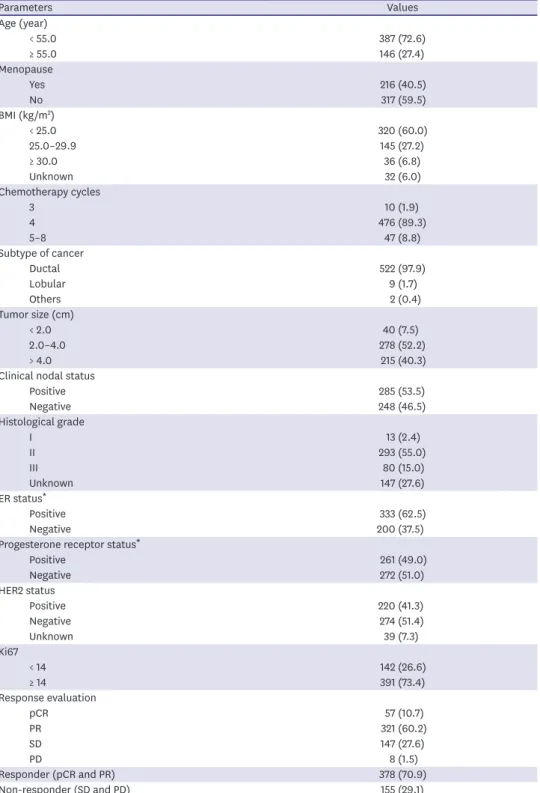
Methods: A total of 533 breast cancer patients who had received NAC were retrospectively studied. The pretreatment of serum lipids, including total cholesterol (TC), triglycerides (TG), high-density lipoprotein cholesterol (HDL-C), low-density lipoprotein cholesterol (LDL-C), and lipoprotein-α, and clinicopathological characteristics were collected to assess their predictive roles.
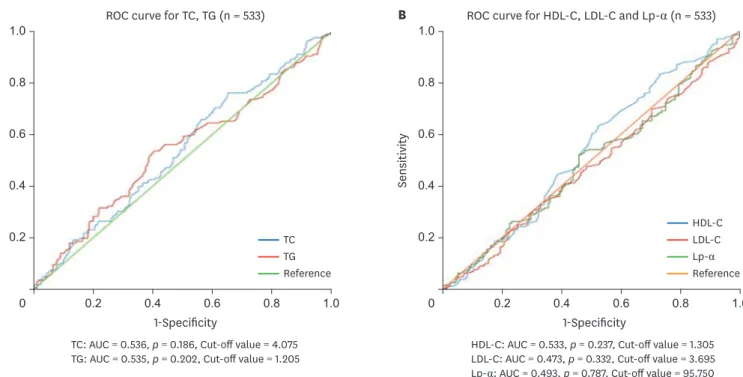
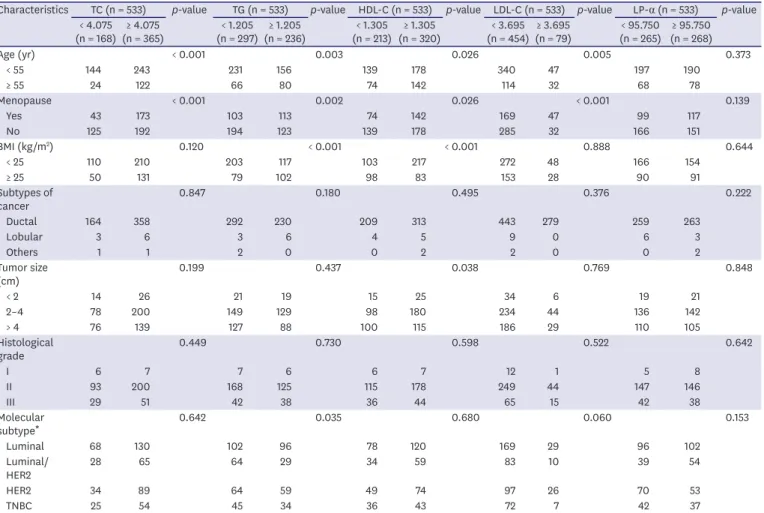
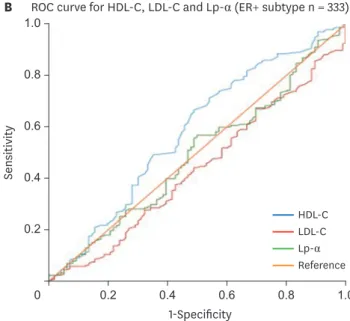
Results: Breast cancer patients had significantly lower TC, TG, HDL-C, and LDL-C levels than normal individuals. Among these indicators, TG and LDL-C levels and HDL-C level increased and decreased significantly after NAC, respectively. In estrogen receptor (ER)- positive patients, increased LDL-C level was associated with better outcomes. Moreover, the receiver operating characteristic curve analyses suggested that TG and HDL-C levels at diagnosis can be used as predictors of the response to NAC only in the ER-positive subgroup.
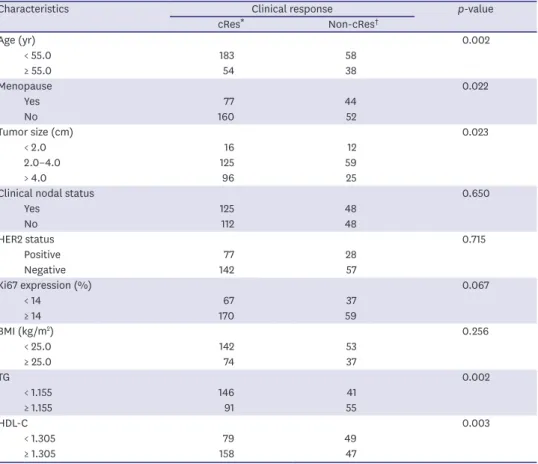
According to univariate analyses, patients with low TG level (< 1.155 mmol/L) or high HDL-C level (≥ 1.305 mmol/L) in the ER-positive subgroup had more favorable clinical responses than the other patients in the subgroup. Furthermore, according to multivariate analyses, a high HDL-C level (≥ 1.305 mmol/L, p = 0.007) was an independent predictor of NAC efficacy.
Conclusion: High HDL-C level (≥ 1.305 mmol/L) before NAC and increased LDL-C level after NAC were associated with the better treatment response in ER-positive breast cancer patients.
These results are potentially considered beneficial in establishing treatment decisions.
Keywords: Breast neoplasms; Drug therapy; Lipids; Lipoproteins; Neoadjuvant therapy
INTRODUCTION
Breast cancer is the most common malignant tumor in women, and it has the second highest cancer-related death rate [1]. Neoadjuvant chemotherapy (NAC), which offers an alternative treatment to adjuvant chemotherapy with the same therapeutic effect, has become a standard treatment for locally advanced breast cancer to reduce the extent of operation [2]. Furthermore, NAC can be considered an in vivo chemosensitivity test for tumor therapy
Original Article
Received: Sep 9, 2019 Accepted: Apr 18, 2020 Correspondence to Shengchun Liu
Department of Breast Surgery, The First Affiliated Hospital of Chongqing Medical University, No.1 Youyi Road, Yuzhong District, Chongqing 400016, China.
E-mail: [email protected]
*These authors contributed equally to this work.
© 2020 Korean Breast Cancer Society This is an Open Access article distributed under the terms of the Creative Commons Attribution Non-Commercial License (https://
creativecommons.org/licenses/by-nc/4.0/) which permits unrestricted non-commercial use, distribution, and reproduction in any medium, provided the original work is properly cited.
ORCID iDs Fanli Qu
https://orcid.org/0000-0002-6908-0630 Rui Chen
https://orcid.org/0000-0001-9702-2799 Yang Peng
https://orcid.org/0000-0002-4146-8369 Ying Ye
https://orcid.org/0000-0002-6886-8602 Zhenrong Tang
https://orcid.org/0000-0003-4706-926X Yihua Wang
https://orcid.org/0000-0002-9024-0811 Beige Zong
https://orcid.org/0000-0003-0667-1721 Haochen Yu
https://orcid.org/0000-0003-4600-4085
Fanli Qu
1,*, Rui Chen
2,*, Yang Peng
1, Ying Ye
1, Zhenrong Tang
1, Yihua Wang
1, Beige Zong
1, Haochen Yu
1, Shengchun Liu
11
Department of Breast Surgery, The First Affiliated Hospital of Chongqing Medical University, Chongqing, China
2