• 검색 결과가 없습니다.

A New Record of Pseudanostirus ecarinatus (Stepanov, 1930) (Coleoptera: Elateridae) in Korea

N/A
N/A
Protected

Academic year: 2021

Share "A New Record of Pseudanostirus ecarinatus (Stepanov, 1930) (Coleoptera: Elateridae) in Korea"

Copied!
4
0
0

로드 중.... (전체 텍스트 보기)

전체 글

(1)

KOREAN JOURNAL OF APPLIED ENTOMOLOGY

한응곤지 51(2): 79~82 (2012) ⓒ The Korean Society of Applied Entomology

Kor. J. Appl. Entomol.

DOI: http://dx.doi.org/10.5656/KSAE.2012.01.1.69

A New Record of Pseudanostirus ecarinatus (Stepanov, 1930) (Coleoptera: Elateridae) in Korea

Taeman Han 1,3 , Hae Chul Park 1 , Bong-Woo Lee 2 and Seunghwan Lee 3 *

1

Applied Entomology Division, Department of Agricultural Biology, National Academy of Agricultural Science, Suin-ro 150, Gweonseon-gu, Suwon, 441-100, Korea

2

Korea National Arboretum, Soheul-eup, Pocheon, Gyeonggi, 487-821, Korea

3

Laboratory of Insect Biosystematics, Division of Entomology, School of Agricultural Biotechnology, Seoul National University, San 56-1 Shilim-dong, Gwanak-gu, Seoul, 151-742, Korea

한국미기록 Pseudanostirus ecarinatus (Stepanov, 1930) (딱정벌레목: 방아벌레과)의 보고

한태만 1,3 ㆍ박해철 1 ㆍ이봉우 2 ㆍ이승환 3

1국립농업과학원, 농업생물부, 곤충산업과, 2국립수목원, 산림생물조사과, 3서울대학교, 농생명공학부
ABSTRACT: Pseudanostirus ecarinatus (Stepanov, 1930) is recognized for the first time in Korea. A redescription and illustrations of the species are presented based on a single male specimen collected from Mt. Bangtae Gangwon-do. We also provide diagnostic characteristics of the genus, which clearly separate it from other closely related genera, Calambus Thomson, 1859 and Anostrius Thomson, 1859.

Key words: Taxonomy, Coloeptera, Elateridae, Pseudanostirus ecarinatus, Korea

초 록: 방아벌레과의 Pseudanostirus ecarinatus (Stepanov, 1930)의 국내분포를 처음으로 보고한다. 강원도 방태산에서 채집된 수컷 표본을 근거 로 본 종의 형태를 재기재하고 사진자료를 제공하였다. 또한 국내 신기록인 본 속의 형태적 진단형질을 근연 분류군인 Calambus속 및 Anostrius 속과 비교하였다.

검색어: 분류 , 딱정벌레목 , 방아벌레과 , 북방방아벌레 ( 신칭 ), 한국

*Corresponding author: [email protected]

Received November 3 2011; Revised January 2 2012 Accepted April 2 2012

Introduction

Pseudanostirus Dolin, 1964 was originally established as a subgenus of Anostrius Thomson, 1859 based on the type species Diacanthus globricollis Germar, 1843, which is widely dis- tributed from South Russia to Central Europe (Germany, Poland, the Czech Republic, Austria, Slovakia and Hungary). However, Gurjeva (1982) raised Pseudanostirus to valid generic status.

The members of this genus include 17 Palaearctic and six Nearctic species (Laibner, 2000). In Palaearctic regions, most species are known from Middle Asia to Siberia (Gurjeva, 1989;

Tarnawski, 1996, 2000; Laibner, 2000). The members of Pseudanostirus generally occur in shrubby zones or meadows near forest (Laibner, 2000; hira and Ijima, 2001). No species of Pseudanostirus was previously recognized from Korean fauna.

We found a male specimen of the genus collected from Mt.

Bangtae, Gangwon-do, Korea (Fig. 1). It was subsequently identified as P. ecarinatus (Stepanov, 1930). We present a taxonomic diagnosis of the genus and species based on morphological

79

(2)

80 Kor. J. Appl. Entomol. 51(2): 79~82 (2012)

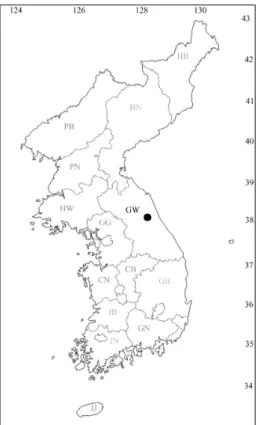
Fig. 1. The collection locality of Pseudanostirus ecarinatus (Stepanov, 1930) in Korea. The black circle indicates Mt. Bangtae, Gangwon-do, Korea.

characteristics.

Materials and Methods

The male specimen reported in this paper was found in insect collections housed at the Korean National Arboretum (KNA) in Pocheon-si, Gyeonggi-do, Korea. The specimen was examined under a stereoscopic microscope (MZ16A and MZ 6; Leica, Solms, Germany) for general morphological structures. Photo- graphs were taken with two digital cameras (Canon D 30 and Leica MZ 16A equipped with a 14.2 color mosaic digital camera system).

Taxonomic Accounts

Family Elateridae Leach, 1815

Subfamily Dendrometrinae Gistel, 1856 Tribe Prosternini Gistel, 1856

Genus Pseudanostirus Dolin, 1964 북방방아벌레속 (신칭) Pseudanostrius Dolin, 1964. Kiev: 120, as a subgenus of

Anostirus. Type-species: Diacanthus globicollis Germar, 1843.

Z. Ent. Germar, Leipzing, 4: 79 (S. Russia), by original designation;

Gurjeva, 1982. Leningrad, 110: 21, raised to valid generic status.

Diagnosis. Body generally medium, rather stout elliptic shaped;

frontal carination of head incomplete and merged with clypeus in middle, their carination diagonally extended forward from each eye; antennae serrate form, generally reaching to apex of hind angles of pronotum in male, but shorter than apex of hind angles in female; pronotum with obscure basal incisures at posterior margin; hind angles of pronotum without carina or with short and vague carina nearly extended to lateral margins;

prosternal sutures simple; hypomeron with intersurface within punctures extremely narrow, coarse, and dull; prosternal pro- cess elongated and slightly bent inwardly from beyond procoxal cavities; elytral striae distinct wholly or sometimes obliterated in posterior, intervals generally well convex; male genitalia with median lobe longer than parameres, with parameres streamlined expansion at their apex in most species (except for P. risillus (Gurjeva, 1978) which has distinct hook shaped expansion in the apex of parameres); female bursa copulatrix with small spines in median, and their gathering formed a belt liked shape.

Distribution. Holarctic region.

Remarks. Pseudanostirus is new to Korean fauna. This genus is closely related to two other genera, Calambus Thomson, 1859 and Anostirus Thomson, 1859, but is easily distinguished by the following diagnostic characters: 1) the frontal carination dia- gonally projected forward, nearly reaching frons margin, incomplete at middle; 2) the hypomeron with a coarse surface and narrowly scattered punctures; 3) antennae serrated form; 4) female bursa copulatrix with small spinules forming as a belt-liked shape in the median region.

Pseudanostirus ecarinatus (Stepanov, 1930) 북방방아벌레 (신칭)

Selatosomus (Calambus) ecarinatus Stepanov, 1930. Entomol.

Nachrichtenbl., Troppau, 4(4): 88 (Type locality: Khabarovsk and Vladivostok in Far East Russia)

Corymbites (Calambus) ecarinatus: Jagemann, 1943. Entomol.

Listy, 6: 99.

(3)

A New Record of Pseudanostirus ecarinatus (Stepanov, 1930) (Coleoptera: Elateridae) in Korea 81 Fig. 2. Pseudanostirus ecarinatus♂. A. habitus in dorsal view; B. 1st to 4th antennomeres; C. Head in dorsal view; D. Hind angle of pronotum; E. Surface of pronotum; F. Prosternum and prosternal process in ventral view; G. Base of prosternal suture; H. Posterior apex of hypomeron in ventral view; I. Interval between mesocoxal cavities; J. Sternite 9th and 10th; K. Aedeagus in dorsal view.

Selatosomus (Calambus) ecarinatus: Cherepanov, 1957.

Novosibirsk: 281 and 311.

Calambus (Calambus) ecarinatus: Bessolitzina, 1974. Vostoch.

Sibir. ino Dal'n. Vost.: 92.

Pseudanostirus ecarinatus: Gurjeva, 1984. Nauka, Leningrad, 9: 296.

Redescription. Body (Fig. 2A) 13.0 mm long and 4.2 mm wide, 3.1 times as long as wide, stout elliptic; color wholly black with 1 st to 4 th antennomeres, legs dusky brown; pubescences whitish yellow, short, recumbent. Head (Fig. 2C) 1.2 times as long as wide, with broad and shallow impression from dorso- median part between eyes to anterior; frontal carina incomplete at middle, connected with clypeus. Antennae (lacking 8 th to 11 th ) (Fig. 2B) moderately serrated from 4 th antennomere; 1 st one stout, 1.9 times as long as wide, with weakly developed anterior carina; 2 nd small, subcylindrical, 1.3 times as long as wide; 3 rd

cylindrical, 2.0 times as long as wide, 1.7 times as long as 2 nd ; 4 th , 1.8 times as long as wide, 1.4 times as long as 3 rd ; each segment from 5th to 8 th slightly shorter than preceding one.

Pronotum 1.1 times as wide as long, shiny wholly; lateral sides weakly marginate, arched, widest just before middle; punctures small, simple, their diameters 0.0200.025 mm and intervals between punctures 0.0250.050 mm (Fig. 2E); hind angles (Fig.

2D) broad at base, without carina, divergent backwardly, apex with nail-like projection on inner side; posterior margin with obscure basal incisures. Prosternum (Fig. 2F) weakly convex, shiny, with small punctures rather dense; anterior lobe rounded, sub-equal length with apex of hypomeron; prosternal process elongate, bent inwardly beyond procoxal cavities, weakly and narrowly expanded at base; pronosternal sutures straight, simple, but double liked near at procoxal cavities (Fig. 2G).

Hypomeron opaque, coarse, densely punctuated; anterior apex

feebly depressed; posterior margin widely truncated at apex and

(4)

82 Kor. J. Appl. Entomol. 51(2): 79~82 (2012)

emarginated. Metasternum with anterior margin broad between mesocoxal cavities, 0.8 times narrower than the width of mesocoxal cavity (Fig. 2I); median longitudinal suture com- pleted. Scutellum 1.14 times as long as wide, rather elongate tongue shaped; anterior margin straight; lateral margins weakly sinuate inwardly at middle; posterior margin widely rounded, postero-median part shallowly depressed. Elytra 2.15 times longer than wide, parallel sided, but gradually and roundly convergent from middle to posterior apex, lateral sides marginate; elytral striae distinct, but more deeply excavated at anterior, and then gradually shallow to posterior; intervals clearly convex at anterior and generally weak to posterior.

Abdomen with 5th visual abdomen semi-oval; sternite 9th and 10th as figured (Fig. 2J). Aedeagus (Fig. 2K) with median lobe slender, shapely pointed at apex, and a little longer than parameres; Parameres strongly and widely sinuate in middle, out-margins of apexes inflated and elongated as oval shape.

Female. Unavailable in this study.

Specimen examined. 1♂, Mt. Bangtae, Inje-gun, Gangwon- do, Korea. 6. VI. 2000. Bong Kyu Byun.

Distribution. Korea (new record), Russia, China (Heilong- jiang) and Central Mongolia

Remarks. The newly recorded species, P. ecarinatus, in Korea was designated as a member of the subgenus Calambus under the genus Selatosomus. Gurjeva (1984) transferred the species into the genus Pseudanostirus. The species closely resembles P.

dilatatus (Miwa, 1928), occurring in Hokkaido, Japan and Sakhalin, Russia but can be distinguished by the ratio of the 2 nd to 3 rd antennomeres. In P. ecarinatus, the 3 rd antennomere is approximately 2.0 times as long as 2 nd , whereas it is 2.3~2.5 times as long as 2 nd in P. dilatatus. The shape of the male genitalia is also similar; in P. ecarinatus, the inner sides of the parameres are entirely opened to the apex and the anterior-lateral expansions are more expanded.

Acknowledgments

This study was carried out with the support of “Research Program for Agricultural Science & Technology Development

(Project No. PJ0068012012)”, National Academy of Agricultural Science, Rural Development Administration, Republic of Korea. We thank Dr. Hitoo hira, National Institute for Phy- siological Sciences, Okazaki, Japan and Dr. Takashi Kishii, Osaka, Japan, for providing related papers and comparative material for this study. We are also grateful to Dr. Il kown Kim, KNA, Pocheon, Gyeonggi, Korea.

Literature Cited

Bessolitzina E.P. 1974. Fauna of the click beetles (Coleoptera, Elateridae) of the Irkutsk Region. pp. 77104. In Funa naseko- mykh Vostochnoy Sibiri I Dalnego Vostoka, eds. By Kuling S.A.

260pp. Orkutsk: Izd-vo Irkutskogo gos, Un-ta.

Cherepanov, A.I. 1957. Click beetles of western Siberia. 370pp.

Novosibirsk.

Dolin, V.G. 1964. Lichinki Zhukov-Shchelkunov (Provolochniki) Yevropeyskoy ChastiSSSR. 206pp. Kiev,Urozhay.

Gurjeva, E.L. 1982. Novye vidy schelkunov roda Pseudanostrius Dol., gen bonum (Coleoptera, Elateridae) iz Sredni Axii. Novye vidy nasekomyx Srednei Azii. Tr. Zool, in-ta AN SSSR, Leningrad, 110: 2128.

Gurjeva, E.L. 1984. A new species of the click-beetle genus Pseudanostirus Dol. (Coleoptera, Elateridae) from Altai and North Mongolia. Nauka, Leningrad, 9: 295297.

Gurjeva, E.L. 1989. Zhuki-schelkuni (Elateridae). Podsemeistvo Athoinae, Triba Ctenicerini. Fauna SSSR, zhestkoriye, Leningrad, 12, 3, 293 pp.

Jagemann, E. 1943. Notulae elaterologicae (1. -11.). Entomologick Listy 6: 98-102.

Laibner, S. 2000. Elateridae of the Czech and Slovak Republics.

292pp. Nakladatelstv Kabourek.

Miwa, Y. 1928. New and some rare species of Elateridae form the Japanese Empire.Insecta Matsumurana, Sapporo, 2, 3: 133-146.

Ôhira, H. and Ijima, K. 2001. Notes on Pseudanostrius dilatatus (Coleoptera, Elateridae) inHokkaido, Japan. Nzev asopisu v ja- pontin, no.13: 4751.

Stepanov, E.M. 1930. Neue und seltene Elateriden aus SSSR.

Entomologisches Nachrichtenblatt, Troppau, 4(4): 8693.

Tarnawski, D. 1996. A world catalogue of Ctenicerini Fleutiaux, 1936 (Coleoptera; Elateridae; Athoinae). Genus, 7 (4): 587663.

Tarnawski, D. 2000. A world catalogue of Ctenicerini Fleutiaux, 1936. Part II (Coleoptera: Elateridae: Athoinae). Genus, 12(3):

277323.

Thomson, C.G. 1859. Skandinaviens Coleoptera, synoptiskt bear-

betade. Tom I. Lund: Berlingska, [6] +290pp.

수치

Fig. 1.  The collection locality of Pseudanostirus ecarinatus (Stepanov, 1930) in Korea

참조

관련 문서

이에 전남지역 중학생들 대상의 설문조사를 통해서 체벌의 실태와 중학교 교사와 학생들의 체벌에 관한 인식 및 체벌의 교육적 효과 등을 파악하여 체벌이 진정

Sounds like this with airflow along the sides of the tongue are called lateral, all others are called central (though we usually just assume that a sound is central

O3 Search TRIPs with intermediate stop at a city 5 times/day OL O4 Create a new CLIENT record 500 times/day OL O5 Make a reservation 20,000 times/day OL , / y O6 Delete

 Students needing additional information about grading policies and procedures should meet with their faculty advisor, Executive Director/Chairperson or a

- 축산업으로 인한 환경부담을 낮추고, 사회로부터 인정받아야 중장기적으로 축산업 성장 가능 - 주요과제: 가축분뇨 적정 처리, 온실가스 저감, 축산악취 저감

Our analysis has shown that automation is already widespread among both domestic and foreign investors in Vietnam, and that both groups plan to continue investing

이는 아직 지부지사에서 확인 및 승인이 완료되지 않은 상태. 지부지사에서 보완처리 및 승인처 리 시

IF(totals.transactions IS NULL, 0, 1) AS label, IFNULL(device.operatingSystem, "") AS os, device.isMobile AS is_mobile,.. IFNULL(geoNetwork.country, "")