Print ISSN: 2288-4637 / Online ISSN 2288-4645 doi:10.13106/jafeb.2021.vol8.no4.0491
Brand Positioning and Repurchase Intention: The Effect of Attitude Toward Green Brand
Tumpal Pangihutan SITUMORANG
1, Farida INDRIANI
2, Rintar Agus SIMATUPANG
3, Harry SOESANTO
4Received: November 30, 2020 Revised: February 20, 2021 Accepted: March 02, 2021
Abstract
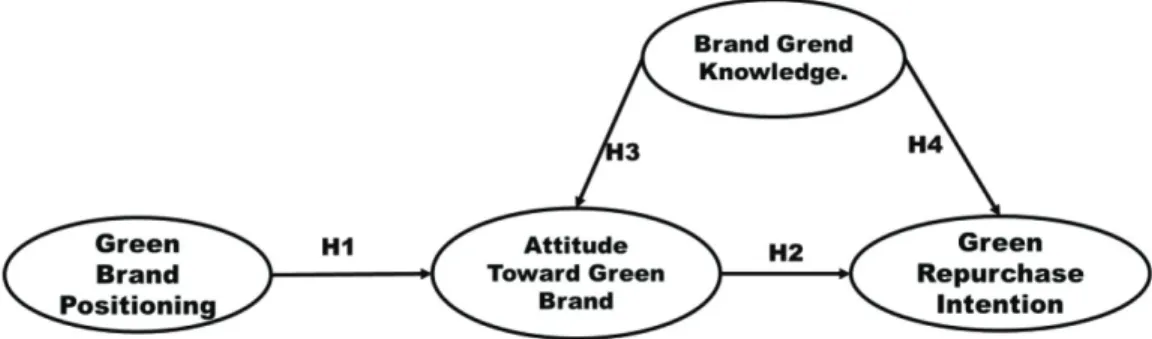
The purpose of this study was to examine the moderating effect of attitude toward green brand on green brand positioning and repurchase intention of environmentally friendly products, product knowledge on attitude toward green brand and the effect of green product knowledge on green repurchase intention. This study uses a structural equation approach with a sample size of 175 and uses an eight-point Likert scale.
The data collection technique used purposive sampling. The criteria for respondents are to use environmentally friendly cosmetic products and the respondents live in Central Java and have consumed more than two times. Online sampling using google form. Data were analyzed using statistical software AMOS 22. The results showed that green brand positioning has a significant effect on repurchase intention. Attitude toward green brand has a positive effect in mediating the relationship between green brand positioning and repurchase intention. Similarly, green brand knowledge has a positive effect on attitudes, although green knowledge has no positive effect on repurchase intention. Product positioning in the minds of consumers is important in shaping attitudes. It is important for companies to continue to develop environmentally friendly products so that product positioning can be distinguished from competitors’ products.
Keywords: Brand Positioning, Green Brand, Knowledge Green Brand, Repurchase Intention JEL Classification Code: D21, E21, M31
concern for the environment has implications for the demand for environmentally friendly products (Baiquni &
Ishak, 2019). Products with an environmentally friendly concept contribute to the success of the company’s strategy in responding to consumers who care about the environment and lead to the green consumption movement (Haung, Pan,
& Lin, 2008). Green consumerism is consumer awareness to get products that are feasible and safe and environmentally friendly (Rios, Martinez, Moreno, & Soriano, 2006). This situation has led companies to integrate the sustainability of business practices and marketing functions through environmentally friendly product positioning (Cronin, Smith, Gleim, Ramirez, & Martinez, 2011; Raska & Shaw, 2012). Studies (Huang, Yang, & Wang, 2014; Rios et al., 2006) state that green brand positioning is a company’s effort to differentiate environmentally friendly products from its competitors.
Consumers who are aware of the benefits of a product are certain to make repeat purchases (Oliver & Lee, 2010).
Environmentally friendly products are successful because of the attribute values attached to the products (Chen &
1
First Author and Corresponding Author. [1] Ph.D. Student, Faculty of Economics and Business, Diponegoro University, Indonesia [2]
Lecturer, Faculty of Economics, Wira Wacana Christian University, Indonesia [Postal Address: Jalan R Suprapto No 35, Kecamatan Kambera, Sumba Timur, Nusa Tenggara Timur, 87113, Indonesia]
Email: [email protected]
2
Lecturer, Faculty of Economics and Business, Diponegoro University, Indonesia. Email: [email protected]
3
Lecturer, Department of Management, Universitas Papua, Manokwari, Indonesia. Email: simatupang1979@gmail
4
Lecturer, Faculty of Economics and Business, Diponegoro University, Indonesia
© Copyright: The Author(s)
This is an Open Access article distributed under the terms of the Creative Commons Attribution Non-Commercial License (https://creativecommons.org/licenses/by-nc/4.0/) which permits unrestricted non-commercial use, distribution, and reproduction in any medium, provided the original work is properly cited.