한수지 52(1), 59-66, 2019
59
Copyright © 2019 The Korean Society of Fisheries and Aquatic Science pISSN:0374-8111, eISSN:2287-8815 Korean J Fish Aquat Sci 52(1),59-66,2019
Original Article
서 론
홍조류갈래곰보
(Meristotheca)
속(genus)
의 해조류는 전세 계적으로13
종이분포하며(Guiry and Guiry, 2018),
우리나라 연안에서는2
종(Meristotheca papulosa, Meristotheca coacta)
이서식하는것으로알려져있다(Lee and Kang, 2002).
그중 갈래곰보(Meristotheca papulosa J. Agardh)
는일본의남부태 평양연안,
대만,
필리핀,
폴리네시아,
인도양까지넓게분포하 며,
수심5-30 m
범위에서주로분포하고있다(Lewis and Nor- ris, 1987; Silva et al., 1987; Yoshida, 1998; Faye et al., 2005;
Tsuda and Walsh, 2013).
우리나라에서갈래곰보는최저수온이
12-13℃
이상을유지하는제주남부해역에서만서식하는지역종
(endemic species)
이며(Kim et al., 2016),
이들의생장적온은
20-24℃
로서,
상대적으로고온에서생장하는아열대성해조류이다
(Lideman et al., 2011; Guiry and Guiry, 2018).
갈래곰보는식감이우수하여샐러드로이용되고
,
일본과중 국에서도고급해산물요리에사용되고있으며(Xia and Abbott, 1987; Shinmura and Tanaka, 2008),
고지혈증의개선에효과 가있을것이라고보고되어(Park et al., 2001)
식품학적으로도 활용가치가높다.
우리나라에서는제주연안에서갈래곰보가 서식한다는것이1960
년에최초로기록되었으며(Kang, 1960), 1985
년부터자연개체군에서해녀들에의해본격적으로채취 되기시작하였다.
제주도해양수산현황(Marine Fisheries Sta- tus, 2018)
에따르면,
갈래곰보의연생산량(
생산금액)
은1990
년에161
톤(6
억원)
으로최대였고이후점차감소하여2004
년 에11
톤(2,300
만원)
으로최저였으며, 2007
년이후에는생산량 에대한기록을찾을수없을정도로자연개체군이감소하였제주도 유용 해조류 갈래곰보(Meristotheca papulosa) 야외개체군의 생장과 성숙
김보연·최한길 1 ·고준철*
국립수산과학원 제주수산연구소, 1원광대학교 생명과학부/씨앤바이오테크
Growth and Maturation of Natural Population of Meristotheca papulosa in Jeju Island
Bo Yeon Kim, Han Gil Choi
1
and Jun-Cheol Ko*Jeju Fisheries Research Institute, NFIS, Jeju 63068, Korea
1Faculty of Biological Science and Sea & Biotech, Wonkwang University, Iksan 54538, Korea
The growth and maturation pattern of a commercial and endemic red algae Meristotheca papulosa were investi- gated in Jeju Island. Ecological researches were performed in a natural population of 10 m water depth in Sinheung from march 2014 to November 2015. Maximal blade length and weight of M. papulosa were 8.7 cm and 5.49 g in July 2014 and 10.7 cm and 10.17 g in September 2015, respectively. Growth in blade area of the species reached a maximum of 43.84 cm 2 and 67.41 cm 2 in July 2014 and 2015, respectively. Thalli in the field population were rarely observed from October to December but new recruits were found from January, following year. Carposporophytes were observed from June to September when bottom seawater temperatures were around 20℃. At the study site, seawater temperature was in the range of 14.9-25.7℃. Growth parameters of M. papulosa and relative abundance of carposporophytes showed significant correlation with environmental factors (temperature, salinity, DIN). In this result, we clarified the growth and maturation period of M. palpulosa , and provided effective data on the protection and management of natural populations and basic data for mass culture of the alga.
Key words: Meristotheca papulosa , Natural population, Growth, Maturation, Phenology
*Corresponding author: Tel: +82. 64. 750. 4375 Fax: +82. 64. 743. 5883 E-mail address: [email protected]
This is an Open Access article distributed under the terms of the Creative Commons Attribution Non-Commercial Licens (http://creativecommons.org/licenses/by-nc/3.0/) which permits unrestricted non-commercial use, distribution, and reproduction in any medium, provided the original work is properly cited.
Received 2 October 2018; Revised 9 November 2018; Accepted 24 December 2018 저자 직위: 김보연(인턴연구원), 최한길(교수), 고준철(연구사) https://doi.org/10.5657/KFAS.2019.0059
Korean J Fish Aquat Sci 52(1), 59-66, February 2019
김보연
ㆍ
최한길ㆍ
고준철60
다
.
이러한 갈래곰보의 남획 이유는시장가격(1985-2013
년)
이평균3,030
원/kg
으로제주도에서생산되는다른해조류(
톳, 1,734
원/kg;
우뭇가사리, 1,981
원/kg)
에비해높고,
일본에수 출하는가격은염장상태로13,000
원/kg
으로서톳(9500
원/kg)
에비해매우높기때문이었다.
이처럼,
우리나라에서갈래곰보 는제주해역에서만서식하는지역종이며남획으로인하여개 체군이현저하게감소하여자연상태에서의보호가필요한종 으로서개체군복원및어업인의소득증대를위하여갈래곰보 의개체군변동에대한연구와향후양식에대한연구가절실하 게필요한실정이다.
식용종인갈래곰보에대한연구는일본에서주로이루어졌으 며
,
갈래곰보포자의방출과초기생장(Shinmura, 1974a),
계절 별생장과포자방출시기(Shinmura, 1974b)
에관한연구를시 작으로,
야외개체군생태연구(Serisawa et al., 2000),
해양심 층수를이용한수조배양(Ohno et al., 2001),
생식구조(Faye et al., 2005),
생장및광합성(Lideman et al., 2011; Lideman et al., 2012)
등다양한연구가수행되었다.
우리나라에서는갈래 곰보의원형질체분리에관한연구(Chung et al., 1999)
와추출 물에대한생리활성효능에관한연구가수행되었다(Park et al., 2001).
하지만,
경제성높은지역특산종인갈래곰보의자연개 체군에대한생태·
생리학적연구자료는1995-1997
년에국립 수산진흥원에서수행한유용해조류(
홑파래,
톳,
갈래곰보)
양 식기술개발의보고서자료가전부이고학회지에게제된논문 은한편도없는실정이다.
해조류는서식환경에따라생장및 성숙시기가다르고나아가개체군의감소와생장에대한영향 을많이받으므로,
우리나라제주도에서식하는갈래곰보개체 군에대한계절별생장과성숙에대한생물학적기초연구가수 행되어야할것이다.
갈래곰보와같은경제종양식과개체군복원을위해서는채묘 및종묘관리가필수적인데
,
이를위해서야외개체군의생장및 성숙시기에대한정보가필요하며,
양식및복원해역의환경 을파악하기위해서는자연서식처의환경에대한자료가필요 하다.
따라서본연구는다양한환경요인들과의통합분석을통 해제주도산갈래곰보야외개체군의최적생장및성숙시기를 파악하여채묘를위한포자확보시기와양식에적절한환경및 양식시기에대한정보를제공하기위한목적으로수행되었다.
재료 및 방법
본 연구를수행하기위해해양환경조사와갈래곰보의 채집 은제주남동부에위치한신흥
(33°17′N, 126°46′E)
해역의조 하대수심10 m
에서2014
년3
월부터2015
년11
월까지매월SCUBA Diving
에의해실시되었다(Fig. 1).
갈래곰보 서식처 환경 조사
본연구해역의저층수온은자동온도측정장치
(HOBO U24- 002-C, Onset, USA)
를수심10 m
에설치하여1
시간마다측정하였고
,
염분측정은YSI (6600-V2, YSI Incorporated, USA)
를이용하였다.
해수시료는Niskin
채수기를이용하여채수후4℃
를유지하면서실험실로운반한후에분석하였다.
암모니아 질소(NH
4+-N),
아질산질소(NO
2--N),
질산질소(NO
3--N),
인산 인(PO
4-3-P)
은각각indophenol method, NED method, cadmi- um reduction method, ascorbic acid method
로분석하였으며(MLTMA, 2010),
규산규소[Si(OH
4)-Si]
는molybdenum blue method
로spectrophotometer (UVIKONxs, SCOMAM)
를이 용하여정량화하였다.
용존무기질소(dissolved inorganic nitro-
gen, DIN)
는암모니아와아질산및질산질소의합으로나타냈다
.
부유물질(suspended solid, SS)
은해수시료2 L
를GF/F
여과지로 여과하고
110℃
에서건조한후 전자저울(CP124S,
Sartorius, Germany)
로무게를측정하였다. Chl a
는해수시료1 L
를GF/F
여과지로여과한후, 90%
아세톤용액10 mL
를첨 가하여엽록소를추출한다음원심분리기로분리된상등액을spectrophotometer (UVIKONxs, SCOMAM)
를이용하여측 정하였다(Parsons et al., 1984).
갈래곰보 채집 및 분석
본연구해역의수심
10 m
에서서식하는갈래곰보를부착기와엽체가손상되지않도록끌칼을이용하여 매월
30
개체이 상 무작위로채집한후실험실로 운반하였다.
갈래곰보의생 식상태를 근거로 영양체(vegetative),
사분포자체(tetrasporo-
phyte)
와과포자체(carposporophyte)
를구분하였고(Fig. 2),
개 체별엽장,
엽중량및엽면적을측정하였다.
개체별엽장(blade
length, cm)
은부착기에서정단부까지를vernier calipers
로측 정하였고,
엽중량(blade weight, g wet weight)
은엽체표면의 수분을종이타월로제거한후0.01 g
단위까지전자저울로측 정하였다.
갈래곰보엽체의면적(blade area, cm
2)
은사진을촬 영한후image J
프로그램(1.40s, National Institute of Health,
Bethesda, USA)
으로측정하였다.
또한,
갈래곰보야외개체군 Fig. 1. A map of sampling sites in Jeju Island, Korea.갈래곰보 야외개체군의 생장과 성숙
61
의생장과성숙에영향을미치는환경요인과의관계를알아보 기 위해상관분석
(pearson correlation)
을실시하였으며,
분석 에는SPSS (Ver 23.0, IBM, USA)
와microsoft Excel 2010
을 이용하였다.
결 과
생장 및 성숙
갈래곰보의엽장
(cm)
은평균7.1±0.7 cm (mean±SE)
였으 며, 2014
년에는6.7±0.5 cm, 2015
년에는7.4±1.1 cm
로2015
년에다소증가하였다.
월별엽장을보면, 2014
년에는4.5-8.7 cm
로7
월에최대였고, 2015
년에는1.2-10.7 cm
로9
월에최 대로 생장하였다(Fig. 3A).
갈래곰보의 개체별엽중량(g wet weight)
은평균4.51±0.84 g (mean±SE)
였으며, 2014
년에는2.97±0.51 g, 2015
년에는5.86±1.38 g
로2015
년에증가한것 을확인하였다.
월별엽중량을보면, 2014
년에는1.13-5.49 g
으 로7
월에최대였으며, 2015
년에는0.55-10.17 g
으로9
월에최 대생장을보였다(Fig. 3B).
갈래곰보엽체의면적(cm
2)
은평균36.37±5.35 cm
2(mean±SE)
였고, 2014
년에는27.55±3.54 cm
2, 2015
년에는44.09±8.93 cm
2로2015
년에 증가하였다.
월별엽면적을보면, 2014
년에는13.63-43.84 cm
2로엽장,
엽 중량와마찬가지로7
월에최대를보였으며, 2015
년에는6.89- 67.41 cm
2로7
월에최대였다(Fig. 3C).
갈래곰보의엽장,
엽중 량과엽면적을근거로한생장기는,
늦봄부터여름(5-9
월)
이었 으며,
가을(10
월)
에모두사라졌다가겨울(1
월)
에다시나타나 는전형적인일년생해조류의계절적특성을보였다.
생식기관인사분포자낭과과포자낭을가진갈래곰보는
5
월(2014
년)
과4
월(2015
년)
에관찰되기시작하였다(Fig. 4). 2014
년에사분포자체는5-9
월에나타났으며, 7
월에53.33%
로최대 였고,
과포자체는6-9
월까지발견되었으며, 9
월에83.33%
로최 대였다.
미성숙한영양체는3-6
월까지나타났으며, 7
월이후에 는모든개체가성숙된것으로확인되었다(Fig. 4A). 2015
년에15 12 9 6 3 0 15 12 9 6 3 0 80 60 40 20 0 Length (cm) Wet weight (g) Area (cm
2)
M A M J J A S O N D J F M A M J J A S O N
2014 2015
A
B
C
100 80 60 40 20 0 100 80 60 40 20 0
Mar Apr May Jun Jul Aug Sep Oct Nov Dec
Jan Feb Mar Apr May Jun Jul Aug Sep Oct Nov Vegetative Tetrasporophyte Carposporophyte
A
B
Relative abundance (%) Relative abundance (%)
30 25 21 15
10
Apr
Jan Apr Jun Oct Jul Nov
2014
Average : 19.9℃
Max : 28.7℃
Min : 14.0℃
SD : 3.67℃
2015
Water temperature ( ℃ )
16
12
8
4
0
35 30 25 20 15 10 5 M A M J J A S O N D J F M A M J J A S O N 0
2014 2015
Water temperature ( ℃ )
Plant weight (g wet wt)
Fig. 3. Monthly variations in average blade length (A), wet weight (B), and area (C) of Meristotheca papulosa at Sinheung site, Jeju Island, from 2014 to 2015. Vertical bars represent standard errors (n = 30 thalli). *, no observation.
Fig. 2. Fronds of Meristotheca papulosa. A, vegetative; B, tetrasporophyte; C, carposporophyte. Scale bars, 2 cm.
김보연
ㆍ
최한길ㆍ
고준철62
는사분포자체가
4-9
월까지출현하였으며, 6-7
월에56.67%
로 최대였고,
과포자체는6-9
월까지출현하였으며, 9
월에66.67%
로최대였다
.
영양체는1
월부터6
월까지출현하였으며, 7
월이 후에는모든개체가성숙하였다(Fig. 4B).
갈래곰보성숙개체(
사분포자체,
과포자체)
의출현비율로볼때성숙시기는6-9
월 로확인되었다.
서식처 환경
본 연구해역의 저층 수온
(seawater temperature)
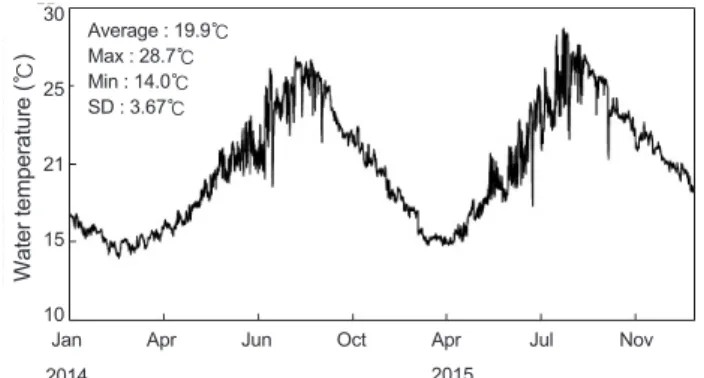
은19.9±
3.67℃ (mean±SD)
였으며,
연도별로는2014
년에19.3±3.55℃, 2015
년에20.6±3.67℃
로2015
년의수온이1℃
이상높은것 으로확인되었다(Fig. 5).
수온의월별변화는2014
년에14.9- 25.4℃
로2
월에최소, 9
월에최대였고, 2015
년에는3
월에평 균15.3℃
로최소, 9
월에25.7℃
로가장높았다.
연평균저층염 분(salinity)
은33.5±0.23 psu (mean±SE)
이었고,
연도별로는2014
년에33.6±0.34 psu, 2015
년에33.3±0.32 psu
로2015
년에다소낮게나타났다(Table 1).
염분의월별변화는2014
년 에31.8-35.0 psu
로9
월에최소, 4
월에최대였고, 2015
년에는31.8-34.7 psu
로9
월에가장낮았고, 2
월에가장높았다.
연구기간 동안 용존무기질소
(dissolved inorganic nitrogen, DIN)
의 농도는 연평균0.085±0.008 mg/L (mean±SE)
이 었고,
연도별로는2014
년에0.062±0.009 mg/L, 2015
년 에0.106±0.010 mg/L
로2015
년에증가한것을확인하였다(Table 1).
월별로는2014
년에0.037-0.118 mg/L
로11
월에 최소, 8
월에최대였으며, 2015
년에는0.061-0.154 mg/L
로5
월에 최소, 11
월에 최대로 나타났다.
용존무기인(dissolved inorganic phosphorus, DIP)
의 연평균 농도는0.004±0.001 mg/L (mean±SE)
이었고,
연도별로큰차이를보이지않았으 며,
월별로는2014
년8
월에0.013 mg/L
의농도를보이며최 대값을보였다.
규산규소(silicon dioxide, SiO
2)
는0.183 (2014
년)-0.193 (2015
년) mg/L (
평균0.188±0.021 mg/L)
로2015
년 에다소증가하였으며,
월별로는2014
년에0.076 (11
월)-0.258 (8
월) mg/L, 2015
년에는0.059 (9
월)-0.373 (5
월) mg/L
의범 위로나타났다.
부유물질(suspended solid, SS)
의경우연평균2.85±0.34 mg/L
이었고,
연도별로는2014
년에3.42±0.50 mg/L, 2015
년에2.33±0.42 mg/L
로2015
년에감소하였다.
월 별로는2014
년에1.80-5.80 mg/L
의범위로4
월과5
월에최소, 11
월에최대를보였으며, 2015
년에는0.65-4.38 mg/L
로3
월 에최소, 11
월에최대였다. Chlorophyll a
의경우연평균농도 는2.32±0.17 µg/L
였으며,
연도별로는2014
년에2.88±0.21 µg/L, 2015
년에1.82±0.11 µg/L
로2015
년에감소한것을확 인하였다.
월별로는2014
년에2.06-3.71 µg/L
으로4
월에최소, 11
월에최대였으며, 2015
년에는1.26-2.40 µg/L
으로2
월에가 장낮고, 7
월에가장높은값을보였다.
환경요인과의 상관관계
갈래곰보서식처의해양환경요인과갈래곰보야외개체군의 월별엽장
,
엽중량,
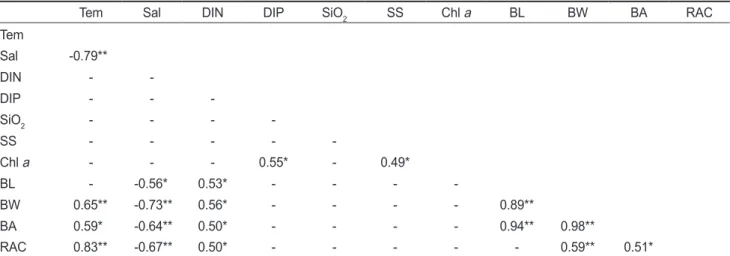
엽면적및과포자체의출현비율의상관관 계를분석한결과는Table 2
와같다.
서식처의수온은갈래곰보 의엽중량,
엽면적및과포자체의비율과양의상관관계를나타 냈으며,
이중엽중량(r=0.65),
과포자체의비율(r=0.83)
과높은 상관관계를보였다(Table 2).
염분은수온과음의상관관계(r=-
0.79)
를보였으며,
갈래곰보개체군의생태학적특성과도음의상관관계를나타냈다
.
영양염류중에서는용존무기질소(DIN)
가갈래곰보의엽장(r=0.53),
엽중량(r=0.56),
엽면적(r=0.50),
Fig. 4. Monthly variations in relative abundance of vegetative,tetrasporophyte and carposporophyte of Meristotheca papulosa at Sinheung site in Jeju Island, from 2014 (A) to 2015 (B). *, no observation.
Fig. 5. Variations of seawater temperature (10 m in depth) of Sin- heung site in Jeju Island from 2014 to 2015. SD, standard devia- tion.
15 12 9 6 3 0 15 12 9 6 3 0 80 60 40 20 0 Length (cm) Wet weight (g) Area (cm
2)
M A M J J A S O N D J F M A M J J A S O N
2014 2015
A
B
C
100 80 60 40 20 0 100 80 60 40 20 0
Mar Apr May Jun Jul Aug Sep Oct Nov Dec
Jan Feb Mar Apr May Jun Jul Aug Sep Oct Nov Vegetative Tetrasporophyte Carposporophyte
A
B
Relative abundance (%) Relative abundance (%)
30 25 21 15
10
Apr
Jan Apr Jun Oct Jul Nov
2014
Average : 19.9℃
Max : 28.7℃
Min : 14.0℃
SD : 3.67℃
2015
Water temperature ( ℃ )
16
12
8
4
0
35 30 25 20 15 10 5 M A M J J A S O N D J F M A M J J A S O N 0
2014 2015
Water temperature ( ℃ )
Plant weight (g wet wt)
15 12 9 6 3 0 15 12 9 6 3 0 80 60 40 20 0 Length (cm) Wet weight (g) Area (cm
2)
M A M J J A S O N D J F M A M J J A S O N
2014 2015
A
B
C
100 80 60 40 20 0 100 80 60 40 20 0
Mar Apr May Jun Jul Aug Sep Oct Nov Dec
Jan Feb Mar Apr May Jun Jul Aug Sep Oct Nov Vegetative Tetrasporophyte Carposporophyte
A
B
Relative abundance (%) Relative abundance (%)
30 25 21 15
10
Apr
Jan Apr Jun Oct Jul Nov
2014
Average : 19.9℃
Max : 28.7℃
Min : 14.0℃
SD : 3.67℃
2015
Water temperature ( ℃ )
16
12
8
4
0
35 30 25 20 15 10 5 M A M J J A S O N D J F M A M J J A S O N 0
2014 2015
Water temperature ( ℃ )
Plant weight (g wet wt)
갈래곰보 야외개체군의 생장과 성숙
63
과포자체의비율
(r=0.50)
과양의상관관계를보였으며,
그상 관계수의값은낮았으나 유의성을나타내는것(P<0.05)
을확 인하였다.
고 찰
해조류의생장과성숙은수온
,
광등다양한환경요인의영향 을받는것으로알려져있으며(Lüning, 1990; Pizarro and San- telices, 1993; Agrawal, 2012),
동일종이라도서식처환경에따 라생물계절적차이를보였다(Kain and Norton, 1990).
본연 구에서제주도신흥해역의조하대에서식하는갈래곰보의생 장은7-9
월에최대였으며, 2015
년9
월에엽장(10.7 cm),
엽중 량(10.17 g)
과엽면적(66.80 cm
2)
은최대였다.
국립수산진흥원의
1997
년보고서에서도제주도남부해역에서식하는갈래곰보야외개체군에서개체별평균엽장은
12.9 cm
이고습중량은9.3 g
으로9
월에최대생장을보인다고기록하여본연구의결과 와유사한패턴을보였다(NFRD, 1997).
한편,
일본Tosa
만의 갈래곰보개체군에서엽장은7
월(20.5 cm),
생물량은5
월(2.1 kg/m
2)
에최대를보였는데(Serisawa et al., 2000),
갈래곰보의 최대생장시기가일본에비해제주도개체군이더늦은것을알 수있었다.
이는일본의Tosa
만(15.7-27.3℃)
이제주신흥해역(14.9-25.4℃)
에비해수온이높기때문이며,
제주산과일본산 갈래곰보모두생장기의수온은21-25℃
로유사하였다.
일본의Tosa
만은쿠로시오난류의본류가연안에직접적으로영향을Table 1. Monthly variations of physical and chemical values observed in the bottom water (10 m in depth) at Sinheung site in Jeju Island, from 2014 to 2015
Sal (psu) DIN (mg/L) DIP (mg/L) SiO2 (mg/L) SS (mg/L) Chl a (µg/L)
2014
Mar 34.3 0.056 0.002 0.120 3.40 2.65
Apr 35.0 0.044 0.001 0.086 1.80 2.06
May 34.6 0.043 0.005 0.219 1.80 2.32
Jun 33.6 0.043 0.001 0.223 4.80 2.44
Jul 32.8 0.086 0.001 0.230 4.00 3.37
Aug 33.9 0.118 0.013 0.258 2.20 3.64
Sep 31.8 0.077 0.003 0.244 4.80 2.43
Oct 32.8 0.059 0.002 0.193 2.20 3.31
Nov 33.8 0.037 0.010 0.076 5.80 3.71
2015
Feb 34.7 0.090 0.001 0.259 1.90 1.26
Mar 34.1 0.065 0.001 0.243 0.65 1.80
Apr 33.9 0.127 0.002 0.361 1.08 1.39
May 32.8 0.061 0.001 0.373 0.85 1.78
Jun 32.4 0.111 0.005 0.141 4.27 1.95
Jul 32.4 0.083 0.002 0.072 2.71 2.40
Aug 32.7 0.108 0.005 0.169 2.95 1.60
Sep 31.8 0.123 0.002 0.059 2.80 1.96
Oct 33.7 0.136 0.004 0.148 1.75 2.09
Nov 34.5 0.154 0.005 0.104 4.38 1.98
Sal, Salinity (psu); DIN, Dissolved inorganic nitrogen (mg/L); DIP, Dissolved inorganic phosphorus (mg/L); SiO2, Silicon dioxide (mg/L);
SS, Suspended solid (mg/L); Chl a, Chlorophyll a (µg/L).
Fig. 6. Monthly variations blade weight of Meristotheca papulosa and seawater temperature at Sinheung site in Jeju Island, from 2014 to 2015. The shade represents the period of appearance of the tetrasporophyte (Ⓣ) and carpospotophyte (Ⓒ). *, no observation.
15 12 9 6 3 0 15 12 9 6 3 0 80 60 40 20 0 Length (cm) Wet weight (g) Area (cm
2)
M A M J J A S O N D J F M A M J J A S O N
2014 2015
A
B
C
100 80 60 40 20 0 100 80 60 40 20 0
Mar Apr May Jun Jul Aug Sep Oct Nov Dec
Jan Feb Mar Apr May Jun Jul Aug Sep Oct Nov Vegetative Tetrasporophyte Carposporophyte
A
B
Relative abundance (%) Relative abundance (%)
30 25 21 15
10
Apr
Jan Apr Jun Oct Jul Nov
2014
Average : 19.9℃
Max : 28.7℃
Min : 14.0℃
SD : 3.67℃
2015
Water temperature ( ℃ )
16
12
8
4
0
35 30 25 20 15 10 5 M A M J J A S O N D J F M A M J J A S O N 0
2014 2015
Water temperature ( ℃ )
Plant weight (g wet wt)
김보연
ㆍ
최한길ㆍ
고준철64
미치는해역으로수온이상승하는시기가빠르고
,
그지속기간 도길어제주연안보다수온이높은것으로사료된다.
또한,
다 양한온도(16, 20, 24, 28, 32℃)
에서실시된갈래곰보의생장실 험에서적수온은24℃
였고,
이보다높은수온에서는생장과광 합성이급감하였는데(Lideman et al., 2011),
이는갈래곰보야 외개체군의생장기수온과일치하였다.
본연구에서제주산일년생갈래곰보의계절별생장과성숙은 밀접하게관련되어있었는데
,
과포자체는서식지수온이19.3- 20.0℃
인6
월에최초로관찰된후9
월까지출현비율이지속 적으로증가하였으나(Fig. 6),
일본개체군에서과포자체는4
월
(20℃)
부터7
월까지출현한다고기록되어생장과성숙은일본개체군이약
2
개월빠른것으로나타났다(Serisawa et al., 2000).
또한,
본연구에서갈래곰보는과포자체비율이최대인9
월이후포자를방출한후소멸되었으며, 3-4
개월이경과한1
월중순경에새롭게가입(recruits)
된개체(
엽장1 cm
이하)
가관 찰되었고수온이상승하는5
월에빠른생장을보이다가9
월에 최대생장을기록하였다.
일본산갈래곰보는수온상승이일어 나는3
월부터생물량이급증하였으며, 7
월에최대생장과성숙 을기록한후소멸하였다가11
월에다시출현한다고하였는데(Serisawa et al., 2000),
이는일년생갈래곰보는최대생장과성 숙이일어나포자를방출하는패턴을보였으나서식지환경에 따라생장및성숙시기에차이가있음을확인하였다.
특히,
갈래 곰보는수온상승과함께빠른생장을보이다가수온이20℃
이 상인시기에생장이최대에도달하고성숙이일어나기시작하 는것으로사료된다.
또한,
성숙한갈래곰보엽체는수온이상승 하면서포자를방출하고이로인해끝녹음이진행되면서엽체 가소실된것으로분석된다.
이처럼서식지수온은갈래곰보야 외개체군의생장및성숙을결정짓는중요한환경요인으로확인되었는데
,
본연구에서수온과갈래곰보의엽중량및과포자 체비율이각기양의상관관계(
각각r=0.65, r=0.83)
를나타낸 것도수온의중요성을뒷받침한다.
수온이해조류의생장및성 숙에중요한환경요인이라는것은Kappaphycus alvarezii
의생 장(Muñoz et al., 2004),
꼬시래기과(Gracilaria spp.)
의8
종의 생장(Raikar et al., 2001)
에서도확인되었다.
이외에도 용존무기질소
(DIN)
가 갈래곰보의 생장에영향을 주는환경요인으로확인되었는데,
이는해조류가해수에용존 하는무기영양염류를흡수하여성장및생존에필요한에너지 로사용(Lobban and Harrison, 1994)
하기때문인것으로판단 된다.
더나아가제주연안의영양염류농도는용천수,
육상양 식장배출수,
양자강유출수,
강우시흘러들어오는하천수등 다양한요인에의해영향을받으므로(Koh et al., 2013),
해조류 의생육과영양염류의상관관계는복합적인분석이필요할것 으로생각된다.
결론적으로본연구는갈래곰보의생장과성숙은수온의변 화와밀접한관련이있는것으로확인되었으며
,
이외에도염분,
영양염농도와도관련이있음을확인하였다.
갈래곰보의생장 및성숙시기는일본개체군이제주개체군에비해약2
개월빠 른것으로비교되어동일종일지라도서식지수온과다른환경 요인에따라생장및성숙시기가변화한다는것을알수있었 다.
본연구에서는경제종으로중요하면서도자연개체군이감 소하는갈래곰보의생장및성숙시기를명확히밝힘으로써효 율적인자연개체군의보호및관리(
채취금지기간등)
와채묘 및종묘관리를통한대량양식을위한기초자료가확보되었다 고할수있다.
Table 2. Pearson correlation coefficient between environmental factors and biological parameters of Meristotheca papulosa at Sinheung site in Jeju Island, from 2014 to 2015
Tem Sal DIN DIP SiO2 SS Chl a BL BW BA RAC
Tem
Sal -0.79**
DIN - -
DIP - - -
SiO2 - - - -
SS - - - - -
Chl a - - - 0.55* - 0.49*
BL - -0.56* 0.53* - - - -
BW 0.65** -0.73** 0.56* - - - - 0.89**
BA 0.59* -0.64** 0.50* - - - - 0.94** 0.98**
RAC 0.83** -0.67** 0.50* - - - - - 0.59** 0.51*
Tem, Temperature (℃); Sal, Salinity (psu); DIN, Dissolved inorganic nitrogen (mg/L); DIP, Dissolved inorganic phosphorus (mg/L); SiO2, Silicon dioxide (mg/L); SS, Suspended solid (mg/L); Chl a, Chlorophyll a (µg/L); BL, Blade length (cm); BW, Blade weight (g); BA, Blade area (cm2); RAC, Relative abundance of carposporophyte (%); *, P<0.05; **, P<0.01.
갈래곰보 야외개체군의 생장과 성숙
65
사 사
본연구는국립수산과학원제주수산연구소
「
제주주변연근해 어업및환경생태조사, R2019027
과제의일환으로수행되었습 니다.
References
Agrawal SC. 2012. Factors controlling induction of reproduc- tion in algae review: the text. Folia Microbiol 57, 387-407.
https://doi.org/10.1007/s12223-012-0147-0.
Chung GH, Sun SM, Cho YC, Gong YG and Yoon JT. 1999.
Isolation and culture of Meristotheca papulosa protoplasts.
J Aquaculture 12, 7-14.
Faye EJ, Shimada S, Kawaguchi S and Masuda M. 2005. Char- acterization of the edible red alga Meristotheca papulosa (Solieriaceae, Gigartinales) from Japan. Phycol Res 53, 234- 245. https://doi.org/10.1111/j.1440-183.2005.00391.x.
Guiry MD and Guiry GM. 2018. AlgaeBase. National Universi- ty of Ireland, Galwaym, Ireland. Retrieved from http://www.
algaebase.org on Sep 27, 2018.
Kain JM and Norton TA. 1990. Marine Ecology. In: Biology of the Red Algae. Cambridge University Press, Cambridge, U.K., 377-422.
Kang JW. 1960. The summer algal flora of Cheju Island (Quelpart Island). Bull Pusan Fish Coll 3, 17-23.
Kim BY, Ko JC and Choi HG. 2016. Rock type difference and Benthic Community Structures in the coast of Jeju, Korea. Korean J Environ Ecol 30, 996-1008. https://doi.
org/10.13047/KJEE.2016.30.6.996.
Koh HJ, Park SE, Cha HK, Chang DS and Koo JH. 2013. Coast- al eutrophication caused by effluent from aquaculture ponds in Jeju. J Kor Soc Mar Environ Saf 19, 315-326. https://doi.
org/10.7837/kosomes.2013.19.4.315.
Lee YP and Kang SY. 2002. A Catalogue of the Seaweeds in Korea. Jeju National University Press, Jeju, Korea, 1-662.
Lewis JE and Norris JN. 1987. A history and annotated account of the benthic marine algae of Taiwan. Smithsonian Contr Mar Sci 29, 1-38. https://doi.org/10.5479/si.01960768.293.
Lideman, Nishihara GN, Noro T and Terada R. 2011. In vi-iv tro growth and photosynthesis of three edible seaweeds,
Betaphycus gelatinus, Eucheuma serra and Meristotheca papulosa (Solieriaceae, Rhodophyta). Aquaculture Sci 59,
563-571. https://doi.org/10.11233/aquaculturesci.59.563.Lideman, Nishihara GN, Noro T and Terada R. 2012. Effect of temperature and light on the photosynthetic performance of two edible seaweeds: Meristotheca coacta Okamura and
Meristotheca papulosa J. Agardh (Solieriaceae, Rhodophy-
ta). Aquaculture Sci 60, 377-388. https://doi.org/10.11233/aquaculturesci.60.377.
Lobban CS and Harrison PJ. 1994. Seaweed Ecology and
Physiology. Cambridge University Press, Cambridge, U.K., 1-366.
Lüning K. 1990. Seaweed: Their Environment, Biogeography and Ecophysiology. Wiley, New York, NY, U.S.A., 1-527.
Marine Fisheries Status. 2018. Jeju Special Self-Governing Province, Jeju, Korea, 1-176.
Ministry of Land, Transport and Maritime Affairs. 2010. Stan- dard methods of marine environment in Korea.
Muñoz J, Freile-Pelegrín Y and Robledo D. 2004. Maricul- ture of Kappaphycus alvarezii (Rhodophyta, Solieriaceae) color strains in tropical waters of Yucatán, México. Aqua- culture 239, 161-177. https://doi.org/10.1016/j.aquacul- ture.2004.05.043.
NFRD (National Fisheries Research Development). 1997. Stud- ies on development of cultivation technique of available sea- weeds (Monostroma nitidum, Hizikia fusiformis and Meris-
totheca papulosa). NFRD, Yeosu, Korea, 1-488.
Ohno M, Yano M, Hiraoka M, Oka N and Taniguchi M. 2001.
Tank culture of Echeuma serra and Meristotheca papulosa using with deep sea water. Bull Mar Sci Fish Kochi Univ 20, 35-40.
Park HY, Yoon HD and Oh EG. 2001. Effect of Meristotheca
papulosa on lipid concentration of serum and liver in rats
fed high fat diet. J Korean Soc Food Sci Nutr 30, 107-111.Parsons TR, Maita Y and Lalli CM. 1984. A manual of chemi- cal and biological methods for seawater analysis. Pergamon Press, Oxford, U.K., 1-173.
Pizarro A and Santelices B. 1993. Environmental variation and large scale Gracilaria production. Hydrobiologia 260/261, 357-363.
Raikar SV, Iima M and Fujita Y. 2001. Effect of temperature, salinity and light intensity on the growth of Gracilaria spp.
(Gracilariales, Rhodophyta) from Japan, Malaysia and In- dia. Indian J Mar Sci 30, 98-104.
Serisawa Y, Taino S and Ohno M. 2000. Ecological study of utilized red alga, Meristotheca papulosa (Solieriaceae, Gi- gartinales) population off Susaki, Tosa Bay, Southern Ja- pan. Aquaculture Sci 48, 597-601. https://doi.org/10.11233/
aquaculturesci1953.48.597.
Shinmura I. 1974a. Development of spore and its growth in Meristotheca papulosa. Bulletin of the Japanese Soc Phycol 22, 77-82.
Shinmura I. 1974b. The seasonal variation of growth and the period of spore-liberation in Meristotheca papulosa. Bull Ja- pan Soc Phycol 22, 124-129.
Shinmura I and Tanaka T. 2008. Useful seaweeds of Kagoshima III. Rhodophyta. Jpn J Phycol 56, 123-128.
Silva PC, Meñez EG and Moe RL. 1987. Catalog of the benthic marine algae of the Philippines. Smith Contr Mar Sci 27, 1-179. https://doi.org/10.5479/si.1943667X.27.1.
Tsuda RT and Walsh SK. 2013. Bibliographic checklist of the marine benthic algae of central Polynesia in the Pacific
김보연
ㆍ
최한길ㆍ
고준철66
Ocean (excluding Hawai'I and French Polynesia). Microne- sica 2013-02, 1-91.
Xia B and Abbott IA. 1987. Edible seaweeds of China and their place in the Chinese diet. Econ Bot 41, 341-353.
Yoshida T. 1998. Marine Algae of Japan. Uchida Rokakuho Publishing Co., Ltd. Tokyo, Japan, 1-222.