697
Copyright © 2018 The Korean Society of Fisheries and Aquatic Science pISSN:0374-8111, eISSN:2287-8815
서 론
연안해역의생물학적오염은생활하수, 축산업이나양식수 산업으로부터배출되는동물의분변, 기타산업시설등의다양 한요인에의한다(Hill et al., 2006; Lee et al., 2010; Park et al., 2013; Roh et al., 2018). 연안해역의오염원과오염에대한영향 을이미파악하고있다면그근원을집중적으로관리할수있을 것이다(Lee et al., 2008). 그러나아직까지연안오염의주요인 에대한연구는미미한실정이다(Yoon, 2017; Roh et al., 2018).
특히우리나라의바닷가에인접한수산양식장으로부터배출된 유출수가연안해수의오염에미치는영향에관한연구는비교 적최근에발표된것을제외하면매우제한적인것이사실이다 (Koh et al., 2013; Park et al., 2013; Roh et al., 2018). Koh et al.
(2013)는 2010-2011년에격월로제주연안의육상양식장인근
해역 4곳(애월, 행원, 표선, 일과)에서채취된해수의식물플랑 크톤과영양염의변화를모니터링하여 2개지역(표선, 일과)은 양식장배출수가인근연안해역의부영양화에영향을줄수있 다고주장하였다. 하지만이연구에서는주변의다른여러오염 원에대한검토가전혀이루어지지않아수질오염에대한양식 장유출수의직접적인영향을판단하는근거로는부적절한것 으로여겨진다. Roh et al. (2018)은 2016년제주지역의양식 장밀집도와오염지표세균과의상관관계를분석하였으나두지 표간의연관성은낮은것으로나타나조사한양식장의유출수 가인근해역의오염에는큰영향을미치지는않는다고하였다. 하지만수산생물양식장이연안해역에미치는영향에대한보 다정확한평가를위해서는국내주요양식장밀집지역에대해 정기적인조사와연구가필요한것으로보인다. 본연구에서는 이전연구(Koh et al., 2013; Roh et al., 2018)에서모니터링된
2017년 동해안권역과 제주도권역 양식장 주변 해역의 오염지표세균의 분포
노형진·김남은·천원경·김아란·이윤항·김영재1·황지연2·김도형*
부경대학교 수산생명의학과, 1㈜한국수산방역기술, 2국립수산과학원 방역과
Distribution of Indicator Bacteria in Seawater off the Coasts of Jeju Island and Pohang in 2017
Heyong Jin Roh, Nam Eun Kim, Won-Kyong Chun, Ahran Kim, Yoonhnag Lee, Youngjae Kim1, Jee- Youn Hwang2 and Do-Hyung Kim*
Department of Aquatic Life Medicine, Pukyong National University, Busan 48513, Korea
1Korea Aquatic Biosecurity Technology (KABT), Busan 48564, Korea
2Aquatic Life Disease Control Division, National Institute of Fisheries Science, Busan 46083, Korea
In 2017, total coliform (TC), fecal coliform (FC) and fecal Streptococci (FS) bacteria were examined in seawater samples collected at coastal sites on Jeju Island (Aewol as a control, Namwon, and Daejeong) and at Pohang (Yeongil as a control, Guryongpo-North, and Guryongpo-South) to examine the correlations between the density of fish farms and distributions of the indicator bacteria. Only a few TC, FC, and FS colonies were detected in all of the samples obtained from Jeju Island. Of note, 2,000 and 1,000 CFU of FS 100 mL-1 were detected in samples from Guryongpo- South in June and August, respectively. Although the total area of approved fish farms located within 5 km of the sampling point at Guryongpo-South is 5-16 times smaller than in other regions, the number of indicator bacteria was highest in this region. Therefore, microbiological pollution in the Guryongpo-South region might be due to sources other than the effluent released from nearby fish farms.
Key words: Fecal indicator bacteria, Fecal coliforms, Fecal streptococci, Fish farm, Seawater quality
*Corresponding author: Tel: +82. 51. 629. 5945 Fax: +82. 51. 629. 5938 E-mail address: [email protected]
This is an Open Access article distributed under the terms of the Creative Commons Attribution Non-Commercial Licens (http://creativecommons.org/licenses/by-nc/3.0/) which permits unrestricted non-commercial use, distribution, and reproduction in any medium, provided the original work is properly cited.
Received 2 October 2018; Revised 31 October 2018; Accepted 6 December 2018 저자 직위: 노형진(대학원생), 김남은(대학원생), 천원경(대학원생), 김아란 (대학원생), 이윤항(대학원생), 김영재(대표이사), 황지연(해양수산연구사), 김도형(교수)
https://doi.org/10.5657/KFAS.2018.0697
Korean J Fish Aquat Sci 51(6), 697-703, December 2018
노형진ㆍ김남은ㆍ천원경ㆍ김아란ㆍ이윤항ㆍ김영재ㆍ황지연ㆍ김도형 698
제주도뿐만아니라동해안권역(포항인근) 양식장밀집지역의 연안에서해수를채취하였다. 이전연구(Roh et al., 2018)와는 다른정량방법을이용하여총대장균군(total coliform, TC), 분 변계대장균(fecal coliform, FC) 그리고분변계연쇄구균(fecal streptococci, FS)을측정하여연안해역의오염과해당지역의 양식장분포간의역학적인관계를이해하고자하였다.
재료 및 방법 시료 채취
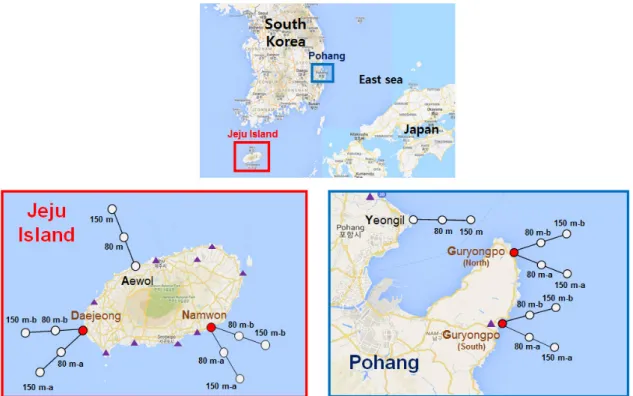
해수시료의채취를위해넙치양식장이많이존재하는포항 시구룡포읍의북부및남부지역과서귀포시남원읍과대정읍 을선정하였다. 각지역에존재하는유수식넙치양식장밀집지 역으로부터 80과 150 m가떨어진정점(각각 2 지점)의해수(중
층)와양식장유출수가배출되는지점을중심으로반경약 5 m
이내에서해수시료를채취하였으며자세한위치와채수수심 은 Table 1과 Table 2에나타내었다. 대조구로수산양식장이존
재하지않는포항시영일만과제주시애월읍해안에서 1, 80 및
150 m 떨어진정점의중층에서채취한해수를사용하였다(Fig.
1). 채수는 2017년도 4-11월에걸쳐총 4회가진행되었으며, 샘
플링정점은 GPS 좌표를이용하여일관성을유지하고자하였
다. 그외채수, 운반, 수온및용존산소량측정방법은이전연구 (Roh et al., 2018)와동일하게진행하였다.
오염지표종의 정량
해수중에존재할수있는오염지표세균인분변계대장균(FC) 과총대장균군(TC)을정량하기위해제조사가추천하는방법 에따라 3 mL의해수를 E. coli/ Coliform count plate (3M Pet- rifilm, 3M, USA)과 Coliform count plate (3M Petrifilm, 3M, USA)에 1 mL씩나눠접종한뒤각각 37℃와 43℃에서 24-48 시간동안배양후세균집락을계수하였다. 또한해수중에존 재하는분변계연쇄구균을정량하기위해 m-Enterococcus agar (DifcoTM, USA)에해수 0.3 mL을 0.1 mL씩나눠접종하여도 말한뒤 28 ℃에서 72시간배양하여총집락을계수하였다.
결과 및 고찰
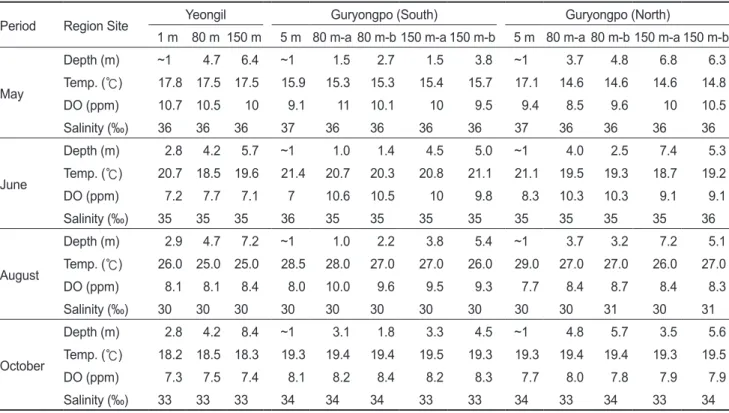
본연구에서해수를채수한시기인 4-5월(1차), 6월(2차), 8 월(3차), 10월(4차)에 포항시 인근 영일만, 구룡포 남부, 북 부 해역의기하적인 평균수온은각각 15.8±1.2, 20.0±1.0,
26.8±1.2, 19.1±0.5℃이였으며기하학적인평균용존산소는
각각 9.9±0.5, 9.0±1.4, 8.6±0.8, 7.9±0.3 ppm이었다. 제주 도인근애월, 남원, 대정해역의 1, 2, 3, 4차채수시에기하평 균수온은각각 16.5±0.8, 19.3±1.0, 27.7±0.3, 21.7±0.4℃
이였으며, 기하평균용존산소는 9.9±0.5, 9.0±0.4, 7.4±0.4, 8.4±0.2 ppm으로두지역모두수온이가장높은 8월에농도 가가장낮은것을확인할수있었다(Table 1, 2).
Table 1. Sampling locations, water depth, water temperature, dissolved oxygen (DO) and salinity in seawater off the coast of Pohang
Period Region Site Yeongil Guryongpo (South) Guryongpo (North)
1 m 80 m 150 m 5 m 80 m-a 80 m-b 150 m-a 150 m-b 5 m 80 m-a 80 m-b 150 m-a 150 m-b May
Depth (m) ~1 4.7 6.4 ~1 1.5 2.7 1.5 3.8 ~1 3.7 4.8 6.8 6.3
Temp. (℃) 17.8 17.5 17.5 15.9 15.3 15.3 15.4 15.7 17.1 14.6 14.6 14.6 14.8
DO (ppm) 10.7 10.5 10 9.1 11 10.1 10 9.5 9.4 8.5 9.6 10 10.5
Salinity (‰) 36 36 36 37 36 36 36 36 37 36 36 36 36
June
Depth (m) 2.8 4.2 5.7 ~1 1.0 1.4 4.5 5.0 ~1 4.0 2.5 7.4 5.3
Temp. (℃) 20.7 18.5 19.6 21.4 20.7 20.3 20.8 21.1 21.1 19.5 19.3 18.7 19.2
DO (ppm) 7.2 7.7 7.1 7 10.6 10.5 10 9.8 8.3 10.3 10.3 9.1 9.1
Salinity (‰) 35 35 35 36 35 35 35 35 35 35 35 35 36
August
Depth (m) 2.9 4.7 7.2 ~1 1.0 2.2 3.8 5.4 ~1 3.7 3.2 7.2 5.1
Temp. (℃) 26.0 25.0 25.0 28.5 28.0 27.0 27.0 26.0 29.0 27.0 27.0 26.0 27.0
DO (ppm) 8.1 8.1 8.4 8.0 10.0 9.6 9.5 9.3 7.7 8.4 8.7 8.4 8.3
Salinity (‰) 30 30 30 30 30 30 30 30 30 30 31 30 31
October
Depth (m) 2.8 4.2 8.4 ~1 3.1 1.8 3.3 4.5 ~1 4.8 5.7 3.5 5.6
Temp. (℃) 18.2 18.5 18.3 19.3 19.4 19.4 19.5 19.3 19.3 19.4 19.4 19.3 19.5
DO (ppm) 7.3 7.5 7.4 8.1 8.2 8.4 8.2 8.3 7.7 8.0 7.8 7.9 7.9
Salinity (‰) 33 33 33 34 34 34 33 33 34 33 34 33 34
Table 2. Sampling locations, water depth, water temperature, dissolved oxygen (DO) and salinity in seawater off the coast of Jeju Island
Period Region Site Aewol Namwon Daejeong
1 m 80 m 150 m 5 m 80 m-a 80 m-b 150 m-a 150 m-b 5 m 80 m-a 80 m-b 150 m-a 150 m-b May
Depth (m) 1.0 3.8 5 ~1 2.6 2.4 5.6 3.1 ~1 2.7 3.8 10.2 10.9
Temp. (℃) 15.8 15.3 15 17.4 17.1 17.3 17.4 17.6 16.8 16.7 16.4 16.2 16
DO (ppm) 10.7 10.3 10.5 9.3 10.5 9.6 9.9 10.4 9.2 9.8 9.9 9.6 9.8
Salinity (‰) 36 35 36 36 37 36 36 37 37 36 36 36 36
June
Depth (m) 1.6 3.9 4.3 ~1 3.9 3.1 5.9 3.9 ~1 3.3 6.6 8.8 10.9
Temp. (℃) 21.4 20.3 21.1 19.3 19.2 19 19.6 19.1 18.8 18.3 18.2 19.1 18.2
DO (ppm) 8.2 9 9.5 8.6 9 9.2 8.8 9.2 9 9 9.3 9.6 9.8
Salinity (‰) 34 34 34 35 35 35 35 35 34 34 34 34 34
August
Depth (m) 1.4 4.4 4.8 ~1 4.2 3.5 4.8 3.5 ~1 3.5 4.9 8.5 10.4
Temp. (℃) 28.0 28.0 27.6 27.3 27.5 27.5 27.5 28.0 27.5 28.0 28.0 27.8 28.0
DO (ppm) 6.9 6.9 7.2 7.4 7.6 7.4 7.5 7.3 7.5 7.7 7.6 7.9 7.5
Salinity (‰) 30 30 30 25 25 25 26 26 30 30 30 31 30
October
Depth (m) 1.7 4.2 6.7 ~1 3.5 2.8 3.6 4.0 ~1 2.8 5.4 7.7 9.2
Temp. (℃) 21.6 21.7 21.8 21.0 22.2 21.3 21.4 21.4 21.7 22.1 22.1 22.2 22.2
DO (ppm) 8.3 8.4 8.5 7.9 8.2 8.5 8.4 8.4 8.6 8.7 8.6 8.5 8.4
Salinity (‰) 34 34 34 28 31 28 30 28 33 32 33 33 33
Fig. 1. Sampling locations (white and red circles) used in this study. Note that three and five locations for Aewol and Yeongil (Control) and for Daejeong and Namwon in Jeju Island and Guryongpo-north and Guryongpo-south in Pohang, respectively. Red circles indicate the sam- pling location (within 5 m in diameter) where effluent water was released from a land-based olive flounder farm seawater. Purple triangles indicate the location of the sewage treatment plant.
노형진ㆍ김남은ㆍ천원경ㆍ김아란ㆍ이윤항ㆍ김영재ㆍ황지연ㆍ김도형 700
이전연구(Roh et al., 2018)에서는해수내미생물을정량하 기위해해수를 GF/C filter에통과시킨후약 300배농축하여 실험을진행하였다. 그러나이방법은 free living bacteria의유 실(Moeseneder et al., 2001; Roh et al., 2018)과농축후의전 처리과정(예를들어 filter 세척)에서세균의유실이일어날수 있기때문에여러단점을내포한다고할수있다. 이번연구에 서는이전연구(Jung et al., 1996; Song et al., 2008; Yoo et al.,
2010)와같이해수의농축없이일반적인방법으로오염지표세
균을정량하고자하였다. 농축방법과비농축방법을대략적으 로비교하기위해, 이전연구결과(Roh et al., 2018)와동일한 지역인제주대정지역의분변계연쇄구균이검출된비율을살 펴보면 Roh et al. (2018)은 6, 8, 10월에걸쳐대략 57% 정도 되었지만, 본연구에서는 4, 6, 8, 10월에걸쳐 8% 정도검출되 어낮은검출율을보였다. 하지만, Roh et al. (2018)이제시하 고있는가장높은분변계연쇄구균농도는 30-35 CFU (colony forming unit) 100mL-1인것에비해본연구의대정지역의농도 는대략 150-200 CFU 100mL-1로 5배정도높았다. 이는해당 해역이 1년전보다 5배정도오염되었다고판단하기보다는시 료를농축하여검출한이전연구와농축없이해수원액을사용 한이번연구의방법적인차이에서기인하는것으로판단된다. 농축을통해오염지표종을모니터링할경우검출한계가낮아 져민감도를높일수는있으나, 농축과정에서오염지표종의유 실이나타날수도있어정확한정량이안될수도있다는장단점 이존재하는것을확인할수있다. 환경부고시제2016-65호수 질오염공정기준에따르면총대장균군과분원성대장균군을측 정하기위해여과해야할시료의양은그성격에따라다르며시 료가해수인경우실험방법에대한정보는없었지만하천수의 경우 1-0.001 또는 1-0.01 mL을사용하는것으로되어있다. 따
라서본연구에서사용한해수원액은실제오염지표세균농도 를모니터링하고해석하는데있어적합하다는것을의미한다.
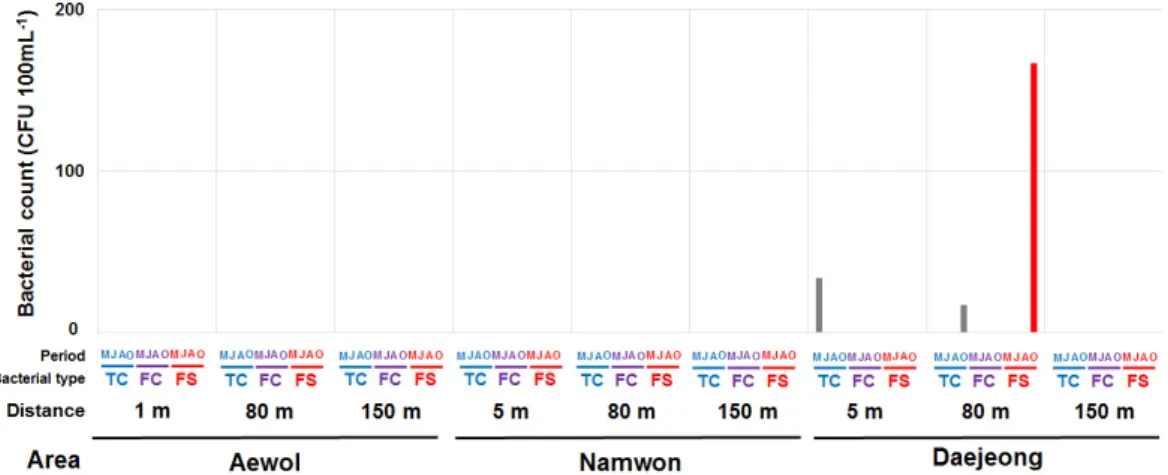
총대장균군의경우포항지역에서 8월에채취된대부분의해 수시료에서검출되었으나그농도는 100 CFU 100 mL-1 이하 인것으로나타났다. 제주도의경우대정지역에서채취한일부 해수시료에서만약 20-40 CFU 100mL-1로나타나포항에비해 총대장균군의농도와검출빈도가낮은것을확인할수있었다. 이농도는해양환경관리법제8조에따른해양환경기준(생활환 경기준) (해양수산부고시제2013-186)은총대장균군의수가 1,000 CFU 100 mL-1이하인경우생활환경적합으로정의하고 있다. 이번연구에서나타난총대장균군의수는이기준에비해 10-20배이상낮은것을알수있다.
분변계대장균의경우해수의오염과관련된국내의기준은없 으나정착성수산동식물생산해역의등급설정기준(해양수산 부고시제2013-154호)의지표로는사용되고 있다. 이기준에 따른 ‘청정해역’은분변계대장균의최확수(MPN)의중앙값또 는기하학적평균치가 14 CFU 100 mL-1를초과하지않아야하 며, 43 CFU 100mL-1를초과하는시료의수가 10% 미만으로 정의하고있다. 본연구에서는 6월과 8월에구룡포남부의양식 장유출수배출지점(5 m)과 80 m 정점에서각각 66.7과 16.7
CFU 100 mL-1의분변계대장균이검출되었으나, 이를제외한
나머지샘플에서는검출되지않아 ‘청정해역’인것으로나타났 다(Fig. 2와 Fig. 3).
또다른오염지표세균인분변계연쇄구균의경우일부지역(3 개정점) (Fig. 2와 Fig. 3)에서검출되었다. 6월달구룡포북부 80 m 지점과 10월의제주도대정 80 m 지점해수의분변계연 쇄구균의 농도는 166 CFU 100 mL-1로 나타났다. 이지표세 균에대한국내의관련기준은없으나 WHO에서제시한기준 Fig. 2. Total coliform (TC), fecal coliforms (FC), and fecal streptococci (FS) counts in seawater sampled in Pohang. Red bars indicate sample harboring more than 43 and 41 CFU mL-1 of FC and FS, respectively. Capital letters (M, J, A and O) indicate May, June, August and October, respectively. CFU, Colony forming unit.
(WHO, 2003)을근거로하면어느정도의관리가필요한 “B 등 급” (분변계연쇄구균의농도가 41-200 CFU 100 mL-1인해역) 에속하는것을확인할수있었다. 6월과 8월에채취된구룡포
남부지역양식장유출수배출지점(5 m) 해수의분변계연쇄구
균은농도는 1,000-2,000 CFU 100 mL-1로나타났지만 80과 150 m 정점의해수에서는검출되지않아(Fig. 2와 3) 인근해역
에큰영향을미치지는않는것으로나타났으나(Fig. 4) 향후양 식장유출수관리의필요성이있을것으로판단된다.
제주지역양식장의유출수배출(5 m) 지점으로부터반경약 5
km 내에존재하는양식장의수면적(대정: 98,765 m2, 표선; 남 원인근: 343,276 m2) (Roh et al., 2018; Fisheries Policy Divi- sion in Jeju Special Self-Governing Province, 2018)과구룡포 Fig. 3. Total coliform (TC), fecal coliform (FC), fecal streptococci (FS) counts in seawater sampled in Jeju Island. Red bars indicate sample harboring more than 1,000, 43 and 41 CFU mL-1 of TC, FC and FS, respectively. Capital letters (M, J, A and O) indicate May, June, August and October, respectively. CFU, Colony forming unit.
Fig. 4. Distribution of indicator bacteria (a total coliform, fecal coliforms, fecal streptococci) in seawater sampled in Pohang and Jeju Island.
Different colors and circle sizes indicate different type of indicator bacteria, bacterial counts, and sampling time points. CFU, Colony form- ing unit.
노형진ㆍ김남은ㆍ천원경ㆍ김아란ㆍ이윤항ㆍ김영재ㆍ황지연ㆍ김도형 702
북부와남부지역(유출수배출지점으로부터반경약 5 km 이 내) 양식장의수면적은각각 84,170와 21,298 m2로나타났다. 구룡포남부지역의양식장수면적은이번연구에서조사되었
던다른지역에비해 4-16배가낮았음에도불구하고인근연안
해수의분변계연쇄구균과분변계대장균의농도가아주더높 은것은단순히양식장으로부터배출된유출수의영향보다는 주변의다른오염원에의한영향이더클수있음을나타내고있 다. Lee et al. (2011)에의하면구룡포남부지역에있는구룡포 항의오염이매우심각하며최근오염지수(예를들어 chemical oxygen demand, COD; total nitrogen, TN; total phosphorus, TP)가계속상승하고있다고보고하였다. 또한본연구에서채 수한지역인근에는구룡포하수처리장, 구룡포해수욕장과많 은음식점이존재하는것도이지역의오염과밀접한연관이있 을것으로판단된다. 추후구룡포남부지역양식장밀접지역의 오염지표세균의유래에대한추적은필요할것으로사료된다. 본연구에서는분변계연쇄구균과 분변계대장균이검출되는 지점은비슷하게나타난것을확인할수있었지만검출되는양 은분변계연쇄구균의수가분변계대장균보다 10-20배높게나 타나는것을확인할수있었다. 이는기존의연구(WHO, 2003;
Roh et al., 2018)에서언급한것과같이해수의오염도를판단 할때는오염지표세균의종별해수내생존능이달라상대적 으로해수에좀더오래생존할수있는분변계연쇄구균이분 변계대장균을이용한오염도측정보다적합하다고하였다. 또 한, Abdallah et al. (2005)에서도해수의생물학적오염도를측 정하기위해서분변계연쇄구균과분변계대장균을함께검출하 였다. 이런점을고려했을때향후해수의생물학적오염을평 가시에분변계연쇄구균도포함시키는것이유용할것으로판 단된다.
본연구에서는제주도권역과동해안권역의양식장밀집지역 인근해역에서의오염지표세균에대한조사결과를바탕으로 해역의오염정도를평가한결과지역및시기별로차이는났지 만양식장의밀집도와해역의미생물학적인오염도간의상관 관계는확인되지않았다. 이는이전연구(Roh et al., 2018)의결 과와도유사하다고판단된다. 하지만일부양식장밀집지역(구 룡포남부지역의양식장) 유출수배출지점의 6월과 8월에채 취된해수에서많은양의분변계연쇄구균이검출된것을고려 하면양식장의배출수가주변의여러점오염원중의하나가될 수도있다는것을보여준다. 이는향후지속가능한양식산업 을위해서연안해역의여러오염원뿐만아니라양식장으로부 터배출되는유출수의오염정도를정확히파악하고필요하다면 관리도이루어져야할것으로판단된다.
사 사
이논문은부경대학교자율창의학술연구비(2017년)에 의하 여연구되었습니다.
References
Abdallah S, Elmanama A, Fahd M and Afifi S. 2005. Microbio- logical Beach Sand Quality in the Gaza Strip in Comparison to Seawater. Environ Res 14, 1-10. https://doi.org/10.1016/j.
envres.2004.12.014.
Fisheries Policy Division in Jeju Special Self-Governing Prov- ince. 2018.Status of aquaculture [License·Permission·Decl aration] as of December 31, 2016. Retrieved from https://
www.jeju.go.kr/open/open/iopenboard.htm?category=1113 on Apri 10, 2018.
Hill D, Owens W and Tchounwou P. 2006. The impact of rain- fall on fecal coliform bacteria in Bayou Dorcheat (North Louisiana). Int J Environ Res Public Health 3, 114-117.
https://doi.org/10.3390/ijerph2006030013.
Jung KJ and Shin SU. 1996. Bacterial Flora of East China Sea and Yosu Coastal Sea Areas 1. Horizontal Distributions Ac- cording to Number of Bacteria, Vibrio spp. and Coliform Group. Korean J Fish Aquat Sci 29, 9-16.
Koh HJ, Park SE, Cha HK, Chang DS and Koo JH. 2013. Coast- al eutrophication caused by effluent from aquaculture ponds in Jeju. J Korean Soc Mar Environ Saf 19, 315-326. https://
doi.org/10.7837/kosomes.2013.19.4.315.
Lee DI, Kim GY, Moon JH and Eom KH. 2011. The Policy Review and Water Quality Characteristics of National Fish- ing Harbors and Designated Ports in East Coast of Korea. J Korean Soc Mar Environ Energy 14, 213-223. https://doi.
org/10.7846/jkosmee.2011.14.4.213.
Lee DI, Eom KH, Kim GY, Hong SJ, Lee WC and Jang JH.
2008. Effective Coastal Water Quality Management and Marine Environmental Impact Assessment. J Korean Soc Mar Environ Saf 14, 29-37.
Lee TS, Oh EG, Yu HD, Ha KS, Yu HS, Byun HS and Kim JH 2010. Impact of rainfall events on the bacteriological water quality of the shellfish growing area in Korea. Ko- rean J Fish Aquat Sci 43, 406-414. https://doi.org/10.5657/
kfas.2010.43.5.406.
Moeseneder MM, Winter C and Herndl GJ. 2001. Horizontal and vertical complexity of attached and free-living bacteria of the eastern Mediterranean Sea, determined by 16S rDNA and 16S rRNA fingerprints. Limnol Oceanogr 46, 95-107.
https://doi.org/10.4319/lo.2001.46.1.0095.
Park K, Park JY, Jo MR, Yu HS, Lee HJ, Kim JH, Oh EG, Shin SB, Kim YK and Lee TS. 2013. Antimicrobial resistance in Escherichia coli isolated from the shellfish farms in the southern coast of Korea. Korean J Fish Aquat Sci 46, 528- 533. https://doi.org/10.5657/kfas.2013.0528.
Roh HJ, Lim YJ, Kim A, Kim NE, Kim YJ, Park NB, Hwang JY, Kwon MG and Kim DH. 2018. Distribution of indi- cator bacteria in seawater off the coast of Jeju Island. Ko- rean J Fish Aquat Sci 51, 450-455. https://doi.org/10.5657/
KFAS.2018.0450.
Song KC, Lee DS, Shim KB, Lim CW, Mog JS, Byun HS, Park YJ and Cho KC. 2008. Evaluation of bacteriological safety for the shellfish growing waters in Taean area, Korea. Ko- rean J Fish Aquat Sci 41, 155-162. https://doi.org/10.5657/
kfas.2008.41.3.155.
WHO (World Health Organization). 2003. Guidelines for safe recreational water environments: Coastal and fresh waters.
World Health Organization. Retrieved from http://apps.
who.int/iris/bitstream/handle/10665/42591/9241545801.
pdf?sequence=1 on Jul 28, 2018.
Yoo HD, Ha KS, Shim KB, Kang JY, Lee TY and Kim JH.
2010. Microbiological quality of the shellfish-growing waters and mussels in Changseon, Namhae, Korea. Ko- rean J Fish Aquat Sci 43, 298-306. https://doi.org/10.5657/
kfas.2010.43.4.298.
Yoon YH. 2017. Marine Bio-environmental Characteristics with the Distributions of Dinoflagellate Cyst Assemblages in the Ulsan Coastal Waters (UCW). Korean J Environ Biol 35, 361-372. https://doi.org/10.11626/kjeb.2017.35.3.361.