서 언
다육식물이면서 현화식물인 선인장과(Cactaceae)는 남북아 메리카 대륙에 주로 자생하며, 현재 전 세계에 서식하고 있다 (Majure et al., 2012b). 선인장과(Cactaceae)는 부채선인장아 과(Opuntioidae), 나뭇잎선인장아과(Pereskioideae), 의사엽 선인장아과(Maihuenioideae), 기둥선인장아과(Cactoideae)의 4개의 아과(subfamilies)로 구분한다(Nyffeler and Eggli, 2010).
이중 부채선인장아과(Opuntioidae)에 포함되어 있는 부채선인 장속(Opuntia)은 약 200여종이 포함될 정도로 큰 속(Genus)에 해당되는데(Anderson, 2001), 손바닥선인장으로도 불린다. 한 국에는 제주 서부지역 애월에서 제주 남동부지역인 남원지역 해안가에 걸쳐 자생하고 있는 Opuntia monacantha Haw.와 제 주 서부 한림지역에서 제주 동부 우도 해안까지 자생하는 해안 선인장(Opuntia stricta Haw.)이 있고(Yang et al., 2020), 충
청도, 경상북도, 전라도 지역에서 재배되는 천년초(Opuntia humifusa Raf.)와 왕가시천년초(Opuntia humifusa Raf. f.
jeollaensis E. J. Kim & S. S. Whang)가 있다(Kim et al., 2014;
Park et al., 2013). 한국의 부채선인장들은 혈액순환, 노화방 지, 암 발생 및 콜레스테롤 수치를 낮추는 역할을 하며(Frenandez et al., 1992), 항산화, 해독, 진통 작용(Ahn, 1998; Chung, 2000;
Kim, 1996; Xinwenfeng Publishing Co., 1982)과 면역세포의 활성화(Shin and Kim, 1998) 등에 효과가 있는 것으로 알려져 있다.
한편 분류학적 연구로는 O. stricta의 nrITS 유전자 분석만 있어(In et al., 2006), O. monacantha에 대한 유전자 분석과 두 분류군의 계통 비교, 나아가 그 기원을 밝히는 분자진화적 계 통 연구가 더 필요하다.
O. monacantha에 대한 Koh et al. (2018)의 연구가 실제 제 주에 분포하고 있는 O. monacantha와 형태학적인 형질 차이가 보인다는 의견이 제기되어왔다.
이에 본 연구는 제주도에 자생하는 부채선인장속 식물군을
제주도 부채(손바닥)선인장속(Opuntia) 두 분류군의 계통발생학적 유연관계
양영수1, 오홍식2*
1
제주대학교 과학교육학부, 박사과정생,
2제주대학교 과학교육학부, 교수
Phylogenetic Relationship between Two Taxa of Opuntia in Jeju Island
Young-Soo Yang1 and Hong-Shik Oh2*
1
Doctorial Course Student, Faculty of Science Education, Jeju National University, Jeju 63243, Korea
2
Professor, Faculty of Science Education, Jeju National University, Jeju 63243, Korea
Abstract - In Jeju Island, there are two different types of Opuntia cactus in cladodae, fruit, flower, flowering period and spine. There is no comparative study of these two taxa yet, so it is often seen as the same species. The purpose of this study was to investigate the phylogenetic relationship between the Taxa of the Opuntia monacantha Haw. and Opuntia stricta Haw. in Jeju Island. The results indicate that the two taxa were completely different from each other on the analysis of nrITS, matK and atpB-rbcL gene as well as the morphological comparison. Also, O. monacantha among the two taxa is included in the Elatae series, so South America is the origin, and O. stricta is included in the Scheerianae series, which confirms that North America is the origin. The name of the O. monacantha in Jeju Island was named 'Jeju-Baick-nyun-cho' considering geographical location conditions and symbolic characteristics.
Key words –
Hae-an-sun-in-jang, Jeju-Baick-nyun-cho, Opuntia monacantha Haw., Opuntia stricta Haw.
*교신저자: E-mail [email protected] Tel. +82-64-754-3283
ⓒ 본 학회지의 저작권은 (사)한국자원식물학회지에 있으며, 이의 무단전재나 복제를 금합니다.
Original Research Article
대상으로 외부형태 형질과 핵 유전자 nrITS와 와 색소체 유전자 인 matK 와 atpB-rbcL을 기준으로 계통분류학적 분석을 수행 하여 Opuntia속 간의 계통 유연관계를 명확하게 규명짓고, O.
monacantha의 명확한 지위를 주어 국명을 명명하고자 한다.
재료 및 방법
표본 채집 및 보관
제주도에 서식하는 부채선인장속인 O. monacantha와 O.
stricta 2종을 대상으로 2017년 6월부터 12월까지 각각의 자생 지에서 어린 1년생 개체를 채집하였다(Table 1). 채집한 재료는 외부 형태적 연구와 줄기에서 DNA 염기서열을 분석하는 데 이 용하였다(Table 1). DNA 염기서열 분석에 사용한 재료 중 O.
stricta는 한림읍 월령리 표본을 O. monacantha는 서귀포 호근
동 표본을 대표로 국립산림과학원 난대・아열대산림연구소 표 본관에 건조표본으로 보관하였다. 나머지 표본은 생체로 서귀 포 호근동 소재 백년초박물관에 보호 재배중이다(O. monacantha voucher number: WTFRC-10033485-69940, O. stricta voucher number: WTFRC-10033489-70100).
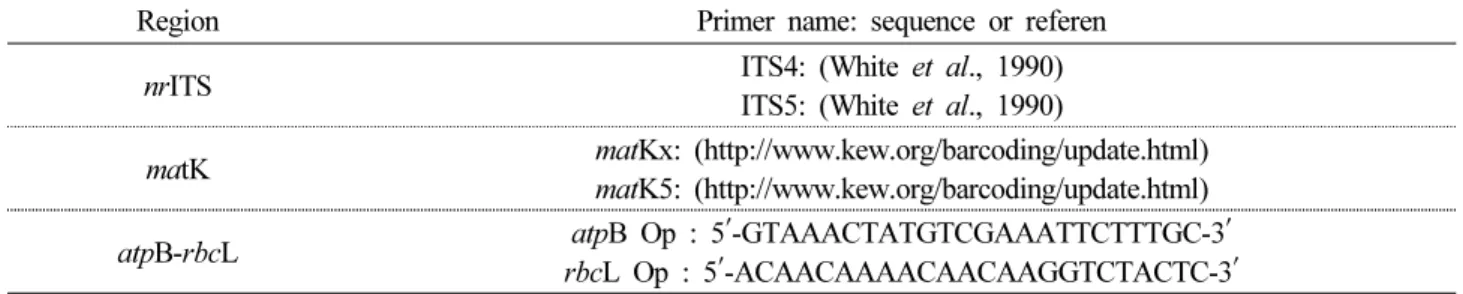
확보된 재료(엽상경)는 깨끗이 증류수에 세척하여 액체 질소 에 동결시켜 –80℃에 보관한 후 DNA를 추출하였고, 핵 유전자 인 nrITS와 엽록체 유전자인 matK와 atpB-rbcL의 염기서열을 결정하고(Table 2), 제주지역 부채선인장속 두 분류군의 변이 양상을 비교하여 계통유연관계를 분석하였다. 제주도 자생 선 인장 2종의 Opuntia s.s.내의 유연관계를 확인하기 위해 외군 (outgroup)으로 Tacinga series를 이용하였고, 외국 종과 외군의 염기서열에 대한정보는 미국 NCBI (GeneBank)를 통해 얻었다.
Table 1. Collection localities of specimens for gene analysis
Species Sample Number
(DNA No.) Locality
(GPS) Individual
O. monacantha
01~04 Jeju Aewol (33°28'07.4"N 126°18'47.3"E) 4 05~06 Seogwipo Bomok (33°14'28.2"N 126°36'46.0"E) 2 07 Seogwipo Hoguen (33°17'37.4"N 126°35'00.2"E) 1 08 Seogwipo Gongchenpo (33°16'05.7"N 126°38'19.5"E) 1 09 Seogwipo Harae (33°15'38.9"N 126°38'23.1"E) 1 10 Seogwipo Taepyungro (33°14'40.6"N 126°32'38.0"E) 1
O. monacantha 10 individuals
O. stricta
01~04 Jeju Hallim Wolryung (33°22'44.7"N 126°13'00.9"E) 4 05~06 Seogwipo Daejung Sinpyung (33°15'57.8"N 126°15'34.9"E) 2 07 Seogwipo Daejung Mureung (33°16'14.1"N 126°12'15.3"E) 1 08 Seogwipo Daejung Gapado (33°16'68.7"N 126°26'84.2"E) 1 09 Seogwipo Daejung Marado (33°06'54.0"N 126°15'58.7"E) 1 10 Jeju Wudo (33°31'21.0"N 126°57'26.4"E) 1
O. tricta 10 individuals
Table 2. DNA regions and associated primers
Region Primer name: sequence or referen
nrITS ITS4: (White et al., 1990)
ITS5: (White et al., 1990)
matK matKx: (http://www.kew.org/barcoding/update.html) matK5: (http://www.kew.org/barcoding/update.html) atpB-rbcL atpB Op : 5′-GTAAACTATGTCGAAATTCTTTGC-3′
rbcL Op : 5′-ACAACAAAACAACAAGGTCTACTC-3′
유전자 증폭 및 정제
PCR은 initial denaturation 단계는 94℃, 5분, 1 cycle, cycling 단계는 denaturation 94℃, 30초, annealing 55℃, 30초, extension 72℃, 2분의 순서로 35 cycles, final extension 단계는 72℃, 10분, 1 cycle 조건으로 수행하였으며, 이후 Montage PCR Clean up kit (Millipore)를 이용하여 DNA를 정제하였다.
nrITS, matK와 atpB-rbcL 유전자의 염기서열 분석 O. monacantha와 O. stricta의 각 3가지 유전자에 대한 염기 서열 결정은 Big Dye 터미네이터 주기 염기서열 분석 키트 v.3.1 와 자동화 DNA 시퀀싱 시스템(Applied BioSystems, 모델명:
3730XL, USA)을 이용하여 수행하였고, 이 과정은 ㈜마크로젠 에 의뢰 하였다.
염기서열 결정을 통하여 연구 대상종의 DNA 염기서열이 완전 하게 확인된 후에는 분자 진화학적인 관점에서 근연종들과의 서 열을 비교 분석하였다(Majure et al., 2012a, b). ClustalX 프로그 램을 이용하여 염기서열을 정열하고(Thompson et al., 1977), Bioedit 프로그램(ver 7.2.6.2)을 사용하여 Opuntia속과 Tacinga series (outgroups)의 염기서열을 편집 및 재정렬하였다. 종간 계 통 유연관계의 확인을 위해 BI와 NJ분석을 수행하였으며, MrBayes–3.2.5 프로그램과 MEGA X를 각각 이용하였다. BI 분
석을 위한 진화적 모델은 GTR+I+G, NJ 분석의 경우 Kimura 2-parameter를 사용하였다. 이때 나온 결과인 con.tre파일로 각 종간 계통 유연관계를 밝힐 수 있는 분자계통도를 작성하였고, 분 자계통도의 확인은 FigTree v1.4.3 프로그램을 이용하였다.
결과 및 고찰
외부 형태 형질 비교
제주 부채선인장속 두 분류군 간의 생육상태, 줄기(엽상경), 꽃, 열매, 가시의 형질을 이용하여 분류하였으며, 외부형태학 적 특징은 다음과 같다.
채집 지역의 모든 군락에서 O. monacantha는 2 m 이상 자랐 고, O. stricta는 1 m를 채 넘지 않았다(Anderson, 2001). 이 결과 로 O. monacantha Haw.는 본줄기가 곧게 자라고 가지가 뻗쳐나 간 형태의 교목성 다육식물이고, O. stricta 는 줄기가 사방으로 퍼져나간 형태인 관목성 다육식물이라는 것을 알 수 있었다.
O. monacantha의 줄기(엽상경, cladode) 모양은 줄기 시작 과 끝의 폭이 좁은 장타원형(Oblong)에 가까운 형태이며(Fig.
1A), O. stricta는 도란형(Ovate or Obovate)이다(Fig. 1B). O.
monacantha의 본줄기에서 1년 자란 엽상경의 크기는 장경(길 이) 26 ㎝, 단경(폭) 12 ㎝였으며, O. stricta는 장경(길이) 15 ㎝,
A. O. monacantha Cladode B. O. stricta Cladode
C. O. monacantha Fruit D. O. stricta Fruit E. O. monacantha Flower F. O. stricta Flo wer
G. O. monacantha Flower Bud H. O. stricta Flower Bud I. O. monacantha Spine J. O. stricta Spine Fig. 1. Photograph of O. monacantha and O. stricta in Jeju. The scale bar at the bottom left of each photograph is 2 ㎝.
단경(폭) 8 ㎝이다. O. monacantha가 O. stricta보다 줄기(엽상 경)의 크기가 장축과 단축 모두 컷다.
기존 연구(Kim et al., 2016; Koh et al., 2018)에서 제주도의 부채선인장은 주로 5월에서 7월 사이에 개화한다고 하였다. 그러 나 O. monacantha는 5월 초순부터 다음 해 1월까지 개화하는 것 이 관찰되었고, O. stricta는 6월 중순부터 8월 초까지 개화하여, 두 개체군의 개화 시기와 기간이 다르다는 것을 알 수 있었다.
꽃망울 색은 O. monacantha는 붉은색, O. stricta는 녹색을 띠고 있다. O. monacantha는 엽상경의 가장자리에 꽃이 피고, 꽃의 크기가 5 ㎝라는 종전의 연구(Koh et al., 2018)와 달리 엽 상경의 가장자리뿐 아니라 엽상경 몸통부위에도 꽃이 피고 (Fig. 1G), 꽃의 직경이 O. monacantha는 약 6~7 ㎝, O. stricta 는 직경이 5~6 ㎝로 O. monacantha의 꽃이 다소 크다는 것을 확인하였다(Table 4).
꽃잎(tepal)은 약 20여 개이며, O. monacantha의 바깥쪽 꽃 잎은 작고, 안쪽으로 갈수록 크기가 커져 일반 식물의 꽃잎과 그 배열이 상반되는 경향이 있으며, 뒷면에 자주색 줄무늬가 있었 다(Koh et al., 2018; Fig. 1E). 한편, O. stricta는 뒷면에 자주 색 줄무늬가 없고 노란색을 띠었다(Fig. 1F).
O. monacantha의 열매는 꽃이 진 후 2~3개월에 걸쳐 녹색 에서 차츰 붉은색으로 변하는 것을 관찰할 수 있었다. 열매의 모 양은 O. monacantha는 몸통이 둥근 자두 모양에 가깝고, O.
stricta는 몸통이 긴 서양배 모양을 띠고 있었다(Fig. 1C and D).
성숙한 열매의 크기도 O. monacantha는 장경 7~8 ㎝, 단경 5
㎝에 가까웠고, O. stricta는 장경 5~6 ㎝, 단경 3 ㎝ 정도로 작 았다(Fig. 1C and D).
또한 다른 식물에서는 줄기에서 열매가 자라는 것이 일반적 이지만, 제주도에 서식하는 O. monacantha는 열매에 꽃망울이 맺히는 특이점이 발견되었고, O. monacantha는 열매에서 줄기 가 자라는 것이 관찰되었다(Fig. 2). 이런 특이한 형질이 개체별 로 일관성 있게 확인되어, O. monacantha Haw. 본종이 제주도 유입 후 유전적으로 고정된 종 동정을 위한 형질로 될 만큼 고착 화된 것으로 판단된다. 또한 열매에서 줄기가 자라는 현상을 통 해서, 열매의 자좌(areole)가 줄기의 자좌와 같은 기능을 한다는 것을 알 수 있었다. 이에 따라 본종인 O. monacantha Haw.와 다른 획득형질이 관찰됨에 따라 추후 추가적인 형질 차이 연구 를 통해서 변종 또는 신품종으로 분류해야 할 것으로 본다. O.
monacantha는 O. stricta보다 엽상경의 자좌 간격이 2 ㎝ 이상 크며(Fig. 1A and B), 강모가 0.5~1 ㎝ 정도 크다는 것을 알 수 있었다(Fig. 1I and J), Koh et al. (2018)은 꽃잎이 30여 개이고,
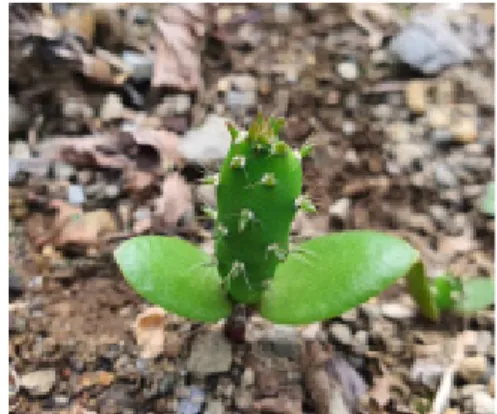
암술머리의 두부는 5갈래, 수술은 수백 개, 열매는 서양배 모양, 종자는 퇴화되었거나 없으며, 엽상경은 난형 또는 도란형 (Ovate or Obovate)이라고 하였다. 하지만, 본 연구에서는 꽃잎 이 20여 개, 암술은 1개이고, 암술머리는 5~6갈래로 갈라지며, 수술이 180~200여 개이고, 열매는 자두모양, 종자는 큰 것이 1 개~2개 (6 ㎜), 작은 것이 50여 개(2~3 ㎜)인 것을 관찰 하였으 며, 발아하여 싹을 틔웠다(Fig. 3). 또한 엽상경은 장타원형 (Oblong)을 띤다는 것이 확인되었다. O. monacantha에 대한 생태학적 접근을 통한 기존 연구(Koh et al., 2018)에서 본 분류 군을 왕선인장으로 소개하였으나, 증거표본제시, 형태학적 형 질에 대한 검색표, 분류군을 비교하기 위한 대조군, 분자 유전 적 실험, 분류학적 연구 결과가 전무하고, 형태적 특징은 상당 부분 오기되어 있다. 따라서 본 연구에서는 제주도에 분포하고 있는 O. monacantha는 왕선인장이 아니다는 결론을 내리게 되 었다(Table 3). 기존 연구(Koh et al., 2018)에서 왕선인장을 O.
monacantha와 O. stricta를 혼돈하여 명명한 것인지 어떤 분류 군으로 명명한 것인지 대해서는 알 수가 없다.
A B
Stem
Fruits
C
Fig. 2. Peculiar phenomenon of Opuntia monacantha Haw. A, Flower bud growing from fruit; B, The stem growing from the fruit, and the fruit growing from the stem and C, The fruit growing from the stem, and the stem growing from the fruit.
Fig. 3. Potograph of germinated O. monacantha.
한국의 Opuntia속 선인장의 검색표
한국의 다른 부채선인장과의 형태적 특징(Table 4)을 비교한 검색표를 동절기 엽상경의 쭈글거림, 꽃의 색, 줄무늬, 가시등 의 형태학적 특징을 기준으로 아래와 같이 정리하였다.
Key to Opuntia ss. in Korea
1. 겨울에 엽상경이 쭈글거리고, 바닥에 몸통 줄기가 누움 2. 노란색 꽃잎을 가지고, 짧은 구침과 엽침을 가짐 ···
···O.humifusa 천년초 2. 노란색 바탕에 중심부가 붉은색인 꽃을 가지고 있고, 길 고 강한 구침과 많은 엽침을가짐 ···
···O. humifusa f. jeollaensis 왕가시천년초 1. 겨울에 엽상경이 쭈글거리지 않고, 몸통 줄기가 바로 서있음 3. 노란색 꽃잎을 가지고, 짧은 구침과 많은 엽침을 가짐
···O. stricta Haw. 해안선인장 3. 노란색 꽃잎의 뒷면에 보라색 줄무늬가 있고, 길고 강한
구침을 가짐 ···O. monacantha Haw. 제주백년초
계통유연관계 분석
nrITS 유전자를 이용한 Bioedit 프로그램(Hall, 1999) 으로 얻은 fasta파일로 Mega 6 (Tamura et al., 2013) 프로그램을 활 용한 NJ Tree는 bootstrap을 1000회 반복으로 도출한 결과 O.
monacantha와 O. stricta가 서로 다르게 분지 되었다는 것을 알 수 있었다(Fig. 4). 또한 관련된 분류군이 함께 모일 수 있는 복제 tree의 비율(확률)이 Branch 옆에 표시 하였다(Felsenstein, 1985). tree는 Phylogenetic tree를 추론하는 데 사용 된 Evolu- tionary distance와 동일한 단위로 branch 길이로 축척하여 나 타냈다. 두 분류군의 샘플을 각각 10개씩 하여 연구한 결과에서 Table 3. Comparison of the Characteristics of O. monacantha and Wangsuninjang
Taxa Petal Pistil head Surgery Fruit shape Seed Cladode Wangsuninjang 30ea 5 branch hundreds western pear degenerated Ovate or
Obovate O. monacantha
(inhabiting Jeju Island) 20ea 5~6 branch 180~200ea plum big 1~2ea
small 50ea Oblong
Table 4. Morphological characteristics of Opuntia s.s. in Korea
Taxa Flower color Fruit shape Cladode
during winter Peculiar phenomenon O. stricta yellow a long western pear not wrinkled nothing O. monacantha yellow-with purple stripes out
side a plums not wrinkled Flower growing from fruit,Stem gro wing fro m fruit.
O. humifusa yellow a long western pear wrinkled nothing O. humifusa f.
jeollaensis yellow-with red in the red center a long western pear wrinkled nothing
Fig. 4. Evolutionary relationships of taxa of Opuntia monacantha Haw. and Opuntia stricta Haw. (NJ tree from the analysis of the nrITS). Bootstrap values are shown on the branch nodes.
두 분류군이 Phylogenetic tree에서 명확히 분지되어 나타나 서 로 다른 종이라는 결론을 내릴 수 있었다.
지금까지 제주지역 부채선인장 두 분류군의 위치는 유전자 수준에서 연구된 바 없어 nrITS 유전자와 Plastid (atpB-rbcL and matK) 유전자를 통한 계통분류학적 유연관계를 밝혔다는 점은 높게 평가할 수 있겠다. 부채선인장 두 분류의 계통분류학 적 위치를 찾기 위해 Majure et al. (2012b)의 연구를 토대로 Genebank (NCBI)에서 nrITS, atpB-rbcL, matK 유전자 104종 을 찾아 nxs 파일로 변환하여 FigTree 프로그램을 활용한 분자 계통학적 분석을 하였다.
기존 연구(Kim et al., 2014)에서와 같이 이번 연구에서도 O.
humifusa, O. humifusa f. jeollaensis 두 분류군의 유연관계 결과 모두 North America Clade에 포함되어 있었으며, O.
humifusa는 Humifusa series에 포함되어있고, O. humifusa f.
jeollaensis는 Macrocentra series에 포함된 것으로 밝혀졌다 (Majure et al., 2012a). 또한 O. monacantha (seogwipo Opuntia cactus)는 South American Clade인 Elatae series에 포함되어 있고, O. stricta (Hallim Opuntia cactus)는 North American Clade인 Scheerianae series (Majure et al., 2012a)에 포함되 어 있다(Appendix 1.).
지금까지 제주의 부채(손바닥선인장 두 분류군의 기원에 대 해서는 정확히 알 수 없어 북미멕시코에서 유입된 종(Kang et al., 1989)으로 발표하였으나, 이번 연구를 통해서 제주에 서식 하고 있는 두 분류군 모두 본 분류군과 마찬가지로 O. monacantha 는 남아메리카 대륙, O. stricta는 북아메리카가 원산지라는 것 (Majure et al., 2012a)을 확인할 수 있었다.
Majure et al. (2012a,b)의 연구 결과와 같이 Appendix 1.에 서도 Opuntia s.s.중 North American Clade에서 이질배수체 종이 서로 잡종을 형성하여 다배체 종분화가 일어나는 망상진 화의 형태로 방사진화 한다는 결과가 나타났다.
그리고, O. monacantha는 대표적인 제주도의 민속식물로 백년초라(Koh et al., 2018; Kwon et al., 2017a,b,c; Yang et al., 2017) 불려져 왔으며, 지리적 입지조건과 상징적 특성을 고 려하여 국명을 ‘제주백년초’로 명명한다.
분류군기재
1. Hae-an-sun-in-jang
Opuntia stricta (Haw.) Haw., Syn. Pl. Succ. 191. 1812;
Benson, Cacti U. S. Canada, 931. 497. 1982; Telford in A. S.
George et al., Fl. Austr. 4: 71. 1984
Cactus strictus Haw., Misc. Nat. 188. 1803 2. Jeju-baik-nyun-cho
Opuntia monacantha Haw., Suppl. pl. succ. 81. 1819 Cactus monacanthos Willd., Enum. pl. suppl. 33. 1813 Opuntia monacantha var. variegata Coll. Cact.
Alexandra Park (Darrah) 57. 1908 fide Britton & Rose, Cactaceae, 1: 157. 1919
적 요
제주도에는 줄기, 열매, 꽃, 가시, 개화시기가 서로 다른 부채 선인장이 분포하고 있다. 아직 이 두 분류군에 대한 비교 연구가 없어 같은 종으로 취급하는 경우가 많다. 이에 본 연구는 제주도 에 자생하고 있는 O. monacantha와 O. stricta 두 분류군의 계통 학적 유연관계를 밝히기 위하여 이루어졌다. 연구 결과, nrITS 와 엽록체 유전자 matK, atpB-rbcL유전자 분석을 통해서 두 개 체군이 전혀 다른 종이라는 것이 밝힐 수 있었다. 또한 두 분류군 중 O. monacantha는 Elatae series에 포함되어 있어 남아메리 카가 원산지이며, O. stricta는 Scheerianae series에 포함되어 북아메리카가 원산지라는 것을 확인할 수 있었다. 그리고, 제주 도에 분포하고 있는 O. monacantha에 대해서 지리적 입지조건 과 상징적 특성을 고려해 국명을 ‘제주백년초’로 명명하였다.
사 사
본 연구 분류군들의 분류 및 동정을 위한 표본제작에 도움을 주신 국립산림과학원 난대・아열대산림연구소 최병기박사에 게 감사드립니다.
Conflicts of Interest
The authors declare that they have no conflict of interest.
References
Ahn, D.K. 1998. Illustrated book of Korean Medicinal herbs.
Kyohaksa, Seoul, Korea. p. 497 (in Korean).
Anderson, E.F. 2001. The Cactus Family, Timber Press, Portland, OR (USA). pp. 484-525.
Chung, H.J. 2000. Antioxidative and antimicrobial activities of
Opuntia ficus-indica var. saboten. Korean J. Soc. Food. Sci.,
16:160-166 (in Korean with English abstract).
Felsenstein, J. 1985. Confidence limits on phylogenies: An approach using the bootstrap. Evolution 39(4):783-791.
Frenandez, M.L., E.C. Lin, A. Trejo and D.J. McNamara. 1992.
Prickly pear (Opuntia sp) pectin reverses low density lipopro- tein receptor suppression induced by a hypercholesterolemic diet in guinea pigs. J. Nutr. 122:2330-2339.
Hall, T.A. 1999. BioEdit: A user-friendly biological sequence alignment editor and analysis program for Windows 95/98/
NT. Nucl. Acids. Symp. Ser. 41:95-98.
In, J.G., B.S. Lee, E.J. Kim, K.S. Choi, S.H. Han, C.W. Shin and D.C. Yang. 2006. Analysis of the ITS (Internal Trans- cribed Spacer) region of Opuntia ficus-indica. Korean J.
Plant Res. 19(1):161-168 (in Korean with English abstract).
Kang, S.H., G.S. Lee, B.W. Kim and S.Y. Kim. 1989. Latest Flower Horticulture Detail, Sunjinmunhwasa, Seoul, Korea.
p. 479.
Kim, M.H., H.J. Kim, M. Jang, T.G. Lim, H.D. Hong, Y.K.
Rhee, K.T. Kim and C.W. Cho. 2016. The morphological and chemical composition characteristics of Opuntia ficus- indica and Opuntia humifusa fruits. Korean J. Food Preserv.
23(5):711-717.
Kim, T.J. 1996. Korea Resource Plants Book, Hyanmunsa, Seoul. p. 559 (in Korean).
Kim, E.J., K. Srikanth, E.A. Lee and S.S. Whang. 2014. Opuntia humafusa Raf. f. jeollaensis E. J. Kim & S. S. Whang, a new forma based on three DNA makers. Korean J. Pl. Taxon.
44(3):181-187.
Koh, S.C., J.K. Kim and M.H. Kim. 2018. An unrecorded species of Opuntia (Cactaceae) in Korea (Wang-seon-in- jang). Korean J. Plant Res. 31(1):32-36 (in Korean with English abstract).
Kwon, J. H., T. Y. Kim, J. K. Kim and J. Y. Kim. 2017a. Beauty Industrialization of Seogwipo Jaekook Backyoncho. Abstracts Presented at KSIEC Meeting 2017(1):264-264. (in Korean) K won, J. H., T. Y. K im, J. K . K im and J. Y. K im. 2017b.
Characteristics of Seogwipo Opuntia for the functional raw material production. Appl. Chem. Eng. 28(2):252-256. (in Korean)
Kwon, J. H., T. Y. Kim, J. K. Kim, Y. S. Yang and J. Y. Kim.
2017c. Extraction of Taxifolin and Antioxidant Activity in Seogwipo Jaekook Backyoncho. Abstracts Presented at KSIEC Meeting 2017(1):264-264. (in Korean)
Majure, L.C., R. Puente, M.P. Griffith, W.S. Judd, P.S. Soltis
and D.E. Soltis. 2012a. Phylogeny of Opuntia s.s. (CACTA CEAE): Clade delineation, geographic origins, and reticulate evolution. Am. J. Bot. 99(5):847- 864.
Majure, L.C., D.E. Soltis, P.S. Soltis, and W.S. Judd. 2012b.
Cytogeography of the Humafusa Clade of Opuntia s.s.
(CACTACEAE: Opuntioideae): Correlations with georraphic distributions and morphological differentiation of a polyploid complex. Comparative Cytogenetics 6:53-77.
Nyffeler, R. and U. Eggi. 2010. A farewell to dated ideas and concepts: Molecular phylogenetics and a revised suprageneric classification of the family Cactaceae. Schumannia 6:109- 149.
Park, C.M., B.H. Kwak, S.H. Park, H. Kim and D.Y. Rhyu.
2013. Comparison of biological activities of Opuntia humifusa and Opuntia ficus-indica. Korean J. Plant Res. 26(5):519- 525 (in Korean with English abstract).
Shin, T.G. and S.H. Kim. 1998. Radiation protection effect of Opuntia cactus. Jeju Life Science Research I(1):25-32 (in Korean).
Thompson, J.D., T.J. Gibson, F. Jeanmougin and D.G. Higgins.
1977. The CLUSTAL-X windows interface: Flexible stra- tegies for multiple sequence alignment adied by quality analysis tools. Nucleic Acids Res. 25:4876-4882.
Tamura, K., G. Stecher, D. Peterson, A. Filipski and S. Kumar.
2013. MEGA6: Molecular Evolutionary Genetics Analysis version 6.0. Mol. Biol. Evol. 30:2725-2729.
White, T.J., T. Bruns, S. Lee and J.W. Taylor. 1990. Amplifi- cation and direct sequencing of fungal ribosomal RNA genes for phylogenetics: In M.A. Innis, D.H. Gelfand, J.J. Sninsky and T.J. White (eds.), PCR Protocols: A guide to methods and applications, Academic Press, San Diego, California (USA). pp. 315-322.
Xinwenfeng Publishing Co. 1982. The Encyclopedia of Chinese Medicine Zhongyao Da Cidian, Xinwenfeng Publishing Co., Taipei, Taiwan. pp. 482-484.
Yang, Y.S., J.H. Kwon, T.Y. Kim, J.K. Kim and J.Y. Kim.
2017. Characterization of anti-glycation and antibacterial activity of Seogwipo. Appl. Chem. Eng. pp. 409-409 (in Korean).
Yang, Y.S., B.K. Choi and H.S. Oh. 2020. A taxonomic review and nomenclature of the Opuntia ficus-indica(L). Mill. in Jeju Island. Journal of the Korean Institute of Traditional Landscape Architecture 38(4):68-73 (in Korean with English abstract).
(Received 3 August 2021 ; Revised 18 September 2021 ; Accepted 23 September 2021)
Appendix 1. The genealogical tree showing phylogenetic relationships among Opuntia s.s. including Jeju taxa. The Clade name recognized by Britton and Rose (1920) was applied. Bayesian inference support values are shown on the branch nodes.
Appendix 2. Genbank (NCBI) accession number (nrITS)
ID Species nrITS ID Species nrITS ID Species nrITS ID Species nrITS
1 Brasiliopuntia
brasiliensis JF786876 28 Opuntia
cespitosa_2 JF786921 55 Opuntia lilae JF786955 82 Opuntia repens_2 JF786993 2 Miqueliopuntia
miquelii JF786889 29 Opuntia
chaffeyi JF786922 56 Opuntia
macbridei_1 JF786957 83 Opuntia repens_3 JF786994 3 Nopalea
auberi JF786890 30 Opuntia
chisosensis JF786923 57 Opuntia
macbridei_2 JF786958 84 Opuntia retrorsa JF786995 4 Nopalea cochenillifera JF786891 31 Opuntia chlorotica JF786924 58 Opuntia macbridei_3 JF786990 85 Opuntia robusta JF786996 5 Nopalea gaumeri JF786894 32 Opuntia cochabambensis JF787046 59 Opuntia macrocentra JF786959 86 Opuntia rufida JF786997 6 Nopalea
guatemalensis JF786895 33 Opuntia
cymochila JF786927 60 Opuntia
macrorhiza JF786960 87 Opuntia salmiana1 JF786998 7 Nopalea
hondurensis JF786896 34 Opuntia
decumbens JF786928 61 Opuntia
magnifica JF786962 88 Opuntia salmiana2 JF786999 8 Nopalea
inaperta JF786898 35 Opuntia
depressa JF786929 62 Opuntia
martiniana JF787061 89 Opuntia santa-rita JF787001 9 Nopalea
karwinskiana JF786899 36 Opuntia
dillenii_1 JF787010 63 Opuntia
megarhiza JF786964 90 Opuntia scheeri JF787002 10 Nopalea lutea JF786900 37 Opuntia dillenii_2 JF787011 64 Opuntia megasperma JF786965 91 Opuntia schickendantzii JF787003 11 Nopalea nuda JF786901 38 Opuntia drummondii JF786930 65 Opuntia microdasys JF786966 92 Opuntia setispina JF787005 12 Opuntia
abjecta JF787021 39 Opuntia
echios JF786932 66 Opuntia
monacantha JF786967 93 Opuntia stenopetala JF787008 13 Opuntia
humifusa var.
ammophila 1 JF786903 40 Opuntia elata JF786934 67 Opuntia orbiculata JF786968 94 Opuntia stricta JF787009 14 Opuntia
humifusa var.
ammophila 2 JF786904 41 Opuntia
ellisiana_1 JF786935 68 Opuntia
pachyrrhiza JF786970 95 Opuntia strigil_1 JF787012 15 Opuntia x
andersonii JF786905 42 Opuntia
ellisiana_2 JF786936 69 Opuntia pailana JF786972 96 Opuntia strigil_2 JF787014 16 Opuntia arechavaletae JF786906 43 engelmanniivar. engelmannii_1 JF786937 70 Opuntia pinkavae JF786976 97 Opuntia sulphurea JF787015 17 Opuntia arenaria JF786907 44 engelmanniivar. engelmannii_2 JF786938 71 Opuntia pollardii JF786978 98 Opuntia tapona JF787016 18 Opuntia
assumptionis JF787007 45 engelmanniivar.
lindheimeri JF786939 72 Opuntia
polyacantha JF786979 99 Opuntia tortispina JF787020 19 Opuntia
atrispina JF786908 46 engelmanniivar.
linguiformis JF786940 73 Opuntia pottsii JF786980 100 Opuntia vaseyi JF787024 20 Opuntia aurea JF786909 47 Opuntia erinacea JF786941 74 Opuntia puberula JF786981 101 Opuntia wilcoxii JF787025 21 Opuntia
aureispina JF786910 48 Opuntia
excelsa JF786942 75 Opuntia pumila JF786983 102 Tacinga inamoena JF787027 22 Opuntia
austrina JF786911 49 Opuntia fragilis JF786945 76 Opuntia
pusilla JF786984 103 Tacinga palmadora JF787028 23 Opuntia basilaris JF786913 50 Opuntia galapageia JF786947 77 Opuntia pycnantha JF786987 104 Tacinga saxatilis JF787029 24 Opuntia camanchica_1 JF786917 51 Opuntia gosseliniana JF786948 78 Opuntia quimilo JF786988 105 Opuntia stricta MW036301-
MW036310 25 Opuntia
camanchica_2 JF786973 52 Opuntia humifusa JF786949 79 Opuntia quitensis JF786989 106 Opuntia
monacantha MW039581 -MW039590 26 Opuntia
caracassana JF786918 53 Opuntia
hystricina JF786951 80 Opuntia
rastrera JF786991 27 Opuntia
cespitosa_1 JF786920 54 Opuntia
jamaicensis JF786952 81 Opuntia repens_1 JF786992
Appendix 3. Genbank (NCBI) accession number (rbcL)
ID Species rbcL ID Species rbcL ID Species rbcL ID Species rbcL
1 Brasiliopuntia
brasiliensis JF787155 28 Opuntia
cespitosa_2 JF787198 55 Opuntia lilae JF787233 82 Opuntia repens_2 JF787272 2 Miqueliopuntia miquelii JF787164 29 Opuntia chaffeyi JF787199 56 Opuntia macbridei_1 JF787236 83 Opuntia repens_3 JF787273 3 Nopalea
auberi JF787165 30 Opuntia
chisosensis JF787200 57 Opuntia
macbridei_2 JF787237 84 Opuntia retrorsa JF787274 4 Nopalea cochenillifera JF787166 31 Opuntia chlorotica JF787201 58 Opuntia macbridei_3 JF787269 85 Opuntia robusta JF787275 5 Nopalea
gaumeri JF787169 32 Opuntia
cochabambensis JF787202 59 Opuntia
macrocentra JF787238 86 Opuntia rufida JF787276 6 Nopalea guatemalensis JF787170 33 Opuntia cymochila JF787204 60 Opuntia macrorhiza JF787239 87 Opuntia salmiana1 JF787278 7 Nopalea
hondurensis JF787171 34 Opuntia
decumbens JF787205 61 Opuntia magnifica JF787241 88 Opuntia salmiana2 JF787279 8 Nopalea inaperta JF787173 35 Opuntia depressa JF787206 62 Opuntia martiniana JF787242 89 Opuntia santa-rita JF787280 9 Nopalea
karwinskiana JF787174 36 Opuntia
dillenii_1 JF787289 63 Opuntia
megarhiza JF787244 90 Opuntia scheeri JF787281 10 Nopalea lutea JF787175 37 Opuntia dillenii_2 JF787290 64 Opuntia megasperma JF787245 91 Opuntia schickendantzii JF787282 11 Nopalea nuda JF787176 38 Opuntia
drummondii JF787207 65 Opuntia
microdasys JF787246 92 Opuntia setispina JF787284 12 Opuntia abjecta JF787300 39 Opuntia echios JF787209 66 Opuntia monacantha JF787247 93 Opuntia stenopetala JF787287 13 Opuntia
humifusa var.
ammophila 1 JF787178 40 Opuntia elata JF787211 67 Opuntia orbiculata JF787248 94 Opuntia stricta JF787288 14 Opuntia
humifusa var.
ammophila 2 JF787179 41 Opuntia
ellisiana_1 JF787212 68 Opuntia
pachyrrhiza JF787250 95 Opuntia strigil_1 JF787291 15 Opuntia x
andersonii JF787180 46 Opuntia
ellisiana_2 JF787213 69 Opuntia pailana JF787252 96 Opuntia strigil_2 JF787292 16 Opuntia arechavaletae JF787181 42 engelmanniivar. engelmannii_1 JF787214 70 Opuntia pinkavae JF787256 97 Opuntia sulphurea JF787294 17 Opuntia
arenaria JF787182 44 engelmanniivar.
engelmannii_2 JF787215 71 Opuntia pollardii JF787258 98 Opuntia tapona JF787295 18 Opuntia assumptionis JF787286 45 engelmanniivar. lindheimeri JF787216 72 Opuntia polyacantha JF787259 99 Opuntia tortispina JF787299 19 Opuntia
atrispina JF787183 46 engelmanniivar.
linguiformis JF787217 73 Opuntia pottsii JF787260 100 Opuntia vaseyi JF787303 20 Opuntia aurea JF787184 47 Opuntia erinacea JF787218 74 Opuntia puberula JF787261 101 Opuntia wilcoxii JF787304 21 Opuntia aureispina JF787185 48 Opuntia excelsa JF787220 75 Opuntia pumila JF787262 102 Tacinga inamoena JF787305 22 Opuntia
austrina JF787186 49 Opuntia fragilis JF787223 76 Opuntia
pusilla JF787263 103 Tacinga palmadora JF787307 23 Opuntia basilaris JF787189 50 Opuntia galapageia JF787225 77 Opuntia pycnantha JF787266 104 Tacinga saxatilis JF787308 24 Opuntia
camanchica_1 JF787195 51 Opuntia
gosseliniana JF787226 78 Opuntia quimilo JF787267 105 Opuntia stricta OK032473 25 Opuntia camanchica_2 JF787253 52 Opuntia humifusa JF787227 79 Opuntia quitensis JF787268 106 Opuntia monacantha OK032474 26 Opuntia
caracassana JF787196 53 Opuntia
hystricina JF787229 80 Opuntia
rastrera JF787270 27 Opuntia
cespitosa_1 JF787197 54 Opuntia
jamaicensis JF787230 81 Opuntia repens_1 JF787271
Appendix 4. Genbank (NCBI) accession number (matK)