• 검색 결과가 없습니다.

Community Structure of Macrobenthic Invertebrates of Fishing grounds in the coastal waters of Jeju Island

N/A
N/A
Protected

Academic year: 2021

Share "Community Structure of Macrobenthic Invertebrates of Fishing grounds in the coastal waters of Jeju Island"

Copied!
18
0
0

로드 중.... (전체 텍스트 보기)

전체 글

(1)

Received September 16, 2011 ; Accepted September 26, 2011

Corresponding author: Jun-Cheol Ko

Tel: +82 (64) 750-4375 e-mail: : [email protected] 1225-3480/24400

제주도 연안 마을어장의 저서무척추동물 군집구조

고준철, 구준호, 이승종, 장대수, 조성환

1

국립수산과학원 아열대수산연구센터,

1

연안생태기술연구소

Community Structure of Macrobenthic Invertebrates of Fishing grounds in the coastal waters of Jeju Island

Jun-Cheol Ko, Jun-Ho Koo, Seung-Jong Lee, Dae-Su Chang and Sung-Hwan Jo

1

Subtropical Fisheries Research Center, NFRDI, Jeju-do, 690-192, Korea

1

Coastal Ecology and Technique Institute, Jeju-do, 695-918, Korea

ABSTRACT

This study was performed to know and compare the community structures of macrobenthic invertebrates of eight fishing grounds in the coastal waters of Jeju Island from September to October 2008.

A total of 166 species was identified. Mollusks comprised 77 species (46.4%); Arthropods 24 (14.5%), Cnidarians 18 (10.8%); Poriferans 16 (9.6%); and the others including Echinoderms 33 (17.7%). Density and biomass were estimated to be 6,905 ind./m

2

and 113,100.7 gwwt/m

2

, respectively. Gastropods was the most dominant taxon in terms of abundance (3,311 ind./m

2

) and number of species as well, and Gastropods was predominant in biomass (55,789.2 gwwt/m

2

). The dominant species were Omphalius pfeifferi, Astralium haematragum, Turbo cornutus, Ergalatax contraacta, Lithophaga cura, Anthocidaris crassispina, Herdmania monus in 5-15 m. Based on the cluster analysis, the study area could be divided into two station groups. The biodiversity, evenness and richness index appeared as follows: H' = 1.59-2.95, E' = 0.38-0.87, R = 3.3-10.4. The dominance index were highest in Daepo and lowest in Woljeong.

Key words : Invertebrates, community structure, fishing ground, coastal water, Jeju Island

서 론

해양생태계를 구성하는 중요한 축의 하나인 대형무척추동물 군집은 복잡한 시‧공간적 패턴을 보이며 , 생물학적 다양성 측 면에서 매우 높은 가치를 가지고 있다 (van der Maarel, 1990). 대형무척추동물은 비교적 이동성이 적다는 이유로 인 하여 플랑크톤이나 어류군집과 비교하여 해역의 환경을 모니 터링 하는데 유용하게 이용되어 왔다 . 특히, 이들 군집의 다양 도와 개체수는 생태계의 건강도를 측정하는 요소로 알려져 있 다 (Pearson and Rosenburg, 1978; Thouzeau et al., 1991). 해양생태계에서 대형무척추동물은 출현 종수 및 생물 량이 높고 , 먹이사슬에서 일차 소비자인 동시에 2차 생산자로

서 역할을 수행하며, 유영생물의 먹이와 상위단계로의 에너지 전달원으로서 중요한 부분을 차지한다 (Cohen et al., 1982).

또한 우리나라 남해안에서 우점종의 분포양상과 환경요인과의 관계에서 일부 우점종에 대한 환경 지표종의 가능성을 제시하 는 등 대형무척추동물은 해양생태계에서 생태학적으로 중요한 위치에 있음을 알 수 있으며 (Paik and Yun, 2000), 대형무 척추동물의 생물다양성과 생물량을 파악하는 것은 해역생태계 전반을 이해하기 위하여 필수적인 요소이기도 하다. 이러한 추 세에 의해 제주도 연안해역의 조간대 및 조하대를 대상으로 대 형무척추동물의 군집구조를 밝히는 많은 연구들이 진행되어져 왔다 (e.g., Lee and Jwa 1988).

그러나, 최근 지구 온난화에 의한 수온상승은 국내외적으로

해양환경에 많은 변화를 가져오고 있으며, 기후변화에 의한 수

온상승은 필연적으로 해양생태계의 변화를 동반하게 되는데

과거 제주도 연안에 밀생하였던 모자반류를 비롯한 해조류의

감소와 이로 인한 공간을 유절 및 무절산호조류나 기타 생물이

차지함으로서 제주연안에 서식하던 다양한 해양생물의 산란지

나 서식지가 급격하게 감소하고 있으며 (Chung et al., 1998;

(2)

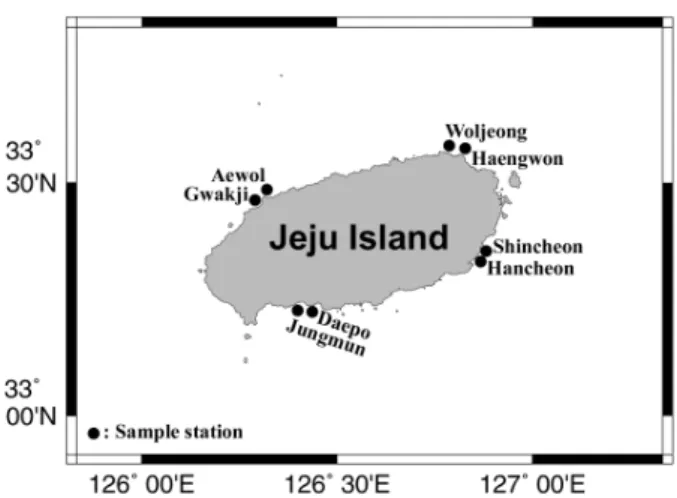
Fig. 1. A map showing the sampling stations in the coastal waters of Jeju Island during August-September, 2008.

Sampling stations Depth (m) Longitude Latitude

Shincheon

5 10 15

126° 52′04″

126° 52′08″

126° 52′12″

33° 21′02″

33° 21′02″

33° 21′01″

Hacheon

5 10 15

126° 51′03″

126° 51′06″

126° 51′09″

33° 19′28″

33° 19′29″

33° 19′30″

Gwakji

5 10 15

126° 17′27″

126° 17′26″

126° 17′22″

33° 26′41″

33° 26′46″

33° 26′51″

Aewol 5

10 15

126° 18′32″

126° 18′28″

126° 18′23″

33° 27′59″

33° 28′05″

33° 28′13″

Daepo

5 10 15

126° 25′29″

126° 25′30″

126° 25′32″

33° 14′02″

33° 13′59″

33° 13′55″

Jungmun

5 10 15

126° 25′17″

126° 25′18″

126° 25′19″

33° 14′11″

33° 14′09″

33° 14′05″

Woljeong

5 10 15

126° 46′56″

126° 47′04″

126° 47′10″

33° 33′47″

33° 33′57″

33° 34′12″

Haengwon

5 10 15

126° 48′35″

126° 48′38″

126° 48′39″

33° 33′33″

33° 33′39″

33° 33′41″

Table. 1. Water depth and positioning of sampling stations and depth in the coastal waters of Jeju Island Ichiki et al., 2000), 제주연안 마을어장의 유용수산물인 우

뭇가사리, 감태, 미역 등의 해조류를 비롯한 소라, 전복 등이 수온상승에 따른 열대 기원 해양생물 (예. 분홍멍게, 거품돌산 호, 빛단풍돌산호, 곤봉말미잘 등) 의 서식공간 확장에 따라 토 착성 해양생물의 서식처가 점차 줄어들어 에로부터 마을어장 을 이용해오며 어민소득에 기여해 왔던 유용수산물의 생산량

은 지속적으로 감소하고 있는 실정이다 . 현재, 기후변화에 따 른 아열대성 해역으로 변화가 가속화되고 있는 시점에서 연안 천해역의 생물상 분포실태를 파악하고 , 마을어장에 서식하는 해양동물 출현종의 분포특성과 시 ·공간적 개체밀도 변화 및 아 열대 생물종 분포실태에 대한 연구는 미진한 수준이라 할 수 있다 .

따라서 , 본 연구의 목적은 는 제주도 연안역에서 방위별로 대표되는 8개 마을어장을 대상으로 연안에 서식하는 대형무척 추동물군집의 구조적 특성을 파악하는데 있다 .

재료 및 방법

제주연안 마을어장에 서식하는 대형무척추동물의 군집특성 을 파악하기 위해 4개 해역별 (동・서・남・북 각 2개소) 로 8개 마을어장(동부-신천과 하천, 서부-곽지와 애월, 남부-대포와 중 문, 북부-월정과 행원)을 대상으로 2008년 9월과 10월에 수중 잠수조사를 실시하여 해역별, 지역별 및 수심별로 분포하는 대 형무척추동물의 정량 및 정성 분석을 실시하였다 (Fig. 1, Table 1).

대형무척추동물의 채집을 위한 현장조사는 각 조사지점에서

5m, 10m, 15m 층에 50 cm × 50 cm 크기의 수중 방형구

(3)

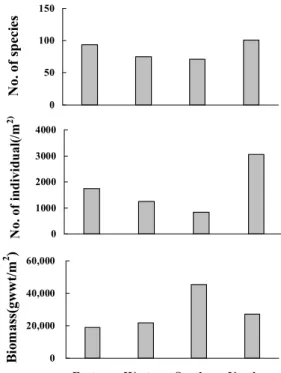
Fig. 2. Species composition, number of individual and biomass of macrobenthic invertebrates in the coastal waters of Jeju Island.

를 이용하여 정점 당 3회 반복채집 하였고, 방형구내 분포하는 모든 대형저서동물을 끌칼과 핀셋으로 기질에서 탈락시킨 후 , 10% 중성 해수 포르말린 수용액으로 고정하여 실험실로 운반 하였다 . 운반된 시료는 최소 24시간의 고정 (fixation) 과정을 거친 후 , 세척과정을 거쳐 확대경과 해부현미경을 이용하여 각 정점별 및 수심대별로 구분하여 각 동물군별로 동정분류 , 개체 수 및 생체량 (0.1g) 을 측정하였다.

표본의 동정은 각 분류군 별로 연체동물에 있어서 Okutani (1986), Okutani and Habe (1990), Yum (1988, 1995), Choe (1992), Habe (1977), Nishimura (1992, 1995)을 참고하였다 . 절지동물 중에서 십각류는 Kim (1973, 1977, 1985), Dai and Yang (1991) 및 Holthuis (1993) 의 연구 를 참고하였고 , 각 종에 대한 국명과 분류체계에 있어 과 수준 까지는 한국동물분류학회 (1997) 를 근거로 분류하였다.

채집된 시료는 단위 면적당 개체수와 생체량으로 환산하 였으며 , 종별 개체수 자료를 토대로 McNaughton (1967) 의 군집우점도 (Dominance index) 를 이용하여 각 조사 정점별 로 출현하는 전체 총 개체수를 기록하여 우점도를 산출하였으 며 조사지점에 따른 종다양성 분석은 Shannon and Weaver (1949) 의 종 다양도 지수 (Species diversity index H') 로 분석하였고 , Pielou (1969) 의 균등도 (E') 와 Margalef (1958) 의 종 풍부도 (R) 를 사용하였다. 군집분석은 정점별 종별 개체수 자료를 사용하여 UPGMA (unweighted pair-group average method) 에 의해 수지도 (dendrogram) 를 작성하였다 (Sneath and Sokal, 1973).

결 과

1. 출현종

제주연안 8개 마을어장에서 조사된 대형무척추동물은 총 9 문 15강 37목 89과 166종이 출현하였다 (Fig. 2). 연체동물 (Mollusca)이 3강 13목 30과 77종으로 전체 출현 분류군 중 46.4%로 종 다양성에 있어서 가장 높은 비율을 차지하였으며, 이중 복족류가 42종 (25.3%), 이매패류가 29종 (17.5%), 다 판류 6종 (3.6%)로 복족류의 점유율이 가장 높게 나타났다.

절지동물 (Arthropoda)은 1강 3목 13과 24종으로 전체의 14.5%를 차지하였고, 십각류가 22종 (13.3%)로 높게 나타났 으며, 다음으로 자포동물이 (Cnidaria) 2강 4목 13과 18종으 로 전체의 10.8%를 차지하였고, 히드라충류 5종 (3.0%), 산 호충류 13종 (7.8%) 로 산호충류의 점유율이 높게 나타났다.

해면동물 (Porifera)은 1강 5목 11과 16종으로 9.6%로 나타

났고, 환형동물 (Annelida)은 1강 3목 5과 12종으로 7.2%였

으며, 극피동물 (Echinodermata)이 4강 6목 11과 12종으로

전체의 6.3%를 차지하였다. 척삭동물 (Chordata)이 1강 1목

2과 3종으로 1.8%, 태형동물 (Bryozoa)은 1강 1목 3과 5종

(4)

0 50 100 150

Eastern Western Southern Northern

N o. o f s p ec ie s

0 1000 2000 3000 4000

Eastern Western Southern Northern

N o. of ind ivi du al( /m

2)

0 20,000 40,000 60,000

Eastern Western Southern Northern B io m ass(g w w t/ m

2

)

Fig. 3. Regional variations of species composition, number of individual and biomass of macrobenthic invertebrates at sampling satation of the coastal waters of Jeju Island.

으로 1.8%로 나타났고, 점유율이 가장 낮은 동물로는 성구동 물 (Sipunculida)이 1강 1목 1과 1종으로 0.6%의 순으로 나 타났다 .

2. 개체밀도

조사기간 동안 채집된 대형무척추동물의 개체수는 총 6,591 개체 /m

2

로 연체동물이 50.2% (3,311 개체/m

2

) 로 개체밀도 가 가장 높았으며 , 다음으로 척삭동물 37.3% (2,456 개체 /m

2

), 절지동물 5.2% (342 개체/m

2

), 극피동물 4.6% (306 개체 /m

2

), 환형동물 1.7% (115 개체/m

2

), 성구동물 0.9% (61 개체 /m

2

) 의 순으로 나타났다. 개체밀도 점유율이 가장 높은 연체동물의 경우 복족류가 전체의 42.4% (2,792개체/m

2

) 로 가장 높게 나타났으며 , 다음으로는 척삭동물의 해초류가 37.3% (2,456개체/m

2

) 를 차지하였는데, 이 중 단위면적당 개체밀도에 있어 우점을 나타낸 종은 분홍멍게 (Herdmania monus) 로서 조사기간 동안 단일종으로서 개체밀도가 높은 것으로 나타났다 .

3. 생체량

대평무척추동물의 생체량은 총 113,100.7 gwwt/m

2

로 연 체동물이 49.1% (55,567.9 gwwt/m

2

) 로 가장 높게 나타났 다 . 다음으로 해면동물 23.8% (26,887.5 gwwt/m

2

), 자포동 물 19.0% (21,455.7 gwwt/m

2

), 척삭동물 4.1% (4,611.6 gwwt/m

2

), 극피동물 3.7% (4,155.2 gwwt/m

2

), 태형동물 및 절지동물이 각각 0.2%, 환형동물 및 성구동물이 0.1%로 가장 낮게 나타났다 . 특히, 단위면적당 생체량이 가장 높은 연체동 물의 경우 이매패류 28.4% (32,104.5 gwwt/m

2

), 복족류 20.7% (23,440.8 gwwt/m

2

) 로써 마을어장의 우점종은 중국 굴 (Hyotissa hyotis) 과 소라 (Turbo cornutus) 로 나타났 다 .

4. 동물분류군의 지역 및 해역별 출현양상

각각 출현한 분류군의 종수를 지역별로 살펴보면 (Table 2, Fig. 3), 행원에서 79종으로 가장 높게 나타났고, 신천과 애월 에서 각각 75종과 72종이 출현하였다. 반면, 출현종수가 가장 적게 나타난 지역은 곽지였고 , 출현종은 17종 이었다. 각 지역 별로 채집된 분류군에 있어 연체동물의 출현 종수가 가장 높게 나타난 지역은 신천과 애월로 각각 36종이 나타난 반면, 종수 의 출현이 가장 적었던 곽지에서는 8종이 출현하여 종 다양성 에 있어서 가장 낮았다 . 연체동물을 제외한 기타 동물의 출현 의 경우 절지동물은 신천에서 16종으로 가장 높았고, 애월과 행원에서 각각 11종이 나타났다. 자포동물은 대포에서 10종으 로 조사지역 중에서 가장 높은 종 다양성을 나타냈고 , 곽지에 서 1종으로 가장 낮았다. 해역별 출현양상의 경우 종수 범위는 71-101종으로 북부해역에서 101종으로 가장 높고, 동부해역 94종, 서부 및 남부해역에서 각각 75종, 71종으로 남부해역에

비해 북부해역의 종 다양성이 높은 것으로 나타났다 . 각 지역별 개체밀도의 경우 행원에서 1,700 개체/m

2

로 가 장 높은 개체밀도를 나타냈다 . 신천, 애월 및 월정에서 1,910-1,343 개체/m

2

비교적 유사한 수준이었으며 한천과 곽지에서 각각 341 개체/m

2

, 120 개체/m

2

로 가장 낮게 나타 났다 . 분류군별로는 신천에서 연체동물과 절지동물이 각각 940 개체/m

2

, 119 개체/m

2

로 타 지역보다 높은 개체밀도를 보였고 , 행원에서는 척삭동물이 1,167 개체/m

2

로 신천에 이 어 개체밀도가 높은 지역으로 나타났다 . 해역별로는 북부해역 에서 3,061 개체/m

2

로 다른 해역에 비해 약 50% 이상으로 높은 밀도를 나타냈고 , 동부와 남부해역은 1,754 개체/m

2

, 1,261 개체/m

2

로 비교적 유사하였으나 남부해역은 841 개체 /m

2

로 가장 낮았다.

생체량의 경우 대포에서 41,954.2 gwwt/m

2

로 다른 지역

에 비해 월등히 높게 나타났고 , 이중 생체량 비율이 가장 높게

나타난 분류군은 연체동물로 33,518.9 gwwt/m

2

였다. 해면

동물은 행원에서 7,641.7 gwwt/m

2

, 자포동물은 애월에서

7,066.8 gwwt/m

2

, 절지동물 및 극피동물은 신천에서 각각

42.8 gwwt/m

2

와 1,185.5 gwwt/m

2

였으며 척삭동물은 행

(5)

Sampling stations

Total(%) Sincheon Hacheon Gwakji Aewol Daepo Jungmun Woljeong Haengwon

No. of Species 75 53 17 72 49 45 64 79 166 (100)

Porifera 6 8 1 7 3 3 8 8 16 (9.6)

Cnidaria 4 3 1 4 10 7 7 5 18 (10.8)

Bryozoa 3 2 - - 1 - 1 1 3 (1.8)

Mollusca 36 25 8 36 22 18 27 35 77 (46.4)

Annelida 3 4 1 3 2 - 5 9 12 (7.2)

Arthropoda 16 5 2 11 7 8 9 11 24 (14.5)

Sipunculida 1 1 - 1 1 1 - 1 1 (0.6)

Echinodermata 4 5 3 8 3 7 6 7 12 (7.2)

Chordata 2 - 1 2 - 1 1 2 3 (1.8)

Density(ind./m

2

) 1,343 341 120 1,091 539 230 1,225 1,700 6,591 (100)

Mollusca 940 288 67 766 394 169 262 424 3,311 (50.2)

Annelida 5 8 8 13 35 - 12 33 115 (1.7)

Arthropoda 119 24 9 54 25 22 39 50 342 (5.2)

Sipunculida 5 1 - 4 41 3 - 7 61 (0.9)

Echinodermata 65 20 29 77 44 35 17 19 306 (4.6)

Chordata 209 - 7 177 - 1 895 1,167 2,456 (37.3)

Biomass(gwt/m

2

) 12,450.2 6,350.1 4,705.2 16,969.8 41,954.2 3,410.5 10,513.2 16,748.1 113.100.7 (100) Porifera 4,368.3 2,534.7 3,089.2 2,627.6 894.2 409.7 5,322.1 7,641.7 26,887.5 (23.8) Cnidaria 402.3 151.7 241.5 7,066.8 6,519.0 1,049.7 1,942.3 4,082.6 21,455.7 (18.9)

Bryozoa 5.2 119.7 - - 85.6 - 9.7 1.1 221.3 (0.2)

Mollusca 6,017.2 3,163.3 937.2 6,238.6 33,518.9 1,472.2 1,670.9 2,549.6 55,789.2 (49.2)

Annelida 1.0 5.8 2.0 2.6 6.2 - 0.6 1.8 20.0 (0.1)

Arthropoda 42.8 31.5 9.3 22.4 22.8 22.8 7.3 15.7 174.0 (0.2)

Sipunculida 0.6 0.1 - 0.4 5.2 0.6 - 0.6 7.5 (0.1)

Echinodermata 1,185.5 343.3 415.2 714.9 902.3 284.6 161.1 148.3 4,155.2 (3.7) Chordata 427.3 - 10.8 296.5 - 170.9 1,399.2 2,306.7 4,611.6 (4.1) Table. 2. Number of species, number of individual and biomass of macrobenthic invertebrates in the coastal waters of Jeju

Island

원에서 2,306.7 gwwt/m

2

로 높게 나타났다. 해역별로는 남부 해역이 45,364.5 gwwt/m

2

로 가장 높게 나타났고, 북부해역 이 27,261.0 gwwt/m

2

, 서부해역 21,675.0 gwwt/m

2

및 동 부해역 18,800.2 gwwt/m

2

로 북부과 서부해역에 비해 동부 해역에서 낮은 생체량을 보였다.

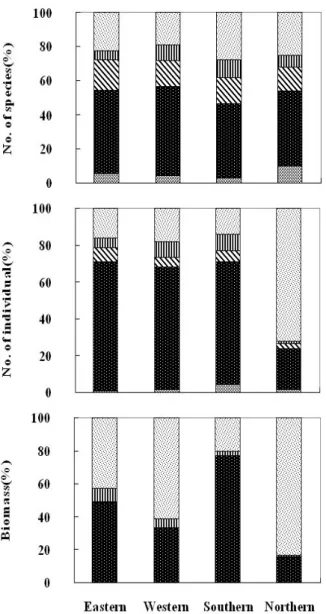
분류군의 해역별 출현양상을 살펴보면 (Fig. 4), 출현 종수

는 연체동물이 기타동물에 비해 높은 비율을 차지하고 있었으

며, 점유율은 43.7-52.7%로 비교적 유사하지만 서부해역에서

높고, 남부해역이 낮게 나타났다. 절지동물은 동부해역에서

18.1% 로 높았으며, 남부해역 15.5%, 서부해역 14.9% 및 북

부해역에서 14.0%의 순이었다. 극피동물과 기타동물은 남부

해역에서 출현비율이 높게 나타난 반면, 동부와 서부해역이 낮

(6)

Fig. 4. Regional variations of species composition, number of individual and biomass at each class of macrobenthic in- vertebrates in the coastal waters of Jeju Island.

게 나타났다. 단위면적당 개체수 비율의 경우도 연체동물의 점 유율이 월등히 높게 나타났으며, 동부와 남부 및 서부해역에서 66.7-70.1%로 높은 반면, 북부해역에서 22.4%로 가장 낮았 다. 극피동물과 절지동물은 동부와 서부 및 남부해역에서 비교 적 유사한 개체비율을 보였지만, 북부해역에서는 기타동물이 다른 동물에 비해 72.0%로 상당히 높은 점유율을 보였다. 생 체량 비율의 경우도 연체동물과 기타동물의 점유율이 높은 것 으로 나타났으며, 동부와 남부해역에서는 연체동물이 높고, 서 부와 북부해역에서는 기타동물이 높게 나타나는 해역별 특성 을 보이고 있었다.

5. 동물분류군의 수심별 출현양상

지역별로 출현한 분류군별 수심에 따른 출현양상을 살펴보 면 (Fig. 5), 수심 5 m (이하 5 m) 에서 121종, 수심 10 m (이하 10 m) 98종, 수심 15 m (이하 15 m) 103종으로 5 m 수심에서 출현종의 다양성이 높게 나타났다 . 5m 수심에서 종 다양성이 높은 분류군은 복족류로서 34종이 출현하였고, 다음 으로 이매패류가 15종, 십각류 18종으로 나타났다. 10 m 와 15 m 에서도 복족류가 각각 24종, 21종으로 나타나 5 m 수 심과 같은 양상으로 복족류의 종수가 높게 나타났으나 , 서식 수심이 깊을수록 출현종수는 점차 줄어드는 경향을 나타냈다 . 복족류와 이매패류 및 십각류는 5 m 수심에서 가장 많이 분 포하였고 , 보통해면류는 10 m층, 산호충류 및 다모류는 15 m 층에서 높게 나타났다 .

개체밀도의 경우 전 조사 수심대에서 복족류가 다른 동물에 비해 월등히 높은 것으로 나타났다 . 특히, 5 m 에서는 1,391 개체 /m

2

로 전 수심층에서 개체밀도가 가장 높았고, 10 m 873 개체/m

2

, 15 m 563 개체/m

2

로 수심이 깊을수록 개체 밀도가 점차 낮아지는 것으로 나타났다 . 다음으로는 척삭동물 인 해초류가 높은 개체밀도를 보였으며 , 수심별로는 5 m 에서 가장 높고 , 15 m 에서 낮은 밀도를 나타냈다. 기타 동물들 중 에서 십각류 , 불가사리류 및 성게류의 경우도 5 m 수심대에 개체밀도가 높게 나타났다 .

생체량의 경우 종수 및 개체수의 양상과는 달리 연체동물인 이매패류가 가장 높게 나타났고 , 다음으로 보통해면류, 복족류 및 산호충류의 순으로 나타났다 . 5 m 에서는 이매패류가 15,614.8gwwt/m

2

로 가장 높았고, 복족류 9,848.4 gwwt/m

2

, 산호출류 및 성게류가 각각 2,432.7 gwwt/m

2

, 2,264.7 gwwt/m

2

순으로 나타났다. 10 m 에서는 보통해면 류가 11,050.8 gwwt/m

2

로 높게 나타났으며, 다음으로는 이 매패류와 복족류 및 산호충류의 순으로 비교적 유사한 값을 보 였다 . 15 m 의 경우도 보통해면류가 13,930.5 gwwt/m

2

로 전 수심층에서 가장 높게 나타났고 , 산호충류, 이매패류 및 복 족류의 순으로 대부분 해면동물과 자포동물 및 연체동물이 차 지하는 비중이 높은 것으로 나타났다 .

6. 군집 우점도

개체밀도에 따른 상위 5.0%이상의 점유율을 차지하는 군집 우점종에 대한 분포유형을 각 지역별로 분석한 결과 (Table.

3) 신천에서 조사된 군집 제1우점종은 바퀴고둥 (Astralium

haematragum), 제2우점종 분홍멍게 (Herdmania monus),

3우점종 소라 (Turbo cornutus), 제4우점종 탑뿔고둥

(Ergalatax contraacta), 제5우점종 애기돌맞조개 (Lithophaga

cura) 의 순으로 군집우점도 (CDI) 지수는 5.0-39.4 범위로

바퀴고둥이 최상위 우점종으로 나타났다 . 하천에서 조사된 군

(7)

Sampling stations

Dominant species and index (CDI) No. 1

dominant species

CDI

No. 2 dominant

species

CDI

No. 3 dominant

species

CDI

No. 4 dominant

species

CDI

No. 5 dominant

species

CDI

Shincheon Astralium

haematragum 39.4 Herdmania

monus 15.1 Turbo

cornutus 5.9 Ergalatax

contraacta 5.5 Lithophaga cura 5.0

Hacheon Astralium

haematragum 34.0 Turbo

cornutus 11.8 Ergalatax

contraacta 8.6 Lithophaga cura 6.4

Gwakji Anthocidaris

crassispina 19.4 Columbellopsis

bella 16.1 Astralium

haematragum 12.9 Turbo

cornutus 6.5 Thais

bronni 6.5

Aewol Astralium

haematragum 50.4 Herdmania

monus 15.4 Turbo

cornutus 5.7

Daepo Astralium

haematragum 20.6 Lithophaga

cura 14.3 Turbo

cornutus 9.0 Phascolosoma

scolops 6.9 Ergalatax contraacta 5.6

Jungmun Astralium

haematragum 35.6 Ergalatax

contraacta 10.8 Anthocidaris

crassispina 7.0 Euplica

scripta 5.9 Turbo

cornutus 5.4

Woljeong Herdmania

monus 69.8 Omphalius

pfeifferi 6.5 Astralium haematragum 5.0

Haengwon Herdmania

monus 65.5 Astralium haematragum 7.8

Table. 3. Dominant species and community dominance index (CDI) of sampling stations.

집 제 1우점종은 바퀴고둥, 제2우점종 소라, 제3우점종 탑뿔고 둥, 제4우점종 애기돌맞조개의 순으로 군집우점도 (CDI) 지수 는 6.4-34.0 범위로 신천과 같은 양상으로 바퀴고둥이 최상위 우점종으로 나타났다 . 곽지에서 조사된 군집 제1우점종은 보 라성게 (Anthocidaris crassispina), 제2우점종 고운띠무륵 (Columbellopsis bella), 제3우점종 바퀴고둥, 제4우점종 소, 제5우점종 두드럭고둥 (Thais bronni) 의 순으로 군집우 점도 (CDI) 지수는 6.5-19.4 범위로 보라성게가 최상위 우점 종으로 나타났지만 , 조사정점 중 우점종의 군집지수가 가장 낮 은 지역으로 나타났다 . 애월에서 조사된 군집 제1우점종은 바 퀴고둥, 제2우점종 분홍멍게, 제3우점종 소라의 순으로 군집우 점도 (CDI) 지수는 5.7-50.4 범위로 최상위 우점종은 바퀴고 둥으로 나타났다 . 대포에서 조사된 군집 제1우점종은 바퀴고 둥, 제2우점종 애기돌맞조개, 제3우점종 소라, 제4우점종 상어 껄질별벌레 (Phascolosoma scolops), 제5우점종 탑뿔고둥의 순으로 군집우점도 (CDI) 지수는 5.6-20.6 범위로 최상위 우 점종은 바퀴고둥으로 나타났다. 중문에서 조사된 군집 제1우 점종은 바퀴고둥 , 제2우점종 탑뿔고둥, 제3우점종 보라성게, 제 4우점종 무늬무륵 (Euplica scripta), 제5우점종 소라의 순 으로 군집우점도 (CDI) 지수는 5.4-35.6 범위로 최상위 우점

종은 바퀴고둥으로 나타났다 . 월정에서 조사된 군집 제1우점 종은 분홍멍게, 제2우점종 팽이고둥 (Omphalius pfeifferi), 제 3우점종 바퀴고둥의 순으로 군집우점도 (CDI) 지수는 5.6-69.8 범위로 최상위 우점종은 분홍멍게로 나타났으며 조 사 지역 중 분홍멍게 단일종의 우점지수가 가장 높게 나타났 다 . 행원에서 조사된 군집 제1우점종은 분홍멍게, 제2우점종 바퀴고둥의 순으로 군집우점도 (CDI) 지수는 7.8-65.5 범위 로 최상위 우점종은 월정과 마찬가지로 분홍멍게 였지만, 조사 지역 중 군집우점종수가 가장 낮은 것으로 나타났다 .

7. 수심별 우점종

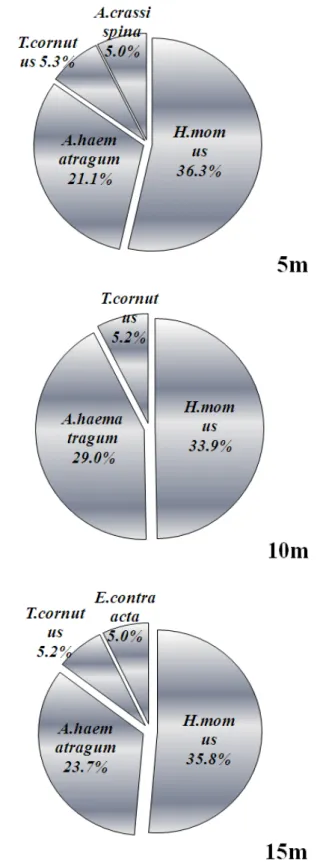
개체밀도에 따른 상위 5% 이상에 대한 각 수심층별 우점종 을 살펴보면 (Fig. 6), 5 m 수심에서는 분홍멍게가 전체의 36.3%로 가장 우점하였고, 다음으로 바퀴고둥 21.1%였고, 소 라 가 5.3%, 보라성게가 5.0%로 나타났다. 10m 수심의 경우 도 최상위 우점종은 분홍멍게로 33.9%의 점유율을 차지하였 고 , 다음으로 바퀴고둥이 29.0%, 소라가 5.2% 를 차지하였다.

15m 수심에서는 분홍멍게가 35.8% 로 최상위 우점종이었고,

바퀴고둥이 23.7%, 소라가 5.2%, 탑뿔고둥 5.0% 로 나타났

다 .

(8)

Fig. 5. Species composition, numbers and biomass of macrobenthic invertebrates at three water depths in the coastal

waters of Jeju Island.

(9)

Fig. 6. Percentage composition of dominant species in individual numbers at each water depth from the eight sampling stations.

8. 군집 다양성 지수

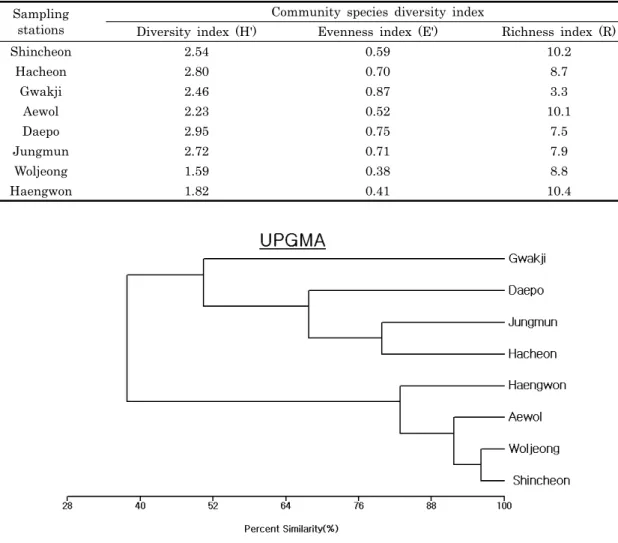
각 지역별 종 다양도 지수 (H') 는 1.59-2.95범위로 남부해 역의 대포에서 2.95으로 가장 높은 값을 나타냈다. 다음으로 는 남부해역인 중문과 동부해역의 신천에서 각각 2.72, 2.80 으로 유사한 상위 수준을 나타냈지만 , 북부해역인 월정과 행원 에서 1.59 및 1.82로 지역별 종 다양도 지수가 가장 낮은 것 으로 나타났다 .

균등도 (E') 의 경우 조사지역 전반에 걸쳐 0.38-0.87 범위 로 서부해역인 곽지에서 가장 높았고 , 하천, 대포 및 중문에서 0.70-0.75 로 비교적 유사한 값을 보였으나, 북부해역인 월정 과 행원에서 0.38, 0.41 로 가장 낮게 나타났다.

풍부도 (R) 의 경우 북부해역인 행원에서 10.4 로 가장 높았고 , 애월과 신천에서 각각 10.1, 10.2 로 유사한 상위 수 준을 보였으며 , 풍부도가 가장 낮은 지역은 서부해역인 곽지 (3.3) 로 나타났다 (Table. 4).

9. 군집분석
제주연안 마을어장에서 지역별로 출현한 저서무척추동물의 종별 개체수 자료를 이용하여 집괴분석을 실시한 결과 각 정점 들은 2개 그룹으로 구분되었다 (Fig. 7). 집괴분석에 의하면 북부에 위치한 행원과 월정을 비롯한 서부와 동부의 애월과 신 천이 하나의 그룹으로 구분되었고 , 남부해역인 대포와 중문을 비롯한 동부인 하천과 서부에 위치한 곽지가 하나의 그룹으로 구분되었다 .

고 찰

제주연안 8개 마을어장의 주변해역에서 조사된 대형무척추

동물은 총 166종이 출현하였고, 연체동물이 전체 출현 동물들

중 46.4%로 가장 높은 비율을 차지하였다. 이처럼 제주도 주

변 연안역은 대부분 수평·수직 암반으로 이루어진 지형적 특징

에 의해 암반 속 공간과 부착기질에 의존해 서식하는 연체동

물, 절지동물 및 자포동물의 서식밀도가 우리나라 남해안 및

서해안에 비해 높게 나타난다 (Ko et al., 2008). 본 연구와

유사한 제주도 주변해역에서 기 보고되었던 조사결과와 비교

해 보면, 제주도 북부연안 조간 및 조하대의 81종 (Lee,

1990), 제주도 남부 연안역의 59종 (Lee and Hyun, 1991),

제주도 북부연안의 135종 (Lee et al., 1989), 제주도 주변연

안의 25개 조간대 42종 (Lee and Jwa 1988) 을 비롯해 제

주도 주변해역의 유·무인도에서 조사된 마라도 주변 90종

(Lee, 1991), 차귀도 주변 146종 (Yang et al., 2007), 문섬

주변 112종 (Ko et al., 2008) 에 비해 본 연구에서는 총 166

종으로 출현종수가 높게 나타났지만, 제주도 동부해역의 201

종 (Lee and Hyun, 1992), 제주도 저서동물 다양성 보고의

(10)

Sampling stations

Community species diversity index

Diversity index (H') Evenness index (E') Richness index (R)

Shincheon 2.54 0.59 10.2

Hacheon 2.80 0.70 8.7

Gwakji 2.46 0.87 3.3

Aewol 2.23 0.52 10.1

Daepo 2.95 0.75 7.5

Jungmun 2.72 0.71 7.9

Woljeong 1.59 0.38 8.8

Haengwon 1.82 0.41 10.4

Table. 4. The diversity (H'), evenness (E'), and richness (R) of the macrobenthic invertebrates collected from the sublittoral zone in sampling stations.

Fig. 7. Dendrogram showing faunal similarity between station produced by cluster analysis using UPGMA.

173종 (Je et al., 2002), 차귀도 주변 연안역 201종 (Lee et al., 1995), 비양도 168종 (Lee and Kim, 1993) 에 비해서 는 낮게 나타났다.

대형무척추동물의 개체밀도는 총 6,591 개체/m

2

로 나타났 으며 이중 연체동물이 3,311 개체/m

2

로 다른 출현동물들에 비해 개체밀도가 가장 높게 나타났다. 연체동물에 이어 개체밀 도 우위를 차지한 동물은 척삭동물인 해초류로서 2,456 개체 /m

2

로 37.3% 의 점유율을 나타냈으며 우점종은 분홍멍게 (Herdmania monus) 로 나타났다. 이종은 전체 출현 동물에 있어 단일종으로서 개체밀도가 가장 높은 종으로 나타났다. 이 와 같이 제주연안에서 출현한 무척추동물의 개체밀도를 우리 나라 남해안의 섬 주변해역들과 비교해보면, 영정도 해역 1,392 개체/m

2

(Yu et al., 2004), 대부도 해역 1,093 개체 /m

2

(Lim and Choi, 1998) 및 소리도 해역 1,068 개체/m

2

(Lim and Choi, 2001) 에 비해 월등히 높은 밀도를 나타냈 다. 생체량의 경우도 총 113,100.7 gwwt/m

2

로 연체동물이 55,567.9 gwwt/m

2

(49.1%) 로 점유율이 최고치를 나타냈으 며, 특히, 이매패류 (28.4%) 와 복족류 (20.7%) 의 점유율이 매우 높게 나타났다. 이처럼, 제주도 주변연안은 화산활동에 의한 현무암 기질인 다공성 암반과 수평 및 수직형의 넓은 암 반대의 갈리진 틈새 등에 포식동물로 부터의 보호와 산란 및 서식에 필요한 공간형 암반을 이루는 지형적 특성에 의해 대부 분 사니질로 이루어진 남해안과 서해안의 우점 생물상이 다르 게 나타나며, 특히, 암반 부착기질을 기반으로 서식하는 연체 동물과 자포동물의 밀도가 우리나라 다른 연안에 비해 매우 높 게 나타나는 유리한 조건을 갖추고 있다 (Ko et al., 2008).

출현 종에 대한 지역별 양상은 행원에서 79종으로 가장 높

고, 신천과 애월에서 각각 75종과 72종으로 비교적 높은 양상

(11)

을 나타냈다 . 개체밀도의 경우도 출현 종과 같은 양상으로 행 원에서 1,799 개체/m

2

로 가장 높았다. 그러나, 생체량의 경 우는 대포에서 41,954.2 gwwt/m

2

로 타 지역에 비해 월등히 높게 나타났다 . 해역별 출현양상의 경우 행원과 월정의 북부해 역에서 101종, 중문과 대포의 남부해역에서 71종으로 남부해 역에 비해 북부해역의 출현 종수가 높게 나타났고 , 개체밀도의 경우도 남부해역 (841 개체/m

2

) 보다 북부해역 (3,061 개체 /m

2

) 이 높았다. 그러나, 생체량은 이와 상반된 양상으로 남부 해역에서 45,364.5 gwwt/m

2

로 가장 높게 나타났다. 이처럼 남부해역의 생체량이 높게 나타난 요인으로는 조사정점 내 이 매패류인 중국굴 (Hyotissa hyotis) 의 개체밀도가 다른 지역 에 비해 상대적으로 높게 나타난 것으로 판단된다 .

분류된 출현 동물군들에 대한 해역별 출현빈도에 있어 가장 점유율이 높은 연체동물의 출현종수는 서부해역에서 높고 남 부해역에서 낮게 나타났으며 , 절지동물은 동부해역, 극피동물 과 기타동물은 남부해역에서 출현빈도가 높았다 . 개체밀도의 경우도 동부해역에서 연체동물의 점유율이 가장 높았고 , 기타 동물은 북부해역에서 다른 출현동물에 비해 상당히 높은 점유 율 (72.0%) 을 나타냈으며, 생체량의 경우 동부와 남부해역에 서 연체동물이 높고 , 서부와 북부해역에서는 기타동물의 비율 이 높게 나타났다 . 이처럼 제주도 마을어장은 해역별로 서로 다른 생태적 군집특성을 나타내고 있었으며 특히 , 북부해역에 종수 및 개체밀도가 높은 것으로 보아 이 해역은 다양한 생물 종들의 연안어장으로 가입될 수 있는 기회가 높은 해역이라 할 수 있으며 생체량이 높게 나타난 남부해역은 기존 토착종을 비 롯한 외해에서 가입되는 외래종들의 정착과 서식처 군집확산 이 높은 해역이라 판단된다 . 제주연안에서 유입되어 정착화 되 고 있는 아열대종은 여러종들이 있지만 특히 , 분홍멍게 (Herdmania monus) 와 거품돌산호 (Avelophora japonica) 를 들 수 있다. 본 연구에서도 해역별 출현 동물들 중 분홍멍게는 북부해역에서 84.2%로 단위 면적당 개체밀도 가 가장 높았고 , 동부해역 8.5%, 서부해역 7.4%의 순으로 나 타났다 . 거품돌산호의 경우도 전 해역에서 채집되었으며 서부 해역이 42.5%, 동부해역 29.3%, 남부해역 26.8%, 북부해역 2.4%로 나타났다.

지역별 수심에 따른 분포특성을 보면 출현종수 , 개체수 및 생체량이 가장 높은 수심대는 5 m 층으로 나타났고, 5 m층과 10 m층에서는 연체동물인 복족류가 대부분을 점유하였으나, 15 m층에서는 이매패류의 출현이 높게 나타났다. 특히, 종수 와 개체수는 5 m 층의 낮은 수심대에 출현밀도가 높게 나타 난 반면 , 생체량은 15 m 층에서 높게 나타나 수심이 깊을수록 서식구조가 비슷하거나 단순하기 때문에 굵은나선별해면 (Stirastrella insignis) 및 중국굴 (Hyotissa hyotis) 등 생 체중량이 높은 종들이 우점한 결과로 판단된다 .

마을어장별 종다양도 (H') 범위는 1.59-2.95 로 나타났다.

남부해역인 대포리에서 2.95 에서 가장 높게 나타나 제주연안 에서 군집내 종다양성 및 개체수 균일성이 가장 안정된 해역으 로 나타났다 . 이러한 결과는 제주도 문섬 주변해역 2.71-3.41 (Ko et al., 2008), 차귀도 주변해역 3.21-3.74 (Yang et al., 2007; Lee et al., 1995), 비양도 연안의 3.27-3.75 (Lee and Kim, 1993) 보다 낮았고, 제주도 화순과 송악산 주변해 역의 1.27-2.72, 0.74-0.93 (Lee et al., 2001; Lee and Hyun, 2002) 보다는 높게 나타났다. 제주연안의 저서동물 군 집은 2개의 그룹으로 구분되었으며 특히, 출현종수와 개체밀 도가 높게 나타난 북부해역과 이와 상대적으로 낮게 나타난 남 부해역으로 크게 구분되었다 .

지역별로 군집의 최상위 우점종을 파악한 결과 신천 , 하천,

애월 , 대포 및 중문에서 최상위 우점종은 바퀴고둥

(Astralium haematragum) 으로 나타났고, 곽지에서는 보

라성게 (Anthocidaris crassispina), 북부해역인 월정과 행

원에서 분홍멍게 (Herdmania monus) 로 나타났다. 그러나,

우점종 군집지수에 있어 행원과 월정은 65.5-69.8의 범위로

다른 해역에 비해 상대적으로 높게 나타났다 . 이러한 결과는

단일종의 개체수가 월등히 높은 분홍멍게 (Herdmania

monus) 의 극우점 현상에 따라 서식처의 다양성이 상대적으

로 떨어져 다른 동물들이 서식처 공간경쟁에서 밀리기 때문인

것으로 판단된다 . 또한 지역별 조사수심에서 동일하게 나타난

최상위 우점종은 분홍멍게 (Herdmania monus) 로 대부분

조사 수심에서 34% 이상의 점유율을 보여 전 수심에서 가장

높게 나타났다 . 이처럼 분홍멍게는 1960-1970년대 초에 국내

에 처음 알려진 종으로써 (Rho, 1971, 1975) 특히, 2007년

-2008년까지 제주연안에서 개체군이 급속하게 번식되어 해양

저서생태계의 극우점종 (Lee, 2010) 이 되었고, 이런 비정상

적인 대증식으로 인해 서식처 다양성을 감소시키며 기존 고유

생태계에 영향을 미칠 수 있는 교란생물로 취급되어져 왔다 .

Lee (2010) 에 의하면 분홍멍게는 성체로서의 크기인 4-6cm

자리는 동안 2-3개월이 소요되고, 성장률은 월별 0.2-0.25 정

도이며 수심이 얕은 지역일수록 개체밀도가 높다고 하였다 . 또

한 고수온기인 8월에서 10월까지 급격히 개체수가 증가하지

만 , 저수온기인 2월에서 4월 동안은 개체수가 감소하는 등 본

종의 개체밀도는 수온의 변화에 큰 영향을 받는다고 하였다

(Hatcher, 1991). 그러나, 이와 같은 극우점 현상은 집단의

밀도가 극상일 때 나타나는 자기조절기전 (Auto-Regulation

Mechanism) 의 현상으로 판단되지만, 정확한 원인은 파악되

지 않고 있으며 단순히 아열대성 해양생물의 제주 연안역 가입

에 따른 출현 요인으로만 추측 되어져 왔다 . Trewartha and

Hom (1980) 는 평균기온이 18℃ 이하이면서 월평균 기온이

10℃ 이상인 달이 8-12개월 이상 나타나는 기후구 구분을 아

(12)

열대로 정의 하였고 , 이러한 기준을 적용하여 1996-2005년 까지 우리나라 부근의 해수면온도를 예측한 결과 제주도 주변 해역의 수온이 18-20℃ 로 나타나 제주도를 포함한 남동 및 남서해역은 이미 아열대화로 진행되고 있음을 밝혔다 (Kwon et al., 2007). 따라서, 해수온도의 지속적 상승에 의한 제주연 안의 아열대화에 따라 열대 해양성 기원 외래종들의 유입 및 정착기회가 점차적으로 증가할 것으로 판단되면서 향후 , 분홍 멍게 (Herdmania monus) 를 비롯한 거품돌산호 (Avelophora japonica), 빛단풍돌산호 (Montipora trabeculata), 곤봉말미잘 (Entacmaea actinostoloides) 등 아열대성 해양생물에 대한 유입경로 및 이들 종에 대한 생리 · 생태 및 개체군 연구가 지속적으로 이루어져야 할 것이다 .

요 약

제주연안 8개 마을어장 주변해역에서 2008년 9월부터 10 월까지 저서 무척추동물의 군집구조를 파악하기 위해 조사 하 였으며 그 결과는 다음과 같다.

조사기간 중 총 166종의 저서동물이 채집되었고, 연체동물 이 77종 (46.4%) 이였으며, 이 중 복족류가 25.3%로 가장 우 점하였고, 절지동물 24종 (14.5%), 자포동물 18종 (10.8%), 해면동물 16종 (9.2%) 및 기타 동물은 33종 (17.7%) 의 순으 로 나타났다

조사해역의 개체밀도와 생체량은 각각 6,905 개체/m

2

, 113,100.7 gwwt/m

2

로 연체동물 중 복족류가 개체수와 생체 량에서 우점하였다. 주요 우점종은 팽이고둥 (Omphalius pfeifferi), 바퀴고둥 (Astralium haematragum), 소라 (Turbo cornutus), 탑뿔고둥 (Ergalatax contraacta), 애기 돌맛조개 (Lithophaga cura), 보라성게 (Anthocidaris crassispina), 분홍멍게 (Herdmania monus) 로 주로 복족 류와 해초류에서 높은 우점율을 나타냈다. 군집유사도의 집괴 분석을 실시한 결과 크게 북부와 남부해역 및 서부해역의 2개 그룹으로 나눌 수 있었다. 정점별 종다양도 (H'), 균등도 (E') 및 풍부도 (R) 지수의 범위는 각각 1.59-2.95, 0.38-0.87, 3.3-10.4 로 종다양성 및 개체수 균일성이 가장 안정된 지역 은 남부인 대포리에서 가장 높게 나타났고, 북부에 위치한 월 정에서 낮게 나타났다.

사 사

본 연구는 국립수산과학원 아열대수산연구센터「기후변 화에 따른 수산자원 변동 및 예측 RP-2011-FR-037」의 지원 에 의해 수행되었다 .

REFERENCES

Abott, R.T. and K.J. Boss. (1989) A classification of living Mollusca. American Malacologists, Inc., Melbourne. 195pp.

Cohen, E. B., Grosslein, M. D., Sissenwine, M. P., Steimle, F. W., Wright, W.R. (1982) An energy budget of Georges Bank. In: Mercer, M. C. (ed.) Multi-species approaches to fisheries management advice. Can. Spec. Pub. Fish. Aquat. Sci., 59:

95-107.

Choe, B.L (1992) Illustrated Encyclopedia of Fauna and Flora of Korea Vol. 33 Mollusca(Ⅱ). Ministry of Education, Seoul, 860pp., 126pls.

Chung, H., K.W. Cho, K.Y. Chung, J.H. Kim, J. Shin, Y.

Seo, J.S. Kang and J.K. Lee. (1998) Ecological characteristics of algal whitening in coastal zone of Seogwipo area, Cheju Island. Algae, 13: 361-374.

Dai, A. and Yang. S. (1991) Crabs of the China Sea.

China Ocean Press Beijing. pp. 1-606.

Habe, T. (1977) Systematics of Mollusca in Japan.

Bivalvia and Scaphopoda. Zukan-no-Hokuryukan Co., Tokyo, 372pp., 72pls.

Hatcher, A. (1991) Effect of temperature on carbon, nitrogen and phosphorus turnover by the solitary ascidian Herdmania momus(Savigny). J. Exp. Mar.

Biol. Ecol., 152: 15-31.

Ichiki, S., H. Misuta and H. Yamamoto. (2000) Effects of irradiance, water temperature and nutrients on the growth of sporelings of the crustose coralline alga Lithophyllum yesoense Foslie (Corallinales, Rho dophyceae). Phycol. Res., 48: 115-120.

Je, J.G., Ko, B.J., Lee, H.G., Kim, B.I., Shin, S.H, Lee, S.W. and Lee, J.H. (2002) Habitats and zoobenthic species diversity in the coast of Jeju Island, Korea:

as a baseline study for conserving coastal and marine biological diversity. The Korea Society of Underwater Science and Technology. 3: 7-117. [in Korean]

Kim, H.S. (1973) Illustreated encyclopedia of fauna &

flora of Korea. Vol. 14, Annomura & Brachyura.

Samhwa Publishing Co. Ltd., Seoul, Korea, 694pp., pls. 1-112.

Kim, H.S. (1977) Illustreated encyclopedia of fauna &

flora of Korea. Vol. 19, Macrura. Samhwa Publishing Co. Ltd., Seoul, Korea, 414pp., pls. 1-56.

Kim, H.S. (1985) Systemtic studies on crustaceans of Korea, 1. Decapods. Proc. Coll. Natur. Sic., SNU, 10: 63-94.

Ko, J.C., Koo, J.H. and Yang, M.H. (2008) Characteristics of ocean environmental factors and community structure of macrobenthos around Munseom, Jeju Island, Korea. Korean Journal of Malacology, 24: 215-228. [in Korean]

Kwon, Y.A., Kwon, W.T. Boo, K.O. and Choi, Y.E. (2007)

Future Projections on Subtropical Climate Regions

over South Korea Using SRES A1B Data. Journal

of the Korean Geographical Society, 42: 355-367. [in

(13)

Korean]

Lee, C.H. (2010) Population study of solitary ascidian Herdmania momus in Jeju Island, Korea. M.S.

Thesis, Sung Kyun Kwan University, pp. 1-23.

Lee, J.J. (1990) Bioecological study of the northern coastal area in Cheju Island. Korean Journal of Malacology, 6: 33-44. [in Korean]

Lee, J.J. and Hyun, J.M. (1991) Bioecological study of the southern coastal area in Cheju Island- 2.

Distribution and community structure of the benthic molluscan shells in around coast to Sogwipo. Korean Journal of Malacology, 7: 58-65.

[in Korean]

Lee, J.J., Zhang, C.I. and Cho, U.S. (1989) Community structure of the ecosystem on the intertidal zone and grass land in Cheju Island - Distribution and community structure of benthic macroinvertebrates.

Korean Journal of Malacology, 5: 10-28. [in Korean]

Lee, J.J. and Jwa, Y.W. (1988) Eological study on the intertidal zone around Cheju Island - 1. Estmation of plankton production and community structure of marine shells - Community structure of molluscan shells. Korean Journal of Malacology, 4: 17-29. [in Korean]

Lee, J.J. (1991) Bioecological studies of the southern coastal area in Cheju Island. - 1. Distribution and community structure of the benthic marcro- invertebrates in Gapa and Mara Islets. Korean Journal of Malacology, 7: 49-57. [in Korean]

Lee, J.J. and Hyun, J.M. (1992) Bioecological study of the eastern coastal area in Cheju Island. - Seasonal changes of macroinvertebrate community on the intertidal rocky shores. Korean Journal of Malacology, 8: 1-20. [in Korean]

Lee, J.J., Hyun, J.M. and Kim, J.C. (1995) Bioecological study of the upwelling area around Cheju Island- community structure of the benthic macroinvertebrates at the rocky interidal zone of Chagwi-do, Cheju Island. Korean Journal of Malacology, 11: 1-20. [in Korean]

Lee, J.J. and Kim, J.C. (1993) Bioecological studies of the western coastal area in Cheju Island. - Distribution and seasonal community changes of the benthic macroinvertebrates on the rocky intertidal zone of Biyangdo. Korean Journal of Malacology, 9:

68-84. [in Korean]

Lee, J.J., Kang, K.C. and Kim, J.C. (2001) Spatial species diversity of macrobenthos in the intertidal zone of Hwasoon, Jeju Island. Korean Journal of Malacology, 17: 63-70. [in Korean]

Lee, J.J. and Hyun, J.M. (2002) Species diversity and community structure of macrobenthic invertebrate inhabiting intertidal zone near Songacksan area, Jeju Island. Korean Journal of Malacology, 18:

41-52. [in Korean]

Lim, S.H. and Choi, J.W. (1998) Macrobenthic community at the subtidal area around Taebudo in Kyeonggi Bay, Korea. Journal of Fisheries Society, 31: 453-462. [in Korean]

Lim, S.H. and Choi, J.W. (2001) Macrobenthic community in the soft bottom around Sorido Island, Southern coast of Korea. Journal of Fisheries Society, 34: 225-237. [in Korean]

Lim, H.S., Lee, J.H., Choi J.W. and Je, J.G. (1995) Macrobenthic community on the soft-bottom around the Youngjong Island. Korea. Journal of Fisheries Society, 28: 635-648. [in Korean]

Margalef, D.R. (1958) Imformation theory in ecology.

General systems, 3: 36-71.

McNaughton, S.J. (1967) Relationship among functional properties of California grassland. Nature, 216:

168-169.

Nishimura, S. (1992) Guide to Seashore Animals of Japan With Color Pictures and Keys, Vol. I.

Hoikusha, Tokyo, 663pp.

Nishimura, S. (1995) Guide to Seashore Animals of Japan With Color Pictures and Keys, Vol. Ⅱ.

Hoikusha, Tokyo, 425pp.

Okutani, T. (1986) Mollusca. Illustrations of animals and plants. Sekaibunka-ska Pub. Co., Japan. 399pp.

Okutani, T. and T. Habe. (1990) The mollusks of Japan.

Gakken Illustrated nature encyclopedia. Gakken Pub. Co., Tokyo. 301pp.

Paik, S.G, and Yun, S.G. (2000) Community structure of the macrobenthos in Chinhae Bay, Korea.

Journal of Fisheries Society, 33: 572-580. [in Korean]

Pearson, T. H. and R. Rosenberg. (1978) Macrobenthic succession in relation to organic enrichment and pollution of the marine environment. Oceanogr. Mar.

Biol. Ann. Rev., 16: 229-311.

Pielou, E.C. (1969) An introduction to mathematical ecology. pp. 291-331, Wiley-interscience.

Rho, B.J. (1971) A stduy on the classification and the distribution of the Korean ascidians. The Journal of Korean Research Institute for Better Living, 6:

103-166.

Rho, B.J. (1975) On the classification and the distribution of the marine benthic animals in Korea.

The Journal of Korean Research Institute for Better Living, 15: 121-169.

Shannon, C. E. and W. Wiener. (1949) The mathematical theory of communication. 125 pp.

University of Illinois Press, Chicago.

Shin, H.C., Choi, J.W. and Koh, C.H. (1989) Faunal assemblages of benthic macrofauna in the inter and subtidal region of the inner Kyeonggi Bay, west coast of Korea. Journal of Korean Society of oceanography. 24: 184-193. [in Korean]

Sneath P.H.A. and Sokal R.R. (1973) Numerical Taxonomy. W.H. Freema, Sanfrancisco, 573pp.

The Korean Society of Systematic Zoology, (1997) List of animals in Korea(excluding insects). Academy Press, 489pp.

Thouzeau, G., Robert, G., Ugarte, R. (1991) Faunal

assemblages of benthic megainvertebrates inhabiting

sea scallop grounds from eastern Georges Bank, in

(14)

relation to environmental factors. Mar. Ecol. Prog.

Ser., 74: 61-82.

Trewartha, G.T. and Horn, L. (1980) An Introduction to Climate, 5th Edition, McGraw-Hill, New York.

Yu, O.H., Koh, B.S., Lee, H.G. and Lee, J.H. (2004) Effect of environmental variables on changes in macrobenthic communities in the coastal area of Inchon, Korea. Journal of Fisheries Society, 37:

423-432. [in Korean]

Yum, S.S. (1988) Classification and distribution of Korean Polyplacophora(Mollusca). M.S. Thesis, Sung Kyun Kwan University, 104pp.

Yum, S.S. (1995) Systematic study of Korean

neoloricates(Polyplacophora, Mollusca) based on

karyotype and character analyses. Ph. D. Thesis,

Sung Kyun Kwan University, 232pp.

(15)

Station Species

Gwakji Daepo Sin-

cheon Aewol Wol- jeong

Jung- mun

Ha- cheon

Haeng- won Phylum Porifera

Stirastrella panis ○ ○ ○ ○ ○ ○

S. insignis ○ ○ ○ ○ ○ ○ ○

Tethya aurantium ○ ○

Axinella rugoda ○

Esperiopsis plumosa ○

Myxilla setoensis ○ ○

Tedania brevispiculata ○ ○

My calepumosa ○

Callyspongia confoederata ○

C. elegans ○ ○ ○ ○ ○

C. elongata ○ ○ ○ ○

Petrosia corticata ○ ○

Halichondria okadai ○ ○

H. oshora ○ ○ ○ ○ ○

H. panicea ○

Hymeniacidon sinapium ○ ○

Phylum Cnidaria

Coryne pusilla ○ ○ ○ ○

Solanderia secunda ○ ○ ○

Aglaophenia whiteleggei ○

Thecocarpus niger ○ ○ ○ ○ ○ ○

Plumularia setacea ○ ○

Verrucella umbraculum ○

Euplexaura abietina ○

Anthoplexaura dimorpha ○ Plexauroides rigida ○

Melithaea flabellifera ○

Bellonella rigida ○

B. rubra ○

Dendronephthya giganted ○ ○ ○ ○

D. castanea ○

Javania insignis  ○ ○

Avelophora japonica ○ ○ ○ ○ ○ ○

Montipora trabeculata ○ ○ ○

Psammocora profundacella ○ ○

Phylum Bryozoa

Membranipora tuberculata ○ ○ ○

Iodictyum axillare  ○

Adeonella sp. ○ ○ ○ ○

Phylum Sipunculida

Phascolosoma scolops ○ ○ ○ ○ ○ ○

Phylum Mollusca

Lepidozona coreanica ○ ○

Mopalia retirera ○

Acantopleura japonica ○

Appendix 1. List of macroinvertebrate species collected from the coastal waters in Jeju Island

(16)

Station Species

Gwakji Daepo Sin-

cheon Aewol Wol- jeong

Jung- mun

Ha- cheon

Haeng- won

Rhyssoplax kurodai ○

Onithochiton hirasei ○

Cryptoplax japonica ○ ○ ○ ○ ○ ○

Diodora sieboldii  ○ ○ ○ ○

Calliostoma unicum ○ ○ ○ ○

Cantharidus callichroa ○ ○ ○ ○

C. japonica ○ ○ ○ ○ ○

Chlorostoma turbinata ○

Omphalius pfeifferi ○ ○ ○ ○ ○

O. rusticus ○ ○ ○

Umbonium costatum ○

Komaitrochus pulcher  ○

Cantharidus callichroa  ○ ○

Trochus sacellus ○ ○

Hybochelus cancellatus ○

Clanculus microdon ○

Astralium haematragum ○ ○ ○ ○ ○ ○ ○ ○

Turbo cornutus ○ ○ ○ ○ ○ ○ ○ ○

T. excellens ○ ○ ○ ○

Phasianella solida ○ ○ ○

Stomatolina rubra ○

Serpulorbis imbricatus ○

Purpuraddusta gracilis ○ ○

Alvania ogasawarana ○ ○

Monoplex echo ○

Ergalatax contraacta ○ ○ ○ ○ ○ ○ ○

Thais bronni ○ ○ ○ ○ ○ ○

T. luteostoma ○ ○ ○ ○ ○

Ceratostoma fournieri ○ ○ ○ ○ ○

Mancinella echinata ○

Maculotriton serriale ○

Ocinebrellus inornatum ○

Columbellopsis bella ○ ○ ○ ○ ○

Euplica scripta ○ ○ ○ ○

Mitrella bicincta ○ ○ ○ ○ ○

M. nympha

Pyrene testudinaria ○ ○ ○ ○

Kelletia lischkei ○

Microfusus magnifica ○

Pollia mollis ○ ○

Cantharus cecillii ○ ○

Pollia subrubiginosus ○

Hypselodoris festiva ○ ○ ○

Ceratosoma trilobatum ○

Phyllidiella pustulosa ○

Barbatia stearnsii ○ ○ ○

Appendix 1. Continued

(17)

Station Species

Gwakji Daepo Sin-

cheon Aewol Wol- jeong

Jung- mun

Ha- cheon

Haeng- won

Arca boucardi ○ ○ ○ ○ ○ ○

Hawaiarca uwaensis ○

Acar plicatum ○

Lithophaga cura ○ ○ ○ ○ ○ ○ ○

Modiolus kurilensis ○

M. auriclatus ○ ○ ○

M. agripetus ○

Hormomya mutabilis ○ ○ ○ ○

Septifer keenae

Tricomusculus semigranatus ○ ○ ○

Musculus viridulus ○ ○ ○

Pteria brevialata ○

Chlamys farreri ○ ○ ○ ○

Anomia chinensis ○

Hyotissa hyotis ○ ○ ○

Dendostrea crenulifera ○ ○

Spondylus varius ○

Chama japonica ○

C. limbula ○ ○ ○

C. fraga ○ ○ ○

C. dunkeri ○ ○

Pseudochama retroversa ○ ○ ○

Cardita leana ○ ○ ○ ○

Irus irus ○

Gastrochaena cuneiformis ○

Agriodesma navicula ○

Chlamys irregularis ○ ○ ○ ○

C. nipponensis ○

Phylum Annelida

Perinereis cultrifera ○ ○ ○ ○ ○ ○ ○

Platynereis bicanaliculata ○

Nereis multignatha ○

N. pelagica ○

Hermenia acantholepis ○

Lepidonotus helotypus ○ ○

L. squamatus ○ ○

Halosydna brevisetosa ○ ○ ○

Sthenelais fusca ○

Eunice antennata ○ ○ ○ ○ ○

Lysidice collaris ○ ○

Spirobranchus tetraceros ○ Phylum Arthropoda

Holotelson tuberculatus ○ ○

Galathea orientalis ○ ○ ○ ○ ○ ○ ○

Alpheus japonicus ○

A. brevicristatus ○

A. bisincisus ○

Appendix 1. continued

(18)

Station Species

Gwakji Daepo Sin-

cheon Aewol Wol- jeong

Jung- mun

Ha- cheon

Haeng- won

Heptacarpus futilirostris ○

Paguristes ortmanni ○ ○ ○ ○ ○ ○

P. japonicus ○ ○ ○ ○ ○ ○

P. kagoshimensis ○ ○

Pagurus gracilipes ○ ○ ○ ○ ○

P. rubrior ○ ○

P. pilosipes ○ ○

Pisidia serratifrons ○

Pugettia quadridens quadridens ○ ○ ○ ○ ○ ○

P. quadridens pellucens ○ ○

Cancer amphioetus ○

Thalamita sima ○

Macromedaeus distinguendus ○ ○ ○ ○ ○ ○ ○ ○

Actaea semblatae ○ ○ ○ ○ ○

Leptodius exaratus ○ ○

Atergatis reticulatus ○ ○

Heteropilumnus ciliatus ○

Pinnotheres sinensis ○ ○

Rhynchoplax messor ○ ○

Phylum Echinodermata

Comanthus japonica ○

Certonardoa semiregularis ○ ○ ○ ○ ○ ○ ○ ○

Asterina batheri ○

Henricia nipponica ○ ○ ○

Ophiactis affinis ○ ○ ○ ○ ○ ○

Ophiothrix exigua ○ ○ ○ ○ ○ ○

Ophiarachnella gorgonia ○ ○ ○ ○ ○

Ophioplocus japonicus ○ ○

Strongylocentrotus intermedius ○

Pseudocentrotus depressus ○

Anthocidaris crassispina ○ ○ ○ ○ ○ ○ ○ ○

Cucumaria chronhjelmi ○

Phylum Chordata

Styela clava clava ○

Herdmania monus ○ ○ ○ ○ ○

Pyura vittata ○ ○ ○ ○

Appendix 1. continued

수치

Fig. 1. A map showing the sampling stations in the coastal  waters of Jeju Island during August-September, 2008
Fig. 2. Species composition, number of individual and  biomass of macrobenthic invertebrates in the coastal  waters of Jeju  Island.
Fig. 3. Regional variations of species composition, number  of individual and biomass of macrobenthic invertebrates at  sampling satation of  the coastal waters of Jeju Island.
Fig. 4. Regional variations of species composition, number of  individual and biomass at each class of macrobenthic  in-vertebrates in the coastal waters of Jeju Island
+4

참조

관련 문서

ABSTRACT Species composition and bimonthly changes of fish community were investigated with the fishes collected by using both trammel nets and fish pots in the coastal

Macroalgal species composition and seasonal variation in biomass on Udo, Jeju Island, Korea.. Seasonal variation in depth- stratified macroalgal assemblage patterns on Marado,

Seasonal variation and species compoition of fishes communities in artificial reef unit at marine ranching area in the coastal waters off Jeju Island,

Monthly variation of mean chlorophyll-a ( μg L -1 ) and mean phytoplankton abundance (cells L -1 ) of all stations at 0 and 30 m in Jeju coastal waters from Mar... 김규범

Occurrence of the eggs of hairtail, Trichiurus japonicus in the coastal waters of Jeju Island, Korea in spring.. Seung-Jong L EE *, Song-Heon H AN1 and Maeng-Jin

Sampling site for fisheries resources study by a set net in the coastal waters off Neungpo, Goeje Island from 2003 to 2004 (The block numbers within map indicate the fishing

Maturation and spawning of the jack mackerel, Trachurus japonicus was investigated based on the samples captured in the coastal waters around Jeju Island from January 2007 to

Length frequency distribution of Trachurus japonicus and Scomber japonicus catch by a set net in the coastal waters of Sinsan, Jeju Island from May to September 2014 and from May