Received 1 April 2020 / Revised 9 June 2020 / Accepted 13 June 2020 Copyright Ⓒ The Korean Society of Propulsion Engineers pISSN 1226-6027 / eISSN 2288-4548
Research Paper DOI: https://doi.org/10.6108/KSPE.2020.24.4.041
GUDN/BTATz를 적용한 친환경추진제 특성 연구
전수아 a ㆍ 원종웅 a ㆍ 박성준 a ㆍ 박정호 a ㆍ 최성한 a, *
A Study on Characteristic of
Eco-friendly Propellant Using GUDN/BTATz
Su-a Jeon a ㆍ Jong-ung Won a ㆍ Sung-jun Park a ㆍ Jung-ho Park a ㆍ Sunghan Choi a, *
a Propulsion Center, Hanwha Coporation Daejeon Plant, Korea
* Corresponding author. E-mail: [email protected]
ABSTRACT
This study aims to develop eco-friendly propellant that reduce the generation of harmful gases such as HCl gas and increase the emmision of nitrogen gas emissions. For this purpose, GUDN(N-Guanylurea dinitramide) and BTATz(3,6-bis(1H-1,2,3,4-tetrazol—5-ylamino)-1,2,4,5- tetrazine), which are low carbon high nitrogen materials, were used instead of AP(Ammonium Perchlorate) and Al(Aluminium), which are gernerally used in solid propellant. The prepared propellants were analyzed for mechanical properties and combustion characteristics, performance and AGARD smoke classification. Compared with AP/Al propellant, GUDN/BTATz propellant tended to decrease mechanical and combustion rate. Also, as a result of the static test after the production of the 4-inch motor, the performance of combustion of the GUDN/BTATz propellant decreased, but it was confirmed that the secondary smoke was improved by reducing harmful gases such as HCl gas.
초 록
본 연구에서는 염소가스 등 유해가스의 발생을 줄이고 질소가스 방출을 증가시키는 친환경 추진제 조성개발을 목표로 한다. 이에 고체 추진제에 일반적으로 사용되는 AP(Ammonium Perchlorate)와 Al(Aluminium)를 대신하여 저탄소 고질소 물질인 GUDN(N-Guanylurea dinitramide)과 BTATz (3,6-bis(1H-1,2,3,4-tetrazol—5-ylamino)-1,2,4,5-tetrazine)를 사용하였다. 제조된 추진제는 기계적 및 연 소 특성, 성능 그리고 AGARD 연기등급을 분석하였다. AP/Al 추진제에 비해 GUDN/BTATz추진제 는 기계적 성질과 연소 속도가 감소하는 경향을 나타내었다. 또한, 4인치표준모타 제작 후 지상연소 시험 결과 GUDN/BTATz추진제 연소 시 성능은 감소하였으나, 염소가스 등의 유해 가스를 줄여 2차 연기 등급도 개선됨을 확인할 수 있었다.
Key Words: Eco-Friendly(친환경), Propellant(추진제), Oxidizer(산화제), Fuel(연료)
This is an Open-Access article distributed under the terms of the Creative Commons Attribution Non-Commercial License(http://creativecommons.org /licenses/by-nc/3.0) which permits unrestricted non-commercial use, distribution, and reproduction in any medium, provided the original work is properly cited.
1. 서 론
일반적인 혼합형 고체 추진제에 사용되는 산 화제, 금속연료는 과염소산암모늄(AP), 알루미늄 (Al) 금속이 흔히 사용되고 있다.
과염소산암모늄(AP)는 고체 추진제 조성에서
60∼88% 차지하며 연소속도에 영향을 주는 산화
제로 사용되고 있다[1].
금속연료로 사용되는 알루미늄(Al)은 비추력과 밀도를 증가시키며 연소속도를 증가시키는 장점 을 가지고 있다[2].
하지만 AP/Al 추진제는 연소 시 과량의 염소
가스를 발생시켜 환경오염 등으로 인한 문제점 을 야기 시킨다[3].
이러한 단점을 보안하기 위하여 저탄소 고질 소 물질을 추진제에 적용하여 화염온도를 낮추 고 고질소 가스의 생성을 증가시켜 친환경추진 제 개발 연구의 필요성이 증가하고 있다.
GUDN은 충격 및 마찰 감도가 AP에 둔감하
여 취급하기가 안전하며, 좋은 성능을 나타낸다 [4]. BTATz는 연소속도 증가에 기여하며, 상대적 으로 낮은 압력지수를 나타내는 장점을 가지고 있다[5].
특히 GUDN과 BTATz는 탄소의 함량이 낮고 질소의 함량이 높아 추진제에 적용 시 불필요한 가스의 발생을 줄이고 질소 가스 발생을 증가시 킬 수 있다.
이에 본 논문에서는 저탄소 고질소 물질로 GUDN과 BTATz를 선정하여 기존 AP/Al추진제 에 적용하여 기계 및 연소특성과 추진제 성능을 분석 하였다.
2. 실 험
2.1 추진제 제작
추진제 제작 시, 바인더로 삼양화학공업(주)의 HTPB(hydroxyl terminated polybutadiene)를 사 용하였으며, 경화제로 Bayer Material Scienece LCC 사의 IPDI(isophorone diisocyanate), 가소 제로 의 LCC사의 DOS(dioctyl sebacate), 결합제
로 ㈜거원기술의 HX-752 (Isophthaloylbis (2-Methyl- aziridine))를 적용하였으며, 금속연료 는 ㈜창성의 Aluminium와 ㈜한화 종합연구소의 BTA Tz(N3, N6-di(1H-tetrazol-5-yl)-1,2,4,5- tetrazine-3,6-diamine)를 사용하였으며, 산화제로
는 ㈜한화 보은사업장의 AP (Ammo-nium
perchlorate), ㈜한화 종합연구소 GUDN(N- Guanylurea dinitramide), 연소촉매로는 Elementis Pigments Inc.의 Fe2O3를 사용하였다.
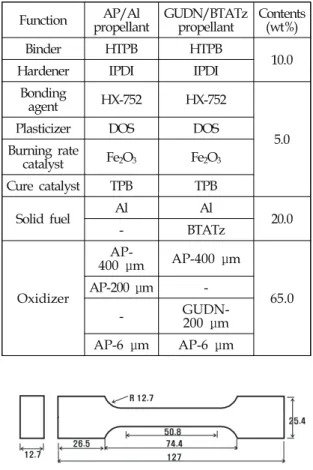
경화촉매는 동인화학 (주)의 TPB (Triphenylbismuth)를 사용하였다. 당량비는 0.850으로 제조하였다. 또한, 산화제와 금속연료 의 무게비는 고정하고 AP, Al 일부 함량을 GUDN, BTATz로 대체한 조성으로 추진제 제조 를 하였다.
Function AP/Al
propellant GUDN/BTATz
propellant Contents (wt%)
Binder HTPB HTPB
Hardener IPDI IPDI 10.0 Bonding
agent HX-752 HX-752
Plasticizer DOS DOS 5.0 Burning rate
catalyst Fe2O3 Fe2O3
Cure catalyst TPB TPB
Solid fuel Al Al
- BTATz 20.0
Oxidizer
AP-
400 μm AP-400 μm AP-200 μm - 65.0
- GUDN-
200 μm AP-6 μm AP-6 μm Table 1. Composition of Propellant.
Fig. 1 JANNAF specimen for tensile test (unit:mm).
2.2 추진제 점도 측정
슬러리 상태의 추진제의 점도는 규격서 ASTM D 2196 브룩필드 점도계에 의한 액체의 점도 측정방법에 따라 수행하였다. 추진제의 pot life를 예측하기 위해 Helipath stand에 Brookfield Synchro-Lectric Co., Model RV 회전 식 점도계를 사용하였다. 또한 T-spindle을 이용 하여 혼합이 완료된 고체 추진제의 점도를 50℃
온도에서 측정하였다.
2.3 추진제 기계적 특성 측정
경화가 완료된 추진제의 기계적 특성은 규격 서 ASTM D 412 경화 추진제의 응력, 변형 및 탄성률 시험 방법에 따라 수행하였다. 다음의 Fig. 1과 같은 형태의 시편(JANNAF Specimen) 으로 제조하여 UTM(Universal Tensile Machine) 로 신율-응력 곡선을 해석하여 강도, 신율, 탄성 률을 구하였다. 인장 속도는 50 mm/min 이었 고, 20℃, 35%RH에서 시험하였다.
2.4 추진제 연소속도 측정
추진제 연소속도는 MIL-STD-286C 실험 방법 을 참조하여 수행하였다. 경화된 고체 추진제의 연소속도는 Strand burner로 측정하였다. 고체 추진제 시편은 직경이 6 mm이고 길이가 130 mm인 시료를 만들어서 외부에는 측면 연소를 방지하기 위하여 난연제를 도포하여 제작하였다. 질소 기체가 충진된 Strand burner로 일정 압력 과 온도에서 연소시간을 측정하여 연소속도와 압력지수를 계산하였다. 연소속도와 압력지수는 Vieille’s Law에 의한 Saint Robert 수학식을 따 라 계산하였다.
2.5 4인치 표준 모타 지상연소 시험
본 연구에서는 추진제 연소속도 결과를 활용 하여 4인치 표준 모타 제작 전 압력 및 추력 성 능의 예측을 위해 내탄도 해석을 수행한 후 노 즐목 직경을 계산하였다. 또한, 모타 외경이 114.3 mm 이고 web 길이가 17 mm인 4인치 표 준모타를 제작하여 지상연소 시험함으로써 연소 시간, 연소압력, 추력 등의 데이터를 얻었다.
2.6 연기등급 분석
설계한 추진제의 이론적으로 생성되는 연기의 정량적 평가를 위하여 AGARD 연기 등급 분석 (AGARD Smoke Classification)을 활용하여 연기 등급을 확인였다. AGARD 연기 등급 기준은
AC이하로 표현되며, A는 1차연기등급을 나타내
고 C는 2차 연기등급을 나타낸다. 1차 연기등급 은 Eq.1로 확인할 수 있으며 추진제 연소에 의 해 배출된 액체 및 고체 산화물 입자에 의해 발 생된 연기이다.
AGARDP = 1-exp[-
] (1)
%는 응축물 I의 질량 백분율, Ni는 응축물 I의 광학적 특성 값, Gi는 응축물 I의 비중이다.
1차연기는 0에서 1사이의 값을 가지며 연기
등급은 0 ≤ AGARDP ≤ 0.35는 A등급, 0.35 <
AGARDP ≤ 0.9는 B등급, 0.9 < AGARDP ≤ 1
은 C등급으로 구분한다. 1차 연기는 A등급으로
갈수록 연기가 적게 발생 된다.
2차 연기등급은 Eq.2로 확인할 수 있으며
AGARDS ≥ 90%는 A등급, 90% > AGARDS >
55%는 B등급, AGARDS < 55%는 C등급으로 구 분하고 있다. 2차연기는 C등급으로 갈수록 연기 가 많이 발생한다[6,7].
AGARDS = 100(K-0.16589) (2)
3. 결과 및 고찰
3.1 GUDN/BTATz 적용에 따른 점도 변화 본 실험의 경우 AP/Al 추진제를 기본조성으 로 한다. 비교 조성으로 AP-200 μm을 대신하여 GUDN-200 μm를 사용하였으며 Al에 BTATz를 첨가하여 점도 변화를 관찰하였다. 초기 점도 결 과를 Fig 2에 나타내었다. 실험 결과 기본 조성 에 비해 GUDN/BTATz 추진제의 점도가 높아졌 다. 일반적으로 추진제 조성 중 가장 많은 비율 을 차지하고 있는 AP가 구형에 가까울수록 점
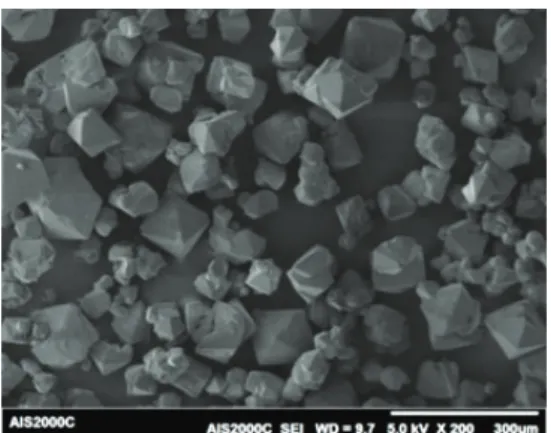
도는 하강한다고 보고되고 있다[8]. 그러나 Fig.
3의 SEM 결과상으로 GUDN은 다각형 입자 구 조를 나타내고 있다. 이에 점도에 영향을 끼친 것으로 판단된다. 또한, GUDN의 함량이 증가할 수록 초기 점도가 증가하는 경향을 나타내는 선 행 연구가 있다[9].
Burning rate AP/Al propellant
GUDN/BTATz propellant Burning rate
(mm/sec, 1000psi 20oC)
7.35 5.15
Exponent 0.02671 0.01349 Pressure
exponent 0.3449 0.3924
Table 3. Burning rate of Propellant.
3.2 GUDN/BTATz 적용에 따른 기계적 특성 AP/Al과 GUDN/BTATz를 적용한 추진제의 기계적 특성을 Table 2에 나타내었다. 기본 조성 에 비해 Sm, Em 그리고 Hs가 모두 감소하는 경향을 나타내고 있다. 추진제의 기계적 특성을 높이기 위한 연구가 추가적으로 수행되어야 할 것으로 판단된다.
3.3 GUDN/BTATz 적용에 따른 연소 특성 AP/Al과 GUDN/BTATz를 적용한 추진제의 연소 특성을 Table 3에 나타내었다. GUDN/
BTATz를 적용함에 따라 연소속도는 감소하며 압력지수는 증가하였다. AP대신 GUDN을 적용 한 추진제의 경우 연소속도가 감소하며 압력지 수는 증가하는 경향을 나타낸다. 이는 GUDN은 negative oxygen balance로 인해 부분 산화가 발 생된다. 이로 인해 연소 표면에서 적은에너지가 발생하여 연소속도가 감소된다[8].
BTATz의 경우 연소속도를 증가시키는 역할은 하나 상대적으로 소량 사용되었기에 연소속도에 는 큰 영향을 미치지 않았을 것으로 판단된다 [5].
따라서 GUDN/BTATz를 동시에 적용한 추진
제는 GUDN이 연소속도 하강에 영향을 끼친 것 으로 판단된다.
3.4 4인치 표준 모타 지상연소시험 결과
4인치 표준 모타를 제작 하여 지상연소시험을 진행한 결과를 Table 4에 나타내었다. 시험 전
모터는 20℃에서 24 hr 온도 처리 후 수행하였
Fig. 2 Viscosity at the end of mix.
Fig. 3 SEM images of GUDN.
Mechanical Properties
AP/Al propellant
GUDN/BTATz propellant
Sm, bar 6.66 5.72
Em, % 59.37 47.88
D, g/cc 1.700 1.648
Hs 53 47
Table 2. Mechanical Properties of Propellants.
으며, 연소시간에 따른 압력과 추력을 측정하였 다. 지상연소 시험 결과 AP/Al 추진제에 비해 GUDN/BTATz 추진제는 평균압력과 추력, 총역 적 그리고 비추력 결과값이 모두 감소하였다.
GUDN/BTATz추진제는 성능적인 측면에서는 우 수하지 않지만 비추력이 낮은 가스발생기에 적 용가능성을 확인하였다.
3.5 연기등급 분석결과
AGARD 연기 등급 분석을 위하여 CEA
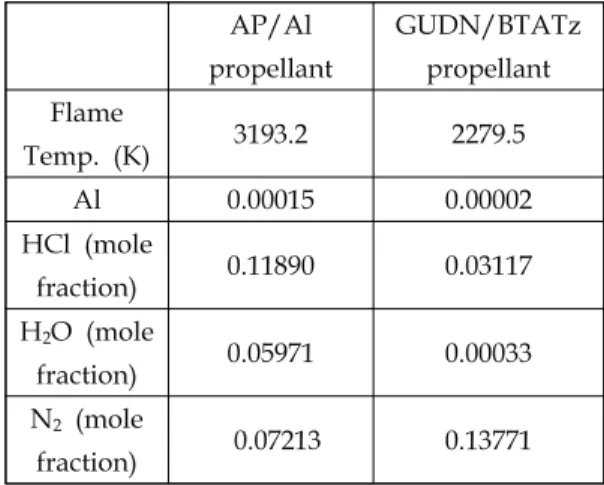
(Chemical Equilibrium Analysis program)을 통 해 추진제의 화염온도 및 연소생성물을 분석한 결과를 Table 5에 나타내었다. AP/Al 추진제에
비해 GUDN/BTATz 추진제는 화염온도가 낮아
지며, HCl의 mole fraction이 감소하는 것을 확 인하였다. CEA의 결과를 활용하여 AGARD 연 기 등급을 계산하여 연기의 등급을 Table 6과 Fig. 4에 나타내었다. AP/Al 추진제와 GUDN/
BTATz 추진제는 1차 연기 등급은 C로 나타낸 다. 이는 알루미늄과 같은 고체 입자의 영향으로 판단된다. 2차 연기의 경우 AP/Al 추진제는 C 등급, GUDN/BTATz 추진제는 B등급을 나타내 었다. 2차 연기는 대부분 물과 염산, 불소산 등 의 산 및 KOH와 같은 수용성 금속염에 의하여 형성이 된다. 이에 2차 연기가 감소했다는 것은 배출되는 염소 가스나 물의 양이 감소했음을 의
미한다. 이에 GUDN/BTATz를 적용함으로써 일 부 염소 가스 등 유해가스를 줄여 2차 연기등급 도 CC에서 CB 등급으로 개선됨을 확인할 수 있 었다.
AP/Al propellant
GUDN/BTATz propellant Flame
Temp. (K) 3193.2 2279.5
Al 0.00015 0.00002
HCl (mole
fraction) 0.11890 0.03117
H2O (mole
fraction) 0.05971 0.00033
N2 (mole
fraction) 0.07213 0.13771 Table 5. CEA results of propellant.
AP/Al propellant
GUDN/BTATz propellant Burning time
(sec) 2.2 3.5
Average
pressure (psia) 1541 1370 Average thrust
(lbf) 342 175
Total impulse
(lbf.sec) 728 572
specific
impulse (sec) 235 185
Table 4. Result of 4-inch motors.
Primary smoke
Secondary smoke
Smoke classification AP/Al
propellant C(0.99) C(47.1) CC GUDN/
BTATz propellant
C(0.99) C(57.5) CB
Table 6. AGARD Smoke Clasiffication of Propellant.
Fig. 4 Test motor plumes with AP/Al propellant (a) GUDN/BTATz propellant (b).
4. 결 론
AP/Al추진제와 GUDN/BTATz추진제를 비교
한 결과, 다음과 같은 결론을 얻었다.
1. GUDN/BTATz 추진제는 AP/Al 추진제에 비해 점도는 증가하고 기계적 물성이 감소 하는 경향을 나타내었다.
2. AP/Al 추진제와 비교했을 때 GUDN/BTATz 추진제는 연소속도는 감소하는 경향을 나타 내었다.
3. AP/Al추진제의 최종연기 등급은 CC, GUDN/
BTATz추진제의 최종 연기등급은 CB등급이 다. 1차 연기는 비슷한 수준을 나타내지만 2차 연기의 경우는 GUDN/BTATz 추진제 가 염소가스 등 유해가스를 줄여 2차 연기 의 감소를 확인할 수 있었다.
4. AP/Al추진제와 GUDN/BTATz추진제를 4 인치 표준 모타에 충전하여 지상연소시험 을 진행한 결과, AP/Al추진제에 비해 GUDN/BTATz 추진제는 압력, 추력, 총역 적 그리고 비추력이 모두 감소함을 확인하 였다.
저탄소 고질소 물질인 GUDN과 BTATz를 추 진제에 적용한 결과, 기계적 물성과 성능은 모두 감소함을 확인하였다. 그러나 기존 물질 AP와 Al을 대체할 수 있는 물질 적용에 대한 가능성 을 확인하였으며, 염소 가스 등 유해 가스를 줄 여 연기등급의 개선을 확인했다. 향 후 추가적인 연구를 통하여 CA수준의 연기 등급 및 기계적 물성과 성능을 보안할 수 있는 추진제 조성 개 발이 필요할 것으로 판단된다.
본 연구는 방위사업청과 국방과학연구소의지 원으로 수행되었으며, 이에 감사드립니다. (계약 번호 UD1400024GD)
References
1. Li, Q., He, Y. and Peng, R., “Graphitic
carbon nitride (g-C3N4) as a metal-free catalyst for thermal decomposition of ammonium perchlorate,” The Royal Society of Chemistry, Vol 5, pp. 24507-24512.
2. Yi, C., Daniel, R.G., Kathryn N.G.H., M.A., Cooper, H.L., Stauffacher, Marcia, A.., Howard, L.S., Michael, S.O. and Ephraim, B.W., “Study of aluminum particle combustion in solid propellant plumes using digital in-line holography and imaging pyrometry,” Combustion and Flame, Vol. 182, pp. 225-237, 2017.
3. Klaus, M. and Siegfried, E., “Rocket Propellant with Reduced Smoke and High Burning Rates,“ Propellant, Explosives, Pyrotechnics, Vol. 22, No. 3, pp. 112-119, 1997.
4. Dilip M. Badgujar, Smadhan Phatak, Rashmi M.Wagh, Varsha Bhingarakar, Mahadev B. Talawar and Seema D Kakade, “Influence of Guanylurea Dinitramide (GUDN) on the Thermal Behaviour, Sensitivity and Ballistic Properties of the B-KNO3-PEC Ignition System,“ Central European Journal of Energetic Materials, Vol 15, No. 2, pp.
315-326, 2018
5. Son, S.F., Berghout, H.L., Bolme, C.A., Chavez, D.E., Naud, D. and Hiskey, M.A.,
“Burn Rate Measurement of HMX, TATB, DHT, DAAF, and BTATz,“ Proceeding of the Combustion Institute, Vol. 28, No. 1, pp.
919-924, 2000.
6. Park, Y.K., Yoo, J.C., Kim, I.C. and Lee, T.H., “Quantitaive Assessmnet of Solid Propellant Smoke with AGARD Smoke Classification,“ Journal of the Korean Society for Aeronautical and Space Sciences, Vol. 27, No. 5, pp. 144-155, 1998.
7. Jeong, J.Y., Song, J.K., Kim, Y.G., Lee, B.G.,
“Study on the Fomulation of an Energetic
Thermoplastic Propellant(I),” Journal of the Korean Society of Propulsion Engineers, Vol.
23, No. 1, pp. 71-78, 2019.
8. Jain, S., Mehilal, D., Nandagopal, S., Singh, P.P., Radhakrishnan, K.K. and Bhattacharya, B., “Size and Shape of Ammonium Perchlorate and their Influenece on Properties of Composite Propellant,“ Defence Science Journal, Vol. 59, No. 3, pp. 294-299, 2009.
9. Won, J., Choi, S.H. and Park, Y.C., “The Study of Propellant Characteristic for Low Carbon & High Nitrogen Oxidizer,“ Journal of the Korean Society of Propulsion Engineers, Vol. 21, No. 2, pp. 26-31, 2017.
10. Pang, W.Q., DeLuca, L.T., Xu, H.X., Fan, X.Z., Zhao, F.Q and Xie, W.X., “Effect of Dual Oxidizers on the Properties of Composite Solid Rocket Propellants,”
Springer, Switzerland, pp. 407-419, 2017.