• 검색 결과가 없습니다.

Anti-inflammatory and Anti-cancer Effect of Stachys affinis Tubers

N/A
N/A
Protected

Academic year: 2021

Share "Anti-inflammatory and Anti-cancer Effect of Stachys affinis Tubers"

Copied!
7
0
0

로드 중.... (전체 텍스트 보기)

전체 글

(1)

Introduction

Stachys affinis also called S. sieboldii, is a perennial plant which tubers are eaten as vegetables for residents, with a prismatic stem about 40-60 cm tall and ovoid leaves opposite covers with softy hair. It has been cultivated in Europe in the nineteenth century and present all over the world. The tubers of S. affinis were rich in α-galactosidase and stachyose.

Stachyose is an oligosaccharide can be directly consumed and benefit for the gastrointestinal system (Sørensen et al., 2011).

Therefore, most researchers focused on the sugars and enzymes in S. affinis tubers. The methyl-α-D-galactopyranoside was separated from 60 % methanolic extract of S. affinis tubers (Kato et al., 1979). The α-galactosidase has been isolated and measured the activity from S. affinis tubers (Ueno et al., 1980).

Three new phenethyl alcohol glycosides named stachysosides A, B, C from the S. sieboldii leaves (Nishimura et al., 1991).

The extraction method was optimized with stachyose or polysaccharides (Yin et al., 2006; Feng et al., 2015). Recently, nine polar compounds were isolated from an n-butanol partitioned ethanolic extract of S. affinis tubers (Venditti et al., 2017).

The natural sourced bioactive compounds had been noticed due to its therapeutic potentials such as anti-microbial, anti- oxidant, anti-inflammatory, and anti-cancer (Park and Cho, 2014; Lee and Yoon, 2014; Yi et al., 2017; Ko et al., 2014).

According to our knowledge, few reports were found to support the pharmaceutical use of S. affinis. The acteoside, phenylethanoid glycoside, and stachysoside C were capable anti-anoxia agents (Yamahara et al., 1990). Venditti et al.

(2017) were researched on the anti-cancer effect of ethanol extract of S. affinis and no effect on K562, SH-SY5Y, and Caco-2 cells even at 1.0 ㎎/㎖, but they found that the ethanolic extracts had high activity of scavenging reactive oxygen species (ROS).

The richest phenolics and flavonoids in Stachys taxa were chlorogenic acids, isoquercitrin, luteolin 7-o glucoside, rutin, and quercitrin; these compounds are useful anti-inflammatory and anti-cancer ingredients which suggested the biological activity of S. affinis was worthy to be researched (Vundać et al., 2005).

Materials and Methods

Chemicals and reagents

DMSO, 3-[4,5-dimethylthia-zol-2-yl]-2,5-diphenyl tetrazolium

Anti-inflammatory and Anti-cancer Effect of Stachys affinis Tubers

Hui-Fang Guo and Myeong-Hyeon Wang*

Department of Medical Biotechnology, Kangwon National University, Chuncheon 24341, Korea

Abstract - Stachys affinis tubers are known for its high content of stachyose and eaten as an edible vegetable. In this work, we assessed on the anti-inflammatory and anti-proliferation activity of a various type of extracts derived from S. affinis tubers. The n-hexane and dichloromethane fractions were showed the high cytotoxicity on the cell lines including RAW264.7 macrophages, HEK293 human kidney cell, A549 human lung cancer cell, KB human oral cancer cell, and a PC-3 human prostate cancer cell. N-butanol and water fractions were not exhibited cytotoxicity on the tested cancer cells, limited in anti-inflammatory and anti-cancer activities. Nevertheless, the ethyl acetate fraction showed little harm to RAW264.7 cells but inhibited the production of nitric oxide (NO) and prostaglandin E2 (PGE2) significantly. In addition, it arrests the cell growth in A549, KB, and PC-3 cell while little cytotoxicity on HEK293 cells. Consequently, these results supported that the ethyl acetate fraction of S. affinis tubers could be a potential anti-inflammatory and anti-cancer ingredient.

Key words - Anti-cancer, Anti-inflammatory, PGE2, Stachys affinis

*Corresponding author. E-mail : [email protected] Tel. +82-33-250-6486

Original Research Article

(2)

bromide (MTT), was purchased from Sigma (St, Louis, MO, USA). RPMI medium 1640, Dulbecco’s Modified Eagles Medium (DMEM) and fetal bovine serum (FBS) were acquired from Hyclone (Logan, UT, USA). The culture supplies were purchased from SPL Brand Products (SPL, Korea). All other chemicals or reagents used were of analytical grade and distilled water was used in all the experiment.

Extraction

The tubers of S. affinis were collected and identified by Professor Myeong-Hyeon Wang (Department of Medical Biotechnology, Chuncheon, Korea). The dried sample was powdered by a pin crusher (Myungsung Machine, Seoul, Korea) and the powders were extracted 3 times with 70%

ethanol. 70% ethanolic extract was filtered through filter paper (100 ㎜; Whatman, Maidstone, UK) and evaporated using a vacuum rotary evaporator (CCA-1110; Eyela, Tokyo, Japan). The dried extract was partitioned by the different polar solvent in the order of n-hexane, dichloromethane, ethyl acetate, n-butanol, and water. Each of the solvent repeated for twice and the filtered solvent was concentrated under a reduced pressure.

Cell line and culture

RAW264.7 (macrophage), HEK293 (human kidney cell), A549 (human lung cancer cell), KB (human oral cancer cell) and PC-3 (human prostate cancer cell) cell lines were purchased from Korean Cell Line Bank (KCLB, Seoul, Korea). The cultivation of RAW264.7, KB, and PC-3 cell line were grown in RPMI medium 1640 medium supplemented with 10% FBS, 100 U penicillin, and 1% streptomycin.

HEK293 and A549 were cultivated in DMEM medium supplemented with 10% FBS, 100 U penicillin, and 1%

streptomycin. All the cells were cultured under the condition of 37 ℃ with 5% CO

2

.

Cytotoxicity on RAW 264.7 cells

Cell viability was analyzed using MTT according to the method described earlier (Nayak et al., 2016). Cells were plated at a density of 2×10

5

cells/㎖ in 96-well plate for 18 h.

Sample solution at various concentrations was added to the wells independently and incubated for 24 h. After incubation,

the medium and 100 ㎕ of 500 ㎍/㎖ MTT solution (diluted by FBS-free medium) was carefully added to each well.

Plates were further incubated for 3 h, supernatants were flicked off from the wells and the crystal was dissolved in 200

㎛ of DMSO. The optical density was measured at an absorbance of 550 nm using a microplate plate reader (Bio-Tek, Winooski, VT, USA).

Determination of nitric oxide production of LPS-stimulated RAW 264.7 cells

The level of nitric oxide production in cell culture super- natant was determined according to Griess reaction (Sastry et al., 2002). The RAW 264.7 cells were seeded in 96-well plates at a density of 1×10

5

cells/well for 16 h. The cells were pre-treated with the sample and stimulated with LPS (1 ㎍/

㎖) for 24 h. Subsequently, 100 ㎕ of each supernatant was carefully transferred into a new 96-well plate and 100 ㎕ of Griess reagent (1% sulfanilamide in 5% phosphoric acid, 50

㎕; 0.1% naphthyl-ethylenediamine dihydrochloride, 50 ㎕) was added to the wells. After 10 min incubation, the absorbance was measured at 550 nm with an ELISA.

Determination of prostaglandin E2 production of LPS- stimulated RAW 264.7 cells

The release of prostaglandin E2 after treatment of sample on LPS-stimulated RAW 264.7 cells was detected by a PGE2 ELISA kit (Enzo Life Science Inc, USA) according to the manufacturer’s protocol. The supernatant of 100 ㎕ from each well was transferred to goat anti-mouse IgG 96-well plate. 50 ㎕ of the conjugate and 50 ㎕ of antibody were added to each well expect the blanks. After 2 h incubation at room temperature, all the supernatant was removed and the plate was washed with wash solution 3 times. The substrate solution (200 ㎕) was added to each well and incubated for 30 min. The absorbance was measured at 405 ㎚ after add 50 ㎕ of stop solution. PGE2 was calculated by the standard curve (pg/ ㎖).

Anti-proliferation activity and cytotoxicity

A549, KB, and PC-3 human cancer cell were used to

determine the anti-proliferation activity of samples on cancer

cells, and HEK293 human embryonic kidney cell was used to

(3)

evaluate the cytotoxicity of the control group. The cells were seeded in 96-well plate at the density of 2×10

4

cells/well for 24 h at 37°C with 5% CO

2

, the appropriate concentration of samples was added on the wells and further incubated for 24 h. The medium was discarded from the wells and add 200 ㎕ of MTT solution (diluted by FBS-free medium) into each well without disturbing the cells. After 4 h incubation, the supernatant was removed from the wells and the deep purple crystal was dissolved in 200 ㎕ DMSO. The absorption was detected at 550 nm by an ELISA plate reader (Bio-Tek, VT, USA). The anti-proliferation activity and cytotoxicity were calculated by the percentage of untreated control.

Statistical analysis

All tests were taken out in triplicate (n=3) and results are expressed in terms of mean ± standard deviation. Comparisons were performed using one-way analysis of variance (ANOVA) followed by Duncan’s test using SPSS 21 software (IBM, USA).

Results

Cytotoxicity of fractions from S. affinis tubers on RAW264.7 cells

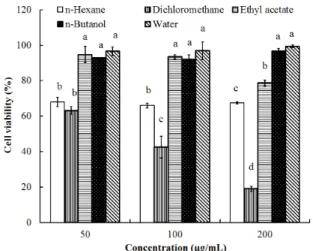
According to Fig. 1, the dichloromethane fraction exhibited

the strongest cytotoxicity on RAW264.7 cells even at the lowest concentration. The exposure of cells with dichloromethane fraction (50 ㎍/㎖) was showed the cell viability of 63.17 %, and it was decreased significantly with the increase of extract concentration, and it was found as 19.02 % at 200 ㎍/㎖ of extract concentration. N-hexane fraction exhibited strong cytotoxicity at 50 ㎍/㎖ and haven’t changed along with the increasing concentration. Ethyl acetate fraction at 200 ㎍/㎖

persevered 78.67% of cells and considered had a little cytotoxicity. Water and n-butanol fractions had no influence on cells at either concentration.

Nitric oxide inhibition activity of fractions from S. affinis tubers

Fig. 2 revealed the nitric oxide (NO) inhibition activity of the fractions from S. affinis tubers. The results suggested dichloromethane fraction almost abolished all the NO production at 200 ㎍/㎖, followed by ethyl acetate and n-hexane fraction, the three fractions showed an inhibition of NO more than 90 %. On the contrary, n-butanol fraction exhibited lower activity on NO inhibition. Moreover, all the fractions inhibited the NO production in a concentration- dependent manner except water fraction, it had no activity of NO inhibition even if the highest concentration of 200 ㎍/㎖.

Fig. 1. Cytotoxicity of fractions from S. affinis tubers on RAW264.7 cells. Values were expressed as the mean ± SD (n = 3).The difference was conducted from fractions, means share different character significantly different (p < 0.01).

Fig. 2. Nitric oxide inhibition activity of fractions from S.

affinis tubers on LPS-stimulated RAW264.7 cells. Values

were expressed as the mean ± SD (n = 3).The difference was

conducted from fractions, means share different characters

significantly different (p < 0.01).

(4)

Inhibition of prostaglandins E2 production

It can be concluded from Fig. 3 that the PGE2 production significantly inhibited by ethyl acetate fraction at 200 ㎍/㎖, followed by n-hexane, dichloromethane, n-butanol, and a water fraction. All the fractions suppressed the release of PGE2 in a concentration-dependent manner although water fraction still remained a high level of 2145.08 pg/ ㎖mL at 200 ㎍/㎖ treatment.

Cytotoxicity of fractions from S. affinis on HEK293 cells Results have been carried out on the percentage of untreated controls. Fig. 4 shows that the cytotoxicity of n-hexane and dichloromethane fractions was at an extremely high level that after exposure to 50 ㎍/㎖of fractions for 24 h, the HEK293 cell viability was only 55.21 and 51.87 %, respectively. When the concentration is 200 ㎍/㎖, the percentage of living cells decreased to 33.54 and 22.00 %, respectively. Conversely, the ethyl acetate, n-butanol, and water fractions had no impact on cell growth in the tested concentration interval.

Anti-proliferation activity of fractions from S. affinis on cancer cells

The anti-proliferation activity was evaluated by MTT

assay and calculated as the percentage of the control group.

Fig. 5A revealed the anti-proliferation activity of S. affinis on A549 cells. With the exposure to 50 ㎍/㎖ of fractions for 24 h, dichloromethane fraction controlled the cell growth by 60.17 % alive cells was remain and exhibited the strongest inhibition activity, followed by n-hexane and ethyl acetate fraction. The three fractions suppressed the cell proliferation in a concentration-dependent manner. For n-butanol and water fraction, however, no significant difference had been found compared with the untreated control. Similarly, the same trend has been found in KB (Fig. 5B) and PC-3 (Fig.

5C) cells.

Discussion

Natural compounds such as phenols or flavonoids have been considered as beneficial for some inflammatory diseases (Arulselvan et al., 2016; Wang et al., 2016). Nitric oxide (NO) is the crucial pro-inflammatory factor take part in the chronic or acute diseases induced by inflammation (Bryan and Lancaster Jr, 2011; Pacher et al., 2007). It is generated by NOS (NO synthase) enzymes and regulates several inflammatory Fig. 3. The release of PGE2 of LPS-stimulated RAW 264.7

cells with the exposure to fractions from S. affinis tubers for 24 h. Values were expressed as the mean ± SD (n = 3).The difference was conducted from fractions, means share different characters significantly different (p < 0.01).

Fig. 4. Cytotoxicity of fractions from S. affinis tubers on

HEK293 kidney cells. 10

5

of cells were exposed to fractions at

the indicated concentration for 24 h, cell viability was

measured by MTT assay and calculated by the percentage of

untreated control. Values were expressed as the mean ± SD

(n = 3).The difference was conducted from fractions, means

share different characters significantly different (p < 0.01).

(5)

related mediators and cytokines of the inflammatory cells (Moilanen and Vapaatalo, 1995). The other important inflammatory mediator is PGE2, which plays a key role in the pathogenesis of several inflammatory diseases (Nakanishi and Rosenberg, 2013; Rechenberg et al., 2016). Lipopoly- saccharide (LPS), which is a substance separated from bacteria own the powerful ability to activate the immune response in macrophages (Xu et al., 2017). Accordingly, the activity of NO and PGE2 in LPS-activated cells can be used as a marker to screen the anti-inflammatory extracts (Dos Santos et al., 2006; Yi et al., 2017). Based on the result in Fig.

1 and Fig. 2, in spite of n-hexane and dichloromethane fractions, possessed superior performance of NO inhibition, we consider ethyl acetate fraction was better anti-inflammatory

ingredient as the cytotoxicity of both n-hexane and dichloro- methane fractions were at very high level. The same reason on the PGE2 release of LPS-stimulated RAW264.7 cell, although n-hexane and dichloromethane fraction showed a potent inhibition activity of PGE2 even if the concentration was only 50 ㎍/㎖, we could not consider they were effective inhibitors in the release of PGE2. Thus, the ethyl acetate fraction showed strong inhibition activity of the NO and PGE2 release that was the most potent anti-inflammatory ingredient among the five fractions.

The plant sourced bioactive compound which is capable of arresting cell growth in cancer cells had been noticed for cancer chemo-preventive approaches (Kim et al., 2017;

Belayachi et al., 2017; Guo and Wang, 2017). To measuring

(A) (B)

(C)

Fig. 5. Anti-proliferation activity of fractions from S. affinis tubers on A549 (A), KB (B), and PC-3 (C) cancer cells. The 10

5

of cells

were exposed to fractions at the indicated concentration for 24 h, cell viability was measured by MTT assay and calculated by the

percentage of untreated control. Values were expressed as the mean ± SD (n = 3). The difference was conducted from fractions,

means share different characters significantly different (p < 0.01).

(6)

the cytotoxicity and the anti-proliferation activity, MTT assay was one of the most often used methods in vitro (Gerlier and Thomasset, 1986). MTT is a tetrazolium salt and can be reduced by succinate dehydrogenase in the mitochondria to form the deep purple color crystal, this compound is impermeable to the membrane of cells. In this regards, the formazan crystal only can preserve in live cells, hence, was taken for the anti-cancer activity evaluation (van Meerloo et al., 2011; Kim et al., 2017). The cytotoxicity and anti- proliferation activity of S. affinis was carried out against HEK293 human normal cells, A549 human lung cancer cells, KB human oral cancer cells, and PC-3 human prostate cancer cells. As explained in the result, although n-hexane and dichloromethane fractions exhibited the strongest anti- proliferation effect in the A549, KB, and PC-3 cancer cells, HEK293 cells remained 55.21 and 51.87 % of alive after exposed to 50 ㎍/㎖ of the fraction for 24 h respectively (Fig.

4 and 5). On the contrary, n-butanol and water fractions had slight influenced the cell viability with the exposure to 50-200 ㎍/㎖ fractions for 24 h in either cell. Unlike the other 4 fractions, ethyl acetate fraction showed no harm to HEK293 cells in the tested concentration but suppressed the A549, KB, and PC-3 cells growth significantly in a concentration- dependent manner. Therefore, ethyl acetate fraction was considered to have anti-cancer activity.

In summary, the current results demonstrated that the ethyl acetate fraction from S. affnis exerts a superior anti-inflammatory effect on LPS-stimulated RAW264.7 cells and also possess better anti-proliferation activity on A549, KB, and PC-3 cell lines. These promising findings proved the tubers of S. affairs not only can be eaten as the vegetable but also suggested its potential to be used in pharmaceutical industry.

Acknowledgement

This study is supported by the 2015 Research Grant from Kangwon National University (No. 520150324), Republic of Korea.

References

Arulselvan, P., M.T. Fard, W.S. Tan, S. Gothai, S. Fakurazi,

M.E. Norhaizan and S.S. Kumar. 2016. Role of antioxidants and natural products in inflammation. Oxid. Med. Cell.

Longev. 2016:1-15.

Belayachi, L., C. Aceves-Luquero, N. Merghoub, S.F. de Mattos, S. Amzazi, P. Villalonga and Y. Bakri. 2017. Induction of cell cycle arrest and apoptosis by Ormenis eriolepis a Morrocan endemic plant in various human cancer cell lines.

Afr. J. Tradit. Complement. Altern. Med. 14:356.

Bryan, N.S. and J.R. Lancaster Jr. 2011. Nitric oxide signaling in health and disease. In Bryan, N. and J. Loscalzo (eds.), Nitrite and Nitrate in Human Health and Disease. Nutrition and Health. Humana Press, Totowa, NJ (USA). pp. 169-186.

Dos Santos, M.D., M.C. Almeida, N.P. Lopes and G.E.P. De Souza. 2006. Evaluation of the anti-inflammatory, analgesic and antipyretic activities of the natural polyphenol chlorogenic acid. Biol. Pharm. Bull. 29:2236-2240.

El-Rahman, A.A.E.M.A., S.M.A.E.A. ElShafei, E.V. Ivanova, A.N. Fattakhova, A.V. Pankova, M.A.E.A. El-Shafei, E.M.

A.E.F. El-Morsi and F.K. Alimova. 2014. Cytotoxicity of Trichoderma spp. cultural filtrate against human cervical and breast cancer cell lines. Asian Pac. J. Cancer Prev.

15:7229-7234.

Feng, K., W. Chen, L. Sun, J. Liu, Y. Zhao, L. Li, Y. Wang and W. Zhang. 2015. Optimization extraction, preliminary characterization and antioxidant activity in vitro of poly- saccharides from Stachys sieboldii Miq. tubers. Carbohydr.

Polym. 125:45-52.

Gerlier, D. and N. Thomasset. 1986. Use of MTT colorimetric assay to measure cell activation. J. Immunol. Methods 94:

57-63.

Guo, H.F. and M.H. Wang. 2017. Dichloromethane fraction of Asiasarum heterotropoides induces S phase arrest and apoptosis in KB oral epithelial carcinoma cells. Biomed.

Pharmacother. 89:559-564.

Kato, K., S. Yokoi, H. Inagaki and Y. Ueno. 1979. Methyl α- d-Galactopyranoside from the Tubers of Stachys affinis.

Agric. Biol. Chem. 43:187-188.

Kim, S.M., J.H. Park, H.O. Boo, S.G. Song and H.Y. Park.

2017. In vitro Comparision of biological activities of solvent fraction extracts from Orostachys japonicus. Korean. J.

Plant Res. 30(2):133-143 (in Korean)

Ko, Y.J., S.M. Song, W.C. Hyun, S.K. Yang, C.K. Song, D.S.

Lee and W.J. Yoon. 2014. Anti-inflammatory effect of

Castanopsis cuspidata extracts in murine macrophage RAW

264.7 cells. Korean J. Plant Res. 27(5):436-446 (in Korean).

(7)

Moilanen, E. and H. Vapaatalo. 1995. Nitric oxide in infla- mmation and immune response. Ann. Med. 27:359-367.

Nakanishi, M. and D.W. Rosenberg. 2013. Multifaceted roles of PGE2 in inflammation and cancer. In Semin. Immun- opathol. 35(2):123-137.

Nayak, D., S. Ashe, P.R. Rauta, M. Kumari and B. Nayak.

2016. Bark extract mediated green synthesis of silver nano- particles: Evaluation of antimicrobial activity and anti- proliferative response against osteosarcoma. Mater. Sci.

Eng. C. 58:44-52.

Nishimura, H., H. Sasaki, N. Inagaki, C. Masao, Z. Chen and H.

Mitsuhashi. 1991. Nine phenethyl alcohol glycosides from Stachys sieboldii. Phytochemistry 30:965-969.

Pacher, P., J.S. Beckman and L. Liaudet. 2007. Nitric oxide and peroxynitrite in health and disease. Physiol. Rev. 87:315-424.

Park, H.J. and Y.J. Cho. 2014. The effect on Anti-oxidative activity and incerasing extraction yield of Aralia elata cortex by Gamma irradiation. Korean J. Plant Res. 27 (5):421-428 (in Korean).

Rechenberg, D.K., J.C. Galicia and O.A. Peters. 2016. Bio- logical markers for pulpal inflammation: A systematic review.

PLoS One 11:e0167289.

Sastry, K.V.H., R.P. Moudgal, J. Mohan, J.S. Tyagi and G.S.

Rao. 2002. Spectrophotometric determination of serum nitrite and nitrate by copper –cadmium alloy. Anal. Biochem. 306:

79-82.

Sørensen, M., M. Penn, A. El-Mowafi, T. Storebakken, C.

Chunfang, M. Øverland and Å. Krogdahl. 2011. Effect of stachyose, raffinose and soya-saponins supplementation on nutrient digestibility, digestive enzymes, gut morphology and growth performance in Atlantic salmon (Salmo salar L).

Aquaculture 314:145-152.

Ueno, Y., T. Ikami, R. Yamauchi and K. Kato. 1980. Purification and some properties of α-galactosidase from tubers of

Stachys affinis. Agric. Biol. Chem. 44:2623-2629.

van Meerloo, J., G.J. Kaspers and J. Cloos. 2011. Cell sensitivity assays: the MTT assay. Cancer cell culture: methods and protocols. I.A. Cree, Editor. 2011, Humana Press: Totowa, NJ (USA). pp. 237-245.

Venditti, A., C. Frezza, D. Celona, A. Bianco, M. Serafini, K.

Cianfaglione, D. Fiorini, S. Ferraro, F. Maggi and A.R.

Lizzi. 2017. Polar constituents, protection against reactive oxygen species, and nutritional value of Chinese artichoke (Stachys affinis Bunge). Food Chem. 221:473-481.

Vundać, V., Ž. Maleš, M. Plazibat, P. Golja and B. Cetina- Čižmek. 2005. HPTLC determination of flavonoids and phenolic acids in some Croatian Stachys taxa. J. Planar.

Chromatogr-Mod. TLC. 18:269-273.

Wang, M.H., S.H. Jeong, H.F. Guo and J.B. Park. 2016.

Anti-inflammatory and cytotoxic effects of methanol, ethanol, and water extracts of Angelicae Dahuricae Radix. J.

Oral Sci. 58:125-131.

Xu, J., Y. Zhao and H.A. Aisa. 2017. Anti-inflammatory effect of pomegranate flower in lipopolysaccharide (LPS)-stimulated RAW264. 7 macrophages. Pharm. Biol. 55:2095-2101.

Yamahara, J., T. Kitani, H. Kobayashi and Y. Kawahara. 1990.

Studies on Stachys sieboldii MIQ. II. Anti-anoxia action and the active constituents. Yakugaku zasshi-J. Pharmaceutical Society of Japan. 110:932-935.

Yi, M.R., C.H. Kang and H.J. Bu. 2017. Anti-inflammatory and tyrosinase inhibition effects of amaranth (Amarantus spp l.) seed extract. Korean. J. Plant Res. 30(2):144-151 (in Korean).

Yin, J., G. Yang, S. Wang and Y. Chen. 2006. Purification and determination of stachyose in Chinese artichoke (Stachys sieboldii Miq.) by high-performance liquid chromatography with evaporative light scattering detection. Talanta 70:208- 212.

(Received 9 October 2017 ; Revised 4 December 2017 ; Accepted 11 December 2017)

수치

Fig. 1. Cytotoxicity of fractions from  S. affinis tubers on  RAW264.7 cells. Values were expressed as the mean ± SD  (n = 3).The difference was conducted from fractions, means  share different character significantly different (p &lt; 0.01).
Fig. 4. Cytotoxicity of fractions from  S. affinis tubers on  HEK293 kidney cells. 10 5  of cells were exposed to fractions at  the indicated concentration for 24 h, cell viability was  measured by MTT assay and calculated by the percentage of  untreated c
Fig. 5. Anti-proliferation activity of fractions from  S. affinis tubers on A549 (A), KB (B), and PC-3 (C) cancer cells

참조

관련 문서

Anticancer activities of EF-24, a novel curcumin analog, on KB human. oral

Concentration-Dependent inhibition of cell viability by adenosine in human oral fibroblast and FaDu human head and neck squamous cell carcinoma · · ·

1) Effects of methanol extracts of Capsella bursa-pastoris on cyclooxygenase-2 (COX-2) and Inducible Nitric oxide synthase (iNOS) expression in human prostate cancer cell

Inhibitory effects of classified methanol extracts of Smilax china L on the COX-2 and iNOS expression of human colorectal cancer cell lines... Inhibitory

Results: The human breast cancer cell subline MCF-7/MX5 cells selected in the presence of 5 µg/ml mitoxantrone (MX) were more resistant to MX (15.7... Western blot and

Synthesized 6- and 2- substituted 5,8-dimethoxy-1,4-naphthoquinone derivatives showed a potent anticancer activity in MTT Assay against AML-2/WT and A549 anti-cancer..

Activated H-Ras expression in human fibroblast cell lines increases the activity of Ku80 to bind injuried DNA, reduces γ-H2AX expression by UV irradiation,

Pro-allergic cytokines were important mediators of allergic inflammation, cell recruitment and allergenic response decided to further investigate the