Original Article
Cytotoxic Evaluation of Plant Essential Oils in Human Skin and Lung Cells 1
Changhwan Ahn
2⋅Mi-Jin Park
3⋅Jae-Woo Kim
3⋅Jiyoon Yang
3⋅ Sung-Suk Lee
3⋅ Eui-Bae Jeung
2,†ABSTRACT
1)Plant essential oils are defined as fragrant volatile oils extracted from leaves, stems, fruits, flowers, and roots of a plant. Such oils are composed of multiple components and multiple functions. By accumulation of inductive information, various plant essential oils have been studied for using in therapeutic medicine for various diseases. Despite of the apparent advantages of essential oils as a source of therapeutic medicines, plant essential oils have many limitations, including cytotoxic side effects. Therefore, it is necessary to evaluate the toxicity and the mechanisms of cytotoxicity of such oils. In this study, we evaluated the cytotoxicity to human-derived cell lines of 10 plant essential oils provided by National Institute of Forest Science (i.e., Larix kaempferi; Abies holophylla; Zanthoxylum ailanthoides; Pinus parviflora;
Tsuga sieboldti; Chamaecyparis pisifera; Cryptomeria japonica; Pinus densiflora; Illicium anisatum; Pinus thunbergii).
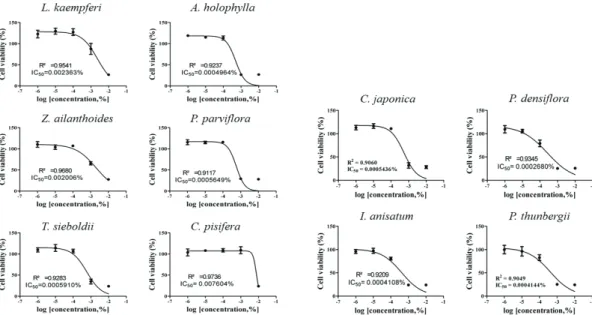
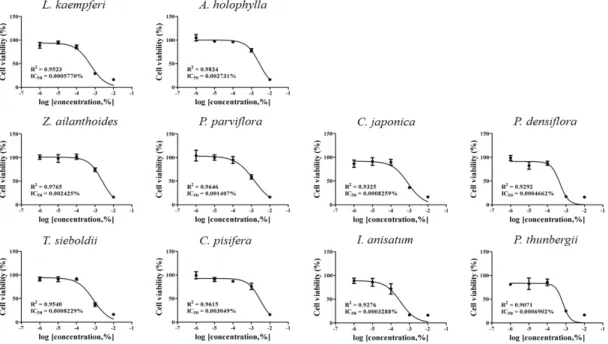
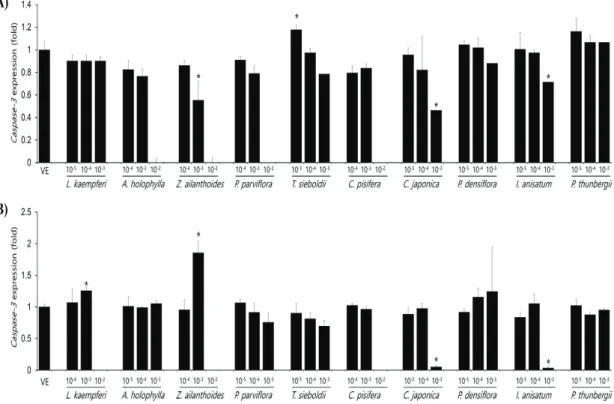
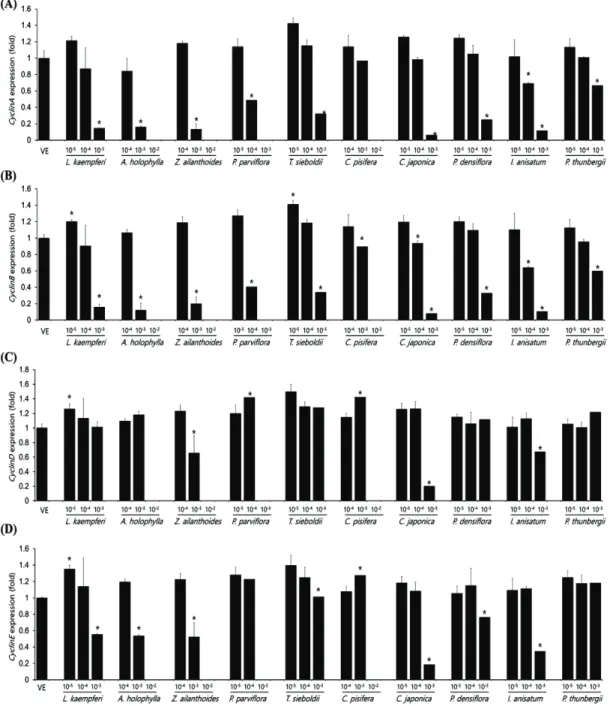
Cytotoxicity evaluations were accomplished by using CCK-assays and PCR-based cytotoxicity-related marker gene analyses with A549 cell line, and the Detroit551 cell line which are lung and skin cell line. The genes were analyzed included caspase-3 has a role in cell apoptosis, and the other cyclinA, cyclinB, cyclinD, and cyclinE regulated cell cycling for the cell proliferation. By examining the five cytotoxicity-related marker genes by performing real-time PCR and examined the cytostatic gene regulation associated with the various essential oils. The results of this study showed that the degree of cytotoxicity and the cytostatic gene regulation which could give precious information for using the plant essential oil for the clinical usages.
Keywords: essential oil, cytostatic effect, cytotoxicity
1. INTRODUCTION
A plant essential oil is a volatile natural compound that is obtained as a secondary product of the plant and is characterized by a strong smell (Galindo et al., 2010). The components of a plant essential oil depend
on the species of plant, and of the plant (Kahkonen et al., 1999; Lee et al., 2014). Oils may be extracted from different parts of the plant, such as leaves, fruit peels, seeds, bark, wood wicks, and flowers, and are usually obtained via steam or hydro-distillation (Waseem and Low, 2015). Over the centuries, plant
1
Date Received January 9, 2018, Date Accepted March 12, 2018
2
Laboratory of Veterinary Biochemistry and Molecular Biology, College of Veterinary Medicine, Chungbuk National University, Chungbuk 28644, Republic of Korea
3
Division of wood chemistry & Microbiology, Department of Forest Products, National Institute of Forest Science, Seoul 02455, Republic of Korea
†