• 검색 결과가 없습니다.

Nuclear Safety: A Longitudinal Case Study from the Fukushima Nuclear Disaster

N/A
N/A
Protected

Academic year: 2021

Share "Nuclear Safety: A Longitudinal Case Study from the Fukushima Nuclear Disaster"

Copied!
9
0
0

로드 중.... (전체 텍스트 보기)

전체 글

(1)

후쿠시마 원전사고 종적사례연구를 통한 원전에너지 안전성 고찰

이준혁⋅진영민⋅조영혁⋅이순홍

안양대학교 환경에너지공학과

(2016. 1. 6. 접수 / 2016. 2. 15. 수정 / 2016. 2. 18. 채택)

Nuclear Safety: A Longitudinal Case Study from the Fukushima Nuclear Disaster

Joon-Hyuk Lee⋅Young-Min Jin⋅Young-Hyuk Jo⋅Soon-Hong Lee

Department of Environment and Energy Engineering, Anynag University (Received January 6, 2016 / Revised February 15, 2016 / Accepted February 18, 2016)

Abstract : Nuclear energy is considerably cheap and clean compared to other fossil fuels. Yet, there are rising safety concerns of nuclear

power plants including the possibility of radiation releasing nuclear accidents. In light of the Fukushima nuclear crisis in 2011, Japan has been re-evaluating their existing energy policies and increasing the share of alternative energy. This paper first tracks the major historical changes of energy policy in Japan by time period. Next, energy security, reignited concerns and alternative energy are covered to examine Japan's energy security situation and its transition after the Fukushima disaster. Lastly, a short survey based on thematic analysis was conducted in South Korea and Japan to understand the public awareness of nuclear. This paper postulates that the case of Fukushima will contribute to establish and operate a safe-future nuclear program in South Korea, given that the country is not only geographically neighbouring Japan but also the world's fourth largest producer of nuclear energy.

Key Words : fukushima nuclear energy disaster, nuclear safety, nuclear energy policy, energy security, alternative energy, thematic

analysis, NIMBY

Corresponding Author : Soon Hong Lee, Tel :+82-31-467-0965, E-mail:[email protected]

Department of Environment & Energy Engineering, Anyang University, 22 Samdeok-ro 37beon-gil, Manan-gu, Anyang-si, Gyeonggi-Do 14028, Korea

1. Introduction

Concerns about the nuclear safety include the possibility of radiation exposure accidents. On March 11, 2011, Japan, the only nation attacked by nuclear weapons in the entire human history, had caught in another nationally devastating event. Following a major earthquake with magnitude 9.0, tsunami did considerable damage to the cooling and power supply of three Fukushima nuclear plants. Due to aforementioned natural disasters, three cores melted down in the first three days.

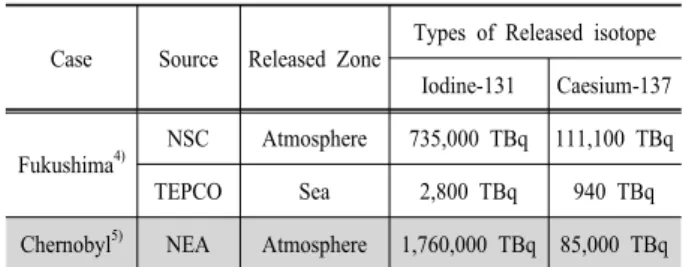
Since radioactive materials were released into the air and sea which estimated as Table 1, over 80,000 households were displaced in the evacuation zone by the government.

Released radioactive materials from the disaster were spreaded around the world, including neighboring countries, North America and even Europe 1) . Hamada and Ogino states

that such atmospheric release may cause internal exposure into the body by Japanese produced food and drink 2) .

The accident in Fukushima became a turning point for nuclear and its branch energy policies 3) . In light of the Fukushima nuclear crisis, Japan has been re-evaluating their existing nuclear energy policies. On the following paragraph,

Table 1. Total estimated atmospheric release during the Fukushima accident

Case Source Released Zone Types of Released isotope Iodine-131 Caesium-137

Fukushima

4)

NSC Atmosphere 735,000 TBq 111,100 TBq

TEPCO Sea 2,800 TBq 940 TBq

Chernobyl

5)

NEA Atmosphere 1,760,000 TBq 85,000 TBq

· NSC stands for Nuclear Safety Commission of Japan; TEPCO stands for

Tokyo Electric Power Company; NEA stands for Nuclear Energy Agency.

(2)

this paper will compare and contrast the change in pre- and post-Fukushima's energy policies to reflect three energy concepts; resource-scarcity, safety issues and alternative energy. Results from three pillars will be a lesson to South Korea, since the country is also a national poor in natural resources and aimed to build twelve new nuclear reactors.

2. The History of Nuclear Energy Policy in Japan Japan has stepped into modern nuclear research program from 1954 with ¥200 million budget. The Atomic Energy Basic Act was introduced in 1955, which states that the use of nuclear technology should be aimed on peaceful purposes 6) . In the following year, the Japanese Atomic Energy Commission(JAEC) was established, which enables key governmental agencies and industry to develop a nuclear fuel cycle by reprocessing and recycling the used nuclear fuel from water reactors 7) . From 1960s, a major research and fuel cycle were established by the Power Reactor and Nuclear Fuel Development Corporation(PNC). PNC owned a nuclear reprocessing facility with its breeder reactor technology. In all regards, democratic methods, transparency and independent management were the cornerstone of nuclear research policy in the early period.

Japan went through negative growth for the first time in its post-war period during two oil crises in the 1970s. After the 1979 oil crisis, Japan's energy policy was developed upon a concept of decreasing dependency on foreign resources, since the country has almost no domestic fossil resources. Thus, the Japanese government adopted policies aimed at prioritizing resource diversification and its efficiency by launching more aggressive nuclear program which can be seen in Fig. 1 8,9) .

Fig. 1. Japan's energy demand structure.

3. The Quest for Energy Security

By the time of 2011, Japan had one of the world's most advanced nuclear energy programs with more than 50 reactors and the generating capacity of nearly 50 GW 10) . After the accident, nearly one-third of existing nuclear facilities are out of operation. As a counterbalance, import of fossil fuel is increasing every year. The increased commodity energy imports are being offset burden to the insufficient economic growth.

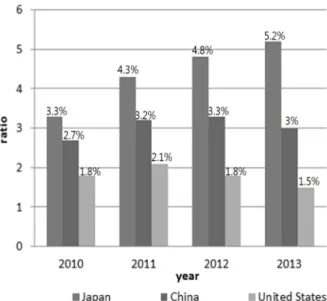
Expenditures on net imports of fossil fuel as a ratio of nominal GDP for Japan reached over 5 percent in 2013, compared with 3 percent for China and 1.5 percent in the United States. China's ratio-drop implies that there is no additional burden on the economy. On the opposite, Fukushima accident had clearly contributed to the increased burden of Japan 11) . Since Japan is the world's fifth largest energy consumer, it is fair relative to the current increment on net imports of fossil fuel. Yet, the burden stressing from the import reveals one factor of the vulnerability in Japanese energy supply structure.

Consequences of Fukushima accident, Japan's energy security and the economy are deeply challenged. In 2011, Japan recorded her second trade deficit after the oil crisis.

Moreover, Tokyo Electric Power(TEPCO) reported a significant net loss around $7 billion after Fukushima crisis 12) . As a result, energy security is once again at the core of attention among Japanese policymakers. In order to

Fig. 2. Expenditures on net imports of fossil fuel as a ratio of

nominal GDP

13)

.

(3)

support the domestic demand of fuel without additional economic burden, Japanese policymakers are seeking ways to rehabilitate the nuclear facilities in Fukushima.

Moreover, the government is also aimed to construct 23 new nuclear plants by 2030 14) .

4. Reignited Concerns of Nuclear Energy Japan's nuclear regulatory bodies and their related industries had been interconnected through an elaborate system which can be seen in Fig. 3.

Fig. 3. Organization chart of Japan's nuclear sector.

Japan's nuclear regulators had been strongly attached to industry influence 15) . Since 2000, the private nuclear power industry companies had sent nearly 100 employees to central government bodies, in particular to the NSC. The governmental body also reserved seats at several positions for private industries to secure advantageous positions after the retirement. Such incestuous relationships and close ties between the public and private sector have revealed negligence in preparedness and regulatory oversight.

TEPCO, one of the largest energy monopolies with ¥68 billion capital stock, supplies nearly 40 percent of Japan's total electricity. However, the company had lost its trust from the public in its response of the Fukushima disaster.

Despite Japan's regulator documents noted TEPCO's Fukushima Daiichi plant as one of the country's most insecure reactors during the 1990s, MEXT approved its continued operation which proves delinquency of duties in safety and security for both MEXT and TEPCO. The government also abets overall responsibility to TEPCO in

the aftermath of the Fukushima disaster, MEXT was not solely exercising poor nuclear safety management regulations. In the domain of national nuclear energy policy, the JAEC also overlooked safety considerations after consultations with MEXT. Flaws in administrative and regulatory routine were the root of endemic in the cozy relations.

The Fukushima disaster revealed a weakened Japan and disappointing recovery. Certainly, risk management is acknowledged as a crucial part of energy policy. After 3/11, the Japanese government immediately announced three priority risk managements(cool down damaged reactors, relieve stress placed on the energy grid and bring stability to society) to prevent the future economic decrement 16) . Yet, the Japanese government failed to cool down damaged reactors and relieve stress placed on the energy grid. As a consequence, residents were highly exposed to radioactive emissions by the time the government asked people to evacuate the area 17) . Moreover, the Japanese government established the evacuation zones with an 11 km radius around the Daiichi power plant, which is smaller than the exclusion zones suggested by the United States.

Such fatal nuclear accident and its immature recovery responses appear to decrease the positive effect of nuclear energy on public. Fig. 4 shows public acceptance rates of nuclear energy before and after the Fukushima disaster 18) . After the Fukushima disaster, public acceptance rates among seven countries had experienced decrement.

Inevitably, Japan had the largest decrease in public acceptance rates of nuclear energy with 24 percent decrease which reveals public concern over nuclear energy.

Fig. 4. Public acceptance rates of nuclear energy.

(4)

5. In Comparision to Alternative Energy As a respond to the negative public acceptance of nuclear energy and such consequences of the disaster, the Energy and Environment Council(ECC) was established to support Japan's future energy security and self-sufficiency 19) . ECC's

“Innovative Energy and Environment Strategy” was announced on 2012, encouraging alternative resources, green energy policy framework and reactivating nuclear silos. Followings are the potential alternative energy sources that Japan is seeking on.

First, under the Basic Energy Plan, renewable energy in particular solar energy is aimed to increase from 9 percent to 20 percent by 2030 20) . Japanese government strongly believes that most of renewable energy is expected to come from increased solar energy, by assisting the installation of solar panels on roofs and developing large-scale solar energy generating facilities. However, solar energy is a costly form of alternative energy in Japan. Since Japan is not Spain, it has been criticized that not enough sunlight will result in high cost of installment to collect sunlight with large panels. Moreover, Japan’s solar energy project may result in economically regressive as huge corporations and relatively wealthier households would afford the installation cost of solar panels and sell the surplus energy to relatively weaker positions with high price to make profit.

In contrast, wind energy seems to be an economically viable option than solar energy in Japan 21) . Tetsuro Nagata, president of the wind association, said that wind development in Japan is being held up by requirement to conduct environmental impact assessments, since the country is having frequent storms and other natural hazards.

Japan's potential wind generating power is estimated as, 144 GW for onshore and more than 600 GW for offshore wind 22) . To expand offshore power, wind resource corporations started to build 350 feet tall windmills off the coast of Fukushima from 2013. The country's goal is to generate 1 GW of electricity from wind by 2020. Also Japan has 70 biomass power plants which are considered as renewable resource, since organic materials could be reharvested 23) . Currently, three kinds of wood biomass are utilized for energy source; construction-derived wood residues, industrial and logging residues 24) . The Renewables Portfolio Standard Law(RPSL) supports power companies

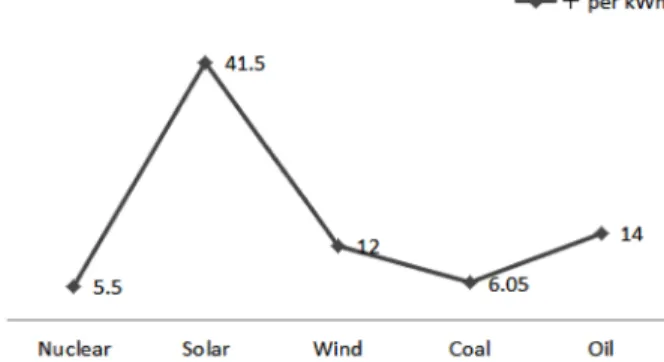
Fig. 5. Operating cost for major energy sources in Japan.

using wood biomass from these three kinds. Yet, the government cannot withdraw nuclear energy because of its relatively cheap operating cost compared to alternative energy 25) .

Besides the high cost, alternative energy emits more carbon dioxide than nuclear energy. Japan was supposed to reduce their carbon dioxide emissions by 25 percent till 2020, however, the government has loosen the restriction policy due to the Fukushima disaster. The incremental carbon dioxide emissions resulting from the additional use of fossil fuels and alternative energy have increased by 15 percent in 2012, compared with the 1990 Kyoto Protocol level 26) . In order to reduce carbon dioxide emissions and avoid the high cost of alternative resources, Japan will seek ways to economize the alternative cost and extend nuclear energy.

6. In Comparision to South Korea

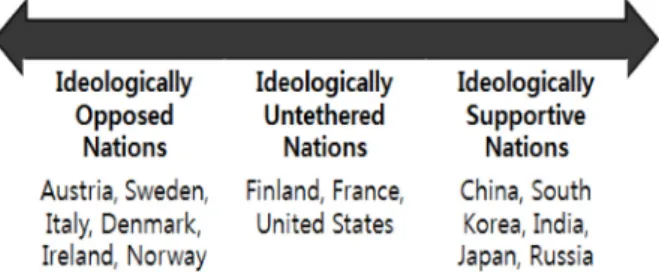
According to previous paragraphs, it is a paradox that nuclear energy could be a double-edged sword by being both cheap and expensive. On the one hand, nuclear energy is cheap in terms of less operating cost and releasing carbon dioxide. On the other hand, potential threats of nuclear exposure and a chronic back-scratching alliance of government and business are being shortcomings. Valentine and Sovacool have noted ideological grouping toward nuclear energy development which can be seen in Fig. 6 27) .

As shown in Fig. 6, South Korea is labeled as

“Ideologically Supportive Nations” with Japan. Not

surprisingly, two countries have developed in such a way

that there is an imbalance between human resource and

natural resource. Both countries are deeply suffering from

a national poor in natural resources with their rapid

(5)

Fig. 6. A spectrum of nuclear energy development path by ideological groupings.

economic growth. Although South Korea would be relative lack of the overall economic capability compared to Japan, South Korea has minimized the economic gap in recent years. South Korea also successfully adapted modern political and legal system from Japan after the independence. Moreover, as shown in Fig. 4, South Korea recorded the highest friendly public nuclear acceptance rate among other countries. Given that both countries share similar political, economic and socio-cultural conditions, road to extending nuclear energy is causing unlimited competition in Northeast Asia. South Korea ranks the world's fourth largest nuclear energy producer, and is expected to extend more nuclear plants. Especially, Kori nuclear plant is expected to boast the world's largest capacity with 6,860 MW after the construction of 2 new reactors.

However, Kori nuclear plant is also being targeted by several social activists including Greenpeace. Table 2 shows that a nuclear disaster at Kori nuclear plant may cause more potential damage to Pusan residents compared to Fukushima, if there are not enough back-up strategies.

Ranked as high possibility of potential danger of nuclear accident due to high-density population in South Korea, yet the country has insignificant probability of seismic tremor than Japan since South Korea is not included in the Pacific Ring of Fire. Additionally, South Korean nuclear plants are built under seismic design which

Table 2. Current status of Pusan and Fukushima Area

Comparison matter Pusan Fukushima

Residents

within the 30 km zone 3.4 million 0.2 million

Number of reactors 6 3

Regulated evacuation zone

(U.S recommendations: 30 km radius) 8-10 km

radius 11 km radius

Fig. 7. Energy trilemma balance of South Korea.

could handle an earthquake within 300km radius around the predicted construction point. While the Fukushima plant consists of six boiling water reactors(BWR), Kori nuclear plants are pressurized water reactor(PWR) types which are stable with their immediate temperature control and radioactive-free secondary loop. Acknowledging that South Korea is dealing with unbalanced energy trilemma as shown in Fig. 7, nuclear energy could be a possible stepping-stone with its comparative advantages 28) .

7. Questionnaire Study on Two Countries According to the United States’ national survey of residents living within 10 miles of nuclear energy facilities(2015), nearly 90 percent of respondents showed a favorable impression of the nuclear plant closest to where they live 29) . Moreover, 83 percent of respondents believed that nuclear energy facilities are highly safe.

Fig. 6 revealed that both South Korean and Japanese residents are also in favor of nuclear energy with ideological perspectives. However, the favor may limited at the state level due to NIMBY(Not in my backyard).

Gudykunst et. al., indicate that South Korean and Japanese behaviors are more influenced by collectivism than individualism on a grouping dimension with their communitarian based cultural influence 30) . Yet, if the state level moves to personal level, collectivism based idea may result in exclusive individualism. There are existing cases of protest and non-favorable attitude toward nearby nuclear energy facilities in both countries which are contrary to Fig.

6, such as 2011 Pusan anti-nuclear demonstration and 2011

Fukushima anti-nuclear movement. Certainly, it is not easy

to measure the exact degree of public acceptance and

(6)

opinion on nearby nuclear energy facilities in South Korea and Japan.

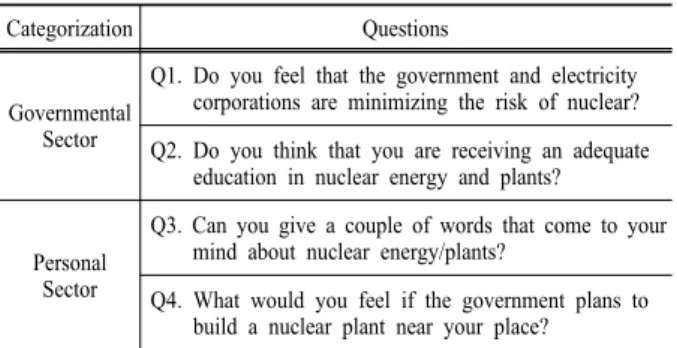
Thus, a short survey was conducted which captures the gap toward nuclear energy facilities with national and personal perspectives. A survey in Table 3 was conducted by borrowing a thematic analysis procedure to explore the symbolic interactionism of nuclear and public awareness.

Earlier studies had revealed an intriguing link between the distinct realms of social phenomena and actuality by adapting thematic analysis 31,32) . Thematic analysis provides a more visual and sentimental response of qualitative data analysis through non-numerical responses which a straightforward observation could not clearly capture.

A set of four questions are comprised of two categories;

governmental and personal sectors. Form of questioning does not follow multiple-choice method, but are constructed with short-answer questions to collect broad opinions.

As shown in Table 4, respondents were reclassified by demographic profile. Survey in Japan was conducted in September, 2015 and survey in South Korea was conducted in October, 2015. Nuclear neighbouring communities, particularly age group of 34 to 49 in Fukushima and Pusan, were found to be the most engrossed group in participation.

Table 3. Survey questions corresponding to thematic analysis

Categorization Questions

Governmental Sector

Q1. Do you feel that the government and electricity corporations are minimizing the risk of nuclear?

Q2. Do you think that you are receiving an adequate education in nuclear energy and plants?

Personal Sector

Q3. Can you give a couple of words that come to your mind about nuclear energy/plants?

Q4. What would you feel if the government plans to build a nuclear plant near your place?

Table 4. Demographic profiles of respondents sample

Country Japan South Korea

Province Tokyo Fukushima Seoul Pusan Total number of respondents 80 80 80 80

Male age range

18-33 15 9 11 14

34-49 17 28 13 19

50-65 9 5 16 3

Female age range

18-33 16 8 14 11

34-49 17 19 22 29

50-65 6 11 4 4

Fig. 8. Primary keywords based on thematic analysis.

Both men and women showed even participation ratio regardless of gender. According to Table 5 and Fig. 8, the most frequent word from respondents was NIMBY.

Although respondents from both countries agreed upon a concept of nuclear necessity need, however, the views of the majority disagreed to have a nuclear plant nearby.

Analysis of primary keywords from each question also revealed that there is a strong repulsion of nuclear energy, which testifies the need of adequate education.

It is worthy to notice that in the case of Japan, most respondents chose the correct term for Japanese nuclear agencies and related corporations. On the other hand, more than half of respondents in South Korea used Korea Nuclear Power Corporation to explain Korea Hydro and Nuclear Power Corporation. With the same case, more than half of respondents in South Korea did not understand what Hansuwon stands for, which reveals that friendly and frequent advertisement by accompanying the correct information is required.

8. Conclusion and Discussions

The overall analysis indicates that Japan has always been

struggled to prioritize resource security from imported fossil

fuel through nuclear. In the early era of energy policy in

Japan was based on the belief of peaceful use, since the

country owns moral debts to other countries during the

World War II. However, international oil crisis shifted

Japan's position from objective to active. Japan's modern

energy policy was deeply spotted on the Achilles tendon

of its energy issues; resource scarcity and energy

self-sufficiency. Yet, as discussed in the paper, the country

faced critical drawbacks in energy transition after the

(7)

Theme No.

Primary keywords from each question

Japan South Korea

Tokyo Fukushima Seoul Pusan

Govern-mental Sector

Q1

∙ Tokyo Electric Power Company

∙ Fukushima nuclear accident

∙ Negative

∙ Undiscovered impacts of the Fukushima nuclear accident on Tokyo

∙ Tokyo Electric Power Company

∙ Fukushima nuclear accident

∙ Negative

∙ Failed follow-up action

∙ Improper correspondence

∙ Unreliable support

∙ Indifference

∙ Neither negative nor supportive

∙ Lack of information

∙ Partly negative

∙ NIMBY

∙ Focused on growth-oriented development

Q2 ∙ Lack of advertisement and necessary information

∙ Inhospitable Official web-pages

∙ Lack of advertisement and information

∙ Friendly blogs and SNS with easy accessibility, but the information is mostly targeted on students

Personal Sector

Q3

∙ Japan Atomic Energy Research Institute

∙ Nuclear Regulation Authority

∙ Tokyo Electric Power Company

∙ Necessary evil

∙ NIMBY

∙ Japan Atomic Energy Research Institute

∙ Nuclear Regulation Authority

∙ Tokyo Electric Power Company

∙ Risky

∙ NIMBY

∙ Korea Nuclear Power Corporation

∙ Korea Hydro & Nuclear Power Corporation

∙ Essential to national development and energy security

∙ Stepping-stone energy

∙ NIMBY

∙ Korea Nuclear Power Corporation

∙ Korea Hydro & Nuclear Power Corporation

∙ Decrement in housing prices

∙ Risky

∙ NIMBY

Q4

∙ NIMBY

∙ Proper compensation

∙ Favorable to hydro or others energy facilities except nuclear Table 5. Survey results from two aspects

Fukushima accident. While the country's energy policy was mainly focused on the economic efficiency, the tragedy revealed the lack of risk management and inappropriate reactions. However, there is a way that nuclear energy could be eco-friendly and economic compared to alternative energy under close supervision and thoroughness management.

In case of South Korea, the nation is also labeled as a resource-poor country, however, its nuclear energy technology enabled energy self-sufficiency. Moreover, South Korean nuclear energy regulations show how nuclear energy can reduce environmental costs by safely operating nuclear energy. This paper believes that consideration in a long-run with the integration between social and physical elements seems to be the key for nuclear safety.

First, operating nuclear energy facilities should be based on safety. After the crisis, Japan has reactivated its first nuclear reactor on October, 2015 and currently operating three nuclear reactors under revised safety regulation and risk assessment. The Japanese government claims that the new regulations are following the world’s toughest standards. In case of South Korea, its nuclear industry is under mutual cooperation with international nuclear organizations, such as International Atomic Energy

Agency(IAEA), Nuclear Regulatory Commission(NRC) and International Commission on Radiological Protection (ICRP). Despite mutual surveillance to prevent potential threat, a lack of adequate education and publicity of nuclear energy is widening gap between technology and public awareness. Contrary to Fig. 4, Table 5 shows that some public yet feel anxiety of nuclear plant itself while they show tolerance in other energy facilities. Thus, appropriate education and friendly promotion based upon hard evidence are required. Second, the South Korean government needs to widen the official nuclear evacuation zone to 30-kilometer radius. As aforementioned in Table 2, relative high population density in South Korea may cause aggravate nuclear risk compared to Japan.

In addition to social elements, physical elements including technical improvements may lower degree of potential nuclear threat. For instance, fuel rod in South Korea could technically handle no more than 2,000℃

melting point. The case from Fukushima revealed that fuel rod could exceed up to 2,800℃ during a serious nuclear meltdown. Technically, it is not easy to build a fuel rod to handle more than 2,000℃. Thus, a high-security monitor and close observation seems to be the one way strategy.

If a spider-web type of real-time monitoring sensor on the

(8)

nuclear protective wall structure could be installed, it may slacken the stress of human surveillance to address the wall crack before the leakage. Moreover, it may provide reassurance if the public could access to security monitors via internet.

References

1) A. Stohl, P. Seibert, G. Wotawa, D. Arnold, J.F. Burkhart, S. Eckhardt & T.J. Yasunari, “Xenon-133 and Caesium-137 Releases into the Atmosphere from the Fukushima Dai-ichi Nuclear Power Plant: Determination of the Source Term, Atmospheric Dispersion, and Deposition”, Atmospheric Chemistry and Physics Discussions, Vol. 11, pp. 2313-2343, 2011.

2) N. Hamada and H. Ogino, “Food Safety Regulations: What we Learned from the Fukushima Nuclear Accident”, Journal of environmental radioactivity, Vol. 111, pp. 83-99, 2012.

3) V. Vivoda, “Japan’s Energy Security Predicament Post- Fukushima”, Energy Policy., Vol. 46, pp. 135-143, 2012.

4) C. K. Kim, J. I. Byun, J. S. Chae, H. Y. Choi, S.W. Choi, D.J.

Kim and J.Y. Kim, “Radiological Impact in Korea following the Fukushima Nuclear Accident”, Journal of Environmental Radioactivity, Vol. 111, pp. 70-82, 2012.

5) H. Métivier, “Chernobyl: Assessment of Radiological and Health Impacts”, Nuclear Energy Agency Organization for Economic co-operation and Development, pp. 33-38, 2002.

6) Nuclear Safety Commission, Atomic Energy Basic Act, http://nsc.go.jp/NSCenglish/documents/laws/1.pdf 7) E. Shadrina, “Fukushima Fallout: Gauging the Change in

Japanese Nuclear Energy Policy”, International Journal of Disaster Risk Science, Vol. 3, pp. 69-83, 2012.

8) J. Duffield and B. Woodall, “Japan’s New Basic Energy Plan”, Energy Policy, Vol. 39, pp. 3741-3749, 2011.

9) V. Vivoda, “Japan’s Energy Security Predicament Post-Fukushima”, Energy Policy, Vol. 46, pp. 135-143, 2012.

10) C. Frischknecht, L. Gaudard & F. Romerio, “Natural Hazard Risk and Energy Supply”, International Association for Energy Economics, pp. 45-46, 2015.

11) J. Duffield and B. Woodall, “Japan’s New Basic Energy Plan”, Energy Policy, Vol. 39, pp. 3741-3749, 2011.

12) J. C. Rausch and R.A. da Fonseca, “Nuclear Energy Safety-new Challenges”, International Nuclear Atlantic Conference, 2011.

13) Y. Arika, “China will Soon become the Largest Net Oil Importer and will Spend the Most for its Net Fossil Fuel Imports”, IEEJ, Vol. 11, pp. 1-8, 2013.

14) J. Byrne, “International Energy Policy in the Aftermath of the Fukushima Nuclear Disaster”, Center for energy and Environmental Policy, 2013.

15) V. Vivoda, “Japan’s Energy Security Predicament post-Fukushima”, Energy Policy, Vol. 46, pp. 135-143, 2012.

16) J. Byrne, “International Energy Policy in the Aftermath of the Fukushima Nuclear Disaster”, Center for energy and Environmental Policy, 2013.

17) Y. Hamamatsu, Y. Inoue, C. Watanabe & M. Umezaki,

“Impact of the 2011 Earthquake on Marriages, Births and the Secondary Sex Ratio in Japan”, Journal of Biosocial science, pp. 1-12, 2011.

18) Y. Kim, M. Kim and W. Kim, “Effect of the Fukushima Nuclear Disaster on Global Public acceptance of nuclear energy”, Energy Policy, Vol. 61, pp. 822-828, 2013.

19) J. Meltzer, “After Fukushima: What's Next for Japan's Energy and Climate Change Policy?”, Brookings Institution, 2011.

20) N. Ayoub and N. Yuji, “Governmental Intervention Approaches to Promote Renewable Energies-Special Emphasis on Japanese Feed-in Tariff”, Energy Policy, Vol.

43, pp. 191-201, 2012.

21) S. Rodrigues, C. Restrepo, E. Kontos, R.T. Pinto and P.

Bauer, “Trends of Offshore Wind Projects Renewable and Sustainable Energy Reviews”, pp. 1114-1135, 2015.

22) GWEC, “Global Wind Report: Annual Market Update”, Global Wind Energy Council, pp. 60-61, 2013.

23) K. Nishio and H. Asano, “Supply Amount and Marginal Price of Renewable Electricity under the Renewables Portfolio Standard in Japan”, Energy Policy, Vol. 34, pp.

2373-2387, 2006.

24) D.B. Mahin, “Bioenergy Systems Report: Industrial Energy and Electric Power from Wood Residues”, Winrock International Institure for Agriculture Development, 1991.

25) FEPC, Electric power sources, The Federation of Electric Power Companies of Japan, 2014.

26) N. Tanaka, “Japan's Post‐Fukushima Energy Policy Challenges”, Asian Economic Policy Review., Vol. 8, pp.

296-297, 2013.

27) S. V. Valentine and B.K. Sovacool, “The Socio-political

Economy of Nuclear Power Development in Japan and

South Korea”, Energy Policy, Vol. 38, pp. 7971-7979, 2010.

(9)

28) World Energy Coulcil, Energy Trilemma Index, https://www.worldenergy.org/data/trilemma-index/

29) Nuclear Energy Institute, 2015 Plant Neighbor Survey Memo, http://www.nei.org/Master-Document-Folder/Backgrounders/

Reports-And-Studies/2015-Plant-Neighbor-Survey-Memo 30) W. B. Gudykunst, Y. C. Yoon and T. Nishida, “The Influence

of Individualism-collectivism on Perceptions of Communication in Ingroup and Outgroup Relationships”, Communications Monographs, Vol. 54, pp. 295-306, 1987.

31) A.G. Tuckett, “Applying Thematic Analysis Theory to Practice: a Researcher’s Experience”, Contemporary Nurse, Vol. 19, pp. 75-87, 2005.

32) V. Braun, V. Clarke & G. Terry, “Thematic Analysis”,

Qualitative Research in Clinical and Health Psychology,

pp. 95-113, 2014.

수치

Table  1.  Total  estimated  atmospheric  release  during  the  Fukushima accident
Fig. 1. Japan's energy demand structure.
Fig. 4. Public acceptance rates of nuclear energy.
Fig. 5. Operating cost for major energy sources in Japan.
+3

참조

관련 문서

박기갑 법학전문대학원 교수 유엔 국제법위원회 위원 IAEA 원자력손해배상전문가 (전) OECD/NEA

Na, Prediction of Hydrogen Concentration in Nuclear Power Plant Containment under Severe Accidents using Cascaded Fuzzy Neural Networks, Nuclear Engineering

That is, the dry powder of the sludge wastes, generated during the decommissioning of nuclear power plants, were compacted, and a study, focused on

How to strengthening safety assessment capability for design and operation of nuclear power plants. ● Opening

Waste lubricating oil, which is radioactive waste generated from nuclear power plants, is a lubricant for major equipment of nuclear power plants, and is incinerated

In nuclear power plants, the water level is maintained by controlling the water supply when the steam generator's water level deviation occurs. During

For example, the public’s sentiments of risk regarding nuclear power plants exceeds the risk felt by an expert in the area, and therefore the public sentiment is a negative

discovered this was out with his girl friend the night after he realized that nuclear reactions must be going on in the stars in order to make them shine.. She said “Look