Research Report
Growth and Development of Grafted Cucumber Transplants as Affected by Seedling Ages of Scions and Rootstocks and Light Intensity during Their Cultivation in a Closed Production System
Yurina Kwack 1 , Seon Woo Park 2 , and Changhoo Chun 1,2*
1
Research Institute of Agriculture and Life Science, Seoul National University, Seoul 151-921, Korea
2
Department of Plant Science, Seoul National University, Seoul 151-921, Korea
Abstract: The objective of this study was to determine the effects of seedling ages of scions and rootstocks for grafting and light intensity during their cultivation in a closed transplant production system on the growth and development of grafted cucumber transplants. Cucumber scions and rootstocks were cultivated under 5 photosynthetic photon flux (PPF) levels: 100, 140, 180, 230, and 280 µmol・m
-2・s
-1in a closed transplant production system. The scions were grafted onto the rootstocks at 8, 9, 10, 11, and 12 days after sowing (DAS). Hypocotyl length of scions and rootstocks decreased significantly as PPF increased, and an increase in dry weight with increasing PPF was more pronounced in scions. After grafting, cucumber transplants were grown in a greenhouse until 22 DAS and were then transplanted for investigation of their growth and development.
Plant height, leaf area, and fresh weight of cucumber transplants grafted at 8, 9, and 10 DAS were greater, but light intensity during cultivation of scions and rootstocks did not significantly affect the early growth of cucumber transplants after grafting.
The number of female flowers in grafted cucumber after transplanting was highest when scions and rootstocks were cultivated under PPF 140 and 180 µmol・m
-2・s
-1and were grafted at 8 DAS. These results indicate that controlling environmental conditions in a closed transplant production system during the production of scions and rootstocks can advance grafting time and promote the growth and development of grafted cucumber transplants.
Additional key words: controlled environment, Cucumis sativus, grafting, PPF
*Corresponding author: [email protected]
※ Received 9 March 2014; Revised 9 April 2014; Accepted 29 April 2014. This study was supported by “Cooperative Research Program for Agriculture Science & Technology Development (Project No.9027022)” of Rural Development Administration, Republic of Korea. We would like to sincerely thank to Yong-Gyo Kim, CEO of Hoban Agricultural Association Cooperation for his support and cooperation.
Ⓒ 2014 Korean Society for Horticultural Science
Introduction
Grafting has become an essential tool for vegetable production using high tunnels and greenhouse in Korea and Japan for many years in order to overcome issues associated with intensive cultivation using limited arable land (Kubota et al., 2008). It is well-known that the use of grafted transplants can reduce problems involved in successive cropping and stress tolerance (Lee et al., 2010;
Schwarz et al., 2010).
The ‘closed transplant production system’ was developed in Japan in 2000 for the large-scale production of high-
quality transplants at a low cost with minimum use of resources (Chun and Kozai, 2000). More recently, closed transplant production system has been commercialized and widely used because of several advantages that include:
(1) rapid and efficient growth of transplants due to optimized
growth conditions, (2) production of high-quality transplants
under uniformly controlled environments, (3) higher pro-
ductivity per floor area per year due to the use of multi-
layered shelves, (4) production of disease-free transplants
in an area protected from pests and pathogens, and (5)
easier control of plant growth and development stages
such as stem elongation, bolting, flowering, and root
formation (Kozai, 2006).
Recently, the annual production of vegetable transplants was recorded to be over 19 billion plants in Korea according to a report from Korean Research Society of Plug Transplant Production in 2009. Lee et al. (2010) reported that grafted cucumber transplants comprised approximately 75% of all cucumber transplants and that approximately 132 million grafted transplants were needed, assuming the cultivation area for cucumbers in Korea. Cucumbers are usually grafted when the first true leaf appears but is not fully developed in scions and rootstocks. Therefore, determining the most appropriate seedling age for grafting is important for scions and rootstocks (Davis et al., 2008). Production of uniform scions and rootstocks is necessary for successful grafted transplant production and can facilitate use of automation in the grafting process (Kubota et al., 2008). Because a closed transplant production system can precisely control environmental factors, such as light and air temperature, it is suitable for producing scions and rootstocks with uniform sizes and shapes. Optimum seedling age for grafting may differ between species, cultivation systems, and grafting methods. Consequently, it is essential to identify the optimum environmental conditions and to determine the appropriate seedling age of scions and rootstocks for grafting in order to improve the efficiency of production in a closed transplant production system.
The objective of this study was to determine the effects of seedling ages of scions and rootstocks and PPF during their cultivation in a closed transplant production system on the early growth and development of grafted cucumber transplants.
Materials and Methods
Cultivation of Scions and Rootstocks in a Closed Transplant Production System
We used Cucumis sativus L. ‘Oh My’ scions (Wonnong Seeds, Ansung, Korea) and Cucurbita ficifolia ‘Heukjong’
rootstocks (Seminis Vegetable Seeds Korea, Seoul, Korea) for the preparation of grafted transplants. The seeds for scions and rootstocks were sown in 162- and 128-cell trays filled with a commercial substrate mix (Sunshine Mix; Sun Gro Horticulture, Agawam, MA, USA). The cell trays were placed in a dark room with a controlled air temperature of 28°C and 95% relative humidity for germination.
Three days after sowing (DAS), the seedlings of scions and rootstocks were moved to a closed transplant production system with multi-level shelves and white fluorescent lamps (20 W, Philips Electronics, Amsterdam, The Netherlands).
The cell trays for scions and rootstocks were randomly placed on shelves under five levels of PPF (100, 140, 180, 230, and 280 µmol・m
-2・s
-1). The photo/dark periods were 10/14 h and the air temperatures during the photo/dark periods were set at 26/14
oC. The relative humidity and CO
2concentration in a closed transplant production system were maintained at 60% and 8 00 µmol・mol
-1, respectively.
The scions and rootstocks were sub-irrigated every other day with ‘Oi Hanbang’ nutrient solution (Coseal Co. Ltd., Seoul, Korea) at an EC of 1.3 dS・m
-1. Just before grafting, hypocotyl length (stem length below cotyledons), stem diameter, fresh weight, dry weight, and percentage dry matter (dry weight/fresh weight × 100%) of shoots and roots were measured in scions and rootstocks of each treatment group.
Grafting and Acclimation of Cucumber Transplants
Grafting was carried out at 8 , 9, 10, 11, and 12 DAS.
For rootstocks, one cotyledon, the growing point, and the roots were removed. The scions cuttings were grafted onto the rootstock cuttings with clips using the splice grafting method described by Lee et al. (2010). Additional scions and rootstocks were prepared and cultivated conventionally for 12 days (August 12 to 24, 2013) in a greenhouse and grafted by same method as mentioned above. These grafted transplants were used as controls.
The grafted cucumber transplants were rooted in 32-cell trays filled with a commercial substrate mix (Sunshine Mix; Sun Gro Horticulture, Agawam, MA, USA) and then moved to an acclimatization chamber. They were placed under Red + Blue LED lights (red/blue light density ratio:
2/1), which were switched on and off every 2 minutes, and irradiated at PPF 50 μmol・m
-2・s
-1for 3 days. The air temperature and relative humidity in the chamber were maintained at 28°C and 95%, respectively.
Cultivation of Cucumber Transplants in a Greenhouse after Grafting
After forming the grafted union, cultivation of grafted transplants was carried out at a greenhouse of a commercial propagator located in Chuncheon, Korea (E 127.5°, N 37.5°).
During the first 3 days, grafted transplants were placed in a tunnel with 50% shade of ambient greenhouse conditions.
Then, they were cultivated in a greenhouse and watered
once a day. A fertilizer solution (Peter’s 20N-20P-20K, The
Scotts Co., Marysville, OH, USA) was applied to the plants
every other day. For each treatment, plant height, number
of leaves, leaf area, and fresh weight of grafted cucumber
transplants were measured just before transplanting.
A
B
C
D
Fig. 1. The effects of seedling age (days after sowing, DAS) and PPF during the production of scions and rootstocks in a closed transplant production system on plant height (A), number of leaves (B), leaf area (C), and fresh weight (D) of grafted cucumber transplants 22 days after sowing.
Cultivation of Cucumber Transplants in a Greenhouse after Transplanting
Grafted cucumber transplants were transplanted in plastic containers (800 × 300 × 200 mm, L × W × H) filled with a commercial substrate mix (Plant world; Nongwoo Bio Co., Ltd., Suwon, Korea) at 22 DAS. The containers, each containing three plants were arranged in two rows with a plant density of 24 plants/m
2. The plants were grown in a greenhouse located at the experimental field, Seoul National University, Suwon, Korea (E 127.0°, N 37.3°) for 28 days (from September 3 to October 1, 2013). They were drip-irrigated twice per day with ‘Oi Hanbang’ nutrient solution (Coseal Co., Ltd., Seoul, Korea) and the EC of the nutrition solution was 2.5 dS・m
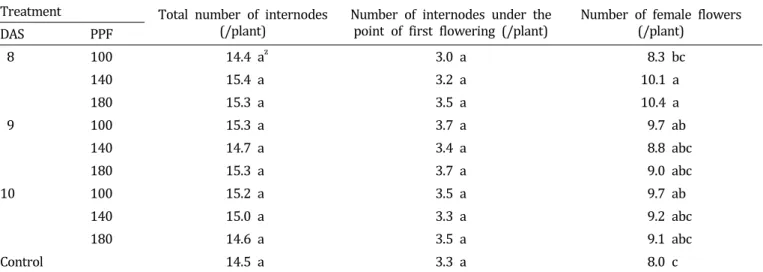
-1. We investigated the total number of internodes, the number of internodes under the point of first flowering, and the number of female flowers at 50 DAS.
Statistical Analysis
The experimental data were analyzed using SAS statistical software (SAS Institute, Cary, USA) and differences between treatments were assessed by Duncan’s multiple range tests (p ≤ 0.05).
Results and Discussion
Quality of Scions and Rootstocks as Affected by PPF and Seedling Age
In scions, increasing PPF significantly decreased hypocotyl length and increased stem diameter, dry weight, and percentage dry matter (Table 1). In rootstocks, hypocotyl length decreased with increasing PPF, while stem diameter and dry weight were not affected by PPF (Table 2).
Increasing seedling age increased the dry weight of the shoots and roots of scions and rootstocks, and an increase in PPF was associated with an increase in the percentage dry matter of shoots and roots of scions regardless of seedling age.
Light intensity is one of the most important environmental factors affecting growth and quality of transplants (Kitaya et al., 1998). Increasing light intensity suppressed stem elongation and increased the stem diameter of scions, and the results obtained in this study support previous reports on a similar subject matter (Butler, 1963; Kozai et al., 1995). The effect of light intensity on dry weight and percentage dry matter was more pronounced in scions.
It is well known that more intense light increases dry weight due to the increased carbon assimilation rate through photosynthesis (Mosaleeyanon et al., 2005; Nemali and
van Iersel, 2004). These data indicate that scions are more
efficient to assimilate carbon products through photosynthesis
because scions have been selected on the basis of its efficacy
for vigorous shoot growth and high fruit quality.
Table 1. Hypocotyl length, stem diameter, fresh weight, dry weight, and percentage dry matter of scions as affected by seedling age (days after sowing, DAS) and PPF in a closed transplant production system.
Treatment Hypocotyl
length (mm)
Stem diameter
(mm)
Fresh weight (g) Dry weight (mg) % Dry matter
DAS PPF Shoot Root Shoot Root Shoot Root
8 100 31.1 a
z1.62 a 0.336 a 0.138 b 25.7 b 5.06 d 7.62 c 3.71 b
140 30.0 a 1.68 a 0.341 a 0.168 a 28.7 b 6.19 cd 8.46 b c 3.79 b
180 26.9 b 1.71 a 0.354 a 0.180 a 31.4 b 8.25 a 8.94 b c 4.65 a
230 24.7 bc 1.69 a 0.338 a 0.136 b 32.5 b 7.00 b c 9.64 b 5.21 a
280 23.9 c 1.69 a 0.340 a 0.148 b 42.4 a 7.50 ab 12.51 a 5.19 a
9 100 31.8 a 1.47 c 0.357 c 0.183 b 33.1 b 6.25 c 9.30 b 3.43 b
140 26.9 b 1.58 bc 0.387 ab 0.205 ab 37.1 b 8.00 b 9.66 ab 3.87 ab
180 25.5 b 1.66 ab 0.364 bc 0.214 a 38.4 b 7.94 b 10.62 ab 3.77 ab
230 22.8 c 1.68 ab 0.369 c 0.212 a 34.9 b 8.44 ab 9.50 b 4.08 ab
280 22.5 c 1.79 a 0.398 a 0.224 a 45.2 a 9.69 b 11.43 a 4.31 a
10 100 30.9 a 1.78 d 0.419 ab 0.213 c 29.7 c 6.84 b 7.12 c 3.26 b
140 28.4 b 1.87 cd 0.424 a 0.223 bc 37.6 b 8.63 a 8.83 b 3.85 ab
180 26.9 b 2.04 bc 0.396 b 0.236 ab 36.0 b 8.06 ab 9.03 b 3.50 ab
230 23.6 c 1.99 b 0.403 ab 0.247 a 47.1 a 9.06 a 11.59 a 3.74 ab
280 23.1 c 2.18 a 0.406 ab 0.235 abc 45.8 a 9.50 a 11.31 a 4.02 a
11 100 31.6 a 1.71 b 0.409 b 0.197 a 29.9 b 7.69 b 7.36 c 4.03 ab
140 28.3 b 1.92 a 0.411 b 0.197 a 35.3 b 7.88 b 8.75 b c 3.93 b
180 27.4 b 1.85 a 0.452 a 0.208 a 44.8 a 9.94 a 9.90 ab 4.82 a
230 27.6 b 1.91 a 0.439 ab 0.222 a 43.8 a 9.38 ab 10.08 ab 4.29 ab
280 25.1 c 1.90 a 0.445 ab 0.214 a 45.9 a 10.25 a 10.32 a 4.77 a
12 100 35.8 a 1.83 b 0.456 ab 0.204 b 35.9 c 8.13 b 7.91 c 4.02 b
140 30.4 b 1.98 a 0.451 b 0.215 b 42.3 b 8.81 b 9.40 b 4.25 b
180 29.5 b 1.91 ab 0.481 a 0.230 ab 43.8 b 9.69 ab 9.05 b c 4.20 b
230 26.3 c 2.02 a 0.484 a 0.251 a 42.3 b 10.56 a 8.75 b c 4.22 b
280 26.0 c 2.00 a 0.450 b 0.214 b 54.1 a 11.06 a 12.07 a 5.23 a
z
Means in columns followed b y different letters are significantly different b y Duncan’s multiple range tests at p ≤ 0.05.
Early Growth of Cucumber Transplants Grown in a Greenhouse after Grafting
When scions were grafted onto rootstocks at 8, 9, and 10 DAS, plant height, leaf area, and fresh weight of cucumber transplants were greater than those of the control group (Fig. 1). The scions and rootstocks in the control group were conventionally cultivated in a greenhouse, and cucumber transplants were grafted at 12 DAS. Although cucumber transplants were grafted at same time (12 DAS), the growth of cucumber transplants that has been grafted using the
scions and rootstocks cultivated in a closed transplant production system was less than that of the control group.
Increasing PPF during the production of scions and rootstocks in a closed transplant production system increased dry weight of scions and rootstocks, while the growth of cucumber transplants grown in a greenhouse after grafting was not significantly affected by light intensity during the production of scions and rootstocks.
After grafting, the callus formed at the grafted interface
develops vascular bundles allowing the flow of water and
Table 2. Hypocotyl length, stem diameter, fresh weight, dry weight, and percentage dry matter of rootstocks as affected by seedling age (days after sowing, DAS) and PPF in a closed transplant production system.
Treatment Hypocotyl
length (mm)
Stem diameter
(mm)
Fresh weight (g) Dry weight (mg) % Dry matter
DAS PPF Shoot Root Shoot Root Shoot Root
8 100 52.3 a 3.10 a 1.329 a 0.572 a 123 a 24.4 a 9.68 ab 4.30 b
140 51.4 a 2.95 a 1.246 a 0.416 c 120 a 20.6 b 9.19 ab 4.92 ab
180 42.9 b 3.08 a 1.342 a 0.401 c 112 a 20.1 b 8.45 b 5.13 a
230 40.5 b 2.79 a 1.269 a 0.492 b 118 a 20.8 b 9.41 ab 4.28 b
280 33.9 c 3.07 a 1.248 a 0.486 b 123 a 20.6 b 9.86 a 4.29 b
9 100 56.7 a 2.67 b 1.502 ab 0.525 b 112 b 22.8 ab 7.48 c 4.36 a
140 54.4 a 3.08 a 1.598 a 0.536 b 117 b 22.3 b 7.35 c 4.22 a
180 43.3 b 3.21 a 1.497 ab 0.552 b 120 ab 21.7 b 8.01 b 3.97 a
230 43.0 b 2.88 ab 1.478 ab 0.562 ab 112 b 21.8 b 7.59 bc 3.92 a
280 35.9 c 3.20 a 1.420 b 0.637 a 129 a 25.4 a 9.15 a 4.10 a
10 100 60.6 a 2.66 a 1.808 a 0.513 b 135 a 23.5 b 7.50 c 4.57 a
140 54.3 b 2.85 a 1.736 ab 0.462 b 136 a 22.1 b 7.83 c 4.81 a
180 45.1 c 2.86 a 1.622 b 0.494 b 137 a 23.4 b 8.47 ab 4.77 a
230 43.3 c 2.87 a 1.603 b 0.479 b 133 a 23.6 b 8.32 b 4.95 a
280 34.4 d 2.82 a 1.620 b 0.606 a 141 a 27.3 a 8.71 a 4.55 a
11 100 56.6 a 2.52 a 1.725 a 0.533 b 129 a 26.5 a 7.47 b 5.03 ab
140 50.1 b 2.54 a 1.646 ab 0.412 c 127 a 22.0 b 7.74 b 5.60 a
180 43.2 c 2.59 a 1.603 ab 0.464 bc 131 a 22.4 b 8.17 a 4.97 ab
230 40.3 cd 2.53 a 1.575 b 0.498 b 129 a 25.1 a 8.20 a 5.16 ab
280 36.1 d 2.58 a 1.518 b 0.625 a 129 a 27.5 a 8.48 a 4.49 b
12 100 54.6 ab 2.67 a 1.793 a 0.513 a 149 a 25.9 bc 8.29 b 5.11 bc
140 51.2 b 2.52 b 1.572 b 0.398 b 146 a 23.4 c 9.44 a 6.20 a
180 39.4 a 2.83 a 1.787 a 0.542 a 141 a 24.1 c 7.91 b 4.48 c
230 36.8 a 2.82 b 1.607 a 0.499 a 149 a 29.6 a 9.31 a 5.98 ab
280 33.2 ab 2.70 b 1.566 a 0.541 a 148 a 27.1 ab 9.44 a 5.05 bc
z
Means in columns followed b y different letters are significantly different b y Duncan’s multiple range tests at p ≤ 0.05.
nutrients from rootstock to scion (Moore, 1984). Wright (1893) reported that there is a certain stage of growth in which plants may be easily grafted. In much younger plants, the tissues are not strong enough to survive the injuries inflicted during the operation, while in older plants the activity of cell division is generally low. Our results suggest that the scions and rootstocks cultivated for 11 and 12 DAS in a closed transplant production system were past the optimal growth stage for grafting, and that the initiation and development of vascular bundles occurs
slowly. Previous studies have also reported a decrease in survival rate and growth after grafting in older plants (Greenwood, 1984; Johkan et al., 2008, 2009). Chang et al.
(2000) reported that the relative growth rates of watermelon transplants at the early days after grafting increased with decreasing seedling ages of scions and rootstocks.
Although cucumber transplants were grafted at the same
time, the cultivation system of scions and rootstocks affected
the growth of cucumber transplants grown in a greenhouse
after grafting. Plant growth was significantly higher in the
Table 3. The effects of seedling age (days after sowing, DAS) and PPF during production of scions and rootstocks in a closed transplant production system on the development of grafted cucumber transplants 28 days after transplanting.
Treatment Total number of internodes
(/plant) Number of internodes under the
point of first flowering (/plant) Number of female flowers (/plant)
DAS PPF
8 100 14.4 a
z3.0 a 8.3 b c
140 15.4 a 3.2 a 10.1 a
180 15.3 a 3.5 a 10.4 a
9 100 15.3 a 3.7 a 9.7 ab
140 14.7 a 3.4 a 8.8 ab c
180 15.3 a 3.7 a 9.0 ab c
10 100 15.2 a 3.5 a 9.7 ab
140 15.0 a 3.3 a 9.2 ab c
180 14.6 a 3.5 a 9.1 ab c
Control 14.5 a 3.3 a 8.0 c
z