A New Diversity Combining Scheme Based on Interleaving Method for Time-of-arrival
Estimation of Chirp Signal
Seong-Hyun Jang*, Jong-WhaChong*★
Abstract
A new diversity combining scheme is proposed for time-of-arrival (TOA) estimation of chirp signal in dense multipath channel. In the multipath channel, the performance of TOA estimation using conventional correlation matrix-based diversity combining scheme is degraded due to the lack of de-correlation effect. To increase the de-correlation effect, the proposed diversity scheme employs interleaving method based on the property of de-chirped signal. As a result, the proposed scheme increases de-correlation effect and also reduces the noise of TOA estimation. Finally, the diversity achieved from the proposed scheme improves TOA estimation performance. The de-correlation effect is analyzed mathematically. The estimation accuracy of the proposed diversity scheme is superior to that of conventional diversity scheme in multipath channel.
Keywords: chirp signal, de-chirped signal, de-correlation, interleaving method, time-of-arrival estimation
* School of Electronics Engineering, Hanyang University
★Corresponding Author
※ Acknowledgement
This work was supported by Ministry of Knowledge Economy (MKE), ETRI chip design joint research project, and ITRC support program
supervised by the NIPA
(NIPA-2012-H0301-12-1011). The IDEC provide research facilities for this study. This work was also supported by the Brain Korea 21 Project in 2012 and IT R&D program of MKE/KEIT.
[10035570, Development of self-powered smart sensor node platform for smart&green building]
I. Introduction
Recently, the demand of positioning systems has been increased due to the requirement for the services such as tracking personnel, road safety, and situation awareness [1]. The positioning systems generally locate unknown target based on the estimation of parameters, e.g., received signal
strength (RSS) [2], time of arrival (TOA) [3], and time difference of arrival (TDOA) [4]. The positioning system based on RSS estimation has unstable performance; the system based on TDOA estimation requires time synchronization. On the other hand, the positioning system based on TOA estimation provides high and stable performance as well as does not need the time synchronization.
Therefore, we focus on the positioning system based on TOA estimation in this paper.
For decades, chirp signals have been widely used for various positioning systems such as asset tracking and sonar due to their good correlation property [5]. Specifically, the chirp signals can be used with subspace-based super resolution (SBSR) algorithm such as multiple signal classification (MUSIC) [6] and estimation of signal parameters via rotational invariance techniques (ESPRIT) [7]
for accurate TOA estimation. Generally, the SBSR algorithm is the algorithm that estimates parameters inherent in the received signals based on algebraic theory. Before the estimation of the desired
parameters, the SBSR algorithm requires a sum of sine waves with channel information as its input signal; therefore, Fourier transform (FT) is indispensable.
On the other hand, when the chirp signal is employed as baseband signal, the FT is not necessary. Without FT, a sum of sine waves with channel information can be obtained using de-chirping process in [8]. The de-chirping process is the operation that multiplies the received signal by the conjugate of the transmitted signal. Due to the simple multiplication, the computational complexity of the de-chirping process is less than that of the FT. Therefore, the complexity can be reduced when the chirp signal is used with the de-chirping process.
In positioning scenario, dense multipath can be frequently encountered due to buildings and other obstacles between transceivers. In a dense multipath environment, the correlation between paths is increased because the relative distance between paths is smaller than the reciprocal of the signal bandwidth [9]. In that situation, the SBSR algorithm performs poorly since it fails to decompose the paths [10].
Correlation matrix-based diversity combining scheme (CMDCS) was proposed to improve the TOA estimation performance against the correlation case in [10]. The CMDCS takes blocks of samples at large intervals because channel amplitude varies randomly and slowly in dense multipath channels.
Then, CMDCS can achieve time diversity by averaging correlation matrices of multiple blocks extracted from received signal, i.e. averaging the fading of the channel over time [11]. This diversity helps us to decompose the correlated paths and is called as a smoothing technique for direction-of-arrival (DOA) estimation [6,7].
In detail, the CMDCS organizes multiple blocks which are overlapped or non-overlapped one another. In contradiction to DOA estimation, the performance of TOA estimation with overlapping blocks is poor due to noise correlation between blocks, as shown in [10,11]. As a result, CMDCS
with non-overlapped blocks (CMDCS-NB) is appropriate for TOA estimation. However, when CMDCS-NB blocks are employed with a finite number of samples, the time interval between blocks becomes short as the number of blocks increases. It makes the blocks be correlated; consequently, the accuracy of TOA estimation is degraded.
In this paper, a novel diversity combining scheme generates new non-overlapped blocks by using an interleaving method based on the property of the dechirped signal resulting from the dechirping process. As a result, the correlation of the blocks generated by the proposed algorithm is reduced.
From the reduction of the correlation, the proposed diversity combining scheme enhances the ability to decompose paths in a dense multipath channel.
Consequently, the performance of TOA estimation of the first arrival path improves.
II. System Model
A transmitted chirp signal is modeled as s(t)=exp(j(ω+(ξμt/2))t) for –(Tsym / 2) ≤ t < (Tsym / 2), where μ and ξ are the chirp rate and the sign of the chirp rate, respectively. Chirp duration is denoted by Tsym, and the center frequency of the chirp is described by ω. We assume tapped delay line channel, and that all paths fade independently.
The received signal is represented by
(1)
where l is the path index, and K is the total number of paths. It is also assumed that the largest path delay difference is less than Tsym, i.e. |max{τl} – min{τl}| < Tsym. The complex amplitude and the TOA of the lth path are denoted by αl and τl, respectively. The TOA τl = nintTs + τf,l is composed of the integer TOA (nintTs) and the fractional TOA (τf,l) where Ts is sampling period. Assume that the integer TOA is obtained at the time instant of peak output of the matched filter. The additive white
( )
1
( ) l ( )
K l l
r t as t t ht
=
=
å
- +Gaussian noise (AWGN) is represented as η(t) with zero mean and variance ση2 According to the dechirping operation in [3], the dechirped signal can be modeled as
(2)
where βl=–ξμτf,l, θl=(ξμ/2)((τf,l)2+2τf,lnintTs)–ωτf,l
and n is the sample index. The superscript * denotes the conjugate operation. Although η(t) is sampled and multiplied by the chirp signal, "η" ̃
"(n" "T" _"s" ")" maintains the properties of AWGN because the chirp signal is deterministic.
We can then write the dechirped signal in vector form
(3)
where y=[y(0) y(Ts) … y((N–1)Ts)]T, V=[v(τ1) v(τ2) … v(τK)], v(τl)=[1 exp(–jβlTs) … exp(–jβl(N –1)Ts)]T, a=[α1exp(jθ1) α2exp(jθ2) … αKexp(jθK)]T, and "η" ̃=["η" ̃(0) "η" ̃(Ts) … "η" ̃((N–
1)Ts)]T. The superscript T denotes the matrix transpose operation.
III. Property of Dechirped Signal
In [3], the phase shift between two consecutive samples in a dechirped signal is constant as yl((n+1)Ts)=yl(nTs)exp(–jξμτf,lTs) where yl((n+1)Ts) and yl(nTs) are the (n+1)th and nth samples of the lth path of y(nTs), respectively. Then, the fractional TOA is estimated from the phase shift, exp(–jξμτ
f,lTs), using MUSIC. MUSIC exploits the orthogonality between the signal subspace and the noise subspace to estimate the phase shifts exp(–jξ μτf,lTs). The estimated fractional TOA of the first arrival path can be described as
(4)
where χe represents the estimation error of the super-resolution algorithm due to noise. As shown in (4), the dechirped signal has the property that reduces the estimation error when the phase shift increases.
V. A New Time Diversity Combining Scheme Based on Interleaving Method
for TOA Estimation
Generally, a diversity technique employs two or more paths with uncorrelated characteristics to combate fading or to avoid burst errors. Interleaving the dechirped signal into several blocks helps us to obtain uncorrelated blocks. This will be verified in Section V. When the number of blocks is equal to D the interleaving distance, the gth block is obtained using selection matrix "J" _"g" ^"(D)" as follows:
(5)
where Ik denotes a k by k identity matrix and 0m represents a 1 by m zero vector. The Kronecker product is denoted by "⨂" . It is assumed that D is a submultiple of N in order to fully exploit samples.
Then, the interleaved blocks have common frequency but different initial phases. As a result, direct averaging interleaved blocks destroys frequency of interleaved signal. To combine D interleaved blocks while maintaining the frequency, the auto-correlation matrices of the blocks are averaged as
(6)
where the superscript H denotes the Hermitian of a matrix. The matrix V has full column rank because the fractional TOA is assumed all different.
If we assume that amplitude of αl is constant and ( )
(
( ))
1
2
1
1
, where 1
D H
D D
avg g g
g
D
H H
i
D
h D s
=
=
=
= + =
å
å
D y y
VAV I A aa
( ) ( ) ( )
( 1) 1 ( )
where .
D D D
g = g g = N DÄéë g- D g- ùû
y J y J I 0 I 0
( ) ( )
,1 ,1 ,1
ˆf Ts f e Ts f e Ts
t = -xm t +c -xm =t -c xm y = Va + η%
( )
( (
( )) )
( )( )
( )
( )1
exp
s int s s
K
l l s l s
l
y nT s n n T r nT
j nT nT
a b q h
*
=
= -
=å + +%
the phase of αl is a uniform random variable in [0, 2π], the covariance matrix A is nonsingular.
Assuming (N/D) > K, the rank of the matrix VAVH is K. The eigenvectors (EVs) corresponding to the ((N/D)–K) smallest eigenvalues of Davg are called noise EVs, while the EVs corresponding to the K largest eigenvalues are called signal EVs.
Therefore, the (N/D)-dimensional subspace can be divided into signal subspace and noise subspace according to the signal EVs and noise EVs, respectively. The projection matrix of the noise subspace is obtained by "P" _"η" "=" "W" _"η"
"W" _"η" ^"H" where Wη = [ w(K+1) w(K+2) … w(N/D-1)] and wm, (K+1) ≤m≤(N/D–1) are noise EVs. Since v(τm), 1≤m≤K is orthogonal to the noise subspace, we have Pηv(τm)=0. As a result, the fractional TOAs τf,lcan be determined by finding the time delay values at which the following MUSIC pseudospectrum achieves maximum value as
(7)
VI. Effects of the Proposed Time Diversity Combining Scheme
A. Noise reduction in TOA Estimation The gth block in (5) can be represented as
(8)
where 1 ≤ m ≤ N/D and 1 ≤ g ≤ D. After we interleave the dechirped signal into D blocks, the phase shift between consecutive samples in an interleaved block is still constant as dg,l(m+1)=dg,l(m)exp(–jβlDTs)=dg,l(m)exp(–jξμτ
f,lDTs) where dg,l(m+1) and dg,l(m) are the (m+1)th
and mth samples of the lth path of dg(m), respectively. Furthermore, the estimated fractional TOA of the first arrival path can be described as
(9)
Different from (4), the dividing term ξμDTs can be increased when D increases. Then, the estimation noise can be further reduced by D, as in (9).
Consequently, the accuracy of TOA estimation can be improved with increased interleaving distance.
B. De-correlation Effect
The proposed diversity scheme generates each block which does not contain consecutive samples but the samples at a distance of D from the dechirped signal. The fading between consecutive samples in a block can be considered to be decorrelated when DTs is larger than the coherence time [10]. As shown in Section IV, the time diversity is achieved by combining interleaved blocks.
The correlation coefficient between the pth path dg,p(m) and the qth path dg,q(m) in the gth interleaved block is derived as
(10) where
Generally, the de-correlation effect is improved as the magnitude of the correlation coefficient decreases. In (10), the de-correlation effect is governed by the interleaving distance D. Therefore, D should be increased to improve the de-correlation effect.
( ) ( )
( ) ( )
(( ) )( ) ( )
( ), ,
sin sin ,
2 2
and 1 1
2
p q
j j
p p q q
p q p q
s s
p q
p q p q s p q s
e e
L DT T
m D T D T
f f
a a a a
b b b b
b b
e f f b b q q
= =
é - ù é - ù
= ê ú ê ú
ê ú ê ú
ë û ë û
= - + - - + - + - -
( ) ( )
{ }
( ) ( )
{ } {
( ) ( )}
, ,
, , , ,
1
g p g q j
pq
g p g p g q g q
E d m d m
DLe E d m d m E d m d m r e
*
* *
= =
( ) ( )
,1 ,1 ,1
ˆf DTs f e DTs f e DTs .
t = -xm t +c -xm =t -c xm
( )
( ( (
( )) ) )
( )
( )
( )
1
exp 1
1
K
g l l s l
l
s
d m j m D g T
m D g T
a b q
h
=
= - + +
+ - +
å
%
( ) ( ) ( )
( )
( )
2 2
1 2
1
1 1
1 .
MUSIC
H
N D H m m K
Q
h h
t
t t
t
-
= +
= =
=
å
P v W v
w v
-20 -10 0 10 20 30 40 50 60 70 80 10-9
10-8 10-7 10-6
SNR [dB]
Root mean squared error (second)
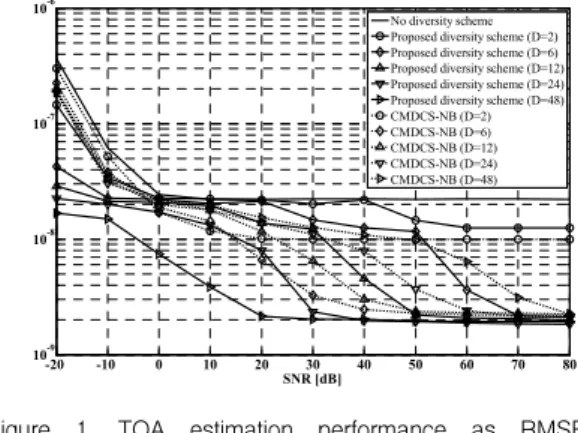
No diversity scheme Proposed diversity scheme (D=2) Proposed diversity scheme (D=6) Proposed diversity scheme (D=12) Proposed diversity scheme (D=24) Proposed diversity scheme (D=48) CMDCS-NB (D=2) CMDCS-NB (D=6) CMDCS-NB (D=12) CMDCS-NB (D=24) CMDCS-NB (D=48)
VII. Simulation Results
In this section, the TOA estimation performance of the proposed diversity scheme is compared with that of CMDCS-NB with regard to the root mean squared error (RMSE). The parameters of the chirp signal are employed from the IEEE 802.15.4a chirp spread spectrum in [13]. Simulation parameters are fixed as N=480, and the various submultiples of N is employed to D. Blocks of the proposed diversity scheme and CMDCS-NB have the same length for each D in order to fairly compare their TOA estimation performances.
Figure 1 shows that the comparison results between the proposed diversity scheme and the CMDCS-NB. The CMDCS-NB organizes D non-overlappling blocks which have adjacent samples from the dechirped signal. Then, time diversity is obtained by averaging the auto-correlation matrices of the blocks. When D is two, the auto-correlation matrices of two blocks at a distance are averaged; thus, the fade is degraded.
However, as D increases, the distance between blocks is reduced, i.e., the de-correlation between blocks deteriorates. Besides phase shift between samples in blocks does not changes as D increases.
Due to the fixed phase shift, noise reduction is not achieved by the property of dechirped signal in CMDCS-NB. Consequently, TOA estimation performance is degraded as D increases.
On the other hand, the proposed diversity scheme composes D blocks, and samples of each block are extracted from the dechirped signal at a distance of D. The time diversity is also achieved by averaging the auto-correlation matrices of the blocks. When D is small, the de-correlation effect is insignificant, as was shown in Section V-B; in addition, extension of the phase shift is also slight.
Thus, TOA estimation performance is inferior to that of CMDCS-NB. In contrast, when D is large, the correlation coefficient is reduced according to (10) and the phase shift is increased. As a result, the de-correlation effect is enhanced; and, noise reduction is achieved through the increased phase
shift. When D is 48, the SNR gain is about 30 dB at 10-8 RMSE. The large D produces interleaved blocks of short length, which results in small auto-correlation matrices of the interleaved blocks.
Consequently, TOA estimation performance improves with low computational complexity for EVD operation and searching operation in subspace-based super-resolution algorithm.
Figure 1. TOA estimation performance as RMSE versus SNR for various D.
VIII. Conclusion
A new time diversity scheme is proposed using interleaving method for the dechirped signal. The interleaving method helps reduce noise during TOA estimation by extending the phase shift between adjacent samples in interleaved block. The increment in the interleaving distance also enhances the de-correlation effect. Furthermore, the low computational complexity of TOA estimation will be achieved because the sizes of auto-correlation matrices are reduced.
References
[1] S. Gezici, Z. Tian, G. B. Giannakis, H.
Kobayashi, A. F. Molisch, H. V. Poor, and Z.
Sahinoglu, “Localization via ultra-wideband radios: a look at positioning aspects for future sensor networks,” IEEE Signal Processing
Magazine, vol. 22, no. 4, pp. 70–84, Jul. 2005.
[2] J. Caffery, Jr., Wireless Location in CDMA Cellular Radio System. Boston, MA: Kluewer, 2000.
[3] K. W. Cheung, “Least squares algorithms for time-of-arrival-based mobile location,” IEEE Transactions on Signal Processing, vol. 52, no.
4, pp. 1121–1130, Apr. 2004.
[4] Yiu-Tong Chan, H. Yau Chin Hang, and Pak-chung Ching, “Exact and approximate maximum likelihood localization algorithms,”
IEEE Transactions on Vehicular Technology, vol. 55, no. 1,pp. 10–16 Jan. 2006.
[5] G. W. Deley, “Waveform Design,” in Radar Handbook, M. I. Skolnik, Ed., 1st ed. New York:
McGraw-Hill, 1970.
[6] R. Schmidt, “Multiple Emitter Location and Signal Parameter Estimation,” IEEE Transactions on Antennas and Propagation, vol.
34, no. 3, pp. 276–280, Mar. 1986.
[7] R. Roy and T. Kailath, “ESPRIT—estimation of signal parameters via rotational invariance techniques,” IEEE Transactions on Acoustics, Speech and Signal Processing, vol. 37, no. 7, pp. 984–995, Jul. 1989.
[8] S. H. Jang, Y. S. Kim, S. H. Yoon, and J. W.
Chong, “Performance Optimization of Time Delay Estimation Based on Chirp Spread Spectrum Using ESPRIT,” IEICE Transactions on Communications, vol. E94-B, no. 2, pp. 607–
609, Feb. 2011.
[9] T. J. Shan, M. Wax, and T. Kailath, “On Spatial Smoothing for Direction-of-Arrival Estimation of Coherent Signals,” IEEE Transactions on Acoustics, Speech, and Signal Processing, vol.
33, no. 4, pp. 806–811, Aug. 1985.
[10] X. Li, K. Pahlavan, “Super-Resolution TOA Estimation with Diversity for Indoor Geolocation,” IEEE Transactions on Wireless Communications, vol. 3, no. 1, pp. 224–234, Jan.
2004.
[11] Z. Gu, E. Gunawan, “A Performance Analysis of Multipath Direction Finding with Temporal Smoothing,” IEEE Signal Processing Letters, vol. 10, no. 7, pp.200–203, Jul. 2003.
[12] D. Tse and P. Viswanath, Fundamentals of Wireless Communication, Cambridge University
Press, 2005.
[13] IEEE Std. 802.15.4a, IEEE Standard for Low-Rate Wireless Personal Area Networks, IEEE, Aug. 2007.
BIOGRAPHY
Seong-Hyun Jang (Non-member)
2006 : BS degree in Electronic and Computer Engineering, Hanyang University.
2007 ~ Present : Unified Master’s and Doctor’s candidate in Electronic and Computer Engineering, Hanyang University.
Jong-Wha Chong (Member)
1975 : BS degree in Electronics Engineering, Hanyang University.
1979 : MS degree in Electronics Engineering, Hanyang University.
1981 : PhD degree in
Electronics and Communication Engineering, Waseda University.
1979 ~ 1980 : Researcher in the C&C research center of Nippon Electronic Company (NEC).
1981 ~ Present: Professor, Electronics Engineering, Hanyang University.