한국표면공학회지 J. Korean Inst. Surf. Eng.
Vol. 50, No. 4, 2017.
https://doi.org/10.5695/JKISE.2017.50.4.289
<연구논문>
ISSN 1225-8024(Print) ISSN 2288-8403(Online)
전기방사법으로 합성된 SnO
2
-Cr2
O3
복합나노섬유의 이산화탄소 가스감응 특성이재형, 김재훈, 김진영, 김상섭*
인하대학교 신소재공학과
CO 2 Sensing Properties of SnO 2 -Cr 2 O 3 Composite Nanofibers Via Electrospinning Method
Jae-Hyoung Lee, Jae-Hun Kim, Jin-Young Kim, and Sang Sub Kim*
Department of Materials Science & Engineering, Inha University, Incheon 22212, Republic of Korea (Received July 11, 2017 ; revised July 28, 2017 ; accepted August 1, 2017)
Abstract
Detection of CO
2gas in both indoor and outdoor atmospheres is now becoming an important issue because of greenhouse effect and climate crisis. In this study, gas sensors based on SnO
2-Cr
2O
3composite nanofibers were fabricated by the electrospinning method to detect CO
2gas. The gas sensors showed a response to ppm level of CO
2gas from room temperature to 200
oC while the highest response was observed at 150
oC.
The gas response is enhanced by the catalytic property of Cr
2O
3. Selective CO
2detection is obtained through the chemical reaction of Cr
2O
3to chromium carbonate. All the results suggest the SnO
2-Cr
2O
3composite material is promising for the use of CO
2gas sensors.
Keywords : Nanofiber, CO
2gas, Gas sensor, Electrospinning, SnO
2-Cr
2O
31. 서 론
CO2가스는 자동차 연료의 연소와 산업현장에서 배출되는 주된 가스 중 하나로 최근에는 지구온난화, 해수면 상승 등 생태계에 가장 큰 영향을 미치는 가 스 중 하나로 알려져 있다. 미국 연방 직업안전·보건 국은 대기 중 CO2의 농도가 4 %를 초과할 경우 일상 생활과 생명에 위험한 수치라 지정하였고[1], 이에 따 라 CO2가스검출을 위한 고선택성, 빠른 감응속도를 갖는 가스센서의 개발이 널리 진행 중이다[1-4].
1차원 구조의 나노재료는 박막형, 다른 구조의 재 료에 비해 표면적이 넓어 전하의 이동성이 Bulk형
재료보다 우수하다. 또한 금속 산화물은 다른 물질 과 비교할 때, 비독성, 열적, 화학적 안정성이 뛰어 나다[30]. 이로 인해 1차원 구조의 산화물 반도체는 전기적, 화학적으로 안정한 특징을 갖는 동시에 미 세농도의 가스검출에 매우 뛰어난 성질을 갖고 있 다[5-10]. 그 중 SnO2는 대표적인 n-형 가스센서 재 료로서 여러 종류의 가스를 검출할 수 있어 다른 금 속산화물 재료보다 월등히 뛰어나 많이 연구가 되 고 있다[11-14]. 그러나 센서의 작동온도가 높고, 낮 은 가스 선택성, 느린 반응 및 회복속도로 인해 재 료의 성능을 향상시킬 수 있는 연구가 필수적이다.
최근 금속입자 기능화[15,16], Hollow 섬유 구조 제작[17,18], p-n 헤테로 접합형성을 위한 코어-쉘 구조[19-22]와 복합나노섬유 제작[6,23] 등의 다양 한 방법을 이용하여 센서의 가스 선택성 및 반응속 도를 향상시키는 연구가 진행 중이다. 그 중 헤테 로 접합이 형성된 나노섬유 가스센서의 경우 p-n접
*
Corresponding Author: Sang Sub Kim
Department of Materials Science & Engineering, Inha University
Tel: +82-32-860-7546 ; Fax: +82-32-862-5546
E-mail: [email protected]
합으로 인한 센서 고유 저항의 증가, 섬유를 구성 하고 있는 입자들로 인한 넓은 반응 표면적의 이유 로 센서 재료에서 매우 각광받고 있는 물질이다.
본 연구에서는 전기방사법을 이용하여 p-n 접합이 형성된 SnO2-Cr2O3복합나노섬유를 제작하고, CO2가 스에 대한 가스 감응특성을 조사하였다. 전기방사법 은 나노재료를 제작하는 다양한 방법 중 상대적으로 저렴하고, 다량의 샘플제작이 용이하다는 점에서 널 리 이용되고 있는 방법이다[24,25]. 본 연구에서 합 성된 SnO2-Cr2O3 복합나노섬유는 가스와 감응이 가 능한 넓은 표면적을 갖는 동시에 기존의 SnO2나노 섬유에 CO2가스에 촉매역할을 하는 Cr2O3가 혼재되 어 CO2가스에 대한 감응성 및 선택성이 확인되었다.
2. 실험방법
그림 1은 나노섬유 용액을 합성하기 위한 용액 제조 과정의 모식도이다. 첫 번째 공정인 전기방사 법을 위해 용액을 다음과 같이 제작하였다.
Ethanol(J. T. Baker), N. N. Dimethylformamide (DMF, 99.8 %, Sigma-Aldrich Corp.)과 Poly Vinyl Acetate (PVAc, molar weight of ~850,000)를 4시간 동안 용해시켜 폴리머 용액을 형성하였다. 그 후, Tin(II) Chloride Dihydrate(SnCl2.2H2O, Sigma- Aldrich Corp.)와 Cr(NO3)2. 9H2O (99 % Sigma- Aldrich Corp.)를 첨가한 후, 12시간동안 용해시켰 다. 시편의 조성은 xSnO2-(1-x)Cr2O3 (x = 0.1, 0.5, 0.9) 범위로 조절하여 용액을 합성하였다.
합성된 용액을 전기방사법을 이용하여 나노섬유 를 합성하였다. 인가전압은 15kv, -10kv으로 고정하 고, Feeding Rate는 0.01 ml/h, 콜렉터와 바늘 사이 의 거리는 20 cm로 설정하여 15분동안 전기방사를 실시하였다.
두 번째 공정으로 제작된 나노섬유를 Air 분위기 에서 승온속도 10oC/min, 600oC에서 2시간 동안 하소를 실시하였다. 이 과정에서 고분자와 잔존용 매 등을 제거하는 동시에 산화물 상(Phase) 나노섬 유를 얻을 수 있었다.
전극을 형성하기 위해 세 번째 공정으로 제작된 나노섬유 시편을 금속 마스크를 이용하여 전극을 형성하였다. 전극은 스퍼터링(Sputtering) 증착법을 이용하여 Ti ~50 nm, Pt ~200 nm를 Ar가스 분위 기에서 증착시켰다.
나노섬유의 미세구조는 주사전자현미경(FE-SEM, Hitachi S-4200)를 이용하여 관찰하였고, 상 구조는 X-ray diffraction(XRD, Phillips X’pert MRD)를 이 용해 분석하였다.
3. 결과 및 고찰
SEM 이미지를 통해 SnO2-Cr2O3 복합체가 나노섬 유 형태로 형성되었음을 그림 2를 통해 확인하였다.
그림 2의 Inset 이미지들을 통해 As-spun 상태의 SnO2-Cr2O3 나노섬유가 하소과정 중 As-spun 상태 의 직경인 3.135 μm 에서 하소 후 약 1.33 μm 정 도로 감소하였음을 알 수 있다. 그림 2b, 2c, 2d에 각 조성별 나노섬유의 SEM이미지를 나타내었다.
나노섬유의 평균직경이 각각 1.24 μm, 1.32 μm, 1.43μm으로 측정되었고, 이를 통해 조성별 직경과
Fig. 2. FE-SEM images of (a) as-spun, (b) 0.5SnO
2- 0.5Cr
2O
3, (c) 0.1SnO
2-0.9Cr
2O
3, and (d) 0.9SnO
2- 0.1Cr
2O
3composite nanofibers.
Fig. 1. Schematic illustration of the fabrication process
of SnO
2-Cr
2O
3composite nanofibers-based gas
sensors.
형상의 차이가 거의 없음을 확인하였다.
SnO2와 Cr2O3 상의 형성 여부를 확인하기 위해 XRD 분석을 실시하였다. 그림 3에 0.5SnO2- 0.5Cr2O3 시편의 XRD 패턴을 나타내었다. SnO2의 경우 26.52o와 51.7o에서 각각 (110), (211)면
(JCPDS No: 88-0287), Cr2O3의 경우 33.8o에서 (104)면 (JCPDS No: 84-0315)이 존재하는 것으로 판단하건대 SnO2와 Cr2O3 상이 잘 형성되었음을 알 수 있다.
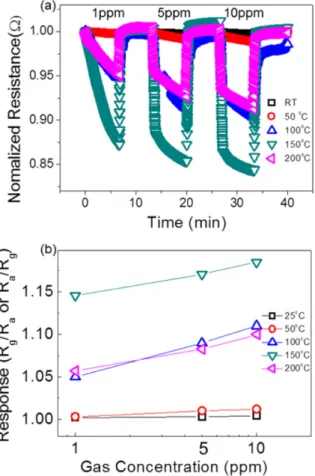
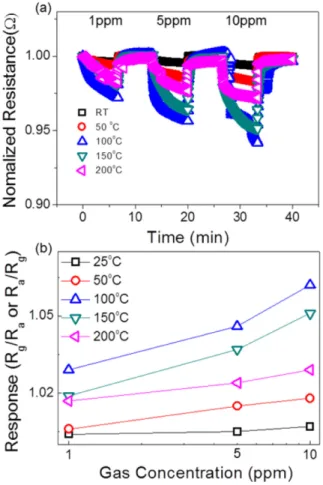
0.1SnO2-0.9Cr2O3의 CO2가스에 대한 감응곡선과 감응도를 그림 4에 나타내었다. 감응도는 공기에서 의 저항(Ra)과 가스를 흘려주었을 때 감소된 저항 (Rg)의 비를 이용하여 계산하였다. 상온에서 CO2 1 ppm의 농도를 흘려주었을 때, 감응도는 1.01의 매 우 낮은 수치로 측정되었으며, 작동온도가 150oC 인 분위기에서는 1 ppm의 감응도가 약 1.167로 상 온에서 200oC의 작동온도 범위 중 가장 높게 측정 되었다. 그림 5에서는 0.5SnO2-0.5Cr2O3 조성의 시 편에 대한 CO2가스 감응을 나타내었다. 그림 5a에 있는 0.1SnO2-0.9Cr2O3 시편의 데이터에서 보인 바 와 같이 CO2가스와 감응 시 센서의 저항이 감소하 였다. 감응도는 그림 5b에 보이는 바와 같이 상온 에서 150oC까지 온도가 상승함에 따라 같이 증가 하였고, 150oC보다 높은 온도인 200oC에서는 감소 하는 경향을 보였다.
Fig. 3. Typical X-ray diffraction pattern taken from 0.5SnO
2-0.5Cr
2O
3composite nanofibers.
Fig. 4. (a) Resistance curves of the 0.1SnO
2-0.9Cr
2O
3nanofibers sensor towards various CO
2concentrations at different temperatures. (b) Summary of corresponding responses.
Fig. 5. (a) Resistance curves of the 0.5SnO
2-0.5Cr
2O
3nanofibers sensor towards various CO
2concentrations at
different temperatures. (b) Summary of corresponding
responses.
n-type SnO2가 많이 포함된 0.9SnO2-0.1Cr2O3의 데이터를 그림 6에 나타내었다. 타 조성의 샘플들 과 동일하게 상온에서도 CO2가스와 반응을 하였고, 모든 측정온도범위에서 CO2가스와 반응 시 센서의 저항이 감소하였다. 그러나 감응도가 가장 우수한 작동온도는 100oC로 측정되어 타 조성의 시편들과 차이점을 보였다. 센서의 감응도는 CO2를 10 ppm 농도로 흘려주었을 때, 100oC에서 1.062, 150oC에 서 1.051로 측정되어 0.1SnO2-0.9Cr2O3와 0.5SnO2- 0.5Cr2O3에서의 감응도보다 낮은 특성을 보였다.
그림 4, 5, 6의 결과 모든 경우에 CO2가스의 농 도가 증가할수록 가스의 감응도(Ra/Rg)가 향상되고, 센서의 성능이 가장 우수한 150oC의 온도에서 0.1SnO2-0.9Cr2O3 조성의 경우 CO2 10 ppm의 감응 도가 1.188로 다른 조성의 경우(0.5SnO2-0.5Cr2O3 : 1.185, 0.9SnO2 - 0.1Cr2O3 : 1.051) 보다 더 높은 감응도를 나타내었다. 작동온도가 150oC일 때 CO2
가스의 농도 별 감응도를 그림 7에 정리한 결과, Cr2O3의 조성이 높아질수록 CO2가스에 대한 감응 도가 더 높음을 알 수 있다.
M. W. Abee의 연구팀과 U. A. Kitzinger 연구팀은 Cr2O3가 CO2와 상온에서 반응하면 Cr2O3의 표면에 Chromium Carbonate(Cr2(CO3)3)가 형성된다는 결과를 보고한 바 있다 [26,27]. 또한 M. R. -Nasarabadi의 연구팀은 Chromium Carbonate가 Cr2O3와 CO2로 분해되는 결과를 보고하였다 [31]. Cr2O3와 CO2가 반응하여 Cr2(CO3)3를 형성하는 화학반응식을 아래 의 식(1)에 나타내였다.
(1)
대기중의 CO2가 Cr2O3와 접촉하면 (1)번의 반응 식을 통해 Cr2O3 입자 표면에 Cr2(CO3)3가 형성되 는 과정에서 Cr2O3내부에 있는 전자와 SnO2의 전
Cr2O3+3CO2+2e–↔Cr2(CO3)3
Fig. 6. (a) Resistance curves of 0.9SnO
2-0.1Cr
2O
3nanofibers sensor towards various CO
2concentrations at different temperatures. (b) Summary of corresponding responses.
Fig. 7. CO
2Responses of SnO
2-Cr
2O
3nanofibers gas sensors at 150
oC.
Fig. 8. Sensing mechanism operating in SnO
2-Cr
2O
3composite nanofibers gas sensors: (a) modulation of
hole accumulation layer at the Cr
2O
3surface. (b)
n<<p. (c) n>>p.
자가 Chromium Carbonate 형성을 위해 Cr2O3의 표 면으로 이동한다. 그림 8a에 나타낸 바와 같이 Cr2O3 가 전자를 잃는 과정에서 Cr2O3의 입자 표면에서는 p-type 물질의 전도층인 HAL (Hole Accumulation Layer)의 두께가 증가되어 센서의 전체적인 저항이 감소하게 된다. 조성에 따른 감응도 차이의 원인을 HAL 면적의 차이를 바탕으로 그림 8b와 8c에 설 명하였다. Cr2O3의 조성이 높은 그림 8b의 경우 HAL의 면적이 넓어 저항의 감소가 상대적으로 크 기 때문에 가스에 대한 감응도가 클 것이다. 반면, SnO2의 조성이 Cr2O3의 조성보다 많은 그림 8c의 경우에는 HAL의 면적이 적어 저항의 감소가 작기 때문에 감응도가 낮을 것으로 판단된다.
본 연구팀에서는 p-n 헤테로 접합을 갖는 복합나 노섬유를 제작하여 H2, H2S, NO2가스에 선택성을 갖는 산화물 반도체 가스센서에 관한 연구를 보고 한 바 있다 [6,23,24]. 해당 연구결과에서는 1차원 나노재료 가스센서의 기본 메커니즘인 Radial Mod- ulation Mechanism, Grain Boundary Mechanism에 더해 RGO (Reduced Graphene Oxide)의 촉매역할,
ZnO와 CuO 입자포면에서의 Metallic Transformation 의 영향이 추가적으로 발생하여 특정 가스에 대한 선택성을 향상시켰다는 이론을 제시한 바 있다. 본 연구에서는 Cr2O3가 Chromium Carbonate로 상변태 하는 과정을 기반으로 하는 촉매역할이 나노섬유 가스센서의 기본 메커니즘에 추가되어 CO2가스에 대한 선택성을 향상되었다고 추정할 수 있다.
합성된 SnO2-Cr2O3 복합나노섬유의 CO2에 대한 선택적 감응성능을 조사하기 위해 Benzene, Toluene, CO가스에 대한 감응도를 작동온도 150oC에서 측 정하였으며, 그 결과를 그림 9에 정리하였다. CO2
가스에 대한 감응성이 가장 우수한 0.1SnO2-0.9Cr2O3 복합섬유에 대해 비교해 보면 Benzene, Toluene, CO 모두 약 1.0006 정도로 CO2가스에 비해 매우 낮은 감응도를 보였다. 따라서 본 연구에서 합성된 SNO2-Cr2O3 복합나노섬유는 Cr2O3가 Chromium Carbonate로 상변태하는 촉매역할이 추가되어 타 가 스보다 CO2가스에 매우 높은 선택성을 갖는다는 것 을 추론할 수 있다.
나노재료를 기반으로 하는 가스센서의 경우 재현 성이 낮아 재현성을 향상시키는 연구가 필요하다
Fig. 9. (a) Resistance curves of the 0.1SnO
2-0.9Cr
2O
3composite nanofibers sensor towards various concentrations of benzene, CO, toluene at 150
oC. (b) Summary of gas responses of 0.1SnO
2-0.9Cr
2O
3nanofibers sensor.
Fig. 10. (a) Resistance curves and (b) Responses of
reproduced SnO
2-Cr
2O
3nanofibers gas sensors at
150
oC.
[28,29]. 제작된 센서소자의 재현성을 조사하기 위 해 그림 4, 5, 6의 복합나노섬유와 동일한 조성의 복합나노섬유를 합성하여 CO2가스에 대한 감응도 를 150oC 온도에서 측정하였다. 그림 10에 정리된 바와 같이 세 조성의 복합나노섬유는 모두 기존과 매우 유사한 가스감응 거동을 보였고, 감응도 역시 0.1SnO2-0.9Cr2O3에서 가장높에 나타났다. 따라서 본 연구에서 합성된 SnO2-Cr2O3나노섬유를 이용하여 제작된 센서소자는 재현성이 높고, 신뢰성이 우수 함을 알 수 있다.
4. 결 론
CO2에 선택성을 갖는 가스센서의 제작을 위해, SnO2- Cr2O3복합나노섬유를 전기방사법을 이용하여 0.1SnO2- 0.9Cr2O3, 0.5SnO2-0.5Cr2O3, 0.9SnO2-0.1Cr2O3 세 종류 의 조성으로 합성하였다. 150oC의 작동온도에서 0.1 SnO2-0.9Cr2O3 시편에서 감응도가 가장 높게 측정 되었고, SnO2의 함유량과 관계없이 모든 조성의 시 편에서 CO2가서를 흘려주었을 경우 저항이 감소하 는 경향을 보였다. 이는 Cr2O3 표면이 CO2가스와 반응 시 Chromium Carbonate의 형성으로 인해 HAL의 두께가 증가하여 저항이 감소하기 때문으 로 추정된다. Benzene, CO, Toluene 가스의 감응도 가 CO2의 감응도에 비해 현저히 낮게 측정되어 CO2
가스에 대한 선택적 검출 가능성을 확인하였다. 또 한 Cr2O3의 양이 증가할 수 록 HAL의 면적이 넓 어지면 저항 변화의 폭이 같이 증가하여 CO2가스 에 대한 감응도가 향상되었다.
Acknowledgement
이 논문은 2016년도 정부(교육부)의 재원으로 한 국연구재단의 지원을 받아 수행된 기초연구사업임 (2016R1D1A1B03935228).