․교신저자: 한창우 경남 양산시 물금읍 부산대학로 49 부산대학교 한의학전문대학원
TEL: 055-360-5957 FAX: 051-510-8420 E-mail: [email protected]
동과자 에탄올 추출물이 비알코올성 지방간 세포 모델에 미치는 효과
최준용1, 김소연1, 권민정2, 김균하2, 주명수2, 한창우1
1부산대학교 한의학전문대학원 내과학교실,2부산대학교 한의학전문대학원 응용의학부
Effects of Ethanol Extract of Benincasa Seeds on the Experimental Cellular Model of Nonalcoholic Fatty Liver Disease
Jun-young Choi1, So-yeon Kim1, Min-jung Kwun2, Kyun-ha Kim2, Myung-soo Joo2, Chang-woo Han1
1Dept. of Internal Medicine, School of Korean Medicine, Pusan National University,
2Division of Applied Medicine, School of Korean Medicine, Pusan National University
ABSTRACT
Objectives :
In this study, we investigated the effect and the underlying mechanism of ethanol extract of Benincasa seeds on a cellular model of non-alcoholic fatty liver disease (NAFLD) established by treating HepG2 cells with palmitate.
Methods :
We evaluated ethanol extract of Benincasa seeds (EEBS) for its hepatic lipid-lowering potential in fatty acid overloaded HepG2 cells. After incubation in palmitate containing media with or without EEBS, intracellular neutral lipid accumulations were quantified by Nile red staining. We also investigated the effect of EEBS on lipogenesis and β-oxidation.
LXRα-dependent SREBP-1c activation, expression of lipogenic genes, and expression of β-oxidation related genes were determined with or without pretreatment of EEBS.
Results :
EEBS significantly attenuated palmitate-induced intracellular neutral lipid accumulation in HepG2 cells. EEBS suppressed fatty acid synthesis by inhibiting LXRα-dependent SREBP-1c activation. EEBS also repressed SREBP-1c mediated induction of lipogenic genes, including ACC, FAS, and SCD-1. However, EEBS had no effect on β-oxidation related CPT-1 and PPARα gene expression.
Conclusions :
Our results suggest that EEBS has an efficacy to decrease hepatic lipid accumulation, and this effect was mediated by inhibiting the LXRα-SREBP-1c pathway that leads to expression of lipogenic genes and hepatic steatosis.
Therefore, the Benincasa seeds may have a potential clinical application for treatment of this chronic liver disease.
Key words : Benincasa seed, NAFLD, LXRα, SREBP-1c
Ⅰ. 서 론
비알코올성 지방간 질환(Non-alcoholic fatty liver disease, NAFLD)은 내장지방증가, 당뇨, 고혈압 및
고지혈증 등을 포함하는 대사성 증후군의 일부로
간세포 내 중성지방의 미만성 침윤이 발생한 경우
를 말하며, 알코올성 간질환과 유사한 조직학적 손
상 패턴을 나타낸다
1. 최근 대사성 질환의 유병율
증가와 함께, 만성 간질환에서 그 비중이 점차 증
가하는 것으로 보고되고 있는데
2, 비교적 가벼운
경우에는 단순 지방간(steatosis) 소견 만을 나타내
기도 하지만, 염증을 동반하는 지방간염(steatohepatitis)
으로 나타날 수 있으며, 염증이 장기간에 걸쳐 유 지되거나 반복될 경우에는 섬유화(fibrosis) 및 간 경변증(cirrhosis)으로 진행할 수도 있다
3.
증가하는 유병률과 비가역적 조직 손상을 유발 할 수 있다는 사실을 인지함에 따라 근래에는 비 알코올성 지방간 질환의 기전 연구과 치료약 개발 을 위한 노력이 활발히 이루어지고 있으나, 여전히 효과적인 표준 치료법은 제시되지 못하고 있으며, 이에 따라 한의계에서도 비알코올성 지방간질환 치료제 개발을 위한 연구가 다양하게 진행되고 있 다
4-7.
동과자(冬瓜子)는 박과(Cucurbitaceae) 동과 Benincasa hispida Cogniaux의 씨를 말하며
8, 동과 는 한국을 비롯한 태국, 인도, 몽고, 일본 등의 주 변 아열대 지역에 널리 분포한다
9. 전통한의학에서 동과는 ≪本經≫에서부터 그 기록이 나타나는데,
≪東醫寶鑑≫에는 “너무 비만하여 몸을 여위고 가 볍게 하면서 건강하고 싶을 때는 동과를 장기간 복용할 수 있다”는 기록이 있으며
10, 최근 연구에서 도 비만
11, 고혈압
12, 당뇨
13및 고혈당에 의한 혈관 손상
14등에 효능이 밝혀졌다.
이에 저자는 이러한 문헌기록과 현대연구들을 바탕으로 동과자가 지방간에도 효능이 있을 것으 로 추정하였다. 이러한 가설을 확인하기 위하여 HepG2 cell에 palmitate를 처리하여 유도한 지방간 질환 세포 모델에 동과자 에탄올 추출물이 미치는 영향을 관찰하고, 동과자의 anti-lipogenic effect의 기전을 이해하기 위해, 동과자 에탄올 추출물이 lipogenesis에 관여하는 LXRα, SREBP-1c, ACC, FAS, SCD-1 과 β-oxidation에 관여하는 CPT-1, PPARα에 미치는 영향을 관찰하여 그 결과를 보고 하는 바이다.
Ⅱ. 재료와 방법
1. 동과자 에탄올 추출물 조제
실험에 사용된 동과자는 대한약전외한약(생약)
규격집에 근거하여 (주)옴니허브로부터 구매한 것 을 사용하였다. 동과자 200 g을 정량하여 제분기로 분쇄하였다. 용매로 에탄올 600 ml을 가하여 60 ℃ 에서 8시간 추출한 후 여과하였다. 여과한 잔사에 다시 에탄올 600 ml를 가하여 동일한 추출의 과정 을 거쳐 여과한 다음, 처음 얻은 여과액과 함께 감 압 농축하고 동결건조하여 5 g의 동과자 에탄올 추 출물을 얻었다(수율 2.5%).
2. 재 료
3-(4,5-dimethylthiazol-2-yl)-2,5-diphenyltetrazolium bromide(MTT), Palmitate, Nile Red, T0901317 은 Sigma-Aldrich Co.(St. Louis, MO, USA)에서 구입 하였다. SREBP-1 antibody(SC8984), Lamin A/C antibody(SC7293), CPT-1 antibody(SC98834), PPARα (SC9000), β-Actin(SC47778) 및 horseradish peroxidase (HRP)-conjugated goat anti-rabbit IgG(SC2004) 는 Santa Cruz Biotechnology(Santa Cruz, CA, USA) 에서 구입하였다.
3. 세포 배양
Human hepatocellular carcinoma 세포주인 HepG2 cell을 American Type Culture Collection(Manassas, VA, USA)로부터 구입하였다. 100 U/ml penicillin, 100 μg/ml streptomycin 및 10% heat-inactivated fetal bovine serum을 포함한 Dulbecco's modified Eagle's medium(DMEM)을 이용하여, 37 ℃, 5%
CO
2환경에서 배양하였다.
4. 세포 활성도의 측정
MTT assay를 통해 세포 활성도를 측정하였다.
96-well plate에 10
4cells/well의 밀도로 HepG2 Cell
을 seeding하였다. 하룻밤 경과 후, 준비된 동과자
에탄올 추출물(10, 50, 100, 500, 1000 μg/ml)을 투
약하고 24시간 배양하였다. 각 well에 MTT (final
concentration, 500 μg/ml)를 처리하고 4시간 뒤
medium을 제거하였다. 활성이 있는 세포들이 MTT
를 환원하여 생성한 formazan crystal을 DMSO를 사용하여 용해하였고, background subtraction을 630 nm로 하고 570 nm에서의 흡광도를 측정하였다.
5. 지방산 처리
Palmitate를 isopropanol에 50 mM 농도가 되도 록 녹였다. 최종 투약 농도는 0.5 mM, 용매에 대하여 1% 농도였다. 배양액은 1% bovine serum albumin을 함유한 DMEM을 사용하였다.
6. Nile Red 염색으로 지방량 측정
동과자 에탄올 추출물과 함께 또는 0.5 mM palmitate만으로 24시간 처리된 HepG2 세포들을 상온에서 15분간 4% paraformaldehyde로 고정하였 다. PBS로 세척 후, 상온에서 5분간 Nile Red(100 ng/ml)를 처리하여 세포 내 중성 지방을 염색하였다.
Olympus FV-1000 confocal laser scanning microscope (Tokyo, Japan)를 이용하여 촬영하고, Image J 1.46 software를 이용하여 형광을 정량화하였다.
7. Western blot 분석
Total cell lysate는 protease inhibitor Cocktail(Roche, Indianapolis, IN, USA)를 포함한 radioimmunoprecipitation assay(RIPA) buffer(50 mM Tris-HCl(pH 8.0), 150 mM NaCl, 2 mM EDTA, 1% sodium orthovanadate, 1% Triton X-100, 0.5% deoxycholate, 0.1% SDS) 를 사용하여 추출하였다. Nuclear protein은 NE-PER
™
nuclear extraction kit(Thermo Scientific, IL, USA)를 이용하여 추출하였다. Bradford assay로 정량 후 sodium dodecyl sulfate polyacrylamide gel electrophoresis(SDS-PAGE)로 전개하고 Polyvinylidene fluoride(PVDF) membrane에 transfer하였다. 5%
skim milk가 들어 있는 Tris-buffered saline(TBS) 로 상온에서 1시간 동안 blocking하였다. 각각의 specific primary antibody와 4 ℃에서 하루밤 동안 반응시킨 다음 horseradish peroxidase(HRP)가 결 합되어 있는 2차 항체와 상온에서 1시간 동안 반응
시켰다. SuperSignal® chemiluminescence detection kit(Thermo Scientific, IL, USA)를 이용하여 band 를 검출하였으며, lamin A/C band를 control로 사 용하였다.
8. RNA 추출과 semi-quantitative RT-PCR
Lipogenesis 관련 유전자들의 발현을 semi-quantitative RT-PCR을 이용하여 확인하였다. RNeasy Mini Kit(Qiagen, Hilden, Germany)를 이용하여 total RNA를 추출하고, M-MLV Reverse Transcriptase (Promega, Madison, WI, USA)를 이용하여 추출된 total RNA를 역전사하여 cDNA를 합성하였다.
TaqPCRx DNA Polymerase(Invitrogen, Carlsbad, CA, USA)와 각각의 primer(Bioneer)를 사용하여 합성된 cDNA를 증폭하였으며, 각각의 primer는 아래과 같다. 증폭된 DNA는 1.2% agarose gel에 전기영동하고 ethidium bromide으로 염색 후 자외 선으로 band를 확인하였으며, GAPDH를 control로 사용하였다.
hLXRα :
5'-ACAACTGGGCATGATCGAGA-3' 5'-AAGCCGGGTAGCTGTTTAGC-3' hSREBP-1c :
5'-CAGTGGAGGGAACACAGACG-3' 5'-AAAGACTGGGCTGTCAGGCT-3' hACC :
5'-GGAACAGTGTGCGGTGAAAC-3' 5'-TCACTAGTGATCCGAGCAGC-3' hFAS :
5'-GACATCGTCCATTCGTTTGTG-3' 5'-GTTGACATTGTACTCGGCGG-3' hSCD-1 :
5'-GCCCCTCTACTTGGAAGACG-3' 5'-CGAGCTTTGTAAGAGCGGTG-3’
hGAPDH :
5'-AAGGGTCATCATCTCTGCCC-3'
5'-GTGATGGCATGGACTGTGGT-3’
9. 통계 분석
통계에는 PASW Statistics Data Editor v18 Korean(SPSS Inc, Chicago, IL, USA) 프로그램을 사용하였다. 모든 측정값은 평균(mean) ± 표준오 차(SEM)으로 표시하였다. One-way analysis of variance(ANOVA) test 로 그룹 간 비교를 시행하 였고, 사후분석은 Turkey test를 사용하였다. 모든 검정에서 P <0.05 인 경우 통계적으로 유의한 차이 가 있는 것으로 판단하였다.
Ⅲ. 결 과
1. 동과자 에탄올 추출물이 HepG2 cell의 활성도에 미치는 영향
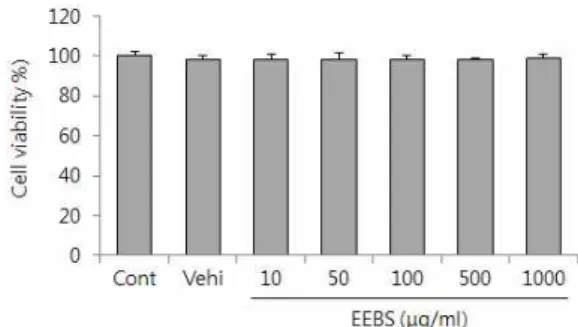
동과자 에탄올 추출물이 세포 독성을 유발하지 않는 한계 농도를 확인하기 위해 MTT assay를 시 행하였다. 동과자 에탄올 추출물을 10 μg/ml 에서 1000 μg/ml 사이의 여러 농도로 투약하고 24시간 배양한 다음 MTT assay로 HepG2 cell의 활성도를 측정하였다. 동과자 에탄올 추출물은 측정 최고 용 량인 1000 μg/ml 까지는 HepG2 cell의 활성도를 저하시키지 않았다(Fig. 1). 이 결과로 동과자 에탄 올 추출물이 1000 μg/ml 이하의 농도에서는 HepG2 cell에 세포 독성을 유발하지 않음을 확인하였으며, 세포 독성을 일으키는 한계 농도를 확인하지는 못 하였으나 동과자의 안전 범위가 매우 넓을 것으로 추정할 수 있었다.
Fig. 1. Effect of EEBS on cell viability.
To evaluate cytotoxic effect of EEBS on HepG2 cells, an MTT assay was conducted. The cells were treated with various concentration of EEBS for 24h prior to MTT assay. Data are presented as the mean±SEM (n=4).
2. 동과자 에탄올 추출물이 palmitate에 의해 유발
된 HepG2 cell의 steatosis에 미치는 영향
동과자 에탄올 추출물이 간세포 내 지방 축적을
감소시키는지 확인하기 위해 palmitate를 처리하여
유발한 비알코올지방간 세포 모델에 동과자 에탄
올 추출물을 처리하였다. HepG2 cell에 지방증을
유발시키기 위해 1% bovine serum albumin을 포
함한 배지에서 0.5 mM palmitate를 첨가하여 24시
간 배양하였다. Palmitate에 의해 세포 내 지방 축
적이 증가한 것을 Nile Red staining을 통해 확인
할 수 있었으며, Palmitate에 의해 발생한 세포 내
지방 축적은 동과자 에탄올 추출물 300 μg/ml이
함께 투여된 경우 통계적으로 유의하게 감소하였
다(Fig. 2). 이 결과로 동과자 에탄올 추출물이 세
포 내 지방 축적을 주요 특징으로 하는 실제 비알
코올성 지방간질환에서도 지방증을 감소시키는 효
과가 있을 것으로 추정할 수 있었다.
A B
Fig. 2. Effects of EEBS on intracellular lipid accumulation in HepG2 cells.
HepG2 cells were treated with palmitate and/or EEBS for 24h. After incubation, the cells were stained with Nile red. (A) Intracellular lipid droplets were viewed by fluorescencemicroscopy (original magnification ×400).
(B) Cellular steatosis was quantified for each condition using four random low power fields of view. The fluorescence intensity was expressed as the means ± SEM (n=4). *
P
<0.01, compared to untreated cells;‡P
<0.01, compared to palmitate treated cells.3. 동과자 에탄올 추출물이 LXRα-SREBP-1c pathway 에 미치는 영향
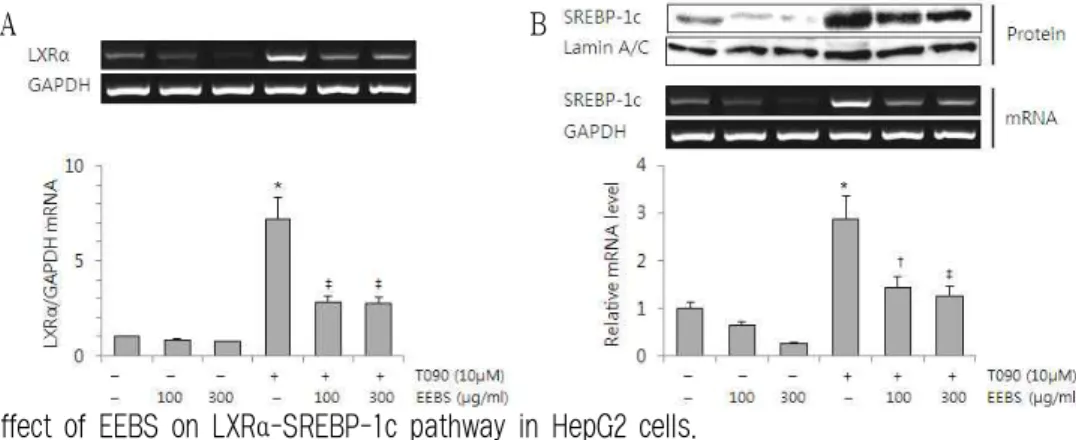
동과자 에탄올 추출물이 세포 내 지방 축적을 감 소시키는 기전을 확인하기 위하여, lipogenesis를 유발 하는 주요 신호 체계인 LXRα-SREBP-1c pathway 에 동과자 에탄올 추출물이 미치는 영향을 조사하 였다. HepG2 cell에 LXRα agonist인 T0901317 10μM 을 처리하여 24시간 배양하였다. T0901317에 의해 LXRα mRNA 발현이 증가되는 것을 확인하였으 며, 동과자 에탄올 추출물을 함께 투여할 경우
LXRα mRNA 발현 증가가 억제되었다(Fig. 3A).
SREBP-1c는 간세포 lipogenesis의 핵심적 조절인 자로서 LXRα에 의해 발현이 증가한다. 본 실험에 서도 HepG2 cell에 T0901317 10μM을 24시간 처리 한 경우 LXRα mRNA의 증가와 함께, SREBP-1c mRNA 와 SREBP-1c protein의 발현도 증가하는 것이 확인되었다. T0901317에 의해 증가한 SREBP-1c mRNA 및 protein level 또한 동과자 에탄올 추출 물이 함께 투여된 경우 통계적으로 유의하게 감소 하였다(Fig. 3B).
A B
Fig. 3. Effect of EEBS on LXRα-SREBP-1c pathway in HepG2 cells.
The effect of EEBS on the expression level of LXR α (A) by PCR, and SREBP-1c (B) by Western blot analysis and PCR. The intensity of each PCR band was measured by densitomeric analysis (ImageJ), and relative expression of each gene was calculated over GAPDH. Data are presented as the mean±SEM (n=4). *
P
<0.01, compared to untreated cells; †P
<0.05, ‡P<0.01, compared to palmitate treated cells.4. 동과자 에탄올 추출물이 ACC, FAS, SCD-1에 미 치는 영향
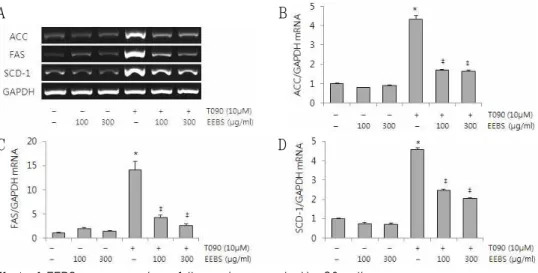
다음으로 SREBP-1c의 타겟 효소들로서 Fatty acid 합성에 관여하는 ACC, FAS, SCD-1에 동과 자 에탄올 추출물이 미치는 영향을 조사하였다.
T0901317 10μM 24시간 처리에 의해 ACC, FAS, SCD-1 mRNA level 또한 증가하였으며, LXR agonist에 의한 lipogenic genes의 발현 증가 역시 동과자 에탄올 추출물을 함께 투여할 경우 통계적 으로 유의하게 감소하였다(Fig. 4).
A B
D C
Fig. 4. Effect of EEBS on expression of lipogenic genes in HepG2 cells.
Expression of lipogenic genes were determined by semi-quantitative RT-PCR (A), and relative mRNA levels of ACC (B), FAS (C), SCD-1 (D) was represented on each bar graph. Data are presented as the mean±SEM (n=4). *
P
<0.01, compared to untreated cells;‡P
<0.01, compared to palmitate treated cells.5. 동과자 에탄올 추출물이 CPT-1, PPARα에 미치 는 영향
동과자 에탄올 추출물이 β-oxidation에 미치는 영향을 관찰하기 위해 HepG2 cell에 동과자 에탄 올 추출물을 투여하고 PPAR-α, CPT-1의 변화를 관찰하였다. 농도와 시간을 달리하는 여러 차례의 반복 실험에서도 동과자 에탄올 추출물은 PPARα, CPT-1의 발현에 영향을 미치지 않았다(Fig. 5). 따 라서, 동과자 에탄올 추출물이 비알코올성 지방간 을 완화시키는 기전이 β-oxidation을 증가시키는 방법을 통해 일어날 가능성은 비교적 낮은 것으로 추정되었다.
A
B
Fig. 5. Effect of EEBS on expression of β-oxidation related genes in HepG2 cells.
To know whether or not EEBS increases fatty acid β-oxidation, protein level of CPT-1 (A) and PPARα (B) were measured by Western blot analysis.
As seen in above figures, EEBS had no effect on the two β-oxidation related genes expression.